

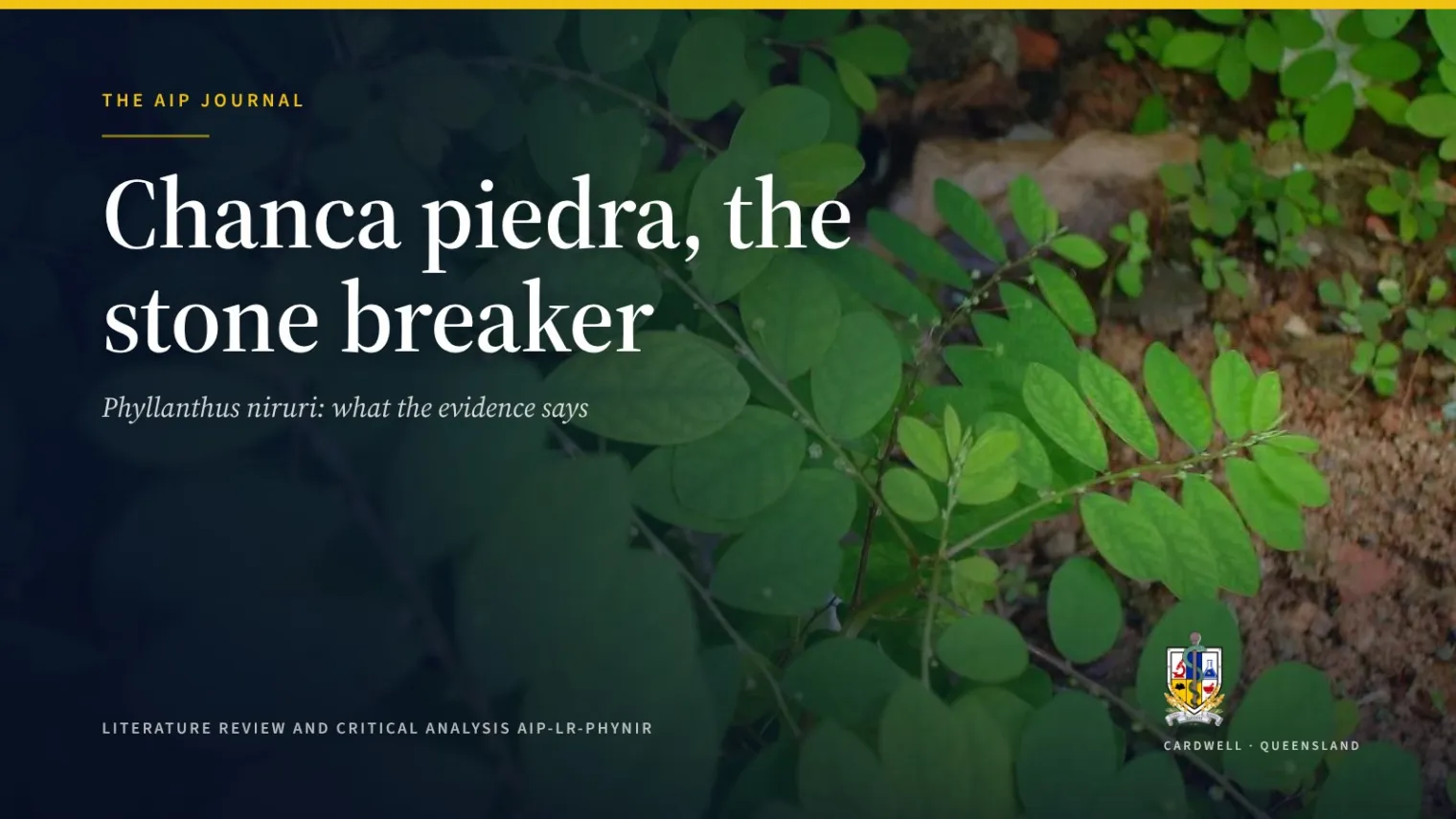
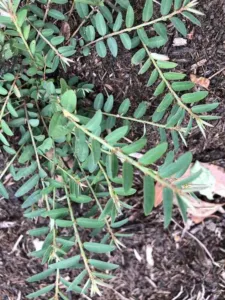
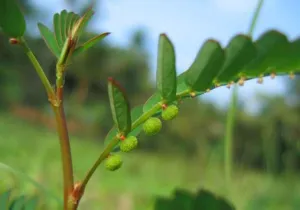
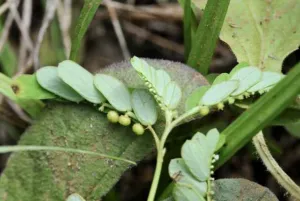
Cover: quebra-pedra, Brazil, filed on Wikimedia Commons as Phyllanthus niruri. Photo: Toluaye · Public domain · Wikimedia Commons
In the Peruvian Amazon it is chanca piedra, in Brazil quebra-pedra, and in English stonebreaker: a small weed whose tea has been drunk for generations to pass kidney stones. Traditional In the laboratory it keeps calcium oxalate crystals small and apart, Evidence suggests and in people the evidence is a handful of small studies. Evidence suggests In Australia the species in the research is not a permitted ingredient, while a look-alike is listed as “Stonebreaker” and grows wild across the north. Attested
This is AIP Literature Review and Critical Analysis AIP-LR-PHYNIR in the Australian Institute of Pharmacognosy’s series of literature reviews and critical analyses. It covers Phyllanthus niruri L. and the related species sold under its names, above all P. amarus Schumach. & Thonn.: their identity and botany, where they grow in Australia, their traditional use in South America, India and South-East Asia, their chemistry and pharmacology, the human evidence for kidney stones and the liver, safety and interactions, Australian regulation and import rules in October 2026, and how the quality and identity of products can be tested.
This article is educational. It is not medical, legal or regulatory advice, and it is not an advertisement. No product is recommended or discouraged, and the article links to no seller. The subject was chosen through the Institute’s own daily review series; no maker or seller of a Phyllanthus product commissioned or paid for it.
1. Stones need a diagnosis. Severe flank pain, fever or chills with urinary symptoms, vomiting, inability to pass urine or visible blood in the urine need urgent medical care, and no herb should delay it. Mechanism
2. Medicines. Phyllanthus has diuretic, blood-pressure-lowering and blood-sugar-lowering effects in animal and small human studies. People taking medicines for blood pressure, diabetes or fluid retention, or taking lithium, should not add it on their own initiative. Mechanism
3. Pregnancy and breastfeeding. No human safety data were found, and there is a traditional record of use as an abortifacient. Avoid in pregnancy on present evidence. Use while breastfeeding is a decision for a degree-qualified herbalist with competencies and adequate training in pharmacognosy. Mechanism
4. Identity. Products sold as chanca piedra may contain P. niruri, P. amarus, P. tenellus or unrelated plants. Imported products are not assessed by the TGA. Confirmed
Emergency: call Triple Zero (000). For a suspected poisoning or overdose, call the Poisons Information Centre on 13 11 26 (24 hours, Australia-wide). Report suspected side effects to the TGA (TGA, reporting adverse events). Before taking any botanical drug, consult a degree-qualified herbalist with competencies and adequate training in pharmacognosy.
| Botanical name | Phyllanthus niruri L., Phyllanthaceae (formerly Euphorbiaceae) Attested §2 |
| Common names | Chanca piedra (Peru), quebra-pedra (Brazil), stonebreaker, seed-under-leaf Attested §2 |
| Often confused with | P. amarus (bhumi amla), P. tenellus, P. urinaria Confirmed §2 |
| In Australia | P. niruri barely recorded; look-alikes naturalised or native across the north and east Attested §3 |
| Tradition | Tea of the whole plant for kidney and gall stones (Amazon, Brazil); liver and urinary use in Ayurveda Traditional §4 |
| Chemistry | Ellagitannins (corilagin, geraniin), lignans (phyllanthin, hypophyllanthin), flavonoids Confirmed §5 |
| Laboratory | Keeps calcium oxalate crystals small and dispersed; slows stone growth in rats; no dissolution Evidence suggests §6 |
| Kidney stones in people | Small studies, one negative placebo-controlled trial of stone passage; no proven prevention Evidence suggests §7 |
| Liver in people | Two short modern randomised trials: no effect on liver tests beyond placebo Evidence suggests §8 |
| Safety | No toxicity signal in short adult studies; diuretic, blood pressure and blood sugar questions; avoid in pregnancy; no data in children or kidney disease Evidence suggests §9 |
| Australian law | P. niruri not a permissible ingredient; P. amarus permitted, 3 ARTG listings; unscheduled Attested §10 |
| Imports | Personal Importation Scheme: own use, up to 3 months’ supply; not TGA-assessed Attested §10 |
| Quality | Brazilian teas DNA-tested: 1 of 4 suppliers had P. niruri, mixed with a legume Confirmed §11 |
| Emergency | Triple Zero (000); Poisons Information Centre 13 11 26 Attested §9 |
- Confirmed Established in humans by trial, or an unambiguous analytical or chemical fact.
- Evidence suggests Real published data, but preclinical, observational, small, uncontrolled or not independently replicated.
- Mechanism A plausible mechanistic or pharmacological inference, or the Institute’s own interpretation, short of a measured outcome.
- Traditional Historical or ethnobotanical use. Evidence of practice. Efficacy is a separate question.
- Attested A documentary fact attested in a named record: a legislative instrument, a regulator’s register or web page, a taxonomic index, a biodiversity database, a historical text or a paper’s own statement. It states what the record says.
- Unsourced A statement the Institute could not trace to a source it was able to open and read, flagged so no reader mistakes it for a sourced claim.
Every PubMed ID (PMID) below links to its record and was checked against PubMed in October 2026, and every paper cited by PMID was read in full text. Papers the Institute could not open in full have been requested through its library and are not cited for their content; where their results are reported, the review that describes them is cited and named in the text. Every compound was checked against PubChem and is linked by CID. Every Australian regulatory statement was read from the regulator’s or the legislature’s own document or database in October 2026. Brazilian, Indian and other overseas material is overseas and does not govern Australia.
Which plant. Chanca piedra is Phyllanthus niruri, but for decades the same name was used for P. amarus, the bhumi amla of Ayurveda, and Brazilian quebra-pedra teas often contain P. tenellus. The species look almost identical; DNA separates them. Confirmed
Stones. In the laboratory the extract keeps calcium oxalate crystals small and separate and stops kidney cells taking them up; in rats it slows stone growth and smooths stones without dissolving them. In people, small and mostly uncontrolled studies report fewer stones and better clearance after lithotripsy, and the one placebo-controlled trial of stone passage found no overall difference. Prevention of stones has not been shown. Evidence suggests
Liver. Hepatitis B research in the 1980s used P. amarus. Two recent, short randomised trials of products labelled P. niruri found no improvement in liver tests beyond placebo. Evidence suggests
Safety. Short-term use looked safe in trials. Diuretic, blood pressure and blood sugar effects raise questions for people on those medicines, and there are no data in pregnancy, in children or in people with reduced kidney function. Fever with flank pain is an emergency. Evidence suggests
In Australia. P. niruri is not a permissible ingredient for listed medicines; P. amarus is, and appears in three listings, one listed on the ARTG as “Stonebreaker”. A herbalist may prepare P. niruri for an individual patient after a consultation. The plant is unscheduled and can be imported for personal use within TGA limits. Look-alike species grow wild in Queensland. Before taking any botanical drug, consult a degree-qualified herbalist with competencies and adequate training in pharmacognosy.
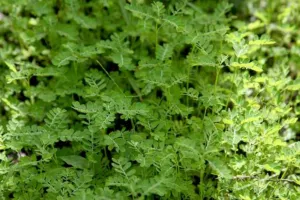 Chapter 1Why chanca piedra, and why now
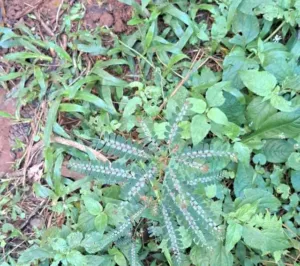 Chapter 2Which plant is chanca piedra?
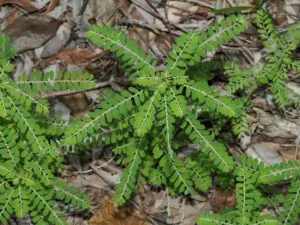 Chapter 3Botany and Australian status
 Chapter 4Traditional and historical use
 Chapter 5Phytochemistry
 Chapter 6Pharmacology
 Chapter 7Clinical evidence: kidney stones
 Chapter 8Clinical evidence: the liver
 Chapter 9Safety and interactions
 Chapter 10In Australia: law and the shelf
 Chapter 11Quality and adulteration
 Chapter 12Discussion and research agenda
1. Why chanca piedra, and why now
Chanca piedra is Spanish for “stone breaker”. In Brazil the same small herb is quebra-pedra, and in English-language shops it is stonebreaker. All three names describe one use: drinking a tea of the whole plant to help pass kidney and bladder stones PMID 29929208; PMID 36407559. Traditional The plant behind the names is usually given as Phyllanthus niruri L., a small annual herb 30 to 40 cm tall, now placed in the family Phyllanthaceae PMID 31440162; PMID 29929208. Attested It is one of the best-known plant medicines of South America, and in India a close relative carries a long Ayurvedic record for the liver and the urinary tract PMID 36407559. Traditional
Chanca piedra is marketed internationally, including for the prevention of kidney stones PMID 40458577, Attested and kidney stones give Australians good reason to take an interest. Stones affect up to 13 per cent of people worldwide, and about 35 per cent of untreated patients have another symptomatic stone within five years of the first PMID 40458577. Evidence suggests Low urine volume is a recognised risk factor PMID 29617079, and in the heat of far north Queensland, where the Institute works, people lose a great deal of water as sweat. Mechanism
The Institute expected to find almost no Australian information. The search turned up more than that, and some of it is surprising. The species named in the stone research, P. niruri, is not a permissible ingredient for Australian listed medicines, while one listed medicine on the Australian Register of Therapeutic Goods (ARTG) is called “Stonebreaker”, a common name also given to Phyllanthus amarus, and contains that species, which is a permissible ingredient (ARTG public summaries). Attested And several close look-alikes, P. amarus among them, grow wild as weeds across northern Australia (Australian Plant Census). Attested
This review introduces the plant properly. It sorts out which Phyllanthus is which, sets out the traditional use as traditional use, reads the laboratory, animal and human studies on stones and on the liver, and measures how far they fall short of established clinical benefit. It closes with safety, Australian law and quality. The Institute writes as an admirer of this little plant. A weed that generations of Amazonian and Brazilian families have trusted with one of the most painful conditions in medicine deserves a careful reading of its evidence.
2. Identity and taxonomy: which plant is chanca piedra?
A genus of look-alikes
Phyllanthus is the largest genus of the Phyllanthaceae, with somewhere between 550 and 750 species by one count; 88 grow in Brazil alone PMID 29929208. Attested Older papers, the 2010 São Paulo review and the 2018 São Paulo trial among them, file these plants in the spurge family, Euphorbiaceae; the Brazilian barcoding team used the current family, Phyllanthaceae PMID 21176271; PMID 29617079; PMID 29929208. Attested The genus name means “leaf flower”: in many species the flowers and fruits hang in a neat line beneath what looks like a pinnate leaf, which is in fact a whole branchlet carrying two rows of small simple leaves. Unsourced In Barbados P. niruri is known as “seed-under-leaf” PMID 36530331. Attested
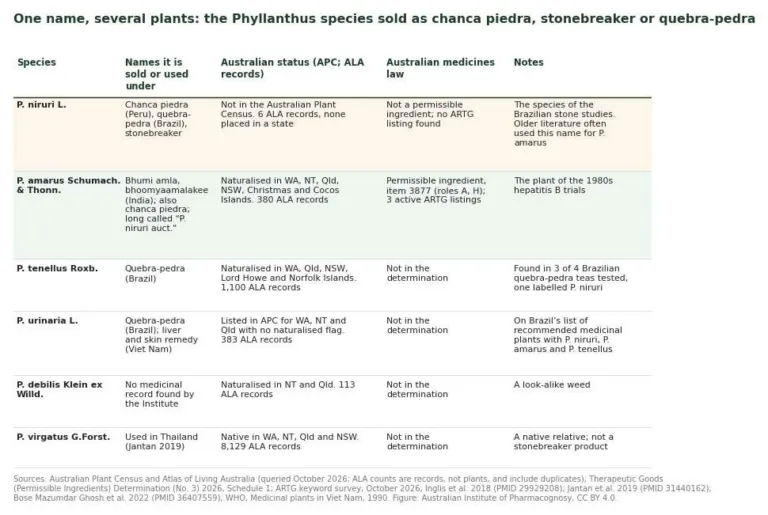
That shared body plan is the root of the muddle. The Brazilian team that DNA-barcoded the country’s medicinal Phyllanthus wrote that P. amarus, P. niruri, P. tenellus and P. urinaria are well delimited by taxonomists yet “difficult for the nonspecialist to identify”, that P. niruri, P. tenellus and P. amarus are “morphologically very similar, particularly in the vegetative state”, and that people “often treated [them] together as quebra-pedra, leading to inconsistencies in efficacy” PMID 29929208. Attested All four are on the Brazilian Ministry of Health’s list of recommended medicinal plants, and the Brazilian Pharmacopoeia recommends only P. niruri for stones PMID 29929208. Attested
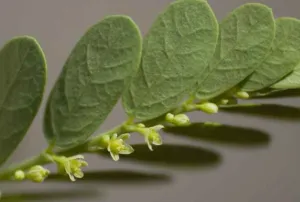
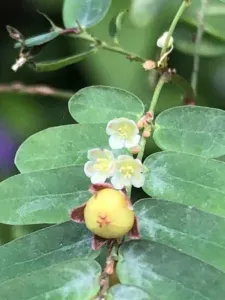
Phyllanthus niruri and Phyllanthus amarus
The most important confusion is between P. niruri L. and P. amarus Schumach. & Thonn. For much of the twentieth century botanists in Asia and Africa applied the name P. niruri to the plant now called P. amarus; the review by Jantan and colleagues lists “P. niruri auct.” as a synonym of P. amarus, meaning the name as used by those authors, and notes that cladistic work has since confirmed the two as separate species PMID 31440162. Attested A 2022 review of P. amarus states plainly that misidentification “has made evaluation of published information difficult” and that many clinical papers make no distinction between P. amarus, P. niruri and P. sellowianus PMID 36407559. Attested
In practice this means three things for a reader. First, Indian research and products labelled P. niruri very often concern P. amarus, the plant Ayurveda calls bhoomyaamalakee or bhumi amla PMID 36407559. Mechanism One 2021 Indian trial described its material as a P. niruri extract, and the paper gives the extract the name “Bhumi Amla”, the Indian name of P. amarus PMID 34975132. Attested Second, the Brazilian kidney-stone research was done on plants identified in Brazil as P. niruri, the species the Brazilian Pharmacopoeia names PMID 21176271; PMID 29929208. Attested Third, a product label may name either species and contain a third, as section 11 shows.
Names
Linnaeus published Phyllanthus niruri in Species Plantarum in 1753, and Schumacher and Thonning published Phyllanthus amarus in their account of the plants of Guinea in 1827 (IPNI). Attested In 1958 Leandri reduced P. amarus to a variety of P. niruri, P. niruri var. amarus, a name that shows how long the two have been run together (IPNI). Attested Today P. amarus is accepted in the Australian Plant Census as a naturalised species (Australian Plant Census). Attested Common names cross between them freely. A 2022 review gives “chanca piedra” as a name for P. amarus as well as P. niruri PMID 36407559, and an Indian trial report lists “punarnava”, “dukung anak”, “chanca piedra”, “quebra pedra” and “praparai mi” as names for P. niruri PMID 34975132. Attested “Punarnava” is more widely the name of Boerhavia diffusa, a different plant altogether, so even the vernacular names in published trials need checking. Mechanism
3. Botany, distribution and Australian status
The plant
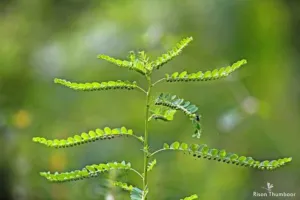
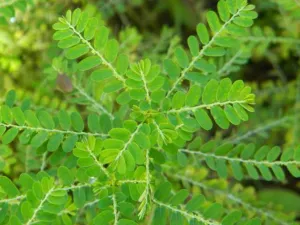
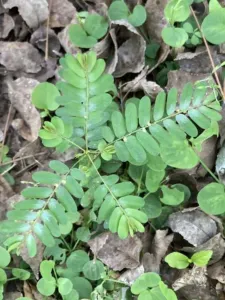
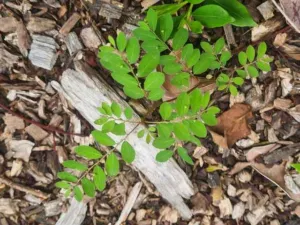
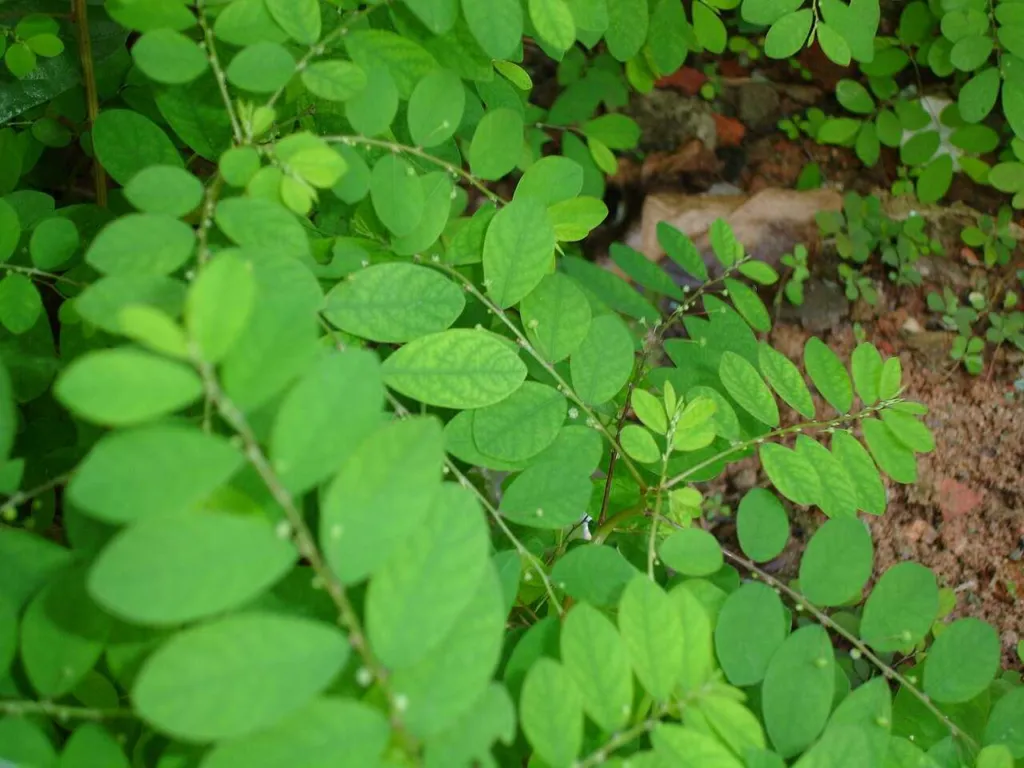
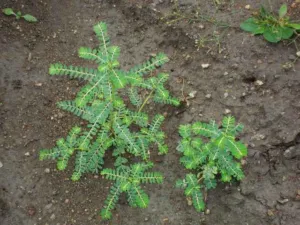
Phyllanthus niruri is a small, erect annual herb, usually 30 to 40 cm tall, with alternate leaves and tiny greenish-white flowers that carry no petals PMID 31440162. Attested Male and female flowers are borne on the same plant, singly in the leaf axils, and the fruit is a small rounded capsule PMID 31440162. Attested P. amarus is very similar: an erect annual 10 to 60 cm tall with flowers in ones or twos in the leaf axils, three stamens with their filaments fused, and seeds marked by five to seven fine ribs PMID 31440162. Attested Separating the two reliably needs a hand lens and a key, or DNA. Mechanism
Jantan and colleagues describe P. niruri as indigenous to the Amazon rainforest and other tropical areas PMID 31440162. Attested In Brazil both P. niruri and P. tenellus grow as ruderal plants of waste ground and roadsides, and the market supply comes largely from the wild or from informal cultivation, because the Brazilian team knew of no large-scale commercial cultivation PMID 29929208. Attested A Brazilian review found the leaves of P. niruri hold calcium oxalate crystals that stay evenly spaced and never clump, a detail the researchers found suggestive given what the plant is used for PMID 21176271. Attested
Is chanca piedra wild in Australia?
Readers in the tropics often ask whether chanca piedra grows wild here. The short answer is that P. niruri itself barely appears in Australian records, and its look-alikes are common.
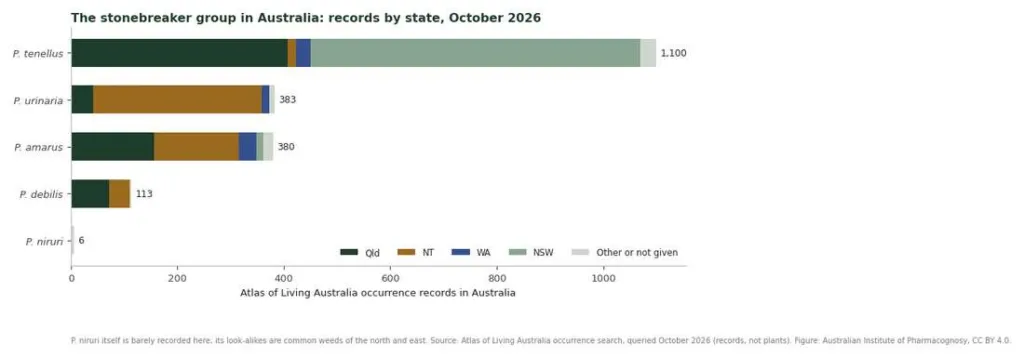
The Australian Plant Census (APC), the national consensus list of vascular plants, has no entry for Phyllanthus niruri. The Atlas of Living Australia (ALA) holds six Australian occurrence records under that name, none of them assigned to a state, and matches the name only to the New Zealand Organisms Register (Atlas of Living Australia). Attested Given the long history of the name being applied to P. amarus, those six records may well be misapplied names. Mechanism
The relatives are a different story. In October 2026 the APC listed P. amarus as naturalised in Western Australia, the Northern Territory, Queensland and New South Wales and on Christmas and Cocos (Keeling) Islands; P. tenellus as naturalised in Western Australia, Queensland, New South Wales and on Lord Howe and Norfolk Islands; and P. debilis as naturalised in the Northern Territory and Queensland (Australian Plant Census). Attested P. urinaria is listed for Western Australia, the Northern Territory and Queensland with no naturalised flag (Australian Plant Census), Attested which in the census convention means it is treated as native. Mechanism Australia also has many native Phyllanthus; P. virgatus alone has more than 8,000 ALA records across four mainland states (Atlas of Living Australia). Attested
None of these species is named in the Queensland Biosecurity Act 2014 or the Biosecurity Regulation 2016. The only mention the Institute found is the family Phyllanthaceae among the host families listed in Schedule 7 of the Regulation as “pyriform scale carriers”, a rule about moving live plants that could carry an insect pest (Biosecurity Regulation 2016 (Qld)). Attested They are garden and roadside weeds, and nobody is required to control them. Mechanism
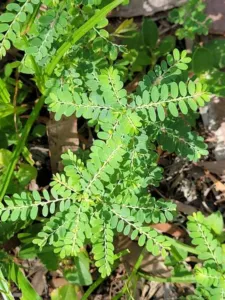
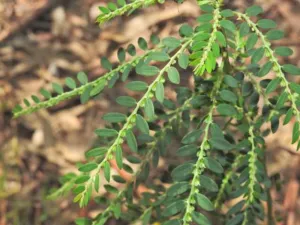
The practical point for Queensland gardeners is that the plant in the pot or the lawn edge that looks like chanca piedra is most likely P. tenellus, P. amarus, P. debilis or a native species. Mechanism They cannot be told apart by eye with confidence, and the Institute does not suggest that anyone pick and use them on the strength of a resemblance.
4. Traditional and historical use
Everything in this section is evidence of practice. It tells us how people have used these plants and for how long. Whether the uses work is a separate question, taken up in sections 6 to 8.
The Amazon and Brazil
The name chanca piedra is attributed to Amazonian peoples who used the plant over many generations to clear gallstones and kidney stones, according to a 2022 review PMID 36407559. Traditional The same review lists a broad South American repertoire under the name, among them bladder and gall bladder complaints, colic, fever, influenza, diabetes, jaundice, dysentery and intestinal worms PMID 36407559. Traditional In Brazilian household medicine the tea is used to eliminate kidney and urinary stones and as a diuretic PMID 40094548. Traditional A 2025 review of plants used for kidney complaints in Brazilian traditional medicine counted P. niruri among the three most cited, with ten citations, alongside avocado leaf (Persea americana) and Casearia sylvestris PMID 40094548. Traditional Brazil’s living-pharmacy programmes (farmácias vivas) grow quebra-pedra for local phytotherapy, and Brazilian researchers found some of those plants were P. tenellus PMID 29929208. Attested
The preparation in these traditions is simple: a tea or infusion of the whole plant or the leafy stems, often fresh PMID 29929208; PMID 40094548. Traditional The infusion studied in São Paulo in 2018 followed that pattern, using sachets of shade-dried Brazilian herb that the authors call a dry extract PMID 29617079. Attested The Institute gives no doses here, and none should be read into these accounts.
India and Ayurveda
In Ayurveda the plant called bhoomyaamalakee, “amla of the ground”, is used for jaundice, urinary disorders, cough, breathlessness, anaemia, burning sensations and skin conditions; the review that sets this out identifies it as P. amarus and dates Ayurvedic use back more than 2,000 years PMID 36407559. Traditional Unani literature knows it as “Bhuti” PMID 36407559. Traditional Jantan and colleagues note that Ayurveda uses about 15 Phyllanthus species, with P. niruri used for inflammation, fever, malaria, stones, gonorrhoea and hepatitis, and P. amarus for complaints of the stomach, liver, kidney, spleen and genitourinary system PMID 31440162. Traditional Given the naming history, the Institute treats these two lists as one tradition attached to two names. Mechanism
South-East Asia, the Pacific and Africa
The World Health Organization’s Medicinal plants in Viet Nam (1990) describes Phyllanthus urinaria as a common weed whose whole plant is used fresh or dried for sore throat, boils, impetigo, eczema, mouth thrush, joint pain, snake and centipede bites, fever, eye inflammation and liver and gall bladder disease, and adds that “the species Phyllanthus niruri is also useful” (WHO, Medicinal plants in Viet Nam, 1990). Traditional In Thailand P. urinaria, P. amarus and the Australian native P. virgatus are used for jaundice, liver complaints and diabetes, and P. niruri for high blood pressure, malarial fever, constipation and urinary disorders PMID 31440162. Traditional In Malaysia the plant is dukung anak PMID 39789561. Attested In Cameroon, Ghana, Côte d’Ivoire, Kenya, Nigeria and Zambia, Phyllanthus stems, roots and leaves are used for fever, wounds and sexually transmitted infections PMID 31440162. Traditional
One traditional record bears directly on safety. The 2022 review notes that in Barbados the plant has been used as an abortifacient, and that decoctions are used after childbirth and for uterine complaints in Suriname PMID 36407559. Traditional A traditional use is not proof of an effect on the womb. It is still a reason for care in pregnancy, taken up in section 9. Mechanism
5. Phytochemistry
More than 50 compounds have been reported from P. niruri, among them alkaloids, flavonoids, lignans and triterpenes PMID 21176271. Attested The review by Jantan and colleagues tabulates the main ones for P. niruri: the lignans phyllanthin, hypophyllanthin, niranthin, nirtetralin, phyltetralin and hinokinin; the flavonoids rutin, astragalin, quercetin, quercitrin and isoquercitrin; the hydrolysable tannins geraniin and corilagin with gallic and ellagic acids; the securinega-type alkaloids nirurine and norsecurinine; and triterpenes such as lupeol PMID 31440162. Attested Because the literature mixed the two species for decades, the Institute cannot say how much of this list belongs to P. niruri as now defined and how much to P. amarus. Mechanism
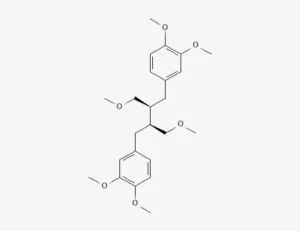
C24H34O6 · diarylbutane lignan
PubChem CID 358901 · structure image: PubChem, public domain
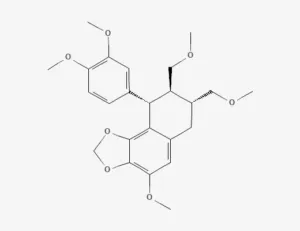
C24H30O7 · aryltetralin lignan
PubChem CID 182140 · structure image: PubChem, public domain
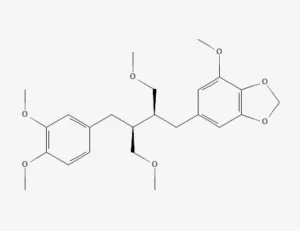
C24H32O7 · lignan
PubChem CID 11575632 · structure image: PubChem, public domain
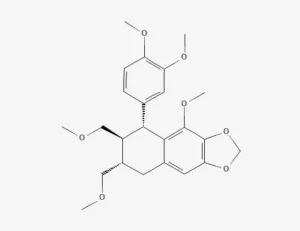
C24H30O7 · aryltetralin lignan
PubChem CID 182644 · structure image: PubChem, public domain
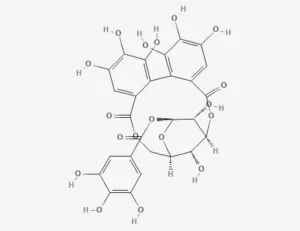
C27H22O18 · ellagitannin of the water extract
PubChem CID 73568 · structure image: PubChem, public domain
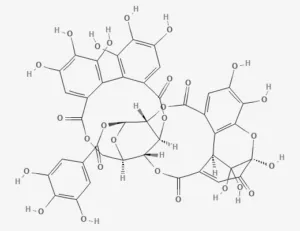
C41H28O27 · ellagitannin
PubChem CID 3001497 · structure image: PubChem, public domain
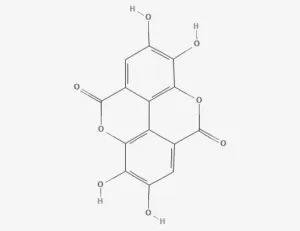
C14H6O8 · released from the tannins
PubChem CID 5281855 · structure image: PubChem, public domain
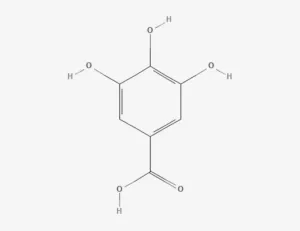
C7H6O5 · released from the tannins
PubChem CID 370 · structure image: PubChem, public domain
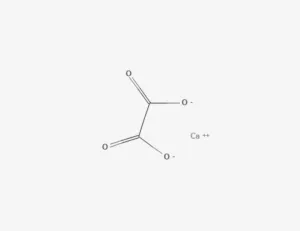
C2CaO4 · the main mineral of kidney stones, for comparison
PubChem CID 33005 · structure image: PubChem, public domain
Nine structures: four lignans, two ellagitannins and their hydrolysis products ellagic and gallic acid, and calcium oxalate, the stone mineral the plant is studied against. Every CID was checked against PubChem in October 2026; the depictions are PubChem’s own (US National Library of Medicine, public domain).
The tannins
When an Egyptian team fractionated a water extract of P. niruri aerial parts by following its activity on liver cells, the compounds they isolated were corilagin, isocorilagin, brevifolin, quercetin, a kaempferol rhamnoside, gallic acid and brevifolin carboxylic acid PMID 31940365. Confirmed Corilagin (CID 73568) is an ellagitannin, glucose esterified with a galloyl group and a hexahydroxydiphenoyl bridge. Confirmed Geraniin (CID 3001497) is a larger relative, and both release ellagic acid (CID 5281855) and gallic acid (CID 370) on hydrolysis. Mechanism A water infusion of the kind used in traditional practice extracts these polar tannins well. Mechanism The dried herb used in the 2018 São Paulo trial was specified to contain at least 1.5 per cent tannins PMID 29617079. Attested
The lignans
Phyllanthin (CID 358901) and hypophyllanthin (CID 182140) are dibenzylbutane and aryltetralin lignans, closely related molecules built from two phenylpropane units. Confirmed With niranthin (CID 11575632) and nirtetralin (CID 182644) they are the classic marker compounds of P. amarus research, where they were tested for liver protection as early as 1985 PMID 36407559. Attested Lignans are poorly soluble in water, so a tea is likely to carry far less of them than an alcoholic or lipophilic extract. Mechanism A methanol leaf extract of P. niruri containing lignans increased uric acid excretion in hyperuricaemic rats PMID 21176271. Evidence suggests
Calcium oxalate
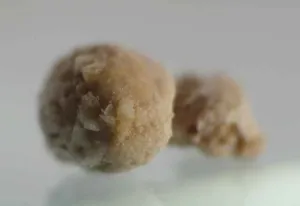
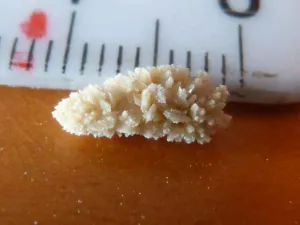
Calcium oxalate (CID 33005) is included in the structure panel because it is the main mineral of human kidney stones PMID 21176271. Confirmed It crystallises from urine as a monohydrate (whewellite) and a dihydrate (weddellite); the monohydrate binds more strongly to kidney cells and to other crystals, and the dihydrate is the form more common in the urine of people who do not form stones PMID 21176271. Confirmed That distinction matters for the laboratory work in section 6.
6. Pharmacology: what the laboratory and animal work shows
Most of the stone pharmacology comes from one group at the Federal University of São Paulo, and their 2010 review collects it PMID 21176271. Attested The Institute read that review in full. The primary papers it summarises have been requested through the Institute’s library; until they arrive, their results are reported here as the review describes them.
Crystals in human urine
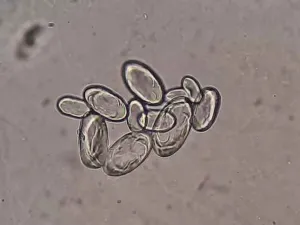
When Barros and colleagues added an aqueous P. niruri extract to human urine and then provoked calcium oxalate to precipitate, the extract did not stop crystals forming; more crystals appeared, but they were smaller, and after 24 hours they stayed dispersed while crystals in untreated urine had formed large clumps PMID 21176271. Evidence suggests The extract also shifted the balance towards the dihydrate and away from the monohydrate, the form more prone to stick and grow PMID 21176271. Evidence suggests A plant that keeps crystals small and separate would, in principle, let them wash out before they become stones. Mechanism
Kidney cells
Campos and Schor exposed cultured canine kidney tubular cells (MDCK cells) to calcium oxalate crystals at concentrations up to five times the upper limit found in human urine. The extract strongly inhibited the binding and swallowing of crystals by the cells (endocytosis) and did not harm the cells PMID 21176271. Evidence suggests A 2025 review reports the effective concentration as 5 µg/mL of a hot aqueous extract PMID 40094548. Attested Crystal uptake by tubular cells injures them, and the debris of dead cells can seed new stones, so blocking that step is a plausible protective mechanism PMID 21176271. Mechanism
Rats and mice
In rats with a calcium oxalate crystal implanted in the bladder, drinking P. niruri tea slowed the growth of the stone that formed around it PMID 21176271. Evidence suggests Freitas and colleagues gave the extract for 42 days and saw slower stone growth without any change in urine volume, urinary calcium, oxalate, citrate or magnesium; stones from treated rats carried more glycosaminoglycans in their organic matrix PMID 21176271. Evidence suggests Barros and colleagues then compared treatment started at the moment of implantation with treatment started 30 days later, once a stone had formed. Early treatment slowed growth. Late treatment neither stopped growth nor made the stones pass, but the stones became smoother and more compact, without the spiky surface of stones from untreated rats PMID 21176271. Evidence suggests The review’s authors concluded that the plant “could interfere with the calculi growth or prevent stone formation rather than dissolving pre-formed stones” PMID 21176271. Attested The name “stone breaker” promises more than the rat data deliver: in these experiments the plant shaped stones and slowed them, and no stone dissolved. Mechanism
A 2022 Chinese study combined gene-expression data, network pharmacology and docking to nominate ellagic acid as an active compound, then showed that ellagic acid itself reduced kidney injury in mice given glyoxylate to load the kidneys with calcium oxalate, lowering serum creatinine and the expression of three lipid-metabolism enzymes, HMGCS1, SQLE and SCD PMID 36034880. Evidence suggests The mice received purified ellagic acid. Whether a tea delivers enough of it, or of the tannins that release it, to the human kidney is untested. Mechanism The journal later published a correction to the paper PMID 36034880. Attested
Smooth muscle, uric acid and the urine
Alkaloids from Phyllanthus species relax smooth muscle in laboratory preparations, an effect the Brazilian reviewers linked to easier passage of stones down the ureter PMID 21176271. Mechanism Antispasmodic activity of P. niruri was reported by Iizuka and colleagues in 2006, as cited in a later toxicity paper PMID 22319255. Evidence suggests Methanol extracts inhibited xanthine oxidase, the enzyme that makes uric acid, and the lignans increased uric acid excretion in rats PMID 21176271. Evidence suggests Diuretic, anti-inflammatory and antihyperuricaemic effects have been described in experimental studies PMID 29617079. Evidence suggests
The liver
The liver pharmacology is extensive and preclinical. In the Egyptian bioassay-guided study, a water extract protected rat and human liver cell lines from carbon tetrachloride, and in rats given carbon tetrachloride it normalised liver enzymes, lipids, bilirubin and glucose at oral doses of 25 to 200 mg/kg and reduced inflammatory markers; the isolated tannins corilagin and isocorilagin were among the most active compounds PMID 31940365. Evidence suggests For P. amarus, the lignans phyllanthin and hypophyllanthin protected cultured rat liver cells in work published in 1985, and aqueous extracts inhibited hepatitis B virus DNA polymerase in the test tube and lowered viral surface antigen in woodchucks carrying the related woodchuck hepatitis virus PMID 36407559. Evidence suggests Australian plants have a place in this story: Shead and colleagues tested extracts of five Australian Phyllanthus species, P. hirtellus, P. gunnii, P. gasstroemii, P. similis and P. tenellus, against duck hepatitis B virus PMID 36407559. Attested
The immune system, blood sugar and blood pressure
Phyllanthus extracts and their compounds both stimulate and suppress immune responses in cell and animal studies, depending on the extract and the model, and Jantan and colleagues warn that most of this work used chemically uncharacterised crude extracts PMID 31440162. Evidence suggests For P. amarus, a 2022 review reports hypoglycaemic effects in alloxan- and streptozotocin-diabetic rats, comparable in one mouse study to the drug glibenclamide, and a small study in 21 people with type 2 diabetes PMID 36407559. Evidence suggests A 1995 study by Srividya and Periwal examined hypoglycaemic, hypotensive and diuretic effects in human volunteers, and a later paper cites it for attributing the blood pressure effect to geraniin PMID 22319255; PMID 36407559. Evidence suggests These are the effects behind the interaction questions in section 9.
7. Clinical evidence: kidney stones
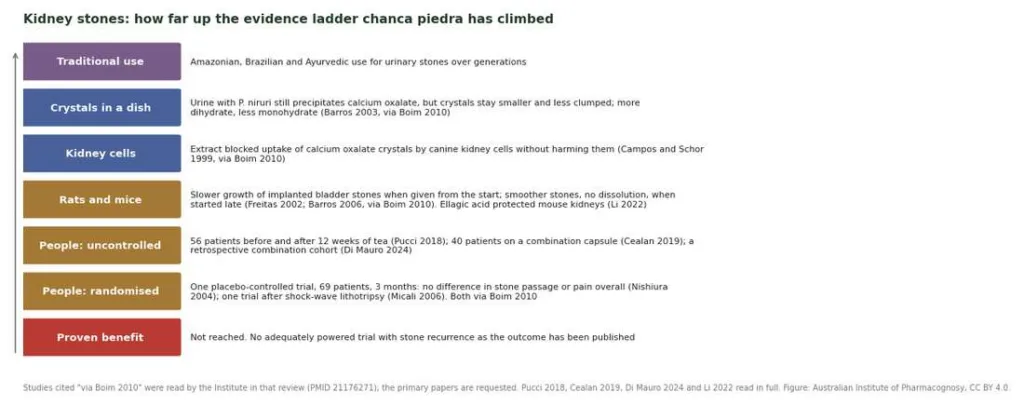
The randomised trials
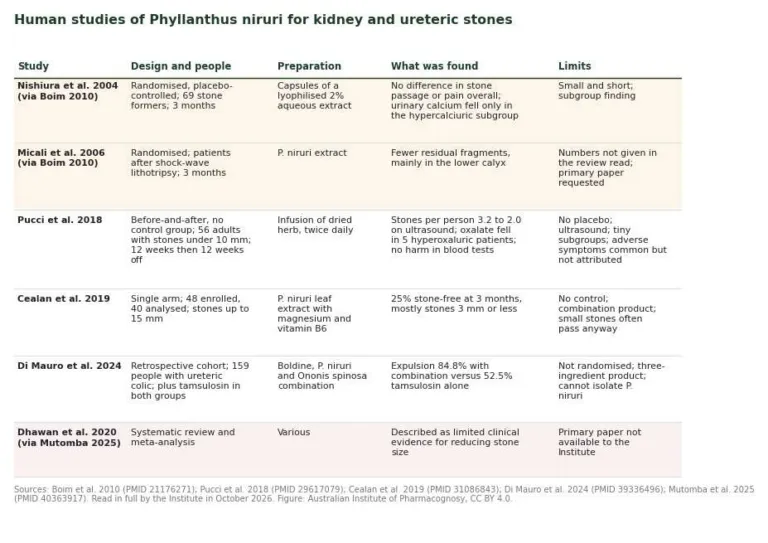
Two randomised trials of P. niruri for stones have been published, both before 2007, and the Institute has read them only as the 2010 review reports them. The primary papers are requested.
In the larger, Nishiura and colleagues gave 69 stone formers capsules of a lyophilised 2 per cent aqueous extract or a placebo for three months. They found no difference between groups in stone passage or pain. When patients were grouped by their metabolic profile, urinary calcium fell in those with high urinary calcium (hypercalciuria) PMID 21176271. Evidence suggests A subgroup result from a trial that missed its main outcome is a lead to follow, and confirms nothing on its own. Mechanism
Micali and colleagues, in Italy, gave P. niruri for three months to patients after shock-wave lithotripsy and reported fewer residual stone fragments than in untreated patients, mainly in the lower pole of the kidney PMID 21176271. Evidence suggests The review the Institute read does not give the trial’s numbers, and the primary paper has been requested. The review also mentions an earlier Brazilian study, published in a 1995 book chapter, in which stone patients drinking the tea for three months showed an apparent increase in stone passage compared with patients drinking a placebo PMID 21176271. Evidence suggests
Pucci and colleagues, São Paulo, 2018
The most detailed modern study is from the University of São Paulo, and the Institute read it in full PMID 29617079. Fifty-six adults with stones smaller than 10 mm drank an infusion of dried P. niruri twice daily for 12 weeks and were then followed for 12 weeks without it. Each patient served as his or her own control, and there was no placebo group PMID 29617079. Attested
Across the whole group, urinary calcium, oxalate, citrate, uric acid, sodium, pH and volume did not change. Urinary potassium and the magnesium and potassium ratios to creatinine rose, reaching significance only by the end of the washout. The mean number of stones on ultrasound fell from 3.2 to 2.0 per patient (p < 0.001), and 38 patients (67.8 per cent) had fewer stones; four patients passed six stones during the tea phase PMID 29617079. Evidence suggests In the five patients with high urinary oxalate, oxalate fell from 59.0 to 28.8 mg per day, and in the six with high urinary uric acid, uric acid fell from 0.77 to 0.54 in the paper’s units (p = 0.0057) PMID 29617079. Evidence suggests
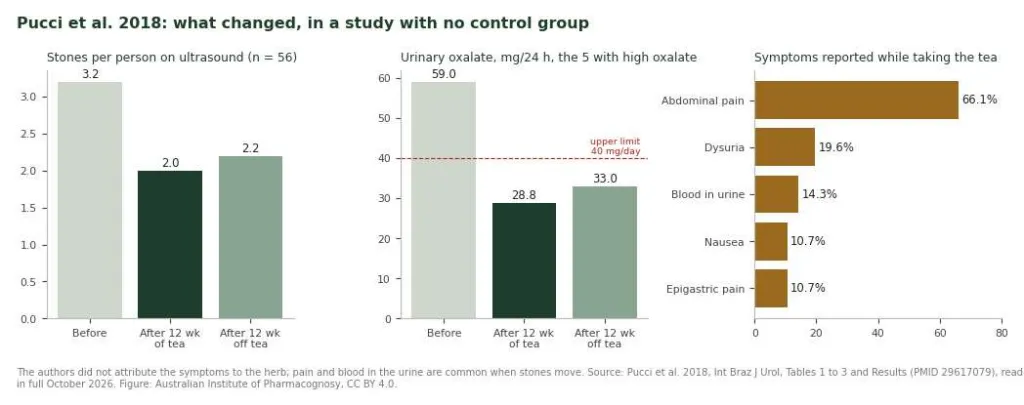
These are encouraging numbers, and the design limits what they can mean. Small stones pass spontaneously; about half of ureteric stones do so without intervention PMID 39336496. Evidence suggests Ultrasound is not the reference method for counting small stones, as the authors acknowledge PMID 29617079. Attested The subgroups with abnormal oxalate and uric acid had five and six patients, and an extreme value tends to move back towards the average on repeat testing whatever the treatment. Mechanism Table 3 of the paper gives a mean stone size of 15.6 mm at baseline in a study that enrolled only stones smaller than 10 mm, and the paper does not explain the measure. Attested And 66 per cent of patients reported abdominal pain during the tea phase, 20 per cent painful urination and 14 per cent blood in the urine. The authors attribute these symptoms to moving stones, which is plausible, and could not test it without a control group PMID 29617079. Evidence suggests
Combination products
Two European studies tested P. niruri inside multi-ingredient products. In Romania, Cealan and colleagues gave 48 people with stones up to 15 mm a capsule of P. niruri leaf extract with magnesium and vitamin B6 for three months; 40 completed, a quarter were stone-free on CT afterwards, and success was concentrated in stones of 3 mm or less in the upper and middle parts of the kidney PMID 31086843. Evidence suggests There was no control group, and three patients developed renal colic during the study PMID 31086843. Attested
In Italy, Di Mauro and colleagues looked back at 159 people treated for ureteric stones of 10 mm or less with renal colic. Those given tamsulosin plus a product combining boldine, P. niruri and restharrow (Ononis spinosa) passed their stones more often than those given tamsulosin alone, 84.8 against 52.5 per cent, and needed analgesia for fewer days PMID 39336496. Evidence suggests The study was retrospective, so the groups were not formed by chance, and with three active ingredients it cannot tell what P. niruri contributed. Mechanism
What the reviews conclude
The Brazilian group that did most of the work wrote in 2010 that its studies “suggest a preventive effect” and that “longer-term randomized clinical trials are necessary to confirm its therapeutic properties” PMID 21176271. Attested A 2025 systematic review of non-guideline therapies for preventing calcium oxalate stones included the Pucci study and placed P. niruri among the therapies that reduced urinary risk factors and stone formation, while recommending larger studies and standard definitions of stone formation PMID 40458577. Evidence suggests A 2025 overview of phytotherapy for stones describes a 2020 systematic review and meta-analysis by Dhawan and colleagues as showing “limited clinical evidence” for reducing stone size PMID 40363917. Attested The Institute could not obtain the Dhawan paper and does not report its numbers.
The Institute’s own reading is that chanca piedra has a coherent laboratory story, consistent signals in small human studies, and no adequately powered randomised trial showing that it prevents stones from forming again or makes existing stones pass. Mechanism That is where most well-loved stone remedies stand, herbal or otherwise, and it is an honest place to start a research programme.
8. Clinical evidence: the liver
The liver story began in the 1980s with P. amarus and hepatitis B. The first trial in chronic carriers, published by Thyagarajan and colleagues in 1988, reported clearance of the viral surface antigen in 59 per cent of treated carriers against 4 per cent on placebo, and a second, open trial reported 20 per cent clearance PMID 36407559. Evidence suggests Those results drew wide attention. Later trials and two Cochrane reviews (2011 and 2013) examined the question again; the Institute has requested the Cochrane reviews and the later trials and, having not read them in full, does not report their findings here. The authors of a 2021 randomised trial summarised the earlier hepatitis B and stone studies as showing promise but “not sufficient enough to gain conclusive evidence as the studies had poor methodological quality and a small sample size” PMID 34975132. Attested
Two modern placebo-controlled trials have been published, both read in full. In India, Sowjanya and colleagues randomised 100 people with mild to moderate alcoholic hepatitis to a whole-herb extract labelled P. niruri or a placebo for four weeks; 71 were analysed. Liver and kidney function tests did not improve significantly compared with placebo. Total antioxidant capacity rose, and so did appetite PMID 34975132. Evidence suggests
In Egypt, Shaker and colleagues randomised 146 people with risk factors for fatty liver inflammation (non-alcoholic steatohepatitis) to placebo or one of two doses of a capsule combining P. niruri aerial-part extract with milk thistle (Silybum marianum) for 36 weeks. Liver enzymes fell in every group, placebo included, and the relative falls did not differ between groups; neither did the fibrosis score. Seven mild, non-serious adverse events were recorded among 167 people screened, five of them on placebo PMID 39789561. Evidence suggests The trial was funded through a Malaysian government programme awarded to the product’s developer PMID 39789561. Attested
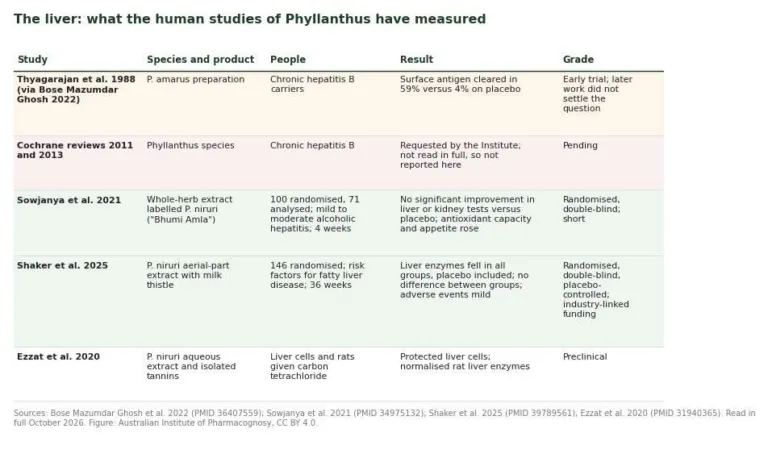
Both trials were well designed, and both found that a Phyllanthus product made no measurable difference to standard liver tests over the period studied. Evidence suggests Neither tested hepatitis B, and both were short compared with the course of liver disease. Mechanism The liver traditions of Ayurveda and Vietnamese medicine remain traditions, and the Institute found no human evidence that would let them be described as anything more. Mechanism The listed products on the ARTG that use P. amarus for “liver health” make traditional or general claims and are barred from referring to liver disease (ARTG public summaries). Attested
9. Safety and interactions
The safety record of chanca piedra in the published studies is reassuring as far as it goes. It does not go very far, because the studies were small and short.
What has been measured
In rats, a single oral dose of aqueous P. niruri leaf extract at 5,000 mg/kg produced no signs of toxicity and no changes in blood counts or liver and kidney chemistry over 14 days, so the median lethal dose is above that level PMID 22319255. Evidence suggests The authors stressed that toxicological data on the plant are limited and that results apply only to the species and part tested PMID 22319255. Attested In the 2018 São Paulo study, 12 weeks of tea caused no significant change in blood counts, kidney function or liver enzymes PMID 29617079. Evidence suggests In the Egyptian trial, 36 weeks of a P. niruri and milk thistle product produced no more adverse events than placebo PMID 39789561. Evidence suggests The Brazilian group reported no adverse renal, cardiovascular, neurological or toxic effects in its studies PMID 21176271. Evidence suggests
The symptoms in the São Paulo study deserve attention for a practical reason. Two-thirds of the patients reported abdominal pain while taking the tea, and some had blood in the urine PMID 29617079. Attested If a remedy helps stones move, moving stones hurt. Mechanism Severe flank pain, vomiting, inability to pass urine or visible blood in the urine are reasons for urgent medical care, and no herb should delay it. Fever or chills with flank pain can mean a blocked and infected kidney, which is an emergency: call Triple Zero (000) or go to the nearest emergency department. Mechanism
Kidney function, children and other groups with no data
The trials set limits on who took part, and those limits are also the limits of what is known. The São Paulo study enrolled adults with a mean age of 44 and excluded people with a serum creatinine above 2.0 mg/dL, a urinary tract infection, uncontrolled diabetes, chronic liver disease, cancer or pregnancy PMID 29617079. Attested The Romanian study enrolled adults aged 19 to 85 and excluded pregnancy and breastfeeding, kidney swelling from obstruction (hydronephrosis) on imaging, renal colic and impaired liver or kidney function PMID 31086843. Attested The Institute found no clinical study in children, in people with reduced kidney function or a single kidney, or in people with a urinary infection or a stone already blocking the kidney. Mechanism For these groups there is no safety evidence either way. They are also the people in whom a stone moving down the ureter matters most. Mechanism A child with a suspected stone needs a diagnosis before any remedy is considered. Mechanism People with chronic hepatitis B or other chronic liver disease are in the same position: the modern trials found no benefit on liver tests (section 8), and a Phyllanthus product should not replace antiviral treatment or regular liver monitoring. Mechanism
Diuretic, blood sugar and blood pressure questions
Diuretic, hypotensive and hypoglycaemic effects are described for Phyllanthus in animal studies and small human studies PMID 29617079; PMID 36407559. Evidence suggests In the São Paulo study, 27 of the 56 patients had high blood pressure and 26 took blood pressure medicine; diastolic pressure was slightly higher during the tea phase and fell during washout, and blood glucose was measured without a reported change PMID 29617079. Attested The human data are too thin to predict an interaction. Mechanism The cautious reading is that people taking medicines for blood pressure, diabetes or fluid retention, and people taking lithium, whose levels depend on kidney handling of salt and water, should not add a Phyllanthus product on their own initiative. Mechanism
Drug metabolism
A 2022 computational study from Barbados predicted that several P. niruri flavonoids and tannins, including astragalin, rutin, quercitrin and corilagin, could bind targets involved in the handling of common antihypertensive drugs, such as transporters and cytochrome P450 enzymes PMID 36530331. Mechanism Those are docking predictions, and no human interaction study has tested them. Mechanism A 2025 laboratory study of P. amarus lignans and drug-metabolising enzymes and receptors has been requested and is not reported here.
Pregnancy and breastfeeding
The Institute found no human data on the use of chanca piedra in pregnancy or breastfeeding. The clinical studies excluded pregnant women, and two also excluded breastfeeding mothers PMID 29617079; PMID 31086843; PMID 34975132. Attested A traditional record of use as an abortifacient in Barbados, and of use after childbirth and for uterine complaints in Suriname, exists for P. amarus PMID 36407559. Traditional A 2021 study in rats of a P. niruri extract during pregnancy and lactation has been requested. With no human safety data and a recorded traditional use to end pregnancy, the prudent course on present evidence is to avoid chanca piedra in pregnancy. Any use while breastfeeding is a decision for a degree-qualified herbalist with competencies and adequate training in pharmacognosy, made with the full picture. Mechanism
Reproductive and genetic toxicity
Two Ghanaian rat studies of aqueous P. niruri extracts, one on male hormones and the testes and one on genotoxicity, could not be retrieved in full on the day and are not reported. Brazilian researchers noted that the toxicity of Phyllanthus species “is currently uncertain” and that P. tenellus extracts caused agitation and then lethargy in mice PMID 29929208. Evidence suggests That is one more reason species identity matters.
Contamination
Plants harvested from roadsides and waste ground can take up heavy metals from soil. Mechanism A Brazilian study of cadmium in soil and P. niruri near ceramic factories has been requested. The Brazilian barcoding study found alfalfa (Medicago sativa) and another legume, Desmodium barbatum, both unrelated to Phyllanthus, in commercial quebra-pedra teas PMID 29929208. Confirmed Imported products are not assessed by the TGA for quality, and the TGA warns that they “may not adhere to Australian standards” and may contain prohibited substances (TGA, Personal Importation Scheme). Attested
In an emergency call Triple Zero (000). For a suspected poisoning or overdose, call the Poisons Information Centre on 13 11 26, at any hour, anywhere in Australia. Suspected side effects of any medicine, herbal medicines included, can be reported to the TGA (TGA, reporting adverse events). Before taking any botanical drug, consult a degree-qualified herbalist with competencies and adequate training in pharmacognosy.
10. In Australia: the law and what is on the shelf
This section sets out the Australian position as the Institute read it from the regulators’ own documents in October 2026. It is general information for readers. It is not legal advice.
Permissible ingredients
Most herbal products in Australian pharmacies and health food shops are listed medicines, shown by an AUST L number. A listed medicine may contain only ingredients named in the Therapeutic Goods (Permissible Ingredients) Determination, and must meet any conditions the determination sets (Permissible Ingredients Determination). Attested The current determination, No. 3 of 2026, in force since 13 October 2026, names Phyllanthus amarus at item 3877, permitted as an active ingredient and in homoeopathic preparations, with no specific requirements (Permissible Ingredients Determination). Attested It names Phyllanthus emblica, the amla fruit, at item 3878. It does not name Phyllanthus niruri, P. tenellus or P. urinaria (Permissible Ingredients Determination). Attested
The consequence, as the Institute reads the determination, is that a sponsor cannot list a medicine in Australia with P. niruri as an active ingredient. To use it, a sponsor would first need the TGA to evaluate the ingredient and add it to the determination, or would need a registered medicine, a much more demanding pathway. Mechanism
The ARTG
The Institute searched the ARTG in October 2026 and read the public summaries of every listing containing Phyllanthus amarus (ARTG searches, October 2026; ARTG public summaries). Attested Three active listed medicines contain it, entered between 2010 and 30 September 2026. A fourth, a combination liver product entered in 2021, was on the public register when the Institute first searched in October 2026 and no longer appeared on it when the search was repeated later that month; the register does not say why, and the Institute draws no conclusion from it (ARTG searches, October 2026). Attested One is a single-ingredient capsule listed on the ARTG as “Stonebreaker”, entered on 2 June 2026, a name that fits P. amarus, which is also called chanca piedra, Spanish for “stone breaker” PMID 36407559; its summary declares a dry extract of P. amarus herb and permitted indications that include “traditionally used in Ayurvedic medicine to maintain/support kidney health”, with the requirement that “product presentation must not imply or refer to kidney disease” (ARTG public summaries). Attested The other two are combination products, one for the liver and one for fluid balance, with similar requirements barring references to liver or kidney disease (ARTG public summaries). Attested The Institute found no listing containing P. niruri and none using the name chanca piedra (ARTG searches, October 2026). Attested Of the 52 ARTG entries returned by a search for “phyllanthus” at the second reading, 49 contain P. emblica, the amla fruit, a different medicine with different uses, and three contain P. amarus (ARTG searches, October 2026). Attested
The indications on these listings are traditional or general health claims. None of them claims to treat or prevent kidney stones, and the listings’ own requirements bar any reference to kidney or liver disease (ARTG public summaries). Attested Earlier reviews in this series cover how the TGA handles safety signals in listed herbal medicines, for turmeric (Curcuma longa) and ashwagandha (Withania somnifera).
Scheduling
Phyllanthus is not mentioned in the Poisons Standard of October 2026, and neither are securinine or norsecurinine, the alkaloid type reported from the plant (Poisons Standard, October 2026) or in the Medicines Advisory Statements Specification 2021 (Medicines Advisory Statements Specification 2021). Attested Chanca piedra is therefore unscheduled, and no mandatory label warning applies to P. amarus in listed medicines. Mechanism
Food or medicine?
Chanca piedra reaches Australians in two forms: capsules and tinctures, which look like medicines, and loose or bagged tea, which can look like food. Whether a product is a therapeutic good turns largely on how it is presented. The TGA’s food-medicine interface guidance asks what a product is represented to be for, and lists the signs that point to therapeutic use: the product’s name, dosage instructions, and a capsule, tablet or powder form (TGA food-medicine interface guidance). Attested It also asks whether a product has a tradition of use as food in Australia or New Zealand in the form presented, giving tea in a teabag and a dried herb as examples of forms to consider (TGA food-medicine interface guidance). Attested A tea sold as a “kidney stone dissolver” is making a therapeutic claim, whatever its packaging. Mechanism On the food side, Phyllanthus is named in neither the prohibited plants list (Schedule 23) nor the restricted plants list (Schedule 24) of the Food Standards Code (Food Standards Code, Schedules 23 and 24). Attested The Institute did not assess whether a chanca piedra tea would need approval as a novel food, and gives no view on it. Unsourced Classifying any particular product is the TGA’s call, and this review does not attempt it.
A herbalist’s preparation
Because P. niruri is not a permissible ingredient, products containing it cannot be listed medicines in Australia. A herbalist can still supply it lawfully. The Therapeutic Goods Regulations 1990 exempt from ARTG entry medicines “dispensed, or extemporaneously compounded, for a particular person for therapeutic application to that person” (Schedule 5, item 6) (Therapeutic Goods Regulations 1990). Attested They also exempt from manufacturing licensing herbalists, naturopaths and similar practitioners who make a herbal preparation on their own closable premises and supply it “for administration to a particular person after consulting with that person”, using their own judgement as to the treatment required (Schedule 8, item 4) (Therapeutic Goods Regulations 1990). Attested Because the plant is unscheduled, Queensland’s medicines and poisons law places no extra supply control on it. Mechanism One-to-one practice also deals with identity: the herbalist chooses the herb, can check what it is, and knows the patient’s other medicines, which a mail-order bottle cannot do. Mechanism Whether bulk dried P. niruri can be lawfully bought in Australia as a practitioner’s starting material was not examined for this review. Unsourced
Ordering from overseas
Outside a consultation, anyone who wants a P. niruri product is likely to import it. The TGA’s Personal Importation Scheme allows an individual to import therapeutic goods that are not on the ARTG for their own use or that of an immediate family member, provided the goods are not sold, supplied or given to anyone else (TGA, Personal Importation Scheme). Attested For non-prescription medicines, a single import may not exceed three months’ supply at the dose the manufacturer recommends, and the total in any 12 months may not exceed 15 months’ supply; products must be in their original or identifiable packaging, must not contain a controlled substance, and must not be prohibited under customs or quarantine rules (TGA, Personal Importation Scheme). Attested The TGA adds that quarantine clearance may be needed for any material of plant origin and directs importers to the Department of Agriculture, Fisheries and Forestry (TGA, Personal Importation Scheme). Attested The Institute did not check the department’s import conditions database for dried Phyllanthus herb, tea or extract, and readers should check it themselves before ordering. Unsourced
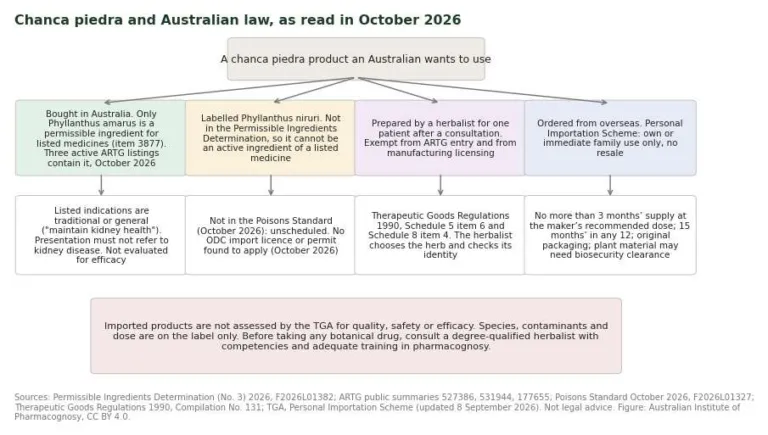
The TGA’s own advice on personal imports is blunt: imported products “are not evaluated by us, meaning their safety, quality and efficacy cannot be guaranteed”, and people should avoid ordering herbal preparations online unless they know the product’s contents and have checked the law (TGA, Personal Importation Scheme). Attested For chanca piedra the species question adds to that. A bottle labelled P. niruri from overseas may contain P. amarus, P. tenellus or a mixture, and nobody in Australia has checked. Mechanism The series’ reviews of sangre de grado (Croton lechleri) and soursop (Annona muricata) deal with other Amazonian medicines that reach Australia mainly by mail order.
11. Quality, identity and adulteration
The Brazilian barcoding study is the clearest evidence on quality, and it is sobering. Inglis and colleagues tested six DNA regions on 48 vouchered Phyllanthus samples from germplasm banks, living-pharmacy programmes and the wild, then used them to check four commercial quebra-pedra teas PMID 29929208. Confirmed The nuclear ITS region and the chloroplast matK, psbA-trnH, trnL and trnL-trnF regions all separated P. amarus, P. niruri, P. tenellus and P. urinaria, and ITS also separated P. tenellus from its close relative P. nummularifolius PMID 29929208. Confirmed rbcL could not separate P. niruri from P. urinaria PMID 29929208. Confirmed
The commercial results were these. Teas from two suppliers contained only P. tenellus. A third supplier’s tea, labelled P. niruri, contained P. tenellus and alfalfa. Of five samples from a fourth supplier, four were Desmodium barbatum, a legume, and one was P. niruri PMID 29929208. Confirmed So in this small Brazilian sample, one of four products contained the species the pharmacopoeia names, and four of the five samples from that supplier were something else. Confirmed Even the reference collections had errors: one germplasm-bank voucher listed as P. amarus was P. niruri, and two wild collections were misidentified PMID 29929208. Confirmed The Brazilian authors note that other unrelated plants, including Euphorbia prostrata and Heimia salicifolia, are sold as quebra-pedra in southern Brazil PMID 29929208. Attested
The Institute found no comparable survey of products sold in North America or online to Australians. Unsourced The Brazilian results show what can go wrong in the plant’s home market, and there is no reason to assume export products are better identified. Mechanism
How identity and quality can be tested
DNA barcoding with ITS or matK settles species identity in whole or cut herb PMID 29929208. Confirmed For extracts, where DNA may be degraded, chemical fingerprinting is needed. Corilagin has been proposed and validated as an HPLC marker for standardising P. niruri herb and extracts, in a 2009 paper the Institute has requested; the Egyptian study confirms corilagin is a major active tannin of the aqueous extract PMID 31940365. Confirmed The Brazilian infusion trial specified tannin content (at least 1.5 per cent), moisture, microbiological limits and gamma irradiation for its herb PMID 29617079. Attested That is the kind of specification a product should be able to show. Mechanism The Brazilian Pharmacopoeia names P. niruri as quebra-pedra PMID 29929208. Attested
Discussion: conclusions, hypotheses and research still required
What the evidence supports
Chanca piedra is a real medicine of real traditions. Amazonian, Brazilian, Indian and South-East Asian communities have used Phyllanthus niruri and its relatives for stones, the liver and much else for generations, and the record of that use is well documented. Traditional In the laboratory, P. niruri extract keeps calcium oxalate crystals small and dispersed, favours the less sticky crystal form and blocks crystal uptake by kidney cells; in rats it slows stone growth and smooths stones that have already formed. Evidence suggests In people, small studies report fewer stones, lower oxalate in a handful of hyperoxaluric patients and better clearance after lithotripsy, and the only placebo-controlled trial of stone passage found no overall difference. Evidence suggests Two modern randomised trials, short and of different products, found no effect on liver tests beyond placebo. Evidence suggests Short-term use in trials has looked safe, with no signal in blood tests. Evidence suggests
In Australia, P. amarus is a permissible ingredient in three active listed medicines, one of them listed on the ARTG as “Stonebreaker”; P. niruri is not a permissible ingredient and the Institute found it in no ARTG listing; the plant is unscheduled; and personal importation is allowed within the TGA’s limits. Attested P. niruri is barely recorded as growing here, while its naturalised look-alikes P. amarus, P. tenellus and P. debilis, and the native P. urinaria, are common in the north and east. Attested
What can reasonably be hypothesised
- The tannins (corilagin, geraniin) and their hydrolysis product ellagic acid, which water extracts well, may carry much of the anti-crystal and kidney-protective activity of a traditional tea, and the lignans may matter more in alcoholic extracts and for the liver. Mechanism
- If chanca piedra works for stones, it is more likely to act by keeping crystals small and helping fragments pass than by dissolving stones; the rat data and the lithotripsy result both point that way. The name may describe the experience of passing gravel more than a chemical effect. Mechanism
- The benefit, if any, may be concentrated in particular metabolic groups (high urinary calcium, oxalate or uric acid), which would explain why whole-group results are weak. Mechanism
- Some of the inconsistency in the human literature may reflect species substitution, given that commercial quebra-pedra in Brazil was mostly P. tenellus or not Phyllanthus at all. Mechanism
- Australian P. amarus and the native P. urinaria, growing in the same climate as far north Queensland’s stone formers, may carry a similar tannin profile, but nobody has measured it. Mechanism
What research is still required
- Clinical research. A randomised, placebo-controlled trial of a DNA-verified, chemically standardised P. niruri preparation in recurrent calcium stone formers, with CT-confirmed new stone formation or symptomatic recurrence over at least two years as the primary outcome, and 24-hour urine chemistry stratified by metabolic type. A second trial after lithotripsy or ureteroscopy, to test the residual-fragment result.
- Taxonomy and botany. Herbarium checks of the six ALA records filed as P. niruri, and voucher-based DNA barcoding of the Phyllanthus weeds of north Queensland, so that Australian records and any local research rest on certain names.
- Quality analysis. A market survey of chanca piedra products available to Australians online and of the three ARTG-listed P. amarus products, by ITS barcoding and HPLC fingerprinting with corilagin and phyllanthin as markers, plus heavy-metal and microbial testing. The Institute could begin this on purchased samples.
- Phytochemistry. A comparison of the tannin and lignan profiles of authenticated P. niruri, Australian-grown P. amarus and native P. urinaria, in both water infusions and hydroethanolic extracts, to show what a tea actually delivers.
- Pharmacology and pharmacokinetics. Studies of what reaches human urine after a tea, ellagic acid and its gut metabolites included, and whether urine collected from volunteers after drinking it changes calcium oxalate crystallisation ex vivo.
- Toxicology and interactions. Repeated-dose toxicity of authenticated material, a reproductive toxicity review, and a clinical interaction study with a common antihypertensive and a CYP3A probe, to test the computational predictions.
- Regulatory science. A review of whether P. niruri should be evaluated for addition to the Permissible Ingredients Determination with identity requirements that exclude look-alikes, and of whether the existing P. amarus entry needs an identity test.
- Ethnobotany. A collation, with the communities concerned, of Amazonian and Brazilian accounts of how the plant is prepared and for whom, so that clinical trials test the traditional preparation as well as convenient capsules.
A small weed that breaks no stones in a test tube but keeps crystals apart, slows their growth and has a few hopeful human studies behind it is worth a proper trial. Until one is done, chanca piedra belongs with the traditional medicines that people use with care and good advice, and its evidence should be described as it stands.
About the Australian Institute of Pharmacognosy and this series
The Australian Institute of Pharmacognosy is a clinic and research laboratory in Cardwell, far north Queensland, studying medicinal plants and natural products to the same evidentiary standard as any other branch of pharmacology: traditional knowledge taken seriously, and tested honestly. Visit the Institute at australian-pharmacognosy.org.
Series: AIP Literature Reviews and Critical Analyses (evidence reviews). Related reviews: sangre de grado (Croton lechleri) and soursop (Annona muricata) are other Amazonian medicines that reach Australia mostly by mail order; Indian barberry (Berberis aristata) is another Ayurvedic medicine reviewed for Australian readers; and turmeric (Curcuma longa) and ashwagandha (Withania somnifera) show how the TGA handles safety signals in listed medicines. Earlier reviews: echinacea (Echinacea purpurea) · black cohosh (Actaea racemosa) · Greek mountain tea (Sideritis scardica) · sutherlandia (Lessertia frutescens) · pygeum (Prunus africana) · devil’s claw (Harpagophytum procumbens) · andrographis (Andrographis paniculata). Follow the series for a new evidence review each morning.
Corrections: if you find an error or a source we have missed, write to the Institute at our contact form. We would rather correct a claim than repeat it.
About the images and the evidence. Photographs come from Wikimedia Commons and iNaturalist under the licences shown in each caption and in the image credits; several iNaturalist photographs record Phyllanthus growing wild in Queensland and the Northern Territory. Plant identifications are the photographers’ and the iNaturalist community’s; where a Commons file named P. niruri was photographed in India, the caption says that the plant may be P. amarus. Chemical structures are from PubChem. The seven tables and charts were drawn by the Institute from the sources named in each figure. No photograph shows a product, and no product is endorsed.
Head of Education and Research
Australian Institute of Pharmacognosy
Cardwell QLD, Australia
australian-pharmacognosy.org · our contact form
Suggested citation: Ridley T. Chanca piedra (Phyllanthus niruri L.) and the stonebreaker group: identity, traditional use, the evidence for kidney stones and the liver, safety and the Australian regulatory position. AIP Literature Review and Critical Analysis AIP-LR-PHYNIR. Cardwell (QLD): Australian Institute of Pharmacognosy; 2026.
Educational content only; not medical, legal or regulatory advice. Australian regulatory information reflects the ARTG, the Permissible Ingredients Determination, the Medicines Advisory Statements Specification, the Poisons Standard, the Therapeutic Goods Regulations 1990, the Food Standards Code and TGA web pages as read in October 2026 and may change. Brazilian, Indian and other overseas material is described as overseas material and does not govern Australian law. No product is advertised, endorsed or recommended. Material drawn from Commonwealth sources is © Commonwealth of Australia and appears here as short extracts for the purpose of reporting, criticism and review.
References
32 references: tap to open
Listed in order of first citation. All 16 PMIDs were verified against PubMed in October 2026 and read in full text; every regulatory, legislative, taxonomic and biodiversity record was read from its own source. Requested through the Institute’s library and not cited for their content (where their results appear, the review that reports them is cited): Nishiura et al. 2004, Micali et al. 2006, Barros et al. 2003 and 2006, Freitas et al. 2002, Campos and Schor 1999 and Rodgers et al. 2014 on stones; Iregui-Parra et al. 2025 and Dhawan et al. 2020 (systematic reviews); Thyagarajan et al. 1988, Liu et al. 2001, Baiguera et al. 2018 and the Cochrane reviews of Xia et al. 2011 and 2013 on hepatitis B; Bagalkotkar et al. 2006 and Calixto et al. 1998 (chemistry reviews); Colombo et al. 2009 (corilagin HPLC marker); da Costa Alves et al. 2021 (pregnancy and lactation in rats); Husain et al. 2025 (drug-metabolising enzymes); Santos et al. 2018 (cadmium); de Souza et al. 2021 (diuretic plants of Brazil); Thaker et al. 2026 (online claims and oxalate content of herbal ‘stone’ ingredients). Asare et al. 2012 and 2013 (rat genotoxicity and male reproductive toxicity) could not be retrieved on the day.
- Therapeutic Goods Administration. Reporting adverse events for consumers. Read by the Institute in October 2026. https://www.tga.gov.au/safety/reporting-problems/reporting-adverse-events-consumers
- Inglis PW, Mata LR, da Silva MJ, Vieira RF, Alves RBN, Silva DB, et al. DNA Barcoding for the Identification of Phyllanthus Taxa Used Medicinally in Brazil. Planta Med. 2018 Nov;84(17):1300-1310. PMID 29929208. DOI 10.1055/a-0644-2688.
- Bose Mazumdar Ghosh A, Banerjee A, Chattopadhyay S. An insight into the potent medicinal plant Phyllanthus amarus Schum. and Thonn. Nucleus (Calcutta). 2022;65(3):437-472. PMID 36407559. DOI 10.1007/s13237-022-00409-z.
- Jantan I, Haque MA, Ilangkovan M, Arshad L. An Insight Into the Modulatory Effects and Mechanisms of Action of Phyllanthus Species and Their Bioactive Metabolites on the Immune System. Front Pharmacol. 2019;10:878. PMID 31440162. DOI 10.3389/fphar.2019.00878.
- Lo CYZ, Khor QH, Abdullatif VA, Delgado C, Lu Y, Katz J, et al. Systematic review of pharmacological, complementary, and alternative therapies for the prevention of calcium oxalate stones. Asian J Urol. 2025 Apr;12(2):169-188. PMID 40458577. DOI 10.1016/j.ajur.2024.04.006.
- Pucci ND, Marchini GS, Mazzucchi E, Reis ST, Srougi M, Evazian D, et al. Effect of phyllanthus niruri on metabolic parameters of patients with kidney stone: a perspective for disease prevention. Int Braz J Urol. 2018;44(4):758-764. PMID 29617079. DOI 10.1590/S1677-5538.IBJU.2017.0521.
- Therapeutic Goods Administration. ARTG public summaries for the listed medicines containing Phyllanthus amarus, read in full by the Institute in October 2026: ARTG 527386 (start date 2/06/2026), 531944 (30/09/2026) and 177655 (16/11/2010), active at both readings, and 364705 (6/05/2021), active at the first reading only: permitted indications, indication requirements, warnings and active ingredients. https://www.tga.gov.au/resources/artg/527386
- Australian Plant Census, Council of Heads of Australasian Herbaria, via the National Species List. Distribution statements read by the Institute in October 2026: Phyllanthus amarus Schumach. & Thonn. (WA, CoI, ChI, NT, Qld, NSW, all naturalised); P. tenellus Roxb. (WA, Qld, NSW, LHI, NI naturalised; Vic formerly or sparingly naturalised); P. urinaria L. (WA, NT, Qld); P. debilis Klein ex Willd. (NT, Qld naturalised); P. virgatus G.Forst. (WA, NT, Qld, NSW). No APC entry for P. niruri L. https://id.biodiversity.org.au/node/apni/2891386
- Boim MA, Heilberg IP, Schor N. Phyllanthus niruri as a promising alternative treatment for nephrolithiasis. Int Braz J Urol. 2010;36(6):657-64; discussion 664. PMID 21176271. DOI 10.1590/s1677-55382010000600002.
- Evadgian A, Bharatha A, Cohall D. Use of Cheminformatics to Determine Potential Drug Interactions between Popular Barbadian Botanical Medicines and Antihypertensive Drugs. ACS Omega. 2022 Dec 13;7(49):44603-44619. PMID 36530331. DOI 10.1021/acsomega.2c02446.
- Sowjanya K, Girish C, Bammigatti C, Prasanna Lakshmi NC. Efficacy of Phyllanthus niruri on improving liver functions in patients with alcoholic hepatitis: A double-blind randomized controlled trial. Indian J Pharmacol. 2021;53(6):448-456. PMID 34975132. DOI 10.4103/ijp.IJP_540_20.
- International Plant Names Index, queried October 2026: Phyllanthus niruri L., Sp. Pl. 2: 981 (1753), 194900-2; Phyllanthus amarus Schumach. & Thonn., Beskr. Guin. Pl.: 421 (1827), 326408-2; Phyllanthus niruri var. amarus (Schumach. & Thonn.) Leandri, Fl. Madagasc. 111: 73 (1958), 77287617-1. https://www.ipni.org/n/194900-2
- Atlas of Living Australia. Species and occurrence searches, Australia only, October 2026: Phyllanthus niruri 6 records (no state; name matched to the New Zealand Organisms Register), P. amarus 380, P. tenellus 1,100, P. urinaria 383, P. debilis 113, P. virgatus 8,129, with state breakdowns as in Figure 2. https://biocache.ala.org.au/occurrences/search?q=taxon_name%3A%22Phyllanthus%20amarus%22
- Biosecurity Act 2014 (Qld) and Biosecurity Regulation 2016 (Qld), both current as at 27/04/2026, full texts searched by the Institute in October 2026: no mention of Phyllanthus; the family Phyllanthaceae appears only in Schedule 7 of the Regulation, Pyriform scale carriers. https://www.legislation.qld.gov.au/view/html/inforce/current/sl-2016-0156
- Moraes Carlesso R, Cappellari YLR, Boeff DD, da Costa Pereira A, Schmitt Rusch E, de Souza Claudino T, et al. Nephroprotective Plant Species Used in Brazilian Traditional Medicine for Renal Diseases: Ethnomedical, Pharmacological, and Chemical Insights. Plants (Basel). 2025 Feb 20;14(5). PMID 40094548. DOI 10.3390/plants14050648.
- World Health Organization Regional Office for the Western Pacific. Medicinal plants in Viet Nam. Manila: WHO WPRO; 1990. Entry 143, Phyllanthus urinaria L., pp. 286–287. Copy held in the Institute’s library and read in October 2026.
- Shaker MK, Hassany M, Eysa B, Adel A, Zidan A, Mohamed S. The activity of a herbal medicinal product of Phyllanthus niruri and Silybum marianum powdered extracts (Heptex®) in patients with apparent risk factors for nonalcoholic steatohepatitis: a phase II, multicentered, randomized, double-blind, placebo-controlled clinical trial. BMC Complement Med Ther. 2025 Jan 09;25(1):8. PMID 39789561. DOI 10.1186/s12906-024-04692-y.
- Ezzat MI, Okba MM, Ahmed SH, El-Banna HA, Prince A, Mohamed SO, et al. In-depth hepatoprotective mechanistic study of Phyllanthus niruri: In vitro and in vivo studies and its chemical characterization. PLoS One. 2020;15(1):e0226185. PMID 31940365. DOI 10.1371/journal.pone.0226185.
- Li MT, Liu LL, Zhou Q, Huang LX, Shi YX, Hou JB, et al. Phyllanthus Niruri L. Exerts Protective Effects Against the Calcium Oxalate-Induced Renal Injury via Ellgic Acid. Front Pharmacol. 2022;13:891788. PMID 36034880. DOI 10.3389/fphar.2022.891788.
- Asare GA, Addo P, Bugyei K, Gyan B, Adjei S, Otu-Nyarko LS, et al. Acute toxicity studies of aqueous leaf extract of Phyllanthus niruri. Interdiscip Toxicol. 2011 Dec;4(4):206-10. PMID 22319255. DOI 10.2478/v10102-011-0031-9.
- Di Mauro E, Saldutto P, La Rocca R, Sangiorgi G, Patelli G, Barone B, et al. Efficacy and Safety of Boldine Combined with Phyllanthus niruri and Ononis spinosa in Medical Expulsive Therapy for Distal Ureteral Stones with Renal Colic: A Single-Center, Retrospective Cohort Study. Medicina (Kaunas). 2024 Sep 05;60(9). PMID 39336496. DOI 10.3390/medicina60091455.
- Cealan A, Coman RT, Simon V, Andras I, Telecan T, Coman I, et al. Evaluation of the efficacy of Phyllanthus niruri standardized extract combined with magnesium and vitamin B6 for the treatment of patients with uncomplicated nephrolithiasis. Med Pharm Rep. 2019 Apr;92(2):153-157. PMID 31086843. DOI 10.15386/mpr-1246.
- Mutomba WF, Symeonidis EN, Mykoniatis I, Tzelves L, Tsaturyan A, Juliebo-Jones P, et al. Phytotherapy in Urolithiasis: An Updated Overview of Current Knowledge. J Clin Med. 2025 Apr 22;14(9). PMID 40363917. DOI 10.3390/jcm14092885.
- Therapeutic Goods Administration. Personal Importation Scheme. Web page, last updated 8 September 2026. Read in full by the Institute in October 2026. https://www.tga.gov.au/products/unapproved-therapeutic-goods/personal-importation-scheme
- Therapeutic Goods (Permissible Ingredients) Determination (No. 3) 2026 (Cth), F2026L01382, registered and in force 13/10/2026, replacing No. 2 of 2026. Schedule 1 read by the Institute in October 2026: item 3877 PHYLLANTHUS AMARUS, purposes A and H, no column 4 requirements; item 3878 PHYLLANTHUS EMBLICA; no entry for Phyllanthus niruri, P. tenellus or P. urinaria. Sections 5 and 6 specify permissible ingredients for paragraph 26BB(1)(a) of the Therapeutic Goods Act 1989. https://www.legislation.gov.au/F2026L01382/asmade/text
- Therapeutic Goods Administration. Australian Register of Therapeutic Goods, public keyword searches run by the Institute twice in October 2026: “phyllanthus” (53 results at the first reading, 49 containing Phyllanthus emblica and 4 containing P. amarus; 52 at the second, after ARTG 364705 no longer appeared), “niruri”, “amarus”, “stonebreaker” (1 result), “chanca” and “stone breaker” (no results). At the first reading the public record of every entry returned was opened and its ingredients read at species level; at the second the P. amarus entries were rechecked. No entry contained P. niruri. Raw survey held by the Institute. https://www.tga.gov.au/resources/artg
- Therapeutic Goods (Poisons Standard—October 2026) Instrument 2026 (Cth), F2026L01327, registered 30/09/2026. Full text searched by the Institute in October 2026: no entry for Phyllanthus, niruri, securinine or norsecurinine. https://www.legislation.gov.au/F2026L01327/asmade
- Therapeutic Goods (Medicines Advisory Statements) Specification 2021 (Cth), F2021L01888. Full text searched by the Institute in October 2026 for Phyllanthus, niruri and amarus: no entry. https://www.legislation.gov.au/F2021L01888/latest/text
- Therapeutic Goods Administration. Food-Medicine Interface Guidance Tool questions: explanation and information. Web page, last updated 10 June 2025. Read by the Institute in October 2026. https://www.tga.gov.au/resources/decision-trees/food-medicine-interface-guidance-tool-fmigt/food-medicine-interface-guidance-tool-questions-explanation-and-information
- Australia New Zealand Food Standards Code, Schedule 23 (Prohibited plants and fungi), F2015L00435, compilation of 13 April 2017, and Schedule 24 (Restricted plants and fungi), F2015L00438, compilation of 13 April 2017. Full texts searched by the Institute in October 2026: no entry for Phyllanthus. https://www.legislation.gov.au/F2015L00435/latest/text
- Therapeutic Goods Regulations 1990 (Cth), Compilation No. 131, compilation date 5 October 2026, read by the Institute in October 2026: Schedule 5 item 6 (medicines dispensed or extemporaneously compounded for a particular person, exempt from Parts 3-2 and 3-2A of the Act) and Schedule 8 item 4 (herbalists, naturopaths and similar practitioners, exempt from Part 3-3 of the Act on the conditions stated). https://www.legislation.gov.au/F1996B00406/latest/text
- Chemical records and structure depictions: PubChem, US National Library of Medicine, public domain. CIDs cited in the text: 358901, 182140, 11575632, 182644, 73568, 3001497, 5281855, 370, 33005.
Image credits
- Quebra-Pedra. Phyllanthus niruri.JPG, Toluaye. Public domain. Wikimedia Commons. Resized and re-encoded for the web by AIP; no other changes.
- Chanca piedra (Phyllanthus niruri).jpg, Kristi Denby/Archivo Centro Takiwasi. CC BY-SA 4.0. Wikimedia Commons. Resized and re-encoded for the web by AIP; no other changes.
- Hojas de Chanca Piedra (Phyllanthus niruri).jpg, Pisofrix. CC BY-SA 4.0. Wikimedia Commons. Resized and re-encoded for the web by AIP; no other changes.
- Stonebreaker(Phyllanthus niruri) കീഴാര്നെല്ലി. (37281569264).jpg, Rison Thumboor from Thrissur, India. CC BY 2.0. Wikimedia Commons. Resized and re-encoded for the web by AIP; no other changes.
- Phyllanthus amarus 75694611.jpg, Siddarth Machado. CC BY 4.0. Wikimedia Commons. Resized and re-encoded for the web by AIP; no other changes.
- Phyllanthus amarus in its natural environment.JPG, Gopipedia. Public domain. Wikimedia Commons. Resized and re-encoded for the web by AIP; no other changes.
- Phyllanthus urinaria subsp. urinaria – 51500382957.jpg, sonnia hill. CC BY 2.0. Wikimedia Commons. Resized and re-encoded for the web by AIP; no other changes.
- Calcium Oxalate Monohydrate Crystals in Urine Microscopy.jpg, Ajay Kumar Chaurasiya. CC BY-SA 4.0. Wikimedia Commons. Resized and re-encoded for the web by AIP; no other changes.
- Kidney stone 4mm 05.jpg, Jacek Proszyk. CC0. Wikimedia Commons. Resized and re-encoded for the web by AIP; no other changes.
- Kidney stone 01.JPG, Tsester. CC0. Wikimedia Commons. Resized and re-encoded for the web by AIP; no other changes.
- Phyllanthus niruri closeup.jpg, Vinayaraj. CC BY-SA 3.0. Wikimedia Commons. Resized and re-encoded for the web by AIP; no other changes.
- Photo 336249562, iNaturalist observation 191643118 (Guatambú, SC, Brasil, 2023-11-04; research), William G. Borges ((c) William G. Borges, some rights reserved (CC BY)). CC BY 4.0. iNaturalist. Resized and re-encoded for the web by AIP; no other changes.
- Photo 163317355, iNaturalist observation 98128840 (Goya, Buenos Aires, Ciudad Autónoma de Buenos Aires, AR, 2021-10-13; research), Rodrigo Cesáreo Pampin ((c) Rodrigo Cesáreo Pampin, some rights reserved (CC BY)). CC BY 4.0. iNaturalist. Resized and re-encoded for the web by AIP; no other changes.
- Photo 641727431, iNaturalist observation 351640067 (along Free Beach Road, Casuarina Coastal Reserve, Darwin, Northern Territory, 2026-04-10; research), Thomas Mesaglio ((c) Thomas Mesaglio, some rights reserved (CC BY)). CC BY 4.0. iNaturalist. Resized and re-encoded for the web by AIP; no other changes.
- Photo 446491471, iNaturalist observation 249736586 (Douglas, AU-QL, AU, 2024-10-30; needs_id), andrew2285 (no rights reserved). CC0 1.0. iNaturalist. Resized and re-encoded for the web by AIP; no other changes.
- Photo 608841689, iNaturalist observation 335174393 (Brisbane QLD, Australia, 2026-01-18; research), Scott W. Gavins ((c) Scott W. Gavins, some rights reserved (CC BY)). CC BY 4.0. iNaturalist. Resized and re-encoded for the web by AIP; no other changes.
- Photo 358740748, iNaturalist observation 203073060 (Hervey Bay QLD 4655, Australia, 2024-03-19; research), Scott W. Gavins ((c) Scott W. Gavins, some rights reserved (CC BY)). CC BY 4.0. iNaturalist. Resized and re-encoded for the web by AIP; no other changes.
- Photo 59494525, iNaturalist observation 37520149 (Corinda, QLD, AU, 2020-01-12; research), Greg Tasney ((c) Greg Tasney, some rights reserved (CC BY-SA)). CC BY-SA 4.0. iNaturalist. Resized and re-encoded for the web by AIP; no other changes.
- Photo 399143134, iNaturalist observation 225149151 (Calle 113, Corrientes, Corrientes, AR, 2024-06-25; research), Juanito Escamilla ((c) Juanito Escamilla, some rights reserved (CC BY)). CC BY 4.0. iNaturalist. Resized and re-encoded for the web by AIP; no other changes.
- Chemical structure depictions (phyllanthin, hypophyllanthin, niranthin, nirtetralin, corilagin, geraniin, ellagic acid, gallic acid, calcium oxalate): PubChem, US National Library of Medicine. Public domain.
- Figures 1 to 7 (the species table, the Australian records chart, the evidence ladder, the Pucci 2018 chart, the human stone studies table, the liver evidence table and the Australian regulatory diagram): Australian Institute of Pharmacognosy, 2026, CC BY 4.0, drawn from the sources printed in each figure.
The Institute sets and publishes its own monographs. The catalogue is in Publications.