

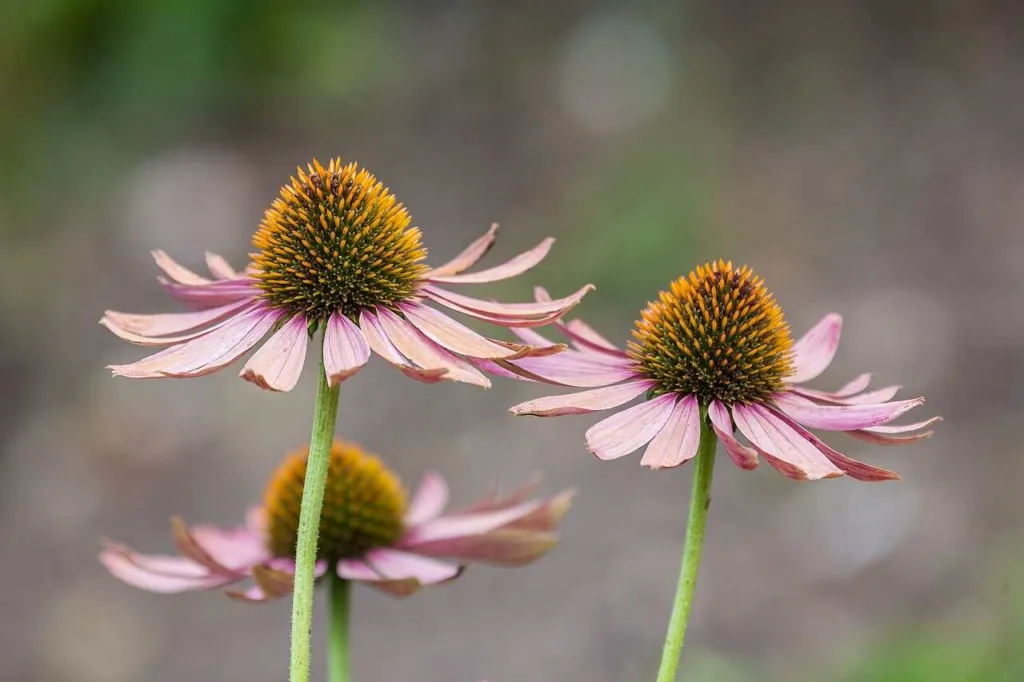
Cover: Echinacea purpurea, Botanical Garden, Munich. Photo: Diego Delso · CC BY-SA 3.0 · Wikimedia Commons
Andrographis left the list of ingredients permitted in Australian listed medicines on 17/09/2026 after 287 anaphylaxis reports Attested, and the herb most often in the same tablet was echinacea. Attested Echinacea has a century of medical use and more cold trials than almost any other herb, and its evidence depends on which echinacea you mean. Evidence suggests
This is AIP Literature Review and Critical Analysis AIP-LR-ECHPUR in the Australian Institute of Pharmacognosy’s series of literature reviews and critical analyses. It covers Echinacea purpurea (L.) Moench and its medicinal relatives E. angustifolia and E. pallida: their names and botany, Australian status, Plains-nation and Eclectic use, chemistry and pharmacology, what the trials and systematic reviews show for preventing and treating colds, how echinacea differs from andrographis, its safety and drug interactions, its position under Australian law and on the ARTG in October 2026, and how its quality is tested.
This article is educational. It is not medical, legal or regulatory advice, and it is not an advertisement. No product is named, recommended or discouraged. The Institute has no commercial interest in echinacea or andrographis products.
1. Daisy-family allergy. Echinacea belongs to the Asteraceae. Allergic reactions, including rare anaphylaxis, are reported, mostly in people with asthma, hay fever, eczema or a known allergy to daisy-family plants. Evidence suggests Anyone who has reacted to an echinacea product before should not take it again. Mechanism
2. Children. In the one large trial in children aged 2 to 11, a pressed-juice syrup did not help and caused rash in 7.1 per cent against 2.7 per cent on placebo. Confirmed
3. Medicines. Echinacea modestly speeds the clearance of some drugs (CYP3A substrates, S-warfarin). People on warfarin, chemotherapy, transplant or other immunosuppressant medicines, or with an autoimmune disease, should not self-select it. Evidence suggests
4. Pregnancy and breastfeeding. Human data are limited: the one prospective pregnancy study described in the reviews was small and covered unspecified products, and the Institute found no breastfeeding data. Evidence suggests Use while pregnant or breastfeeding is a decision to make with a degree-qualified herbalist with competencies and adequate training in pharmacognosy. Mechanism
Emergency: call Triple Zero (000). For a suspected poisoning or overdose, call the Poisons Information Centre on 13 11 26 (24 hours, Australia-wide). Report suspected side effects to the TGA (TGA, reporting adverse events). Before taking any botanical drug, consult a degree-qualified herbalist with competencies and adequate training in pharmacognosy.
| Botanical names | Echinacea purpurea (L.) Moench; E. angustifolia DC.; E. pallida (Nutt.) Nutt.; Asteraceae Attested §2 |
| Common names | Echinacea, purple coneflower; narrow-leaved and pale purple coneflower Attested §2 |
| Parts used | E. purpurea fresh flowering tops (pressed juice, extracts) and root; roots of the other two Attested §2 |
| In Australia | Garden plant only; no wild record; not a declared weed in Queensland Attested §3 |
| Tradition | Plains nations: root for toothache, pain, burns and bites; Eclectic doctors from 1880s Traditional §4 |
| Chemistry | Cichoric acid (E. purpurea), echinacoside (E. angustifolia, E. pallida root), alkamides, polysaccharides Confirmed §5 |
| Pharmacology | Alkamides absorbed, act at CB2 receptors in models; caffeic acid esters poorly absorbed Evidence suggests §6 |
| Colds: prevention | Possible 10–20% relative reduction with some products (Cochrane, post hoc) Evidence suggests §7 |
| Colds: treatment | No clear benefit in the Cochrane review; largest independent trial 0.53 day, not significant Confirmed §7 |
| Versus andrographis | Different plant, chemistry and evidence; 10 echinacea-only anaphylaxis reports to TGA in 20 years against 287 for andrographis Attested §8 |
| Safety | Allergy (atopic people), rash in young children, modest CYP3A and warfarin effects Evidence suggests §9 |
| Australian law | Permitted in listed medicines; no specified warning or age limit; unscheduled; 219 ARTG entries Attested §10 |
| Quality | Species and part confusions and Parthenium substitution; HPTLC separates them Confirmed §11 |
| Emergency | Triple Zero (000); Poisons Information Centre 13 11 26 Attested §9 |
- Confirmed Established in humans by trial, or an unambiguous analytical or chemical fact.
- Evidence suggests Real published data, but preclinical, observational, small, post hoc, industry-run or not independently replicated.
- Mechanism A plausible mechanistic or pharmacological inference, or the Institute’s own interpretation, short of a measured outcome.
- Traditional Historical or ethnobotanical use. Evidence of practice. Efficacy is a separate question.
- Attested A documentary fact attested in a named record: a legislative instrument, a regulator’s register or report, a taxonomic index, a biodiversity database, a historical text or a paper’s own statement. It states what the record says.
- Unsourced A statement the Institute could not trace to a source it was able to open and read, flagged so no reader mistakes it for a sourced claim.
Every PubMed ID (PMID) below links to its record and was checked against PubMed in October 2026, and every paper cited by PMID was read in full text. Papers the Institute could not open in full have been requested through its library and are not cited for their content; where their results are reported, the review that describes them is cited. Every compound was checked against PubChem and is linked by CID. Every Australian regulatory statement was read from the regulator’s or the legislature’s own document or database in October 2026 unless another month is given. European and United States material is overseas and does not govern Australia.
Which echinacea. Three North American coneflowers are used. E. purpurea tops are pressed for juice or extracted fresh; the roots of all three are dried and extracted. They differ in chemistry, and almost every Australian product uses E. purpurea, nearly always in a combination formula. Attested
Colds. The Cochrane review of 24 trials found no clear benefit for treating colds, and a possible 10 to 20 per cent relative reduction in catching one with some products. Pooled meta-analyses are more positive but mix very different products. The evidence is for particular preparations, and results do not transfer between them. Evidence suggests
Andrographis. Echinacea is a different herb with different chemistry and a weaker record for treating an established cold. The TGA found only 10 echinacea-only anaphylaxis reports in twenty years and concluded echinacea was not the main cause of the andrographis reactions. Attested
Safety. Generally well tolerated. Allergy is the main issue, chiefly in atopic people and those allergic to the daisy family; one pressed-juice syrup caused rash in young children; drug interactions measured in people are modest. Evidence suggests
In Australia. A permitted ingredient in listed medicines with no specified label warning and no age limit, unscheduled, in 219 ARTG entries in October 2026, 30 of which still also contained andrographis. Before taking any botanical drug, consult a degree-qualified herbalist with competencies and adequate training in pharmacognosy.
 Chapter 1Why echinacea, and why now
 Chapter 2Three species, two parts, many medicines
 Chapter 3Botany, range and Australian status
 Chapter 4Traditional and historical use
 Chapter 5Phytochemistry
 Chapter 6Pharmacology
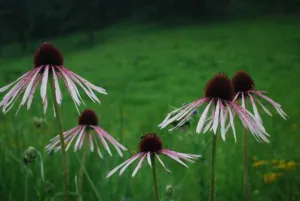 Chapter 7Clinical evidence for colds
 Chapter 8After andrographis
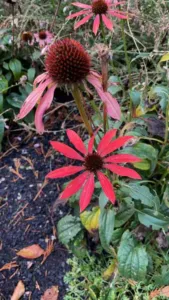 Chapter 9Safety and interactions
 Chapter 10Australian regulation and the ARTG
 Chapter 11Quality and adulteration
 Chapter 12Discussion and research agenda
1. Why echinacea, and why now
On 17/09/2026 andrographis left the list of ingredients that Australian listed medicines may contain. The Therapeutic Goods Administration made the change by a legislative instrument that repealed a single line, item 603, of the Permissible Ingredients Determination (Andrographis removal amendment, F2026L01211). Attested Its decision notice says that new listed medicines containing andrographis can no longer be entered in the Australian Register of Therapeutic Goods (ARTG), that sponsors will be asked to cancel listings or recall stock, and that the TGA will start its own regulatory action from mid-October 2026 if they do not act (TGA decision notice, 18 September 2026). Attested The reason is anaphylaxis: 287 reports to the TGA between 2005 and the end of 2025, including a death reported in June 2024 (TGA supplementary report, March 2026; TGA decision notice, 18 September 2026). Attested The Institute reviewed that decision in detail when it was first proposed, in its review of andrographis (Andrographis paniculata).
For many households the andrographis product in the cupboard was a cold-and-flu tablet that also contained echinacea, zinc and vitamin C. The TGA’s own decision notice says so: andrographis “is often combined with other herbal ingredients, including Echinacea” (TGA decision notice, 18 September 2026). Attested When those tablets go, echinacea is the familiar name left on the shelf, and it is the obvious thing to reach for next.
That makes this a good moment to look at echinacea carefully. The name covers three species, two quite different plant parts and several ways of making a medicine, and the clinical trials tested particular preparations, which do not all behave alike. Echinacea is also a member of the daisy family, Asteraceae, with its own record of allergic reactions, and the TGA examined that record while it was building the andrographis case. This review sets out what echinacea is, what the trials and systematic reviews show for colds, why it is a different herb from andrographis with a different evidence base, what the safety record says, and what the ARTG showed was on Australian shelves when the Institute searched it in October 2026.
The Institute writes as an admirer of this plant. Echinacea is one of the most studied herbs in Western herbal medicine, and the work on it is a model of how preparation, chemistry and trial design have to be read together. Taking it seriously means reporting its evidence as it stands, modest benefits and real uncertainties included.
2. Identity and taxonomy: three species, two parts, many medicines
The names
Linnaeus named the eastern purple coneflower Rudbeckia purpurea in Species Plantarum in 1753. Conrad Moench moved it to a new genus in 1794 as Echinacea purpurea (L.) Moench, the name in use today (IPNI). Attested Augustin Pyramus de Candolle described the narrow-leaved prairie species Echinacea angustifolia DC. in 1836, and Thomas Nuttall the pale purple coneflower, now Echinacea pallida (Nutt.) Nutt., in 1840 (IPNI). Attested Around 1900 several American botanists placed the genus under the older name Brauneria, so early twentieth-century pharmacy texts sometimes speak of Brauneria angustifolia or B. pallida (IPNI). Attested The genus name comes from the Greek echinos, hedgehog, for the spiny cone in the middle of the flower head. Unsourced
The genus has nine species in the treatment most botanists follow, all native to North America, and six of the nine are ranked globally imperilled or vulnerable by NatureServe. (PMID 40995006). Attested Hybridisation between species has made the family tree hard to resolve, and a 2025 target-capture sequencing study was still working out how the species are related (PMID 40995006). Confirmed
Which part, which preparation
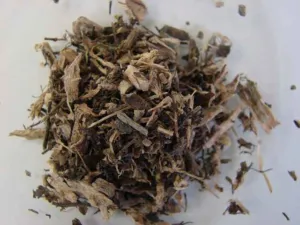
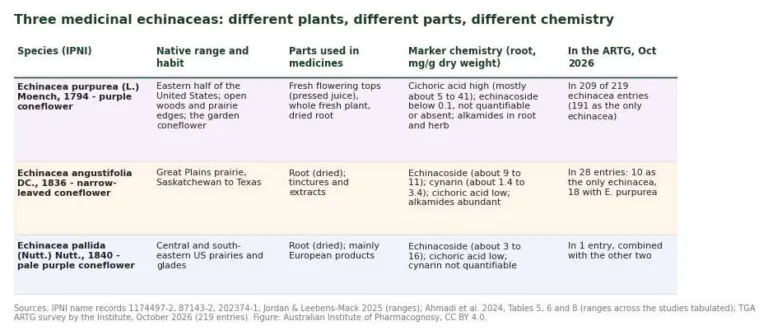
The three species are used differently. The aerial parts of E. purpurea, gathered fresh in flower, are pressed for their juice or extracted in alcohol; the roots of all three species are dried and extracted (PMID 26441065; PMID 24554461). Attested The Cochrane reviewers listed the products in the 24 trials they accepted and found pressed juices of E. purpurea tops, alcoholic extracts of the fresh whole plant, tablets of dried-root extracts, extracts of E. angustifolia root made three different ways, teas and capsules of unstated parts (PMID 24554461). Attested The United States Pharmacopeia keeps separate monographs for Echinacea purpurea Aerial Parts and Echinacea purpurea Root for the same reason: each is a different herbal drug with its own identity standard (PMID 41557965). Attested
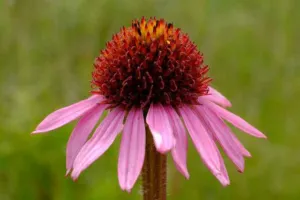
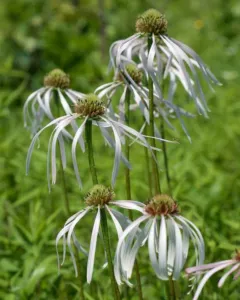
The practical lesson for a reader standing in a pharmacy aisle is that “echinacea” on a label tells you the genus and little else. The species, the part, the preparation and the amount of each decide what is in the tablet. Figure 1 sets the three species side by side.
3. Botany, distribution and Australian status
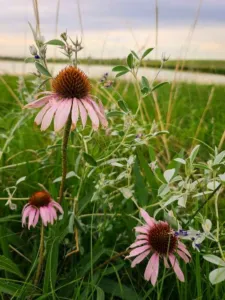
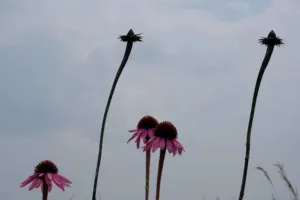
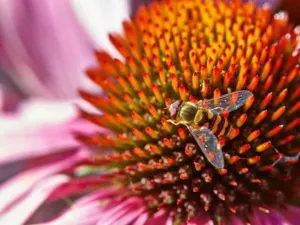
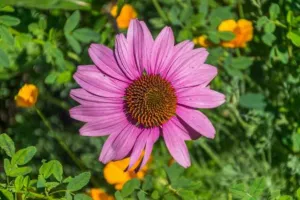
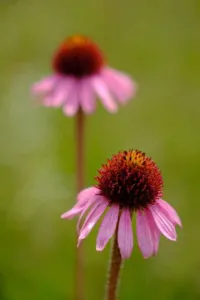
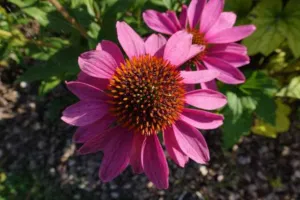
Echinaceas are long-lived perennials with a single flower head on each stem. Each head has an outer ring of sterile ray florets, the “petals”, around a domed disc of fertile florets set among stiff, pointed chaffy bracts that make the cone prickly to touch. The fruits are small four-angled achenes (King’s American Dispensatory, 1898). Attested King’s American Dispensatory of 1898 described E. angustifolia as a plant of 60 to 90 centimetres with a “thick, black, pungent root” growing in rich prairie soil from Illinois to Nebraska and south to Texas (King’s American Dispensatory, 1898). Attested E. purpurea has the broadest range in the genus and covers much of the eastern half of the United States; E. tennesseensis, at the other extreme, grows only in the cedar glades of six counties in central Tennessee (PMID 40995006). Attested E. purpurea is the one most often cultivated, and its cultivation for medicine and gardens has spread to nearly every continent (PMID 38732450). Attested
In Australia
Echinacea grows in Australian gardens and is not recorded as growing wild here. When the Institute queried the Atlas of Living Australia in October 2026, it held ten records for Echinacea purpurea, all from New Zealand, the Cook Islands, the United States or Canada, and none for E. angustifolia or E. pallida (Atlas of Living Australia). Attested The name in the Atlas comes from the New Zealand Organisms Register, which suggests the Australian Plant Census has no entry for a naturalised population. Mechanism iNaturalist held 38 Australian observations of E. purpurea and one of E. angustifolia; every one was marked by its observer or the community as cultivated, in gardens from Brisbane and the Gold Coast hinterland to Adelaide, Melbourne and Ballarat (iNaturalist, Australia). Attested Neither the Queensland Biosecurity Act 2014 nor the Biosecurity Regulation 2016 mentions Echinacea (Biosecurity Act 2014 (Qld)). Attested
Wild American stands deserve a word, because Australian money buys a great deal of echinacea root. A 2022 European market survey notes that E. angustifolia is endangered in the wild and that its root is easily confused with E. pallida root (PMID 36003516). Attested Most medicinal E. purpurea is now cultivated, which is one reason the species dominates the Australian register (chapter 10). Mechanism
4. Traditional and historical use
Plains nations
The deepest record of echinacea as medicine belongs to the peoples of the North American plains, and the plant they used most was E. angustifolia. Daniel Moerman’s Native American Ethnobotany database, which collects published ethnographic records, lists 50 uses of the species by the Omaha, Dakota, Lakota, Cheyenne, Pawnee, Blackfoot and other nations (Native American Ethnobotany database). Traditional The commonest were for toothache and other pain, burns, sore mouths and throats, and snakebite and other poisonings. The Blackfoot chewed the root to numb the mouth for toothache; the Cheyenne chewed it or used an infusion of leaves and roots for sore mouths, gums and throats; the Dakota washed burns with the juice (Native American Ethnobotany database). Traditional The database holds only a handful of records for E. purpurea, including Choctaw use of the chewed root for cough and indigestion (Native American Ethnobotany database). Traditional It holds no record of echinacea as a cold remedy. Attested
The numbing tingle those healers relied on has a chemical explanation, set out in chapter 5: it comes from the alkamides concentrated in the root. Mechanism Modern pharmacologists working on those compounds have drawn the link to Indigenous uses for pain and burns themselves (PMID 33986678). Evidence suggests
The Eclectics and “Meyer’s Blood Purifier”
Echinacea entered American medicine through a Nebraska country doctor. According to King’s American Dispensatory, H. C. F. Meyer of Pawnee City had used the root since 1870, sold it in a secret mixture with wormwood and hops called “Meyer’s Blood Purifier”, and claimed it as an antidote to rattlesnake venom, once letting a snake bite him to prove the point (King’s American Dispensatory, 1898). Attested He sent root to the Cincinnati pharmacist John Uri Lloyd in the autumn of 1885, and Curtis Gates Lloyd identified a specimen plant received on 28 September 1886 as E. angustifolia (King’s American Dispensatory, 1898). Attested John King of the Eclectic Medical Institute took the drug up, and by 1898 the Dispensatory called it the most conspicuous new remedy of its time, while recording that Lloyd had long viewed the exaggerated claims “with suspicion” (King’s American Dispensatory, 1898). Attested
The Eclectics used echinacea for a long list of conditions, chiefly septic and “blood-poisoning” states, ulcers, wounds and bites, internally and on the skin at once (King’s American Dispensatory, 1898). Traditional They also tested quality by taste. A good root, the Dispensatory says, tastes sweetish at first, then acrid, and leaves “a persistent tingling sensation, followed by a peculiar numbness of the tongue” (King’s American Dispensatory, 1898). Attested Respiratory infections were a minor part of the Eclectic indications (King’s American Dispensatory, 1898). Attested Most of the modern trials of the cold use tested European products; five of them used the same pressed juice of E. purpurea tops made by the German company Madaus (PMID 24554461). Attested The Institute did not find a source it could read in full that dates the shift from the Eclectic indications to the cold remedy, and leaves that history open.
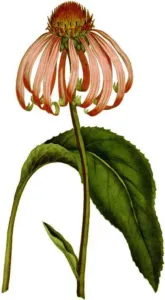
The distinction between the eastern and prairie plants mattered to the Eclectics too. C. G. Lloyd wrote that E. purpurea, known as “black sampson”, was “an entirely different plant” from the prairie E. angustifolia, which had no earlier medical literature before Meyer and King (King’s American Dispensatory, 1898). Attested The modern market reversed the Eclectics’ preference: their drug was the prairie root, and today’s shelves are filled with the garden species.
5. Phytochemistry
Four groups of compounds are thought to carry most of echinacea’s activity: caffeic acid derivatives, alkamides (also called alkylamides), polysaccharides and glycoproteins (PMID 24554461; PMID 26441065). Confirmed Flavonoids, essential oils, polyacetylenes, ketones and pyrrolizidine alkaloids have also been isolated from the genus (PMID 24554461). Confirmed The 2016 safety review points out that echinacea lacks the 1,2-unsaturated pyrrolizidine alkaloids that injure the liver in other plants, and that it also lacks sesquiterpene lactones, a class found in many other members of the daisy family (PMID 26441065). Confirmed
Caffeic acid derivatives: the species fingerprints
The caffeic acid esters separate the species. Ahmadi and colleagues tabulated measurements from many laboratories in 2024. In root extracts, cichoric acid mostly ran from about 5 to 41 mg per gram dry weight in E. purpurea, and was below 1 mg/g in E. pallida and E. angustifolia in the studies that measured all three roots side by side. Echinacoside showed the reverse in those side-by-side studies: about 9 to 11 mg/g in E. angustifolia root and 3 to 16 mg/g in E. pallida root, against less than 0.1 mg/g, an unquantifiable trace or none in E. purpurea root. Cynarin (1,3-dicaffeoylquinic acid) was measurable mainly in E. angustifolia root, at about 1.4 to 3.4 mg/g (PMID 38732450). Confirmed The flowering tops of E. purpurea contain little or no echinacoside: most measurements in the same tables found none (PMID 38732450). Confirmed
One sentence in the same review says the opposite, describing E. purpurea roots as “rich in echinacoside, which is rarely found in the roots of other echinacea species” (PMID 38732450). Attested The review’s own Table 6 contradicts that sentence, and the table agrees with the European Pharmacopoeia’s HPTLC fingerprints, which tell the roots of the three species apart by their phenolic and alkamide zones (PMID 36003516). Confirmed The Institute follows the tables. Readers who meet the opposite claim online may be meeting this sentence.
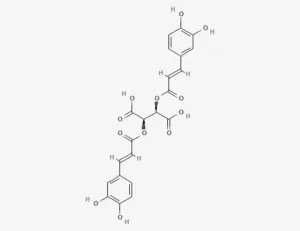
C22H18O12 · marker of E. purpurea herb and root
PubChem CID 5281764 · structure image: PubChem, public domain
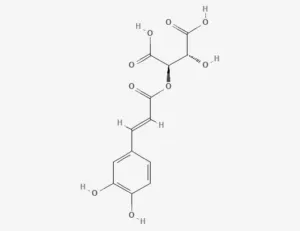
C13H12O9 · abundant in E. purpurea tops
PubChem CID 6440397 · structure image: PubChem, public domain
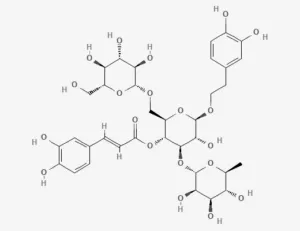
C35H46O20 · marker of E. angustifolia and E. pallida root
PubChem CID 5281771 · structure image: PubChem, public domain
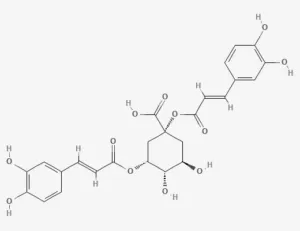
C25H24O12 · 1,3-dicaffeoylquinic acid, E. angustifolia root
PubChem CID 5281769 · structure image: PubChem, public domain
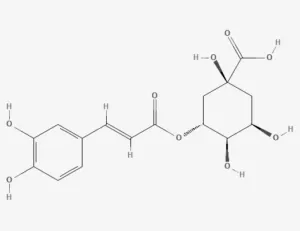
C16H18O9 · minor caffeic ester
PubChem CID 1794427 · structure image: PubChem, public domain
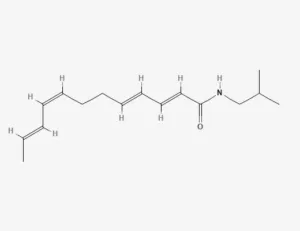
C16H25NO · the main “tetraene” alkamide (2E,4E,8Z,10E)
PubChem CID 6440539 · structure image: PubChem, public domain
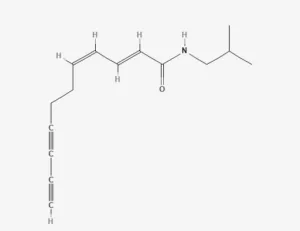
C15H19NO · an acetylenic alkamide (2E,4Z)
PubChem CID 15609884 · structure image: PubChem, public domain
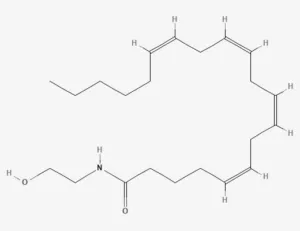
C22H37NO2 · the body’s own cannabinoid, for comparison
PubChem CID 5281969 · structure image: PubChem, public domain
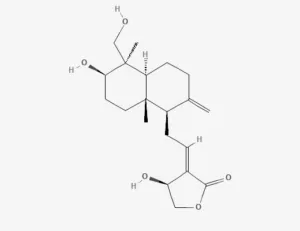
C20H30O5 · andrographis, for comparison
PubChem CID 5318517 · structure image: PubChem, public domain
Nine structures. Five caffeic acid derivatives that fingerprint the species, two alkamides, the endocannabinoid anandamide that the alkamides resemble, and andrographolide from andrographis for comparison (chapter 8). Polysaccharides have no single structure or CID. Every CID was checked against PubChem in October 2026; the depictions are PubChem’s own (US National Library of Medicine, public domain).
Alkamides: the tingle
Alkamides are fatty-acid amides, most of them isobutylamides with a run of conjugated double and triple bonds. The best studied are the dodeca-2E,4E,8Z,10E/Z-tetraenoic acid isobutylamides, abundant in the roots of E. angustifolia and E. purpurea and present in E. purpurea tops (PMID 24554461; PMID 26441065). Confirmed These are the compounds behind the tongue-tingling the Eclectics tasted for. Mechanism Alkamides dissolve in fat and alcohol and are carried poorly into watery preparations. Aerial parts are generally richer in polar caffeic acid derivatives and roots in lipophilic alkamides, which is why a pressed juice and an ethanolic root extract are chemically different medicines (PMID 42737476). Confirmed
Polysaccharides and glycoproteins
Arabinogalactans and other high-molecular-weight polysaccharides and glycoproteins are concentrated in the aerial parts and in water-based preparations such as pressed juice (PMID 38732450; PMID 24554461). Confirmed Polysaccharides have no single structure and no PubChem record, so they do not appear in the structure panel. The trial table in chapter 7 shows how much the balance between these groups varied: one E. angustifolia root extract tested in the United States held 73.8 per cent alkamides and no polysaccharide, another made from the same root with 20 per cent ethanol held 42.1 per cent polysaccharide and 0.1 per cent alkamides (PMID 24554461). Attested
6. Pharmacology
What gets into the blood
Absorption sorts the constituents quickly. In a study from MediHerb’s research laboratories at the University of Queensland, combining a gut-cell model with a small human trial, caffeic acid conjugates crossed Caco-2 cell layers poorly and could not be found in the plasma of volunteers at any time after they took echinacea tablets made from an ethanolic extract. Alkamides crossed the cell layers rapidly and appeared in plasma within 20 minutes (PMID 18007516). Confirmed The 2016 safety review reached the same conclusion from the wider literature: alkamides reach human blood in measurable concentrations after oral doses, and the bioavailability of the polysaccharides and caffeic acid derivatives is unresolved (PMID 26441065). Evidence suggests Polysaccharides may still act in the gut lining and the mouth and throat, where a drop of tincture or juice makes direct contact. Mechanism
Alkamides and the cannabinoid receptor CB2
Alkamides resemble the body’s own cannabinoid anandamide in shape, and several bind the CB2 cannabinoid receptor, which is expressed mainly on immune cells (PMID 26441065). Evidence suggests In a 2021 study from Ottawa, four alkamides isolated from echinacea roots acted as agonists at CB2 and not at CB1, the receptor responsible for cannabis intoxication. Root extracts of E. angustifolia and E. purpurea given by mouth reduced inflammatory pain in rodents in a dose-dependent way, and cannabinoid receptor blockers partly reversed the effect (PMID 33986678). Evidence suggests Echinacea does not intoxicate, and no human study has linked its use to cannabinoid-type effects on the mind. Mechanism
“Immune stimulant” or “immune modulator”?
Older laboratory work, much of it on E. purpurea polysaccharides, described activation of macrophages and natural killer cells, and echinacea was sold for decades as an immune stimulant (PMID 24554461). Evidence suggests Research since about 2004 has found that lipophilic, alkamide-rich preparations can also damp down some cellular immune responses, and the 2016 safety review argues that “immunomodulatory” describes the evidence better than “immunostimulatory” (PMID 26441065). Evidence suggests The Cochrane authors summarise the mechanistic picture as unclear, with both pro- and anti-inflammatory effects reported depending on preparation and model (PMID 24554461). Evidence suggests The 2026 review by Kotula and colleagues makes the same point at length: the activity of an E. purpurea preparation follows from its organ, cultivation, extraction and chemical profile, and results from one preparation cannot be transferred to another (PMID 42737476). Evidence suggests
Antiviral activity
Laboratory studies have reported activity of echinacea extracts against enveloped respiratory viruses, including influenza (PMID 24554461; PMID 26265958). Evidence suggests Two industry trials of one fresh-plant E. purpurea extract reported fewer laboratory-confirmed infections with enveloped viruses in the echinacea group (PMID 23024696; PMID 33832544). Evidence suggests Antiviral effects in a dish do not establish antiviral effects in a nose, and no independent trial has confirmed that a particular echinacea product reduces viral load in people. Mechanism
7. Clinical evidence: colds and respiratory infections
Echinacea has been tested in more controlled trials for colds than almost any other herb, and the trials disagree. Most of the disagreement goes away once the preparations are kept apart.
The Cochrane review
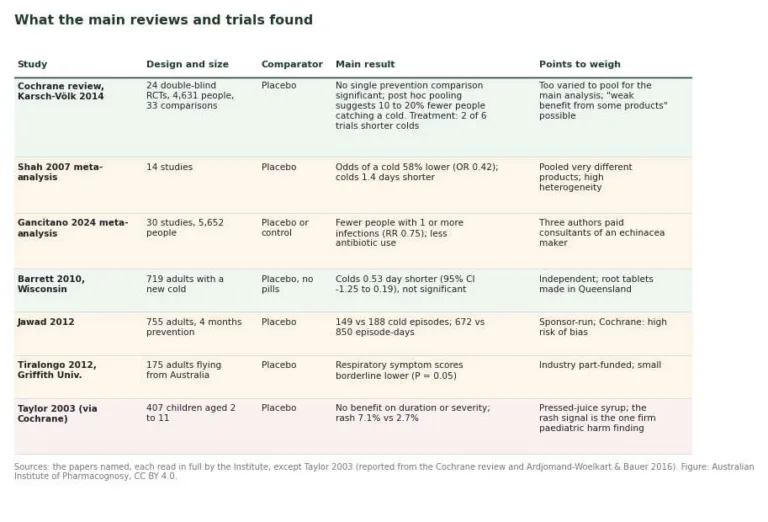
The 2014 Cochrane review accepted 24 double-blind randomised trials with 4,631 participants and 33 comparisons of an echinacea preparation against placebo (PMID 24554461). Confirmed The reviewers judged the products too different to pool for their main analysis. None of the 12 prevention comparisons that counted people catching at least one cold found a significant difference on its own. A post hoc pooling of those comparisons suggested a relative reduction of 10 to 20 per cent in the risk of catching a cold. Of six treatment trials reporting cold duration, two found a significant benefit (PMID 24554461). Confirmed The authors put a number on it: if 500 of 1,000 people on placebo caught a cold, about 425 of 1,000 on an effective echinacea product would, a small effect of uncertain clinical relevance (PMID 24554461). Confirmed Their conclusion was that echinacea products had not been shown to benefit people treating colds, that “it is possible there is a weak benefit from some Echinacea products”, and that the prevention trials “consistently show positive (if non-significant) trends” (PMID 24554461). Confirmed They found “some hints” of benefit on cold symptoms in adults from alcoholic extracts and pressed juices based mainly on the aerial parts of E. purpurea, and could not say which products work (PMID 24554461). Evidence suggests
The meta-analyses that pooled
Two meta-analyses pooled across products and reached stronger conclusions. Shah and colleagues combined 14 studies in 2007 and reported 58 per cent lower odds of developing a cold (odds ratio 0.42) and colds 1.4 days shorter (PMID 17597571). Evidence suggests Gancitano and colleagues pooled 30 studies of 5,652 people in 2024 and reported fewer people with one or more respiratory infections (risk ratio 0.75), fewer recurrent infections and complications, and less antibiotic use (PMID 38667040). Evidence suggests The 2024 analysis was part-funded by A. Vogel AG, an echinacea manufacturer, and three of its authors declared consulting honoraria from the company (PMID 38667040). Attested The Cochrane authors explain their own caution: pooling heterogeneous preparations is “methodologically questionable” (PMID 24554461). Attested Readers can hold both views at once. Pooling shows that the trial literature leans towards benefit; the Cochrane approach shows that the lean cannot yet be pinned to a named product.
Trials worth knowing by name
Barrett 2010. The largest independent treatment trial randomised 719 adults with new colds in Wisconsin to echinacea tablets, blinded placebo, open-label echinacea or no pills. Colds lasted 6.34 days on blinded echinacea and 6.87 days on placebo, a 0.53-day difference whose 95 per cent confidence interval ran from 1.25 days shorter to 0.19 days longer; the authors concluded the results did not support a substantive effect of that dose of that formulation (PMID 21173411). Confirmed The tablets were dried-root extracts of E. purpurea and E. angustifolia made by MediHerb in Warwick, Queensland (PMID 24554461). Attested
Jawad 2012. In a four-month prevention trial of 755 healthy adults, a fresh-plant alcoholic extract of E. purpurea (95 per cent herb, 5 per cent root) was followed by 149 cold episodes and 672 episode-days, against 188 episodes and 850 episode-days on placebo; adverse events were similar in the two groups (PMID 23024696). Evidence suggests It tested one manufacturer’s commercial extract, and the Cochrane review rated it at high risk of bias (PMID 24554461). Attested
Tiralongo 2012. Griffith University researchers gave 175 adults flying from Australia to America, Europe or Africa either echinacea root tablets standardised to 4.4 mg alkamides or placebo. Respiratory symptom scores during travel were borderline lower on echinacea (P = 0.05) (PMID 22229040). Evidence suggests The tablets were an Australian listed medicine, and the trial was part-funded by its manufacturer through an AusIndustry grant (PMID 22229040). Attested
Ogal 2021. In children aged 4 to 12, a fresh-plant E. purpurea extract taken for four months was compared with vitamin C, an active comparator; there was no placebo group. Respiratory infection episodes were reduced (odds ratio 0.52), and antibiotic courses fell from 24 to 6 (PMID 33832544). Evidence suggests The corresponding author worked for the manufacturer of the extract (PMID 33832544). Attested
Taylor 2003. The one large placebo-controlled treatment trial in children, 407 children aged 2 to 11 given a pressed-juice syrup of E. purpurea tops, found no benefit on duration or severity, and rash in 7.1 per cent of children on echinacea against 2.7 per cent on placebo (PMID 26441065; PMID 24554461). Confirmed A 2025 review of herbal medicines for children’s respiratory infections, funded by the maker of a pelargonium extract (the Institute’s umckaloabo review covers that herb), reported that trial as showing echinacea was not effective for children’s upper respiratory infections (PMID 40376625). Attested The Institute has requested the original report through its library and cites its results here from the two reviews it read in full.
Rhinovirus challenge studies. Volunteers deliberately infected with a cold virus provide a cleaner test. In the best-known, three E. angustifolia root extracts with very different chemistry had no effect on infection or illness, as reported in the Cochrane review (PMID 24554461). Confirmed Challenge studies of E. purpurea pressed juice were also negative in the Cochrane analysis (PMID 24554461). Confirmed
Influenza and sore throat
One industry trial in the Czech Republic compared an echinacea hot drink with oseltamivir in early influenza and reported similar recovery rates over ten days (PMID 26265958). Evidence suggests A single non-inferiority trial, with no placebo arm and a sponsor among the authors, is not enough to treat influenza with echinacea, and influenza in older people, pregnant women, babies and people with chronic illness needs medical care. Mechanism
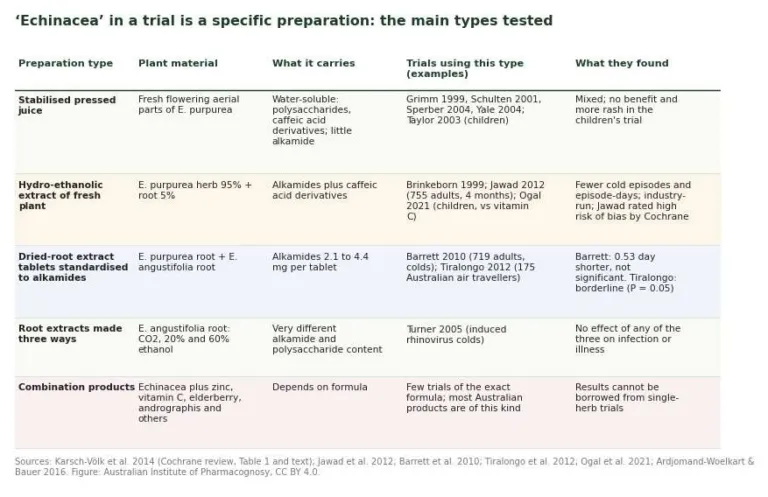
Taken together, the evidence supports a modest, preparation-specific effect, most consistent for prevention with some fresh-plant and pressed-juice E. purpurea products in adults. Evidence suggests It does not show that any echinacea product shortens a cold that has already started, and it shows no benefit and a rash signal for the one pressed-juice syrup tested in young children. Confirmed The Institute regards that as a fair account of a genuinely useful herb whose benefits are real enough to keep studying and small enough to describe carefully.
8. After andrographis: two different herbs
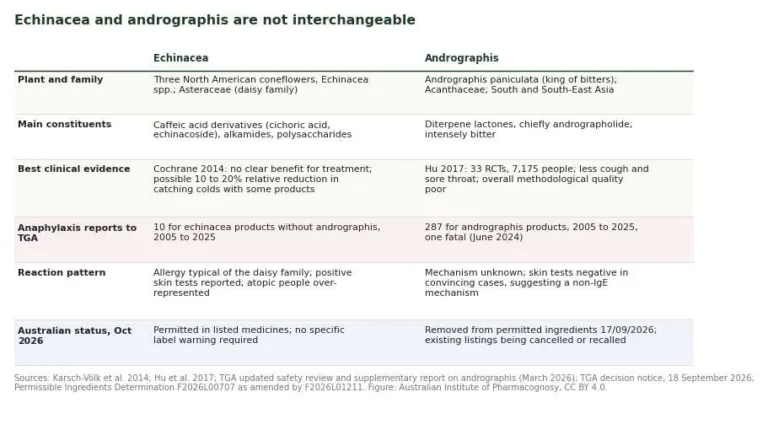
The two herbs share a shelf and a marketing category, and very little else. Andrographis is an intensely bitter member of the acanthus family from South and South-East Asia; its main constituents are diterpene lactones, chiefly andrographolide (PMID 28783743). Confirmed Echinacea is a North American daisy whose main constituents are caffeic acid esters, alkamides and polysaccharides (chapter 5). Confirmed They act through different chemistry, and their trials measured different things.
Andrographis has its own respectable evidence base. A 2017 systematic review of 33 randomised trials and 7,175 patients found that it improved cough and sore throat compared with placebo and shortened symptoms when added to usual care, while warning that the methodological quality of the trials was “overall poor” (PMID 28783743). Evidence suggests Its trials mostly treated an infection that had already started; the stronger echinacea trials mostly tried to prevent one. Someone who took andrographis at the first sign of a sore throat and switches to echinacea for the same purpose is moving to a herb whose treatment evidence, by the Cochrane reading, is the weaker half of its record (PMID 24554461). Evidence suggests
What the TGA found about echinacea in the andrographis cases
The TGA had to decide whether echinacea, present in most of the implicated products, was the real problem. Of the 287 anaphylaxis reports for andrographis medicines to the end of 2025, 237 (83 per cent) involved products that also contained echinacea, 35 involved andrographis combinations without echinacea, and 15 involved andrographis as the only active ingredient (TGA supplementary report, March 2026). Attested Over the same twenty years the TGA received only 10 anaphylaxis reports for medicines containing echinacea without andrographis, 8 for combinations and 2 for products reported simply as “echinacea” (TGA supplementary report, March 2026). Attested The 2024 supply analysis showed that about 98 per cent of the andrographis product volume sold also contained echinacea and other actives, and that the share of anaphylaxis cases for each formulation type broadly tracked its share of supply (TGA updated safety review, March 2026). Attested The TGA concluded that echinacea “was not the primary causative factor” (TGA supplementary report, March 2026). Attested
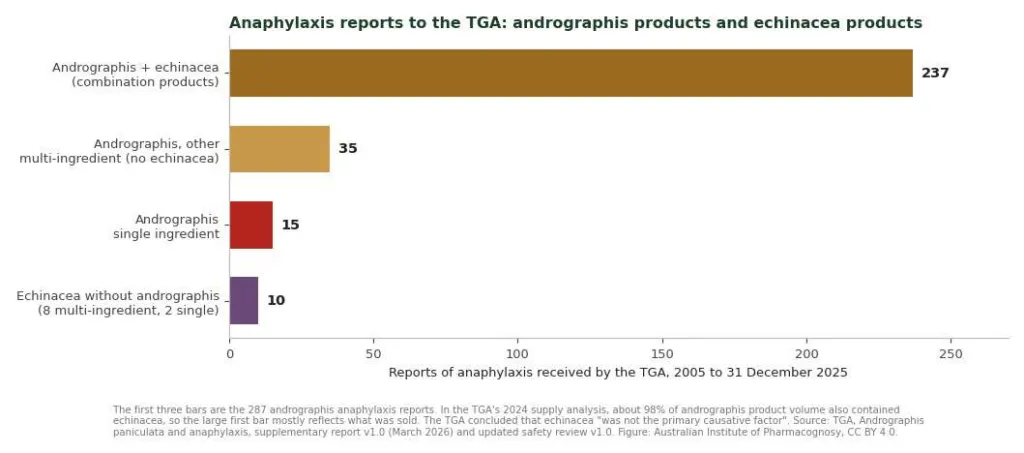
The international data point the same way. In the WHO’s VigiBase, the TGA found 4 anaphylaxis reports worldwide where an oral echinacea product was the only suspect, none from Australia, and disproportionate reporting only for E. purpurea and anaphylactic shock, at a lower score than for andrographis (TGA supplementary report, March 2026). Attested The TGA’s expert adviser also noted something about mechanism: positive skin tests have been recorded for echinacea, while people with convincing andrographis reactions had negative skin tests, which suggests andrographis triggers reactions by a route that does not involve IgE antibodies (TGA updated safety review, March 2026). Attested The adviser considered it possible that some reports reflected reactions to the echinacea component, or an interaction between the two (TGA updated safety review, March 2026). Attested
So the regulator’s analysis is reassuring about echinacea in proportion: ten anaphylaxis reports in twenty years is a small number for one of the most widely sold herbs in the country. Evidence suggests It does not make echinacea allergy-free. Chapter 9 explains who is most at risk. For a reader whose andrographis product has gone, the honest message is that echinacea is a different medicine with a different, more modest evidence base for treating a cold, and a different allergy profile that still deserves attention. Before taking any botanical drug, consult a degree-qualified herbalist with competencies and adequate training in pharmacognosy.
9. Safety and interactions
Echinacea has a long and largely reassuring safety record. In the 2014 Cochrane analysis, people taking echinacea and people taking placebo reported adverse effects and dropped out at similar rates, with a non-significant trend towards more drop-outs for adverse effects in the prevention trials (PMID 24554461). Confirmed Reviewing the clinical and toxicological literature in 2016, Ardjomand-Woelkart and Bauer found the adverse events in trials of single-herb products “generally mild and mostly without causality”, no toxicological concern in studies of continuous use for up to six months, and no lethal dose in animal studies (PMID 26441065). Confirmed Gastrointestinal upset, unpleasant taste and a tingling or burning tongue are the commonest complaints (PMID 26441065). Confirmed
Allergy and the daisy family
The most relevant adverse effects are allergic reactions, as both the Cochrane review and the 2016 safety review conclude (PMID 24554461; PMID 26441065). Confirmed Some of the key clinical data are Australian. The 2016 review reports a case of anaphylaxis and skin allergy testing of 84 patients with asthma or allergic rhinitis in which 16 (19 per cent) reacted to echinacea extracts, citing Mullins’s 1998 report in the Medical Journal of Australia (PMID 26441065). Evidence suggests The Institute has requested that report and Mullins and Heddle’s 2002 paper on the Australian experience through its library and gives the figures here only as the review states them. Reported reactions include hives, itchy and watering eyes, asthma, and, rarely, anaphylaxis (PMID 26441065). Evidence suggests
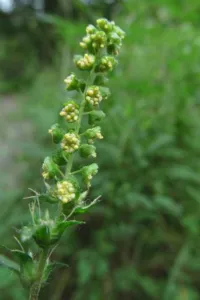
The plausible explanation is cross-reactivity with other members of the family Asteraceae, whose pollens include ragweed, mugwort and chamomile allergens. Mechanism The European Union’s herbal monographs list allergic predisposition among their cautions and advise atopic people to seek professional advice before use (PMID 26441065). Attested That is overseas guidance; chapter 10 sets out the Australian position. In a large German pharmacovigilance study of 18,830 patients prescribed daisy-family remedies, including 4,605 prescriptions containing echinacea (most of them homoeopathic), no serious adverse reactions were reported (PMID 26441065). Evidence suggests Allergy to echinacea is uncommon, and it clusters in people who already have allergies. Evidence suggests
Children and the rash signal deserve their own mention. In the Taylor trial, 7.1 per cent of children on E. purpurea pressed-juice syrup developed a rash against 2.7 per cent on placebo (PMID 26441065). Confirmed The European herbal committee’s monographs caution against use in children under 12; the 2016 review disputes the basis for it, citing observational data on more than 1,000 children with few adverse events (PMID 26441065). Evidence suggests These are overseas positions and do not apply in Australia.
Autoimmune disease and immunosuppressant medicines
Labels and monographs have long warned people with autoimmune disease, HIV, tuberculosis or multiple sclerosis away from echinacea, on the theory that an “immune stimulant” could worsen an immune-driven illness (PMID 26441065). Attested The direct human evidence is thin. The 2016 review found only a handful of case reports, among them a flare of a blistering autoimmune skin disease, a case of recurrent erythema nodosum, and a cholestatic hepatitis with autoimmune features, each involving an uncharacterised product and none establishing cause (PMID 26441065). Evidence suggests A separate 2015 report from Larissa, Greece, described a 44-year-old man who developed cholestatic hepatitis after five days of echinacea root tablets and recovered within three months of stopping them; autoimmune markers were negative (PMID 26119446). Evidence suggests The review’s authors argue that the autoimmune contraindication is questionable because alkamide-rich preparations can suppress some immune responses (PMID 26441065). Mechanism
The Institute’s reading is that the theoretical concern is unproven in either direction, and that people with an autoimmune disease or on immunosuppressant medicines after a transplant have the most to lose from guessing. Mechanism They should take echinacea only under the care of a degree-qualified herbalist with competencies and adequate training in pharmacognosy who knows their whole medication list.
Drug interactions
Echinacea’s measured effects on drug metabolism in people are small. Confirmed In healthy volunteers, 28 days of an E. purpurea extract lowered exposure to the CYP3A probe midazolam by about 27 per cent but left the HIV drug lopinavir unchanged, because ritonavir in the same tablet blocks CYP3A; the authors warned of “modest decreases” in other CYP3A substrates (PMID 20653355). Confirmed Two weeks of echinacea root tablets in a Sydney study increased the clearance of S-warfarin without changing the INR or platelet function in healthy men (PMID 20573086). Confirmed An echinacea extract of E. purpurea and E. angustifolia did not change digoxin levels, which depend on the P-glycoprotein pump (PMID 18214850). Confirmed In people with HIV, E. purpurea root did not significantly change darunavir or etravirine levels (PMID 21078942; PMID 22869560). Confirmed
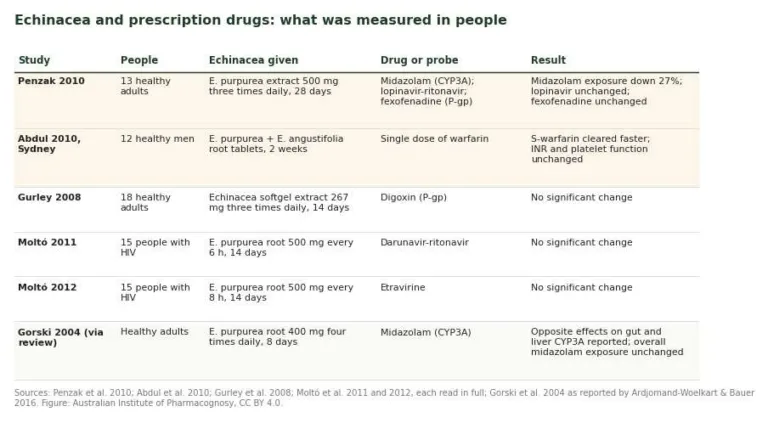
Those results justify care with narrow-margin drugs cleared by CYP3A, such as some chemotherapy agents and immunosuppressants, and with warfarin, where any new medicine warrants an INR check. Mechanism A single case of low platelets in a man taking echinacea alongside etoposide chemotherapy is reported, with the product uncharacterised and other supplements also taken (PMID 26441065). Evidence suggests
Pregnancy and breastfeeding
The only prospective human study followed 206 women who took echinacea in pregnancy, 112 of them in the first trimester, and 206 matched controls. Rates of major and minor birth defects, birth weight, gestational age and delivery did not differ; there were 13 miscarriages in the echinacea group against 7 in the controls, a difference the study was not powered to interpret (PMID 26441065; PMID 24624087). Evidence suggests Mouse studies have raised questions about angiogenesis and early fetal resorption that have not been tested in people (PMID 26441065; PMID 24624087). Evidence suggests A 2014 review concluded that the evidence was “not sufficient to conclude on the safety in pregnancy” (PMID 24624087). Attested A 2016 report from the Norwegian Mother and Child Cohort is relevant and has been requested by the Institute; it is not cited here for its content. No data on breastfeeding were found in the papers the Institute read. Attested As a precaution in the absence of good data, the Institute’s view is that echinacea in pregnancy and while breastfeeding is a decision for a degree-qualified herbalist with competencies and adequate training in pharmacognosy, made with the individual, and not a shelf purchase. Mechanism
If a reaction happens. Stop taking the product. Swelling of the lips, tongue or throat, wheeze, difficulty breathing or talking, dizziness or collapse after taking any herbal product is an emergency: call Triple Zero (000). For advice about a possible poisoning or overdose, call the Poisons Information Centre on 13 11 26 at any hour. Suspected side effects can be reported to the TGA (TGA, reporting adverse events).
10. Australian regulatory status and what is on the shelf
Permitted ingredient, no specified warning
All three medicinal species are permissible ingredients for Australian listed medicines. The current Therapeutic Goods (Permissible Ingredients) Determination (No. 2) 2026 lists ECHINACEA ANGUSTIFOLIA (item 1982), ECHINACEA PALLIDA (item 1983) and ECHINACEA PURPUREA (item 1984), each for use as an active, excipient or homoeopathic ingredient, with no specific requirements in column 4 (Permissible Ingredients Determination). Attested The 17/09/2026 amendment repealed only the andrographis entry and left these three untouched (Andrographis removal amendment, F2026L01211). Attested
The brief for this review asked the Institute to check for any required label statement and any age limit. The Institute found none. The Determination specifies no warning for echinacea, in contrast to its required andrographis allergy warnings before September 2026 and the liver warning it still requires for black cohosh, which the Institute’s black cohosh review describes (Permissible Ingredients Determination). Attested The Therapeutic Goods (Medicines Advisory Statements) Specification 2021 contains no entry for echinacea and no statement about the daisy family, and it does not apply to listed medicines that comply with a permissible ingredients determination (Medicines Advisory Statements Specification 2021). Attested The October 2026 Poisons Standard does not mention echinacea, so it is unscheduled (Poisons Standard, October 2026). Attested Some Australian products carry voluntary daisy-family or atopy warnings; the Institute could not read individual labels at scale because the TGA’s ARTG public summary service returned errors on the day of the survey, and makes no statement about what any particular label says. Unsourced
The absence of an Australian requirement is a regulatory fact, and it does not show that echinacea is free of allergy risk. Mechanism Daisy-family allergy and atopy remain the main points to discuss with a degree-qualified herbalist with competencies and adequate training in pharmacognosy.
What the ARTG showed in October 2026
A keyword search of the public ARTG for “echinacea” returned 219 entries, every one of them an active listed medicine containing an echinacea species; there was no registered echinacea medicine (ARTG searches, October 2026). Attested E. purpurea was the only echinacea in 191 entries; 17 combined it with E. angustifolia, 10 contained E. angustifolia alone, and one contained all three species (ARTG searches, October 2026). Attested Only 16 entries had echinacea as their sole ingredient. The rest were combinations, most often with vitamin C, zinc, elderberry (Sambucus nigra), olive leaf (Olea europaea), vitamin D and andrographis (ARTG searches, October 2026). Attested Thirty entries contained both echinacea and andrographis and were still active on the day of the search, 23 in licence category LI and 7 in category LIE (ARTG searches, October 2026). Attested The TGA’s pages do not define LIE; several LIE entries carry “(export)” or “(export only)” in their names. Attested Four echinacea entries were added between 17/09/2026 and the day of the search, and none contained andrographis (ARTG searches, October 2026). Attested
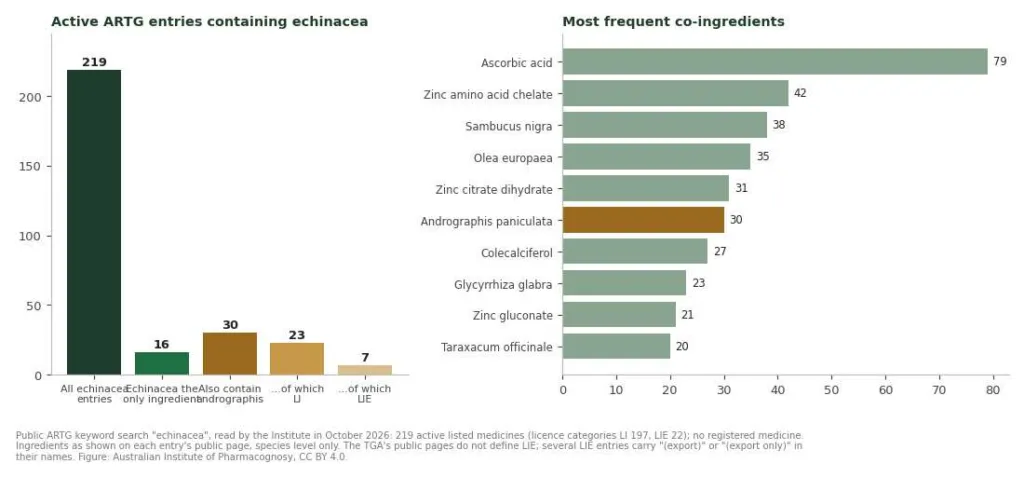
The ARTG lists ingredients at species level on its public pages and does not show the plant part, preparation or amount, so the survey cannot say how many products contain root, herb or pressed juice. Attested What it does show is that almost every Australian echinacea product is a multi-ingredient listed medicine, and that the trial evidence in chapter 7, almost all of it on single-herb preparations, cannot be transferred to them without a trial of the formula. Mechanism The TGA assesses registered medicines individually for safety, quality and effectiveness before they enter the ARTG (TGA decision notice, 18 September 2026); listed medicines, including every echinacea product found, take the lower-risk listing pathway. Attested Herbalists in Australia may also prepare echinacea for an individual patient after a consultation; the Regulations exempt that preparation from the requirement for a TGA manufacturing licence (Therapeutic Goods Regulations 1990). Attested
11. Quality, identity and adulteration
Echinacea has a long quality history. In the late twentieth century, American products sold as echinacea root often contained the root of wild quinine or Missouri snakeroot, Parthenium integrifolium, another Asteraceae (PMID 36003516). Attested A 2026 paper on compendial identity testing explains why: fresh Parthenium root looks nothing like echinacea, but once dried, cut and sifted it has “an uncanny resemblance” to E. angustifolia or E. pallida root (PMID 41557965). Attested The roots of E. angustifolia and E. pallida are also confused with each other (PMID 36003516). Attested The Cochrane review notes that labelling of echinacea products sold in health food stores has been shown to be wrong (PMID 24554461). Attested
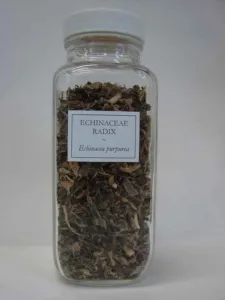
Modern analysis handles this well. The European Pharmacopoeia’s HPTLC methods separate the herbal drugs: the phenolic fingerprint shows zones characteristic of E. purpurea herb and of E. pallida root, and the alkamide fingerprint distinguishes E. angustifolia root from E. purpurea root (PMID 36003516). Confirmed Using those methods on 23 coneflower products bought in the United Kingdom, Frommenwiler and colleagues found that all 11 products registered as traditional herbal medicines matched their labels, while 3 of the 12 food supplements did not; two of the three showed no zones from coneflower at all (PMID 36003516). Attested The overseas pattern, regulated medicines good and loosely regulated supplements variable, is a reminder that a regulatory category tells you something about quality. Evidence suggests No equivalent independent survey of Australian echinacea products was found. Attested
For a herbalist or manufacturer the quality questions follow from the earlier chapters. Which species, confirmed how? Which part, harvested when? What preparation, and what is its alkamide, cichoric acid and echinacoside content? Without those answers, a product cannot be matched to any trial. Mechanism
Discussion: conclusions, hypotheses and research still required
What the evidence supports
Echinacea is three species and several distinct herbal drugs. E. purpurea aerial parts, rich in cichoric acid and polysaccharides, and the roots of E. angustifolia and E. pallida, rich in echinacoside and alkamides, are chemically different materials, and the preparation decides what reaches the patient. Confirmed Alkamides are absorbed and act on the CB2 receptor in laboratory models; the caffeic acid derivatives are poorly absorbed. Confirmed The trials show a small, inconsistent benefit for preventing colds with some E. purpurea preparations in adults, no clear benefit for treating a cold once it has started, and no benefit plus a rash signal for one pressed-juice syrup in children. Confirmed Drug interaction effects measured in people are modest, with CYP3A and warfarin clearance the main signals. Confirmed Allergy is the main safety issue, concentrated in atopic people and those sensitised to the daisy family. Evidence suggests The TGA’s own analysis found ten echinacea-only anaphylaxis reports in twenty years and concluded that echinacea was not the main cause of the andrographis reactions. Attested In Australia echinacea is a permitted ingredient with no specified label warning and no age limit, it appears in 219 listed medicines, nearly all of them combinations, and 30 of those still contained andrographis on the day of the Institute’s search. Attested
What can reasonably be hypothesised
The Institute offers four working hypotheses, and none of them is a finding. First, the larger prevention signal in the fresh-plant trials may reflect alkamide content, since alkamides are the absorbed fraction; a dose-response analysis across trials using measured alkamide content would test this. Mechanism Second, the rash seen in children given pressed-juice syrup may reflect sensitisation to proteins or polysaccharides in a water-based preparation, which would predict fewer skin reactions with alcoholic root extracts. Mechanism Third, part of the allergic reporting attributed to echinacea in Australia may come from combination products whose other ingredients, including other daisy-family herbs such as calendula and dandelion, were not separately tested. Mechanism Fourth, the loss of andrographis may change how Australians use echinacea, moving from treatment of established colds towards longer prevention courses; that would change the safety questions that matter, from acute allergy towards long-term use and interactions. Mechanism
What research is still required
- Pharmacovigilance and regulatory science. A DAEN analysis of echinacea-containing products for 2026 and 2027, split by product formula and with supply data, to see whether reporting changes as echinacea products replace andrographis combinations. A check of the 30 echinacea-andrographis listings still active in October 2026 against the TGA’s recall and cancellation actions.
- Clinical research. An independent, adequately powered placebo-controlled prevention trial in Australian adults of a chemically defined E. purpurea preparation, with laboratory-confirmed infections and the core outcome set the Cochrane authors recommended. A trial of at least one common Australian combination formula as sold.
- Allergy and immunology. Skin-prick and basophil activation testing with characterised extracts of each species and part in atopic Australians, to replace the older Australian data with modern methods and test the cross-reactivity hypothesis.
- Pregnancy. Australian participation in pregnancy registries recording the species, part and product taken, since the existing human data cover unspecified products.
- Quality analysis. A market survey of Australian echinacea products by HPTLC to Ph. Eur. methods, with alkamide and cichoric acid assay by HPLC, to establish whether Australian products match the identity and content their ARTG entries imply. The Institute could begin this on retail samples.
- Pharmacology. Human studies of alkamide exposure after the doses used in Australian combination products, and of whether those exposures reach concentrations active at CB2 or CYP3A.
- Botany and agronomy. Trials of E. purpurea cultivation in Australian climates, including the wet tropics, with chemical profiling of the harvest, to reduce reliance on imported and wild-harvested root.
- History and ethnobotany. A collation of the Plains-nation records with the Eclectic literature, done with the communities concerned, to recover the original indications for the root, which centred on pain, wounds and bites.
Echinacea has earned its place in herbal medicine through more than a century of use and a large body of research. Its future in Australian practice depends on matching the right preparation to the right person, and on knowing who should not take it.
About the Australian Institute of Pharmacognosy and this series
The Australian Institute of Pharmacognosy is a clinic and research laboratory in Cardwell, far north Queensland, studying medicinal plants and natural products to the same evidentiary standard as any other branch of pharmacology: traditional knowledge taken seriously, and tested honestly. Visit the Institute at australian-pharmacognosy.org.
Series: AIP Literature Reviews and Critical Analyses (evidence reviews). Related reviews: the series’ review of andrographis (Andrographis paniculata) covers the TGA decision this article follows from; umckaloabo (Pelargonium sidoides) is another herbal medicine studied for acute respiratory infections; black cohosh (Actaea racemosa) shows what a required ingredient warning looks like; and ashwagandha (Withania somnifera) and turmeric (Curcuma longa) show how the TGA handles safety signals in listed medicines. Earlier reviews: sangre de grado (Croton lechleri) · Greek mountain tea (Sideritis scardica) · sutherlandia (Lessertia frutescens) · pygeum (Prunus africana) · Indian barberry (Berberis aristata) · devil’s claw (Harpagophytum procumbens) · Syrian rue (Peganum harmala). Follow the series for a new evidence review each morning.
Corrections: if you find an error or a source we have missed, write to the Institute at our contact form. We would rather correct a claim than repeat it.
About the images and the evidence. Photographs come from Wikimedia Commons and iNaturalist under the licences shown in each caption and in the image credits. Chemical structures are from PubChem. The seven tables and charts were drawn by the Institute from the sources named in each figure. No photograph shows a product, and no product is endorsed.
Head of Education and Research
Australian Institute of Pharmacognosy
Cardwell QLD, Australia
australian-pharmacognosy.org · our contact form
Suggested citation: Ridley T. Echinacea (Echinacea purpurea (L.) Moench, E. angustifolia DC., E. pallida (Nutt.) Nutt.) after andrographis: species and preparations, the clinical evidence for colds, safety, interactions and the Australian regulatory position. AIP Literature Review and Critical Analysis AIP-LR-ECHPUR. Cardwell (QLD): Australian Institute of Pharmacognosy; 2026.
Educational content only; not medical, legal or regulatory advice. Australian regulatory information reflects the ARTG, the Permissible Ingredients Determination, the Medicines Advisory Statements Specification, the Poisons Standard and TGA publications as read in October 2026 and may change. European and United States material is described as overseas material and does not govern Australian law. No product is advertised, endorsed or recommended. Material drawn from Commonwealth sources is © Commonwealth of Australia and appears here as short extracts for the purpose of reporting, criticism and review.
References
42 references: tap to open
Listed in order of first citation. All 25 PMIDs were verified against PubMed in October 2026 and read in full text; every regulatory, legislative, taxonomic and biodiversity record was read from its own source. Requested through the Institute’s library and not cited for their content (where their results appear, the review that reports them is cited): Mullins and Heddle 2002 and Mullins 1998 on echinacea allergy in Australia; Taylor et al. 2003 (children’s trial); Turner et al. 2005 (E. angustifolia rhinovirus challenge); Gallo et al. 2000 and Heitmann et al. 2016 (pregnancy); Gorski et al. 2004 and Gurley et al. 2004 (cytochrome P450); Hoban et al. 2019 (Australian adverse reaction reports); Lee and Werth 2004 (autoimmunity); Raduner et al. 2006 (alkamides and CB2); Schapowal et al. 2015 and David and Cunningham 2019 (meta-analyses); Gilroy et al. 2003 (labelling); Matthias et al. 2005 (Life Sciences) and Ardjomand-Woelkart et al. 2011 (alkamide pharmacokinetics); and the trials of Melchart 1998, Grimm 1999, Barrett 2002, Yale 2004 and Spasov 2004. The paper by Ardjomand-Woelkart and Bauer (2016) was read in full on the publisher’s site; the Cochrane review in the Cochrane Library.
- Therapeutic Goods Administration. Reporting adverse events for consumers. Read by the Institute in October 2026. https://www.tga.gov.au/safety/reporting-problems/reporting-adverse-events-consumers
- Therapeutic Goods (Permissible Ingredients) Amendment (Removal of Andrographis Paniculata) Determination 2026 (Cth), F2026L01211, made 11 September 2026, registered 14/09/2026, commenced 17 September 2026. Schedule 1 item 1 repeals table item 603 and makes no other change. Read in full by the Institute in October 2026. https://www.legislation.gov.au/F2026L01211/asmade/text
- Therapeutic Goods Administration. High-moderate risk changes to permissible ingredients – Andrographis paniculata 2026. Regulatory decision notice, published 18 September 2026. Read in full by the Institute in October 2026. https://www.tga.gov.au/news/regulatory-decision-notices/high-moderate-risk-changes-permissible-ingredients-andrographis-paniculata-2026
- Therapeutic Goods Administration. Andrographis paniculata (Andrographis) and anaphylaxis. Supplementary report: updated adverse event figures to 31 December 2025. Version 1.0, March 2026 (published April 2026). Read in full by the Institute. https://www.tga.gov.au/sites/default/files/2026-04/andrographis-paniculata-andrographis-anaphylaxis-supplementary-report.pdf
- International Plant Names Index, queried October 2026: Rudbeckia purpurea L., Sp. Pl. 2: 907 (1753), 223787-2; Echinacea purpurea (L.) Moench, Methodus 591 (1794), 1174497-2; Echinacea angustifolia DC., Prodr. 5: 554 (1836), 87143-2; Echinacea pallida (Nutt.) Nutt., Trans. Amer. Philos. Soc. ser. 2, 7: 354 (1840), 202374-1; Brauneria Neck. ex Porter & Britton (1894) and combinations under it. https://www.ipni.org/n/1174497-2
- Jordan C, Leebens-Mack JH. Utilizing target capture sequencing to resolve the speciation history of Echinacea (Asteraceae). Front Plant Sci. 2025;16:1602041. PMID 40995006. DOI 10.3389/fpls.2025.1602041.
- Ardjomand-Woelkart K, Bauer R. Review and Assessment of Medicinal Safety Data of Orally Used Echinacea Preparations. Planta Med. 2016 Jan;82(1-2):17-31. PMID 26441065. DOI 10.1055/s-0035-1558096.
- Karsch-Völk M, Barrett B, Kiefer D, Bauer R, Ardjomand-Woelkart K, Linde K. Echinacea for preventing and treating the common cold. Cochrane Database Syst Rev. 2014 Feb 20;2014(2):CD000530. PMID 24554461. DOI 10.1002/14651858.CD000530.pub3.
- Sarma ND, Monagas M, Giancaspro G, Brinckmann JA, Harnly J, Kababick J, et al. Compendial Perspectives on Botanical Identity Testing. J Nat Prod. 2026 Feb 27;89(2):339-351. PMID 41557965. DOI 10.1021/acs.jnatprod.5c01200.
- Felter HW, Lloyd JU. King’s American Dispensatory. 18th ed., 3rd revision. Cincinnati: Ohio Valley Co.; 1898. Entry “Echinacea”. Public domain; read in full by the Institute in October 2026 in the transcription on Henriette’s Herbal Homepage. https://www.henriettes-herb.com/eclectic/kings/echinacea.html
- Ahmadi F, Kariman K, Mousavi M, Rengel Z. Echinacea: Bioactive Compounds and Agronomy. Plants (Basel). 2024 Apr 29;13(9). PMID 38732450. DOI 10.3390/plants13091235.
- Atlas of Living Australia. Species and occurrence searches for Echinacea purpurea, E. angustifolia and E. pallida, October 2026: 10 records for E. purpurea (New Zealand, Cook Islands, United States, Canada; taxon from the New Zealand Organisms Register), none for the other two, no Australian occurrence. https://biocache.ala.org.au/occurrences/search?q=taxon_name%3A%22Echinacea%20purpurea%22
- iNaturalist. Observations of Echinacea in Australia (place 6744), queried by the Institute in October 2026: 38 of E. purpurea and 1 of E. angustifolia, all flagged cultivated; none of E. pallida. https://www.inaturalist.org/observations?place_id=6744&taxon_name=Echinacea
- Biosecurity Act 2014 (Qld), reprint current as at 27/04/2026, and Biosecurity Regulation 2016 (Qld), full texts searched by the Institute in October 2026 for Echinacea: no mention. https://www.legislation.qld.gov.au/view/html/inforce/current/act-2014-007
- Frommenwiler DA, Reich E, Sharaf MHM, Cañigueral S, Etheridge CJ. Investigation of market herbal products regulated under different categories: How can HPTLC help to detect quality problems?. Front Pharmacol. 2022;13:925298. PMID 36003516. DOI 10.3389/fphar.2022.925298.
- Moerman DE. Native American Ethnobotany database, BRIT. Searches for Echinacea angustifolia (50 records), E. purpurea and E. pallida, October 2026. Records cite their original ethnographic sources, among them Gilmore 1919 and Grinnell 1972. http://naeb.brit.org/uses/search/?string=Echinacea+angustifolia
- Liu R, Caram-Salas NL, Li W, Wang L, Arnason JT, Harris CS. Interactions of Echinacea spp. Root Extracts and Alkylamides With the Endocannabinoid System and Peripheral Inflammatory Pain. Front Pharmacol. 2021;12:651292. PMID 33986678. DOI 10.3389/fphar.2021.651292.
- Kotula M, Kobylińska Z, Och E, Kielar P, Galiniak S, Mołoń M. From Phytochemical Diversity to Clinical Translation: Preparation-Dependent Bioactivity of Echinacea purpurea. Int J Mol Sci. 2026 Aug 24;27(17). PMID 42737476. DOI 10.3390/ijms27177574.
- Matthias A, Penman KG, Matovic NJ, Bone KM, De Voss JJ, Lehmann RP. Bioavailability of Echinacea constituents: Caco-2 monolayers and pharmacokinetics of the alkylamides and caffeic acid conjugates. Molecules. 2005 Oct 30;10(10):1242-51. PMID 18007516. DOI 10.3390/10101242.
- Rauš K, Pleschka S, Klein P, Schoop R, Fisher P. Effect of an Echinacea-Based Hot Drink Versus Oseltamivir in Influenza Treatment: A Randomized, Double-Blind, Double-Dummy, Multicenter, Noninferiority Clinical Trial. Curr Ther Res Clin Exp. 2015 Dec;77:66-72. PMID 26265958. DOI 10.1016/j.curtheres.2015.04.001.
- Jawad M, Schoop R, Suter A, Klein P, Eccles R. Safety and Efficacy Profile of Echinacea purpurea to Prevent Common Cold Episodes: A Randomized, Double-Blind, Placebo-Controlled Trial. Evid Based Complement Alternat Med. 2012;2012:841315. PMID 23024696. DOI 10.1155/2012/841315.
- Ogal M, Johnston SL, Klein P, Schoop R. Echinacea reduces antibiotic usage in children through respiratory tract infection prevention: a randomized, blinded, controlled clinical trial. Eur J Med Res. 2021 Apr 08;26(1):33. PMID 33832544. DOI 10.1186/s40001-021-00499-6.
- Shah SA, Sander S, White CM, Rinaldi M, Coleman CI. Evaluation of echinacea for the prevention and treatment of the common cold: a meta-analysis. Lancet Infect Dis. 2007 Jul;7(7):473-80. PMID 17597571. DOI 10.1016/S1473-3099(07)70160-3.
- Gancitano G, Mucci N, Stange R, Ogal M, Vimalanathan S, Sreya M, et al. Echinacea Reduces Antibiotics by Preventing Respiratory Infections: A Meta-Analysis (ERA-PRIMA). Antibiotics (Basel). 2024 Apr 16;13(4). PMID 38667040. DOI 10.3390/antibiotics13040364.
- Barrett B, Brown R, Rakel D, Mundt M, Bone K, Barlow S, et al. Echinacea for treating the common cold: a randomized trial. Ann Intern Med. 2010 Dec 21;153(12):769-77. PMID 21173411. DOI 10.7326/0003-4819-153-12-201012210-00003.
- Tiralongo E, Lea RA, Wee SS, Hanna MM, Griffiths LR. Randomised, double blind, placebo-controlled trial of echinacea supplementation in air travellers. Evid Based Complement Alternat Med. 2012;2012:417267. PMID 22229040. DOI 10.1155/2012/417267.
- Kamin W, Seifert G, Zwiauer K, Bonhoeffer J, De Ketelaere V, D'Avino A, et al. Phytotherapy for acute respiratory tract infections in children: a systematically conducted, comprehensive review. Front Pediatr. 2025;13:1423250. PMID 40376625. DOI 10.3389/fped.2025.1423250.
- Hu XY, Wu RH, Logue M, Blondel C, Lai LYW, Stuart B, et al. Andrographis paniculata (Chuān Xīn Lián) for symptomatic relief of acute respiratory tract infections in adults and children: A systematic review and meta-analysis. PLoS One. 2017;12(8):e0181780. PMID 28783743. DOI 10.1371/journal.pone.0181780.
- Therapeutic Goods Administration. Andrographis paniculata (Andrographis) and anaphylaxis. Updated safety review with adverse event data to 31 December 2024. Version 1.0, March 2026 (published April 2026). Read in full by the Institute. https://www.tga.gov.au/sites/default/files/2026-04/andrographis-paniculata-andrographis-anaphylaxis-updated-safety-review.pdf
- Gabranis I, Koufakis T, Papakrivos I, Batala S. Echinacea-associated acute cholestatic hepatitis. J Postgrad Med. 2015;61(3):211-2. PMID 26119446. DOI 10.4103/0022-3859.159430.
- Penzak SR, Robertson SM, Hunt JD, Chairez C, Malati CY, Alfaro RM, et al. Echinacea purpurea significantly induces cytochrome P450 3A activity but does not alter lopinavir-ritonavir exposure in healthy subjects. Pharmacotherapy. 2010 Aug;30(8):797-805. PMID 20653355. DOI 10.1592/phco.30.8.797.
- Abdul MI, Jiang X, Williams KM, Day RO, Roufogalis BD, Liauw WS, et al. Pharmacokinetic and pharmacodynamic interactions of echinacea and policosanol with warfarin in healthy subjects. Br J Clin Pharmacol. 2010 May;69(5):508-15. PMID 20573086. DOI 10.1111/j.1365-2125.2010.03620.x.
- Gurley BJ, Swain A, Williams DK, Barone G, Battu SK. Gauging the clinical significance of P-glycoprotein-mediated herb-drug interactions: comparative effects of St. John's wort, Echinacea, clarithromycin, and rifampin on digoxin pharmacokinetics. Mol Nutr Food Res. 2008 Jul;52(7):772-9. PMID 18214850. DOI 10.1002/mnfr.200700081.
- Moltó J, Valle M, Miranda C, Cedeño S, Negredo E, Barbanoj MJ, et al. Herb-drug interaction between Echinacea purpurea and darunavir-ritonavir in HIV-infected patients. Antimicrob Agents Chemother. 2011 Jan;55(1):326-30. PMID 21078942. DOI 10.1128/AAC.01082-10.
- Moltó J, Valle M, Miranda C, Cedeño S, Negredo E, Clotet B. Herb-drug interaction between Echinacea purpurea and etravirine in HIV-infected patients. Antimicrob Agents Chemother. 2012 Oct;56(10):5328-31. PMID 22869560. DOI 10.1128/AAC.01205-12.
- Holst L, Havnen GC, Nordeng H. Echinacea and elderberry-should they be used against upper respiratory tract infections during pregnancy?. Front Pharmacol. 2014;5:31. PMID 24624087. DOI 10.3389/fphar.2014.00031.
- Therapeutic Goods (Permissible Ingredients) Determination (No. 2) 2026 (Cth), F2026L00707, registered 11/06/2026; current compilation F2026C00940 from 17/09/2026. Schedule 1 read by the Institute in October 2026: items 1982 ECHINACEA ANGUSTIFOLIA, 1983 ECHINACEA PALLIDA and 1984 ECHINACEA PURPUREA, each roles A, E, H, with no column 4 requirements; section 6A and the black cohosh entry read for comparison. https://www.legislation.gov.au/F2026L00707/latest/text
- Therapeutic Goods (Medicines Advisory Statements) Specification 2021 (Cth), F2021L01888, in force without amendment (compilation 0). Full text searched by the Institute in October 2026 for echinacea, Compositae, Asteraceae and daisy: no entry. https://www.legislation.gov.au/F2021L01888/latest/text
- Therapeutic Goods (Poisons Standard—October 2026) Instrument 2026 (Cth), F2026L01327, registered 30/09/2026. Full text searched by the Institute in October 2026: no entry for echinacea. https://www.legislation.gov.au/F2026L01327/asmade
- Therapeutic Goods Administration. Australian Register of Therapeutic Goods, public keyword searches for “echinacea” (219 results) and “andrographis” (54 results) run by the Institute in October 2026, with the public record of every entry opened and read (ARTG name, start date, sponsor, ingredients at species level, licence category and status). The ARTG public summary service returned server errors on the day, so labels, plant parts and quantities were not read. Raw survey held by the Institute. https://www.tga.gov.au/resources/artg
- Therapeutic Goods Regulations 1990 (Cth), Compilation No. 130 (F2026C00872), read by the Institute in September 2026. Schedule 8 item 4: herbalists and other practitioners preparing herbal preparations for a particular person after consultation (exemption from the manufacturing provisions of Part 3-3 of the Act). https://www.legislation.gov.au/F1996B00406/latest/text
- Chemical records and structure depictions: PubChem, US National Library of Medicine, public domain. CIDs cited in the text: 5281764, 6440397, 5281771, 5281769, 1794427, 6440539, 15609884, 5281969, 5318517.
Image credits
- Echinacea purpurea, Jardín Botánico, Múnich, Alemania, 2013-09-08, DD 01.jpg, Diego Delso. CC BY-SA 3.0. Wikimedia Commons. Resized and re-encoded for the web by AIP; no other changes.
- Échinacée pourpre (Echinacea purpurea) (1).jpg, Gzen92. CC BY-SA 4.0. Wikimedia Commons. Resized and re-encoded for the web by AIP; no other changes.
- Echinacea purpurea-IMG 9025.jpg, C T Johansson. CC BY 3.0. Wikimedia Commons. Resized and re-encoded for the web by AIP; no other changes.
- Echinacea angustifolia – Narrow-leaved Purple Coneflower 01.jpg, Jasper Shide. CC0. Wikimedia Commons. Resized and re-encoded for the web by AIP; no other changes.
- Echinacea angustifolia – Narrow-leaved Purple Coneflower 10.jpg, Jasper Shide. CC0. Wikimedia Commons. Resized and re-encoded for the web by AIP; no other changes.
- Echinacea angustifolia – Narrow-leaved Purple Coneflower 05.jpg, Jasper Shide. CC0. Wikimedia Commons. Resized and re-encoded for the web by AIP; no other changes.
- Pale Purple Coneflower (Echinacea pallida).jpg, wackybadger. CC BY-SA 2.0. Wikimedia Commons. Resized and re-encoded for the web by AIP; no other changes.
- Echinacea pallida (8).jpg, Eric Hunt. CC BY-SA 4.0. Wikimedia Commons. Resized and re-encoded for the web by AIP; no other changes.
- Echinaceae2.JPG, Maša Sinreih in Valentina Vivod. CC BY-SA 3.0. Wikimedia Commons. Resized and re-encoded for the web by AIP; no other changes.
- Echinaceae1.JPG, Maša Sinreih in Valentina Vivod. CC BY-SA 3.0. Wikimedia Commons. Resized and re-encoded for the web by AIP; no other changes.
- Echinacea purpurea-1787.jpg, Sydenham Edwards / William Curtis. Public domain. Wikimedia Commons. Resized and re-encoded for the web by AIP; no other changes.
- Andrographis paniculata from Trivandrum.jpg, Deoxyribose12. CC BY-SA 4.0. Wikimedia Commons. Resized and re-encoded for the web by AIP; no other changes.
- Ambrosia artemisiifolia, 2021-08-15, Seldom Seen, 02.jpg, Cbaile19. CC0. Wikimedia Commons. Resized and re-encoded for the web by AIP; no other changes.
- Purple Coneflower & Silverleaf Scurfpea Lake Andes Wetland Management District South Dakota (52389072775).jpg, USFWS Mountain Prairie. Public domain. Wikimedia Commons. Resized and re-encoded for the web by AIP; no other changes.
- Echinacea purpurea (purple coneflowers) 3 (38566472155).jpg, James St. John. CC BY 2.0. Wikimedia Commons. Resized and re-encoded for the web by AIP; no other changes.
- Photo 273847777, iNaturalist observation 158453128 (Glen Waverley VIC 3150, Australia, 2023-05-01; casual), Elaine Fieth ((c) Elaine Fieth, some rights reserved (CC BY)). CC BY 4.0. iNaturalist. Resized and re-encoded for the web by AIP; no other changes.
- Photo 120165262, iNaturalist observation 73592769 (Lake Wendouree, 2021-04-11; casual), Oliver S. ((c) Oliver S., some rights reserved (CC BY)). CC BY 4.0. iNaturalist. Resized and re-encoded for the web by AIP; no other changes.
- Echinacea purpurea in Jardin botanique de la Charme 01.jpg, Krzysztof Golik. CC BY-SA 4.0. Wikimedia Commons. Resized and re-encoded for the web by AIP; no other changes.
- Echinacea angustifolia – Narrow-leaved Purple Coneflower 08.jpg, Jasper Shide. CC0. Wikimedia Commons. Resized and re-encoded for the web by AIP; no other changes.
- Chemical structure depictions (cichoric acid, caftaric acid, echinacoside, cynarin, chlorogenic acid, two alkamides, anandamide, andrographolide): PubChem, US National Library of Medicine. Public domain.
- Figures 1 to 7 (the three species, the trials table, the preparations table, the echinacea and andrographis comparison, the TGA anaphylaxis chart, the interactions table and the ARTG survey chart): Australian Institute of Pharmacognosy, 2026, CC BY 4.0, drawn from the sources printed in each figure.
The Institute sets and publishes its own monographs. The catalogue is in Publications.