
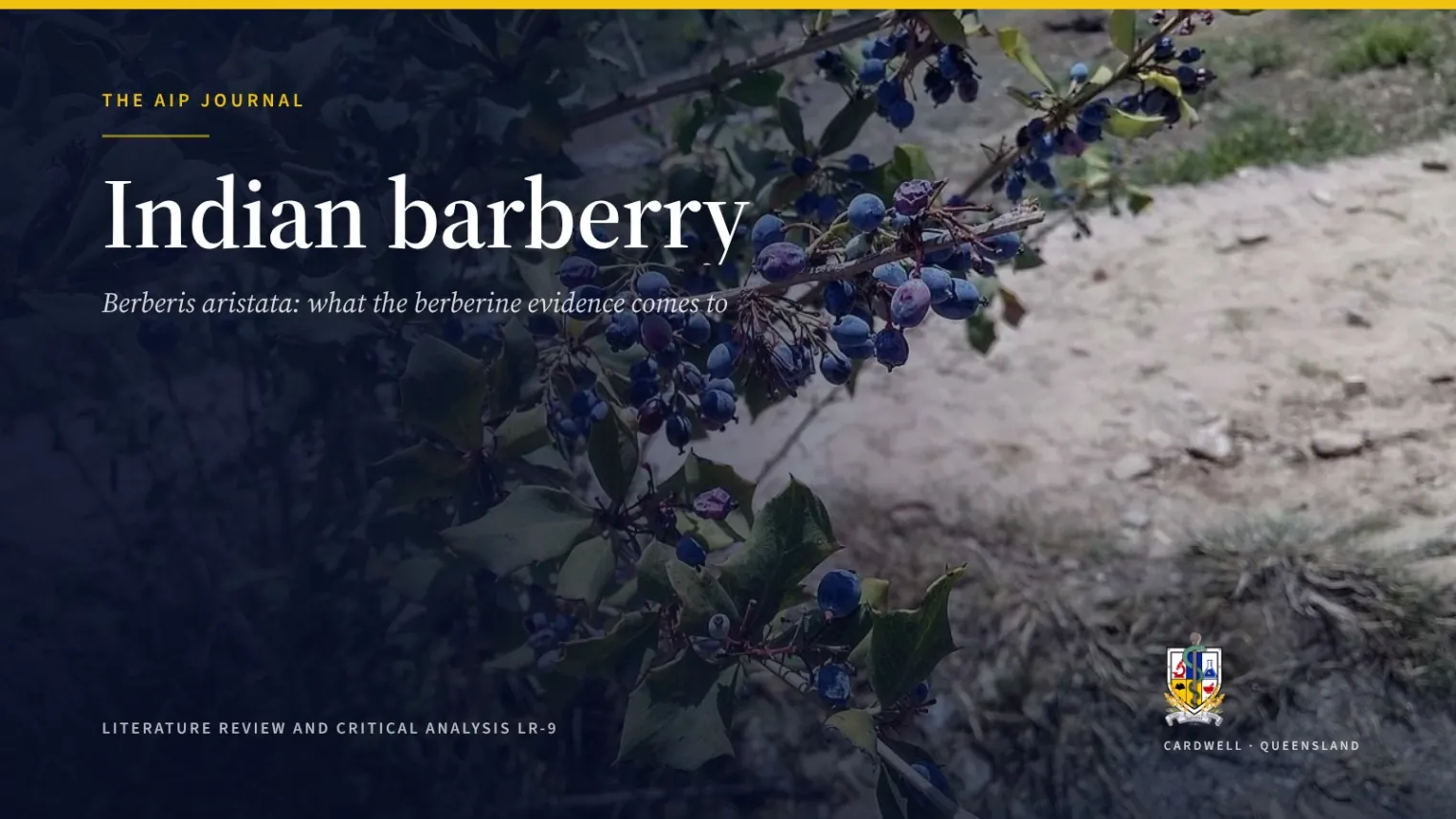
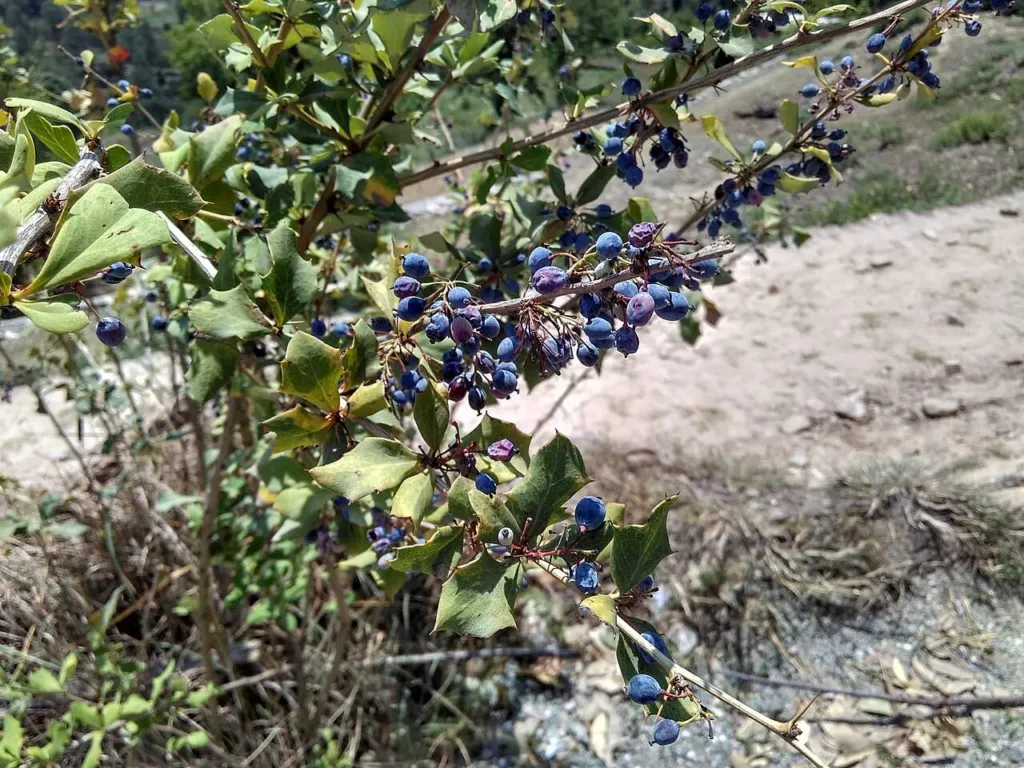
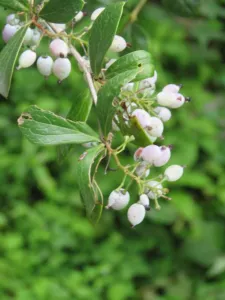
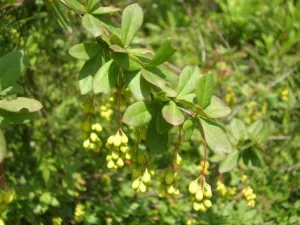
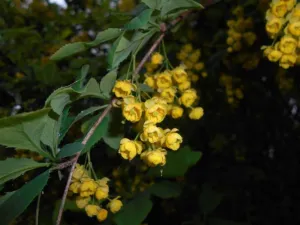
Cover: a fruiting Berberis aristata bush in Uttarakhand, India. Photo: Ramwik · CC BY-SA 3.0 · Wikimedia Commons
The bottle says Indian barberry. The capsule usually holds one molecule, purified to about 97 per cent — a figure no Australian listing on the public record states. Evidence suggests Between those two sentences sits everything Australians are currently getting wrong about berberine, including the nickname that put it on the shelf: the trials put the mean weight change somewhere between nothing and 0.84 kg, against 14.9 per cent of body weight for semaglutide. Evidence suggests
This is LR-9 in the Australian Institute of Pharmacognosy’s series of literature reviews and critical analyses. It reads Berberis aristata DC. properly: the plant and the part used, the chemistry of the protoberberine alkaloids, the pharmacokinetic problem that makes berberine strange, the trial evidence graded tier by tier, the cytochrome, transporter and cardiac interactions that make it a prescribing problem and no gentle herb, the bilirubin question that bears on newborns, and the Australian regulatory position read from the Commonwealth’s own instruments.
This article is educational. It is not medical, legal or regulatory advice, it is not an advertisement, and nothing in it is a recommendation to buy or take berberine or any product containing it. Products are named only where a public ARTG record exists and statements about them are confined to what that record says. The Institute has no commercial interest in any berberine product.
1. Never give it to a newborn or an infant. Berberine displaces bilirubin from albumin, about ten times more potently than phenylbutazone in vitro (PMID 8513024; Bone and Mills, 2nd edition). Mechanism Kernicterus in premature infants has been reported in association with Coptis chinensis exposure, although that association has been challenged (Bone and Mills, 2nd edition). Evidence suggests Kernicterus is permanent brain injury caused by bilirubin, and there is no treatment for it once it is established. A separate and equally unsettled question concerns haemolysis in infants with glucose-6-phosphate dehydrogenase (G6PD) deficiency (Bone and Mills, 2nd edition). Evidence suggests The conservative reading is the only defensible one.
2. Not in pregnancy or breastfeeding. Australian law requires the warning on Berberis aristata products (Permissible Ingredients Determination). Attested
3. It is an interaction problem. Berberine inhibits CYP3A4/5 and CYP2D6 in human liver microsomes (PMID 32591416) and intestinal P-glycoprotein in animals (PMID 19370549); CYP2C9 inhibition and inhibition of the metformin transporters are carried by review syntheses rather than by a human study (PMID 42653808; PMID 39141022). Evidence suggests Ciclosporin trough levels ran 29.3% higher in the berberine arm of a randomised controlled study in renal transplant recipients, 52 patients to an arm (PMID 16133554). Confirmed Statins, macrolides, calcium-channel blockers, anticoagulants, immunosuppressants, antiarrhythmics and QT-prolonging medicines are all in scope.
4. There is a cardiac signal, and it is unsettled. Berberine blocks the hERG channel carrying the cardiac IKr current and lengthens the action potential and the QT interval in cell work, and a 2026 review collecting that literature records QT prolongation, bradycardia and hypotension alongside berberine’s own antiarrhythmic effects (PMID 42653808). Mechanism Acquired long QT with torsades de pointes has been reported in a 56-year-old woman taking 250 mg berberine with cannabidiol and cannabigerol hemp oil at six times the labelled dose; her QTc was 667 ms and normalised five days after all supplements stopped (PMID 35607330). Evidence suggests Causality cannot be assigned to berberine alone in that case, and the measured potencies sit well above the blood levels oral dosing reaches, so this is a real mechanism of uncertain clinical size. Anyone on an antiarrhythmic, a QT-prolonging medicine, a beta blocker or an antihypertensive is the person with most to lose from it.
5. Glucose medicines cut both ways. The additive hypoglycaemia that has clinical evidence behind it belongs to sulfonylureas and insulin, and berberine adds to it (PMID 42653808). Evidence suggests With metformin the documented transporter interaction runs in the opposite direction: berberine inhibits OCT1, OCT2 and MATE1, and in animal work and in a human probe-cocktail study it lowered metformin exposure rather than raising it, so losing glycaemic control is as plausible an outcome as hypoglycaemia, and neither can be read off the laboratory numbers (PMID 42653808). Mechanism
6. Do not use it to postpone a diagnosis. Thirst, weight change, fatigue, blurred vision or a family history of diabetes need investigation and a real diagnosis. The worst harm in this whole file is delay.
Emergency: call Triple Zero (000). For a suspected poisoning or overdose, call the Poisons Information Centre on 13 11 26 (24 hours, Australia-wide). Before taking any botanical drug, consult a degree-qualified herbalist with competencies and adequate training in pharmacognosy.
| Botanical name | Berberis aristata DC., Berberidaceae; a later homonym B. aristata Sims exists Attested §2 |
| Common names | Indian barberry, tree turmeric, daruharidra (Sanskrit), rasaut (the root extract), maramanjal Attested §2 |
| Other berberine sources | Berberis vulgaris, Coptis chinensis, Phellodendron amurense, Hydrastis canadensis Attested §6 |
| What is in the bottle | Berberine hydrochloride, the traded raw material, is standardised to 97–98%. The four Australian listings read here declare a root extract and a dry-root equivalent, and state no berberine figure at all Attested §1 |
| The drug | Root and root bark. Not the fruit, and stem bark is much poorer Confirmed §3 |
| Native range | Himalaya and sub-Himalaya, roughly 1,800–3,500 m; largely wild-collected Attested §4 |
| In Australia | 42 Atlas of Living Australia records, 24 in NSW; no wild population, no local supply. All imported Attested §4 |
| Traditional standing | Ayurvedic bitter, hepatic and eye medicine; huang lian in Chinese medicine. Never for weight loss Traditional §5 |
| Oral bioavailability | Under about 1%. Cmax 0.44 ng/mL after 400 mg; half-life 28.6 h Confirmed §7 |
| Weight loss | −0.11 kg and not significant in one meta-analysis, −0.84 kg in another. Semaglutide: −14.9% of body weight Evidence suggests §8 |
| Glucose | Fasting glucose −0.82 mmol/L and HbA1c −0.63% pooled, from small heterogeneous trials Evidence suggests §9 |
| Lipids | LDL −0.50, total cholesterol −0.45, triglycerides −0.37 mmol/L, with a worked-out mechanism Evidence suggests §9 |
| Interactions | CYP3A4 and P-glycoprotein inhibition, ciclosporin exposure up a third in transplant recipients. CYP2D6, CYP2C9 and OCT/MATE rest on microsome and review data Confirmed §10 |
| Heart and blood pressure | hERG block and QT prolongation in cell work, one torsades case report under co-exposure, additive bradycardia and hypotension with beta blockers and antihypertensives Mechanism §10 |
| Contraindications | Pregnancy, breastfeeding, newborns and infants. Caution in G6PD deficiency, and in anyone on a narrow-therapeutic-index or QT-prolonging medicine Attested §11 |
| Children | The paediatric trial evidence is in acute diarrhoea and 85% of it used a rectal enema, not an oral capsule; none of it covers metabolic use or neonates Evidence suggests §11 |
| Australian law | Berberine is not itself a permitted ingredient; eight plant entries are. Only item 828 carries a warning Attested §12 |
| Poisons Standard | No entry for berberine or any of the source genera. Not scheduled Attested §4 |
| Quality | Species substitution documented in Indian markets; none of the four Australian ARTG public summaries read here states a berberine percentage Evidence suggests §13 |
| Supply | Wild-dug Himalayan root; goldenseal, the North American alternative, is CITES Appendix II since 1997 Attested §14 |
- Confirmed Established in humans by trial, or an unambiguous analytical, chemical or official-record fact.
- Evidence suggests Real published data, but preclinical, observational, small, case-based or not yet independently replicated.
- Mechanism A plausible mechanistic or pharmacological inference about how something works, short of a measured outcome.
- Traditional Historical or ethnobotanical use. Evidence of practice. Efficacy is a separate question.
- Attested A documentary fact attested in a named record: a legislative instrument, a regulator’s publication, a taxonomic index or a database. It states what the record says. It makes no claim about what a plant does.
- Unsourced A statement the Institute could not trace to a source it was able to open and read. It is left in because it is useful context, and flagged so no reader mistakes it for a sourced claim.
Every PubMed ID (PMID) below links to its record and was checked against PubMed on 27/09/2026. Where the full text is open access the Institute read the full text; papers whose full text is paywalled are queued through the Institute’s library and are cited here only for facts also carried in a full text the Institute holds. Every compound was checked against PubChem and is linked by CID. Every Australian regulatory statement was read from the regulator’s or the legislature’s own document. Where a claim could not be traced to a source the Institute could open, the text says so.
What it is. An isoquinoline alkaloid purified from the root and root bark of Berberis aristata, or from European barberry, Chinese goldthread, Amur cork tree or goldenseal, and sold as the hydrochloride salt at 97 to 98 per cent purity. Confirmed Pharmacologically it behaves as a single-molecule drug. The plant name on the label records where it was extracted from.
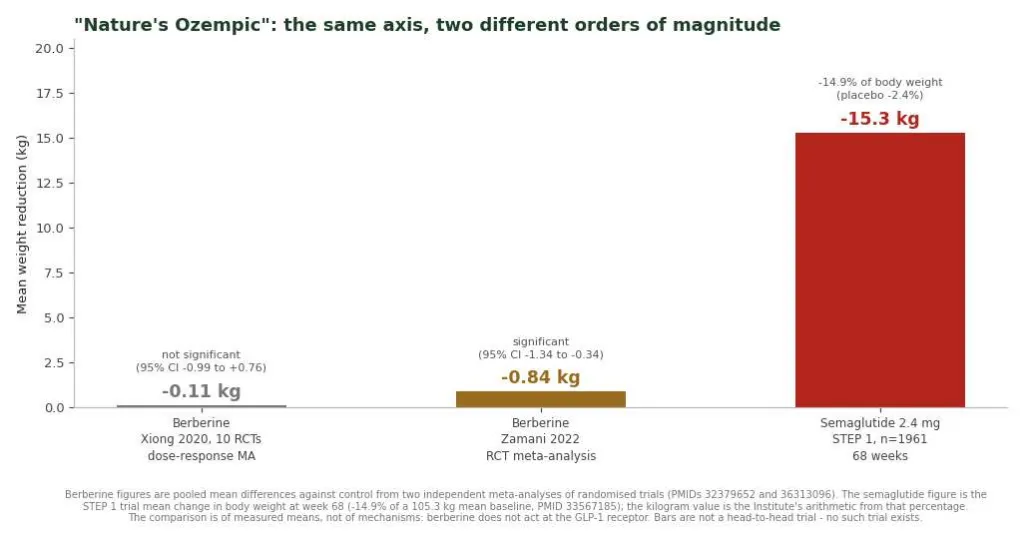
The nickname. Berberine has no described activity at the GLP-1 receptor. Mechanism Pooled randomised trials put its mean weight effect at between nothing and 0.84 kg; semaglutide 2.4 mg produced a 14.9 per cent mean reduction in body weight over 68 weeks in STEP 1. Evidence suggests The gap is in mechanism and in two orders of magnitude.
What the evidence does support. Modest reductions in fasting glucose, HbA1c and LDL cholesterol in metabolic disease, consistent in direction across independent meta-analyses, from trials that are small, short, heterogeneous and largely unreplicated outside China. Evidence suggests The Institute makes no therapeutic claim and this is not a treatment for diabetes, obesity or high cholesterol.
Safety. Berberine inhibits CYP3A4 and P-glycoprotein and raised ciclosporin exposure by about a third in transplant recipients. Confirmed Inhibition of CYP2D6, CYP2C9 and the metformin transporters OCT1, OCT2 and MATE1 rests on human liver microsome work and on review syntheses, not on human outcome studies. Mechanism Separately from the enzymes, berberine blocks the cardiac hERG channel and prolongs QT in cell work, adds to the hypotension and bradycardia of antihypertensives and beta blockers, and has one published torsades de pointes case in which it was one of several supplements taken at once. Mechanism It is contraindicated in pregnancy and breastfeeding, and must not be given to newborns or infants because it displaces bilirubin from albumin. Mechanism Gastrointestinal effects dominate at the doses people choose.
The bit that surprised us. Berberine is not a permitted ingredient in Australian listed medicines at all. Eight plant entries across four genera are, and exactly one of them, Berberis aristata, carries a compulsory pregnancy and lactation warning. Attested The same alkaloid therefore reaches an Australian buyer with a warning or without one depending on which shrub the manufacturer bought.
Before taking it. Consult a degree-qualified herbalist with competencies and adequate training in pharmacognosy, and tell them every prescription medicine you take.
1. The plant on the label, the molecule in the capsule
Pick up an Australian berberine product and the front of the bottle will usually say something botanical. Berberis aristata. Indian barberry. Tree turmeric. Sometimes daruharidra, the Sanskrit name. What is inside the capsule is a single isoquinoline alkaloid, berberine, purified out of the root and root bark of that shrub. Berberine hydrochloride, the traded raw material the category is built on, is sold standardised to somewhere around 97 to 98 per cent of one compound. Attested Whether any particular Australian pack contains it at that purity is a question the public record does not answer: the four ARTG public summaries the Institute read declare a root extract and a dry-root equivalent and give no berberine figure at all, which is section 13.
That gap matters more than anything else in this article. A herbal extract is a mixture: hundreds of compounds in proportions the plant decided, some of them modifying what the others do. A 97 per cent alkaloid salt is a drug substance that happens to have been isolated from a plant, and it behaves like one. It has a defined molecular target list, a defined interaction profile, and a dose at which side effects begin. The binomial on the label is a sourcing statement about where the molecule was extracted from. It is not a description of what the buyer is swallowing.
The Institute is writing this now because berberine is, at the time of writing, the loudest herbal product in the Australian wellness market, and it got there on a nickname. Australian retail and lifestyle media have run explainer after explainer comparing it with semaglutide and tirzepatide, and the searches follow. The people doing the searching are frequently managing weight, blood glucose or cholesterol, sometimes on prescription medicines, which is exactly the group for whom a potent inhibitor of four cytochrome P450 enzymes and P-glycoprotein is the least safe thing to add quietly. Almost none of the coverage mentions that.
So this review does three things. It separates the plant from the molecule, because Australian buyers are sold the first and given the second. It grades the evidence honestly, tier by tier, including the part of the evidence that does hold up. And it sets out the Australian legal and safety position from the primary documents, because the Commonwealth has already decided several things about this plant that no video is going to tell you.
2. Identity, names and the taxonomic trap
The accepted name is Berberis aristata DC., published by Augustin Pyramus de Candolle in his Systema Naturale in 1821, family Berberidaceae, order Ranunculales. The International Plant Names Index carries it at record 106427-1, and also carries a later homonym, Berberis aristata Sims, published in the Botanical Magazine in 1825, which is a different application of the same epithet. Attested Anyone matching a supplier’s botanical name against the literature needs the author citation; the binomial on its own will not do it.
In India the plant answers to daruharidra in Sanskrit and Ayurveda, literally “wood turmeric”, and to rasaut for the concentrated aqueous extract of the root. In the south it is traded as maramanjal. In English it is Indian barberry or tree turmeric. Australian labels pick whichever of these reads best.
The trap is that the name has never been used precisely in trade. A 1933 Indian source already recorded that Berberis aristata was routinely confused with B. lycium and B. vulgaris in Indian commerce, and the confusion has not improved: a 2013 survey of daruharidra and its allied species in Indian herbal drug markets found commercial samples that were not the nominal species at all (PMID 23431340). Evidence suggests A 2025 study combining macroscopy, microscopy, DNA barcoding and HPTLC on material traded as maramanjal or daruharidra reached the same conclusion from better instruments (PMID 40945162). Evidence suggests
For an isolate product this matters less than it would for a whole extract, because berberine purified to 97 per cent is berberine whatever Berberis it came out of. It matters a great deal for anything sold as a whole root extract, and it matters for the Australian regulatory position, because the Commonwealth treats the berberine-bearing species differently from one another. That is section 12.
3. Botany, and which part is the drug
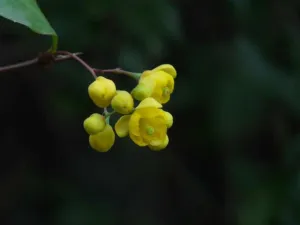
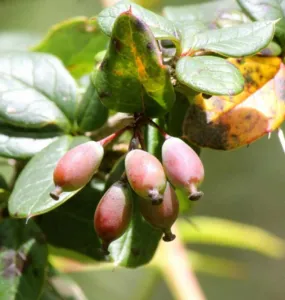
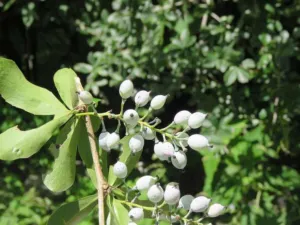
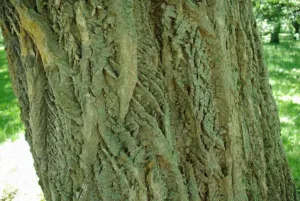
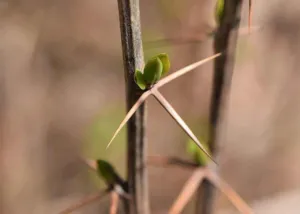
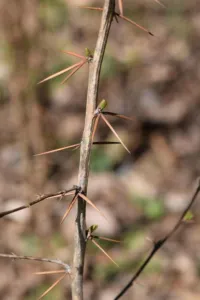
Berberis aristata is a spiny deciduous or semi-evergreen shrub of the Himalayan and sub-Himalayan belt, typically two to three metres, with the pinnately-veined obovate leaves and triple spines of the genus, yellow six-sepalled and six-petalled flowers in drooping racemes, and small purple-red berries. The berries are edible and sour and have nothing to do with the medicine.
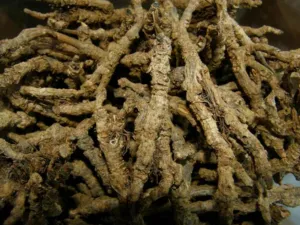
The drug is the root and the root bark. Cut across, the wood is a strong chrome yellow, and that colour is the alkaloid: berberine is a quaternary protoberberine cation with an absorption band that makes it a useful dye as well as a drug. The traditional Indian preparation, rasaut, is made by boiling the root in water and reducing it until a dark extract remains, which concentrates the alkaloids along with everything else that is water-soluble.
Australian ARTG listings are specific about the part. The Caruso’s Natural Health product BERBERINE 500 (entry 430001) declares Berberis aristata root extract dry concentrate 1000 mg equivalent to 90 g of dry root; the JSHealth Vitamins product Berberine+ (entry 520797) declares Berberis aristata root extract dry concentrate 606.45 mg equivalent to 11.22 g dry, alongside chromium picolinate. Attested Both are root, both are concentrated extracts, and neither public summary states a berberine percentage. Neither does the Genetic Labs Berberis vulgaris root product (entry 421575), which declares 515.46 mg of extract equivalent to 15.4638 g of dry root (ARTG 421575). The one number that would let a buyer connect the capsule to the trial literature is absent from all of them.
4. Where it grows, and its Australian status
The native range runs along the Himalaya from Pakistan through Kashmir, Himachal Pradesh, Uttarakhand and Nepal into Sikkim and Bhutan, at roughly 1,800 to 3,500 metres, with related species filling in adjacent altitudes. Berberis lycium and B. asiatica occupy overlapping ground and are collected alongside it, which is one reason the market keeps mixing them.
In Australia the plant is barely here. A search of the Atlas of Living Australia on 27/09/2026 returned 42 occurrence records for Berberis aristata, of which 24 are New South Wales and one Victorian; the remainder are New Zealand land districts, Indian states and overseas museum collections. Twenty-three are preserved herbarium specimens and 19 are human observations, most of the New South Wales material coming through the BioNet Atlas (Atlas of Living Australia). Attested That is the signature of a garden and arboretum plant with occasional escapes, and not of a naturalised population. There is no Australian wild-harvest industry, no Australian cultivation industry, and no Australian supply chain of any size. Every gram in an Australian capsule was imported.
There is no Berberis entry in the Poisons Standard, and none of the berberine-bearing genera appears there. The Institute searched the full text of the Therapeutic Goods (Poisons Standard—June 2026) Instrument 2026 (F2026L00633) for berberine, Berberis, Hydrastis, Coptis and Phellodendron on 27/09/2026 and found nothing (Poisons Standard, June 2026). Attested Berberine is not scheduled in Australia.
5. What tradition actually used it for
Daruharidra has a long Ayurvedic record as a bitter: a digestive and hepatic remedy, an antimicrobial applied to the eyes and to skin, a wound and ulcer wash, and a component of compound formulations. Rasaut in particular was an eye medicine. Traditional In Chinese medicine the berberine-bearing drugs are huang lian, the rhizome of Coptis chinensis, and huang bai, the stem bark of Phellodendron, used to clear what the tradition calls damp-heat, which in practice covers dysenteric and inflammatory gut conditions. Traditional In North America the Cherokee used Hydrastis canadensis as a dye and an internal remedy, and the nineteenth-century Eclectic physicians made goldenseal one of their signature herbs for catarrhal states of mucous membranes and as a bitter stomachic. Unsourced Both statements are standard in the herbal literature, but the Institute has not traced either to an ethnographic or Eclectic primary source it could open, so neither is presented as sourced.
Not one of those traditions used a berberine plant for weight reduction. The Australian regulator has recorded the traditional claims that can be supported: the ARTG entry for Berberine Complex (218382), a Coptis chinensis and Corydalis turtschaninovii product listed since 2013, carries the permitted indication “traditionally used in Chinese medicine to clear/expel damp-heat from the large intestine”, and the Caruso’s entry carries “traditionally used in Ayurvedic medicine to hepatoprotectant/protect the liver” and to support bile secretion and flow. Attested Those are the traditional indications a berberine product may lawfully carry in Australia, and they are bowel and liver claims.
The oldest real clinical result in the berberine literature belongs to the tradition, and not to the metabolic story. In 1987 Rabbani and colleagues randomised patients with acute diarrhoea from enterotoxigenic Escherichia coli and from Vibrio cholerae to berberine sulphate or control and measured stool output (PMID 3549923). Confirmed That trial, and the 1980s Indian trachoma trials of berberine eye drops (PMID 6754599; PMID 1344968), are the points where traditional use and clinical measurement met. Neither is about metabolism.
6. Phytochemistry: one cation and its relatives
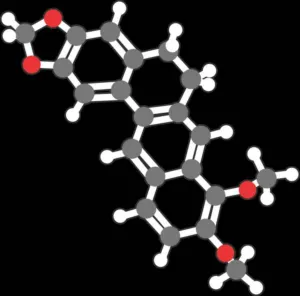
The Berberis root bark alkaloid fraction runs to about 13 per cent of the dry weight in B. vulgaris, and it is not one compound. The protoberberine group contributes berberine itself, at up to 6 per cent of root bark, with jatrorrhizine, palmatine and columbamine alongside it; the bisbenzylisoquinoline group, under 5 per cent in total, contributes oxyacanthine and berbamine, which are chemically quite different molecules with their own pharmacology (Bone and Mills, 2nd edition). Confirmed Stem bark is much poorer than root bark. Hydrastis carries 2.5 to 6 per cent total alkaloids, of which berberine is 2 to 4.5 per cent, hydrastine 2.2 to 4 per cent and canadine 0.5 to 1 per cent; hydrastine is unique to goldenseal and is one reason goldenseal is not pharmacologically interchangeable with barberry. Coptis chinensis rhizome is the richest of the common sources at 7 to 9 per cent berberine.
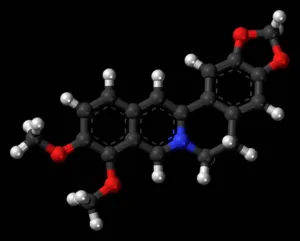
Berberine is a quaternary ammonium cation, so it is permanently charged at every physiological pH. That single structural fact drives the whole pharmacokinetic story in section 7: charged molecules do not cross lipid membranes readily. Commercial material is sold as the hydrochloride salt, and occasionally as the sulphate, which is what the 1987 diarrhoea trial used.
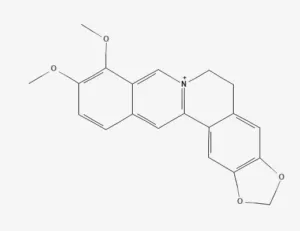
C20H18NO4+ · the quaternary protoberberine cation the whole market is built on
PubChem CID 2353 · structure image: PubChem, public domain
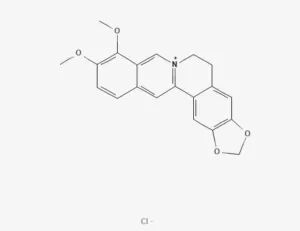
C20H18ClNO4 · the salt actually sold, standardised to 97–98%
PubChem CID 12456 · structure image: PubChem, public domain
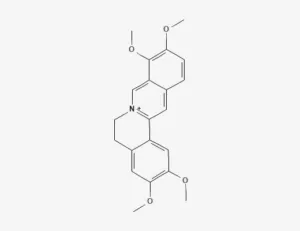
C21H22NO4+ · protoberberine companion in Berberis root bark
PubChem CID 19009 · structure image: PubChem, public domain
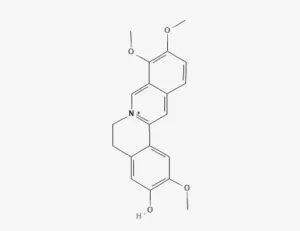
C20H20NO4+ · companion alkaloid and a berberine metabolite
PubChem CID 72323 · structure image: PubChem, public domain
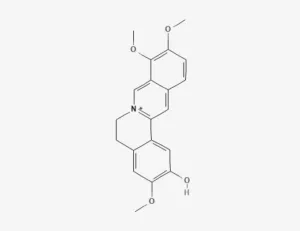
C20H20NO4+ · minor protoberberine
PubChem CID 72310 · structure image: PubChem, public domain
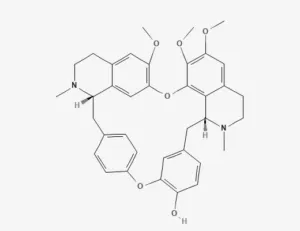
C37H40N2O6 · bisbenzylisoquinoline, a different pharmacology entirely
PubChem CID 275182 · structure image: PubChem, public domain
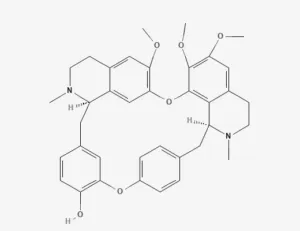
C37H40N2O6 · the other main bisbenzylisoquinoline of B. vulgaris
PubChem CID 442333 · structure image: PubChem, public domain
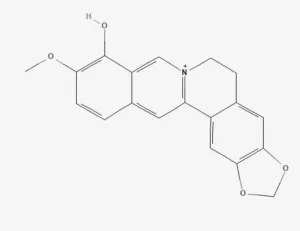
C19H16NO4+ · phase I demethylation metabolite; also induces CYP3A4
PubChem CID 72704 · structure image: PubChem, public domain
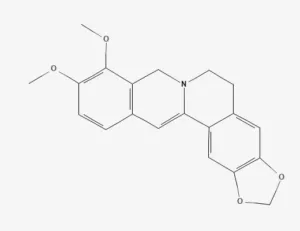
C20H19NO4 · the gut-bacterial reduction product that actually absorbs
PubChem CID 10217 · structure image: PubChem, public domain
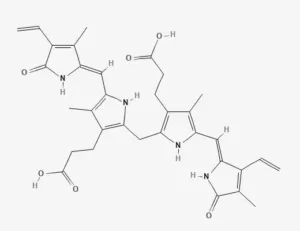
C33H36N4O6 · the albumin passenger berberine displaces
PubChem CID 5280352 · structure image: PubChem, public domain
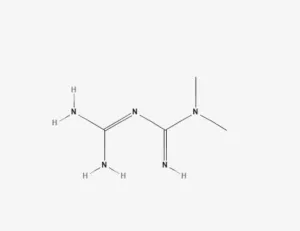
C4H11N5 · the other AMPK activator, and an OCT/MATE substrate
PubChem CID 4091 · structure image: PubChem, public domain
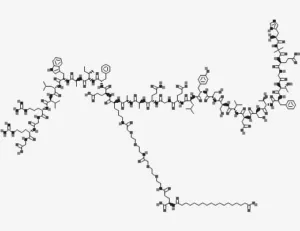
C187H291N45O59 · a 31-residue engineered peptide, for scale
PubChem CID 56843331 · structure image: PubChem, public domain
Seven alkaloids from the plants, two berberine metabolites, the albumin passenger, the drug berberine is compared with in the laboratory and the drug it is compared with in the marketing. Every CID was checked against PubChem on 27/09/2026; the depictions are PubChem’s own (US National Library of Medicine, public domain).
The one figure a label should carry and does not
A whole-root extract and a 97 per cent hydrochloride isolate are different products with different risk profiles, and the Australian public summaries the Institute read do not distinguish them. An “extract dry concentrate 1000 mg equivalent to 90 g of dry root” is a 90:1 concentration ratio, which is a very high ratio for a root extract and tells you the manufacturer is chasing the alkaloid; but without a stated berberine percentage, a buyer comparing two products on the shelf cannot tell whether they are getting 100 mg of the alkaloid or 500 mg. Every clinical trial in section 8 dosed the isolate in milligrams of berberine. Nothing on an Australian shelf is labelled in those units.
7. Pharmacology and the bioavailability problem
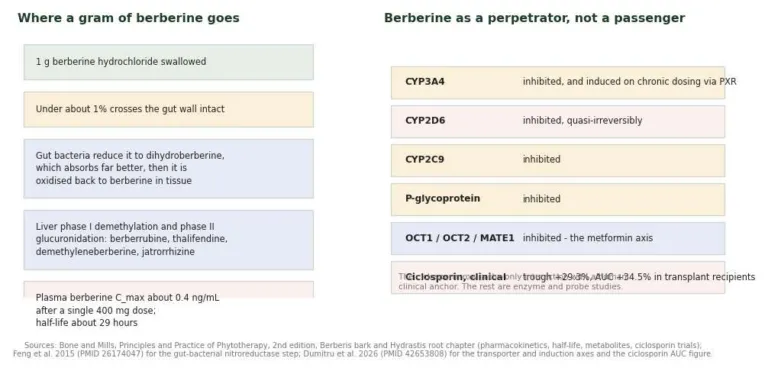
Berberine’s oral bioavailability is very low. In 20 healthy volunteers given a single 400 mg oral dose, the mean plasma maximum was 0.44 ng/mL, reached at nearly 10 hours, with a half-life of 28.6 hours (Bone and Mills, 2nd edition). Confirmed A plasma concentration in that range is orders of magnitude below what the in-vitro pharmacology papers use to demonstrate anything. Something other than plasma berberine has to be doing the work.
Two candidate answers exist, and they are complementary. The first is that the gut bacteria do the absorbing for it. Feng and colleagues showed in 2015 that intestinal nitroreductase-producing bacteria convert berberine to dihydroberberine, which crosses the gut wall roughly five times better, and is then oxidised back to berberine in tissue (PMID 26174047). Mechanism The second is that most of the measurable activity belongs to the metabolites and very little to the parent. Phase I demethylation and phase II glucuronidation produce berberrubine, thalifendine, demethyleneberberine and jatrorrhizine, and these reach considerably higher and more persistent plasma concentrations than berberine itself, largely through enterohepatic recirculation; in germ-free animals they barely appear (Bone and Mills, 2nd edition). Mechanism
What it does to cells
The two best-worked-out mechanisms are both from the 2000s and both are cell and animal work. Lee and colleagues showed in 2006 that berberine activates AMP-activated protein kinase, with metabolic effects in diabetic and insulin-resistant animal models (PMID 16873688); Turner and colleagues showed in 2008 that it does so by inhibiting mitochondrial respiratory complex I, and that dihydroberberine does the same thing at lower exposures (PMID 18285556). Mechanism That is a mild metabolic stressor acting on the same kinase that metformin activates, which is why the two are so often discussed together. Separately, Kong and colleagues showed in 2004 that berberine upregulates the hepatic LDL receptor by a post-transcriptional route distinct from the statin mechanism (PMID 15531889). Mechanism The LDL result is the most satisfying mechanistic story berberine has, because it predicts an outcome the trials then found.
The microbiome axis is the newest and the least settled. Zhang and colleagues reported in 2012 that berberine restructures the gut microbiota of high-fat-diet rats while preventing insulin resistance (PMID 22880019). Mechanism Ten and more years on, the microbiome remains a plausible route that nobody has demonstrated in humans, and the 2026 interaction review the Institute read is explicit that the microbiome axis carries nothing above its lowest evidence grade for any specific outcome (PMID 42653808). Mechanism An honest reading is that berberine almost certainly acts partly through the gut flora and that nobody has yet shown which human outcome that produces.
8. The weight-loss nickname: doing the arithmetic
The nickname makes three implicit claims: same mechanism, same outcome, different origin. All three fail, and they fail in different ways.
The mechanism is unrelated. Semaglutide and tirzepatide are engineered peptides that agonise the glucagon-like peptide-1 receptor, and in tirzepatide’s case the glucose-dependent insulinotropic polypeptide receptor as well; they work by slowing gastric emptying and acting on central appetite circuits, which is why patients eat less. Berberine has no described activity at the GLP-1 receptor. It is a small charged alkaloid acting on a mitochondrial complex, a kinase, a hepatic receptor and the gut flora. Mechanism Two compounds that lower a blood glucose reading are not therefore doing the same thing, any more than a diuretic and a beta blocker are the same drug because both lower blood pressure.
The size of the effect is in a different bracket. Here is the arithmetic, from full texts the Institute read in full. Xiong and colleagues pooled 10 randomised trials in a 2020 dose-response meta-analysis and found a significant reduction in body mass index of 0.29 kg/m2 and in waist circumference of 2.75 cm, and no significant change in body weight at all: weighted mean difference −0.11 kg, 95% confidence interval −0.99 to +0.76, p = 0.79 (PMID 32379652). Evidence suggests Zamani and colleagues, pooling a larger set in 2022, did find a significant weight reduction, of 0.84 kg, 95% CI −1.34 to −0.34, with BMI down 0.25 kg/m2 (PMID 36313096). Evidence suggests Liu and colleagues in 2025, restricting themselves to 12 placebo-controlled trials in metabolic syndrome with 889 patients between them, found BMI down 0.435 kg/m2, and reported that when the two low-quality trials were removed the BMI effect fell to 0.302 kg/m2 and lost significance (PMID 40740996). Evidence suggests
Set that beside the trial that made semaglutide famous. In STEP 1, 1,961 adults with overweight or obesity were randomised to semaglutide 2.4 mg weekly or placebo for 68 weeks; mean body weight change was −14.9 per cent with semaglutide against −2.4 per cent with placebo, from a mean baseline weight of 105.3 kg (PMID 33567185). Confirmed Fifteen per cent of 105 kg is about 15.7 kg. The berberine literature’s best case is 0.84 kg, and its most careful analyses say the true figure may be zero.
And the framing has the pharmacognosy backwards. A GLP-1 receptor agonist is a peptide designed molecule by molecule for one receptor. Berberine is an isolated plant alkaloid with a scattered target list and a bioavailability problem. Calling the second a natural version of the first tells the buyer that the difference is in the origin, when the difference is in the pharmacology and in two orders of magnitude of measured effect.
The Institute makes no therapeutic claim about berberine, for weight, for type 2 diabetes or for cholesterol. The reason to be blunt about the nickname is not that herbs are weak. It is that someone with an HbA1c of 9 per cent who takes berberine instead of getting diagnosed and treated has bought themselves a delay, and delay in type 2 diabetes is measured in retinas and kidneys.
9. The evidence, graded tier by tier
Strip out the weight-loss story and there is a genuine body of trial evidence here, with genuine problems.
Glucose
Xie and colleagues pooled the randomised trials of berberine in type 2 diabetes in 2022 and reported fasting plasma glucose down 0.82 mmol/L, 95% CI −0.95 to −0.70, HbA1c down 0.63 per cent, 95% CI −0.72 to −0.53, and two-hour post-load glucose down 1.16 mmol/L (PMID 36467075). Evidence suggests Wang and colleagues in 2024, pooling 50 trials in 4,150 participants, found HbA1c down 0.69 per cent where berberine was added on top of a hypoglycaemic drug, and fasting glucose down 0.59 mmol/L for berberine on its own (PMID 39640489); Guo and colleagues in 2021 and Dong and colleagues in 2012 reached the same direction (PMID 34956436; PMID 23118793). Evidence suggests An umbrella review of these meta-analyses appeared in 2024 (PMID 38016844).
The direction is consistent and the effect is not trivial: a 0.6 per cent HbA1c reduction is in the range of some pharmaceutical agents. The problem is underneath the pooled number. Heterogeneity in these analyses is routinely above 80 per cent. The individual trials are small, usually under 100 patients, frequently three months long. A large share are Chinese-language and were never independently replicated outside China. Dose ranges from 500 mg to 1.5 g a day and the preparations differ. Several of the most-cited early trials, including Yin and colleagues in 2008 (PMID 18442638) and Zhang and colleagues in 2008 (PMID 18397984), are small single-centre studies whose results have carried far more weight in the literature than their size justifies.
Lipids
The lipid signal is the one with a mechanism attached to it. Liu and colleagues found LDL cholesterol down 0.495 mmol/L, total cholesterol down 0.451 mmol/L and triglycerides down 0.367 mmol/L across their 12 trials, with HDL unchanged (PMID 40740996). Evidence suggests Zamani and colleagues found the same direction in mg/dL, with triglycerides down 23.70, total cholesterol down 20.64 and LDL down 9.63; in their pooled set HDL rose slightly rather than staying flat (PMID 36313096). Evidence suggests The LDL-receptor mechanism from 2004 predicts exactly this, which is the sort of agreement between bench and bedside that ought to make a reader more confident, subject to the same quality limits as the glucose data.
Waist circumference, and a curiosity
The single most internally consistent anthropometric result in the whole literature is waist circumference. Liu and colleagues pooled four trials with 396 patients and found a reduction of 3.27 cm with an I2 of exactly zero, meaning the trials agreed with one another completely (PMID 40740996). Evidence suggests Xiong and colleagues found 2.75 cm (PMID 32379652). Evidence suggests Four trials is a thin base, and a centimetre measurement is easier to influence unblinded than a scale reading, so the Institute treats this as interesting and unestablished. It is, though, the one anthropometric claim with any internal consistency behind it, and it is a different claim from weight loss.
The outlier worth knowing about
Berberine’s most rigorous clinical evidence is in a field nobody markets it for. A Chinese randomised trial of berberine 300 mg twice daily for the prevention of colorectal adenoma recurrence has now reported six-year follow-up (PMID 40795846). Evidence suggests The follow-up phase is a retrospective observational cohort rather than a continuing randomised comparison, which is worth knowing before the six-year figure is quoted at anyone. The parent study is still large, long, registered and outcome-based, of a kind the metabolic literature does not have. A reader deciding how much to trust berberine research in general should know that the field is capable of doing it properly when it wants to.
10. Safety: this is an interaction problem
The short form. Berberine inhibits CYP3A4 and P-glycoprotein, and on microsome and review evidence CYP2D6 and CYP2C9 as well. CYP3A4 handles a large share of all prescription medicines. Unsourced The figure usually quoted is about half; the Institute has not traced that percentage to a primary source it could open and does not state one. Anyone on a statin, a calcium-channel blocker, a macrolide, an anticoagulant, an immunosuppressant, an antiarrhythmic or an antidiabetic medicine who adds berberine is running an interaction experiment on themselves. No Australian label will warn them, because no Australian label is required to: of the eight permitted-ingredient entries, only item 828 carries any requirement at all, and that requirement is the pregnancy and lactation warning (Permissible Ingredients Determination). Attested
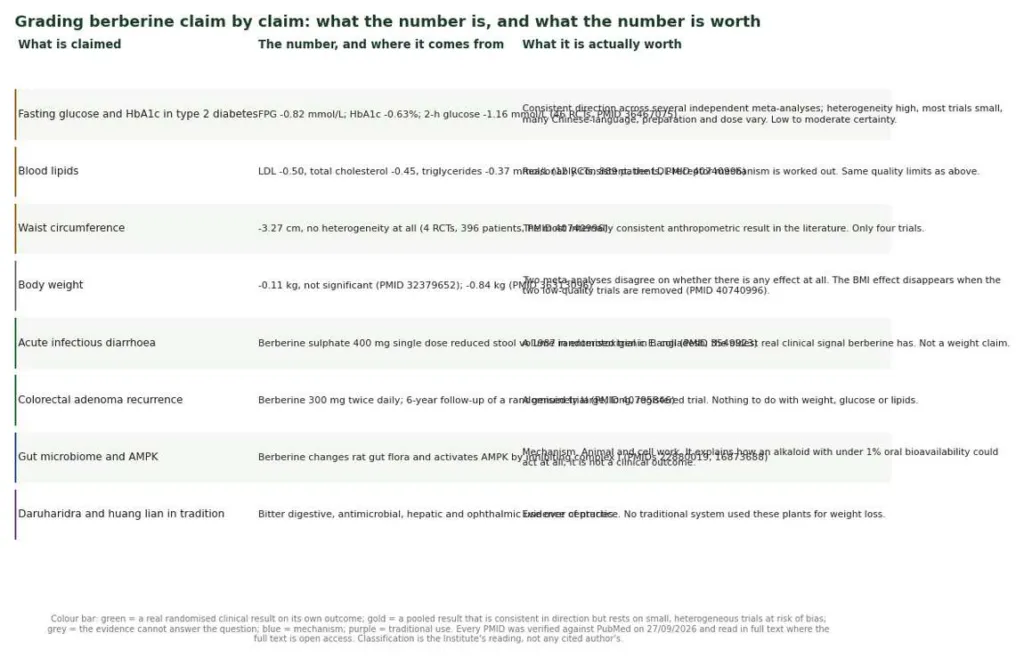
The clinical anchor is ciclosporin, and it is not theoretical. In a randomised controlled study, 52 renal transplant recipients took ciclosporin with berberine 0.2 g three times a day for three months while another 52 took ciclosporin without it; trough ciclosporin finished 29.3 per cent higher in the berberine arm. There was no placebo: the control arm simply had no berberine added. In a separate pharmacokinetic arm of the same paper, co-administration in six patients for 12 days raised the mean ciclosporin AUC by 34.5 per cent (PMID 16133554; Bone and Mills, 2nd edition). Confirmed For a drug with a narrow therapeutic index in a transplant recipient, a third more exposure is a clinically material change. A 2026 narrative review of berberine interactions treats this as the only berberine interaction with a top-grade human clinical anchor, and grades everything else lower (PMID 42653808). Evidence suggests
The enzyme picture behind it has been worked out in human liver microsomes and in human probe studies. Berberine itself inactivated CYP2D6 and CYP3A4/5 in human liver microsomes, with time-dependent and allosteric behaviour that makes simple potency numbers misleading; the CYP2C9 inhibition in that same study came from hydrastine, which is a goldenseal alkaloid and not a Berberis one (PMID 32591416). Evidence suggests A human probe study with a goldenseal extract, standardised on its alkaloids, reduced CYP3A activity in vivo in healthy volunteers, while kava did not (PMID 17495878). Confirmed In rats, berberine raised the oral bioavailability of digoxin and of ciclosporin by inhibiting intestinal P-glycoprotein, and in that same study produced no measurable change in CYP3A activity, which is a caution against treating the CYP3A story as settled (PMID 19370549); physiologically based pharmacokinetic modelling has been used to predict goldenseal and berberine interactions with imatinib and bosutinib (PMID 35048143). Mechanism A 2025 review collects the cytochrome data for Berberis vulgaris and berberine specifically (PMID 39141022).
Two complications make this harder rather than easier. First, the direction of the CYP3A4 effect is not fixed: berberine and berberrubine can also induce CYP3A4 through the pregnane X receptor, so acute inhibition and chronic induction can coexist and the net result depends on dose and duration (PMID 42653808). Mechanism Second, berberine inhibits the organic cation transporters OCT1, OCT2 and MATE1, with half-maximal inhibitory concentrations of 18.8, 1.02 and 10.7 micromolar respectively, and those are the transporters that handle metformin (PMID 42653808). Mechanism
The direction of that one deserves care, because the obvious reading is the wrong way round. OCT1 sits on the hepatocyte and carries metformin into the liver, which is where metformin works rather than where it is cleared; inhibiting it would blunt the glucose-lowering effect while leaving blood levels alone. OCT2 and MATE1 sit in the kidney and handle secretion into urine; inhibiting those raises exposure. The two pull against each other, and what the studies actually found is that berberine lowered metformin’s peak concentration and exposure while increasing its renal accumulation, with the net effect depending on the route: given metformin intravenously, berberine raised exposure and cut clearance instead. A probe-cocktail study in 16 healthy volunteers, using a goldenseal extract standardised on berberine, likewise reduced metformin systemic exposure while raising midazolam AUC by about 43 per cent (PMID 42653808). Evidence suggests So a person who adds berberine to metformin may be getting less metformin, not more, and losing glycaemic control is at least as plausible an outcome as hypoglycaemia. Neither can be predicted from in vitro potency, and neither is something a buyer can detect without measuring.
The additive hypoglycaemia that does carry human pharmacodynamic evidence belongs to the sulfonylureas and to insulin, where berberine’s own glucose-lowering effect simply adds to theirs (PMID 42653808). Evidence suggests None of the trial literature was designed to detect that in unsupervised use.
The part that is about the heart
The interaction literature has a fourth axis that the enzyme story tends to swallow, and it is the one with the least reassuring endpoint. Berberine blocks the hERG channel that carries IKr, the rapid delayed-rectifier potassium current that repolarises the ventricle, with only weak effects on the IKs channels, and it lengthens the action potential and the QT interval in cell and tissue work. It also promotes degradation of the hERG channel, reducing how much of it reaches the cell surface, which is an effect that develops slowly and at much lower concentrations than direct block (PMID 42653808). Mechanism
Against that, the honest caveat is large. Reported potencies for direct hERG block differ by more than an order of magnitude between expression systems, roughly 3 micromolar in mammalian HEK-293 cells and 75 to 80 micromolar in frog oocytes, and even the lower of those is two to three orders of magnitude above the plasma concentrations an oral dose produces — which is the same bioavailability problem as section 7, working this time in the patient’s favour. Acute channel block on its own cannot explain a clinical QT signal. The trafficking effect and pharmacokinetic amplification, when berberine is taken with something that inhibits its own metabolism or prolongs QT in its own right, are the two candidate reconciliations, and both are unquantified in humans (PMID 42653808). Mechanism The 2026 review’s own verdict is that the cardiac axis is a plausible, mechanistically anchored, clinically uncalibrated risk, and the Institute has nothing to add to that phrasing.
What exists at the level of people is one published case and a preclinical model. A 56-year-old woman with an unremarkable history presented with syncope and short runs of torsades de pointes, a QTc of 667 ms and a blood pressure of 86/42; she had been taking cannabidiol and cannabigerol hemp oil for four months at up to six times the recommended dose and, for the last six weeks, a supplement containing 250 mg of berberine. Everything was stopped, the QTc fell to 413 ms over five days, and at three months she was well with a normal ECG (PMID 35607330). Evidence suggests Berberine cannot be blamed for that on its own: cannabidiol prolongs repolarisation and inhibits CYP3A4 and CYP2D6, and cannabigerol is an alpha-2 agonist that can drop blood pressure and heart rate. That case shows the combined mechanism at work. Separately, giving berberine with a macrolide has been shown experimentally to increase cardiac toxicity, which matters because macrolides are already on the list of CYP3A4 victims above (PMID 42653808). Mechanism
The same axis has a quieter limb. Berberine has vasodilatory and bradycardic effects of its own, documented in humans as far back as a 1988 study in severe congestive heart failure, so it adds to the hypotension and bradycardia produced by antihypertensives and beta blockers (PMID 42653808). Evidence suggests That is the commonest co-medication in the age group buying it, and lightheadedness on standing is the sign.
What actually happens to people at the doses they choose
Gastrointestinal effects dominate. Constipation, diarrhoea, abdominal pain, flatulence and nausea are the reported adverse events in trials, generally mild and generally dose-related. Above about 500 mg, the older literature records dizziness, epistaxis, dyspnoea, gastrointestinal irritation and skin and eye irritation, and the German Commission E monograph on Berberis is a negative one, noting the risks of berberine-containing plant parts (Bone and Mills, 2nd edition). Evidence suggests Reassuringly, the pooled trial data do not show an excess of total adverse events or of hypoglycaemia against control (PMID 36467075) Evidence suggests, though trials of 12 weeks in supervised patients are a poor model of a person buying 1,200 mg capsules online and taking them for a year.
11. Pregnancy, breastfeeding, and the newborn question
This is the part of the berberine file that the trend never mentions and that the Australian regulator has already acted on.
Berberine displaces bilirubin from its binding site on albumin. An in-vitro study found it about ten times more potent at this than phenylbutazone, itself a strong displacer, and chronic dosing in rats significantly reduced mean bilirubin protein binding (PMID 8513024; Bone and Mills, 2nd edition). Mechanism Free, unbound bilirubin is the fraction that crosses the immature blood-brain barrier, and bilirubin encephalopathy is why neonatal jaundice is treated and never simply watched. The mechanism therefore points straight at the most vulnerable patient there is.
The clinical evidence behind it is weaker than the mechanism, and honesty requires saying so. Kernicterus is the permanent brain injury that follows when unbound bilirubin reaches the basal ganglia, and it has no treatment once established. Cases of it in premature Chinese infants with neonatal jaundice have been reported as associated with exposure to Coptis chinensis, by direct administration, transplacental transfer or breast milk. That association has been challenged by two Chinese authors whose experiments in newborn rats and mice found that Coptis did not raise serum bilirubin (Bone and Mills, 2nd edition). Evidence suggests There is a parallel and equally unsettled question about berberine precipitating haemolysis in infants with glucose-6-phosphate dehydrogenase deficiency, where a 2001 review questioned the causal link (Bone and Mills, 2nd edition). Evidence suggests Berberine also causes uterine contraction in animal models, although in a study of ten berberine-containing extracts the uterine effect did not track berberine content, which suggests other constituents matter.
Older children, and what the paediatric evidence is actually about
Berberine has been given to children in trials. How it was given is the part that matters. A 2020 systematic review and meta-analysis pooled 38 studies in 3,948 participants, of which 27 trials and 2,702 participants were paediatric, all of them in acute or chronic diarrhoea rather than in anything metabolic. In those paediatric trials 2,306 of the 2,702 children, 85.3 per cent, received berberine as a rectal enema, and 22 of the 27 trials used that route; berberine added to antibiotics improved cure rates and shortened the diarrhoea. No deaths and no serious adverse events were reported, the commonest complaints being vomiting and rash, and the authors graded the evidence moderate to low or very low (PMID 33149763). Evidence suggests
Read carefully, that literature says something narrow. It is about short courses given per rectum for an acute infection, in trials the reviewers themselves would not lean on, and it tells an Australian parent nothing whatever about a 500 or 1,200 mg oral capsule taken daily for months for blood sugar or weight. There is no paediatric metabolic evidence for berberine, there is no established paediatric oral dose, and none of this touches the neonatal contraindication above, which stands on its own mechanism.
Put together, that is a plausible and serious mechanism, a contested clinical signal, and a patient group in whom nobody will ever run the trial. Herbal-medicine practice has settled on the conservative reading: berberine-containing plants are avoided in pregnancy and lactation, and are not given to neonates or very young children (Bone and Mills, 2nd edition). Traditional So has the Commonwealth. Item 828 of Schedule 1 of the Therapeutic Goods (Permissible Ingredients) Determination (No. 2) 2026 permits Berberis aristata only as an active ingredient, only in oral medicines, and requires the label statement “Not recommended for use by pregnant and lactating women” or words to that effect (Permissible Ingredients Determination). Attested That is why the JSHealth ARTG entry carries both “do not use if pregnant or likely to become pregnant” and the not-recommended-in-pregnancy-and-lactation warning, while the Berberis vulgaris entry carries no warnings at all (ARTG 520797; ARTG 421575). Attested
12. Australian regulatory status, read from the instruments
Berberine is lawfully on Australian shelves and the products are real listed medicines, so the framing of berberine as a grey import is wrong. What is true is stranger.
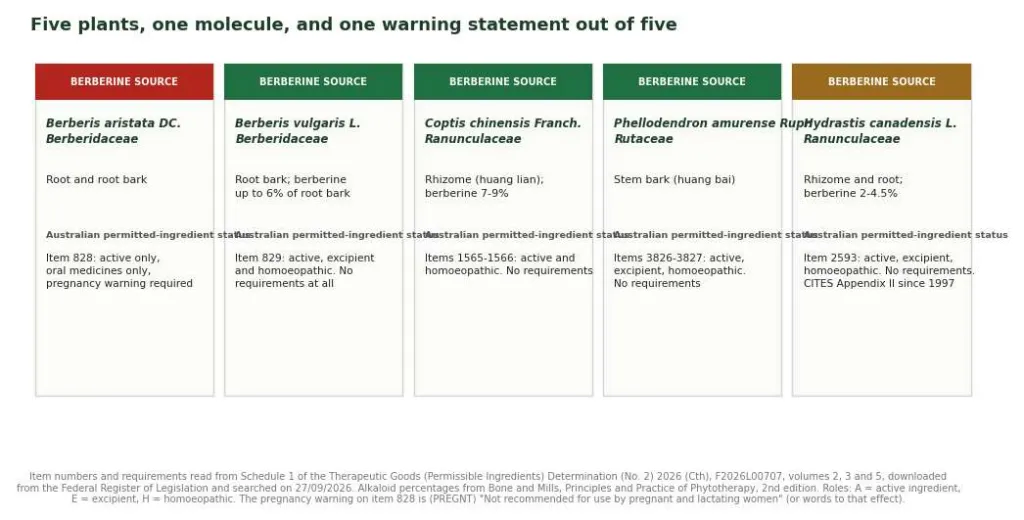
Berberine itself is not a permitted ingredient. The Institute searched the full Schedule 1 of the Permissible Ingredients Determination (F2026L00707, registered 11/06/2026, six volumes) for berberine on 27/09/2026. There is no entry. What are permitted are the plants: item 827 Berberis aquifolium, item 828 Berberis aristata, item 829 Berberis vulgaris, items 1565 and 1566 Coptis chinensis and C. japonica, item 2593 Hydrastis canadensis, items 3826 and 3827 Phellodendron amurense and P. chinense (Permissible Ingredients Determination). Attested An Australian listed berberine product is therefore licensed as a plant extract, which is why every ARTG entry the Institute read declares an extract with a dry-root equivalent and not a quantity of berberine.
Only one of the eight carries any requirement. Berberis aristata, item 828, is restricted to active use in oral medicines and carries the mandatory pregnancy and lactation warning. The other seven entries across four genera carry no requirements at all, and several are permitted as excipients and as homoeopathic ingredients as well as actives (Permissible Ingredients Determination). Attested The Institute has no visibility of the Delegate’s reasoning and does not speculate on it. As a practical matter it means the same alkaloid reaches an Australian consumer with a pregnancy warning or without one depending purely on which shrub the manufacturer bought.
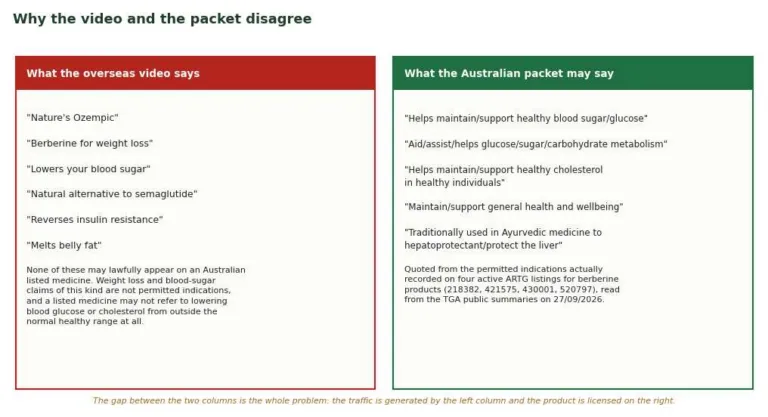
What a listed medicine may say. Listed medicines are the low-risk end of the scheme: the sponsor certifies compliance and holds evidence, and the TGA does not assess that evidence before the product goes on sale (TGA, listed complementary medicines). Attested Claims must be drawn from the permitted indications, and the indication requirements attached to them are as important as the indications. The four active berberine listings the Institute read on 27/09/2026 carry between them “helps maintain/support healthy blood sugar/glucose”, “aid/assist/helps glucose/sugar/carbohydrate metabolism”, “helps maintain/support healthy cholesterol”, “maintain/support general health and wellbeing”, the Ayurvedic liver and bile claims and the Chinese damp-heat claim. Every one of the glucose and cholesterol indications is accompanied by a requirement that the product presentation must not imply or refer to lowering blood glucose or cholesterol from outside the normal healthy range (ARTG 520797; ARTG 421575; ARTG 430001; ARTG 218382). Attested
Read that requirement twice, because it is the whole difference between the Australian packet and the overseas video. A listed medicine here may help a healthy person’s normal glucose stay normal. It may not present itself as something that brings an abnormal number down. “Nature’s Ozempic” is a claim about bringing abnormal numbers down in people with a disease, and no Australian listed medicine may make it. The TGA’s restricted and prohibited representations rules sit on top of that: serious diseases including diabetes cannot be referred to in advertising for a listed medicine without approval (TGA restricted and prohibited representations). Attested
Buying from overseas. A capsule bought from an overseas e-commerce site is not a listed medicine, carries no AUST L number, has not been through Australian manufacturing requirements, and is outside the Australian recall and adverse-event system. It also, in practice, carries none of the identity information in section 13. Personal importation of medicines into Australia sits under its own rules and is not a question this article can answer for an individual.
Reporting harm. Anyone, consumer or practitioner, can report a suspected adverse event from a medicine or supplement directly to the TGA, and the reports go into the Database of Adverse Event Notifications (TGA adverse event reporting). Attested The Institute did not query the DAEN for this review and makes no claim about how many Australian reports involve berberine. Under-reporting for complementary medicines is universal, and the reason it matters here is that an interaction that presents as a statin myopathy or a raised INR will usually be attributed to the drug rather than to the capsule nobody mentioned.
13. Quality, adulteration, and how to read a label
An isolate market has two quality failure modes that a whole-herb market does not. Potency can be wrong in either direction, because the number on the box is a claim about a purification process and says nothing about a plant. And the wrong plant can be substituted without the buyer noticing, because the purified product looks and tastes the same.
Both are documented for this material. The 2013 Indian market survey of daruharidra found commercial samples that were not the nominal species (PMID 23431340). Evidence suggests The 2025 study using macro- and microscopy, DNA barcoding and HPTLC on material traded as maramanjal and daruharidra was built precisely because the identity of traded berberine botanicals could not be assumed (PMID 40945162). Evidence suggests Goldenseal has the same history from the other direction: because genuine Hydrastis root is expensive, commercial goldenseal products have repeatedly been found not to contain the authentic plant (Bone and Mills, 2nd edition). Evidence suggests
Berberine is, ironically, easy to check. It fluoresces yellow, it separates cleanly on a TLC plate, and quantitative HPLC methods are routine. The tests exist. What is missing on the Australian shelf is the number.
Six things to look for, in order
The binomial with its author. Berberis aristata DC., not “Indian barberry” alone, and not “barberry”, which could be any of three permitted species with different Australian requirements.
The plant part. Root or root bark. Stem bark is much weaker. A product that will not say which part it used has told you something about the manufacturer.
Whole extract or purified salt. “Extract dry concentrate, equivalent to n g dry root” describes an extract. “Berberine hydrochloride 500 mg” describes a chemical. They are different products and the second one is the one the trials used.
The berberine percentage, or the milligrams of berberine. If it is not there, the product cannot be compared with any trial, and the buyer cannot compare it with the product beside it on the shelf. This is the single most useful absent number in the category.
The AUST L number. A listed medicine carries one, and the corresponding ARTG public summary is free to read on the TGA website. That summary will tell you the sponsor, the declared ingredients and quantities, the permitted indications and the required warnings. No AUST L number means no Australian regulatory oversight of that pack at all.
The warnings. If the product is Berberis aristata, a pregnancy and lactation warning is compulsory. Its absence from an Australian-supplied B. aristata product is a compliance problem worth reporting.
14. Where the root comes from, and whether it can keep coming
The supply story is the one part of this subject where the plant, rather than the molecule, is the thing that matters.
Berberis aristata is largely wild-collected from Himalayan slopes, and the part collected is the root, which means the harvest kills the plant. A 2024 systematic review of highly-subsidised Indian medicinal plants covered Berberis among the taxa whose traditional use, phytochemistry, quality control and conservation status it assessed (PMID 37951375), and the pressure on Himalayan root-crop medicinals is a long-standing concern in that literature. Evidence suggests The Institute has not verified a current IUCN assessment for the species and makes no claim about its formal conservation category.
The North American alternative source is further down that road. Hydrastis canadensis was listed on Appendix II of the Convention on International Trade in Endangered Species on 18 September 1997 and remains listed, after overexploitation reduced wild populations, and cultivated material is the responsible choice over wild-crafted (Bone and Mills, 2nd edition). Attested The Institute’s own attempts to read the CITES appendices directly on 27/09/2026 were refused by the CITES website, so the listing and its date are cited from the Institute’s library copy of Bone and Mills; the Institute did not read the instrument itself; readers who need the current annotation should check the CITES species record themselves (CITES species record).
The Coptis chinensis and Phellodendron sources are largely cultivated, and cultivated bark and rhizome do not carry the same pressure as wild-dug root. That is a real argument for sourcing berberine from those species instead. It is also an argument almost no berberine label engages with, because the label is marketing the molecule and the molecule does not care.
Discussion: conclusions, hypotheses and research still required
What this review supports
Commercial berberine is a purified isoquinoline alkaloid and should be assessed as a single-molecule drug substance, with the plant name treated as provenance. Confirmed Its oral bioavailability is very low and much of its activity is probably attributable to gut-bacterial reduction and to its metabolites, with little contribution from parent berberine in plasma. Mechanism Randomised-trial evidence supports modest reductions in fasting glucose, HbA1c and LDL cholesterol in populations with metabolic disease, at low to moderate certainty, from trials that are mostly small, short, heterogeneous and frequently unreplicated outside China. Evidence suggests The weight-loss claim is not supported: the meta-analysis that pooled body weight directly found no significant change, a second found 0.84 kg, and a third, in metabolic syndrome, found a BMI reduction that lost significance once its two low-quality trials were taken out, against 14.9 per cent of body weight in the reference semaglutide trial. Evidence suggests Berberine is a clinically significant inhibitor of CYP3A4 and P-glycoprotein, with one top-grade human clinical anchor in ciclosporin. Confirmed Its inhibition of CYP2D6, CYP2C9 and the OCT/MATE transporters rests on human liver microsome work and on review synthesis, not on human outcome data. Mechanism The metformin interaction is real but runs opposite to the intuitive direction, lowering metformin exposure in the studies that measured it, so the risk it poses is loss of glycaemic control as much as hypoglycaemia; the additive hypoglycaemia with human evidence behind it is with sulfonylureas and insulin. Evidence suggests Berberine also blocks the cardiac hERG channel and prolongs QT in cell work, and adds to the hypotension and bradycardia of antihypertensives and beta blockers, but the concentrations at which direct block occurs are orders of magnitude above what oral dosing achieves and the human evidence is one confounded case report, so the cardiac risk is mechanistically anchored and clinically uncalibrated. Mechanism In Australia, berberine is not a permitted ingredient in its own right; the permitted ingredients are eight plant entries across four genera, of which only Berberis aristata carries a mandatory pregnancy and lactation warning and an oral-only restriction. Attested Nothing in the Poisons Standard applies. Attested
What the Institute holds as hypothesis, and would like tested
The waist-circumference finding may be real and may be separable from weight. Four trials with no heterogeneity at all, giving 3.27 cm, alongside pooled body-weight estimates that straddle zero, is the pattern you would expect if berberine were altering fat distribution or visceral fat without altering mass. Mechanism That is a hypothesis, and imaging can test it.
The microbiome route may be the whole mechanism rather than one of several. If nitroreductase-producing gut bacteria are the rate-limiting step in absorption, then an individual’s flora would determine their response, and the enormous heterogeneity in the trial literature would have a simple explanation. Mechanism Nobody has stratified a berberine trial by baseline microbiome. It is the most informative single study anyone could run in this field.
The Australian regulatory asymmetry between item 828 and the other seven entries is a question, and the Institute intends no criticism by asking it. If the pregnancy warning on Berberis aristata is there because of berberine, the same reasoning would apply to Berberis vulgaris, Coptis, Phellodendron and Hydrastis. Attested The Institute has not seen the Delegate’s reasoning and would be glad to.
What research is still required, by discipline
Quality analysis. A market survey of every berberine product available to Australian consumers, quantified by HPLC against a reference standard, reporting berberine content per unit dose against the label, plus species identification by DNA barcoding on any product sold as a whole extract. This is the single most useful piece of work available in this field and it needs a laboratory rather than a literature search.
Clinical pharmacology. A properly powered interaction study of berberine with atorvastatin or simvastatin in humans. Statins are the commonest co-medication in the population buying berberine, most are CYP3A4 substrates, and there is no adequate human study.
Cardiac safety. A thorough QT study, or at minimum serial ECGs in a metabolic trial of ordinary length, would settle the axis this article has had to leave open. The specific question is whether the trafficking-dependent loss of hERG channels, which develops slowly and at concentrations an oral dose might plausibly reach, produces any measurable QTc change over twelve weeks of 1,000 to 1,500 mg a day, and whether that changes in the presence of a CYP3A4 inhibitor. Nobody has measured it, and the population taking berberine is the population already on QT-prolonging and rate-slowing medicines.
Paediatrics. The paediatric evidence is almost entirely rectal berberine for acute diarrhoea in low-quality trials, and it is being used to reassure about a quite different exposure. An oral paediatric pharmacokinetic study, and a systematic look at whether any child has come to harm from an adult metabolic capsule taken from the kitchen cupboard, would both be worth more than another metabolic meta-analysis.
Clinical research. A registered, adequately powered, preferably non-Chinese replication of the HbA1c result, at a stated dose of a characterised preparation, at least six months long, with body composition measured by DXA in place of scale and tape. Until that exists the glucose signal will keep being over-read by marketers and under-read by clinicians.
Toxicology and pharmacovigilance. The bilirubin-displacement question deserves a modern answer: an in-vitro albumin binding study with current methods, and a systematic review of the Coptis neonatal jaundice case literature including the papers that challenged it, and the same treatment for the unresolved G6PD haemolysis question. Separately, a DAEN analysis of Australian adverse-event reports involving berberine products, cross-checked for co-medication, would tell us whether the interaction risk this article describes is actually showing up here.
Pharmacognosy and botany. Comparative alkaloid profiles of Berberis aristata, B. lycium, B. asiatica and B. vulgaris root bark from authenticated voucher material, with a validated HPTLC identity method that distinguishes them. The 2025 maramanjal study is a start; it needs extending to the material Australian manufacturers are actually buying.
Regulatory science. Whether the permitted-ingredient framework is the right instrument for a 97 per cent isolate at all is a genuine question. A purified alkaloid licensed as a plant extract is regulated on the identity of a shrub, while the thing the consumer swallows is a defined chemical with a defined interaction profile. That mismatch is not unique to berberine, and it is worth someone’s submission.
And the honest bottom of it
Berberine is a real pharmacological agent with a real, modest, reasonably consistent effect on glucose and lipids, and a serious interaction profile that its Australian labels do not describe. It is also being sold to Australians on a nickname borrowed from a class of drugs it has nothing in common with, to people who in many cases need a diagnosis. Both of those sentences are true at once, and the Institute would rather publish both than pick the one that reads better.
Before taking any botanical drug, including berberine, consult a degree-qualified herbalist with competencies and adequate training in pharmacognosy, and tell them every prescription medicine you take. For a suspected poisoning or overdose, call the Poisons Information Centre on 13 11 26 (24 hours, Australia-wide). In an emergency call Triple Zero (000).
About the Australian Institute of Pharmacognosy and this series
The Australian Institute of Pharmacognosy is a clinic and research laboratory in Cardwell, far north Queensland, studying medicinal plants and natural products to the same evidentiary standard as any other branch of pharmacology: traditional knowledge taken seriously, and tested honestly. Visit the Institute at australian-pharmacognosy.org.
Series: AIP Literature Reviews and Critical Analyses (evidence reviews). Previous: devil’s claw (Harpagophytum procumbens) · turmeric (Curcuma longa) · sour jujube seed (Ziziphus jujuba) · soursop (Annona muricata) · umckaloabo (Pelargonium sidoides) · andrographis (Andrographis paniculata) · Syrian rue (Peganum harmala). Follow the series for a new evidence review each morning.
Corrections: if you find an error or a source we have missed, write to the Institute at our contact form. We would rather correct a claim than repeat it.
About the images and the evidence. Every photograph in this article is a freely licensed image of the plant or material it names, with the photographer, licence and Commons source page given in the caption and again in the image credits. Chemical structures are PubChem’s own depictions, public domain, each linked to its CID. The five figures were drawn by the Institute from the sources printed inside them. Every PubMed identifier was verified against PubMed on 27/09/2026. Where an open-access full text existed, the Institute read the full text and not the abstract; the papers whose full text is not open access have been queued through the Institute’s library and are cited here only for facts also carried in a full text the Institute holds. Australian legal statements were read from the Federal Register of Legislation and the TGA’s own public summaries on 27/09/2026. The CITES listing for goldenseal is cited from the Institute’s library copy of Bone and Mills because the CITES website refused automated retrieval; no other claim in this article rests on a source the Institute could not open.
Head of Education and Research
Australian Institute of Pharmacognosy
Cardwell QLD, Australia
australian-pharmacognosy.org · our contact form
Suggested citation: Ridley T. Indian barberry (Berberis aristata DC.): the berberine evidence — the isolate on the shelf, the weight-loss arithmetic, the trial evidence in glucose and lipids, the cytochrome, transporter and cardiac interactions, the neonatal bilirubin question and the Australian regulatory position. AIP Literature Review and Critical Analysis LR-9. Cardwell (QLD): Australian Institute of Pharmacognosy; 2026.
Educational content only; not medical, legal or regulatory advice. Australian regulatory information reflects the Permissible Ingredients Determination, the Poisons Standard, the ARTG and TGA publications as read on 27/09/2026 and may change. European, Indian, Chinese and United States material is cited as overseas material and does not govern Australian therapeutic goods law. Products are named only where a public ARTG record exists, and statements about them are confined to what that record says; no product is advertised, endorsed or recommended. Material drawn from Commonwealth sources is © Commonwealth of Australia and appears here as short extracts for the purpose of reporting, criticism and review.
References
47 references: tap to open
Listed in order of first citation. All 33 PMIDs were verified against PubMed on 27/09/2026; every regulatory, legislative, taxonomic and biodiversity record was read from its own source, with the one stated exception of the CITES listing.
- Chan E. Displacement of bilirubin from albumin by berberine. Biol Neonate. 1993;63(4):201-8. PMID 8513024. DOI 10.1159/000243932.
- Bone K, Mills S. Principles and Practice of Phytotherapy: Modern Herbal Medicine, 2nd edition. Churchill Livingstone Elsevier. Chapter “Berberis bark and Hydrastis root (Berberis vulgaris L., Hydrastis canadensis L.)”, read in full from the Institute’s library holding on 27/09/2026. Source for the alkaloid percentages of Berberis, Hydrastis and Coptis; the human pharmacokinetic figures (400 mg single dose, Cmax 0.44 ± 0.42 ng/mL, Tmax 9.8 h, half-life 28.6 ± 9.5 h); the metabolite profile and its dependence on intestinal flora; the bilirubin displacement and neonatal jaundice discussion including the papers challenging it; the G6PD haemolysis discussion; the ciclosporin studies; the Commission E negative monograph on Berberis; the historical confusion of B. aristata with B. lycium and B. vulgaris in Indian commerce (1933 source); Hydrastis adulteration; and the CITES Appendix II listing date of 18 September 1997. A textbook is a secondary source and is cited as one. https://www.elsevier.com/books/principles-and-practice-of-phytotherapy/mills/978-0-443-06992-5
- Therapeutic Goods (Permissible Ingredients) Determination (No. 2) 2026 (Cth), F2026L00707, made 05/06/2026, authorised version registered 11/06/2026. Schedule 1 volumes 2, 3 and 5 downloaded from the Federal Register of Legislation and searched in full on 27/09/2026: item 827 BERBERIS AQUIFOLIUM (A, H); item 828 BERBERIS ARISTATA (A), “Only for use in oral medicines” and the required warning statement (PREGNT) “Not recommended for use by pregnant and lactating women” (or words to that effect); item 829 BERBERIS VULGARIS (A, E, H), no requirements; items 1565 COPTIS CHINENSIS and 1566 COPTIS JAPONICA (A, H); item 2593 HYDRASTIS CANADENSIS (A, E, H); items 3826 PHELLODENDRON AMURENSE (A, E, H) and 3827 PHELLODENDRON CHINENSE (A, H). No entry for berberine as an ingredient in its own right. https://www.legislation.gov.au/F2026L00707/asmade
- McDonald MG, Tian DD, Thummel KE, Paine MF, Rettie AE. Modulation of Major Human Liver Microsomal Cytochromes P450 by Component Alkaloids of Goldenseal: Time-Dependent Inhibition and Allosteric Effects. Drug Metab Dispos. 2020 Oct;48(10):1018-1027. PMID 32591416. DOI 10.1124/dmd.120.091041.
- Qiu W, Jiang XH, Liu CX, Ju Y, Jin JX. Effect of berberine on the pharmacokinetics of substrates of CYP3A and P-gp. Phytother Res. 2009 Nov;23(11):1553-8. PMID 19370549. DOI 10.1002/ptr.2808.
- Dumitru CN, Marcu T, Dumitru AO, Tudor SS, Ferțu ID, Elisei AM, et al. Berberine-Drug Interactions: Mechanisms, Clinical Relevance and Risk Stratification-A Narrative Review. Pharmaceuticals (Basel). 2026 Aug 20;19(8). PMID 42653808. DOI 10.3390/ph19081313.
- Bathaei P, Imenshahidi M, Hosseinzadeh H. Effects of Berberis vulgaris, and its active constituent berberine on cytochrome P450: a review. Naunyn Schmiedebergs Arch Pharmacol. 2025 Jan;398(1):179-202. PMID 39141022. DOI 10.1007/s00210-024-03326-x.
- Wu X, Li Q, Xin H, Yu A, Zhong M. Effects of berberine on the blood concentration of cyclosporin A in renal transplanted recipients: clinical and pharmacokinetic study. Eur J Clin Pharmacol. 2005 Sep;61(8):567-72. PMID 16133554. DOI 10.1007/s00228-005-0952-3.
- Déléaval M, Burri H, Bakelants E. Harmless herbs? A case report of acquired long QT syndrome and torsades de pointes in a patient taking herbal supplements. HeartRhythm Case Rep. 2022 May;8(5):309-312. PMID 35607330. DOI 10.1016/j.hrcr.2022.03.018.
- Srivastava S, Rawat AK. Quality evaluation of ayurvedic crude drug daruharidra, its allied species, and commercial samples from herbal drug markets of India. Evid Based Complement Alternat Med. 2013;2013:472973. PMID 23431340. DOI 10.1155/2013/472973.
- Koppala Narayana SK, Kaira P, Karthikeyan M, Shanmugam M, Sundharamoorthy S, Andalil R, et al. Integrating macro-microscopy, DNA barcoding and HPTLC for quality assessment of berberine containing botanicals traded as Maramanjal/Daruharidra. J Ayurveda Integr Med. 2025;16(5):101192. PMID 40945162. DOI 10.1016/j.jaim.2025.101192.
- Therapeutic Goods Administration. ARTG public summary, entry 421575, “Berberine”, listed medicine, sponsor Genetic Labs Australia, ARTG start date 11/09/2023, status Active. Read 27/09/2026. Berberis vulgaris root extract dry concentrate 515.46 mg equivalent to 15.4638 g dry; fifteen permitted indications; no warnings on record. https://www.tga.gov.au/resources/artg/421575
- Atlas of Living Australia. Occurrence search for Berberis aristata, run 27/09/2026 against the biocache web service: 42 records in total, 23 preserved specimens and 19 human observations; stateProvince values New South Wales 24, Canterbury Land District 6, Sikkim 3, Otago Land District 2, Himachal Pradesh 2, Victoria 1, South Island 1, three unrecorded. Data resources included NSW BioNet Atlas (16), National Herbarium of Victoria AVH data (9), Allan Herbarium (8) and iNaturalist Australia (3). https://biocache.ala.org.au/occurrences/search?q=taxon_name%3A%22Berberis+aristata%22
- Therapeutic Goods (Poisons Standard—June 2026) Instrument 2026 (Cth), F2026L00633, registered 28/05/2026. Full text searched on 27/09/2026 for berberine, Berberis, Hydrastis, Coptis, Phellodendron and goldenseal: no entries. Berberine is not a scheduled poison in Australia. https://www.legislation.gov.au/F2026L00633/asmade
- Rabbani GH, Butler T, Knight J, Sanyal SC, Alam K. Randomized controlled trial of berberine sulfate therapy for diarrhea due to enterotoxigenic Escherichia coli and Vibrio cholerae. J Infect Dis. 1987 May;155(5):979-84. PMID 3549923. DOI 10.1093/infdis/155.5.979.
- Mohan M, Pant CR, Angra SK, Mahajan VM. Berberine in trachoma. (A clinical trial). Indian J Ophthalmol. 1982 Mar;30(2):69-75. PMID 6754599.
- Khosla PK, Neeraj VI, Gupta SK, Satpathy G. Berberine, a potential drug for trachoma. Rev Int Trach Pathol Ocul Trop Subtrop Sante Publique. 1992;69:147-65. PMID 1344968.
- Feng R, Shou JW, Zhao ZX, He CY, Ma C, Huang M, et al. Transforming berberine into its intestine-absorbable form by the gut microbiota. Sci Rep. 2015 Jul 15;5:12155. PMID 26174047. DOI 10.1038/srep12155.
- Lee YS, Kim WS, Kim KH, Yoon MJ, Cho HJ, Shen Y, et al. Berberine, a natural plant product, activates AMP-activated protein kinase with beneficial metabolic effects in diabetic and insulin-resistant states. Diabetes. 2006 Aug;55(8):2256-64. PMID 16873688. DOI 10.2337/db06-0006.
- Turner N, Li JY, Gosby A, To SW, Cheng Z, Miyoshi H, et al. Berberine and its more biologically available derivative, dihydroberberine, inhibit mitochondrial respiratory complex I: a mechanism for the action of berberine to activate AMP-activated protein kinase and improve insulin action. Diabetes. 2008 May;57(5):1414-8. PMID 18285556. DOI 10.2337/db07-1552.
- Kong W, Wei J, Abidi P, Lin M, Inaba S, Li C, et al. Berberine is a novel cholesterol-lowering drug working through a unique mechanism distinct from statins. Nat Med. 2004 Dec;10(12):1344-51. PMID 15531889. DOI 10.1038/nm1135.
- Zhang X, Zhao Y, Zhang M, Pang X, Xu J, Kang C, et al. Structural changes of gut microbiota during berberine-mediated prevention of obesity and insulin resistance in high-fat diet-fed rats. PLoS One. 2012;7(8):e42529. PMID 22880019. DOI 10.1371/journal.pone.0042529.
- Xiong P, Niu L, Talaei S, Kord-Varkaneh H, Clark CCT, Găman MA, et al. The effect of berberine supplementation on obesity indices: A dose- response meta-analysis and systematic review of randomized controlled trials. Complement Ther Clin Pract. 2020 May;39:101113. PMID 32379652. DOI 10.1016/j.ctcp.2020.101113.
- Zamani M, Zarei M, Nikbaf-Shandiz M, Hosseini S, Shiraseb F, Asbaghi O. The effects of berberine supplementation on cardiovascular risk factors in adults: A systematic review and dose-response meta-analysis. Front Nutr. 2022;9:1013055. PMID 36313096. DOI 10.3389/fnut.2022.1013055.
- Liu D, Zhao H, Zhang Y, Hu J, Xu H. Efficacy and safety of berberine on the components of metabolic syndrome: a systematic review and meta-analysis of randomized placebo-controlled trials. Front Pharmacol. 2025;16:1572197. PMID 40740996. DOI 10.3389/fphar.2025.1572197.
- Wilding JPH, Batterham RL, Calanna S, Davies M, Van Gaal LF, Lingvay I, et al. Once-Weekly Semaglutide in Adults with Overweight or Obesity. N Engl J Med. 2021 Mar 18;384(11):989-1002. PMID 33567185. DOI 10.1056/NEJMoa2032183.
- Xie W, Su F, Wang G, Peng Z, Xu Y, Zhang Y, et al. Glucose-lowering effect of berberine on type 2 diabetes: A systematic review and meta-analysis. Front Pharmacol. 2022;13:1015045. PMID 36467075. DOI 10.3389/fphar.2022.1015045.
- Wang J, Bi C, Xi H, Wei F. Effects of administering berberine alone or in combination on type 2 diabetes mellitus: a systematic review and meta-analysis. Front Pharmacol. 2024;15:1455534. PMID 39640489. DOI 10.3389/fphar.2024.1455534.
- Guo J, Chen H, Zhang X, Lou W, Zhang P, Qiu Y, et al. The Effect of Berberine on Metabolic Profiles in Type 2 Diabetic Patients: A Systematic Review and Meta-Analysis of Randomized Controlled Trials. Oxid Med Cell Longev. 2021;2021:2074610. PMID 34956436. DOI 10.1155/2021/2074610.
- Dong H, Wang N, Zhao L, Lu F. Berberine in the treatment of type 2 diabetes mellitus: a systemic review and meta-analysis. Evid Based Complement Alternat Med. 2012;2012:591654. PMID 23118793. DOI 10.1155/2012/591654.
- Nazari A, Ghotbabadi ZR, Kazemi KS, Metghalchi Y, Tavakoli R, Rahimabadi RZ, et al. The Effect of Berberine Supplementation on Glycemic Control and Inflammatory Biomarkers in Metabolic Disorders: An Umbrella Meta-analysis of Randomized Controlled Trials. Clin Ther. 2024 Feb;46(2):e64-e72. PMID 38016844. DOI 10.1016/j.clinthera.2023.10.019.
- Yin J, Xing H, Ye J. Efficacy of berberine in patients with type 2 diabetes mellitus. Metabolism. 2008 May;57(5):712-7. PMID 18442638. DOI 10.1016/j.metabol.2008.01.013.
- Zhang Y, Li X, Zou D, Liu W, Yang J, Zhu N, et al. Treatment of type 2 diabetes and dyslipidemia with the natural plant alkaloid berberine. J Clin Endocrinol Metab. 2008 Jul;93(7):2559-65. PMID 18397984. DOI 10.1210/jc.2007-2404.
- Tan YJ, Zou TH, Yu K, Sheng JQ, Jin P, Zhang MJ, et al. Berberine for preventing colorectal adenoma recurrence and neoplasm occurrence: 6-Year follow-up of a randomized clinical trial. Cell Rep Med. 2025 Sep 16;6(9):102293. PMID 40795846. DOI 10.1016/j.xcrm.2025.102293.
- Gurley BJ, Swain A, Hubbard MA, Hartsfield F, Thaden J, Williams DK, et al. Supplementation with goldenseal (Hydrastis canadensis), but not kava kava (Piper methysticum), inhibits human CYP3A activity in vivo. Clin Pharmacol Ther. 2008 Jan;83(1):61-9. PMID 17495878. DOI 10.1038/sj.clpt.6100222.
- Adiwidjaja J, Boddy AV, McLachlan AJ. Physiologically based pharmacokinetic model predictions of natural product-drug interactions between goldenseal, berberine, imatinib and bosutinib. Eur J Clin Pharmacol. 2022 Apr;78(4):597-611. PMID 35048143. DOI 10.1007/s00228-021-03266-y.
- Yu M, Jin X, Liang C, Bu F, Pan D, He Q, et al. Berberine for diarrhea in children and adults: a systematic review and meta-analysis. Ther Adv Gastroenterol. 2020;13:1756284820961299. PMID 33149763. DOI 10.1177/1756284820961299.
- Therapeutic Goods Administration. ARTG public summary, entry 520797, “Berberine+”, listed medicine, sponsor JSHealth Vitamins Pty Ltd, ARTG start date 25/11/2025, status Active. Read 27/09/2026. Berberis aristata root extract dry concentrate 606.45 mg equivalent to 11.22 g dry, with chromium picolinate 201 micrograms; permitted indications and warnings as quoted. https://www.tga.gov.au/resources/artg/520797
- Therapeutic Goods Administration. Listed complementary medicines. Read 27/09/2026. Listed medicines are assessed for safety and quality but their efficacy evidence is not evaluated by the TGA before marketing; the sponsor certifies compliance and holds the evidence, and the medicine carries an AUST L number. https://www.tga.gov.au/products/medicines/listed-medicines/overview/listed-complementary-medicines
- Therapeutic Goods Administration. ARTG public summary, entry 430001, “BERBERINE 500”, listed medicine, sponsor Caruso’s Natural Health Pty Ltd, ARTG start date 06/12/2023, status Active. Read 27/09/2026. Berberis aristata root extract dry concentrate 1000 mg equivalent to 90 g dry; Ayurvedic liver and bile indications; not recommended in pregnancy and lactation. https://www.tga.gov.au/resources/artg/430001
- Therapeutic Goods Administration. ARTG public summary, entry 218382, “Berberine Complex”, listed medicine, sponsor BlueSkyGreenEarth Herbs Pty Ltd, ARTG start date 11/12/2013, status Active. Read 27/09/2026. Coptis chinensis rhizome extract dry concentrate 420 mg equivalent to 6.3 g dry, with Corydalis turtschaninovii; traditional Chinese medicine damp-heat indication. https://www.tga.gov.au/resources/artg/218382
- Therapeutic Goods Administration. Restricted and prohibited representations in advertising, under the Therapeutic Goods Advertising Code. Read 27/09/2026. Serious forms of disease, including diabetes, are restricted representations and may not be used in advertising without approval. https://www.tga.gov.au/products/regulations-all-products/advertising/applying-advertising-code/restricted-and-prohibited-representations-advertising
- Therapeutic Goods Administration. Report a problem or side effect, and the Database of Adverse Event Notifications (DAEN). Consumers and health professionals may report directly. The Institute did not query the DAEN for this review and makes no claim about the number of Australian reports involving berberine. https://www.tga.gov.au/safety/report-problem-or-side-effect
- Anmol, Aggarwal G, Sharma M, Singh R, Shivani, Sharma U. Ethnopharmacologically important highly subsidized Indian medicinal plants: Systematic review on their traditional uses, phytochemistry, pharmacology, quality control, conservation status and future prospective. J Ethnopharmacol. 2024 Feb 10;320:117385. PMID 37951375. DOI 10.1016/j.jep.2023.117385.
- Convention on International Trade in Endangered Species of Wild Fauna and Flora. Hydrastis canadensis species record. The CITES website refused automated retrieval from the Institute’s network on 27/09/2026 (HTTP 403 on both the appendices document and the species page), so the Appendix II listing and its date of 18 September 1997 are cited from Bone and Mills above and were not read by the Institute from the instrument itself. Readers needing the current annotation should consult the record directly. https://cites.org/eng/taxonomy/term/41416
- International Plant Names Index. Berberis aristata DC., Berberidaceae, in Systema Naturale (de Candolle) 1821, record 106427-1; and the later homonym Berberis aristata Sims, Botanical Magazine 1825, record 106428-1. Queried 27/09/2026. https://www.ipni.org/n/106427-1
- Chemical records and structure depictions: PubChem, US National Library of Medicine, public domain. CIDs cited in the text: 2353, 12456, 19009, 72323, 72310, 275182, 442333, 72704, 10217, 5280352, 4091, 56843331.
Image credits
- Fruiting Barberry (Berberis aristata) bush, Uttarakhand India .jpg, Ramwik. CC BY-SA 3.0. Resized and re-encoded for the web by AIP; no other changes.
- Berberis aristata – Indian Barberry on way from Govindghat to Gangria at Valley of Flowers National Park – during LGFC – VOF 2019 (5).jpg, Vinayaraj. CC BY-SA 4.0. Resized and re-encoded for the web by AIP; no other changes.
- Berberis aristata (2558074439).jpg, Dinesh Valke from Thane, India. CC BY-SA 2.0. Resized and re-encoded for the web by AIP; no other changes.
- Berberis aristata fruit.jpg, Buddhika.jm. CC BY-SA 3.0. Resized and re-encoded for the web by AIP; no other changes.
- Berberis aristata Indian barberry on way from Gangria to Govindghat at Valley of Flowers National Park – during LGFC – VOF 2019 (1).jpg, Vinayaraj. CC BY-SA 4.0. Resized and re-encoded for the web by AIP; no other changes.
- Berberis aristata (2558092247).jpg, Dinesh Valke from Thane, India. CC BY-SA 2.0. Resized and re-encoded for the web by AIP; no other changes.
- Berberis aristata (7787951702).jpg, Dinesh Valke from Thane, India. CC BY-SA 2.0. Resized and re-encoded for the web by AIP; no other changes.
- BerberisAculeata.jpg, L. Shyamal. CC BY-SA 3.0. Resized and re-encoded for the web by AIP; no other changes.
- Berberis vulgaris kz04.jpg, Krzysztof Ziarnek, Kenraiz. CC BY-SA 4.0. Resized and re-encoded for the web by AIP; no other changes.
- Berberis vulgaris kz08.jpg, Krzysztof Ziarnek, Kenraiz. CC BY-SA 4.0. Resized and re-encoded for the web by AIP; no other changes.
- Berberis lycium 2016-05-17 0757.jpg, Salicyna. CC BY-SA 4.0. Resized and re-encoded for the web by AIP; no other changes.
- Coptis japonica、5026696、黄蓮・丹波市立薬草薬樹公園.JPG, 松岡明芳. CC BY-SA 3.0. Resized and re-encoded for the web by AIP; no other changes.
- Phellodendron amurense bark.jpg, Bostonian13. CC BY-SA 3.0. Resized and re-encoded for the web by AIP; no other changes.
- Hydrastis canadensis (goldenseal) (Flint Ridge, Ohio, USA) 1 (26764495675).jpg, James St. John. CC BY 2.0. Resized and re-encoded for the web by AIP; no other changes.
- Hydrastis canadensis – American Medicinal Plants 1887.png, Charles F. Millspaugh, M.D (author and illustrator 1887). Public domain. Resized and re-encoded for the web by AIP; no other changes.
- Omega 3 capsules in a bottle (52715343808).jpg, Jernej Furman from Slovenia. CC BY 2.0. Resized and re-encoded for the web by AIP; no other changes.
- Valley of Flowers National Park 28.JPG, Guptaele. CC BY-SA 4.0. Resized and re-encoded for the web by AIP; no other changes.
- Thin-Layer-Chromatography-of-Fresh-Leaf.jpg, RIT RAJARSHI. CC BY 4.0. Resized and re-encoded for the web by AIP; no other changes.
- Berberine cation ball.png, Jynto (more from this user). CC0. Resized and re-encoded for the web by AIP; no other changes.
- Berberine (NIH BioArt 53).png, Courtesy of NIAID Ryan Kissinger. Public domain. Resized and re-encoded for the web by AIP; no other changes.
- Chemical structure depictions (berberine, berberine hydrochloride, palmatine, jatrorrhizine, columbamine, berbamine, oxyacanthine, berberrubine, dihydroberberine, bilirubin, metformin, semaglutide): PubChem, US National Library of Medicine. Public domain. Background whitened and cropped by AIP.
- Figures 1–5 (the weight-loss arithmetic, the evidence tiers, the pharmacokinetic and interaction picture, the five botanical sources and their Australian status, and the label comparison): Australian Institute of Pharmacognosy, 2026, CC BY 4.0, drawn from the sources printed in each figure.
The Institute sets and publishes its own monographs. The catalogue is in Publications.