

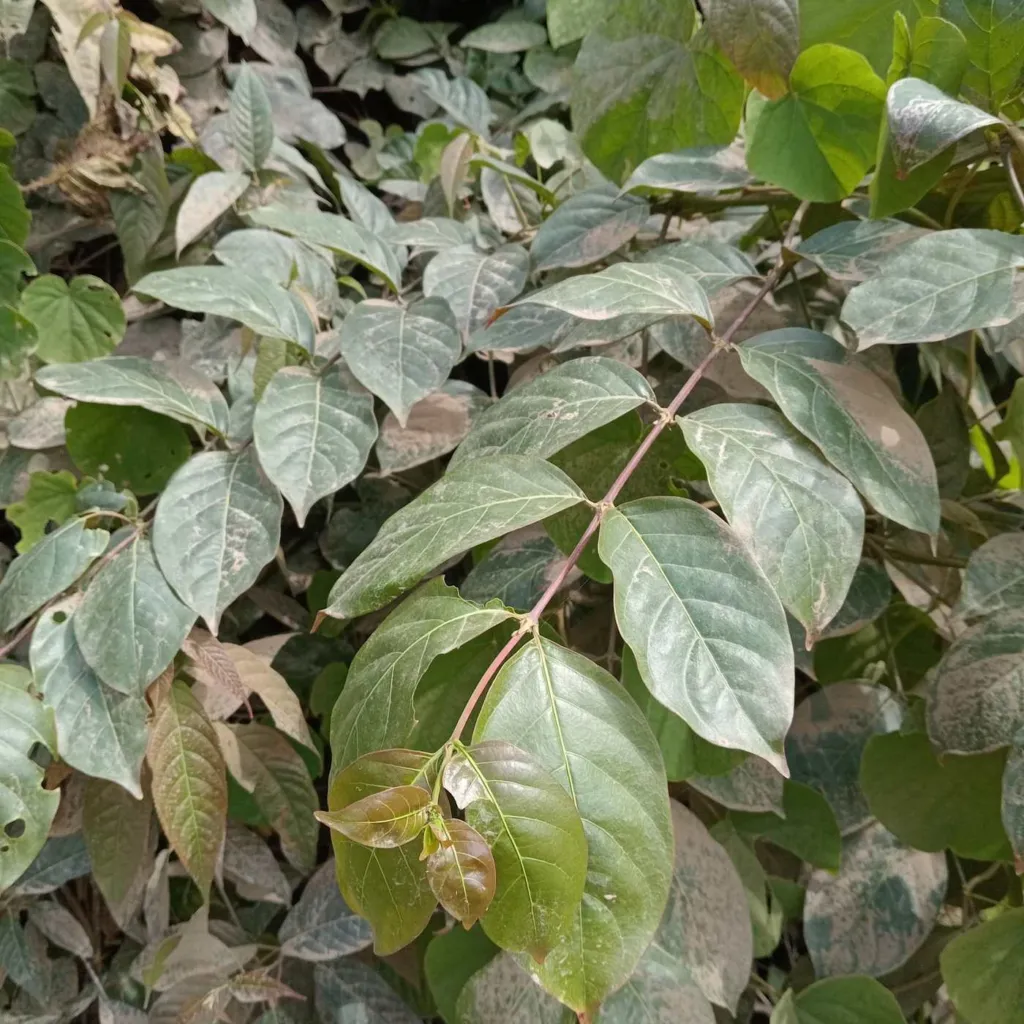
Cover: Uncaria tomentosa at Satipo, Junín, Peru. Photo: Alfredo Gutierrez Dipaz · CC BY 4.0 · iNaturalist
The Asháninka of central Peru have long boiled the bark of a hooked forest vine for joint pain and much else. Traditional In 2002 a small placebo-controlled trial suggested that a root extract of one chemical type of that vine eased painful joints in people with rheumatoid arthritis already on standard drugs; it has not been repeated. Evidence suggests In Australia the bark is sold in listed (AUST L) medicines, though few buyers know that “cat’s claw” names more than one plant. Attested
This is AIP Literature Review and Critical Analysis AIP-LR-UNCTOM in the Australian Institute of Pharmacognosy’s series of literature reviews and critical analyses. It introduces Uncaria tomentosa (Willd. ex Schult.) DC., the Amazonian vine sold here as cat’s claw. It covers the other plants that answer to the name, among them a Queensland weed and a desert acacia; the botany; Asháninka and wider Amazonian use; the two alkaloid chemotypes and why some labels say “TOA-free”; the pharmacology; the small human trials and how far they go; the European Medicines Agency’s conclusions; safety and interactions; quality; and, in Australia, the law, the AUST L label and the Peruvian forest the bark comes from.
This article is educational. It is not medical, legal or regulatory advice, and it is not an advertisement. Products are named only for what their public ARTG records say; nothing here recommends or discourages any product. The Institute’s associated clinic dispenses herbal medicines, which can include cat’s claw, to its own patients. No manufacturer, sponsor or supplier funded, reviewed or saw this article.
1. Pregnancy and fertility. Safety in pregnancy and breastfeeding has not been established, and the plant has a traditional reputation as a contraceptive. Avoid it in pregnancy, while breastfeeding, when trying to conceive and in children. Evidence suggests
2. Autoimmune disease, transplants and immunosuppressants. Cat’s claw is promoted as an immune stimulant, and two cases of kidney inflammation have been reported. Seek individual advice first. Mechanism
3. Other medicines. Laboratory studies show effects on CYP3A4 and drug transporters, and single cases describe raised HIV-medicine levels and worse Parkinson’s control; its alkaloids lower blood pressure in animals. Anyone on anticoagulants, blood-pressure medicines, regular prescription medicines or facing surgery should have it reviewed first. Evidence suggests
4. Leukaemia and cancer treatment. In one laboratory study a cat’s claw product helped leukaemic cells survive. With a blood cancer, or during any cancer treatment, seek individual advice first and tell the oncology team. Evidence suggests
5. Buy products entered on the ARTG. An unlabelled overseas “cat’s claw” blend has been linked to a severe hospital admission; its contents were never identified. Evidence suggests
Emergency: call Triple Zero (000). For a suspected poisoning or overdose, call the Poisons Information Centre on 13 11 26 (24 hours, Australia-wide). Report suspected side effects to the TGA (TGA, reporting adverse events). Before taking any botanical drug, consult a degree-qualified herbalist with competencies and adequate training in pharmacognosy.
| Botanical name | Uncaria tomentosa (Willd. ex Schult.) DC. (1830), Rubiaceae. Basionym Nauclea tomentosa Willd. ex Schult. (1819) Attested §2 |
| Common names | Cat’s claw, uña de gato, savéntaro (Asháninka). Also used for U. guianensis; unrelated to cat’s claw creeper Attested §2 |
| Look-alikes | U. guianensis (Amazon); gou teng, U. rhynchophylla and four others (China) Attested §2 |
| Same name, other plants | Cat’s claw creeper, Dolichandra unguis-cati (a declared Queensland weed); catclaw acacia, Senegalia greggii (a North American desert shrub) Attested §2 |
| Part used | Stem bark, root bark or root; Australian products use stem bark Attested §3 |
| In Australia | Not native or naturalised; native relatives U. lanosa and U. cordata grow in north Queensland Attested §3 |
| Tradition | Asháninka and wider Amazonian use for inflammation, arthritis, stomach complaints, wounds; avoided in pregnancy Traditional §4 |
| Chemistry | Pentacyclic (POA) or tetracyclic (TOA) oxindole alkaloid chemotypes; quinovic acid glycosides; proanthocyanidins Confirmed §5 |
| “TOA-free” | Rests on one 1998 cell study suggesting TOAs oppose POAs; never tested in people Evidence suggests §5 |
| Pharmacology | NF-κB and cytokine effects in cells and animals; TOAs lower blood pressure in animals Evidence suggests §6 |
| Rheumatoid arthritis | One small placebo-controlled trial of a POA root extract, added to standard drugs: fewer painful joints, swelling unchanged Evidence suggests §7 |
| Osteoarthritis | Trials used U. guianensis: one small positive, two combinations without a clear placebo difference Evidence suggests §7 |
| EMA (overseas) | No EU herbal monograph: evidence and documented tradition insufficient; no safety concern at traditional doses Attested §8 |
| Safety | Mild stomach upset in trials; single case reports of kidney inflammation and raised liver enzymes; low acute toxicity in animals, no human overdose data; avoid in pregnancy and in children; interaction cautions Evidence suggests §9 |
| Australian law | Permissible ingredient (item 5097); ARTG-listed (AUST L); not in the Poisons Standard; U. guianensis not permitted Attested §11 |
| Sourcing | Historically wild-harvested, mainly in Peru; exports peaked at 727 tonnes in 1995; Peru restricted raw-bark exports in 1999; ARTG records do not state origin Attested §11 |
| Emergency | Triple Zero (000); Poisons Information Centre 13 11 26 Attested §9 |
- Confirmed Established in humans by trial, or an unambiguous analytical or chemical fact.
- Evidence suggests Real published data, but preclinical, observational, small, inconsistent or not independently replicated.
- Mechanism A plausible mechanistic or pharmacological inference about how something works, short of a measured outcome.
- Traditional Historical or ethnobotanical use. Evidence of practice. Efficacy is a separate question.
- Attested A documentary fact attested in a named record: a legislative instrument, a regulator’s register or report, a taxonomic index, a biodiversity database or a published text. It states what the record says.
- Unsourced A statement the Institute could not trace to a source it was able to open and read, flagged so no reader mistakes it for a sourced claim.
Every PubMed ID (PMID) below links to its record and was checked against PubMed in October 2026, and every paper cited by PMID was read in full text. Trial reports the Institute could not open in full are described through the EMA assessment report and other papers read in full, and have been requested through the Institute’s library. Every compound was checked against PubChem and is linked by CID. Every Australian regulatory statement was read from the regulator’s or the legislature’s own document or database in October 2026. European and US material is overseas and does not govern Australia.
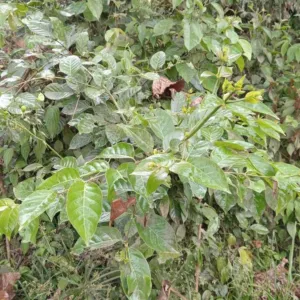
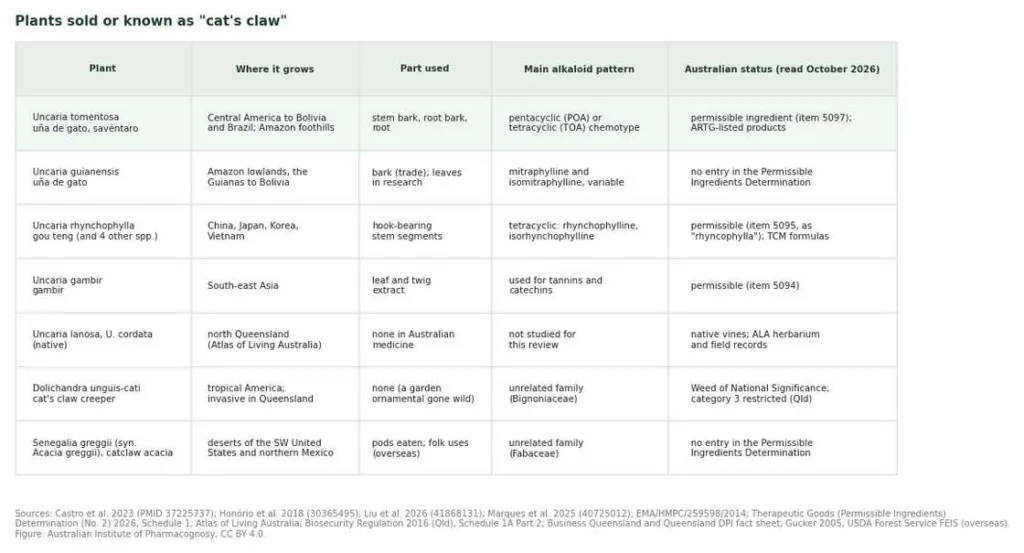
The plant. Cat’s claw is the bark of Uncaria tomentosa, a hooked liana of the Amazon and its foothills. A second Amazonian species, U. guianensis, is sold under the same name, and Chinese gou teng is a different Uncaria medicine. Cat’s claw creeper, a declared weed in Queensland, and catclaw acacia, an American desert shrub, share only the name. Attested
The chemistry. U. tomentosa comes in two chemical types, rich in either pentacyclic or tetracyclic oxindole alkaloids, and alkaloid content varies a hundredfold. Some studied extracts contain almost no alkaloid. “TOA-free” on a label traces back to a single cell study and tells you nothing about the rest of the chemistry. Evidence suggests
The evidence. One small, well-run trial found a pentacyclic root extract reduced painful joints in rheumatoid arthritis when added to standard drugs. The knee osteoarthritis trials used U. guianensis. Europe’s herbal committee found the evidence too thin for an official monograph, and found no safety concern at traditional doses. Evidence suggests
Before taking it. Avoid it in pregnancy, breastfeeding, when trying to conceive and in children. With an autoimmune disease, a transplant, anticoagulants or other regular medicines, consult a degree-qualified herbalist with competencies and adequate training in pharmacognosy first. Choose products with an AUST L number, and check the species on the label. Historically the bark came mostly from wild vines in Peru, which has restricted raw-bark exports since 1999. Australian ARTG records do not say where a product’s bark came from, so ask the sponsor.
 Chapter 1A vine most Australians have never met
 Chapter 2Which plant is cat’s claw?
 Chapter 3Botany and Australian status
 Chapter 4Traditional use
 Chapter 5Phytochemistry and “TOA-free”
 Chapter 6Pharmacology
 Chapter 7Clinical evidence
 Chapter 8What the EMA concluded
 Chapter 9Safety and interactions
 Chapter 10Quality and adulteration
 Chapter 11In Australia: law, label, forest
 Chapter 12Discussion and research agenda
1. A vine most Australians have never met
In the foothill forests where the Andes fall into the Amazon, there is a woody climber with paired, down-curved thorns at every leaf joint. Spanish speakers call it uña de gato, the cat’s claw. The Asháninka people of the Peruvian central forest call the plant they value most savéntaro (PMID 40725012). Attested Its bark has been boiled into a bitter tea for joint pain, stomach complaints, wounds and much else, for as long as anyone has written about the region’s medicine (EMA/HMPC assessment report 2015). Traditional
Very few Australians could pick the plant out of a line-up, yet it is already on our shelves. A keyword search of the Australian Register of Therapeutic Goods (ARTG) for “uncaria tomentosa”, run by the Institute in October 2026, returned 16 entries (ARTG searches, October 2026). Attested Two are practitioner-only cat’s claw tablets made from the stem bark; the rest are blends in which cat’s claw sits beside glucosamine, echinacea, berberine, quercetin or a dozen other ingredients (ARTG 331071; ARTG 519127; ARTG 313806). Attested The first cat’s claw product reached the register in May 1997 (ARTG 59852). Attested
So the plant is quietly legal and quietly available. What a buyer seldom gets is an account of what it is. The common name covers several different plants. The main species exists in two chemical forms that behave differently in the laboratory. The human trials are few and small. And Europe’s herbal medicines committee looked at all of it in 2015 and decided it could not write an official monograph. This review introduces the plant properly, starting with the vine and the people who first used it and ending with the Australian label and the Peruvian forest the bark comes from. Traditional use is reported with respect and tagged as tradition. Trial evidence is tagged as trial evidence. The two are kept apart throughout.
2. Identity and taxonomy: which plant is “cat’s claw”?
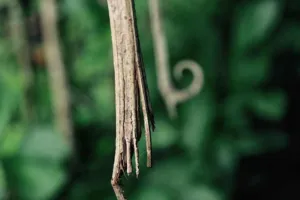
The genus Uncaria belongs to the coffee family, Rubiaceae, and holds about 34 species: 29 in Asia, three in Africa and two in the Americas (PMID 37225737). Attested Every one of them is a climber with the same signature, pairs of hook-shaped thorns formed from aborted flower stalks (PMID 37225737). Attested The two American species are the ones sold as cat’s claw.
The two Amazonian species
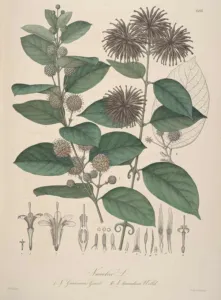
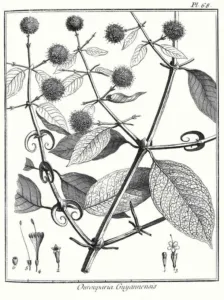
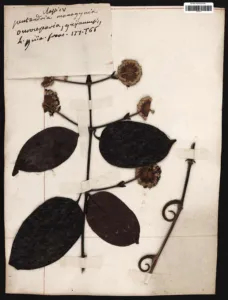
Uncaria tomentosa (Willd. ex Schult.) DC. was first published as Nauclea tomentosa Willd. ex Schult. in 1819 and moved to Uncaria by Augustin Pyramus de Candolle in 1830 (Prodromus 4: 349) (IPNI). Attested The epithet tomentosa means downy: the buds and stipules are densely hairy (PMID 40725012). Attested Uncaria guianensis (Aubl.) J.F.Gmel. is older. Jean-Baptiste Fusée-Aublet described it as Ourouparia guianensis from French Guiana in 1775, and J.F. Gmelin moved it into Uncaria in 1791 (IPNI). Attested
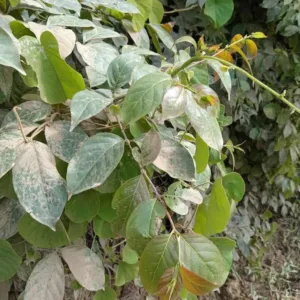
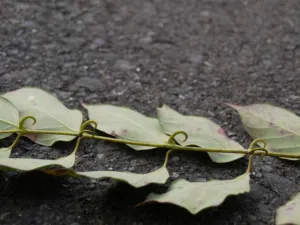
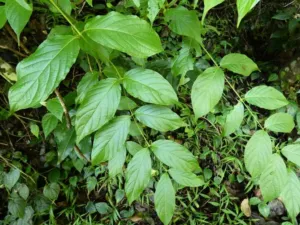
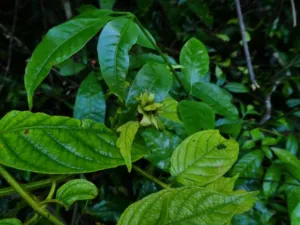
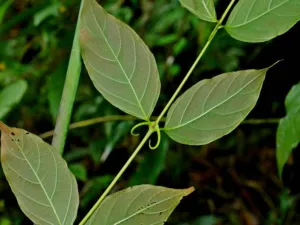
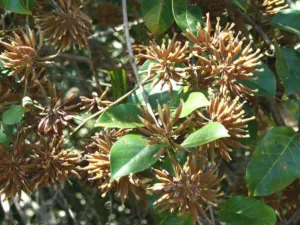
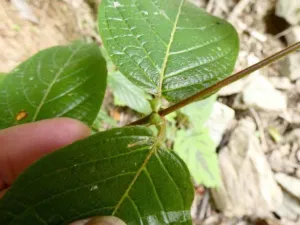
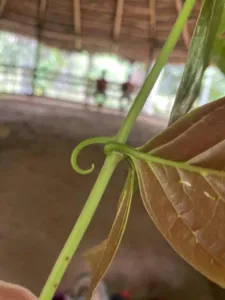
The two are easy to confuse. Both are woody Amazonian lianas, both carry hooked thorns, and both are sold dried and chopped under the one name. Researchers who sequenced the chloroplast genomes of both species in 2023 noted that traders buying dried material from forest communities find it hard to tell them apart, and that some Indigenous communities call U. tomentosa the true cat’s claw while others give that name to U. guianensis (PMID 37225737). Attested In the field, U. tomentosa has thorns that run from straight to sickle-shaped (PMID 40725012) Attested; U. guianensis is a smaller vine of 5 to 10 metres (PMID 30365495) Attested whose hooks, in the photographs here, curl much more tightly.
The difference matters for the evidence. As chapter 7 shows, every knee osteoarthritis trial of a cat’s claw extract used U. guianensis, and the rheumatoid arthritis trials used U. tomentosa. The European Medicines Agency (EMA) records that the two species are marketed interchangeably, that U. tomentosa is generally preferred for its higher alkaloid content, and that overharvesting of U. tomentosa has made the lower-growing U. guianensis a common adulterant (EMA/HMPC assessment report 2015). Attested
Gou teng and gambir
Across the Pacific, a different set of Uncaria species is a long-standing Chinese medicine. Gou teng is the hook-bearing stem of Uncaria rhynchophylla (Miq.) Miq. ex Havil.; the Chinese Pharmacopoeia accepts it together with U. hirsuta, U. macrophylla, U. sessilifructus and U. sinensis (PMID 37225737; PMID 41868131). Attested In Chinese medicine it is used to calm “Liver Wind” and “Liver Yang Rising”, conditions which the tradition associates with tremor, convulsions, dizziness and high blood pressure, and it sits in classic formulas such as Tianma Gouteng Yin (PMID 41868131). Traditional It is a separate medicine with a separate tradition and a different chemistry, and the cat’s claw trials say nothing about it.
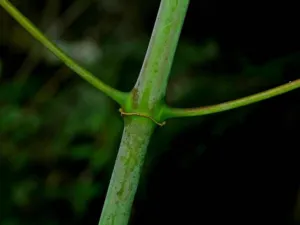
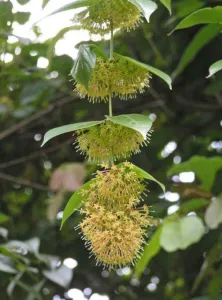
A fourth species, Uncaria gambir, gives the dark astringent extract called gambir, used in South-east Asia for tanning and betel chewing; Australia lists it as a permissible ingredient in its own right (Permissible Ingredients Determination). Attested The word “gambir” has also been borrowed as an English label for gou teng: one Australian Chinese-medicine formula is entered on the ARTG as “Gastrodia & Gambir Combination”, while its ingredient list names the stem of Uncaria rhyncophylla (ARTG 351363). Attested
Three plants that share only the name
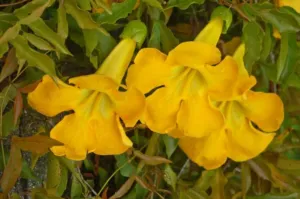
Ask a Queenslander about cat’s claw and you may hear about a weed. Cat’s claw creeper, Dolichandra unguis-cati (L.) L.G.Lohmann, was named by Linnaeus in 1753 as Bignonia unguis-cati and belongs to the jacaranda family, Bignoniaceae (IPNI). Attested It is a tropical American climber once planted as an ornamental in Queensland gardens. Its “claw” is a three-pronged tendril between a pair of leaflets, its flowers are large yellow trumpets, and in the wild it smothers native vegetation, rainforest included (Business Queensland, cat’s claw creeper). Attested It is recognised as a Weed of National Significance and is a category 3 restricted invasive plant under the Biosecurity Act 2014 (Qld), so it must not be given away, sold or released into the environment (Queensland DPI fact sheet; Biosecurity Regulation 2016 (Qld)). Attested A tingid bug, a leaf-tying moth and a leaf-mining jewel beetle have been released against it as biological control agents (Business Queensland, cat’s claw creeper). Attested It has no place in herbal medicine, and nothing in this review applies to it.
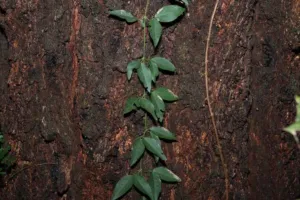
North America has its own cat’s claw, and it is a shrub. Catclaw acacia was described by Asa Gray in 1852 as Acacia greggii and is now Senegalia greggii (A.Gray) Britton & Rose, a name published in 1928 (IPNI). Attested It grows in the deserts of southern California, Arizona, western Texas, Baja California and northern Mexico, with smaller populations in Nevada, Utah and New Mexico, and its branches carry short, stout, curved spines; other common names include devilsclaw and Gregg catclaw (USDA Forest Service FEIS). Attested A US Forest Service species review records that the Akimel O’odham and Cahuilla peoples ate its seeds and pods, and cites a North American herbal writer for uses of its leaves, pods and roots (USDA Forest Service FEIS). Traditional It is a legume, chemically unrelated to Uncaria, and has no entry in Australia’s Permissible Ingredients Determination (Permissible Ingredients Determination). Attested A reader working from an American herbal book should check which catclaw the author means.
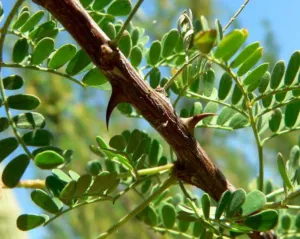
The thread running through all of these is the thorn. Hooked spines, three-pronged tendrils and curved prickles all suggest a cat’s claw, and common names follow what a plant looks like, wherever it grows. The binomial is what separates them. The same habit of naming a plant for its hooks gave us devil’s claw, an African root reviewed earlier in this series.
3. Botany, distribution and Australian status
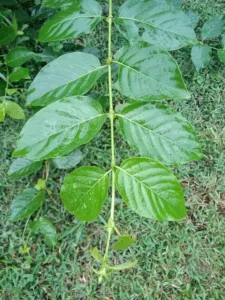
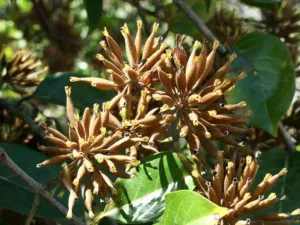
Uncaria tomentosa is a large scrambling liana that can run 20 to 30 metres through the forest, with a main stem up to 25 centimetres across (EMA/HMPC assessment report 2015). Attested It grows from Belize and Guatemala south to Peru, Bolivia and Brazil, and east to Venezuela, Trinidad and Suriname, in tropical low mountain forest; reported altitude ranges differ between sources, from up to about 600 metres in the EMA’s account to 600–1,000 metres in a 2025 review (EMA/HMPC assessment report 2015; PMID 40725012). Attested The flowers are small, yellowish-white and gathered into round heads (PMID 40725012). Attested U. guianensis is a lowland Amazonian species, recorded from Bolivia, Brazil, Colombia, Ecuador, the Guianas, Peru, Suriname and Venezuela (PMID 30365495). Attested
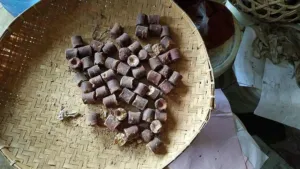
The bark is the traded part. It comes from the stem, the root or both, and the literature is often vague about which. In the 35 primary pharmacology studies the EMA reviewed, 19 said only “bark” and 7 did not name the part at all (EMA/HMPC assessment report 2015). Attested The WHO monograph defines the drug as dried stem bark; the United States Pharmacopeia specifies inner stem bark; the German Hagers Handbuch describes root bark (EMA/HMPC assessment report 2015). Attested All three are overseas definitions. The Australian products we read on the ARTG use stem bark (ARTG 331071; ARTG 519127). Attested
In Australia
Neither Amazonian species grows wild here. The Atlas of Living Australia (ALA), searched by the Institute in October 2026, holds no record of U. guianensis; it holds a pair of 2023 sightings entered as “Uncaria tomentosa” by a habitat restoration project in north-east New South Wales, which the ALA itself could match only to the genus (Atlas of Living Australia). Attested Neither name appears in the Australian Plant Census name list used by the ALA (Atlas of Living Australia). Attested The Institute treats both sightings as unverified; without a specimen there is no way to tell them from the native species below.
Because Australia does have its own cat’s claws. The ALA holds 170 Queensland records in the genus, most of them herbarium specimens of Uncaria lanosa var. appendiculata (Benth.) Ridsdale and Uncaria cordata var. cordata (Atlas of Living Australia). Attested Thirteen of those records fall within 60 kilometres of Cardwell, every one of them U. lanosa var. appendiculata (Atlas of Living Australia). Attested They are rainforest vines of the Wet Tropics with the family hooks. They have no recorded place in Australian herbal medicine, and nothing in this review applies to them.
4. Traditional and historical use
Everything in this chapter is traditional knowledge: evidence that people used the plant and how, and evidence of nothing else. It deserves the respect any long medical tradition deserves, and the same refusal to treat it as proof of effect.
Savéntaro
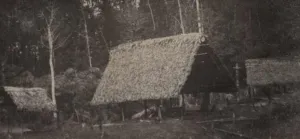
The longest recorded history of use belongs to the Asháninka of central Peru (EMA/HMPC assessment report 2015). Traditional The uses the EMA collected from the ethnobotanical literature are broad: inflammation, arthritis and rheumatism, gastric ulcer and diarrhoea, asthma, wounds, acne, diabetes, urinary complaints, menstrual irregularity, recovery after childbirth, cancer, and a general tonic against disease (EMA/HMPC assessment report 2015). Traditional Peruvian healers also combined it with other forest barks, such as chuchuhuasi, for arthritis (EMA/HMPC assessment report 2015). Traditional A related tradition uses U. guianensis for wounds, as a sedative and for bowel complaints, and regards it as weaker (EMA/HMPC assessment report 2015). Traditional
Two details stand out. A 2025 review, drawing on Keplinger and colleagues’ fieldwork, reports that Asháninka healers use only vines of the pentacyclic alkaloid type, and that savéntaro means “potent plant” (from saveshi, plant, and anteáro, potent) (PMID 40725012). Traditional If that report is right, the healers were sorting chemotypes by eye or by effect long before anyone had a chromatograph, and chapter 5 explains why that would matter. The same review says the plant has been used “for at least 2000 years” (PMID 40725012); the Institute could find no dated evidence behind that figure. Unsourced
The second detail is about women’s health. Peruvian sources describe very concentrated root decoctions taken during menstruation for three months as a contraceptive, said to prevent pregnancy for three or four years, and the plant was traditionally avoided in pregnancy, during breastfeeding and in children (EMA/HMPC assessment report 2015). Traditional Those are claims of tradition. They are also the reason chapter 9 takes pregnancy seriously.
How it was prepared
The usual preparation is a decoction. One Peruvian recipe boils 20 grams of sliced root bark in a litre of water for 45 minutes; the bitter liquid is a ten-day supply (EMA/HMPC assessment report 2015). Traditional Keplinger and colleagues analysed decoctions made this way and estimated that they deliver about 4 milligrams of oxindole alkaloids a day (EMA/HMPC assessment report 2015). Attested That figure is useful. It gives a measured link between how the tradition used the plant and the chemistry that later drew the laboratories in.
Who used it, and where
A 1999 report prepared with Peru’s natural resources agency (INRENA), USAID and the Center for International Forestry Research (CIFOR) traced the same history from the Peruvian side. Medicinal use had been recorded among the Asháninka of the Chanchamayo, Perené and Tambo valleys and among the Yanesha of the Palcazu valley; U. guianensis was recorded among the Bora near the Colombian border and, in Brazil, among the Ka’apor (CIFOR Occasional Paper 22 (1999)). Traditional The bark was boiled as a decoction of inner bark or root bark, or left to soak in local sugarcane spirit, which draws out more of the alkaloids than water (CIFOR Occasional Paper 22 (1999)). Traditional The authors were frank that nobody can say who first found the plant’s value, and thought the knowledge had long been shared among many groups in the region (CIFOR Occasional Paper 22 (1999)). Attested The same rainforest pharmacy produced sangre de grado, the red latex of Croton lechleri, reviewed earlier in this series.
From the forest to Europe
The CIFOR report records that Arthur Brell, who settled in Peru in 1926, saw Asháninka women using a plant he took to be uña de gato as a contraceptive, and that Klaus Keplinger received specimens through Oscar Schuler, a German long resident in Peru, and took them to Innsbruck (CIFOR Occasional Paper 22 (1999)). Attested According to the EMA, the first scientific study in Peru was made by Brell in 1950; Klaus Keplinger, in Austria, took up the plant in the 1970s (EMA/HMPC assessment report 2015). Attested His work produced extracts sold in Austria and Germany and four US patents on oxindole alkaloid extraction and immune effects, and the commercial demand that followed thinned wild U. tomentosa in the Peruvian forests (EMA/HMPC assessment report 2015). Attested By the 1990s cat’s claw was being used in Peru and Europe alongside treatment for cancer and HIV (EMA/HMPC assessment report 2015). Traditional Austria authorised a root extract as an add-on medicine for rheumatoid arthritis in 2000; the authorisation was withdrawn in 2015 (EMA/HMPC assessment report 2015). Attested Spain and Hungary have sold stem bark preparations as traditional or “healing” products since 1998 to 2001 (EMA/HMPC assessment report 2015). Attested
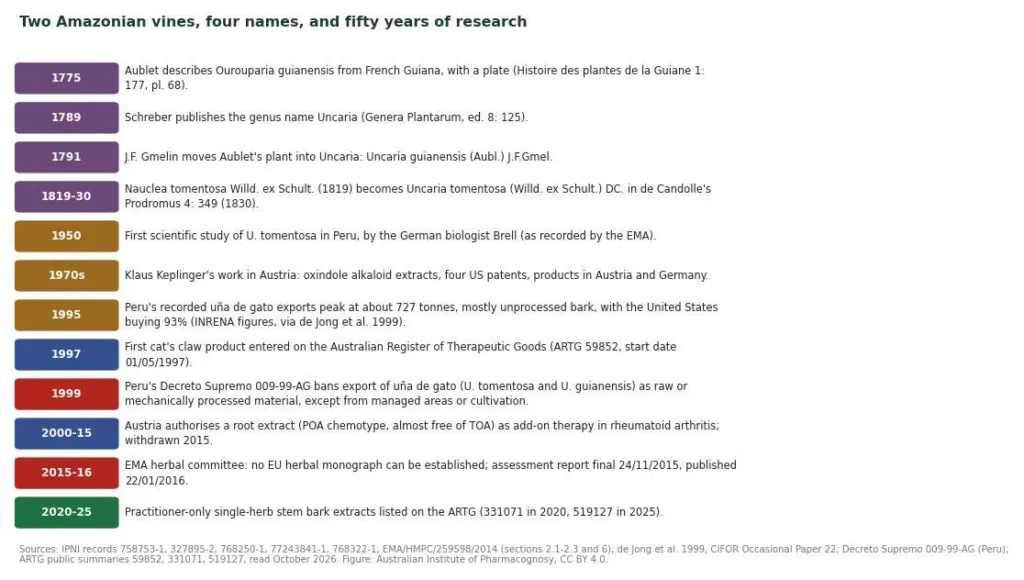
The question of who benefits from that history is a live one. The 1999 report listed three US patents granted to Keplinger and colleagues on oxindole alkaloids, in 1989, 1990 and 1994, and set out the argument made in Peru that communities whose knowledge pointed researchers to the plant should be compensated; it also noted how hard that would be when the knowledge is spread across many peoples and several countries (CIFOR Occasional Paper 22 (1999)). Attested None of the documents read for this review records how, or whether, Asháninka or other Amazonian communities now share in the trade. That is a gap in the evidence, and the Institute names it as one.
5. Phytochemistry: two alkaloid patterns in one species
About 50 compounds have been isolated from U. tomentosa (EMA/HMPC assessment report 2015). Confirmed The EMA groups the main classes as oxindole and indole alkaloids (0.15 to 4.6 per cent of the bark), quinovic acid glycosides, pyroquinovic acid glycosides, organic acids, proanthocyanidins, plant sterols and polyoxygenated triterpenes (EMA/HMPC assessment report 2015). Confirmed Two pyroquinovic acid glycosides, tomentosides A and B, were first found in this species and can serve as its markers (EMA/HMPC assessment report 2015). Confirmed
Pentacyclic and tetracyclic
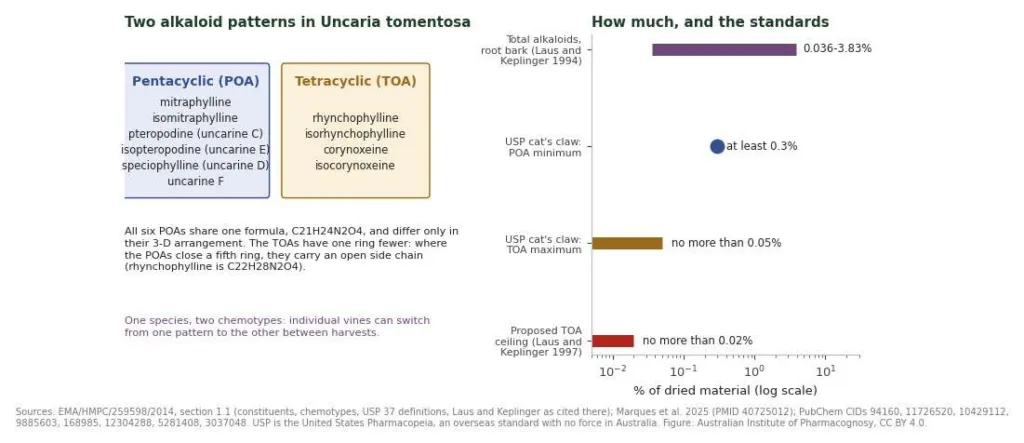
The alkaloids are where the story turns. U. tomentosa makes two kinds of oxindole alkaloid. The pentacyclic oxindole alkaloids (POAs) have five rings: mitraphylline, isomitraphylline, pteropodine (uncarine C), isopteropodine (uncarine E), speciophylline (uncarine D) and uncarine F (PMID 40725012). Confirmed All six share one molecular formula, C21H24N2O4; they differ only in the three-dimensional arrangement of their atoms (CID 94160; CID 10429112). Confirmed The tetracyclic oxindole alkaloids (TOAs) have four rings and an open side chain: rhynchophylline, isorhynchophylline, corynoxeine and isocorynoxeine (PMID 40725012). Confirmed Rhynchophylline and isorhynchophylline are also the main alkaloids of Chinese gou teng (PMID 41868131). Confirmed
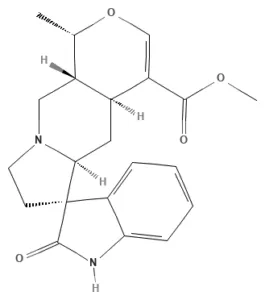
C21H24N2O4 · pentacyclic oxindole; a marker of both Amazonian species
PubChem CID 94160 · structure image: PubChem, public domain
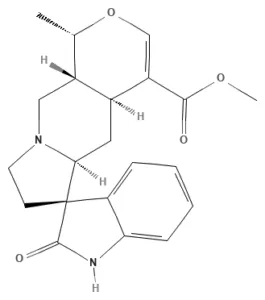
C21H24N2O4 · pentacyclic oxindole
PubChem CID 11726520 · structure image: PubChem, public domain
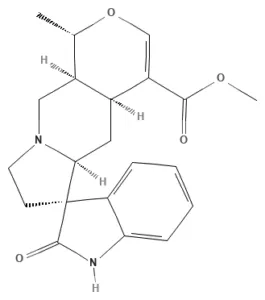
C21H24N2O4 · pentacyclic oxindole
PubChem CID 10429112 · structure image: PubChem, public domain
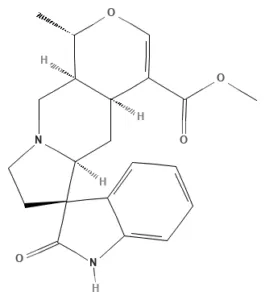
C21H24N2O4 · pentacyclic; the USP assay reference
PubChem CID 9885603 · structure image: PubChem, public domain
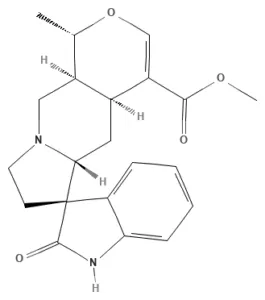
C21H24N2O4 · pentacyclic oxindole
PubChem CID 168985 · structure image: PubChem, public domain
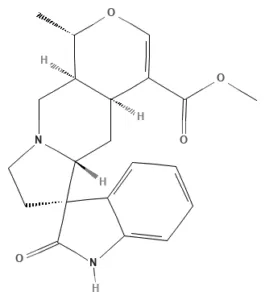
C21H24N2O4 · pentacyclic oxindole
PubChem CID 12304288 · structure image: PubChem, public domain
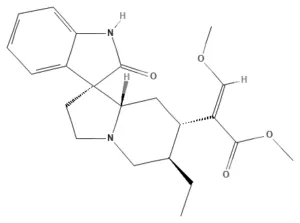
C22H28N2O4 · tetracyclic oxindole; also the main gou teng alkaloid
PubChem CID 5281408 · structure image: PubChem, public domain
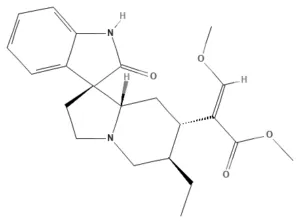
C22H28N2O4 · tetracyclic oxindole
PubChem CID 3037048 · structure image: PubChem, public domain
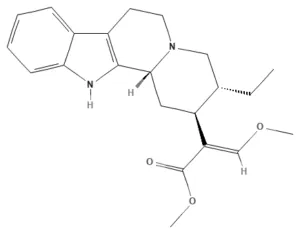
C22H28N2O3 · tetracyclic indole alkaloid
PubChem CID 3037884 · structure image: PubChem, public domain
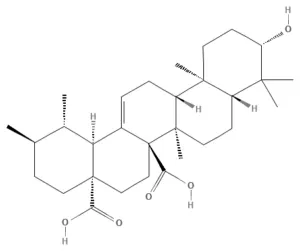
C30H46O5 · triterpene aglycone of the quinovic acid glycosides
PubChem CID 120678 · structure image: PubChem, public domain
Ten constituents of cat’s claw bark: the six pentacyclic oxindole alkaloids (one formula, six shapes), two tetracyclic oxindoles, the indole alkaloid hirsutine and the triterpene quinovic acid. Every CID was checked against PubChem in October 2026; the depictions are PubChem’s own (US National Library of Medicine, public domain), background whitened and cropped by the Institute.
Individual vines lean heavily one way or the other. The EMA describes two chemotypes, one dominated by POAs and one rich in TOAs, and records Laus and Keplinger’s finding that total alkaloid content in root bark ranged from 0.036 to 3.83 per cent between harvests, with single plants switching from one pattern to the other over time (EMA/HMPC assessment report 2015). Confirmed A hundredfold range in content, and a pattern that can flip, is a quality problem before it is anything else.
Manufacturers care about the pattern. The Austrian rheumatoid arthritis product was specified to contain at least 13 mg/g POA and at most 0.5 mg/g TOA, and the extract used in the main rheumatoid arthritis trial contained 14.7 mg/g POA and no measurable TOA (EMA/HMPC assessment report 2015). Attested
Why some labels say “TOA-free”
The phrase goes back to a 1998 cell study and the rule of thumb built on it. Wurm and colleagues treated human endothelial cells with pentacyclic alkaloids, collected the fluid the cells released, and found it changed the growth of lymphocytes; tetracyclic alkaloids reduced that effect in proportion to their dose (EMA/HMPC assessment report 2015). Evidence suggests From that work came the statement, repeated in reference books, that bark mixing the two chemotypes is unsuitable for therapeutic use unless certified to contain less than 0.02 per cent TOA (EMA/HMPC assessment report 2015). Attested Makers who select vines or process the bark to exclude tetracyclic alkaloids can then sell the product as “TOA-free”. One overseas extract, tested in the laboratory against the Lyme disease bacterium, is described in a 2018 pharmacology paper simply as “a TOA-free extract from Uncaria tomentosa” (PMID 30602711). Attested
The phrase tells a buyer that one class of alkaloid was kept out. It says nothing about how much pentacyclic alkaloid is left, which part of the plant was used, or whether the product behaves differently in the body. The antagonism behind it has been shown in one cell system, and no study in people has compared a TOA-free product with a mixed one. Mechanism The EMA report also notes that one tetracyclic alkaloid, isorhynchophylline, stimulated phagocytosis in an earlier experiment, while its isomer rhynchophylline did not (EMA/HMPC assessment report 2015). Evidence suggests So the tetracyclic alkaloids do not act as a single block. None of the Australian ARTG summaries read for this review describes its product as TOA-free or states any alkaloid content (chapter 11). Attested
The standards, and the extracts with almost no alkaloid
The United States Pharmacopeia (USP), an overseas standard with no force in Australia, defines cat’s claw as inner stem bark with at least 0.3 per cent POAs and no more than 0.05 per cent TOAs, and sets an extract standard of 4:1 to 6:1 assayed for the six named POAs (EMA/HMPC assessment report 2015). Attested Some studied extracts went the other way entirely. A patented hot-water extract used in several US immune studies is standardised to 8–10 per cent “carboxy alkyl esters” and contains 0.05 per cent oxindole alkaloids or less (EMA/HMPC assessment report 2015). Attested The U. guianensis extract used in two osteoarthritis trials was a water extract limited to 0.3 mg/g oxindole alkaloids, chosen that way because its makers regarded the alkaloids as immune-stimulating and therefore unwanted for joint inflammation (PMID 16242032). Attested One plant name, then, has been used for preparations rich in alkaloids, preparations nearly free of them, and preparations from a different species.
U. guianensis is variable too. In 2018 Honório and colleagues measured mitraphylline and isomitraphylline, regarded as its chemical markers, in leaves from eight wild Brazilian populations; 68 per cent of individual plants contained neither (PMID 30365495). Confirmed Leaves are not bark, and the result cannot be carried straight across to commercial material. It does show how little a species name guarantees.
The non-alkaloid fractions matter as well. Quinovic acid glycosides (CID 120678 is the aglycone) and proanthocyanidins are present in quantity, and the EMA lists alkaloids, quinovic acid glycosides and polyhydroxylated triterpenes as the three groups thought to carry the activity (EMA/HMPC assessment report 2015). Mechanism Water extracts that are nearly free of alkaloids still show anti-inflammatory activity in cell studies (chapter 6), which suggests the alkaloids are only part of the picture. Mechanism
6. Pharmacology
Most of what is known about how cat’s claw acts comes from cells and animals. That evidence is real and useful for designing trials. It tells us nothing about benefit in people until a trial confirms it.
Inflammation
The anti-inflammatory work centres on NF-κB, a transcription factor that switches on many inflammatory genes. A hot-water bark extract blocked NF-κB activation and the induction of inducible nitric oxide synthase in cultured gut and immune cells, and protected them from oxidant-induced death; a micropulverised bark decoction suppressed tumour necrosis factor (TNF-α) production by mouse macrophages by 65 to 85 per cent at very low concentrations (EMA/HMPC assessment report 2015). Evidence suggests
A 2024 systematic review and meta-analysis by Arado and colleagues pooled 24 animal studies of U. tomentosa extracts in inflammatory disease models. The extracts lowered interleukin-6 (standardised mean difference −0.72) and NF-κB (−1.19), and did not significantly change interleukin-1, interleukin-10 or TNF-α (PMID 38881881). Evidence suggests Mixed results across cytokines, from many different extracts, in animals: a consistent signal on some pathways and none on others. A German expert group reading the same literature in 2026 judged that the anti-inflammatory and immune effects seen in cells and animals have not yet been shown to translate into anti-inflammatory or disease-modifying effects in patients (PMID 42448806). Attested
The immune system
Cat’s claw’s reputation as an immune stimulant comes from Keplinger’s work on the POAs, and from the cell study described in chapter 5 (EMA/HMPC assessment report 2015). Evidence suggests The human data on immune markers are thin: small studies with mixed results (chapter 7). The EMA called the immunostimulant effect “rather controversial” (EMA/HMPC assessment report 2015). Attested The two reputations sit together oddly. A plant marketed for calming inflammation and a plant marketed for stimulating immunity may be the same plant, or two chemotypes of it, or two different extracts. The label rarely says which.
The heart and blood vessels
The tetracyclic alkaloids act on the cardiovascular system. Rhynchophylline and isorhynchophylline lower blood pressure and relax blood vessels in animal studies, possibly through several calcium pathways, and TOA-chemotype alkaloids including hirsutine (CID 3037884) lowered blood pressure in rats (PMID 40725012). Evidence suggests Those actions underlie gou teng’s traditional place in Chinese formulas for high blood pressure (PMID 41868131). Mechanism They also suggest why a TOA-rich product could, in principle, add to the effect of blood-pressure medicines. Mechanism
How the body handles it, and other medicines
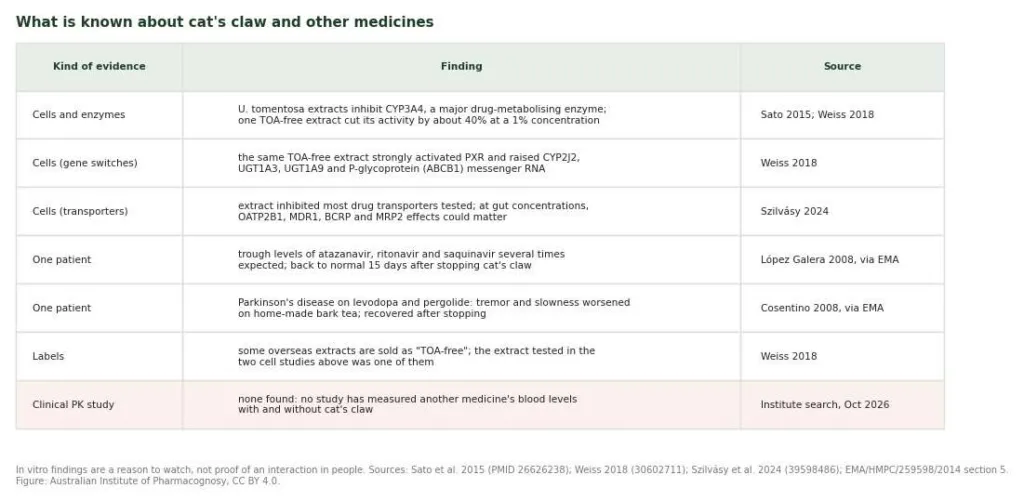
No pharmacokinetic study of cat’s claw in people was available to the EMA (EMA/HMPC assessment report 2015). Attested Laboratory studies point to several ways it could alter other medicines. Extracts inhibited CYP3A4, a major drug-metabolising enzyme, in two independent cell systems; one TOA-free commercial extract reduced CYP3A4 activity by about 40 per cent at a 1 per cent concentration (PMID 26626238; PMID 30602711). Evidence suggests The same extract strongly activated the pregnane X receptor (PXR), a switch that tells cells to make more drug-handling enzymes and transporters, and raised the messenger RNA for CYP2J2, two UGT enzymes and P-glycoprotein (PMID 30602711). Evidence suggests A 2024 study found that an extract inhibited most of the drug transporters tested, and calculated that effects on gut transporters such as OATP2B1, MDR1 (P-glycoprotein) and BCRP could be relevant at realistic intestinal concentrations (PMID 39598486). Evidence suggests Inhibition and induction pull in opposite directions, and which wins in a person is unknown. Chapter 9 turns these findings into practical cautions.
7. Clinical evidence: what the small trials show
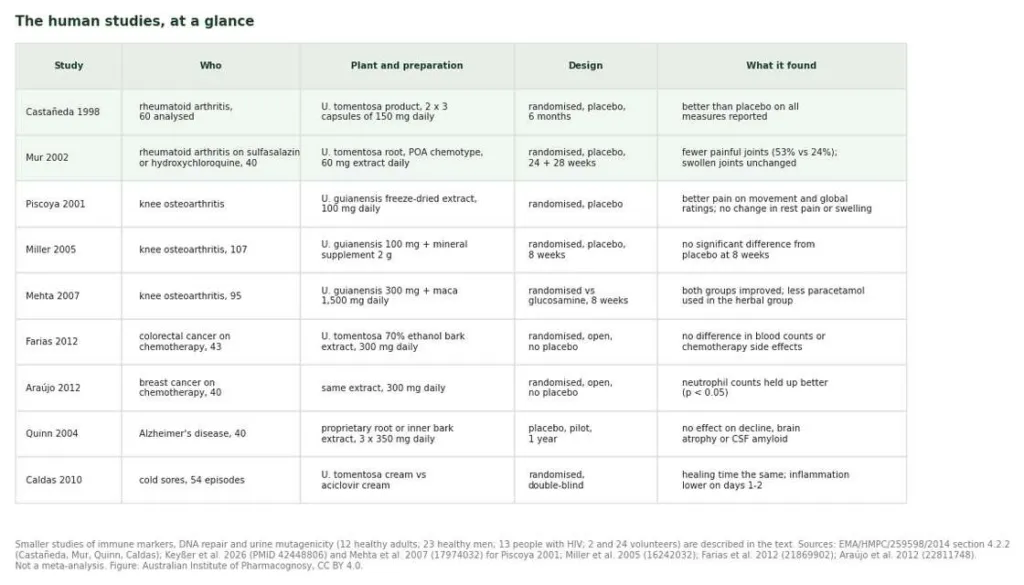
The EMA counted 12 human studies of U. tomentosa by 2014, with about 370 participants between them, spread across seven different questions and almost as many preparations (EMA/HMPC assessment report 2015). Attested Seven were randomised, six placebo-controlled and four double-blind; nearly half were open studies, and four had fewer than 20 participants (EMA/HMPC assessment report 2015). Attested Add the U. guianensis osteoarthritis trials and the record is still small enough to describe one study at a time. Two of the trial reports below (Mur 2002 and Piscoya 2001) were not available to the Institute in full text when this review was written; they are described through the EMA assessment report and other papers the Institute did read in full, and the originals have been requested.
Rheumatoid arthritis
The best-designed trial is Mur and colleagues’ 2002 study. Forty people with active rheumatoid arthritis, already taking sulfasalazine or hydroxychloroquine, were randomised to a root extract of the pentacyclic chemotype (20 mg capsules, three a day) or placebo for 24 weeks, after which everyone took the extract for another 28 weeks (EMA/HMPC assessment report 2015). Attested At 24 weeks the extract group had a larger fall in the number of painful joints (53.2 per cent against 24.1 per cent), tender joints, the Ritchie index and morning stiffness; swollen joints, patients’ own ratings of disease activity and pain, and laboratory markers of inflammation did not differ (EMA/HMPC assessment report 2015). Evidence suggests Adverse events occurred in 12 people in each group (EMA/HMPC assessment report 2015). Evidence suggests
That is a genuine positive signal from a properly controlled study, and it is small. With 37 people analysed, a few responders either way could move the result. Painful-joint counts respond to pain relief; swollen joints and blood markers are closer to the disease process, and they did not move. A German expert group reading the trial in 2026 noted that most of its participants were seronegative (PMID 42448806). Attested The trial has not been repeated in the 24 years since.
An earlier trial by Castañeda and colleagues (1998) randomised 70 people with rheumatoid arthritis, 60 analysed, to a U. tomentosa product (two capsules of 150 mg, three times a day) or placebo for six months, and reported large improvements in morning stiffness, pain and joint counts (EMA/HMPC assessment report 2015). Evidence suggests The EMA noted that the report gave no information about what the product contained (EMA/HMPC assessment report 2015). Attested An untraceable product makes a trial impossible to reproduce, whatever it found.
Osteoarthritis of the knee
There is no published placebo-controlled trial of U. tomentosa on its own in osteoarthritis among the sources the Institute read. The osteoarthritis evidence for “cat’s claw” is evidence for U. guianensis.
Piscoya and colleagues (2001) tested a freeze-dried water extract of U. guianensis at 100 mg a day against placebo in knee osteoarthritis (PMID 17974032; PMID 42448806). Attested As summarised by the German Society for Rheumatology’s committee, the extract improved physicians’ and patients’ global ratings and pain on movement, and did not change pain at rest or knee swelling (PMID 42448806). Evidence suggests The German summary calls the extract U. tomentosa; the investigators who used the same extract later identify it as U. guianensis (PMID 16242032; PMID 17974032). Attested It is a small example of the species muddle reaching even a specialist society’s review.
Two later trials used that extract in combinations. Miller and colleagues (2005) randomised 107 people with knee osteoarthritis to a silicate mineral supplement at two doses, the mineral plus 100 mg of the U. guianensis extract, or placebo, for eight weeks (PMID 16242032). Attested All four groups improved, the supplement groups faster, and none differed significantly from placebo on the main WOMAC scores at eight weeks (PMID 16242032). Evidence suggests Mehta and colleagues (2007) compared a blend of 300 mg U. guianensis extract and 1,500 mg maca (Lepidium meyenii) with glucosamine sulfate in 95 people; both groups improved substantially, with less paracetamol used in the herbal group, and there was no placebo arm (PMID 17974032). Evidence suggests Two authors of the 2005 trial declared equity in the companies behind the extract, and the 2007 trial was run by a contract research organisation that employed two of its authors (PMID 16242032; PMID 17974032). Attested Neither fact makes the results wrong. Both belong in the reader’s weighing of them.
Alongside chemotherapy
Two open studies from Santa Maria, Brazil, both reported as randomised, gave 300 mg a day of a 70 per cent ethanol bark extract, free of TOAs, to people having chemotherapy. In 43 people with colorectal cancer it made no difference to blood counts, oxidative stress markers or chemotherapy side effects (PMID 21869902). Evidence suggests In 40 women with stage II breast cancer, neutrophil counts stayed closer to normal in the extract group (4,016 against 1,083 per cubic millimetre after six cycles) (PMID 22811748). Evidence suggests In the colorectal study, patients were in fact allocated alternately in order of starting treatment (PMID 21869902). Attested Neither study was blinded or placebo-controlled, and neither was designed to measure survival or cancer outcomes. Neither found harm from adding the extract.
Immunity, the brain, the skin
The remaining studies are small. A filtered water extract nearly free of alkaloids was tested in healthy volunteers for DNA repair (12 people) and pneumococcal vaccine response (23 men); the EMA judged both weak, and found the vaccine study biased by unequal starting immunity between groups (EMA/HMPC assessment report 2015). Evidence suggests An open study of 13 people with HIV reported a rise in lymphocyte percentage (EMA/HMPC assessment report 2015). Evidence suggests Two small studies found less mutagenic activity in smokers’ urine after bark decoction or extract (EMA/HMPC assessment report 2015). Evidence suggests A cream of U. tomentosa extract healed cold sores in the same time as aciclovir cream, with less swelling and pain over the first two days (EMA/HMPC assessment report 2015). Evidence suggests And a one-year pilot trial of a proprietary root or inner bark extract in 40 people with Alzheimer’s disease found no effect on decline, brain atrophy or spinal fluid amyloid (EMA/HMPC assessment report 2015). Evidence suggests
How far the evidence goes
Put together: one well-run, small placebo-controlled trial suggests a root extract of the pentacyclic chemotype eased painful and tender joints when added to standard drugs in rheumatoid arthritis. One small trial suggests a U. guianensis water extract eased knee pain on movement. Combinations built on that extract did no better than placebo or did as well as glucosamine. Nothing in the record supports cat’s claw for cancer, HIV, dementia or stronger immunity as an outcome in people. Evidence suggests The trial preparations are specific: a chemotype-selected root extract, an alkaloid-poor water extract of another species. Few products on any shelf are documented to match either.
8. What the European Medicines Agency concluded
The EMA’s Committee on Herbal Medicinal Products (HMPC) placed cat’s claw on its priority list in 2010, called for scientific data, released a draft assessment for public consultation in 2015, and published its final assessment report and a public statement on 22/01/2016 (EMA herbal medicine page). Attested This is overseas regulatory material. It does not govern Australian products, and it is the most thorough public review of the plant by any medicines regulator.
The committee reached two conclusions. On evidence of efficacy: given the small trials, the seven different questions they addressed and the different extracts used, “the well-established use of Uncariae tomentosae cortex is not acceptable in any of the investigated conditions” (EMA/HMPC assessment report 2015). Attested On tradition: stem bark products had been on the market in Spain since 1998 and in Hungary since 2000 and 2001, which met the 15-year requirement for use inside the European Union, and there was no documented evidence of 30 years’ use of a defined preparation, indication and dose overall as European law requires (EMA/HMPC assessment report 2015). Attested “Consequently a European Union herbal monograph on Uncaria tomentosa (Willd.) DC, cortex cannot be established at present” (EMA/HMPC assessment report 2015). Attested
Two points are easily lost. The EMA did not find cat’s claw unsafe: it concluded that the non-clinical data “raise no safety concern”, that oral stem bark “can be regarded as safe at traditionally used doses”, and that only few and mild side effects had been reported (EMA/HMPC assessment report 2015). Attested And the tradition the committee could not count was largely Amazonian, held orally and recorded in ethnobotanical surveys without the defined preparations and doses European law asks for. The decision is about a legal threshold of documentation. It says nothing about whether the Asháninka knew what they were doing.
The German Society for Rheumatology’s committee on complementary medicine, reviewing 13 plants in 2026, made no recommendation for cat’s claw in inflammatory or degenerative joint disease. It noted that no preparation with a clearly characterised, standardised content was available in Germany, and advised against self-medication for now (PMID 42448806). Attested That too is overseas, and it concerns German products. The common thread in both documents is the one this review keeps returning to: the evidence cannot be applied to a product whose species, part and chemistry are unknown.
9. Safety and interactions
Cat’s claw has a reassuring record in its trials. Side effects in the rheumatoid arthritis trials did not differ from placebo; the most common complaints across studies were stomach upset, nausea, diarrhoea, a bitter taste, wind and constipation, and liver and kidney blood tests did not change in the studies that measured them (EMA/HMPC assessment report 2015; PMID 21869902). Evidence suggests Hungarian product leaflets list heartburn, diarrhoea, constipation and flatulence (EMA/HMPC assessment report 2015). Attested Against that background, a small number of case reports and laboratory findings mark out the people who should take particular care.
Toxicology
The animal toxicity data are few and, at the doses tested, reassuring. For most preparations no oral LD50 could be calculated because no animals died at the highest dose given: above 8 g/kg for a filtered water extract of the bark, above 2 g/kg for a bark powder and above 5 g/kg for a water and ethanol extract (EMA/HMPC assessment report 2015). Evidence suggests In mice a freeze-dried root extract had an LD50 above 16 g/kg, although two of ten mice died within four hours of a single large dose, with bleeding in the stomach and intestines (EMA/HMPC assessment report 2015). Evidence suggests Rats given a filtered water extract for up to eight weeks showed no toxicity, and a 28-day study at 1,000 mg/kg a day found small shifts in white cell proportions and heavier kidneys whose tissue looked normal (EMA/HMPC assessment report 2015). Evidence suggests Bark extracts were not mutagenic in the Ames test (EMA/HMPC assessment report 2015). Evidence suggests No carcinogenicity study has been published, reproductive and genotoxicity testing is not adequate, nothing is recorded on overdose in people, and no safety study has included people with liver or kidney disease (EMA/HMPC assessment report 2015). Attested
Pregnancy, breastfeeding and fertility
Safety in pregnancy and breastfeeding has not been established, and no fertility data exist (EMA/HMPC assessment report 2015). Attested Several things point the same way. The tradition used concentrated decoctions as a contraceptive and avoided the plant in pregnancy (chapter 4). Traditional The EMA cites a report that extracts reduced progesterone production by human ovarian granulosa cells in culture, and that female rats given a cat’s claw extract for eight weeks, including at a dose described as matching a manufacturer’s suggested daily dose, had progesterone 68 per cent and oestradiol 71 per cent lower than controls by the eighth week. The same secondary source describes a patent in which female mice given a root extract produced no offspring, and a chicken-embryo study found disturbed blood cell development (EMA/HMPC assessment report 2015). Evidence suggests The American Herbal Products Association, an overseas trade body, classes it as not to be used in pregnancy (EMA/HMPC assessment report 2015). Attested The sensible course is to avoid cat’s claw in pregnancy, while breastfeeding and while trying to conceive. Evidence suggests
Children
The EMA found no data on use in children or adolescents (EMA/HMPC assessment report 2015). Attested The Amazonian tradition the EMA summarises counts children, with pregnancy and breastfeeding, among the cases where the plant is not used (EMA/HMPC assessment report 2015). Traditional That is a record of practice, and it points the same way as the absence of data. With no evidence from which to set a dose, cat’s claw is best avoided in children and adolescents. Evidence suggests Keep tablets out of children’s reach; if a child swallows some, call the Poisons Information Centre on 13 11 26 (24 hours).
Autoimmune disease, transplants and immunosuppressants
This is the most complicated part of the safety picture. The plant’s best trial was in an autoimmune disease, and people taking two disease-modifying drugs tolerated the extract as well as placebo for 24 weeks (EMA/HMPC assessment report 2015). Evidence suggests At the same time cat’s claw is sold as an immune stimulant, and a 2025 review, citing a Portuguese phytotherapy text, advises that it should not be used by people with organ transplants or skin grafts who take immunosuppressant drugs (PMID 40725012). Mechanism That caution rests on the plant’s reputed immune effects and on reasoning; no transplant rejection has been reported in the sources read. Mechanism
Two kidney cases add weight. A 35-year-old woman with lupus, on prednisolone, several blood pressure medicines and intermittent immunosuppression, developed acute allergic interstitial nephritis while taking a cat’s claw product four times a day; her kidney function improved after she stopped (EMA/HMPC assessment report 2015). Evidence suggests In 2022 Portalatin and colleagues described a 51-year-old woman with biopsy-proven acute interstitial nephritis after three to four months of ketogenic diet shakes containing U. tomentosa; her kidney function returned close to baseline after she stopped the shakes and had a course of steroids (PMID 36465572). Evidence suggests Neither product was analysed, and both women had other possible contributors. Cases like these cannot establish cause. They show what to watch for.
For anyone with an autoimmune condition, a transplant, or on immunosuppressants such as ciclosporin, tacrolimus, mycophenolate or biologic drugs, cat’s claw should only be used after careful individual assessment by a degree-qualified herbalist with competencies and adequate training in pharmacognosy, with everyone prescribing the other medicines kept informed. Mechanism
Anticoagulants and bleeding
No case of bleeding or of a changed anticoagulant effect with cat’s claw appears in any source the Institute read, and the EMA assessment records none (EMA/HMPC assessment report 2015). Attested A 2021 laboratory study of cat’s claw extracts as antiplatelet agents and thrombin inhibitors has been published; the Institute has requested its full text and does not report its findings here. Unsourced The EMA assessment report does summarise two laboratory findings: a U. tomentosa extract did not inhibit ADP-induced platelet aggregation at 5 mg/mL, while isolated rhynchophylline, one of the tetracyclic alkaloids, inhibited platelet aggregation induced by arachidonic acid, collagen and ADP (EMA/HMPC assessment report 2015). Evidence suggests Separately, the laboratory effects on CYP3A4, PXR and P-glycoprotein (chapter 6) involve the same pathways that clear several of the newer oral anticoagulants. Unsourced The risk is theoretical and unquantified. People on warfarin, apixaban, rivaroxaban, dabigatran or antiplatelet drugs, and anyone facing surgery, should have a herbalist with pharmacognosy training review cat’s claw before starting it. Mechanism
Other medicines
The clearest human signal is a single case. A woman with HIV and hepatitis C cirrhosis had trough levels of atazanavir, ritonavir and saquinavir several times higher than expected; she had been taking cat’s claw for two months, and 15 days after stopping it the levels had fallen to normal (EMA/HMPC assessment report 2015). Evidence suggests Her cirrhosis alone could have raised the levels, and the product was not identified. The EMA concluded that combining cat’s claw with CYP3A4 substrates “may not be beneficial” (EMA/HMPC assessment report 2015). Attested CYP3A4 handles many common medicines, so the caution reaches well beyond HIV treatment. Mechanism For balance, the American Herbal Products Association, an overseas trade body, gives cat’s claw its interaction class A (no clinically relevant interactions expected), while the American Hospital Formulary Service rates the evidence on its potential interactions as poor, level D; both ratings are quoted in the EMA report (EMA/HMPC assessment report 2015). Attested The two positions are compatible: no interaction has been shown in a controlled study, and none has been ruled out.
A 38-year-old man with Parkinson’s disease, well controlled on levodopa and pergolide, had a marked worsening of tremor and slowness of movement within days of starting home-made hot bark extract, three cups a day; his medicine doses were unchanged, and he returned to his previous state over the weeks after stopping. The EMA assessor noted that the preparation and the amount of bark per cup were not recorded (EMA/HMPC assessment report 2015). Evidence suggests A German review cites a published case of serotonin syndrome associated with a cat’s claw product (PMID 42448806). Evidence suggests Given the blood-pressure-lowering effects of the tetracyclic alkaloids in animals (chapter 6), people on antihypertensive medicines would do well to monitor their blood pressure. Mechanism Two Brazilian chemotherapy studies found no harmful interaction with the regimens tested (PMID 21869902; PMID 22811748); that is reassuring for those regimens only. Evidence suggests
Leukaemia and cancer treatment
One laboratory finding deserves more attention than it usually gets. In a study summarised by the EMA, leukaemic cells taken from 53 children with acute leukaemia, and four leukaemia cell lines, were resistant to a commercial cat’s claw product, and the product increased the survival of leukaemic cells in 45 cases (reported as 96 per cent), with no effect on normal lymphocytes (EMA/HMPC assessment report 2015). Evidence suggests The product’s concentration was not stated, and a cell study cannot say what happens in a patient. Attested The two Brazilian chemotherapy studies found no harm in people with solid tumours on specific regimens (chapter 7), and no study has tested cat’s claw in people with leukaemia or lymphoma. Attested Given the plant’s reputed immune effects and that cell finding, anyone with a blood cancer, or having any cancer treatment, should take cat’s claw only after individual assessment by a degree-qualified herbalist with competencies and adequate training in pharmacognosy, with the treating oncology team told. Mechanism
Unlabelled products and high doses
In 2026 Giovane described a 53-year-old American woman admitted with severe insomnia, anxiety and then delirium and very slow heart rhythm after a month on a cat’s claw “proprietary blend” bought at a petrol station. She had started on 10 to 12 tablets a day and was cutting down in the weeks before admission, and the author linked the onset of her symptoms to that self-weaning; the packet carried no manufacturer’s details, a shop attendant had suggested it might contain synthetic opioids, and electrophysiology testing suggested underlying sick sinus syndrome, treated with a pacemaker (PMID 42712860). Evidence suggests The product was never analysed, so nobody knows what she took. The case is a strong argument for buying products whose contents are on a public register, and a weak one about cat’s claw itself. A 2001 report described a 59-year-old woman with untreated lymphoma whose liver enzymes rose sharply (ALT 572 U/L, AST 309 U/L) within a month of adding an unspecified uña de gato product to several other supplements; her AST was back to normal 60 days after she stopped the uña de gato alone and kept taking the rest. The product was not described (EMA/HMPC assessment report 2015). Evidence suggests
10. Quality and adulteration
Every quality problem with cat’s claw follows from what has already been described. The species can be substituted: U. guianensis is a common adulterant of U. tomentosa (EMA/HMPC assessment report 2015). Attested The plant part varies, and published studies often fail to say which part they used (EMA/HMPC assessment report 2015). Attested The chemotype varies between vines and over time, and total alkaloid content can differ a hundredfold (EMA/HMPC assessment report 2015). Confirmed And the extraction method decides whether the product is rich in alkaloids or nearly free of them (chapter 5). Attested
Identification tools exist. The 2023 chloroplast genome study found that the trnH-psbA spacer region was the most variable stretch of DNA between Uncaria species, and noted earlier work showing it discriminates species better than the commonly used rbcL, matK and ITS regions (PMID 37225737). Confirmed Combined with ITS2, it has been used to authenticate Uncaria material (PMID 37225737). Evidence suggests For chemistry, HPLC methods that separate the six POAs and the TOAs underpin the USP specification (EMA/HMPC assessment report 2015). Attested DNA identifies the species. Only chemistry tells you the chemotype and the alkaloid content, and for an extract the DNA may be degraded or gone.
Standardisation problems have consequences overseas. U. tomentosa appeared in the first edition of Brazil’s official herbal medicines formulary and was not carried into the second; the authors of a 2026 Brazilian study link the change to difficulties with standardising the raw material, quality control and the strength of the evidence (PMID 42452205). Attested That is Brazilian material and has no force here.
Gou teng brings its own quality questions. Five species are accepted in the Chinese Pharmacopoeia, other species are traded as substitutes, and alkaloid content varies with plant part, origin and season (PMID 37225737; PMID 41868131). Attested Because Australian Chinese-medicine formulas contain gou teng, a buyer reading “Uncaria” on a TCM label is looking at a different medicine from a cat’s claw tablet.
11. In Australia: the law, the label and the forest
Therapeutic goods
The Therapeutic Goods (Permissible Ingredients) Determination (No. 2) 2026 lists four Uncaria species: U. gambir (item 5094), U. rhynchophylla (item 5095, spelled “rhyncophylla”), U. sinensis (item 5096) and U. tomentosa (item 5097), each permitted as an active ingredient or a homoeopathic ingredient, with no specific conditions recorded against them (Permissible Ingredients Determination). Attested There is no entry for U. guianensis (Permissible Ingredients Determination). Attested Listed medicines can contain only ingredients that the Determination permits (TGA, Listed medicines). Attested On the Institute’s reading, then, the species behind the knee osteoarthritis trials cannot be the declared active ingredient of an Australian listed medicine as at October 2026.
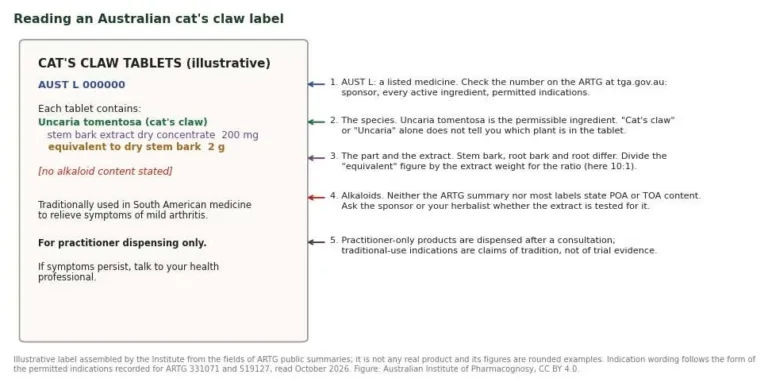
Cat’s claw products in Australia are listed medicines (AUST L). Listed medicines are not individually evaluated by the TGA for efficacy before supply; the sponsor certifies that it holds evidence for each indication, chosen from a set list of permitted indications (TGA, Listed medicines). Attested The two single-herb practitioner products found on the ARTG, both MediHerb Cat’s Claw Forte from Integria Healthcare Australia, are film-coated tablets of Uncaria tomentosa stem bark extract dry concentrate: 183 mg equivalent to 2.2 g of dry bark (ARTG 331071, start date 12/03/2020) and 453.15 mg equivalent to 1.8 g (ARTG 519127, start date 10/11/2025), both labelled for practitioner dispensing only (ARTG 331071; ARTG 519127). Attested Their permitted indications are antioxidant claims and traditional-use claims, for example “Traditionally used in South American medicine to decrease/reduce/relieve symptoms of mild arthritis/mild osteoarthritis”, and their indication requirements forbid any presentation that refers to rheumatoid arthritis or serious immunological disease (ARTG 331071). Attested The one disease with a placebo-controlled positive trial is, under Australian rules, one the label may not mention.
Combination products carry smaller amounts. Joint Eze Plus lists 25 mg of inner stem bark extract, equivalent to 100 mg of bark, alongside glucosamine, chondroitin and fish oil (ARTG 313806); Eagle Cat’s Claw – Echine lists 168.3 mg equivalent to 2.02 g with echinacea and other herbs (ARTG 324889); and Nature’s Sunshine Cat’s Claw Combination Una de Gato, on the register since 1997, lists 300 mg of stem bark powder (ARTG 59852). Attested None of the public summaries read records an alkaloid content or chemotype. Attested These products are named only for what their public ARTG records say; nothing here recommends or discourages any of them.
Poisons, imports and biosecurity
The Poisons Standard (October 2026) contains no entry for any Uncaria species or for their alkaloids (Poisons Standard, October 2026). Attested Cat’s claw is unscheduled, so the Office of Drug Control’s import permits for controlled substances do not apply to it. Attested For contrast, its relative kratom (Mitragyna speciosa), in the same family, is in Schedule 9 (Poisons Standard, October 2026). Attested Queensland’s Biosecurity Act 2014 and Biosecurity Regulation 2016 do not mention Uncaria; the only “cat’s claw” they regulate is the creeper weed (Biosecurity Regulation 2016 (Qld)). Attested Commonwealth import conditions for live plants or seed of Uncaria were outside the scope of this review and were not checked.
Reading the AUST L label
A careful buyer can check six things, in this order.
The AUST L number. It means the product is entered on the ARTG as a listed medicine. Type the number into the ARTG search at tga.gov.au: the public record shows the sponsor, every active ingredient with the plant part and quantity, and the indications the product is permitted to claim (TGA, Listed medicines). Attested A product without an AUST L or AUST R number has not been entered on the register for supply in Australia. The petrol-station product in chapter 9 had no maker’s name at all.
The species. Look for Uncaria tomentosa in full. “Cat’s claw” or “Uncaria” on its own does not tell you which plant is in the tablet, and gou teng in a Chinese formula is a different medicine (chapter 2). Attested
The part and the extract. Australian entries state the part (stem bark, inner stem bark) and give an “equivalent to” quantity of dry herb. Divide that by the extract weight to get the concentration ratio: 2.2 g from 183 mg is about 12:1; 1.8 g from 453.15 mg is about 4:1 (ARTG 331071; ARTG 519127). Attested Two products with similar “equivalent” figures can be very different extracts.
The alkaloids. The ARTG summaries read for this review give no POA or TOA content. Attested “TOA-free” does not appear on them, and a label that does say it still leaves the pentacyclic content unstated (chapter 5). If chemotype matters to you, as the trial and the tradition suggest it might, ask the sponsor whether batches are tested for pentacyclic and tetracyclic alkaloids, or ask your herbalist. The overseas USP standard asks for at least 0.3 per cent POAs and no more than 0.05 per cent TOAs in the bark (EMA/HMPC assessment report 2015). Attested
The claim. “Traditionally used in South American medicine” is a statement about tradition. It is truthful and it is a different kind of statement from a trial result. Attested
Practitioner only. The single-herb products are for practitioner dispensing (ARTG 331071). Attested
Where the bark comes from
Every cat’s claw tablet starts as bark taken from a forest vine or a planted one, and the trade has been large. INRENA recorded exports of 200 kilograms in 1993, about 21 tonnes in 1994, 727 tonnes in 1995 and 347 tonnes in 1996, most of it unprocessed bark; in 1995 the United States bought 93 per cent of it (CIFOR Occasional Paper 22 (1999)). Attested That year INRENA issued 400 trade permits to 100 companies, and bark came from 11 of Peru’s departments, Ucayali supplying the most (CIFOR Occasional Paper 22 (1999)). Attested
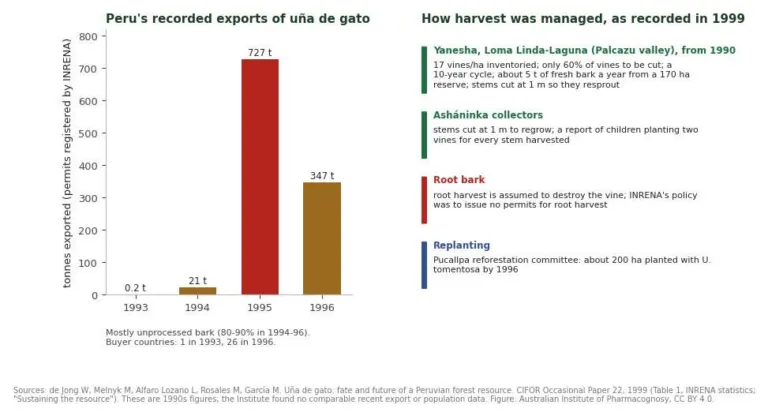
The CIFOR authors tried to judge whether that harvest was sustainable with the data they had. In natural forest U. tomentosa grows at two to eight adult vines per hectare, and 17 per hectare in one Yanesha inventory; on those figures the 1995 exports came from somewhere between about 2,400 and 27,000 hectares, a small fraction of Peru’s tropical forest (CIFOR Occasional Paper 22 (1999)). Evidence suggests Both species need light and do well in secondary forest and old fields, and the authors judged that at 1990s harvest levels neither was at risk of extinction, while warning that their estimate rested on assumptions and scant data and that local over-harvesting could occur (CIFOR Occasional Paper 22 (1999)). Evidence suggests They also recorded rules worked out on the ground. The Yanesha community of Loma Linda-Laguna inventoried its 170-hectare reserve, cut only 60 per cent of the vines on a 10-year cycle and cut stems at one metre so they would resprout; Asháninka collectors supplying one exporter cut stems the same way; and INRENA issued no permits for root harvest, which is assumed to kill the vine (CIFOR Occasional Paper 22 (1999)). Attested
The Peruvian government took a more cautious view. Decreto Supremo 009-99-AG of 28/03/1999 cited heavy extraction from natural forests, little added value and harm to the conservation of both species. It banned the export of uña de gato as raw or mechanically processed material unless it came from managed areas or plantations, and directed INRENA to publish terms of reference for management plans (Decreto Supremo 009-99-AG (Peru)). Attested The Institute could not confirm whether the decree still applies in that form, and found no recent published survey of wild U. tomentosa populations. Unsourced This is Peruvian law. It governs what Peru exports, and Australian import rules are separate.
A 2026 Brazilian study adds a field observation: repeated stripping of stem bark can girdle the trunk and kill the vine, and in the São Luís market the authors surveyed, only the leaves were on sale (PMID 42452205). Evidence suggests None of the ARTG public summaries read for this review says where the bark was grown, whether it was wild-harvested or cultivated, or which country it came from. Attested A sponsor can be asked all three questions. If the 1999 Peruvian rule still applies, bark leaving Peru lawfully as raw material should come from a managed area or a plantation. Mechanism
Before taking cat’s claw
Cat’s claw is a lawful listed herbal medicine in Australia, and the single-herb tablets are labelled for practitioner dispensing, which assumes a consultation first (ARTG 331071). Attested Before taking any botanical drug, consult a degree-qualified herbalist with competencies and adequate training in pharmacognosy. Take the label and a list of everything else you take, prescription medicines included, and mention pregnancy or plans for it, any autoimmune condition or transplant, anticoagulants and any surgery coming up (chapter 9). For a suspected poisoning, call the Poisons Information Centre on 13 11 26; in an emergency, call 000.
Discussion: conclusions, hypotheses and research still required
What the evidence supports
Cat’s claw is a name for several plants. In Australian law, the permissible ingredient is Uncaria tomentosa, and the Australian products we read use its stem bark. Attested U. tomentosa occurs as two chemotypes whose alkaloid patterns differ, and its total alkaloid content varies widely. Confirmed One small, well-run trial of a pentacyclic-chemotype root extract found fewer painful and tender joints, though no fewer swollen joints, when it was added to standard treatment in rheumatoid arthritis. Evidence suggests The knee osteoarthritis evidence comes from U. guianensis and is limited to one small positive trial and two combination trials. Evidence suggests Side effects in trials have been mild and similar to placebo. Evidence suggests A few case reports of kidney inflammation, an interaction with HIV medicines and worsening of Parkinson’s disease, together with laboratory effects on drug-handling enzymes and transporters, define the people who need individual advice. Evidence suggests The EMA declined to write a monograph for want of documentation, and did not find the plant unsafe. Attested Cat’s claw creeper and catclaw acacia share the common name and nothing else. Attested Historically the bark came from a largely wild-harvested Peruvian trade that peaked in the 1990s. Where the bark in today’s Australian products comes from, and the present ecological footprint of the harvest, are undocumented. Attested
What can reasonably be hypothesised
Each of the following is a hypothesis awaiting a test. First, that the Asháninka preference for savéntaro vines reflects a real chemotype selection, and that traditional knowledge could guide the sourcing of consistent material. Traditional Second, that the POA-rich root extract in the Mur trial acts on pain and tenderness more than on synovial inflammation, which would fit the unchanged swollen-joint counts and blood markers. Mechanism Third, that the alkaloid-poor water extracts and the alkaloid-rich ethanol extracts act through different constituents, proanthocyanidins and quinovic acid glycosides in the first case and oxindole alkaloids in the second, so that results from one cannot be borrowed for the other. Mechanism Fourth, that TOA-rich material carries more cardiovascular and interaction risk than POA-rich material, as the gou teng pharmacology suggests. Mechanism Fifth, that the CYP3A4 inhibition and PXR induction seen in cells net out to little effect at ordinary doses in most people, which only a human study can settle. Mechanism And sixth, that “TOA-free” matters clinically; it rests on one 1998 cell study, and no human comparison exists. Mechanism
Research still required
- Quality analysis. A market survey of Australian cat’s claw products: DNA barcoding (trnH-psbA with ITS2) to confirm species, and a validated HPLC assay of the six POAs and four TOAs to show which chemotype, and how much alkaloid, Australians are actually buying.
- Pharmacognosy. An Australian monograph with identity tests separating U. tomentosa stem bark from root bark and from U. guianensis, by microscopy and TLC, and a stated POA minimum and TOA maximum.
- Clinical research. An ethics-approved, adequately powered, placebo-controlled trial of a chemically defined POA-chemotype extract as add-on therapy in rheumatoid arthritis, with swollen joints and imaging as outcomes; and a first placebo-controlled trial of U. tomentosa itself in knee osteoarthritis; and, if chemotype is to stay on labels, a head-to-head trial of a TOA-free and a mixed-chemotype extract.
- Clinical pharmacology. A formal interaction study in healthy volunteers with probe substrates for CYP3A4 and P-glycoprotein, using a characterised product at a usual dose.
- Pharmacovigilance. A search of the TGA’s Database of Adverse Event Notifications for Uncaria products, which this introductory review did not include, and continued reporting of suspected reactions.
- Ecology and conservation. A current population survey of wild U. tomentosa in Peru’s central forest, with regrowth measured on vines cut at one metre; the harvest-impact estimates the Institute found date from the 1990s.
- Supply chains. A survey of Australian sponsors on the origin of their bark: country, wild or cultivated, stem or root, and whether the supplier works under an approved Peruvian management plan.
- Regulatory science. Whether U. guianensis should be considered for the Permissible Ingredients Determination, given that it is the species with the osteoarthritis trials; and whether ARTG records for cat’s claw should state the alkaloid standard.
- Ethnobotany and benefit sharing. Documentation, with the free, prior and informed consent of Asháninka communities, of how savéntaro vines are chosen, and a record of how commercial supply chains share benefits with the people whose knowledge built the market.
- Botany and phytochemistry close to home. Voucher-backed collection and alkaloid profiling of Queensland’s native Uncaria lanosa var. appendiculata and U. cordata, which no study read for this review has examined.
Cat’s claw arrives in Australia with a strong tradition, a careful European review and a handful of promising small trials. Its future here depends on knowing what is in the bottle. The plant has earned that attention.
About the Australian Institute of Pharmacognosy and this series
The Australian Institute of Pharmacognosy is a clinic and research laboratory in Cardwell, far north Queensland, studying medicinal plants and natural products to the same evidentiary standard as any other branch of pharmacology: traditional knowledge taken seriously, and tested honestly. Visit the Institute at australian-pharmacognosy.org.
Series: AIP Literature Reviews and Critical Analyses (evidence reviews). Related reviews: sangre de grado (Croton lechleri), another Peruvian Amazon medicine · guayusa (Ilex guayusa), an Amazonian leaf · echinacea (Echinacea purpurea), which shares an Australian combination product with cat’s claw · devil’s claw (Harpagophytum procumbens), another plant named for its hooks · sutherlandia (Lessertia frutescens) · ashwagandha (Withania somnifera) · pygeum (Prunus africana) · Indian barberry (Berberis aristata) · turmeric (Curcuma longa) · sour jujube seed (Ziziphus jujuba) · soursop (Annona muricata) · umckaloabo (Pelargonium sidoides) · andrographis (Andrographis paniculata) · Syrian rue (Peganum harmala). Follow the series for a new evidence review each morning.
Corrections: if you find an error or a source we have missed, write to the Institute at our contact form. We would rather correct a claim than repeat it.
About the images and the evidence. Photographs are reproduced under the licences named in each caption, from Wikimedia Commons and from iNaturalist observers who chose open licences; the Institute thanks every photographer, and the Muséum national d’Histoire naturelle for making Aublet’s specimen openly available. The European Medicines Agency assessment report, read in full, is the backbone of the clinical and safety chapters, and the 1999 CIFOR report on the uña de gato trade is the main source for the sourcing section. Trial reports the Institute could not read in full have been requested through its library.
Head of Education and Research
Australian Institute of Pharmacognosy
Cardwell QLD, Australia
australian-pharmacognosy.org · our contact form
Suggested citation: Ridley T. Cat’s claw (Uncaria tomentosa (Willd. ex Schult.) DC.): the plant and its namesakes, oxindole alkaloid chemotypes, the clinical evidence, safety, sourcing and the Australian label. AIP Literature Review and Critical Analysis AIP-LR-UNCTOM. Cardwell (QLD): Australian Institute of Pharmacognosy; 2026.
Educational content only; not medical, legal or regulatory advice. Australian regulatory information reflects the ARTG, the Permissible Ingredients Determination, the Poisons Standard, Queensland biosecurity law and Queensland Government and TGA publications as read in October 2026 and may change. European Medicines Agency, German, Brazilian, Peruvian and US material is described as overseas material and does not govern Australian law. Products are named only for what their public ARTG records state; no product is advertised, endorsed or recommended. Material drawn from Commonwealth and Queensland sources is © Commonwealth of Australia or © State of Queensland and appears here as short extracts for the purpose of reporting, criticism and review.
References
39 references: tap to open
Listed in order of first citation. All 16 PMIDs were verified against PubMed in October 2026 and read in full text; every regulatory, legislative, taxonomic and biodiversity record was read from its own source. Trial reports that could not be read in full (Mur 2002, Castañeda 1998, Piscoya 2001 and others) were requested through the Institute’s library and are described through the sources named in the text. Also requested and not cited for their content: the 2021 antiplatelet study, the serotonin-syndrome case report, Reinhard 1999 and Keplinger 1999 (ethnomedicine reviews), and Wurm 1998 (the TOA antagonism study, described here through the EMA report).
- Therapeutic Goods Administration. Reporting adverse events for consumers. Read by the Institute in September 2026. https://www.tga.gov.au/safety/reporting-problems/reporting-adverse-events-consumers
- Marques O, Figueirinha A, Pina ME, Batista MT. Uncaria tomentosa as a Promising Natural Source of Molecules with Multiple Activities: Review of Its Ethnomedicinal Uses, Phytochemistry and Pharmacology. Int J Mol Sci. 2025 Jul 15;26(14). PMID 40725012. DOI 10.3390/ijms26146758.
- European Medicines Agency, Committee on Herbal Medicinal Products. Assessment report on Uncaria tomentosa (Willd. ex Schult.) DC., cortex. Final. EMA/HMPC/259598/2014, 24 November 2015. Rapporteur Z. Biró-Sándor. Read in full by the Institute. Overseas regulatory document; it does not govern Australian products. https://www.ema.europa.eu/en/documents/herbal-report/final-assessment-report-uncaria-tomentosa-willd-ex-schult-dc-cortex_en.pdf
- Therapeutic Goods Administration. Australian Register of Therapeutic Goods, keyword searches run by the Institute in October 2026: “uncaria tomentosa” 16 results; “cat’s claw” 5 results (four medicines and one unrelated medical device); “uncaria” 46 results, including Chinese-medicine formulas containing Uncaria rhyncophylla. https://www.tga.gov.au/resources/artg?keywords=uncaria%20tomentosa
- Therapeutic Goods Administration. ARTG 331071, MediHerb Cat’s Claw Forte. Public summary, read by the Institute in October 2026: medicine listed; sponsor Integria Healthcare Australia Pty Ltd; ARTG start date 12/03/2020; film-coated tablet, oral; active ingredient Uncaria tomentosa stem bark extract dry concentrate 183 mg, equivalent to Uncaria tomentosa (dry) 2.2 g; permitted indications for antioxidant activity and traditional South American use (inflammation, mild rheumatic aches and pains, symptoms of mild arthritis or osteoarthritis, immune defence and function, wound healing); indication requirements excluding reference to rheumatoid arthritis, bone disease and serious immunological disease; warning “For practitioner dispensing only”. https://www.tga.gov.au/resources/artg/331071
- Therapeutic Goods Administration. ARTG 519127, MediHerb Cat’s Claw Forte. Public summary, read by the Institute in October 2026: medicine listed; sponsor Integria Healthcare Australia Pty Ltd; ARTG start date 10/11/2025; film-coated tablet, oral; Uncaria tomentosa stem bark extract dry concentrate 453.15 mg, equivalent to dry 1.8 g; permitted indications and requirements as for ARTG 331071; for practitioner dispensing only. https://www.tga.gov.au/resources/artg/519127
- Therapeutic Goods Administration. ARTG 313806, Joint Eze Plus. Public summary, read by the Institute in October 2026: medicine listed; sponsor Pro Ma Systems Aust Pty Ltd; ARTG start date 30/01/2019; Uncaria tomentosa stem bark inner extract dry concentrate 25 mg, equivalent to dry 100 mg, with glucosamine, shark sodium chondroitin sulfate, hesperidin and omega-3 marine triglycerides. https://www.tga.gov.au/resources/artg/313806
- Therapeutic Goods Administration. ARTG 59852, Nature’s Sunshine Cat’s Claw Combination Una de Gato. Public summary, read by the Institute in October 2026: medicine listed; sponsor Nature’s Sunshine Products of Australia Pty Ltd; ARTG start date 01/05/1997; hard capsule; Uncaria tomentosa stem bark powder 300 mg; permitted indication “Traditionally used in Western herbal medicine to maintain/support immune system health”. https://www.tga.gov.au/resources/artg/59852
- Castro AA, Nunes R, Carvalho LR, Targueta CP, Dos Santos Braga-Ferreira R, de Melo-Ximenes AA, et al. Chloroplast genome characterization of Uncaria guianensis and Uncaria tomentosa and evolutive dynamics of the Cinchonoideae subfamily. Sci Rep. 2023 May 24;13(1):8390. PMID 37225737. DOI 10.1038/s41598-023-34334-1.
- International Plant Names Index, queried by the Institute in October 2026: Ourouparia guianensis Aubl., Hist. Pl. Guiane 1: 177 (1775), 758753-1; Uncaria Schreb., Gen. Pl. ed. 8: 125 (1789), 327895-2; Uncaria guianensis (Aubl.) J.F.Gmel., Syst. Nat. ed. 13 2(1): 370 (1791), 768250-1; Nauclea tomentosa Willd. ex Schult., Syst. Veg. 5: 221 (1819), 77243841-1; Uncaria tomentosa (Willd.) DC., Prodr. 4: 349 (1830), 768322-1; Uncaria rhynchophylla (Miq.) Miq., Cat. Mus. Bot. Lugd.-Bat. 44 (1870), 77186003-1. https://www.ipni.org/n/768322-1
- Honório ICG, Coppede JS, Delprete PG, Costa FHS, Telles MPC, Braga RS, et al. Genetic structure and chemical diversity in natural populations of Uncaria guianensis (Aubl.) J.F.Gmel. (Rubiaceae). PLoS One. 2018;13(10):e0205667. PMID 30365495. DOI 10.1371/journal.pone.0205667.
- Liu T, Ren W, Geng X, Liu C. Uncaria rhynchophylla: an ethnopharmacological review integrating traditional Chinese medicine uses with phytochemical and pharmacological evidence. Front Pharmacol. 2026;17:1723499. PMID 41868131. DOI 10.3389/fphar.2026.1723499.
- Therapeutic Goods (Permissible Ingredients) Determination (No. 2) 2026 (Cth), F2026L00707, registered 11/06/2026. Schedule 1, volume 6, read by the Institute in October 2026: item 5094 UNCARIA GAMBIR, item 5095 UNCARIA RHYNCOPHYLLA, item 5096 UNCARIA SINENSIS and item 5097 UNCARIA TOMENTOSA, each with roles A (active) and H (homoeopathic) and no specific requirement recorded. No entry for Uncaria guianensis, Senegalia greggii (Acacia greggii) or Dolichandra unguis-cati. https://www.legislation.gov.au/F2026L00707/asmade
- Therapeutic Goods Administration. ARTG 351363, Tian Ma Gou Teng Wan-(Gastrodia & Gambir Combination). Public summary, read by the Institute in October 2026: medicine listed; sponsor Cathay Herbal Laboratories; ARTG start date 09/12/2020; ingredients include Uncaria rhyncophylla stem extract dry concentrate 16 mg, equivalent to dry 128 mg, with Gastrodia elata, Scutellaria baicalensis and other herbs; traditional Chinese medicine indication; for practitioner dispensing only. https://www.tga.gov.au/resources/artg/351363
- International Plant Names Index, queried by the Institute in October 2026: Bignonia unguis-cati L., Sp. Pl. 2: 623 (1753), 33001-2; Dolichandra unguis-cati (L.) L.G.Lohmann, Nuevo Cat. Fl. Vasc. Venezuela 273 (2008), 77100466-1; Acacia greggii A.Gray, Smithsonian Contr. Knowl. 3(5): 65 (1852), 470459-1; Senegalia greggii (A.Gray) Britton & Rose, N. Amer. Fl. 23(2): 110 (1928), 234318-2. https://www.ipni.org/n/77100466-1
- Business Queensland (Queensland Government). Cat’s claw creeper. Web page, read by the Institute in October 2026: native to tropical America; once used as an ornamental in Queensland gardens; smothers native vegetation including rainforest; three-clawed tendril between two leaflets; yellow bell-shaped flowers; category 3 restricted invasive plant under the Biosecurity Act 2014; biological control agents Carvalhotingis visenda, Hypocosmia pyrochroma and Hylaeogena jureceki released. https://www.business.qld.gov.au/industries/farms-fishing-forestry/agriculture/biosecurity/plants/invasive/restricted/cats-claw-creeper
- State of Queensland, Department of Primary Industries. Cat’s claw creeper, Dolichandra unguis-cati. Invasive plant fact sheet, restricted category 3, © 2026. Read by the Institute in October 2026: “recognised as a Weed of National Significance due to its invasiveness and potential impacts”. https://www.publications.qld.gov.au/dataset/68f0e6d9-5460-4518-bccb-c28099fd0735/resource/3b1dfe71-8d68-409a-a2ad-a9e2739432c0/download/cats-claw-creeper.pdf
- Biosecurity Regulation 2016 (Qld), current as at 27/04/2026, Schedule 1A Part 2 (restricted matter, invasive plants): cat’s claw creeper (Dolichandra unguis-cati), category 3; Schedule 4 lists recognised biological control agents for it. Biosecurity Act 2014 (Qld), reprint current as at 27/04/2026. Full texts searched by the Institute in October 2026; neither mentions Uncaria. https://www.legislation.qld.gov.au/view/html/inforce/current/sl-2016-0156
- Gucker CL. Senegalia greggii. In: Fire Effects Information System. US Department of Agriculture, Forest Service, Rocky Mountain Research Station, Fire Sciences Laboratory; 2005, name revised 8 September 2017. Read by the Institute in October 2026: synonym Acacia greggii A.Gray; common names catclaw acacia, devilsclaw, Gregg catclaw; distribution; curved spines 3–4 mm; seeds and pods eaten by the Akimel O’odham and Cahuilla; folk uses cited from a herbal writer. Overseas government source. https://www.fs.usda.gov/database/feis/plants/shrub/sengre/all.html
- Atlas of Living Australia. Occurrence searches run by the Institute in October 2026: raw name “Uncaria tomentosa” 2 records (human observations, north-east New South Wales, 2023, NE NSW Grey-headed Flying-fox Habitat Restoration Project; matched by the ALA to genus only); raw name “Uncaria guianensis” 0 records; genus Uncaria 366 records, 170 from Queensland (115 U. lanosa var. appendiculata, 21 U. cordata var. cordata), and 13 within 60 km of Cardwell, all U. lanosa var. appendiculata. Name matching: U. tomentosa and U. guianensis resolve only to Uncaria Schreb. https://biocache.ala.org.au/occurrences/search?q=genus%3AUncaria
- de Jong W, Melnyk M, Alfaro Lozano L, Rosales M, García M. Uña de gato: fate and future of a Peruvian forest resource. CIFOR Occasional Paper No. 22. Bogor: Center for International Forestry Research; May 1999. ISSN 0854-9818. Read in full by the Institute: Table 1 (INRENA export statistics 1993–1996), ecology, collectors and permits, community harvest rules, root versus bark, patents, the proposed export ban. Overseas source. https://www2.cifor.org/ntfpcd/pdf/OWP6.pdf
- Weiss J. Herb⁻Drug Interaction Potential of Anti-Borreliae Effective Extracts from Uncaria tomentosa (Samento) and Otoba parvifolia (Banderol) Assessed In Vitro. Molecules. 2018 Dec 31;24(1). PMID 30602711. DOI 10.3390/molecules24010137.
- Miller MJ, Mehta K, Kunte S, Raut V, Gala J, Dhumale R, et al. Early relief of osteoarthritis symptoms with a natural mineral supplement and a herbomineral combination: a randomized controlled trial [ISRCTN38432711]. J Inflamm (Lond). 2005 Oct 21;2:11. PMID 16242032. DOI 10.1186/1476-9255-2-11.
- Arado GM, Amatto PPG, Marins M, Rizzi ES, França SC, Coppede JDS, et al. Anti-inflammatory and/or immunomodulatory activities of Uncaria tomentosa (cat's claw) extracts: A systematic review and meta-analysis of in vivo studies. Front Pharmacol. 2024;15:1378408. PMID 38881881. DOI 10.3389/fphar.2024.1378408.
- Keyßer G, Sander O, Frohne I, Pfeil A, Michalsen A, Schultz O, et al. [Recommendations of the German Society for Rheumatology committee for complementary treatment and nutrition on phytotherapy : Supplement on the use of selected phytotherapeutic agents and herbal preparations in rheumatology: extension to include 13 medicinal plants]. Z Rheumatol. 2026 Oct;85(8):655-672. PMID 42448806. DOI 10.1007/s00393-026-01840-2.
- Sato Y, Sasaki T, Takahashi S, Kumagai T, Nagata K. Development of a highly reproducible system to evaluate inhibition of cytochrome P450 3A4 activity by natural medicines. J Pharm Pharm Sci. 2015;18(4):316-27. PMID 26626238. DOI 10.18433/j3vk5g.
- Szilvásy N, Lajer P, Horváth A, Veres K, Hohmann J, Schelz Z, et al. Modulation of Multispecific Transporters by Uncaria tomentosa Extract and Its Major Phytoconstituents. Pharmaceutics. 2024 Oct 25;16(11). PMID 39598486. DOI 10.3390/pharmaceutics16111363.
- Mehta K, Gala J, Bhasale S, Naik S, Modak M, Thakur H, et al. Comparison of glucosamine sulfate and a polyherbal supplement for the relief of osteoarthritis of the knee: a randomized controlled trial [ISRCTN25438351]. BMC Complement Altern Med. 2007 Oct 31;7:34. PMID 17974032. DOI 10.1186/1472-6882-7-34.
- Farias IL, Araújo MC, Farias JG, Rossato LV, Elsenbach LI, Dalmora SL, et al. Uncaria tomentosa for Reducing Side Effects Caused by Chemotherapy in CRC Patients: Clinical Trial. Evid Based Complement Alternat Med. 2012;2012:892182. PMID 21869902. DOI 10.1155/2012/892182.
- Santos Araújo Mdo C, Farias IL, Gutierres J, Dalmora SL, Flores N, Farias J, et al. Uncaria tomentosa-Adjuvant Treatment for Breast Cancer: Clinical Trial. Evid Based Complement Alternat Med. 2012;2012:676984. PMID 22811748. DOI 10.1155/2012/676984.
- European Medicines Agency. Uncariae tomentosae cortex: herbal medicine page. Status “F: Assessment finalised”; the HMPC did not adopt a European Union herbal monograph. Documents listed: final assessment report EMA/HMPC/259598/2014, final list of references EMA/HMPC/259599/2014 and final public statement EMA/HMPC/588732/2014, all published 22/01/2016; draft assessment report published 15/04/2015 for consultation to 15/07/2015; call for scientific data EMA/HMPC/615722/2010. Read by the Institute in October 2026. Overseas regulatory document; it does not govern Australian products. https://www.ema.europa.eu/en/medicines/herbal/uncariae-tomentosae-cortex
- Portalatin G, Shettigar S, Carrion-Rodriguez A, Medikayala S, Herlitz L, Sandy D, et al. Ketogenic-Diet Shake Containing Uncaria tomentosa-Associated Acute Interstitial Nephritis. Case Rep Nephrol Dial. 2022;12(3):219-225. PMID 36465572. DOI 10.1159/000526391.
- Giovane R. Severe Delirium and Refractory Bradycardia Associated With Uncaria tomentosa Toxicity: A Case Report. Cureus. 2026 Aug;18(8):e114193. PMID 42712860. DOI 10.7759/cureus.114193.
- Ferreira BR, Campos MF, Rodrigues SBF, Lima AB, Mendonça SC, Vilanova CM, et al. From Traditional Knowledge to SARS-CoV-2 Entry Inhibitor Metabolites: Ethnopharmacological Investigation of Uncaria tomentosa (Willd. ex Schult.) DC. Plants (Basel). 2026 Jun 27;15(13). PMID 42452205. DOI 10.3390/plants15131998.
- Therapeutic Goods Administration. Listed medicines. Read by the Institute in October 2026. “Listed medicines can only use ingredients that we have assessed as safe and of low risk. These ingredients are selected from a list (the Therapeutic Goods [Permissible Ingredients] Determination)”; indications “can only be selected from a list (the Therapeutic Goods [Permissible Indications] Determination)”. Listed medicines are not individually evaluated for efficacy before supply; sponsors certify that they hold the evidence. https://www.tga.gov.au/node/520077
- Therapeutic Goods Administration. ARTG 324889, Eagle Cat’s Claw – Echine. Public summary, read by the Institute in October 2026: medicine listed; sponsor Integria Healthcare Australia Pty Ltd; ARTG start date 15/10/2019; Uncaria tomentosa stem bark extract dry concentrate 168.3 mg, equivalent to dry 2.02 g, with Echinacea angustifolia, Echinacea purpurea, Astragalus membranaceus, Olea europaea and other ingredients; for practitioner dispensing only. https://www.tga.gov.au/resources/artg/324889
- Therapeutic Goods (Poisons Standard—October 2026) Instrument 2026 (Cth), F2026L01327, dated 28 September 2026. Full text searched by the Institute in October 2026 for Uncaria, rhynchophylline, mitraphylline, Dolichandra, Acacia and cat’s claw: no entry for any Uncaria species or alkaloid. MITRAGYNA SPECIOSA and MITRAGYNINE appear in Schedule 9. https://www.legislation.gov.au/F2026L01327/asmade
- Peru. Decreto Supremo Nº 009-99-AG: Prohíben la exportación en forma natural o con procesos de transformación mecánica de especímenes de las especies de uña de gato. Lima, 28 March 1999. Text read by the Institute in October 2026 from the FAO FAOLEX database, articles 1–5. Overseas law; current status not confirmed. https://faolex.fao.org/docs/pdf/per15969.pdf
- Chemical records and structure depictions: PubChem, US National Library of Medicine, public domain. CIDs cited in the text: 94160, 11726520, 10429112, 9885603, 168985, 12304288, 5281408, 3037048, 3037884, 120678.
Image credits
- Corteza y espina curva de uña de gato (Uncaria tomentosa).jpg, Kristi Denby/Archivo Centro Takiwasi. CC BY-SA 4.0. Wikimedia Commons. Resized and re-encoded for the web by AIP; no other changes.
- Florae Columbiae (Plate CLXXX) (8205993854).jpg, Duemmler, Ferdinand.; Karsten, Hermann; Schmidt, Carl Friedrich Wilhelm. Public domain. Wikimedia Commons. Resized and re-encoded for the web by AIP; no other changes.
- Ourouparia guianensis Aublet 1775 pl 68.jpg, Jean-Baptiste-Christophe FUSÉE-AUBLET (1720-1778). Public domain. Wikimedia Commons. Resized and re-encoded for the web by AIP; no other changes.
- Ourouparia guianensis Aubl. s.n. MNHN P-P00778115.jpg, Projet :RECOLNAT (ANR-11-INBS-0004). CC BY 4.0. Wikimedia Commons. Resized and re-encoded for the web by AIP; no other changes.
- 12138-Uncaria guianensis-Cacuri.jpg, Vojtěch Zavadil. CC BY-SA 3.0. Wikimedia Commons. Resized and re-encoded for the web by AIP; no other changes.
- 12140-Uncaria guianensis-Cacuri.jpg, Vojtěch Zavadil. CC BY-SA 3.0. Wikimedia Commons. Resized and re-encoded for the web by AIP; no other changes.
- Gambir di Banda Aceh.jpg, Si Gam. CC BY-SA 4.0. Wikimedia Commons. Resized and re-encoded for the web by AIP; no other changes.
- 兒茶鈎藤 Uncaria gambir -檳城植物園 Penang Botanic Garden- (9268500012).jpg, 阿橋 HQ. CC BY-SA 2.0. Wikimedia Commons. Resized and re-encoded for the web by AIP; no other changes.
- An Asháninka settlement along the Palcazu River, circa 1888.png, Charles Kroehle. Public domain. Wikimedia Commons. Resized and re-encoded for the web by AIP; no other changes.
- Uncaria rhynchophylla kagikzr02.jpg, keisotyo. CC BY-SA 4.0. Wikimedia Commons. Resized and re-encoded for the web by AIP; no other changes.
- Acacia greggii thorns.jpg, Stan Shebs. CC BY-SA 3.0. Wikimedia Commons. Resized and re-encoded for the web by AIP; no other changes.
- Dolichandra unguis-cati03.jpg, Hectonichus. CC BY-SA 3.0. Wikimedia Commons. Resized and re-encoded for the web by AIP; no other changes.
- iNaturalist observation 301987413, photo 544217589: Uncaria tomentosa, Satipo, PE-JU, PE, 2025-07-27, photo by Alfredo Gutierrez Dipaz. CC BY 4.0. iNaturalist. Resized and re-encoded for the web by AIP; no other changes.
- iNaturalist observation 301987413, photo 544217685: Uncaria tomentosa, Satipo, PE-JU, PE, 2025-07-27, photo by Alfredo Gutierrez Dipaz. CC BY 4.0. iNaturalist. Resized and re-encoded for the web by AIP; no other changes.
- iNaturalist observation 197644969, photo 348159610: Uncaria tomentosa, Régina 97390, Guyane française, 2024-01-15, photo by Guillaume Delaitre. CC BY 4.0. iNaturalist. Resized and re-encoded for the web by AIP; no other changes.
- iNaturalist observation 197644969, photo 348159628: Uncaria tomentosa, Régina 97390, Guyane française, 2024-01-15, photo by Guillaume Delaitre. CC BY 4.0. iNaturalist. Resized and re-encoded for the web by AIP; no other changes.
- iNaturalist observation 20145919, photo 31072866: Uncaria tomentosa, Inkaterra Hacienda Concepcion Oxbow lake, 2014-10-02, photo by Tony Rebelo. CC BY-SA 4.0. iNaturalist. Resized and re-encoded for the web by AIP; no other changes.
- iNaturalist observation 34925195, photo 55027426: Uncaria guianensis, Loreto, PE, 2019-10-24, photo by Jude Kesl. CC BY 4.0. iNaturalist. Resized and re-encoded for the web by AIP; no other changes.
- iNaturalist observation 301815311, photo 543895538: Uncaria guianensis, Satipo, PE-JU, PE, 2025-07-27, photo by Alfredo Gutierrez Dipaz. CC BY 4.0. iNaturalist. Resized and re-encoded for the web by AIP; no other changes.
- iNaturalist observation 46896178, photo 74373423: Uncaria guianensis, Cuyabeno, Ecuador, 2015-07-15, photo by Jens-Christian Svenning. CC BY 4.0. iNaturalist. Resized and re-encoded for the web by AIP; no other changes.
- iNaturalist observation 109142365, photo 183891960: Uncaria rhynchophylla, 台灣新北市, 2022-03-20, photo by Jacy Chen. CC BY 4.0. iNaturalist. Resized and re-encoded for the web by AIP; no other changes.
- iNaturalist observation 109142365, photo 183891974: Uncaria rhynchophylla, 台灣新北市, 2022-03-20, photo by Jacy Chen. CC BY 4.0. iNaturalist. Resized and re-encoded for the web by AIP; no other changes.
- iNaturalist observation 260935051, photo 468685681: Dolichandra unguis-cati, Queensland, AU, 2025-02-07, photo by Greg Tasney. CC BY-SA 4.0. iNaturalist. Resized and re-encoded for the web by AIP; no other changes.
- iNaturalist observation 398375100, photo 730786181: Uncaria lanosa appendiculata, Lamb Range QLD 4870, Australia, 2026-09-07, photo by Steve Fitzgerald. CC BY-SA 4.0. iNaturalist. Resized and re-encoded for the web by AIP; no other changes.
- iNaturalist observation 204674117, photo 361801604: Uncaria lanosa appendiculata, Stoney Ck QLD 4870, Australia, 2024-03-31, photo by Steve Fitzgerald. CC BY-SA 4.0. iNaturalist. Resized and re-encoded for the web by AIP; no other changes.
- iNaturalist observation 354124785, photo 646071691: Uncaria lanosa appendiculata, Crystal Cascades QLD 4870, Australia, 2026-04-26, photo by Steve Fitzgerald. CC BY-SA 4.0. iNaturalist. Resized and re-encoded for the web by AIP; no other changes.
- Chemical structure depictions (mitraphylline, isomitraphylline, pteropodine, isopteropodine, speciophylline, uncarine F, rhynchophylline, isorhynchophylline, hirsutine, quinovic acid): PubChem, US National Library of Medicine. Public domain.
- Figures 1–7 (the plants called cat’s claw, the names timeline, the chemotype diagram, the human studies table, the interaction evidence table, the illustrative label and the uña de gato trade): Australian Institute of Pharmacognosy, 2026, CC BY 4.0, drawn from the sources printed in each figure.
The Institute sets and publishes its own monographs. The catalogue is in Publications.