

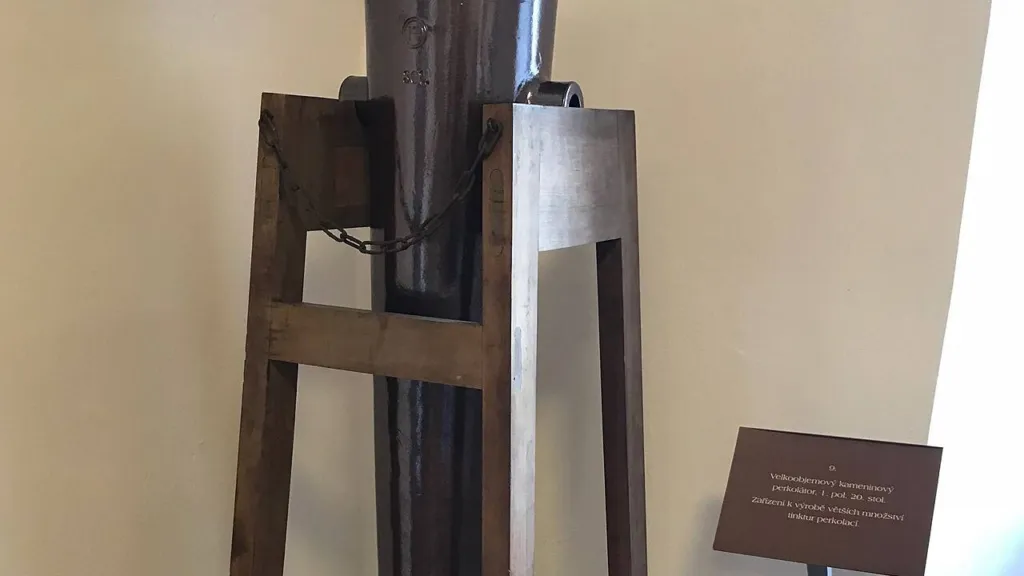
Cover: large-volume stoneware percolator, first half of the twentieth century, used to make tinctures in quantity; exhibition on the history of drug making, Kuks Hospital, Czech Republic. Photo: Jiří Sedláček · CC BY-SA 4.0 · cropped · Wikimedia Commons
Pour a solvent onto a column of powdered herb, keep a layer of it standing on top, and let it leave the bottom a drop at a time. The first liquid out is close to saturated. The last is nearly as clear as the solvent that went in. Between the two lies most of what pharmacy learned about extraction in the nineteenth century, and the reason a well-made 1:2 liquid extract can be produced from dried herb without ever being heated.[1, 2] Attested
This is the first article in a new Journal series on laboratory apparatus and procedures. The next one takes up Soxhlet extraction, the hot, recycling cousin of the method described here. Cold percolation comes first because so much of practical pharmacognosy rests on it: the fluid extracts and tinctures of the old pharmacopoeias, the reserved-percolate method for 1:1 liquid extracts, and the cold-percolated 1:2 extracts that Australian herbal practice has relied on for decades. The article covers the definitions, the history from Réal’s press to the present, the apparatus, the physics of the drug bed, the variants, the reasons the method is preferred where it is, the comparison studies, a worked example, and the places where another method does the job better.
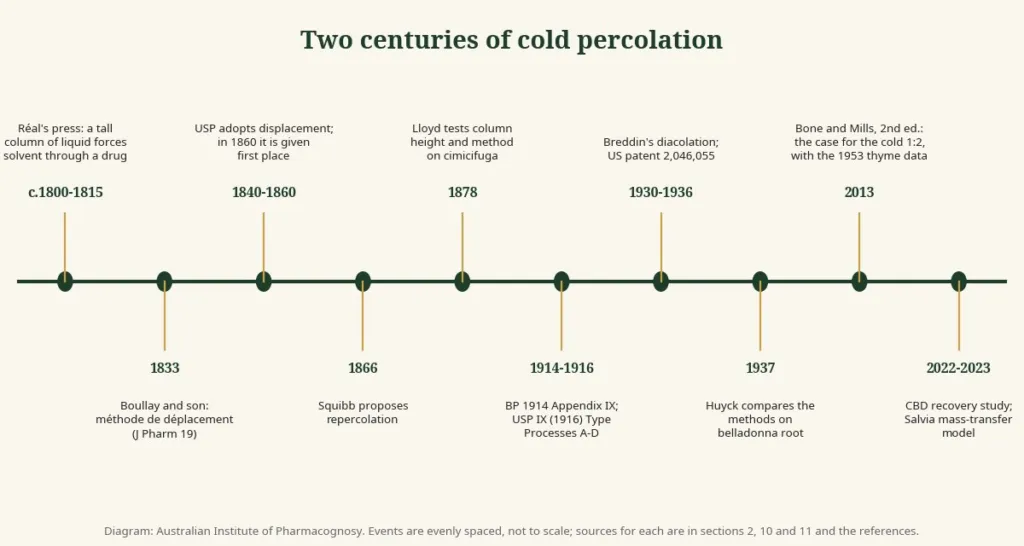
It is written for practitioners and laboratory staff who already make or dispense liquid extracts. The primary sources are the pharmacopoeias and the working papers of the people who built the method, read in their digitised originals, alongside the modern studies that have tested it. Where a claim rests on a single small study, the article says so.
Educational content on a laboratory method. It gives no doses. Every source was read by the Institute in October 2026; access dates for web pages are given in the references.
Ethanol is flammable. Percolation with hydro-ethanolic or stronger menstrua belongs in a ventilated space away from flames, hot plates and sparks, with the percolator covered to limit vapour. In a workplace the usual duties for storing and labelling a flammable liquid apply at any scale, small dispensary batches included.
Two historical examples carry potent alkaloids. Belladonna root (atropine, hyoscyamine and hyoscine) and cinchona bark (quinine and related alkaloids) appear below because the classic percolation experiments were done on them. Atropa belladonna is a Schedule 4 prescription medicine under the Poisons Standard, apart from low-alkaloid Schedule 2 preparations.[3] The article describes the historical work and gives no guidance for preparing either.
Cannabis. Making cannabis drugs in Australia is licensed under the Narcotic Drugs Act 1967, administered by the Office of Drug Control,[4] and the TGA states that its compounding exemptions generally do not cover medicinal cannabis products.[5] In Queensland, unlawfully producing a dangerous drug is a crime under section 8 of the Drugs Misuse Act 1986.[6] The cannabis study in section 11 is overseas research, cited for its extraction data only.
Emergency: call Triple Zero (000). Poisons Information Centre: 13 11 26, 24 hours. Before taking any botanical drug, consult a degree-qualified herbalist with competencies and adequate training in pharmacognosy.
| What it is | A menstruum passed downward through a packed, moistened column of drug, with fresh menstruum always arriving at the top | Attested §1 |
| First set out as a general pharmaceutical method | The Boullays, father and son, Paris, 1833: méthode de déplacement, after Réal’s press (c.1800–1815) | Attested §2 |
| Why it out-extracts a single maceration | The liquid meeting each layer is never at equilibrium with it, so the concentration gradient driving diffusion is renewed all the way down | Mechanism §7 |
| Official flow limit (USP IX, 1 kg) | Not more than 10 drops a minute until the reserved percolate is collected, then 20 | Attested §6 |
| The cold step that matters | No heat at any stage, including concentration: the 1:2 extract and repercolation achieve this; the reserved-percolate 1:1 does not | Attested §10 |
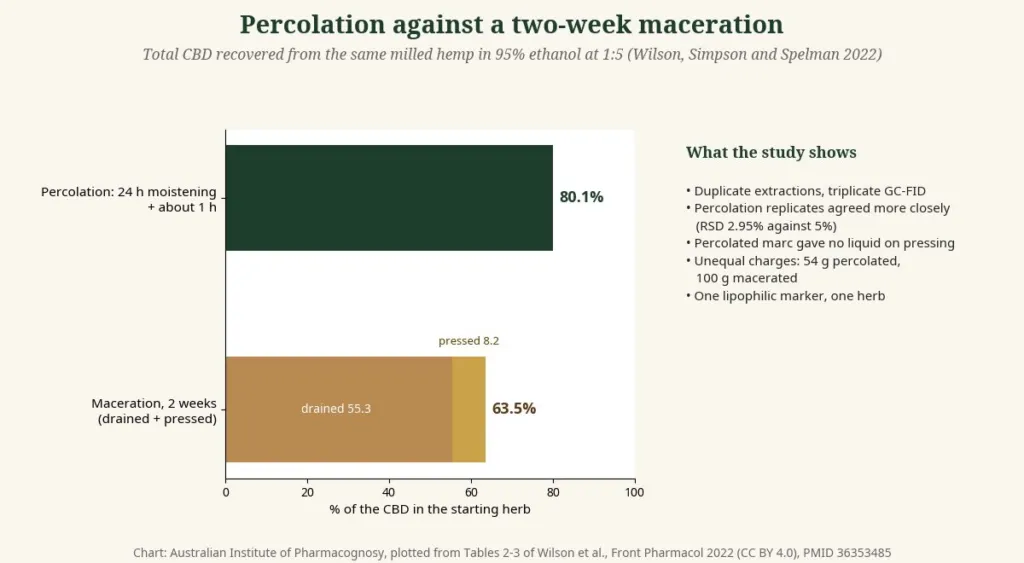
| Head-to-head evidence | Few, small studies; percolation recovered 80% of CBD against 64% for a two-week maceration in the clearest one | Evidence suggests §11 |
| Australian rules | Listed and registered medicines are made under the PIC/S Guide to GMP; herbalists preparing for a particular patient after consultation are exempt from a TGA manufacturing licence; poisons and narcotics law still applies | Confirmed §10 |
- Confirmed Established in humans by trial, or an unambiguous analytical or chemical fact, or a current regulatory fact read from the regulator.
- Evidence suggests Real published data, but small, preclinical, inconsistent or not independently replicated.
- Mechanism A physical or pharmacological inference about how something works, short of a measured outcome.
- Traditional Historical or practitioner use. Evidence of practice. Efficacy is a separate question.
- Attested A documentary fact attested in a named record: a pharmacopoeia, a patent, a dissertation or a published working paper. It states what the record says.
- Unsourced A statement the Institute could not trace to a source it was able to open and read.
Every PubMed ID (PMID) links to its record. Historical texts link to their digitised originals.
Percolation extracts a drug by displacement. A moistened, evenly packed powder sits in a vessel with an outlet at the bottom; menstruum is kept standing on top; and as liquid leaves below, fresh liquid enters above. The first fraction carries most of the soluble matter and the last carries almost none. That is the whole idea, and the Boullays set it out for pharmacy in Paris in 1833, building on Réal’s press and on Robiquet’s observation that ether displaces the oil in bitter almond without mixing with it.[1, 7] Attested
The United States Pharmacopoeia took it up from 1840, preferred it to maceration by 1860, and in its ninth revision, current when Remington wrote in 1917, had written it into numbered “type processes” with a flow limit of 10 drops a minute for a 1000 g charge. The British Pharmacopoeia of 1914 used it for liquid extracts by reserving the first 850 mL and concentrating the rest.[2, 8, 9] Attested
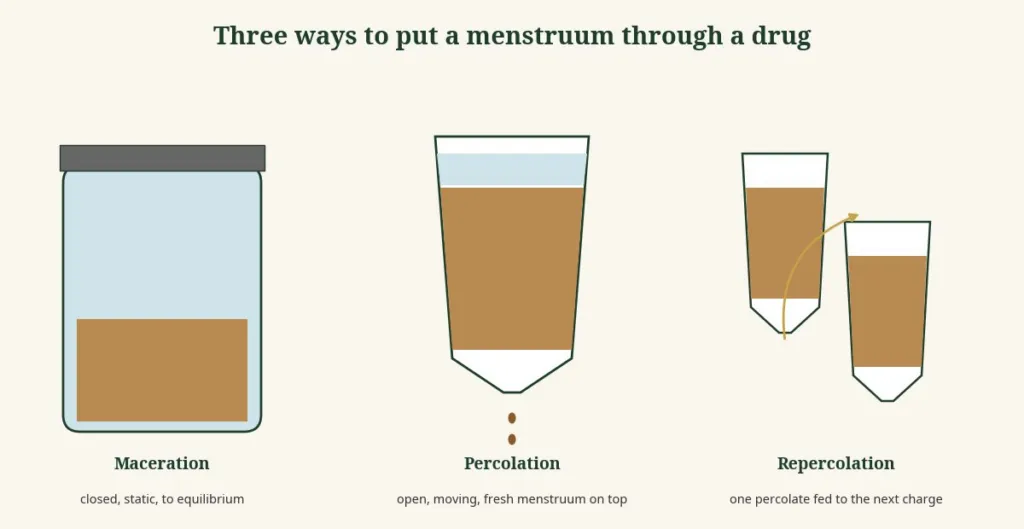
Its advantage is physical. In a closed jar the liquid and the herb drift toward equilibrium and extraction stops; the liquid left in the marc is finished tincture and is lost unless pressed out. In a percolator each layer meets liquid less loaded than itself, so diffusion keeps going until the drug is exhausted, and what stays in the marc at the end is mostly menstruum.[1, 10, 11] Mechanism
Where it is preferred, the reason is usually heat. Repercolation and the cold-percolated 1:2 extract reach a useful concentration without the evaporation step that strips volatile oil and alters resinous extracts. A 1953 thyme study reported by Bone and Mills found that per gram of herb a cold 1:2 kept 37% of the herb’s phenols, against 22% for a 1:1 made by reserved percolation with heat.[12, 13] Evidence suggests
It has limits. Gummy and resinous drugs clog it, mucilaginous drugs swell shut, and it is slow and solvent-hungry if run to exhaustion. Ultrasound and microwave methods extract faster and often more completely, at the cost of heat, equipment and a sometimes different chemical profile. Where exhaustive recovery of a heat-stable constituent is the goal, the Soxhlet apparatus, the subject of the next article, usually wins.[1, 11, 14] Evidence suggests
1. Maceration, percolation and repercolation
Remington’s definition from 1917 has not been bettered: percolation, or displacement, is “the process whereby a powder contained in a suitable vessel is deprived of its soluble constituents by the descent of a solvent through it.” The vessel is the percolator, the liquid poured on top is the menstruum, the liquid that leaves is the percolate, and the exhausted drug left behind is the marc.[1] Attested
Maceration is the closed alternative. The comminuted drug stands in the whole of the menstruum, with occasional shaking, for a set time; the liquid is drained, the marc pressed, and the liquids combined. The British Pharmacopoeia of 1914 set out percolation as its general process for tinctures, and the pharmacopoeias kept maceration for the cases where percolation fails, as Remington notes for aloes, asafoetida and tolu, whose gums and resins block a packed column.[9, 1] Attested
Repercolation is Squibb’s word; the US Dispensatory, giving his definition, calls it “the successive application of the same percolating menstruum to fresh portions of the substances to be percolated”. The weak percolate from one charge of drug becomes the menstruum for the next, so the liquid concentrates as it goes and no evaporation is needed.[8, 13] Attested
Cold and hot
“Cold” refers to every stage of the process, and that is where the term earns its keep. The USP IX Type Process A extracts at room temperature but then concentrates its weak percolate to a soft extract at up to 60 °C before dissolving it in the reserve. Type Process D is hot from the start, infusing the drug in boiling water and percolating with more boiling water in a tinned or enamelled metal percolator, because glass ones crack.[8, 1] Attested A cold-percolated extract in the strict sense never sees heat: the reserve is the product, or the weak percolate is used on fresh drug, as in repercolation.
Exhaustive extraction
An exhaustive percolation runs until the drug has given up what the menstruum can take. The pharmacopoeia never pretended this was a precise endpoint. The USP text quoted by Remington defines “exhausted” as “the point at which the valuable constituents have been as completely extracted as is possible or practical, and this must be determined by the judgment and experience of the operator”, and expects the last portion to be “nearly free from color, odor, and taste, other than those of the menstruum itself.”[1] Attested A 1:2 or 1:1 made without concentration is, by arithmetic, non-exhaustive: there is not enough liquid in the product to carry everything out of the drug. Section 12 returns to what that means in practice.
2. From the lye hopper to the pharmacopoeia
Remington starts the story with the lye hopper, the conical wooden vessel in which water poured on wood ashes ran out below as lye. The principle, lixiviation, is old. Its first recorded application to powdered drugs was by Pierre-François, comte Réal (1757–1834), whose press Remington describes as a metal cylinder with a perforated diaphragm, a stopcock below and a tight lid carrying an upright tube ten or twelve feet high. The column of liquid in the tube forced the menstruum through the drug. It leaked at the joints, and the pressure drove the liquid through too fast to exhaust the powder.[1] Attested Remington dates the press to about 1815; Wisniak’s history of the Boullays puts it around 1800. The difference has not been resolved here.[7]
The second ingredient, in Remington’s account, was a chemist’s observation. Robiquet, testing ether as a solvent for the fixed oil of bitter almond, noticed that ether poured onto the powder drove the oil out ahead of it without mixing with it much, and published the observation.[1] Attested That is displacement in its purest form: one liquid pushing another out of a porous bed like a piston.
The Boullays, 1833
Pierre-François Guillaume Boullay (1777–1869), a Paris pharmacist trained under Vauquelin, and his son Polydore published their first memoir on the méthode de déplacement in the Journal de Pharmacie in 1833. Polydore (Félix-Polydore, 1806–1835) died of injuries from an ether explosion in 1835, the year their book appeared.[7] Remington, writing in America, calls them the Boullay brothers; Wisniak’s biography, with its citations to the journal, shows a father and son. Their study of Réal’s press concluded that the tall tube was unnecessary. The hydrostatic pressure of the displacing liquid itself was enough, and pouring menstruum continuously onto the powder and fractionating what came out gave the most concentrated product.[7, 15] Attested
They then noticed that what they were proposing was exactly how the Dubelloy coffee pot worked, the drip pot attributed to Jean-Baptiste de Belloy, archbishop of Paris, in which hot water dripped through ground coffee held on a metal or porcelain screen. Their apparatus was a long tin cylinder narrowing at the bottom to a funnel that sat in the neck of a bottle, with a finely perforated plate to hold back the powder and a second plate above to spread the liquid evenly. Later memoirs applied it to cinchona, rhatany and guaiacum, and the work was collected as a book in 1835.[7, 15] Attested
Huyck’s 1937 review adds a detail that is easy to miss. Boullay also proposed “continuous displacement” for drugs that were hard to exhaust, with the drug divided among several vessels and the liquid passed from one to the next. Squibb, who coined the word in 1867, claimed no credit for the idea, citing Boullay’s use of it in 1833 and the older Spanish and Portuguese practice of passing hot water through a drug more than once to make infusions.[16] Attested Counter-current extraction and percolation therefore arrived in pharmacy in the same year, from the same family.
Trease and Evans make a further connection. The first isolations of alkaloids in the nineteenth century, from Derosne’s narcotine (1803) and Sertürner’s morphine (1806, 1816) to Pelletier and Caventou’s quinine (1820), “were coincidental with the advent of the percolation process for the extraction of drugs”: that is, with Réal’s press, a decade or more before the Boullays’ memoir.[17] Attested
America takes it up
The method crossed the Atlantic fast. Remington credits Duhamel, Procter, Grahame and Squibb with its development and lists its adoption in the US Pharmacopoeia of 1840 and every revision after.[1] Attested The 1850 edition, published in 1851, explains why it was offered only as an alternative. Displacement “affords so many advantages, both in an economical point of view, and in the character of the resulting preparations” that it could not be left out, yet it needed skill. If the drug was badly comminuted or loosely packed, “the liquid will be apt to pass through it unequally and in distinct channels”; if too fine and close, percolation stopped altogether.[18] Attested
By the 1860 revision the committee had decided. “In many instances percolation has been substituted for maceration; and, wherever alternative processes are allowed, that by percolation is given first, to indicate that it should be preferred.” The same edition defined powders by sieve, from very fine at 80 meshes to the linear inch down to coarse at 20, so that a formula could specify the comminution.[2] Attested
Fluid extracts, the class of preparation that percolation made possible, entered the USP as a class in 1850; until then fluid extract of sarsaparilla was the only one in either the American or the British official books. In 1865 Taylor proposed glycerin as a preservative, adopted in the 1870 USP and later cut back because it dissolved too much inert matter.[8] Attested
Squibb and repercolation
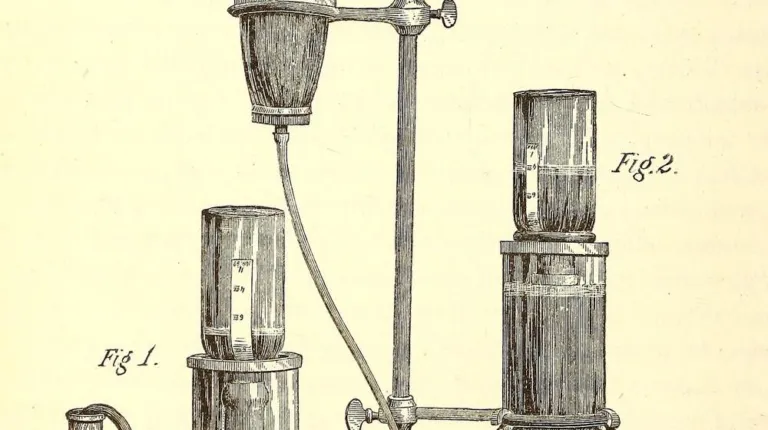
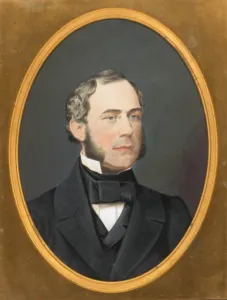
Edward Robinson Squibb of Brooklyn turned percolation into an industrial process. His 1865 paper to the American Pharmaceutical Association was about economising on alcohol, which had become expensive; in a further paper of 1866 he first proposed repercolation; and by 1878 he could report that he had used it “exclusively” for nearly twelve years “in the production of many thousands of pounds of all the principal fluid extracts”.[13, 16, 8] Attested
His real objection was to heat. Concentrating the weak percolate, he argued, did more harm than oxidation alone could explain:
The active principles are so dissociated and split up by the concentration that they are no longer in their natural condition, but form new relations and combinations which change their solubilities, and bring a new set of reactions into play, making the preparation something else than what it professes to be.E. R. Squibb, “Fluid extracts by repercolation”, American Journal of Pharmacy, 1878[13]
His example was buchu. Diluted alcohol exhausts the leaf and holds its oil in solution in something like its natural association with the other constituents; evaporate until the oil separates, and no strength of alcohol will put the extract back together.[13] Attested William Procter Jr admired the process but thought it too complicated for the pharmacopoeia, and the official book took decades to accept it.[16] Attested
Lloyd: column height, and the cold still
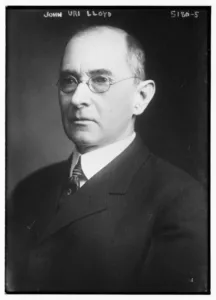
John Uri Lloyd’s laboratory notes on fluid extract of cimicifuga, published in two parts in 1878, are a model of how to test an extraction method. He took 1,000 pounds of root from a pile “just as it came”, because he wanted to test the drug the trade would actually use, ran his experiments in parallel, and measured dry extractive in each fraction of percolate. The pharmacopoeial formula, carefully followed, did not yield a fluid extract representing the drug. Repercolation slightly beat it. Simple percolation without maceration beat everything.[19] Attested
His second finding has outlived the first. “Height of powder exerts a direct influence upon the extractive power of the menstruum, up to fifteen inches”, the amount dissolved rising as the column grew taller.[19] Attested C. L. Diehl reached the same conclusion the next year: lengthen the column without widening it and simple percolation does nearly as well as fractional percolation, so use tall, slender, moderately tapering percolators.[16] Attested (Cimicifuga is black cohosh, Actaea racemosa, now reviewed in its own Journal article.)
Lloyd went on to build the apparatus his firm became known for. The Lloyd Library dates his first patent application, for a “concentrator for solutions”, to 1904 and describes the principle as applying heat to the surface of the liquid instead of the bottom.[20] Attested His 1920 patent for a “percolating and concentrating apparatus” joins a percolator to a jacketed concentrator at their bases. Alcohol distilled from the surface of the extract is condensed and returned through the drug, carrying more extract down to the concentrator, while the inflow at the bottom keeps the concentrate stirred so resinous matter does not precipitate.[21] Attested It is a closed loop, cool at the drug and warm only at the evaporating surface, and it sits halfway between the cold percolator and the Soxhlet.
The type processes, and the British books
By the ninth revision of the USP, which Remington was quoting in 1917, percolation had been codified into Type Processes A to D, described in section 6, and the official book gave a rate of flow for the first time.[8, 1] Attested The British Pharmacopoeia of 1914 set out a general process of percolation for tinctures and a process of repercolation in its Appendix IX, and made its liquid extracts, hydrastis among them, by reserving the first 850 mL of percolate from 1000 g of drug, distilling the alcohol from the rest and dissolving the soft extract in the reserve.[9] Attested The 1934 British Pharmaceutical Codex used the same 850 mL reserve for most of the percolated liquid extracts in its formulary, aletris and chamomile among them.[22] Attested
Remington’s 1917 view from Philadelphia was that the process was well known in Britain, France and Germany but that maceration “still holds in these countries the chief place”.[1] Attested Germany then produced the last important variant. Heinrich Breddin published repetition diacolation in 1930 and patented a pressurised diacolation apparatus, described in section 9.[16, 23] Attested Clement Lee Huyck’s 1937 Florida dissertation compared all of these on belladonna root and is the best single review of the period.[16]
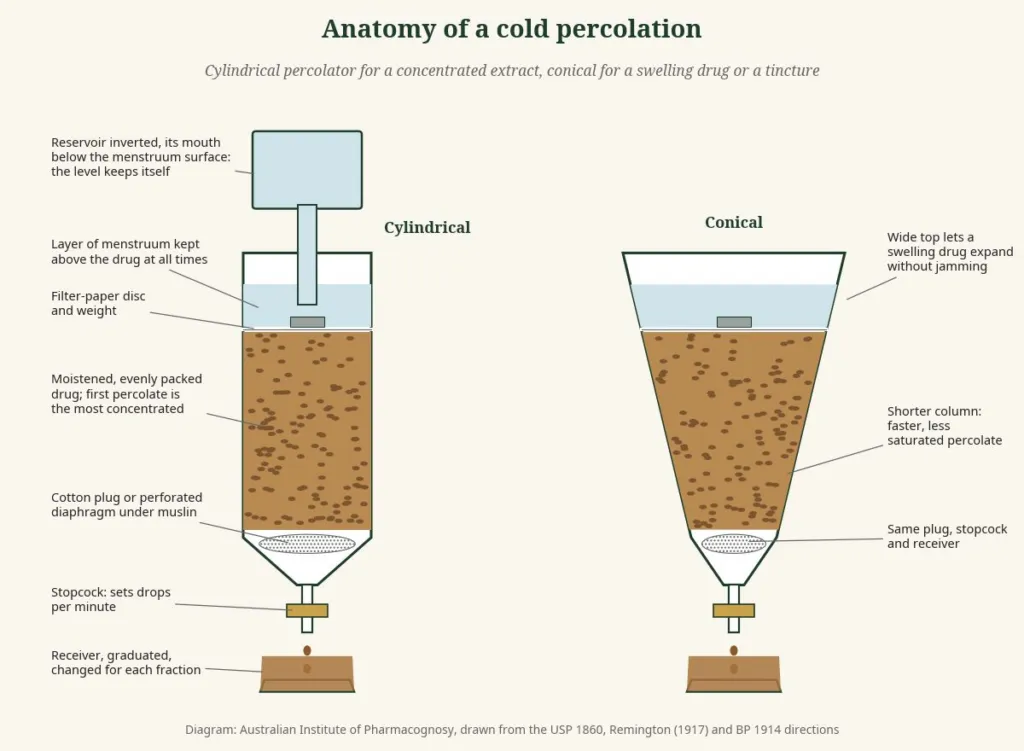
3. The apparatus
A percolator is a vessel open at the top, narrowing at the bottom to an outlet that can be controlled, with something in the neck to hold the powder back. Everything else is refinement, and most of the refinements answer one of three problems: the drug swells, the liquid channels, or the operator cannot keep the flow steady.
Cylindrical or conical
The USP IX text quoted by Remington is clear. “For drugs which are apt to swell, particularly when a feebly alcoholic or an aqueous menstruum is employed, a conical percolator is preferable. A cylindrical or only slightly tapering percolator may be used for drugs which are not liable to swell, particularly if difficult to exhaust, also when the menstruum is strongly alcoholic, or when ether or some other volatile liquid is used.” The packed drug should fill no more than two-thirds of the height.[1] Attested
Shape also sets column height, and column height matters for concentration. Remington’s three figures show the same 200 g of powder in a narrow, an ordinary and a conical percolator: the tall narrow one for a fluid extract, where every drop of menstruum must work hard and the percolate should saturate quickly; the ordinary one for a strong tincture; the funnel for a weak tincture, where menstruum is in excess and speed is welcome. A drug very rich in soluble matter, his example is kino, cannot go in a narrow percolator at all, because the percolate becomes too dense to move.[1] Attested Breddin made the same argument for cylindrical tubes: in a cone the drug near the centre line is extracted faster than the drug beside it, and the loosely packed upper part soaks up more menstruum.[16] Attested
Materials
The 1860 USP preferred ordinary glass funnels of one to eight pints for most of its percolations and allowed earthenware or tinned iron for larger ones, provided the liquid did not attack the metal.[2] Attested Remington adds that glass is best but any material unaffected by drug and menstruum will do, and that hot percolation needs metal.[1] Attested Squibb ran his larger percolations in a two-gallon stoneware pot holding two to three kilograms of drug, and the photograph at the top of this article shows a stoneware percolator of the same family. Modern work uses glass and stainless steel; the Brosimum fluid-extract study in section 11 used a 5 L stainless-steel percolator for 1 kg charges.[13, 24] Attested
Plug, diaphragm and stopcock
The neck is closed with a loose tuft of purified cotton, a deeply notched cork under a scored paper disc, or in the earlier books a perforated diaphragm with muslin over it. Remington adds a practical warning: do not wet the cotton with water when the menstruum is alcoholic and the drug resinous, because the first, densest percolate will precipitate in the plug and stop the flow.[1, 2] Attested The pharmaceutics literature on percolated syrups repeats the point about plug tension: too tight and the flow is hindered, too loose and the liquid comes through turbid.[25] Attested
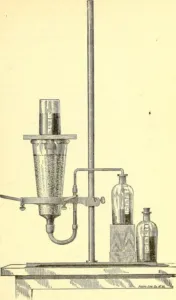
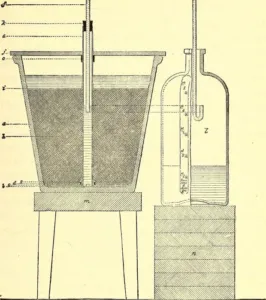
Flow was controlled in the official method by a rubber tube from the outlet that could be raised or lowered: lift its end above the menstruum level and percolation stops; lower it and percolation starts. Metal percolators carried stopcocks.[1] Attested Squibb’s well-tube percolator drew the percolate from a central glass tube through a siphon, and he pointed out a side benefit. The height at which liquid in the siphon balances the liquid in the percolator measures the difference in density between percolate and menstruum, so as the drug approaches exhaustion the column rises toward the level outside.[13] Attested
Keeping the menstruum on top
Every official text insists on a layer of menstruum standing above the drug throughout. The 1860 USP gives the reason: it keeps air out of the interstices of the powder.[2] Attested If the surface runs dry, air enters, the bed cracks, and the next liquid finds the cracks. The convenient answer, given in the USP IX text quoted by Remington, is to invert a bottle holding the whole of the menstruum over the percolator with its mouth below the liquid surface. As the level falls, air enters the bottle and releases liquid, so the head stays constant without attention.[1] Attested The arrangement works on the same principle as the Mariotte bottle of the physics laboratory. Mechanism A paper disc on the surface, held down by a glass weight, spreads the incoming liquid and stops it scouring the bed.[1]
At scale the problems are handling ones. Remington illustrates tinned-copper percolators hung on trunnions so that the marc could be tipped straight into a cart, and Thomson’s egg-shaped vacuum percolators, which pulled menstruum into an evacuated drug bed and could push or pull the liquid through by pump.[1, 8] Attested
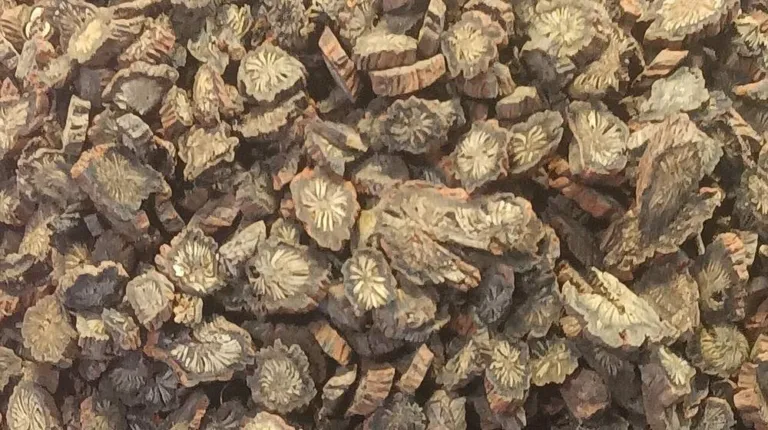
4. The drug bed: comminution, moistening and packing
A percolation is won or lost before the first drop of menstruum goes on. The bed has to be uniform enough that liquid moves through it as a front, permeable enough that it moves at all, and wet enough that it does not swell shut once it is packed.
Comminution
Remington sets out the logic. Nux vomica and ignatia are horny and tough and must be finely powdered; gentian and rhubarb are loose in structure and give up their constituents from a coarse powder. A fluid extract, with little menstruum per gram, needs a finer powder than a tincture. Above all the powder must be uniform, because fine particles resist flow more than coarse ones, and if fines settle on one side the menstruum runs down the coarse side and the rest of the bed is barely touched.[1] Attested
Modern measurements bear this out at both ends. In a percolation extractor for soybean oil, reducing particle size from 0.433 mm to 0.141 mm raised the yield, but going finer still, to 0.129 and 0.122 mm, lowered it again, because the bed compacted and lost porosity and contact area.[26] Evidence suggests For Salvia miltiorrhiza root in water, Wang and colleagues found that particle size changed how fast salvianolic acid B came out but made little difference to how much could come out: fine powder reached equilibrium within five minutes, and even pieces of 5 to 10 mesh within about five hours.[10] Evidence suggests Comminution therefore buys time and permeability, and the trade-off between the two sets the particle size.
Moistening
Remington’s explanation uses a sponge. A dry sponge under a gentle stream absorbs very little; a sponge soaked and squeezed takes up water greedily. Dried drug behaves like the dry sponge, and when it is packed it behaves worse. Pack dry ground orange peel in a glass percolator and pour on water, and the water penetrates a short way and stops: the particles it reaches swell, press against the walls and seal the column. Moisten the same powder first, let it swell, then pack it, and water passes through slowly without stopping.[1] Attested
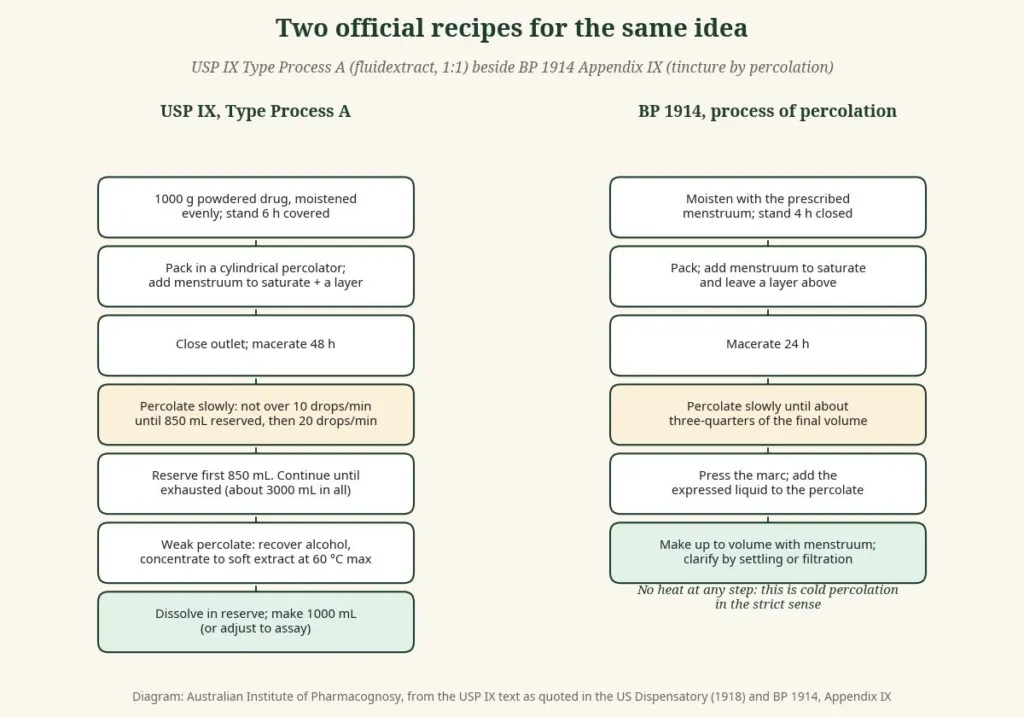
The official books varied in the details. The 1860 USP rubbed the powder with a quarter to half its weight of menstruum; the USP IX moistened it until “evenly and distinctly damp” and let it stand six hours covered; the BP 1914 let it stand four hours. Remington adds that a moistened fine powder should be passed through a coarse sieve before packing to break up wet lumps.[2, 8, 9, 1] Attested The exceptions prove the rule: sugar for syrups is percolated dry, because wetting it makes it cake, and ether oleoresins are not pre-moistened, because the menstruum is too volatile and flammable to spread about in an open dish.[1]
Packing and channelling
The USP VIII told the operator whether to pack a drug “moderately” or “firmly”; the USP IX dropped the instruction when it introduced the type processes, which Remington regretted as the loss of “this valuable aid to the beginner”. The rule of thumb that survived is that strongly alcoholic menstrua allow firmer packing than weak ones, because the drug swells less.[1] Attested
Channelling is the failure the 1850 preface warned about: liquid finds a path of low resistance, along the wall or through a crack, and the rest of the bed is bypassed.[18] Attested Uneven fines, a bed allowed to run dry, an over-wet packing that slumps and pulls away from the glass, or a stream of menstruum poured straight onto the surface will all do it. The visible sign in a glass percolator is a percolate that comes too fast and too pale for the stage of the run, or a band of colour that descends faster on one side than the other. Mechanism

5. The menstruum
The menstruum decides what can come out; the apparatus decides how much of it does. For hydro-ethanolic extracts the practical choice is the ethanol strength, and the evidence for matching it to the constituents is better than for most things in this field.
| Ethanol in the menstruum | What it extracts well (Bone and Mills, Table 6.5) |
|---|---|
| 25% | Water-soluble constituents: mucilage, tannins, some glycosides, including some flavonoids and a few saponins |
| 45–60% | Essential oils, alkaloids, most saponins and some glycosides |
| 90% | Resins and oleoresins |
Bone and Mills support the table with examples. A Swiss study found 55% ethanol best for chamomile oil, with stronger alcohol extracting no more oil and less of everything else; Meier found 40 to 60% the best range for the active constituents of a series of herbs; ivy saponins did not come out at all at 25% ethanol and came out fully at 60%. Higher is not always better: French work found an extract of Viburnum prunifolium bark made in 30% ethanol five times more spasmolytic than one made in 60%.[12] Evidence suggests Martins and colleagues found the same pattern in a percolator, with 55% ethanol out-extracting 80% for psoralen and bergapten from Brosimum gaudichaudii root.[24] Evidence suggests
Two consequences for percolation follow. The moisture already in the drug, which Remington put at anywhere from 8 to 20%, dilutes the first menstruum to reach it, and the drug takes up water and alcohol unequally. The alcohol content of the finished product is therefore always lower than the menstruum’s, and the USP IX said plainly that it could only be found by measurement.[1, 8] Attested The second is that changing menstrua partway, as Type Process B does, can precipitate what the first menstruum dissolved; Remington’s warning about water in the cotton plug is the small version of the same problem.[1] Mechanism
Glycerol deserves a word because practitioners ask about it. It dissolves many constituents poorly, glycetracts keep less well than alcoholic extracts, and its viscosity makes concentrated preparations hard to percolate, so 1:1 and 1:2 glycetracts invariably need a concentration step with heat or vacuum.[12] Evidence suggests Lloyd went further for cimicifuga: in his experience “either water or glycerin injures the fluid extract of this drug.”[19] Attested
6. Maceration in the percolator, flow rate and fractions
The maceration period
Almost every official percolation begins with a maceration inside the percolator: menstruum is added until the bed is saturated and a layer stands on top, the outlet is closed, and the whole is left. The USP IX allowed 48 hours; the BP 1914, 24.[8, 9] Attested The point is to let the menstruum penetrate the particles and dissolve what it can before liquid starts to move, so that the first percolate leaves close to saturation. Mechanism
The evidence that a long rest is always needed is thin. Lloyd’s best cimicifuga extract was made by simple percolation without maceration.[19] Attested Wang’s measurements show Salvia root reaching impregnation equilibrium in minutes to hours, depending on particle size.[10] Evidence suggests For a well-comminuted drug that wets easily, the 24 to 48 hours is probably more than equilibrium requires; for hard, horny or coarse material it may not be enough. It is a parameter worth testing for each drug, which the pharmacopoeias never did.
Rate of flow
The USP IX gave the first official number, quoted in full by Remington: “if this should be too rapid, incomplete exhaustion will result, but if too slow, valuable time may be wasted. The rate of flow for fluidextracts for 1000 Gm. of powder should not exceed ten drops a minute; for official quantities of tinctures and preparations of about the same strength twenty drops a minute.” Under the type processes the limit was 10 drops a minute until the reserve was collected and 20 thereafter, and 1000 g of drug could usually be exhausted with about 3000 mL of percolate.[1, 8] Attested
The figure is given for a 1000 g charge, and the text does not say how it should change for other charges; the controlling variable is more likely the flow per unit of bed cross-section than per unit of mass. Mechanism A drop is a crude measure that varies with the tip and the liquid, which is why later work quotes millilitres a minute; the principle holds either way. Wang found that a faster flow makes the concentration of the percolate fall faster, so the target yield is reached sooner.[10] Evidence suggests The price, on the Institute’s reading, is a weaker percolate and more solvent for the same extract. Mechanism In the soybean extractor the extraction rate rose with flow up to a point and gained nothing beyond it.[26] Evidence suggests The slow official rate trades time for concentration in the reserve; the right rate for a given drug is the slowest one the schedule can stand, unless measurement shows a faster one does as well. Mechanism
Fractional collection and the reserved percolate
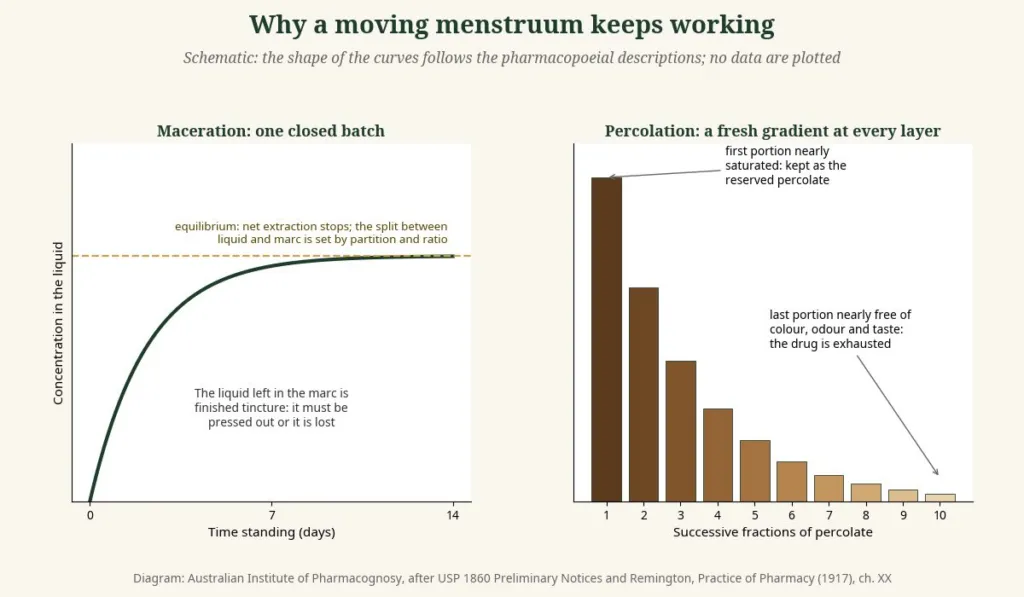
Remington explains why the first percolate is so much stronger than the rest. Milling separates soluble matter from cell wall only partly, and the finest dust, which is richest in soluble principles because woody tissue resists grinding, is reached first by the first menstruum. Each later portion is paler and weaker, and with a strongly coloured drug the gradient can be seen down the receiver.[1] Attested
The reserved-percolate method exploits this. In Type Process A, 1000 g of drug gives a reserve of 850 mL, which is set aside untouched; percolation continues to exhaustion; the alcohol is recovered from the weak percolate and the residue concentrated at no more than 60 °C to a soft extract, which is dissolved in the reserve and the volume made up to 1000 mL, or to whatever the assay requires.[8] Attested The BP 1914 liquid extracts and the BPC 1934 did the same with the same 850 mL figure.[9, 22] Attested Most of the product is never heated, but the fraction that is heated has been concentrated many times over, and that is where losses happen (section 10).
The four type processes
| USP IX process | Menstruum | What happens | Heat |
|---|---|---|---|
| A | Alcohol or alcohol and water | Moisten, stand 6 h, pack, saturate, macerate 48 h, percolate; reserve 850 mL; concentrate the rest | Weak percolate only, to 60 °C |
| B | Menstruum I with glycerin or acid, then menstruum II (alcohol and water) | As A, with the first menstruum carrying the glycerin or acid in a set proportion to the drug | Weak percolate only, to 60 °C |
| C | As A | Fractional or divided percolation: 500, 300 and 200 g portions, each moistened and percolated with the weak percolate of the one before | None |
| D | Boiling water, alcohol added at the end | Macerate 2 h in boiling water, percolate in a metal percolator with boiling water, evaporate, add alcohol | Throughout |
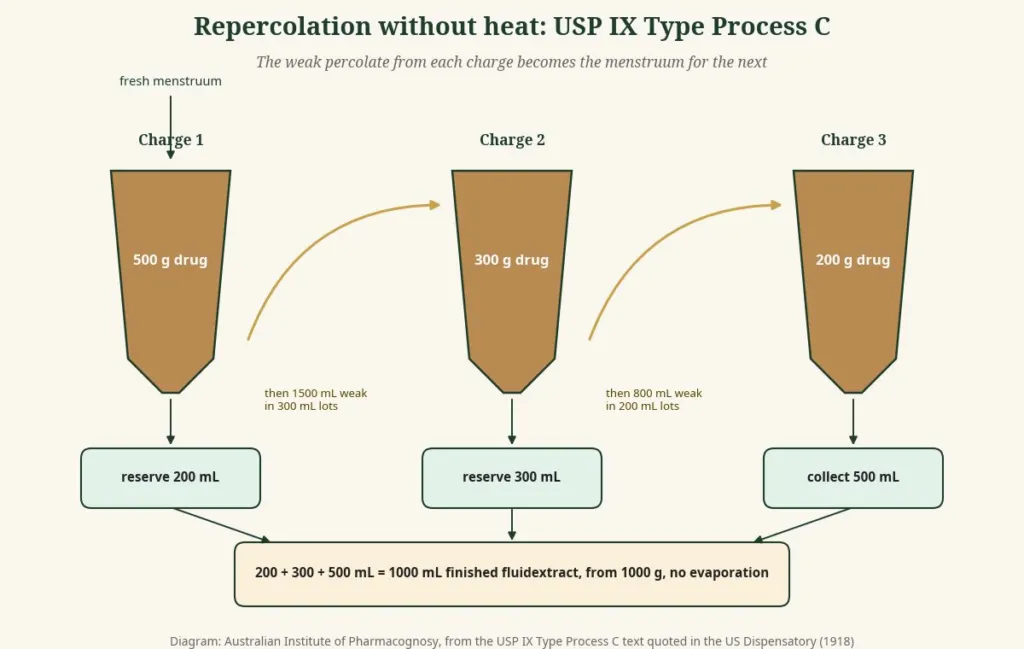
Type Process C was “especially recommended for drugs containing volatile ingredients or constituents injured by exposure to heat”, and could replace Process A for any drug.[8] Attested It is Squibb’s repercolation, adopted half a century after he proposed it.
7. Why a fresh gradient beats a closed jar
Extraction from a dried plant particle is mostly diffusion. Menstruum penetrates the particle, dissolves what it can, and the solute moves out through the cell walls and pores into the surrounding liquid at a rate proportional to the difference in concentration between inside and outside. In a closed jar that difference shrinks as the liquid fills with solute, and when the liquid outside reaches equilibrium with the liquid inside the particles, net extraction stops. Mechanism Equilibrium is set by how the constituent partitions between drug and liquid and by the ratio of liquid to drug. Waiting longer changes nothing.
Wang and colleagues measured those quantities for salvianolic acid B in Salvia root. The best fit to the soaking curves was a diffusion model in which the rate depends on an apparent diffusion coefficient divided by the square of the particle radius. The partition coefficient between herb and water sat between about 1.1 and 1.35 across batches and particle sizes.[10] Evidence suggests Their percolation model then treats the column as a stack of thin slices, in each of which the concentration of the liquid changes for three reasons: liquid flows in and out, solute spreads along the column by axial dispersion, and solute crosses from particle to liquid at a rate proportional to the gap between the concentration at the particle surface and the concentration in the liquid around it. The model predicted their percolation curves across flow rates, particle sizes, charge masses and batches.[10] Evidence suggests
The model gives the qualitative argument the old pharmacists made in numbers. In a percolator the liquid meeting any layer has come from the layers above, which were less exhausted, but it is constantly being replaced, so the gap between particle and liquid never closes until the particle is spent. The first liquid to leave has met the full column of fresh drug and leaves near equilibrium with it, which is why it is so strong. Each later liquid meets drug already partly exhausted, so it leaves weaker, and the last leaves almost as pure menstruum because there is almost nothing left to dissolve. Mechanism
Zhang, Lin and Ye put it in one sentence: “Percolation is more efficient than maceration because it is a continuous process in which the saturated solvent is constantly being replaced by fresh solvent.”[11] Cao and colleagues describe it as a dynamic leaching that “continuously adds new solvents to maintain a certain concentration difference”.[27] Mechanism
What stays in the marc
The second advantage is about the liquid left behind. Remington: “In maceration the liquid left in the residue is finished tincture. In percolation it is merely menstruum, the active portions of the drug having been dissolved in the preceding percolate.”[1] Attested A macerated marc must be pressed hard to recover that tincture, and even a good press leaves some behind. Wilson and colleagues found that pressing a two-week hemp maceration added 8.2% of the herb’s CBD to the product, while pressing the percolated marc gave no measurable liquid at all.[28] Evidence suggests
The same physics explains Lloyd’s column-height result. A taller column is a longer series of contacts, so the first percolate approaches equilibrium with fresh drug more closely and the reserve is stronger. It also explains why repercolation and counter-current batteries work: they lengthen the effective column by putting it in several vessels. Mechanism
8. Knowing when to stop: exhaustion testing
The classic tests were sensory: the last drops nearly free of colour, odour and taste beyond the menstruum’s own.[1, 2] Attested They work tolerably for coloured, bitter or aromatic drugs and badly for constituents that are colourless and tasteless at the relevant concentration. Mechanism
The working papers show the quantitative tests that replaced them. Lloyd evaporated one cubic centimetre of each fraction in a watch glass for 24 hours at 140 °F and weighed the dry extractive, building a curve of extractive against volume collected.[19] Attested Huyck assayed the alkaloids in each fraction of his belladonna percolates.[16] Attested Squibb’s siphon gave a running density reading. Each of these turns “exhausted” from a judgement into a curve with a tail that can be cut at a defined point.
Wang and colleagues take the next step, using their model to calculate the volume of percolate at which a target yield is reached for a given batch, after measuring the batch’s content of the marker first, and to set a “design space” of particle size, flow and charge within which the target is met with a stated probability.[10] Evidence suggests For a dispensary the practical version is simpler. Assay the herb, assay a sample of the product or of the late fractions for one marker, and record the ratio. That figure, extraction efficiency against a known starting content, is what tells a practitioner whether a percolation worked. Mechanism
9. Variants: repercolation, diacolation, counter-current and the industrial column
Repercolation
In Type Process C, 1000 g of drug is split into portions of 500, 300 and 200 g. The first is percolated with fresh menstruum; its first 200 mL is reserved and the next 1500 mL collected in 300 mL lots. Those lots, in the order collected, moisten and percolate the 300 g portion, whose first 300 mL is reserved and the next 800 mL collected in 200 mL lots. Those in turn percolate the last 200 g, from which 500 mL is collected. The three reserves, 200 + 300 + 500 mL, make 1000 mL of fluid extract without any evaporation.[8] Attested
The BP 1914 version divides 100 parts of drug into five equal portions and collects in fractions of 20 parts.[9] Attested Squibb ran repercolation continuously, carrying labelled, numbered bottles of weak percolate from one making of a fluid extract to the next, so that once the series was established every 8 parts of cinchona gave 8 parts of finished extract.[13, 16] Attested
Its disadvantages were known from the start: it needs skill, the drug is less completely exhausted than in a single exhaustive percolation, and a stock of weak percolates has to be stored, labelled and protected between makings.[8, 16] Attested Lloyd found the difference in yield between repercolation and simple percolation of cimicifuga to be about 5% in favour of simple percolation.[19] Attested
Diacolation
Breddin’s repetition diacolation of 1930 replaced percolators with glass tubes about half a metre long and 3.3 cm wide. Three 100 g portions of drug were percolated in series with a total of 300 g of menstruum to give 300 g of fluid extract, and at the end the menstruum held in the drug was displaced with water, a floating marker signalling when the water front arrived. Breddin claimed it saved menstruum, avoided distillation and, because the narrow tubes were packed tight, prevented capillary channels.[16] Attested
His diacolation apparatus proper, patented in the United States in 1936, forced the menstruum slowly by compressed air through one tube or several in series, through a throttle and a drop-counting chamber so that the rate could be set.[23, 16] Attested Huyck records a cinchona run of nine tubes, each 80 cm long and under 2 cm wide, fed at one and a half drops a minute under no more than one and a half atmospheres, and taking about 20 days to make 600 g of extract from 600 g of drug.[16] Attested Huyck’s own conclusion from belladonna root was that slow percolation under pressure through a very long column could make a full-strength fluid extract with neither fractional collection nor heat.[16] Attested
Counter-current batteries
Boullay’s continuous displacement had descendants well before Breddin. Huyck describes Lalieu’s apparatus of 1862, three or four cast-iron cylinders fed in series from a reservoir with little attention, and Giles’s battery of eight conical macerators of 1866, through which water passed in turn. Giles reported exhausting cinchona bark with eight and a half gallons of water where the British Pharmacopoeia’s method used eighty-four.[16] Attested
The industrial column
Percolation is still the commonest extraction format in at least two industries. Wang and colleagues count percolation in about 9.8% of the 1609 preparations in the 2020 Chinese Pharmacopoeia, Part I, and note its advantages as simple equipment, easy operation and a mild process suited to heat-unstable constituents, and its disadvantages as heavy solvent use and long extraction times.[10] Attested Shejawale and colleagues describe the percolation extractor as the most common type in the solvent extraction of vegetable oil, where hexane percolates down a bed of oilseed in stages.[26] Attested
Modern hybrids add energy to the column. Thomson’s vacuum percolators, described by Remington and the US Dispensatory, are one ancestor; a 2025 study of nettle and sage used an ultrasound-assisted percolation at 5 to 7 bar.[8, 29] Attested Neither is a cold percolation in the sense this article uses. Both keep the packed column and add pressure or energy to it.
10. Why it is preferred, and where
Heat-sensitive constituents
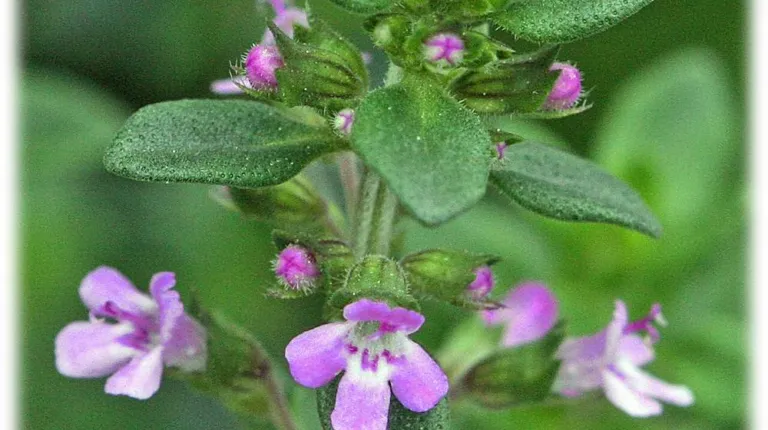
The argument for cold percolation is strongest where heat does damage. The clearest number in the practitioner literature comes from a 1953 Dutch PhD study of thyme reported by Bone and Mills. From the same herb, a 1:1 liquid extract was made in 50% ethanol by reserved percolation, a 1:2 by cold percolation, and a soft extract (13:1) and a spray-dried powder (16:1) from the 1:2. Expressed as the equivalent content of the dried herb, the 1:2 carried 0.22% phenols against 0.13% for the 1:1, so per gram of herb it kept 37% of the herb’s phenols against 22%. The soft extract lost 82% of the phenols and the powder 48%.[12] Evidence suggests
| Thyme preparation (1953 study) | Phenol content | Equivalent in dried herb |
|---|---|---|
| Dried herb | 0.59% | 0.59% |
| 1:1 by reserved percolation (heat on the weak percolate) | 0.13% | 0.13% |
| 1:2 by cold percolation | 0.11% | 0.22% |
| Soft extract 13:1, vacuum concentrated | 0.51% | 0.04% |
| Powdered extract 16:1, spray-dried | 1.84% | 0.12% |
Values from Bone and Mills, Table 6.4, reporting the 1953 study; the Institute has not seen the original thesis.[12]
Bone and Mills add a Swiss finding that vacuum concentration of a chamomile extract lost about half its essential oil, and draw the conclusion that the 1:2 is “the most concentrated preparation which can be achieved from a dried herb without using heat or vacuum concentration, and yet achieving high extraction efficiency”. They note that 1:2 extracts are not new: they appear in nineteenth-century texts, and the seventh edition of the German Pharmacopoeia defined a liquid extract as 1:2.[12] Evidence suggests
The other heat-labile classes follow the same logic. Type Process C was recommended for drugs with volatile constituents or constituents injured by heat; salvianolic acid B is percolated in Chinese manufacture because it degrades at high temperature; and the general reviews put the rule simply, with heat-stable material going to Soxhlet or microwave extraction and heat-unstable material to maceration or percolation.[8, 10, 30] Attested Enzymes cut both ways. Bone and Mills point out that fresh plant tinctures, made in a low-alcohol environment, leave the plant’s enzymes active, and cite Bauer’s finding that cichoric acid in fresh Echinacea purpurea preparations was largely decomposed. A dried drug percolated in an adequate ethanol strength avoids that problem without heat.[12] Evidence suggests (The chemistry of echinacea extracts is covered in the Journal’s echinacea review.)
Alkaloidal and assayed drugs
Many of the classic percolation drugs were alkaloidal, and their liquid extracts were assayed and adjusted: the BP 1914 liquid extract of hydrastis was standardised to its hydrastine content, and Type Process C had its own assay variant for alkaloidal fluid extracts.[9, 8] Attested A method that delivers most of the alkaloid in a reserve of known volume, from a charge of known assay, is easy to adjust. The modern equivalent is the batch assay a manufacturer runs before release. Mechanism
Concentration and economy
Abubakar and Haque summarise the conventional choices: large-volume products such as tinctures by maceration, concentrated products by percolation or Soxhlet, cheap drugs by maceration and costly ones by percolation.[30] Attested Bone and Mills say much the same for practice: tinctures (weaker than 1:2) are usually macerated, 1:1 and 1:2 extracts are best percolated, and tinctures can also be percolated adequately.[12] Evidence suggests Percolation also finishes in hours to days; Wilson’s small-scale runs took about an hour of percolation, after a 24-hour pre-moistening, against two weeks for the maceration.[28] Evidence suggests
Australian manufacturing and the TGA
Herbal liquids sold as listed or registered medicines in Australia are made by licensed manufacturers under the PIC/S Guide to Good Manufacturing Practice. Version PE009-17 has applied since 1 September 2025 to the manufacture of medicines, active pharmaceutical ingredients and sunscreens, unless an exemption applies; its main change concerned sterile products, and non-sterile manufacturers were not materially affected.[31] Confirmed Under GMP a percolation is a manufacturing process like any other: its parameters, particle size, ratio, menstruum, maceration time, flow and endpoint, are set in a master formula and validated, and each batch is recorded. Mechanism
The pharmacopoeial standards that apply by default are the British Pharmacopoeia, the European Pharmacopoeia and the United States Pharmacopeia–National Formulary, defined as “default standards” in section 3 of the Therapeutic Goods Act 1989 since 1 July 2009.[32] Confirmed The historical processes in this article are the ancestors of the general methods in those books; for current methods a manufacturer works from the current editions.
The practitioner’s dispensary
A herbalist (the exemption also covers naturopaths, nutritionists and practitioners of traditional Chinese medicine and homoeopathy) may make a herbal preparation for a patient without a manufacturing licence when the preparation is for use in the course of their business, is made on premises they occupy and can close to the public, and is supplied for a particular person after consulting that person, using their own judgement as to the treatment required. This is an exemption under Schedule 8 of the Therapeutic Goods Regulations.[5] Confirmed The same TGA guidance notes that default standards and Therapeutic Goods Orders may still apply to compounded medicines, that Commonwealth, state and territory laws apply alongside the exemption, and that medicinal cannabis products are generally not covered; the exemption concerns TGA manufacturing licensing and does not authorise anyone to make a scheduled or controlled substance.[5, 3]
The exemption attaches to a preparation made for a particular patient after consultation; making stock ahead of demand is manufacturing, and the TGA allows compounding in anticipation of need only to hospital pharmacies.[5] Confirmed The worked example in section 12 is accordingly framed for a GMP manufacturer. A small glass percolator suits the one-patient setting well. Wilson and colleagues note that pharmaceutical percolation cones are hard to buy for home use and that herbalists commonly cut the base off a tapering mineral-water bottle and use the screw cap in place of a stopcock.[28] Traditional The method is cheap, needs no heat, and finishes a 1:2 or 1:5 in days. What a dispensary usually lacks is the measurement: an assay of the herb and of the product, so that the extraction can be judged by numbers (section 8). For kava, an aqueous preparation with its own Australian rules, see the Journal’s kava review.
11. What the comparison studies show
For a method used for nearly two centuries, there are surprisingly few modern head-to-head comparisons with maceration in herbal liquids, and those that exist differ in solvent, ratio, scale and endpoint. The studies below are the ones the Institute could read in full.
Percolation against maceration
The clearest is Wilson, Simpson and Spelman’s 2022 study of hemp. Decarboxylated, milled flower of known CBD content was extracted at 1:5 in 95% ethanol either by maceration for two weeks, then drained and pressed, or by percolation after the material had been moistened and left for 24 hours, at one to two drops a second. Percolation recovered 80.1% of the CBD in the herb and the maceration 63.5%, of which 55.3% came from the drained liquid and 8.2% from pressing; the difference was highly significant. Percolation replicates agreed more closely (relative standard deviation 2.95% against 5%), menstruum recovery was 75.2% against 70.3%, and each percolation took about an hour.[28] Evidence suggests
The authors note duplicate extractions only, 54 g percolated against 100 g macerated because of the size of the cone, and equipment chosen to mimic home extraction. The study was funded by Health, Education & Research, LLC, with which one author is affiliated, and by Indomira, Inc., whose laboratory housed the work, and the authors declare no competing interests. It measured one lipophilic marker in one herb.[28] (The Australian cannabis setting is discussed in the Journal’s industry report card.)
Paz and colleagues extracted Hamelia patens leaf in 70% ethanol by percolation, by maceration and in a Soxhlet. Percolation gave a 44.5% yield, maceration 25% and the Soxhlet 24%, though the percolation used five times as much solvent (1 L for 20 g of leaf, against 200 mL for the other two). The percolated extract carried more epicatechin and had the lowest minimum bactericidal concentrations, but the authors found no significant difference in MBC between the three extracts.[33] Evidence suggests Oliveira and colleagues found the opposite for Hymenaea martiana, where percolation in 95% ethanol gave the lowest yields of the three methods across leaf, bark, fruit and seed and maceration of the leaves the highest, although the authors’ statistics found no significant difference in yield between methods, only between plant parts; they put the pattern down to shorter contact time in their percolation.[34] Evidence suggests
Percolation against assisted methods
El Maaiden and colleagues compared microwave, ultrasound and homogeniser-assisted extraction with maceration, percolation, decoction, infusion and Soxhlet across a set of medicinal and aromatic plants. The assisted methods gave the highest yields, and percolation the lowest of all eight methods for every plant tested (microwave, then ultrasound, homogeniser, Soxhlet, decoction, infusion and maceration, then percolation), while the conventional methods kept some enzyme-inhibitory activities the assisted methods lost; for elastase and butyrylcholinesterase inhibition the order was Soxhlet, then maceration, then percolation, with no activity from the other methods.[14] Evidence suggests
Martins and colleagues percolated 1 kg charges of Brosimum gaudichaudii root in a 5 L stainless-steel percolator at 0.2 mL a minute for 15 to 25 days and compared the result with ultrasound-assisted extraction optimised by response surface design. Ultrasound reached the same psoralen and bergapten contents about 98 times faster. The paper’s statements about which method gave the higher yield are not consistent with one another, so the Institute does not rely on its yield comparison.[24] Evidence suggests
The historical comparisons
The older work is gravimetric or alkaloidal and was done by people who knew the method well. Lloyd’s cimicifuga series ranked simple percolation without maceration above repercolation, which was slightly above the USP process.[19] Attested Huyck’s belladonna root series found the most alkaloid with a modified repetition diacolation, the least with USP XI repercolation, and the most total extractive with simple percolation; simple percolation was the quickest overall, at about 108 hours from start to finish against 176 hours for repercolation.[16] Attested
What it adds up to
Taken together, the evidence supports a modest claim. When a soluble marker is to be recovered at room temperature with a given menstruum, a properly run percolation can recover more of it, more consistently and faster, than a single static maceration with the same menstruum, because of the gradient and the marc; the one marker study, Wilson’s, found exactly that. The data are few and small, the markers differ, and two studies found the reverse on gravimetric yield (Oliveira, where the differences between methods were not statistically significant, and El Maaiden, where percolation ranked last of eight methods). Paz, Oliveira and El Maaiden measured total dry extract, not a marker. Assisted methods usually extract more and faster, at the cost of heat, equipment and sometimes a changed profile. Evidence suggests No study the Institute found compares cold-percolated and macerated liquids of a common dispensary herb by validated HPLC with matched charge and menstruum. That study is overdue.
12. Worked example: a 1:2 liquid extract of thyme
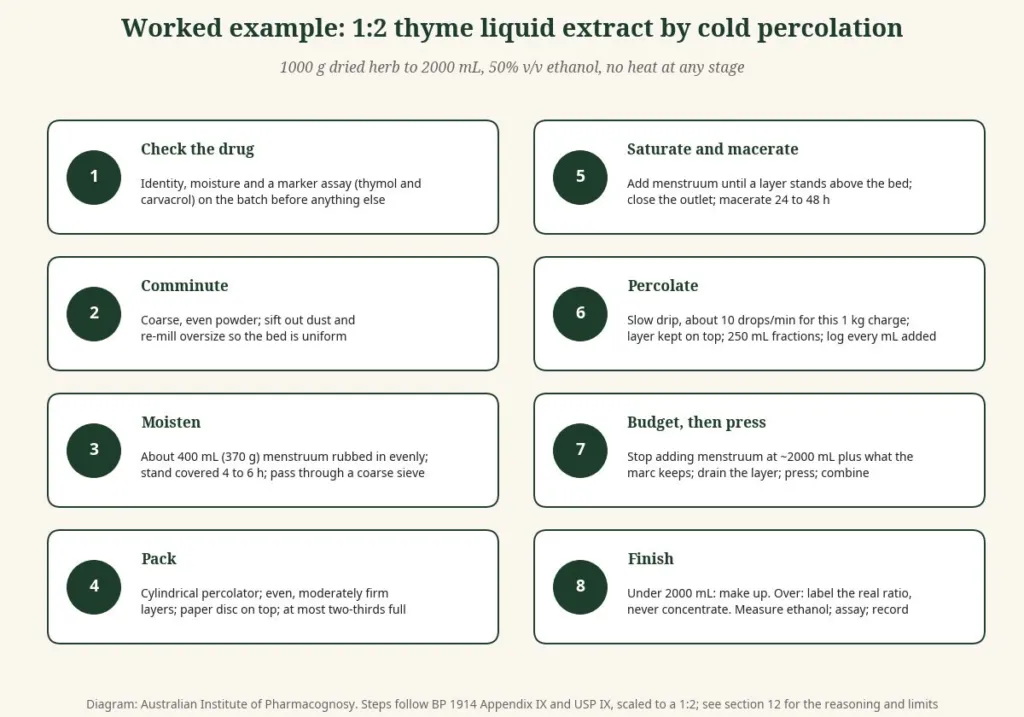
This worked illustration shows how the official directions translate into a 1:2 made without heat. It is written for a manufacturer working under GMP (section 10). It is assembled from the BP 1914 process of percolation and the USP IX directions, scaled to a 1:2 and applied to Thymus vulgaris because the 1953 study gives a published benchmark. It is an illustration drawn from the sources. It is not an Institute-validated standard operating procedure, and a manufacturer would validate every parameter for its own material and equipment.[9, 8, 12]
| Step | What to do | Why |
|---|---|---|
| 1. The herb | 1000 g dried thyme herb, identity confirmed; moisture and thymol plus carvacrol assayed on the batch | Extraction efficiency can only be judged against a known starting content (section 8) |
| 2. Comminution | A coarse, even powder; sift out the dust, re-mill the oversize | Uniform particles percolate as a front; fines channel the flow (section 4) |
| 3. Menstruum | 50% v/v ethanol, the strength used in the 1953 study; 45–60% suits essential oils | Bone and Mills, Table 6.5 (section 5) |
| 4. Moistening | About 400 mL of menstruum (roughly 370 g, a little under 40% of the herb weight, within the USP 1860 quarter to half), rubbed through evenly; stand covered 4 to 6 h; pass through a coarse sieve | The drug swells before it is packed and does not seal the column (section 4) |
| 5. Packing | A cylindrical or slightly tapering percolator, cotton tuft in the neck wetted with menstruum, the moist powder packed in even, moderately firm layers to no more than two-thirds of the height, paper disc and weight on top | Moderate packing because 50% ethanol is not a strongly alcoholic menstruum; a taller column gives a stronger first percolate (sections 3, 4 and 7). The Institute expects little swelling of a leafy herb in 50% ethanol, but has not measured it |
| 6. Saturate and macerate | Add menstruum until a layer stands above the bed; close the outlet; cover; macerate 24 h (BP) to 48 h (USP) | Lets the menstruum reach equilibrium with the first layers; worth testing shorter (section 6) |
| 7. Percolate | Open to a slow drip, no faster than about 10 drops a minute for this 1 kg charge; keep a layer of menstruum on top, ideally from an inverted reservoir; collect in 250 mL fractions; record every millilitre of menstruum added | The USP IX limit for a 1000 g charge; fractions let the tail be tested (sections 3 and 6) |
| 8. Budget, stop and press | Stop adding fresh menstruum when the total added (moistening, saturation and top-ups) reaches about 2000 mL plus the volume the pressed marc is expected to keep; let the standing layer drain into the bed; collect until the flow stops; press the marc and combine | At 1:2 the menstruum budget, not the press, is the control point: a percolated marc may give little or nothing on pressing (section 7) |
| 9. Finish | If the combined liquid is under 2000 mL, make up with menstruum; if it is over, the product is weaker than 1:2 and is labelled by its actual ratio, never concentrated. Mix, settle, filter; measure the ethanol; assay thymol and carvacrol; record efficiency against the herb | The final ethanol is always lower than the menstruum (section 5); the assay is the test of the run |
Expect days. Huyck’s simple percolations of belladonna root took about 108 hours from start to finish.[16] Attested Expect, too, that a 1:2 will not exhaust the herb: two millilitres of liquid per gram, part of it held in the marc, cannot carry out everything the menstruum could dissolve, and the 1953 1:2 held 37% of the herb’s phenols.[12] Evidence suggests The trial run that sets the menstruum budget for a given herb and grind is the first job in validating the process. Mechanism That is the price of keeping heat out. A lower ratio such as 1:3 would extract more completely and give a weaker product; the right ratio is a decision about the product, made with the assay in hand. Mechanism
Some temptations are best resisted. Displacing the last menstruum from the marc with water, as Breddin did, recovers liquid but changes the ethanol content unpredictably. Concentrating a weak tail by warming turns a cold percolation into a reserved-percolate one. And topping up with stronger alcohol to rescue a low ethanol figure dilutes the product below 1:2 if it is not accounted for.[16] Mechanism
13. Limits, and where hot methods or maceration win
Cold percolation is the wrong tool for several jobs. Gummy and resinous drugs such as aloes, asafoetida and tolu block the column, and the pharmacopoeias macerated them.[1] Attested Mucilaginous drugs swell into a gel; Bone and Mills point out that properly made fluid extracts of slippery elm or marshmallow would be too gelatinous to pour, and that such herbs are better given as powders.[12] Evidence suggests Glycerol menstrua are too viscous to percolate to a concentrated product.[12]
Exhaustive percolation uses a lot of solvent and time, and the weak percolate has to be concentrated, which reintroduces heat, or carried forward, which needs repercolation and storage.[10, 11, 8] Attested The method also rewards skill and punishes its absence; the 1850 USP offered it only as an alternative for that reason, and Squibb thought good results unlikely from less than about a pound of drug per percolation.[18, 13] Attested
Where the target is a heat-stable constituent and the goal is to get all of it, continuous hot extraction does better. Trease and Evans describe the Soxhlet apparatus, in which boiling solvent refluxes into a thimble of drug and siphons back to the flask, as the standard for determining extractives such as the fixed oil in seeds and for small-scale isolations.[17] Attested Zhang and colleagues describe it as combining reflux and percolation, recycling fresh solvent automatically, with high efficiency and less time and solvent than maceration or percolation, and with a real risk of thermal degradation from the heat and the long run.[11] Evidence suggests Lloyd’s cold still, with its warm surface and cool drug, is an attempt to have it both ways. The next article in this series takes up the Soxhlet: its invention, its mechanics, and where its continuous hot cycle earns its place over the cold column described here.
Discussion: conclusions, hypotheses and research still required
What the evidence supports
- Percolation entered pharmacy through the Boullays’ 1833 memoirs, built on Réal’s press and Robiquet’s observation, and the US Pharmacopoeia preferred it to maceration by 1860.[7, 1, 2] Attested
- The official parameters were moistening before packing, a maceration in the percolator, a constant layer of menstruum, a slow flow (10 drops a minute for a 1000 g fluid-extract charge under USP IX) and a reserved first fraction.[8, 9, 1] Attested
- Percolation maintains a concentration gradient that a closed maceration loses, and leaves menstruum in the marc in place of finished tincture.[10, 1] Mechanism
- In the few head-to-head studies, percolation recovered more of a single marker than maceration in the one marker-recovery study (Wilson); on gravimetric yield one study favoured percolation (Paz) and two did not (Oliveira, El Maaiden); assisted methods usually recovered the most.[28, 33, 34, 14] Evidence suggests
- Heat concentration loses volatile and phenolic constituents; a cold-percolated 1:2 kept more of thyme’s phenols per gram of herb than a reserved-percolate 1:1.[12] Evidence suggests
What we can reasonably hypothesise
- The 24 to 48 hour maceration in the percolator is longer than equilibrium requires for most finely comminuted, easily wetted dried herbs, and could be shortened without loss. Mechanism
- The yield advantage of percolation over maceration will be largest for constituents with a low partition into the liquid and for drugs that hold a lot of liquid in the marc. Mechanism
- Much of the batch-to-batch variation in practitioner-made percolates comes from channelling and uneven flow, which a constant-head reservoir and a taller, narrower column would reduce. Mechanism
- For some multi-constituent herbs, the slow cold column gives a profile closer to the dried herb than ultrasound or microwave extraction at equal yield. Mechanism
Research still required
- Phytochemistry and quality analysis. A matched comparison of cold-percolated 1:2, macerated 1:5 and reserved-percolate 1:1 for three dispensary herbs with different constituent classes (for example thyme phenols, echinacea alkylamides and a saponin herb), same batch, same menstruum, validated HPLC, triplicate runs, reporting efficiency against the herb assay.
- Process engineering. Residence-time and tracer studies in practitioner-scale glass percolators to measure channelling directly, and a test of maceration periods of 0, 6, 24 and 48 hours on extraction efficiency.
- Endpoint methods. Validation of simple exhaustion endpoints a dispensary can run (refractive index, UV absorbance or dry extractive of the late fractions) against a marker assay.
- Stability. Shelf-life comparison of cold 1:2 and heat-concentrated 1:1 extracts for volatile and phenolic markers under Australian storage temperatures, including far north Queensland conditions.
- History of pharmacy. A reading of the Boullays’ 1833 memoirs and Robiquet’s note in the original Journal de Pharmacie, to settle the date of Réal’s press and the exact sequence of credit, and of the 1953 thyme thesis that Bone and Mills report.
- Regulatory science. A survey of how Australian GMP manufacturers specify and validate percolation parameters for herbal liquids, and how practitioner preparation under the Schedule 8 exemption is documented.
About the Australian Institute of Pharmacognosy and this series
The Australian Institute of Pharmacognosy is a clinic and research laboratory in Cardwell, far north Queensland, studying medicinal plants and natural products to the same evidentiary standard as any other branch of pharmacology: traditional knowledge taken seriously, and tested honestly. Visit the Institute at australian-pharmacognosy.org.
Series: AIP Journal, Laboratory Methods: articles on laboratory apparatus and procedures in pharmacognosy. No. 1, cold percolation (this article). Next: Soxhlet extraction. Related Journal articles: black cohosh (Actaea racemosa) · echinacea (Echinacea purpurea) · kava (Piper methysticum) · medicinal cannabis in Australia. Follow the series for the next method.
Corrections: if you find an error or a source we have missed, write to the Institute at our contact form. We would sooner correct a claim than repeat it.
About the images and the evidence. Every photograph and engraving is reproduced under the licence stated in its caption and in the image credits; the diagrams and the chart were drawn by the Institute from the sources printed in each. The Institute thanks the libraries and digitisation programmes, the Internet Archive and the Smithsonian Libraries among them, whose scans made the primary sources readable.
Chief Scientific Officer
Australian Institute of Pharmacognosy
Cardwell QLD, Australia
australian-pharmacognosy.org · our contact form
Dr Thomas Ridley
Head of Education and Research
Australian Institute of Pharmacognosy
Cardwell QLD, Australia
australian-pharmacognosy.org · our contact form
Suggested citation: Iggulden L, Ridley T. Cold percolation: apparatus, mechanics and practice. AIP Journal, Laboratory Methods No. 1. Cardwell (QLD): Australian Institute of Pharmacognosy; 2026.
Educational content only; not medical, legal or regulatory advice. Australian regulatory information reflects TGA guidance on default standards, good manufacturing practice and compounded medicines as read in October 2026 and may change. United States, British and German pharmacopoeias and patents are cited as historical sources and do not govern Australian practice.
References
34 references: tap to open
Listed in order of first citation. Every PMID was checked against PubMed and every paper read in full in October 2026; historical books, journals and patents were read in their digitised originals in October 2026, except where an entry says otherwise.
- Remington JP. The Practice of Pharmacy. 6th ed. Philadelphia: J. B. Lippincott; 1917. Chapter XX, Percolation, pp. 280–296 (quoting the USP IX directions on percolators, packing and rate of flow). Digitised copy: Internet Archive
- The Pharmacopoeia of the United States of America. Fourth decennial revision, by authority of the National Convention held at Washington, A.D. 1860. Philadelphia: J. B. Lippincott; 1864. Preface; Preliminary notices (Percolation; Fineness of powders), pp. 3–7. Digitised copy: Internet Archive
- Therapeutic Goods Administration. Notice of final decisions to amend (or not amend) the current Poisons Standard (ACMS #46; Joint ACMS-ACCS #38). 19 May 2025; Atropa belladonna, implementation date 1 June 2025. Read by the Institute in October 2026. tga.gov.au
- Office of Drug Control. Narcotic Drugs Act 1967 [legislation summary]. Last updated 21 January 2022. Read by the Institute in October 2026. odc.gov.au. Act: Federal Register of Legislation, C1967A00053
- Therapeutic Goods Administration. Manufacturing, supplying and advertising compounded medicines lawfully. Published 14 May 2026; last updated 8 September 2026. Read by the Institute in October 2026. tga.gov.au
- Queensland. Drugs Misuse Act 1986, section 8 (producing dangerous drugs) and Part 5B (commercial production of industrial cannabis). Read by the Institute in October 2026. legislation.qld.gov.au
- Wisniak J. Pierre-François Guillaume Boullay. An Quím. 2014;110(4):303–312. Open access: Dialnet
- Remington JP, Wood HC, editors. The Dispensatory of the United States of America. Philadelphia: J. B. Lippincott; 1918. “Fluidextracta”, including the USP IX text of Type Processes A to D and the rate of flow. Transcription: henriettes-herb.com
- General Council of Medical Education and Registration of the United Kingdom. The British Pharmacopoeia 1914. London; 1914. Appendix IX (process of percolation; process of repercolation); Extractum Hydrastis Liquidum. Digitised copy (a ‘final draft’ proof issued for correction to the General Medical Council; passages checked in this copy): Internet Archive
- Wang W, Ding F, Qu H, Gong X. Mechanism modeling and application of Salvia miltiorrhiza percolation process. Sci Rep. 2023;13(1):8311. doi:10.1038/s41598-023-35529-2. PMID 37221365.
- Zhang QW, Lin LG, Ye WC. Techniques for extraction and isolation of natural products: a comprehensive review. Chin Med. 2018;13:20. doi:10.1186/s13020-018-0177-x. PMID 29692864.
- Bone K, Mills S. Principles and Practice of Phytotherapy: Modern Herbal Medicine. 2nd ed. Edinburgh: Churchill Livingstone Elsevier; 2013. Chapter 6, pp. 124–129 (liquid preparations, Tables 6.4 and 6.5).
- Squibb ER. Fluid extracts by repercolation. Am J Pharm. 1878 May;50:209–249. Digitised volume: Internet Archive
- El Maaiden E, Bouzroud S, Nasser B, et al. A comparative study between conventional and advanced extraction techniques: pharmaceutical and cosmetic properties of plant extracts. Molecules. 2022;27(7):2074. doi:10.3390/molecules27072074. PMID 35408473.
- Boullay PFG, Boullay P. [Memoirs on the method of displacement.] J Pharm (Paris). 1833;19:281–291 and 393–425; 1835;21:1–22; and Boullay P, Boullay PFG. Méthode de déplacement. Paris: Colas; 1835. The original volumes were not consulted for this article; the bibliographic details are from Wisniak (2014) and Huyck (1937).
- Huyck CL. Drug extraction: a study of repercolation [PhD dissertation]. Gainesville (FL): University of Florida; 1937. Digitised copy: Internet Archive
- Evans WC. Trease and Evans Pharmacognosy. 16th ed. Edinburgh: Saunders Elsevier; 2009. pp. 124–125 (Fig. 16.2, Soxhlet), 137–138 (extraction of plant material) and 353 (history of the alkaloids).
- The Pharmacopoeia of the United States of America. By authority of the National Medical Convention, held at Washington, A.D. 1850. Philadelphia: Lippincott, Grambo; 1851. Preface, pp. xxi–xxii; Preliminary notices (Filtration). Digitised copy: Internet Archive
- Lloyd JU. Laboratory notes on fluid extract of cimicifuga. Am J Pharm. 1878 Jan;50:1–15; continued 1878 Sep;50:434 and following. Digitised volume: Internet Archive
- Lloyd Library and Museum. Lloyd Library and Museum acquires Lloyd extractor [press release]. Cincinnati; 18 April 2012. Archived at the Society of Ohio Archivists list
- Lloyd JU. Percolating and concentrating apparatus. US Patent 1,332,908. Filed 6 June 1918; granted 9 March 1920. Google Patents
- Pharmaceutical Society of Great Britain. The British Pharmaceutical Codex 1934. London: Pharmaceutical Press; 1934. Extracta (general notice), Extractum Aletridis Liquidum and Extractum Anthemidis Liquidum, pp. 1224–1226. Digitised copy: Internet Archive
- Breddin H. Apparatus for extracting drugs and the like. US Patent 2,046,055. Priority 21 October 1932; granted 30 June 1936. Google Patents
- Martins FS, Pascoa H, de Paula JR, da Conceição EC. Technical aspects on production of fluid extract from Brosimum gaudichaudii Trécul roots. Pharmacogn Mag. 2015;11(41):226–231. doi:10.4103/0973-1296.149742. PMID 25709236.
- Dash AK, Singh S, Tolman J, editors. Pharmaceutics: Basic Principles and Application to Pharmacy Practice. Amsterdam: Academic Press; 2014. Chapter 9, Liquid dosage forms, p. 190.
- Shejawale DD, Murugesh CS, Rastogi NK, Subramanian R. Effect of feed particle size and solvent flow rate on soybean oil extraction in a percolation type extractor. J Food Sci Technol. 2022;59(12):4723–4730. doi:10.1007/s13197-022-05554-6. PMID 36276520.
- Cao S, Liang J, Chen M, et al. Comparative analysis of extraction technologies for plant extracts and absolutes. Front Chem. 2025;13:1536590. doi:10.3389/fchem.2025.1536590. PMID 40099208.
- Wilson J, Simpson T, Spelman K. Total cannabidiol (CBD) concentrations and yields from traditional extraction methods: percolation vs. maceration. Front Pharmacol. 2022;13:886993. doi:10.3389/fphar.2022.886993. PMID 36353485.
- Tăbărașu AM, Vlăduț NV, Nenciu F, et al. Improved hybrid percolation-ultrasound extraction of bioactive compounds and their application as nettle and sage-derived biostimulants in tomato and pepper crops. Foods. 2025;14(22):3900. doi:10.3390/foods14223900. PMID 41300058.
- Abubakar AR, Haque M. Preparation of medicinal plants: basic extraction and fractionation procedures for experimental purposes. J Pharm Bioallied Sci. 2020;12(1):1–10. doi:10.4103/jpbs.JPBS_175_19. PMID 32801594.
- Therapeutic Goods Administration. Good manufacturing practice (GMP) requirements for medicinal products: PIC/S Guide to GMP PE009-17. Published 14 June 2024; last updated 27 August 2025. Read by the Institute in October 2026. tga.gov.au
- Therapeutic Goods Administration. Questions and answers relating to the additional default standards legislation. Last updated 21 February 2011. Read by the Institute in October 2026. tga.gov.au
- Paz JEW, Contreras CR, Munguía AR, et al. Phenolic content and antibacterial activity of extracts of Hamelia patens obtained by different extraction methods. Braz J Microbiol. 2018;49(3):656–661. doi:10.1016/j.bjm.2017.03.018. PMID 29246664.
- Oliveira FG, de Lima-Saraiva SR, Oliveira AP, et al. Influence of the extractive method on the recovery of phenolic compounds in different parts of Hymenaea martiana Hayne. Pharmacognosy Res. 2016;8(4):270–275. doi:10.4103/0974-8490.188885. PMID 27695267.
Image credits
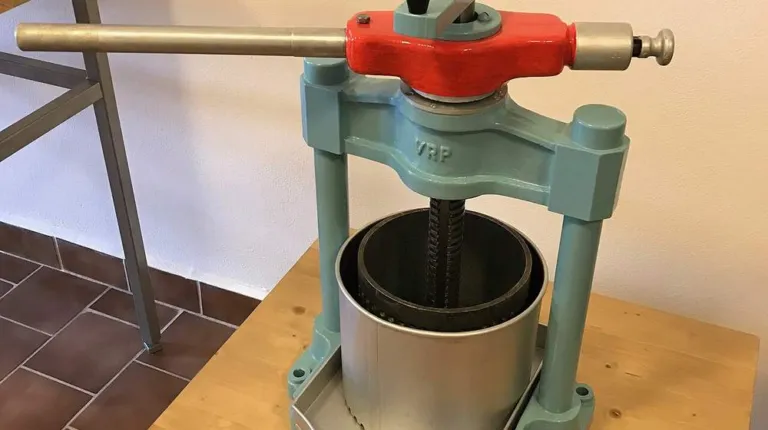
- Cover and marc press: Jiří Sedláček, CC BY-SA 4.0, Kuks Hospital exhibition on the history of drug making.
- Squibb’s percolators (three engravings): American Journal of Pharmacy vol. 50, 1878, Smithsonian Libraries scan via Internet Archive Book Images, no known copyright restrictions.
- E. R. Squibb portrait: James W. Williams, Smithsonian American Art Museum, CC0. J. U. Lloyd: Bain News Service, Library of Congress, public domain.
- Salvia miltiorrhiza slices: Fumikas Sagisavas, CC0. Chamomile: Andrey Nagaycev, CC BY 2.0. Cinchona bark: H. Zell, CC BY-SA 3.0. Thyme: Pharmattila, CC BY-SA 4.0.
- Belladonna: Robert Flogaus-Faust, CC BY 4.0. Black cohosh: Fritzflohrreynolds, CC BY-SA 3.0. Buchu: Margriet B., CC BY-SA 4.0. Dried cannabis: Scrinterlocked, CC BY-SA 3.0. Soxhlet extractors: Angel Mathew, CC BY 4.0.
- Diagrams (methods, timeline, percolator, type processes, gradient, worked example) and the CBD chart: Australian Institute of Pharmacognosy, drawn from the sources named in each caption.
- All photographs and engravings via Wikimedia Commons; each caption links to its source page. Photographs marked “cropped” were cropped to the house banner or grid format and resized; the portraits and the two smaller engravings were resized only.
The Institute sets and publishes its own monographs. The catalogue is in Publications.