

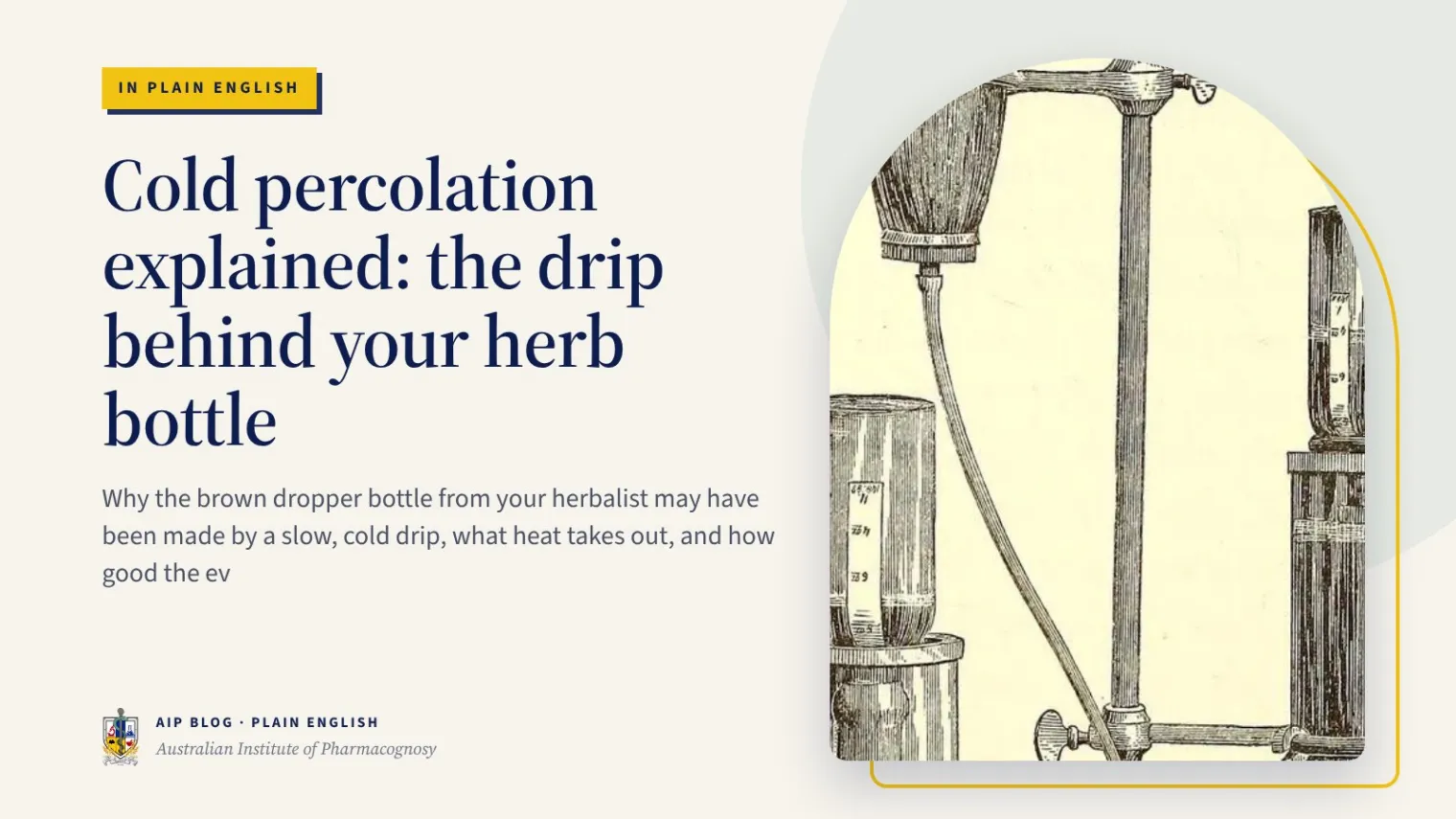
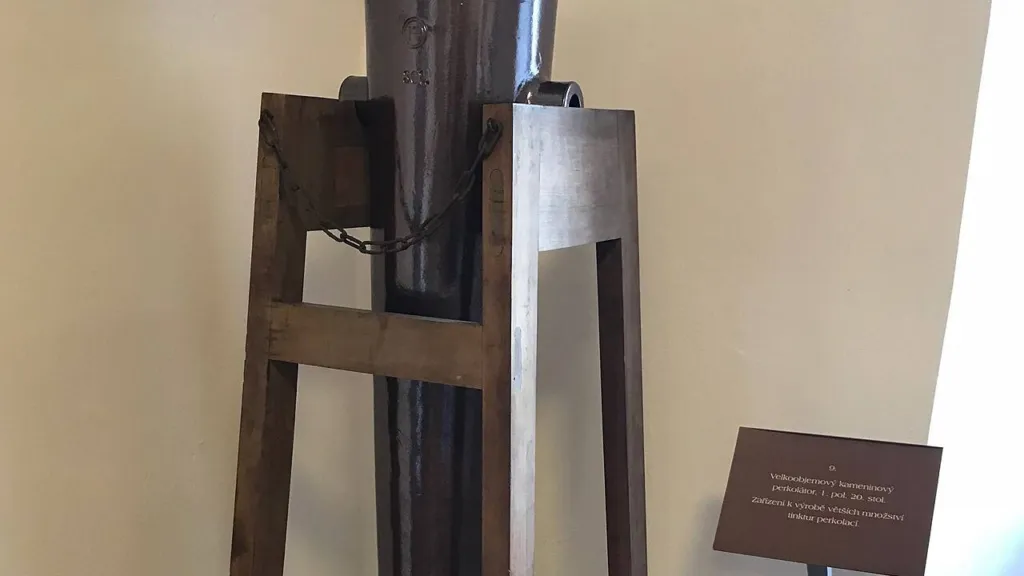
Photo: Jiří Sedláček (stoneware percolator, Kuks Hospital, Czech Republic) · CC BY-SA 4.0 · Wikimedia Commons
Tip your herbalist’s brown dropper bottle to the light and read the label. Beside the plant’s name there is often a little ratio, 1:2 or 1:1, and nothing to say how the liquid inside was made.
Quite possibly it came from a method two centuries old: alcohol and water dripping through a packed column of dried herb, no stove in sight. How that drip was run decides how much of the plant reached your bottle.
Educational only: no recipe, no quantities, no doses. Legal passages are the Institute’s published reading of Australian rules as at October 2026, not legal advice.
Emergency: phone 000. Poisons Information Centre: 13 11 26, 24 hours, Australia-wide; follow its advice.
The alcohol used to make herbal liquids catches fire easily. Work with it only where air moves freely, well away from flames, hotplates and sparks, with the vessel covered to keep vapour down. In any workplace the ordinary rules for storing and labelling a flammable liquid apply, however small the batch.
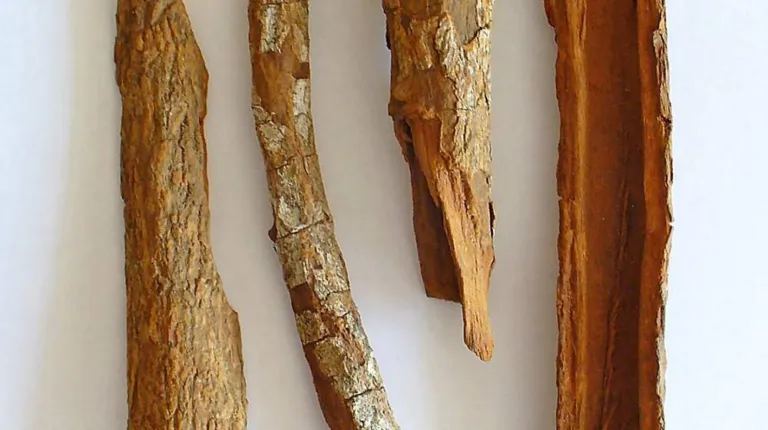
Two plants in this story carry strong alkaloids. Belladonna root is a prescription-only medicine in Australia, apart from some low-alkaloid preparations, and cinchona bark carries quinine. They appear here only because the old experiments were done on them. This page gives no guidance on preparing either.
Making cannabis medicines in Australia needs a Commonwealth licence, and in Queensland unlawfully producing a dangerous drug is a crime. The hemp study described below is overseas research, mentioned for what it measured in the liquid and nothing else.
Before taking any herbal medicine, consult a degree-qualified herbalist with competencies and adequate training in pharmacognosy.
- Liquid trickles through packed dried herb, with no heat at any stage.
- Fresh liquid keeps the herb giving after a jar would have stalled.
- Heat used to thicken an extract can cost a plant its scented oils.
- Fair head-to-head tests are few and small, and they disagree.
- Your herbalist may make one just for you; shop liquids come from licensed makers.
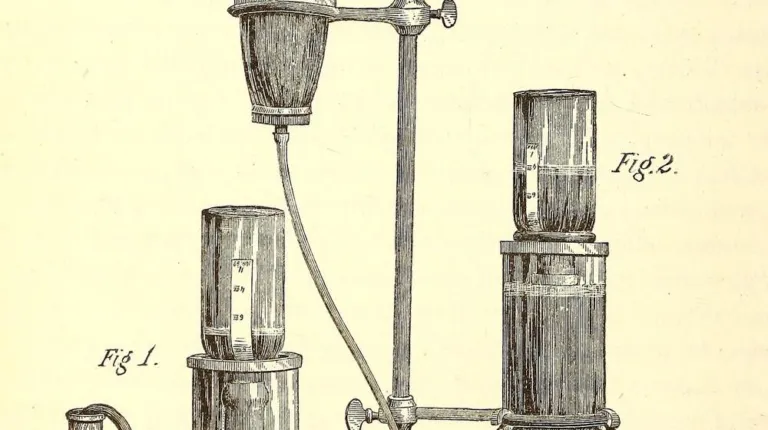
A jar gives up early. A drip keeps going.
Two ways into a plant.
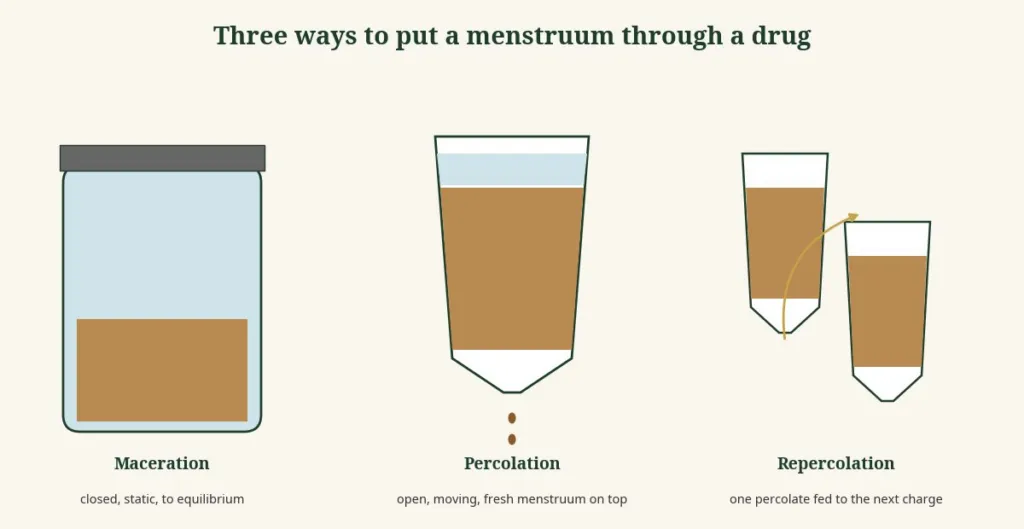
The oldest way is the jar: herb in, liquid on, lid on, then wait days or weeks. Pharmacists call it maceration. Once the liquid matches what is soaked inside the plant, nothing more moves, and the soggy herb holds back finished product that no press fully recovers.
Percolation stands the jar on end: herb is packed into a tall vessel with a tap at the bottom, liquid is kept on top, and it leaves slowly from below. Each layer keeps meeting liquid a little weaker than itself, so it keeps letting go. The first drops run dark and strong; the last come out almost as pale as what went in.
“Percolated” on a label describes the method and says nothing about quality, so ask whether the batch was tested.
What a warm stove takes out of a herb
Why some makers would sooner wait days.
A run taken to the end leaves a strong first portion and a long, weak tail. The old fix boiled the tail down and stirred it back in, and the losses happened there. Edward Squibb, a Brooklyn drug maker, argued heat rearranged what it left until the extract stopped being quite the plant. His example was buchu, a fragrant leaf: warm its extract until the oil separates and no amount of alcohol will mend it.
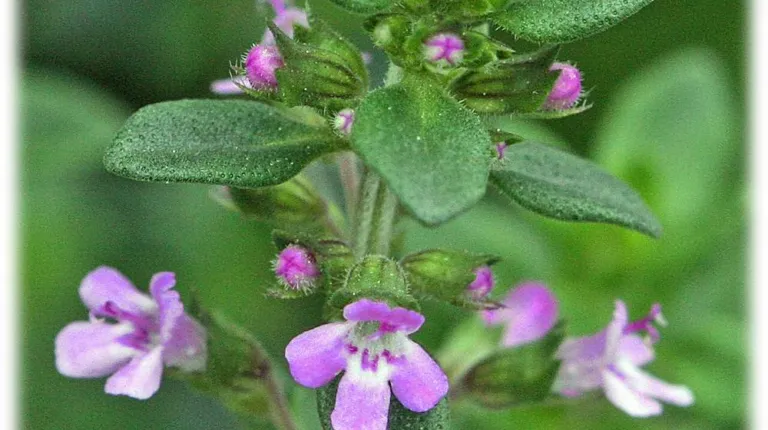
A Dutch thyme study from the 1950s, which the Institute knows only through a standard herbal textbook, found that a cold-made 1:2 (one part herb to two of liquid) kept noticeably more of thyme’s aromatic compounds, weighed against the herb that went in, than a 1:1 finished with heat. The textbook calls the cold 1:2 the most concentrated liquid dried herb gives without heat while still drawing it out well. It can’t carry everything out, though.
Skipping heat seems to keep more of a plant’s scent, at a cost in completeness and time.
The ratio tells you how much herb went in and nothing about what heat took out afterwards. Ask how the liquid was finished.
The honest scorecard
Two centuries of use, few fair tests.
The clearest test, from overseas, was on hemp. Percolation drew out around four-fifths of one compound, CBD, against a little under two-thirds for a fortnight in a jar plus the press, with steadier results and about an hour of dripping. Hold it lightly: two runs a method, unequal amounts of herb, one compound in one plant, and funding from two companies, one tied to an author and one hosting the lab (the authors declared no competing interests).
One leaf study favoured percolation but used far more liquid; one favoured the jar, though the gap could have been chance; a broad comparison put percolation last of eight methods on sheer amount. Ultrasound and microwave methods often get more out, faster, with heat. Every study here measures what ends up in the bottle. None tests what the bottle does for a person.
Read “cold percolated” as careful, unheated making and no more. What a liquid might do for you is a question for the herbalist described in the red box.

Who may make your bottle
A factory, a back room, and the line between.
Liquids sold off the shelf as listed or registered medicines come from licensed manufacturers working to the international manufacturing code that the TGA, the national medicines regulator, applies: steps written down and checked, every batch recorded.
A herbalist (naturopaths and some other practitioners too) needs no manufacturing licence to make a preparation for you in particular, after consulting you and using their own judgement, in their own rooms that they can shut to the public. Stock made in advance is manufacturing. The exemption covers TGA licensing only: it never permits making a scheduled or controlled drug, other national, state and territory laws still apply, and medicinal cannabis is generally outside it.
What a small dispensary often lacks is the testing that shows a run worked. And some herbs refuse: gummy aloes blocks the column, and slimy slippery elm swells into jelly.
If your herbalist made it in their own rooms, it should have been made for you, after a consultation. Making it at home? Read the red box: the alcohol burns.
A coffee pot and a pile of root
Worked out by hand, at a cost.
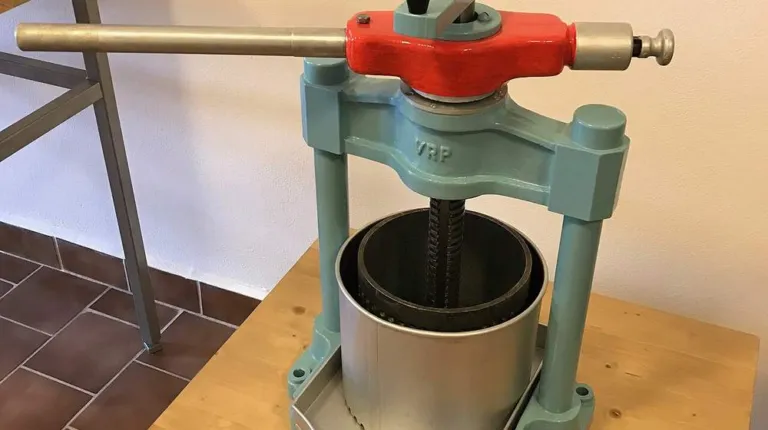
In Paris in 1833 a pharmacist named Boullay and his son saw that an older, leaky press didn’t need its tall pipe: the liquid’s own weight would do. They noticed that a drip coffee pot of their day already did the same with coffee. In 1835, the year their book appeared, the son died after an ether blast.
In Cincinnati in 1878 John Uri Lloyd took a thousand pounds of black cohosh root just as the trade delivered it, and weighed every version of the drip. The official recipe, followed to the letter, fell short. The plainest drip won.
Your brown bottle owes something to a Paris father and son, and a man weighing root.
This page is the short version of our Laboratory Methods article, where every source is set out:
- Dr Luke Iggulden, Chief Scientific Officer — Senior author. Commissioned the Explainer series, set its direction and approved it
- Jesse Kirby — Wrote this edition from his own notes with the journal article closed: chose the five questions a reader holding a dropper bottle would ask, the order, every sentence and the two pull quotes, and rewrote the parent’s safety box in plain words without loosening it
- Zoe Bennett — Wrote the page title, the search description and the labels, built on the dropper bottle a reader already owns, which is the line the page will be shared on
- Theo Karras — Chose the stoneware percolator for the cover, the five section banners and the three-methods diagram from the article’s own set, kept out the recipe-style diagrams, and wrote fresh alt text to match each frame
- Leah Bianchi — Built the page: the red safety box, the one-minute card, five what-this-means cards, the pull quote and the card back to the journal article, with every section kept short enough to read on a phone
Contributors
- Dr Thomas Ridley — Co-wrote AIP Journal, Laboratory Methods No. 1, the article this page retells, and checks the science of this edition
Image credits. Cover stoneware percolator and the marc press: Jiří Sedláček, CC BY-SA 4.0, Kuks Hospital exhibition on the history of drug making, via Wikimedia Commons. Squibb’s percolators: American Journal of Pharmacy, 1878, Internet Archive Book Images, no known copyright restrictions. Thyme: Pharmattila, CC BY-SA 4.0. Chamomile: Andrey Nagaycev, CC BY 2.0. Cinchona bark: H. Zell, CC BY-SA 3.0. All via Wikimedia Commons. Diagram of the three methods: Australian Institute of Pharmacognosy.
AIP Explainers are the plain-language editions of the Institute’s technical articles, published alongside the original. Everything on this page is carried by the full article, where the evidence, the references and the regulatory sources are set out. Regulatory information was read in October 2026 and may change. Spotted an error? Write to our contact form. We would rather correct a claim than repeat it.
Jesse Kirby
Head of Community Outreach
Australian Institute of Pharmacognosy
Cardwell QLD, Australia
australian-pharmacognosy.org · our contact form
The Institute sets and publishes its own monographs. The catalogue is in Publications.