

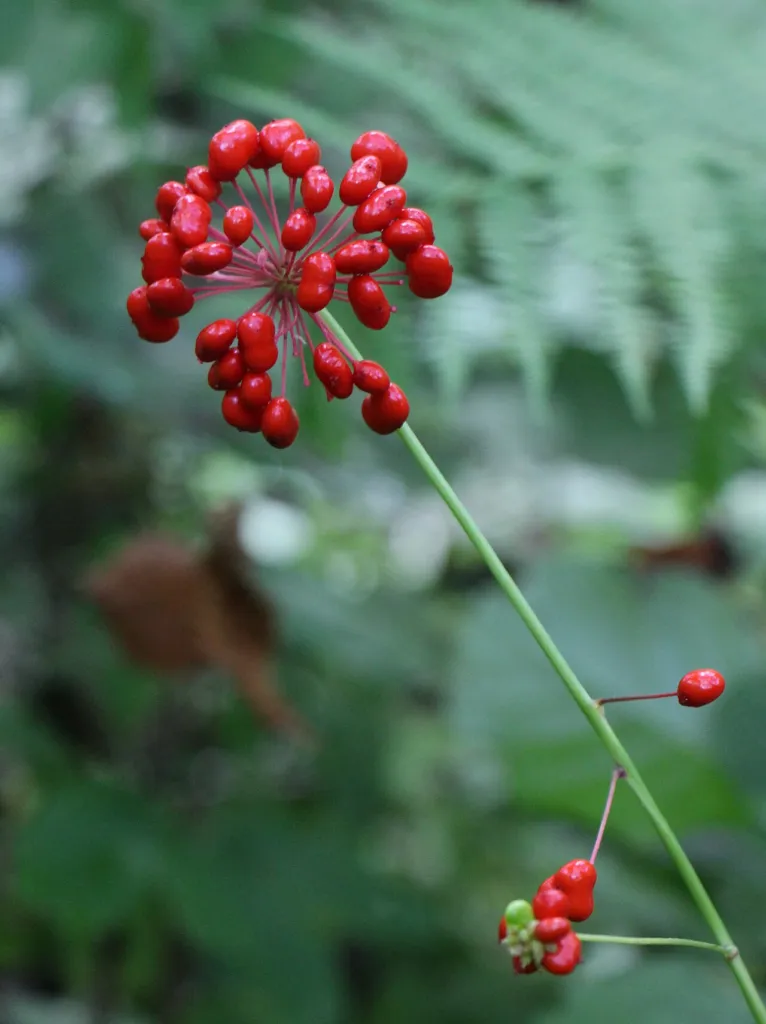
Cover photo: Doge24190, ginseng in fruit on Changbai Mountain, China · CC BY-SA 4.0 · Wikimedia Commons
On a chemist’s shelf, ginseng is printed on a dozen boxes: capsules, tea bags, an energy drink, a tin of red root slices from Seoul.
They don’t all hold the same plant. If you take warfarin or a diabetes medicine, which box you pick deserves a minute.
Educational only: no advice, no dosing detail. Legal passages are the Institute’s reading of Australian rules in October 2026, not legal advice.
Someone unwell after any herbal product: phone 000 in an emergency, or the Poisons Information Centre on 13 11 26 (24 hours, Australia-wide).
Short courses were well tolerated in trials; the European regulator limits use to three months. Ginseng is not a scheduled poison in Australia. Take care with:
- Warfarin. Some reports of the INR falling; one small trial saw no change. Check the INR whenever ginseng starts or stops.
- Insulin or sulfonylureas. Blood glucose may fall a little further.
- Drugs cleared by the CYP3A liver enzyme, such as some immunosuppressants, antiretrovirals and anticancer drugs. One small study found ginseng cut exposure to a test drug by about a third. Have the combination reviewed first.
- Sleep and mood. Insomnia is the most often reported; a few case reports describe mania. Take care with bipolar disorder.
- Pregnancy, breastfeeding, under-18s. Safety not established; the European regulator does not recommend use.
- Surgery. Tell the surgical and anaesthetic team the product and the amount.
Before taking any botanical drug, consult a degree-qualified herbalist with competencies and adequate training in pharmacognosy.
- “Ginseng” can mean four plants. The Latin name settles it.
- Red root is steamed before drying, white is only dried, and their chemistry differs.
- Trials are modest: small, low-certainty gains for erections and fasting blood sugar, mixed for tiredness, nothing convincing for memory.
- Check before pairing it with warfarin, diabetes medicines or some liver-cleared drugs.
- AUST L means listed. The TGA does not assess listed products before sale.
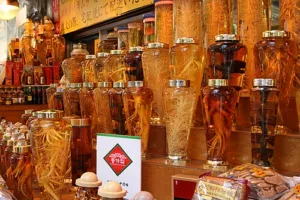
Four plants answer to one name
The back of the box tells you more.
Only two are true cousins. Korean ginseng, also sold as Asian or Chinese, shares its soap-like root compounds, the ginsenosides, with American ginseng. Siberian ginseng, a prickly shrub, and Indian ginseng (ashwagandha) only borrowed the name. Korean ginseng has no record of growing wild in Australia; every root on our shelves is imported.
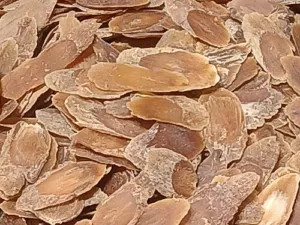
Sliced or powdered, Korean and American root look alike. A small check in Beijing caught American root sold as Asian; Australian shelves are unchecked.
As read in October 2026, Korean ginseng is unscheduled here and sold in listed medicines, marked AUST L. Listed products carry limited claims, and the TGA doesn’t assess them before sale. Teas and energy drinks are sold as food, and their labels usually don’t say how much ginseng is inside.
Turn the box over. Panax ginseng is Korean, Panax quinquefolius American, and anything else is another herb. Then look for root, red or white, and an AUST L number.
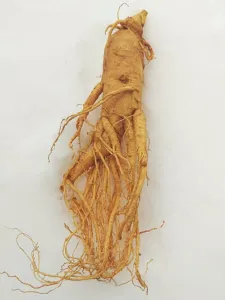
Does it work? The honest answer
Modest, and stronger on some questions.
East Asia has prized ginseng as a tonic for some two thousand years, and Europe’s regulator, whose view has no force here, accepts it for tiredness on that long use alone. Custom is not a trial.
The human trials are mostly small, short and built on differing products.
Tiredness: mixed, and the larger trial, in people with autoimmune illness, found red ginseng no better than dummy pills.
Memory: nothing convincing in healthy people.
Blood sugar: a small dip in fasting readings, with no change in the long-term marker.
Erections: scores rose by less than patients would likely notice and more men said they could have sex, at low certainty.
None of it counts as established.
If you like ginseng, nothing here says stop. Just distrust any pack promising a sharper memory.
Ginseng alongside your other medicines
Mostly gentle; a few pairings to watch.
In short trials, ginseng takers had about the same niggles as dummy-pill takers: an upset stomach, itchy skin, a restless night.
A few patients steady on warfarin saw their INR, the clotting reading, drop after starting ginseng, while a small Sydney trial found no change. All of it can be true at once, because products, strengths and people differ.
On diabetes medicine, your sugar could dip a little further. A handful of case reports link ginseng to mania. They can’t prove cause, but bipolar disorder calls for care.
On warfarin, check the INR when ginseng starts or stops. Before surgery, tell the team. Have any other red-box pairing reviewed first.
Red root, white root, and a recipe from 1908
Same plant, two kitchens.
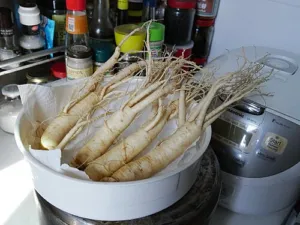
Fresh root spoils, so it is either dried straight, giving white ginseng, or steamed first, giving red. Steam reshapes the ginsenosides and browns the root.
A trial of white root is a trial of white root. It is not proof for a red tablet, and no head-to-head trial backs the claim that red is stronger and gentler.
A trial of white root is a trial of white root.
An account of Korea written in 1123 already describes steamed root. A 1908 government record gives the method: roots washed, sorted and steamed in sealed earthenware, then dried indoors and in the sun until each turned translucent, the colour of cherry blossom. We have it through a paper mostly by staff of a red ginseng company.
Check the label for red or white. Hold a red slice to the window and you see the steam and sun of that 1908 record.
The short version of Dr Thomas Ridley’s review, which carries the trials and references:
Korean Ginseng (Panax ginseng): Which Ginseng, What Evidence
- Dr Luke Iggulden, Chief Scientific Officer — Senior author. Commissioned the Explainer series, set its direction and approved it
- Jesse Kirby — Took his own notes from the review, shut it, and wrote this page fresh: chose the four things a shopper needs, the order, every sentence, and the safety box, kept at full strength
- Zoe Bennett — Wrote the page title, search line and labels around the chemist-aisle moment of picking a box, which is the frame it will be shared on
- Theo Karras — Picked the red-berry cover and the four section banners from the review’s own licensed set, checked each by eye and wrote alt text to match what it shows
- Leah Bianchi — Built the page: safety box, one-minute card, a pull quote, four what-this-means cards and the card back to the review, checked for a phone screen
Contributors
- Dr Thomas Ridley — Wrote Literature Review AIP-LR-PANGIN, the article this page retells
Image credits. Cover: Doge24190, CC BY-SA 4.0. Seoul market jars: yarra64, CC BY 2.0. Single root: Scudsvlad, CC BY-SA 4.0. Red ginseng slices: François Nguyen, CC BY 2.0. Kitchen steamer: Peachyeung316, CC BY-SA 4.0. All via Wikimedia Commons, as credited in the full review.
AIP Explainers are the plain-language editions of the Institute’s technical articles, published alongside the original. Everything on this page is carried by the full review, where the evidence, the references and the regulatory sources are set out. Regulatory information was read in October 2026 and may change. Spotted an error? Write to our contact form. We would rather correct a claim than repeat it.
Jesse Kirby
Head of Community Outreach
Australian Institute of Pharmacognosy
Cardwell QLD, Australia
australian-pharmacognosy.org · our contact form
The Institute sets and publishes its own monographs. The catalogue is in Publications.