

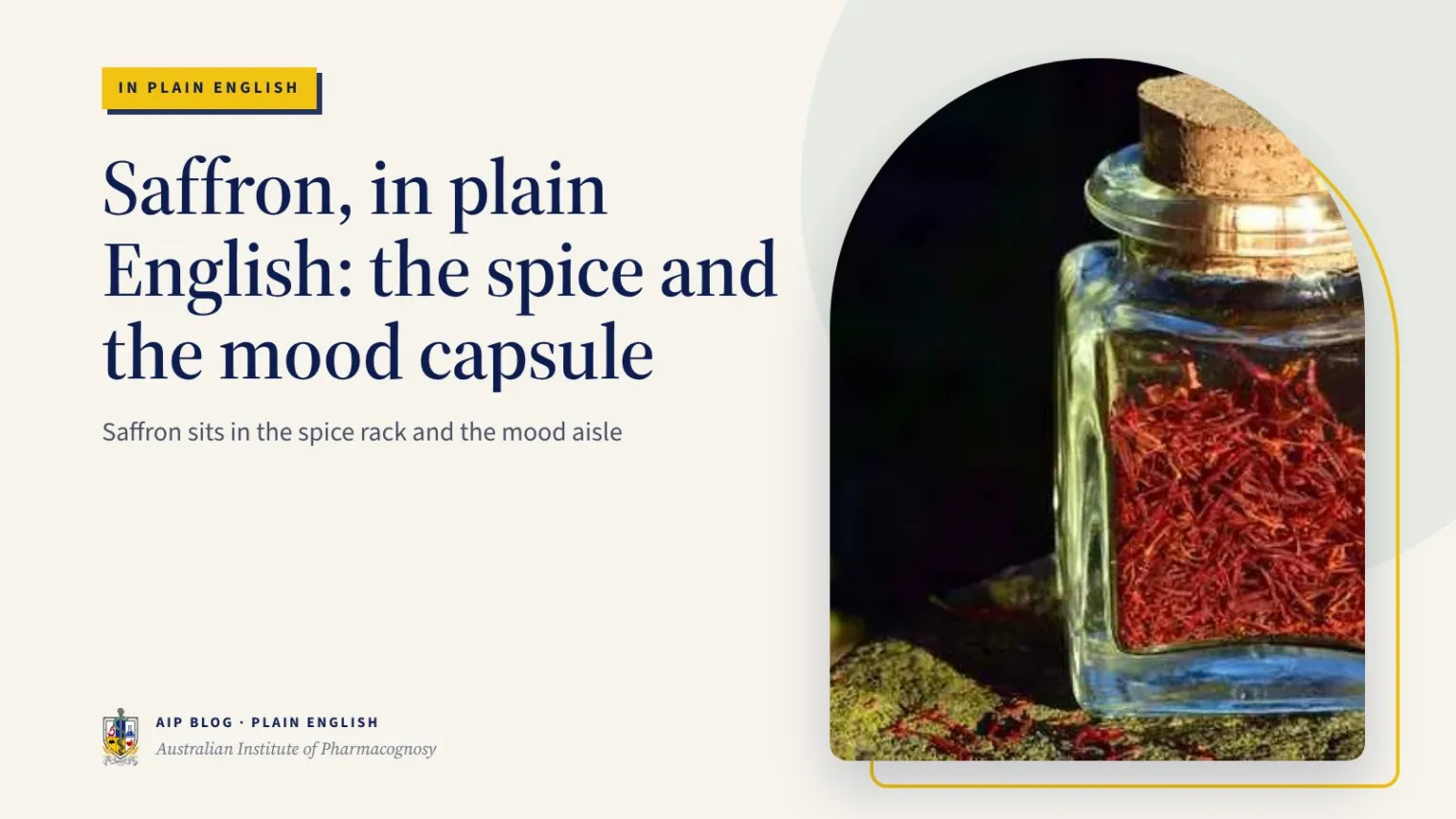
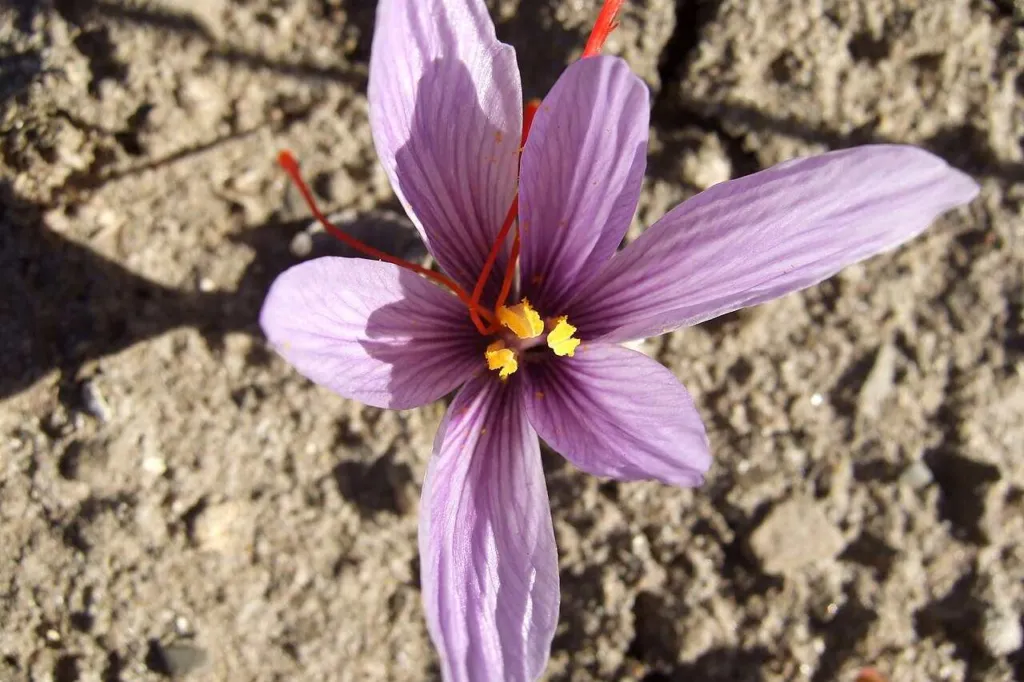
Photo: Emilie40 · CC0 · Wikimedia Commons
A pinch of red threads goes into the Sunday risotto, and that little jar cost more than everything else in the pot. A few aisles over at the chemist, the same word sits on a box of capsules for mood, stress and sleep.
Perhaps you take them, or meant to buy some for your mum. The studies are genuine, small, mostly maker-funded, and a few boxes also contain a second herb that changes how other medicines behave.
Educational only: no advice, no preparation or dosing detail. Legal notes are the Institute’s reading of Australian rules, October 2026, not legal advice.
Call Triple Zero (000) for agitation, confusion, fever, a racing heart, tremor or rigid muscles after combining medicines. 13 11 26, Poisons Information Centre, 24 hours, Australia-wide, for a suspected poisoning or overdose, including a child into saffron capsules or any part of an autumn crocus. 13 11 14, Lifeline, for low mood. Report suspected side effects to the TGA.
Mood medication. Saffron is not an approved treatment for depression in Australia. Never stop, cut or swap a prescribed antidepressant for a supplement on your own. First consult a degree-qualified herbalist with competencies and adequate training in pharmacognosy.
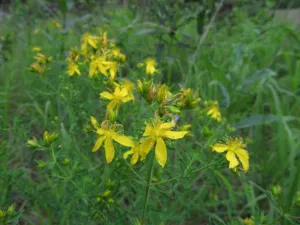
St John’s wort (Hypericum perforatum) is in 8 of 124 Australian saffron medicines. It lowers blood levels of many medicines, including the contraceptive pill, warfarin, ciclosporin and some HIV and cancer drugs, and is linked to serotonin syndrome with antidepressants. Read the ingredients.
Caution with anticoagulant and antiplatelet medicines (one bleeding case, with rivaroxaban; a 2026 safety review advises against combining saffron with direct oral anticoagulants) and in bipolar disorder or a history of mania (a few reports of hypomania). Drowsiness may add to sedating medicines or alcohol. Allergy, including anaphylaxis in people with multiple allergies, has been reported.
Pregnancy and breastfeeding. High doses can stimulate the uterus. Food amounts have a long record of use; extracts have almost no safety data in pregnancy or breastfeeding, so do not start one without first consulting the herbalist described above.
Dose. Capsules are concentrates. Side effects have been reported above about 5 g a day and 20 g has been recorded as potentially fatal. Those figures show where harm was seen and are no guide to a safe amount. Trials lasted 12 weeks or less, so long-term safety is not known.
Autumn crocus (Colchicum autumnale, meadow saffron) contains colchicine, a prescription-only poison. It is not saffron.
- Jar and capsule are different products.
- Capsule trials show a modest, uncertain lift, mostly in maker-funded studies.
- Not shown to treat depression. Never swap an antidepressant for it.
- On prescription medicine? Check for St John’s wort.
- Autumn crocus is a poisonous look-alike.
Two shelves, one flower
The capsule can’t borrow the jar’s history.
Each thread is the pollen-catching tip of a sterile purple crocus, grown from replanted corms and picked by hand over a few autumn days. Hence the price.
A capsule holds a concentrate, and each company measures its extract its own way. A trial of one brand tells you about that brand. No study we read tested the pinch in your risotto on mood.
A trial of one brand tells you about that brand.
Keep cooking with it, as people have for millennia. Judge a capsule on its own.
The mood studies, and who paid for them
Real results, small ones, from people with a stake in the answer.
Early Tehran studies, in adults diagnosed with depression, found saffron beat a dummy pill and kept pace with antidepressants in comparisons too small to prove them equal. Later, much of it in Perth, branded capsules reportedly gave people without a diagnosis a modest lift in self-rated mood, stress or sleep.
Most of those studies were funded by the extract’s maker. The one paid for with public money, in France, found no change in what it set out to measure, and the benefit seems to shrink as studies grow. Nobody can yet say how much the capsules help.
The AUST L number means legally listed, with the maker vouching for its own evidence. “Supports healthy mood” is a wellbeing claim; the label may not pitch it as treating depression.
Lingering low mood deserves proper care; if you have thought of self-harm, call Lifeline on 13 11 14 now. On an antidepressant? Keep taking it as prescribed.
Check the box against your medicine cupboard
The ingredient most saffron stories leave out.
Short trials mostly went smoothly, bar tummy upsets, headaches, drowsiness and, in a few people, hypomania: an abnormally high, driven mood.
The more important check is a second herb. A few Australian saffron products also hold St John’s wort, which hurries the pill, warfarin and other medicines out of the body, and alongside antidepressants has been tied to serotonin syndrome, a serious excess of the body’s chemical messenger serotonin.
Saffron’s own cautions are in the red box. One bleed on a blood thinner, unproven as cause, was enough for a safety review to advise against that pairing. High doses can make the womb contract.
Read every ingredient before you buy. On prescription medicine, pregnant, breastfeeding or living with bipolar disorder? Talk to the herbalist named in the red box first. Keep capsules away from small hands.
Real threads, fakes and the wrong crocus
Fake threads, and a poisonous garden twin.
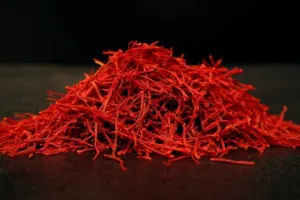
Saffron is reckoned the most faked spice there is, often bulked out with safflower, a daisy with orange florets. Our rough guide, never tested as a method: real threads are deep red with a flared, trumpet tip; safflower is orange and tubular; a bargain price is a warning. None of it works on powder.
The real danger grows in gardens. Autumn crocus, also sold as meadow saffron, flowers at the same time and carries colchicine, a strong prescription-only poison. Look inside: saffron dangles three long red threads over its petals; the look-alike shows six stamens and pale wispy styles.
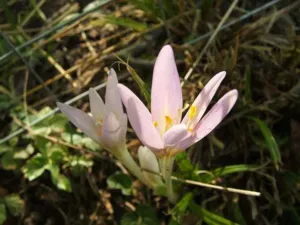
Buy threads you can see from a trusted seller. If anyone eats any part of an autumn crocus, phone 13 11 26 straight away.
From a wall on Santorini to the Huon River
Thirty-five centuries of picking by hand.
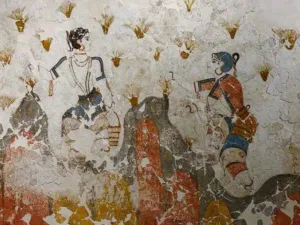
On Santorini, a wall painted around 1600 BCE shows young women gathering crocus among the rocks. Since then it has dyed cloth and gilded biryani; custom, not proof about mood.
In 1990 Terry and Nicky Noonan planted it above the Huon River in Tasmania. Cardwell’s wet tropics don’t suit it. Every autumn, wherever it grows, somebody still bends over a field and picks it flower by flower.
Up here, buy a good jar and enjoy it.
The short version of Dr Thomas Ridley’s full review, with every source:
- Dr Luke Iggulden, Chief Scientific Officer — Senior author. Commissioned the Explainer series, set its direction and approved it
- Jesse Kirby — Wrote every sentence from his own notes with the review closed, chose the five things a reader needs and their order, and recast the red safety box without softening any warning
- Zoe Bennett — Wrote the page title, search description and labels around the ‘two shelves’ idea, the spice jar and the mood capsule, which is the hook the page will be shared on
- Theo Karras — Picked the crocus cover, the five section banners and the autumn crocus figure from the review’s licensed photographs, and rewrote every alt text to describe what each picture shows
- Leah Bianchi — Built the page: the red safety box with its three phone numbers first, the one-minute card, two pull quotes, five what-this-means cards and the card back to the full review, set to read cleanly on a phone
Contributors
- Dr Thomas Ridley — Wrote the evidence review AIP-LR-CROSAT that this page retells
Image credits. All photographs via Wikimedia Commons, reused from the parent review and resized for the web by AIP. Saffron crocus cover: Emilie40, CC0. Threads in a jar: ulleo, CC0. Saffron field in Iran: Hossein Tohidi Fard, CC BY 4.0. St John’s wort: Cbaile19, CC0. Dried threads: Safa Daneshvar, CC BY-SA 3.0. Autumn crocus: Várkonyi Tibor, CC BY-SA 4.0. Akrotiri saffron gatherers fresco: Zde, CC BY-SA 4.0.
AIP Explainers are the plain-language editions of the Institute’s technical articles, published alongside the original. Everything on this page is carried by the full review, where the evidence, the references and the regulatory sources are set out. Regulatory information was read in October 2026 and may change. Spotted an error? Write to our contact form. We would rather correct a claim than repeat it.
Jesse Kirby
Head of Community Outreach
Australian Institute of Pharmacognosy
Cardwell QLD, Australia
australian-pharmacognosy.org · our contact form
The Institute sets and publishes its own monographs. The catalogue is in Publications.