

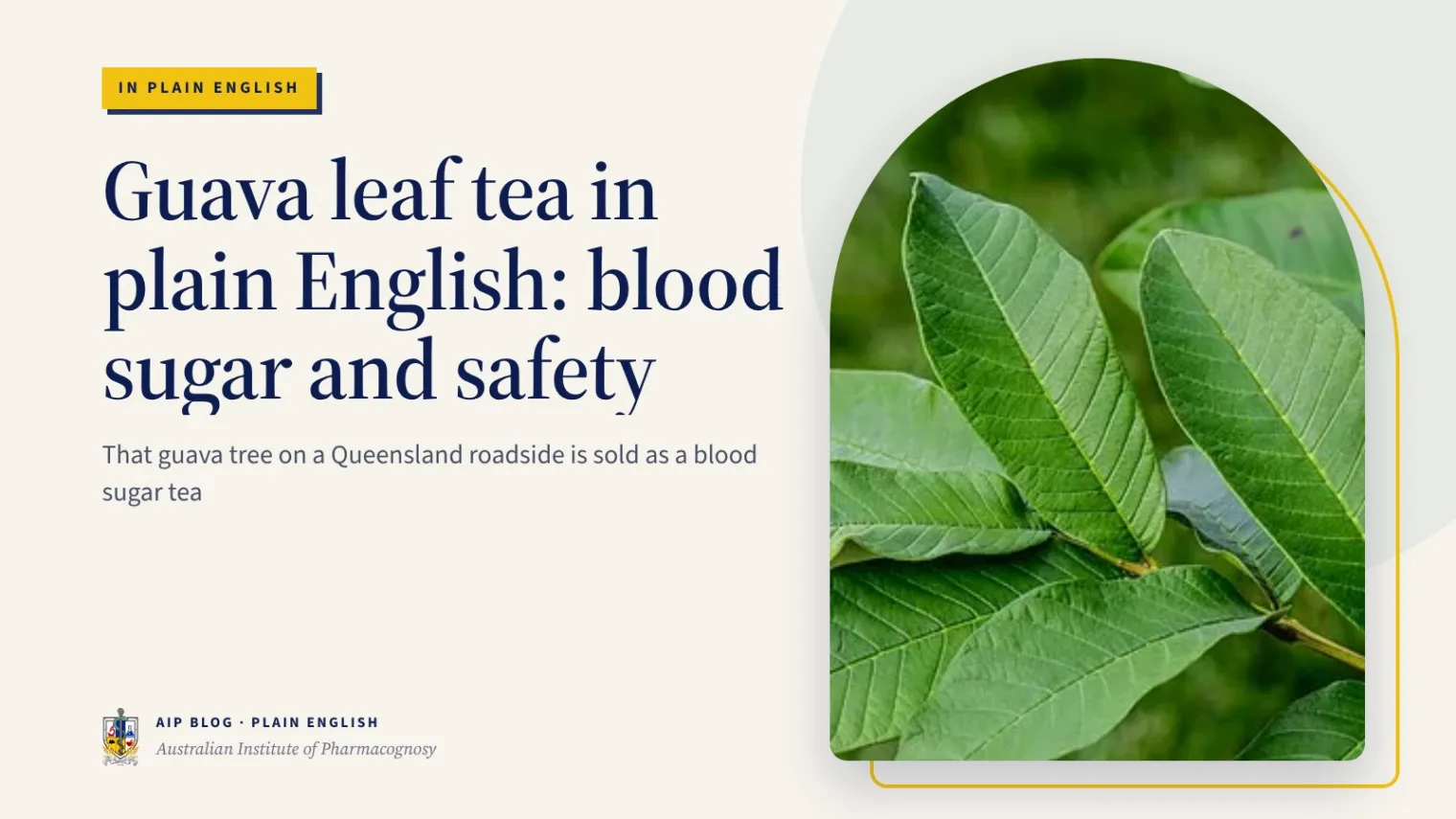
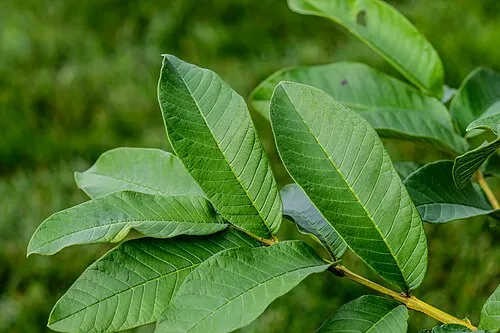
Photo: PumpkinSky, via Wikimedia Commons · CC BY-SA 4.0
On road verges and creek banks around Cardwell, a scruffy tree with peeling copper-and-green bark drops yellow fruit for the birds. In a Fijian village, someone would stop and pick its leaves.
Those are guava leaves, boiled for upset stomachs across the tropics and bottled in Japan as a blood sugar tea. The tea does less than the label hopes.
Educational only: no medical advice, and no preparation or dosing detail.
On insulin, a sulfonylurea such as gliclazide, or several diabetes medicines? Guava leaf may add to the drop in blood glucose. If you start it, check your sugar more often for the first weeks and tell the people managing your diabetes.
On warfarin? Two rat studies disagree and there are no human data. Have your INR checked if you start or stop a regular guava leaf preparation.
Pregnant or breastfeeding? No human safety data for medicinal amounts; avoid medicinal doses.
A baby or young child with diarrhoea can dehydrate within hours. Oral rehydration comes first. Drowsy, not drinking, or passing little urine: phone 000.
Adults: diarrhoea with blood or mucus, high fever, severe stomach pain, dizziness on standing, very little urine, or lasting more than a few days needs prompt medical assessment; 000 if collapsing or confused. Older people and anyone with diabetes, kidney disease or weak immunity dehydrate faster. Don’t wait on a household remedy.
Unwell after a herbal product? 000 in an emergency, or the Poisons Information Centre on 13 11 26 (24 hours, Australia-wide).
Before taking any botanical drug, consult a degree-qualified herbalist with competencies and adequate training in pharmacognosy, and tell them every medicine you take.
- A tropical stomach remedy and a roadside weed here.
- A Japanese tea, tested by its maker, took a modest edge off the sugar spike.
- No trial has shown it lowers long-term blood sugar.
- On insulin or gliclazide, test your sugar more often; on warfarin, check your INR.
- May ease adult diarrhoea cramps; fluids first, above all for children.
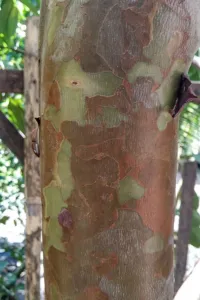
Know it by the trunk, then turn a leaf over
The tree is easy. Chopped dry leaf is not.
Guava has gone wild through the wet tropics wherever birds drop its seed. Queensland lists it as an environmental weed.
The bark lifts away in thin sheets, leaving the trunk blotched copper, grey and green. Flip a leaf: long, blunt, slightly furry beneath, side veins raised like a washboard.
Rose apple and lilly pillies have glossy leaves, plain underneath, and bark that never peels in coloured plates. Feral cherry guava has small, shiny leaves with flat veins.
Roadside trees gather dust and may be sprayed; trees by cane or bananas can carry farm chemicals.
Pick only from a tree you are sure of, on land where you have permission, clear of roads and spray. Dried and chopped, guava is hard to tell from its look-alikes by eye.
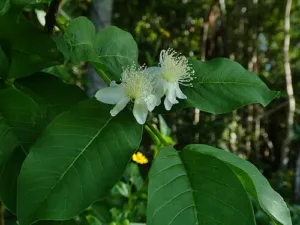
A small dent in the sugar spike, and no more than that
One company, testing its own tea.
Your gut breaks rice starch into glucose, your blood sugar. In the lab, a guava leaf brew slows that, the same step the diabetes tablets acarbose and voglibose act on. Mice had flatter rises, on far bigger doses.
In people, nearly everything rests on one bottled Japanese tea, approved there as a food for after-meal blood sugar. The trials were small, mostly without a dummy drink, and written up by the maker’s scientists. With rice, the tea shaved roughly a fifth off the sugar peak; head to head, voglibose did more.
Men who drank it with every meal for three months ended with the same HbA1c, the test of your average sugar over recent months. We found no independent trial with a dummy drink aimed at moving it. Japan’s food approval has no legal standing in Australia.
Three months of tea with every meal, and the long-term sugar test hadn’t moved.
Drunk with a starchy meal, the tested tea softened the spike a little. Shop teas are untested. A packet promising more has outrun the evidence, and none of it replaces your diabetes care.
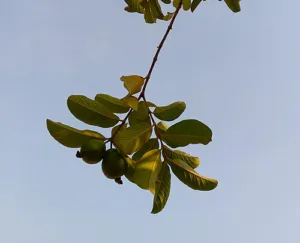
Already on something for your sugar
Two things pulling glucose down can pull too far.
The leaf works on the same step as some diabetes tablets, so the two could add up. Insulin, and tablets such as gliclazide that can push sugar too low alone, give most reason to watch. The maker’s short, small trials saw no lows in people on such medicines, too few to rule them out.
Metformin alone rarely sends sugar too low. Risk climbs with insulin, skipped meals, strong home brews and alcohol. Warfarin, the blood thinner, is the other one: two rat studies disagree, and nothing has been measured in people.
Test more often at first and tell whoever manages your diabetes. On warfarin, check your INR when you start or stop.
An old answer for a runny stomach
Two adult trials, and a firm line on children.
In India, adults with a sudden gut infection who drank the strongest brew recovered about two days sooner than those given rehydration drinks, though everyone knew who got what. In Mexico, against a dummy capsule, it eased cramps; toilet trips stayed the same. Nobody has shown it helps children.
Trial volunteers reported no harm; rodents tolerated big doses. Only a few hundred people have taken it in trials, and nothing covers years of use, pregnancy or children. That record is for the leaf; bark and root extracts proved toxic in a lab test. Its tannins, the pucker of stewed tea, bind iron and may worsen constipation.
That tree on the Cardwell verge is a wash for cuts in the Philippines and a warm bath for new mothers in the Cook Islands. Next time you pass one, look at the bark.
In an adult it may ease cramps and perhaps shorten an ordinary bout; fluids come first; blood, high fever or drying out mean getting seen. For a small child, rehydration is the treatment, and the red-box signs mean 000.
The short version of Dr Thomas Ridley’s full review:
- Dr Luke Iggulden, Chief Scientific Officer — Senior author. Commissioned the Explainer series, set its direction and approved it
- Jesse Kirby — Wrote this edition from his own notes with the review shut: chose the four things a guava drinker needs, the order they come in and every sentence, and set out the red box without softening any warning
- Zoe Bennett — Wrote the page title, the search description and the labels, and framed the share around the roadside tree a far north Queenslander already drives past
- Theo Karras — Picked the sapling-leaf cover, and the four section banners from the review’s own licensed photographs, matched each to its Commons file and credit, and wrote alt text to what each one shows
- Leah Bianchi — Built the page: the red safety box, the one-minute card, the pull quote, the four what-this-means cards and the card back to the review, checked to read on a phone
Contributors
- Dr Thomas Ridley — Wrote Literature Review AIP-LR-PSIGUA, the article this page retells
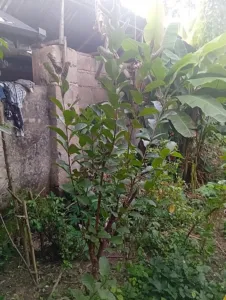
Image credits. All photographs via Wikimedia Commons. Cover, sapling leaves: PumpkinSky, CC BY-SA 4.0. Bark banner: Kristof Zyskowski & Yulia Bereshpolova, CC BY 2.0. Flower and leaves, Cairns QLD: Steve Fitzgerald, CC BY-SA 4.0. Young shrub: Paul The Writer, CC0. Branch with young fruit: Sadekla Wise Nutifafa, CC BY-SA 4.0.
AIP Explainers are the plain-language editions of the Institute’s technical articles, published alongside the original. Everything on this page is carried by the full article, where the evidence, the references and the regulatory sources are set out. Regulatory information was read in November 2026 and may change. Spotted an error? Write to our contact form. We would rather correct a claim than repeat it.
Jesse Kirby
Head of Community Outreach
Australian Institute of Pharmacognosy
Cardwell QLD, Australia
australian-pharmacognosy.org · our contact form
The Institute sets and publishes its own monographs. The catalogue is in Publications.