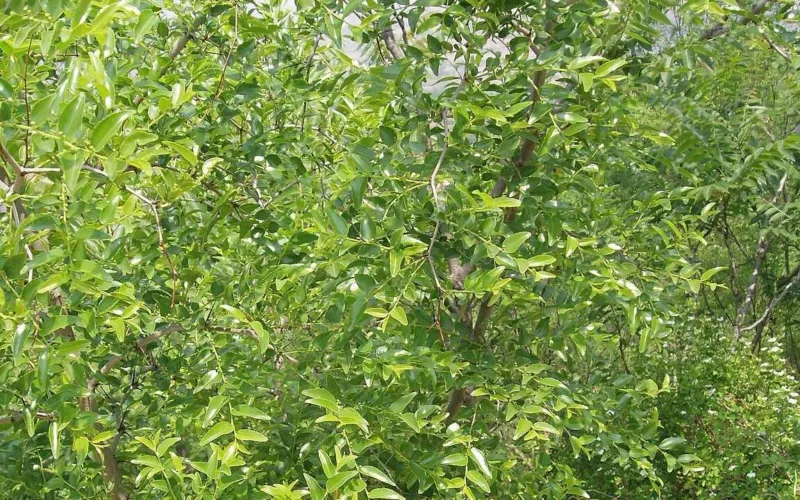

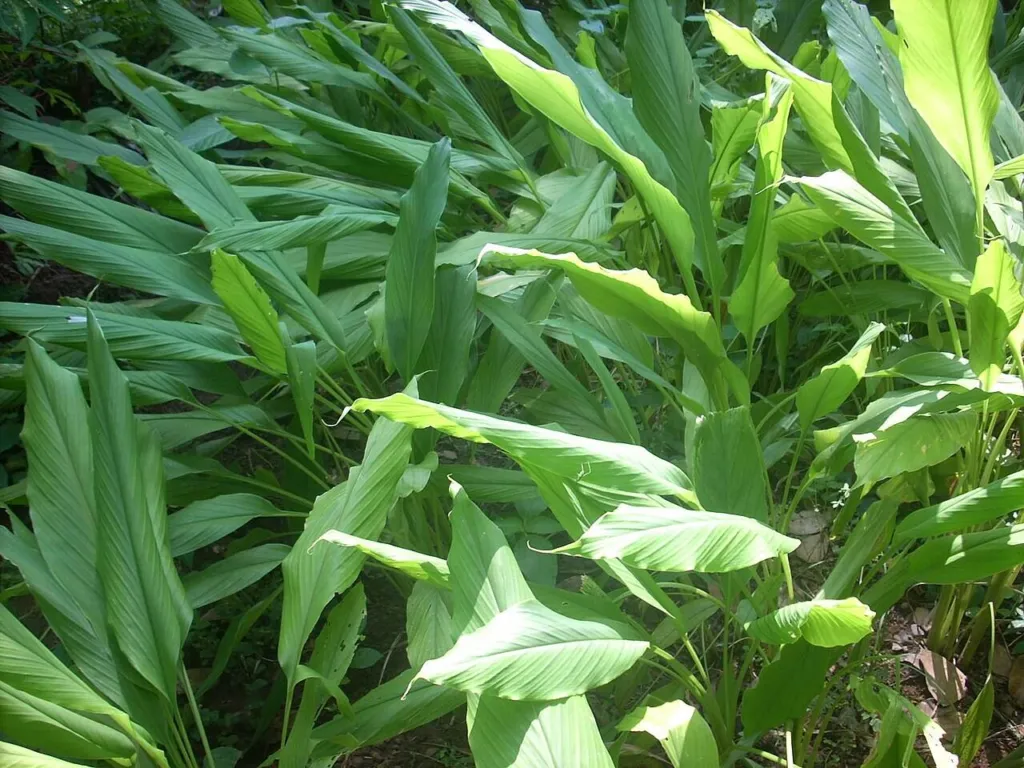
Cover photo: Manojk, via Wikimedia Commons · CC BY-SA 3.0
Two kinds of turmeric probably live in your house. One is the yellow jar beside the cumin. The other is a tub of capsules by the toothbrushes, taken each morning.
Same plant, same name on the front. Since March 2025, though, only the supplements have had to print a warning that they may, very rarely, harm your liver. Australians have been hurt, and at least one has died. The jar has never needed that warning.
For education only: no medical or legal advice, no dosing. Legal passages are our published reading of Australian rules as at 21–22/09/2026.
Yellowing skin or eyes, dark urine, pale stools, itching, unusual tiredness, nausea, vomiting, weakness, losing your appetite, or pain in the belly or under the right ribs: stop the product that same day and get a medical assessment promptly. A blood test tells whether the liver is hurt. Take the bottle with you.
Yellow skin or eyes with confusion, drowsiness, vomiting blood, bleeding or collapse: phone 000.
A child who has swallowed a supplement, an overdose, or any poisons question: the Poisons Information Centre, 13 11 26, 24 hours, Australia-wide. Follow its advice.
Have you ever had liver trouble? Then leave concentrated turmeric alone. Before taking any herbal medicine, consult a degree-qualified herbalist with competencies and adequate training in pharmacognosy.
- Turmeric cooked into food has not been flagged as a liver risk by any regulator that looked.
- Capsules pack far more, and many are built to absorb better.
- Very rarely they injure the liver, in a way nobody can predict from the dose.
- Any sign in the red box, such as yellow eyes or dark urine: stop that day and get checked by a clinician.
- The best evidence it helps is a modest dent in knee pain. Cure-all claims have nothing behind them.
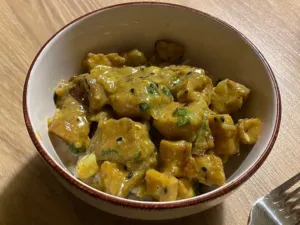
One plant, two very different doses
Further apart than they look.
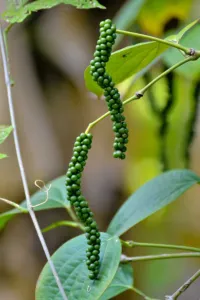
The yellow colour is curcumin, the compound most products are sold on. Your gut takes in very little of it. Some makers concentrate the root into extracts many times stronger than the powder. Many add black pepper, which slows the body’s clean-up of curcumin. Others wrap it in fat; in small studies blood levels shot up.
Australia’s medicines regulator, the TGA, says nobody has worked out a safe dose for those souped-up forms. The old intake limits predate them.
Same plant, same name on the front. Only the supplements have to print a warning.
Keep cooking with it. Pay attention to every capsule, plain ones included.
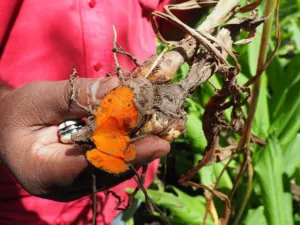
Rare, unpredictable, and usually reversible
What the warning is telling you.
Most side effects grow with the dose. This one doesn’t. The word for it is idiosyncratic: it strikes a few susceptible people, can’t be forecast from how much they took, and usually turns up one to four months in, though it can come sooner or later than that.
How rare? Somewhere between one user in ten thousand and one in a hundred thousand, the TGA roughly estimated, since nobody knows how many people take them. Trials are far too small to catch anything that scarce.
Pepper or boosted absorption may raise the risk; that is unproven. Plain capsules have been involved too, and overseas, once, a turmeric tea. In an American series of ten cases, seven shared one immune gene: a hint, not yet repeated, and not every case has it.
Some cases have been severe enough for hospital. The hopeful part: most reported livers recovered once the person stopped. Carrying on is the danger: the TGA warns it can end in a liver transplant or death.
If you take a turmeric product, learn the signs in the red box and act on them the same day. Stopping early is what usually lets the liver recover.
When to leave the capsules on the shelf
Less room for error.
A liver that has had trouble before. The TGA says avoid these products.
Blood thinners, anti-platelet medicines and surgery. In the lab, curcumin makes platelets less sticky and slows the enzyme that clears warfarin. A few case reports describe clotting tests leaping on warfarin after a turmeric supplement was added. No trial has measured bleeding. Beyond blood thinners, curcumin slightly lowered the breast cancer drug tamoxifen in one small study, and one transplant patient’s anti-rejection drug hit toxic levels after high-dose turmeric.
Gallstones. Curcumin makes the gallbladder squeeze, which could shove a stone into the duct. European regulators advise against turmeric for gallbladder or bile-duct disease.
Kidney stones. The powder is rich in oxalate, the stuff some kidney stones are built from. One small study found more of it in urine; it didn’t count stones.
Pregnancy, breastfeeding, children. Nobody has studied capsules in pregnancy or breastfeeding, and the Institute sees no established place for them. Australian law bars them for under-twos and limits curcumin for older children.
On a blood thinner or anti-platelet medicine, a transplant or cancer drug, tell your prescriber and pharmacist before starting or stopping turmeric capsules, and tell the surgical team before an operation. Ordinary curry hasn’t been flagged.
Does it help?
A little, for one thing, and the evidence is patchy.
The best evidence is for knees. In a Tasmanian trial, people with sore arthritic knees who took an extract for three months reported a bit less pain than those on dummy pills. The swelling didn’t shrink, and the extract’s maker helped pay. Results across other trials vary widely.
We found no solid, repeated trial showing turmeric capsules prevent or cure any serious illness. Four thousand years of kitchen use says nothing about whether a modern extract works or is safe.
If a sore knee is why you take it, you might get a modest easing, and you might not. Treat anything sold as an anti-inflammatory fix for everything as advertising.
Reading the tub in your cabinet
Most answers are printed on it.
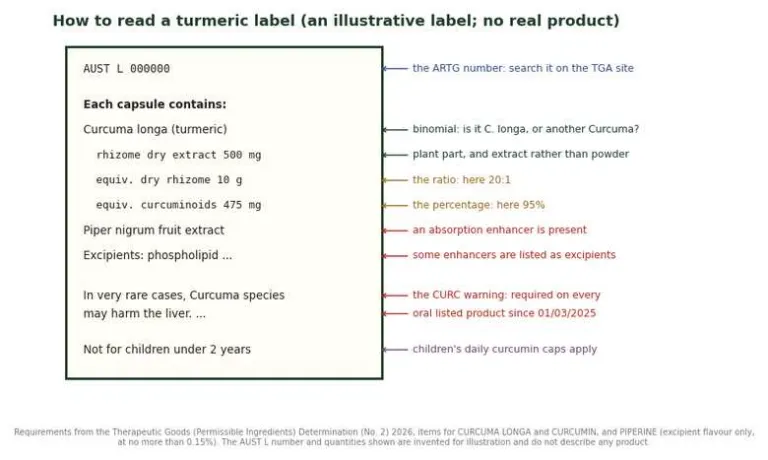
Most turmeric capsules sold here are listed medicines; the AUST L number can be looked up on the TGA site. Listed means the maker vouches for its own claims; nobody checked beforehand that it works.
Check the plant’s Latin name, since three related gingers carry the same warning. Check how concentrated it is. Check for black pepper in the actives, often named as the pepper itself. And find the liver warning. Every listed turmeric or curcumin medicine taken by mouth must carry it.
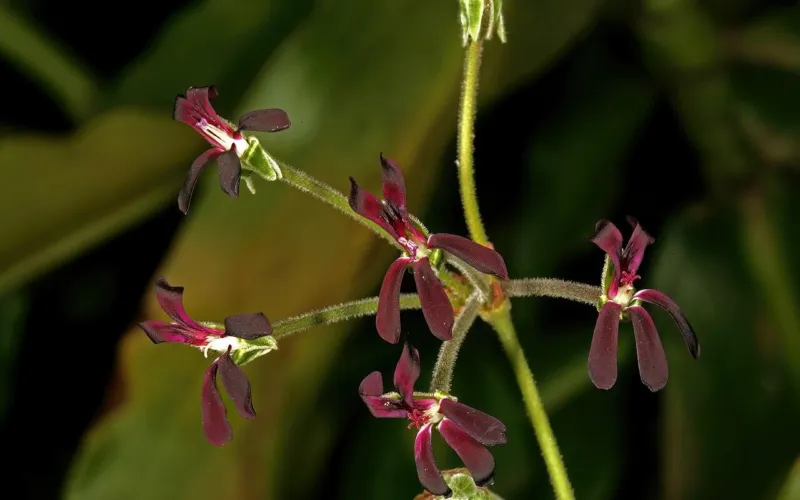
The “native turmeric” in some nurseries, the Cape York lily, is another species: not the spice, and not permitted in any listed medicine.
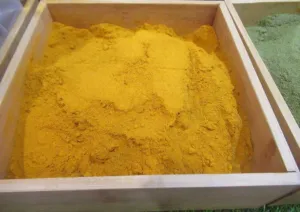
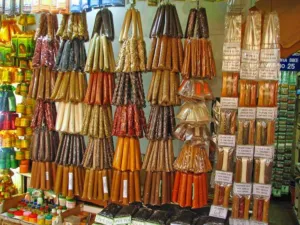
Overseas, in South Asian markets, some loose turmeric powder has been coloured with a lead pigment. Loose market spice and spice bought online carry more of that risk than a listed medicine. The full article has the detail.
Anyone can report a suspected reaction on the TGA’s consumer form. An unsure report still helps.
Turn the tub round and find the warning. If you report a reaction, give the product name, its AUST L number, how long you took it and what else you take.
This page is the short version of Dr Thomas Ridley’s AIP Literature Review and Critical Analysis LR No. 7. The trials, the case reports and the law are all set out there:
- Jesse Kirby — Wrote this edition from his own notes with the review closed: chose the jar-and-bottle framing, the five sections and every sentence, and rewrote the liver warning signs for the red box without weakening them
- Zoe Bennett — Wrote the page title, the search description and the labels, pitched at the reader who already has a bottle of turmeric capsules at home
- Theo Karras — Picked the cover plant, the curry, root, pepper, powder and market banners, and the label diagram, and wrote alt text to match what each image shows
- Leah Bianchi — Built the page: the red warning-signs box, the one-minute card, the pull quote, the five what-this-means cards and the card back to the review, checked for reading on a phone
Contributors
- Dr Thomas Ridley — Wrote AIP Literature Review and Critical Analysis LR No. 7, the article this page retells
Direction and oversight
- Dr Luke Iggulden — Commissioned the Explainer series, set its direction and approved it
Image credits. Turmeric in leaf: Manojk, CC BY-SA 3.0. Vegetable curry: Anna Korcheva, CC BY-SA 4.0. Fresh root: Schlawensko, CC BY-SA 4.0. Black pepper: K Hari Krishnan, CC BY-SA 3.0. Turmeric powder: CNEcija12345, CC BY-SA 4.0. Spice stall, Kandy Market: McKay Savage, CC BY 2.0. All via Wikimedia Commons; resized and re-encoded for the web by AIP, no other changes. Label diagram: Australian Institute of Pharmacognosy, CC BY 4.0.
AIP Explainers are the plain-language editions of the Institute’s technical articles, published alongside the original. Everything on this page is carried by the full article, where the evidence, the references and the regulatory sources are set out. Regulatory information is the Institute’s published reading as at 21–22/09/2026, is not legal advice, and may change. Overseas findings are overseas and do not govern Australia. Spotted an error? Write to our contact form. We would rather correct a claim than repeat it.
Jesse Kirby
Head of Community Outreach
Australian Institute of Pharmacognosy
Cardwell QLD, Australia
australian-pharmacognosy.org · our contact form