

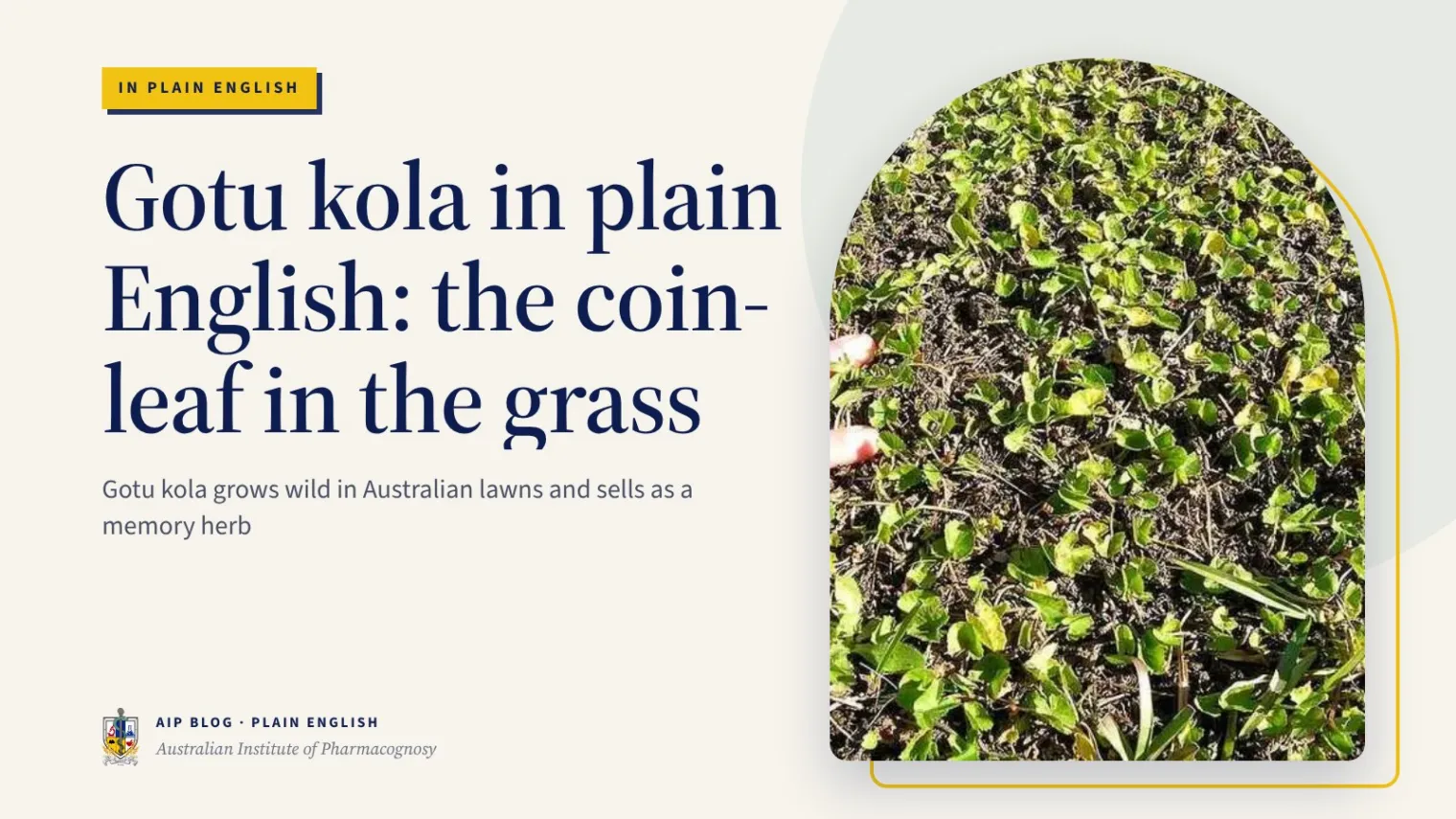
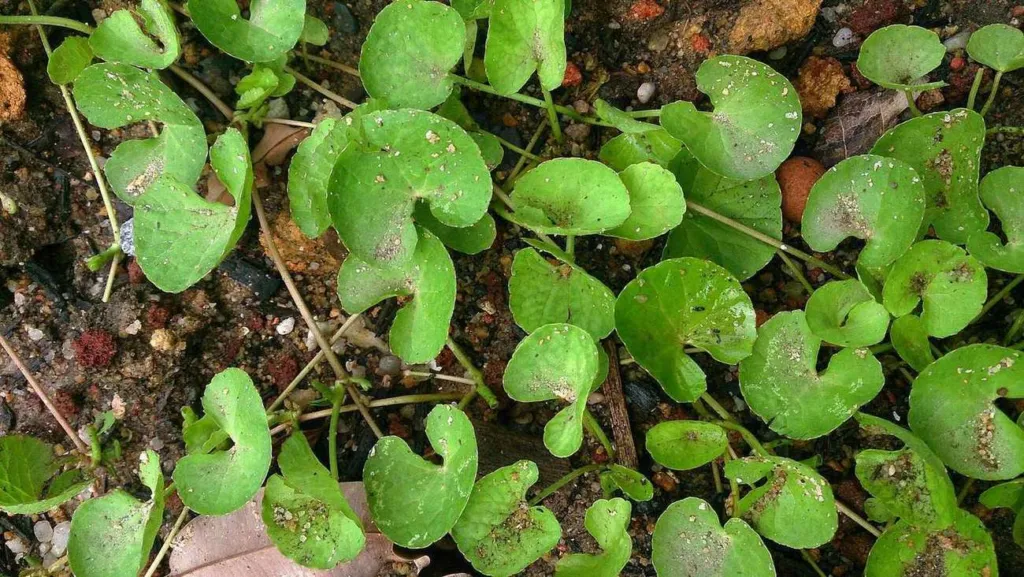
Photo: Mokkie, pegaga in Malaysia · CC BY-SA 4.0 · Wikimedia Commons
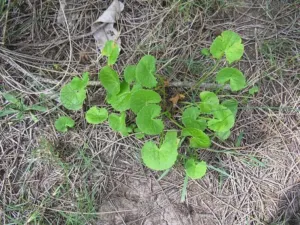
Cross a soggy Cardwell lawn after rain and you have probably trodden on it: small round leaves on long stems, scattered through the grass like dropped green coins.
Across Asia it is a vegetable. Here it is a capsule sold for memory, where the trials came up empty, with one rare side effect worth knowing.
Educational only; no dosing or preparation detail. Legal content is our reading of Australian rules, November 2026, not legal advice.
Someone unwell after taking it: phone 000 in an emergency, or the Poisons Information Centre on 13 11 26 (24 hours, Australia-wide).
Liver. Rare liver injury has been reported with gotu kola taken by mouth; in one case it came back when the product was taken again. Yellow skin or eyes, dark urine, pale stools, itch or unexplained belly pain: stop, get assessed, and don’t take it again. Existing liver disease means the most to lose.
Pregnancy, breastfeeding, under-18s. Not enough human safety information; the European herbal monograph does not recommend it. One of the two published liver reports was in a 15-year-old.
Allergy. Allergic to the carrot family (carrot, celery, fennel and relatives)? Avoid it. Creams have caused allergic rashes.
Medicines. No interaction confirmed in people; laboratory results are mixed. On epilepsy medicines or anything sedating, have the combination reviewed first.
Before taking any herbal medicine, consult a degree-qualified herbalist with competencies and adequate training in pharmacognosy. Suspected side effects can be reported to the TGA.
- A native Australian ground herb and Asian vegetable. No caffeine.
- Best support: aching legs, from small trials of a purified extract, low to very low certainty.
- Memory: the trials found it no better than a dummy pill.
- A rare liver reaction is on record: know the signs in the safety box.
- Legal to sell; the TGA didn’t check the label’s claims before sale.
Green coins underfoot, and two names that mislead
Doubles in the lawn and on the label.
Gotu kola creeps on runners, each rooting joint sending up a tuft of round leaves. It is native to wet ground from north Queensland to south-west Western Australia. Most southern plants (Victoria, Tasmania, around Sydney) are an unstudied cousin.
“Kola” is an accident: kola nuts are African caffeine seeds, and gotu kola won’t perk you up. “Brahmi” also names bacopa, a different herb that looks the same in a capsule.
Buying “brahmi”? Centella asiatica on the label is gotu kola. Picking? Several lawn weeds look alike; skip roadsides and sprayed ground.
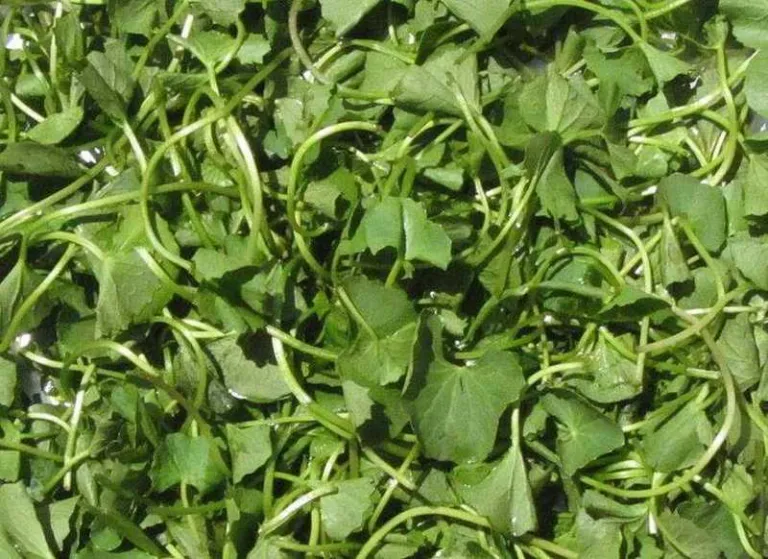
A salad green long before it was a capsule
The plate and the bottle hold different things.
Malaysians eat this leaf raw with rice. Our reviewer found no sign of harm from eating it.
Ayurvedic and Chinese medicine used it mostly for skin: wounds, ulcers, leprosy sores. Its active compounds, triterpenes, push skin cells to make collagen in a lab dish. Most European trials tested a purified powder of them.
So a jar may hold dried leaf, a rough extract or purified powder. A result for one form says nothing certain about the others.
Check which form your bottle holds.
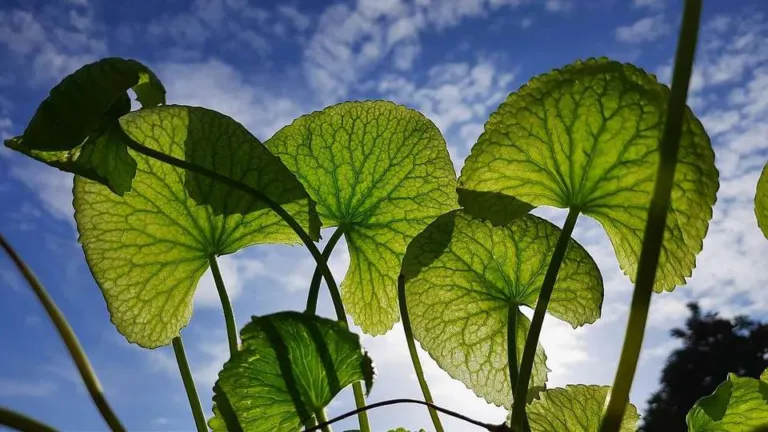
Legs, skin and memory: where the evidence runs out
Small wins, and one loud gap.
Heavy, puffy legs from tired veins are where the purified powder did best. Small trials reported better circulation readings and fewer symptoms, mostly from one Italian group, and a strict independent review rated its confidence very low. Nobody knows whether leaf capsules do the same.
Skin is modest news. In one small Thai trial, gotu kola cream on half of each skin-graft donor site gave better colour than a dummy cream on the other half. Europe’s herbal regulator accepts one use, on tradition rather than proof: applied to minor wounds, and not for anyone under 18. It does not accept taking it by mouth.
Pooled, the trials found the herb alone did no better than a dummy pill at any kind of thinking.
Memory is why most Australians buy it, and the trials so far haven’t shown it helps. For legs or skin, ask whether your product matches the research.
Gentle for most, with one rare exception
Learn the warning signs first.
Trial volunteers mostly took it well; upset stomachs were the commonest complaint. The exception is the liver: a few people on tablets or capsules have turned yellow. In Argentina three women improved after stopping, and one who restarted fell ill again. A 15-year-old girl became seriously ill and needed hospital treatment, then recovered. The Argentine products were never analysed, so a contaminant can’t be ruled out. Our reviewer reads it as rare, probably an unusual reaction in a particular person, and worth taking seriously.
Liver disease, or medicines known to strain the liver, mean you have most to lose. Pregnant, breastfeeding or buying for anyone under 18: leave it on the shelf.
On the shelf, and back on the lawn
Allowed for sale, and here first.
Gotu kola is not on the poisons list and allowed in listed medicines, which carry an AUST L number. The TGA does not check those before sale; the company certifies itself. Fresh leaf sold without a health claim is plain food. Picking on public land or someone else’s place falls under state law; in Queensland, check the nature conservation rules first.
Salad, street drink, leprosy remedy, pharmacy capsule: the little round leaf was growing in Australian wet ground before all of it.
Read AUST L as “allowed to be sold”. Questions? Ask the herbalist named in the safety box.
Dr Thomas Ridley’s full review, with every source:
- Dr Luke Iggulden, Chief Scientific Officer — Senior author. Commissioned the Explainer series, set its direction and approved it
- Jesse Kirby — Took notes from the full review with his own shorthand, then wrote this edition from them with the review shut: chose the five sections, the Cardwell-lawn opening and the closing scene, and set the red box without trimming a warning
- Zoe Bennett — Wrote the page title, search description and labels around the coin-leaf in the lawn and the memory capsule, the two places readers already meet gotu kola, which is the angle it will be shared on
- Theo Karras — Went through the review’s twenty photographs, picked the hero and five section banners, checked each against its alt text and licence, kept the closing banner to a person in a paddock, and left the chemical structure drawings out
- Leah Bianchi — Built the page: the red safety box with the phone numbers first, the one-minute card, the pull quote, a what-this-means card under each section and the card back to the review, checked for reading on a phone
Contributors
- Dr Thomas Ridley — Wrote the evidence review AIP-LR-CENASI, the article this page retells
Image credits. Cover: Mokkie, CC BY-SA 4.0. Gotu kola mat, clump and paddock: Harry Rose (South West Rocks, Australia), CC BY 2.0. Leaves for cooking: Sengai Podhuvan, CC BY-SA 3.0. Leaves against the sky: Rejin Narayanan, CC BY-SA 4.0. All via Wikimedia Commons.
AIP Explainers are the plain-language editions of the Institute’s technical articles, published alongside the original. Everything on this page is carried by the full article, where the evidence, the references and the regulatory sources are set out. Regulatory information was read in November 2026 and may change. Spotted an error? Write to our contact form. We would rather correct a claim than repeat it.
Jesse Kirby
Head of Community Outreach
Australian Institute of Pharmacognosy
Cardwell QLD, Australia
australian-pharmacognosy.org · our contact form
The Institute sets and publishes its own monographs. The catalogue is in Publications.