

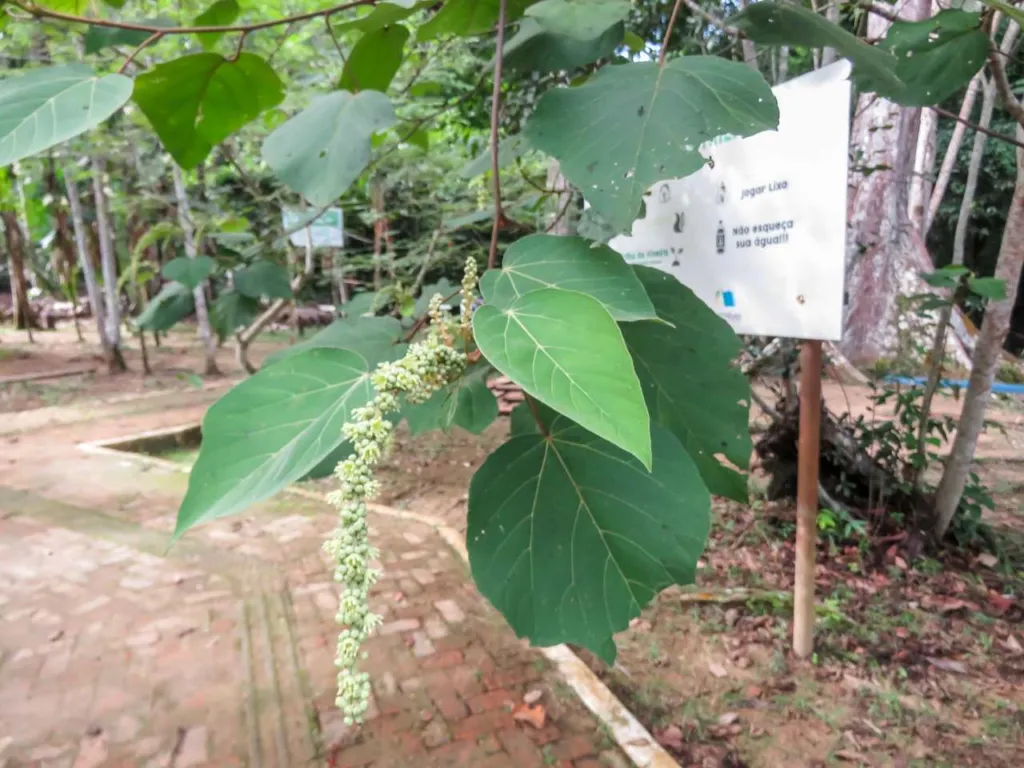
Photo: Diogo Luiz · CC BY 4.0 · iNaturalist · sangre de grado in flower, Porto Velho, Brazil
Pick up a little brown dropper bottle at a weekend market, or a box of incense in a gift shop, and both labels might say dragon’s blood. One promises the Amazon. The other smells of a temple.
They may well be different plants. One, a rainforest tree’s red sap, became a prescription pill that says less about your bottle than its label hopes. Dabbed it on a cut, or tipped drops into water for an upset gut? Here is what we found.
Educational only: no medical or legal advice, no preparation or dosing detail. Legal passages are the Institute’s reading of Australian rules in October 2026.
Emergency: Triple Zero (000). Suspected poisoning or overdose: Poisons Information Centre, 13 11 26, 24 hours, Australia-wide.
Diarrhoea with blood, fever, severe pain or dehydration, after overseas travel, or in someone with HIV or a weakened immune system needs prompt medical assessment for infection before any herbal treatment. Babies, young children and frail older people dehydrate fast: drowsiness, very little urine or not keeping fluids down needs same-day care; collapse or confusion, call 000.
Pregnancy, breastfeeding, children: no human data. As a precaution, not a study finding, the Institute’s position is to avoid the sap and dragon’s blood products by mouth in pregnancy and breastfeeding, and in children.
Raw sap also carries taspine, an alkaloid that is not part of the purified drug: strongly toxic to cells in laboratory studies and highly variable between trees. No harm from sap by mouth was found in the papers the Institute read, and no formal safety study of oral sap in people was found either. “Dragon’s blood” may be Croton latex or dragon-tree or rattan-palm resin, each with different cautions; overseas products are not evaluated by the TGA. Report suspected side effects to the TGA.
Before taking any botanical drug, consult a degree-qualified herbalist with competencies and adequate training in pharmacognosy.
- “Dragon’s blood” names several unrelated plants. Check the label.
- The Amazon sap has a long folk history on cuts and for loose bowels. We found no trial of it swallowed.
- A pill purified from it modestly helped one group with HIV. It has no product here.
- The bottle holds an alkaloid the pill leaves out. Skip it by mouth in pregnancy, breastfeeding and childhood.
- Bloody or feverish diarrhoea, or a dry, drowsy child: get assessed first.
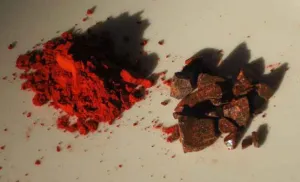
Four plants answer to the same name
The colour is about all they share.
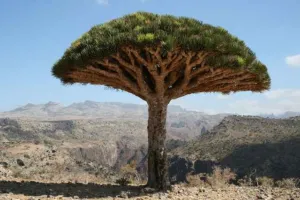
Most of what an Australian finds is Asian: hardened resin from dragon trees on Socotra, the Canary Islands and in southern China, or from a climbing rattan palm. It goes into incense, ink and Chinese herbal formulas.
Sangre de grado is the runny red latex of a fast-growing Amazon tree, Croton lechleri, and a few close cousins. Its chemistry differs from the resins, so a study of one tells you nothing about another.
Australian law draws the same line. Two of the resin plants, the rattan palm and the Canary Islands dragon tree, are allowed in listed herbal medicines, the ones with AUST L on the packet; the Amazon tree is absent from that list. A listed product saying dragon’s blood holds the resin.
Turn the bottle over. Croton lechleri, the part used, the country of origin and a batch number tell you what you hold. “Dragon’s blood” alone could be any of them.
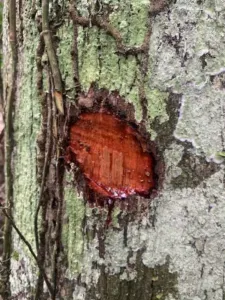
A cut in the bark, a few drops in a glass
What Amazonian families do with it.
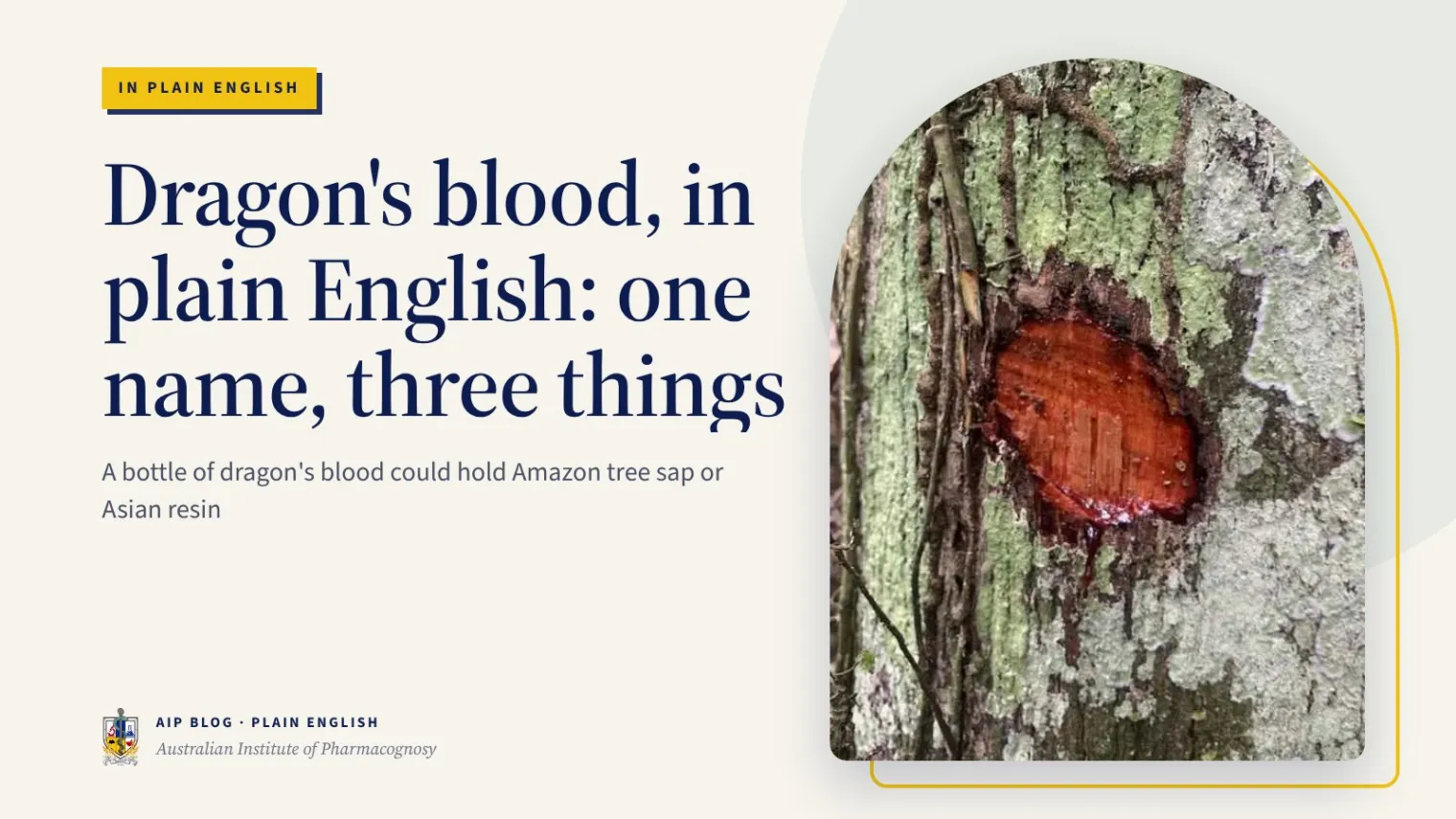
Slash the pale bark and it bleeds a deep, clear red. Amazon families keep a tree by the house, nick it with a machete when needed, and rub the sap into grazes, bites and mouth ulcers, or stir drops into water when the bowels are running.
A habit that old shows people found it worth doing. It cannot say how well it works or what goes wrong.
For skin there is one trial, from Iran, of a cream made from a sangre de grado extract, on small wounds. Treated wounds closed faster, but the design was weak: wounds were counted in place of people, side effects went unreported, and no botanist confirmed which plant was used.
A small clean graze is where it has the most history and the least exposure. Deep, dirty or infected wounds and burns need proper wound care.
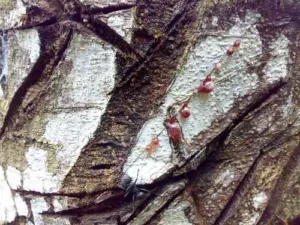
The pill that came out of the sap
A real result, and a narrow one.
A drug company purified crofelemer from the tannin-like chains that make up most of the sap. America’s regulator approved it in 2012 as a coated tablet.
It helps adults with HIV, on their HIV medicines, who have a long-running diarrhoea no infection explains. Against a dummy pill, roughly one extra person in ten reached the trial’s goal for fewer watery stools, and most people taking it did not. Trials in other kinds of diarrhoea missed their main goal.
Cell studies suggest it shuts two of the tiny gates salt uses to leak into the gut, dragging water after it. The sap holds the same kind of chains, which gives the folk use a believable basis. Nobody has shown the drops deliver them where they count, and the Institute found no trial of sap swallowed.
“Source of an approved drug” on a sap label is history. The approval covers one purified tablet, for one condition, overseas, and Australia has no approved crofelemer product.
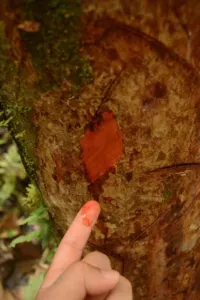
What the bottle holds that the pill leaves out
Same tree, different product.
The bottle is the whole latex, perhaps from several kinds of tree. It keeps what the drug makers removed, including an alkaloid called taspine.
Pure taspine kills cells in a laboratory dish, and its level swings hugely between trees. That work was on cells and injected animals, so it cannot show what sap does to people, and the Institute found no case of anyone hurt by swallowing it. With no proper safety study either, repeated use by mouth calls for caution.
Two bottles of the same sap can be very different things.
Pregnancy is the biggest gap: the sap has never been studied there, and the Socotra dragon tree resin, sold under the same name, has a folk use for ending early pregnancy.
Pregnant, breastfeeding, or dosing a child: leave it out of the glass. On HIV medicines, cancer drugs or warfarin, add oral sap only with professional advice; tannins can latch onto medicines, and nobody has tested whether sap does. On other regular medicines, keep it a few hours apart.
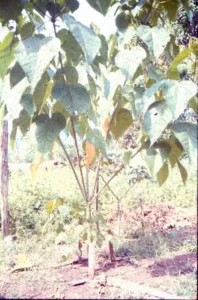
Every tablet starts with a felled tree
And somebody planting the next one.
Nobody can yet build crofelemer from scratch, so every pill begins as sap. Tapped like rubber, the trees gave a trickle and many died; a Kew botanist found that their sap channels never regrow. So the harvest fells each tree, and in Peru’s Pichis valley Yánesha, Asháninka and other local families plant saplings to replace them.
The harvest’s own people report the replanting; the Institute found no independent audit of it.
In house gardens across the western Amazon, young trees like this one wait for the next scraped knee.
Ask a sap seller where it was harvested and whether trees are replanted. Queensland biosecurity law does not name the tree; the Institute has not assessed federal import rules for seed.
This page is the short version of Dr Thomas Ridley’s review. The evidence is all there:
- Dr Luke Iggulden, Chief Scientific Officer — Senior author. Commissioned the Explainer series, set its direction and approved it
- Jesse Kirby — Read the review, kept shorthand notes, then wrote this edition from them with the review shut: chose the five questions a buyer of the bottle has, the order and every sentence, and carried the safety box across at full strength
- Zoe Bennett — Wrote the title, the search description and the labels around the “one name, three things” confusion that readers are most likely to share with someone holding a bottle
- Theo Karras — Picked the flowering branch for the cover, the five section banners and the Socotra dragon tree figure from the review’s own licensed photographs, opened each one and wrote alt text describing what is actually in it
- Leah Bianchi — Built the page: the red safety box, the one-minute card, the pull quote, the five what-this-means cards and the card back to the full review, and read it through at phone width
Contributors
- Dr Thomas Ridley — Wrote AIP Literature Review AIP-LR-CROLEC, the article this page retells
Image credits. Cover: Diogo Luiz, iNaturalist 331480994, CC BY 4.0. Fresh cut with sap: Círculo de Investigación en Taxonomía, Florística y Ecología Vegetal, iNaturalist 110639284, CC0 1.0 (observer’s identification, not yet confirmed). Sap on a fingertip: Siddarth Machado, iNaturalist 370223803, CC BY 4.0 (observer’s identification, not yet confirmed). Beads of sap: por natikka, CC BY 2.5. Young tree at Takiwasi: Jaime Torres/Archivo Centro Takiwasi, CC BY-SA 4.0. Rattan palm resin: Andy Dingley, CC BY-SA 3.0. Socotra dragon tree: Manuel Schwarz, CC BY 4.0. Wikimedia Commons photographs resized and re-encoded by AIP; no other changes.
AIP Explainers are the plain-language editions of the Institute’s technical articles, published alongside the original. Everything on this page is carried by the full article, where the evidence, the references and the regulatory sources are set out. Regulatory information was read in October 2026 and may change; it is the Institute’s published reading, not legal advice. Spotted an error? Write to our contact form. We would rather correct a claim than repeat it.
Jesse Kirby
Head of Community Outreach
Australian Institute of Pharmacognosy
Cardwell QLD, Australia
australian-pharmacognosy.org · our contact form
The Institute sets and publishes its own monographs. The catalogue is in Publications.