
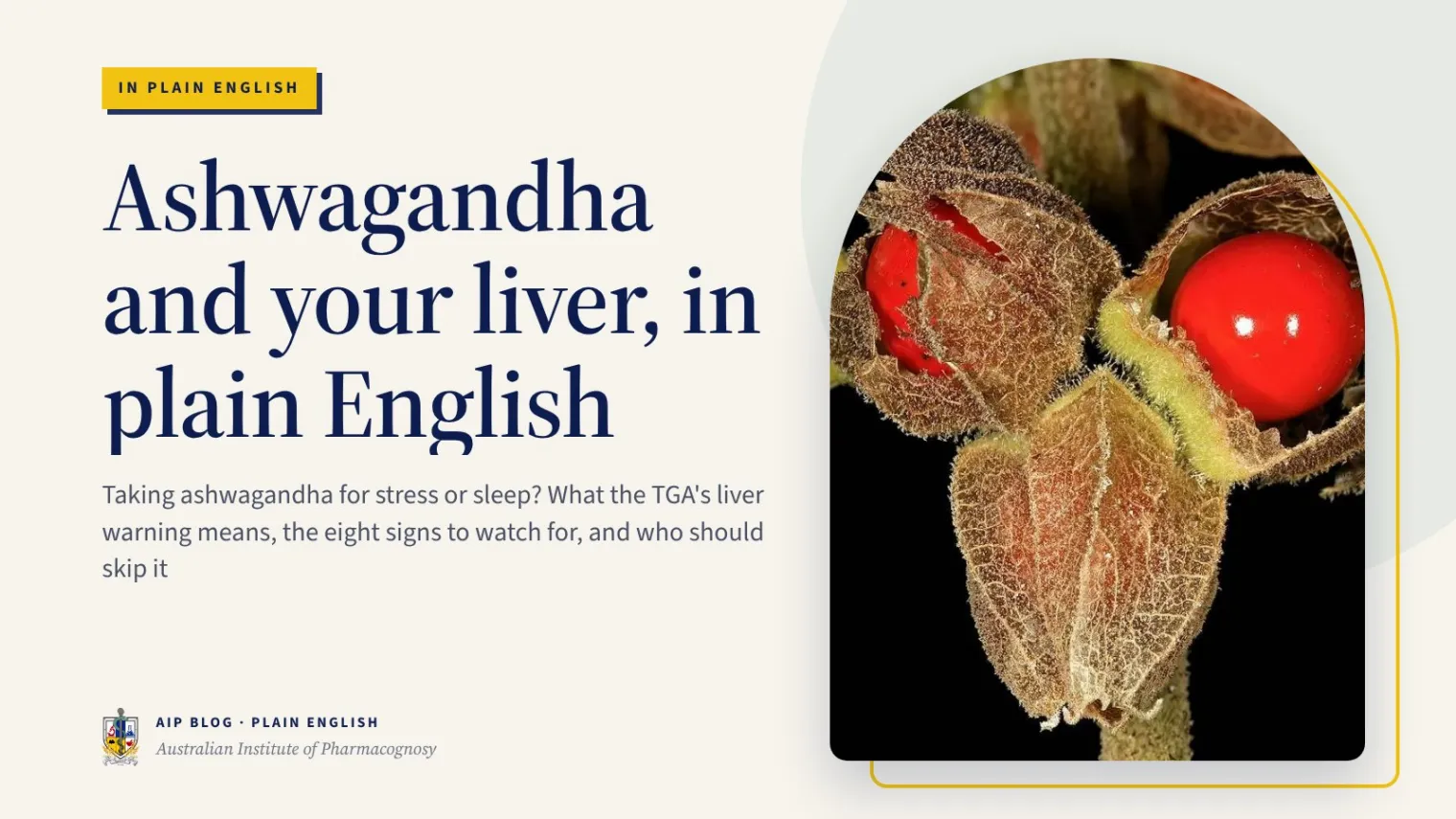
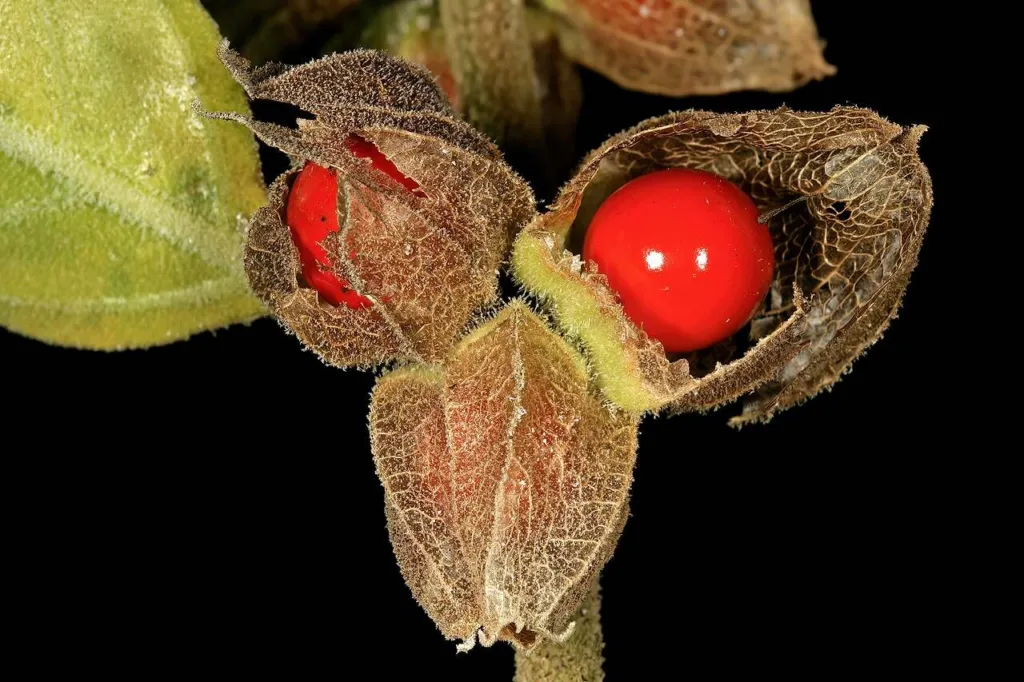
Photo: SAplants, via Wikimedia Commons · licence CC BY-SA 4.0
The tub sits by the toothbrushes. Ashwagandha gummies, bought after a video promised deeper sleep and a calmer head, and one or two go down every night with a glass of water.
Most people who do that will never have a problem. A very small number have turned yellow, and some of those were Australians who bought their product legally, off a shelf here. The pack in your bathroom says nothing about it. This page does.
For education only: no health, legal or regulatory advice, and no preparation or dosing detail. The law here is the Institute’s published reading of Australian rules in late September 2026, and may change.
Stop taking it straight away and get checked without delay, with liver blood tests, if you notice any of the eight signs the TGA lists: yellow skin or yellow whites of the eyes, dark urine, nausea, vomiting, unusual tiredness, weakness, stomach or belly pain, or loss of appetite. Itching often came with the yellowing in the published cases, and pale stools with dark urine point the same way. Take the pack, or a photo of its label and AUST L number, with you.
Sudden hard vomiting or diarrhoea after the first dose or two is a known reaction that has put people in hospital. Stop the product.
Anyone who has or has had liver problems should not take it, the TGA says. Pregnant or breastfeeding: avoid it.
Emergency, such as collapse, confusion or vomiting blood: phone 000. Possible poisoning or overdose, including a child who has eaten gummies: phone the Poisons Information Centre on 13 11 26, 24 hours, Australia-wide, and follow its advice.
Report a suspected side effect to the TGA through its online consumer reporting page. Anyone can.
Before taking any herbal medicine, consult a degree-qualified herbalist with competencies and adequate training in pharmacognosy.
- The TGA says ashwagandha can, very rarely, hurt the liver, and it has Australian cases on file, some from products sold legally here.
- Most people recovered once they stopped. Overseas, a few people who already had badly scarred livers died.
- Know the eight signs in the red box by heart. Trouble can start months after you begin.
- Liver disease, a pregnancy, a baby at the breast or a thyroid in overdrive: any one of those means leave it alone.
- It may ease stress and sleep a little, in small, maker-funded trials. “Cortisol face” has nothing behind it.
What the regulator actually has in its files
A short list, but a real one.
The TGA, the national medicines regulator, first raised this in early 2024 and came back to it in July. Its tally stands at eleven Australians who may have had liver damage from this herb. Set aside the people also swallowing something else that could have done it and six remain. Four of the six had bought a product listed on the Australian register, and two of those four ended up in hospital. The TGA has had no report of an Australian dying or needing a new liver.
Overseas it is darker. Doctors in India reported three deaths, all in people whose livers were already scarred by cirrhosis, and one American woman, also taking another supplement, needed a transplant. Most people in the published cases slowly got better once they stopped.
The TGA calls the risk very rare. It has not pulled the herb or put a liver warning on packs, and says it is still weighing the evidence, including whether products made with the leaf behave differently from the root that tradition used. In mid-September it struck another herb, andrographis, off the list allowed in new products, over severe allergic reactions. Whether ashwagandha follows, the public record does not say.
The pack in your bathroom says nothing about it.
Nobody knows how many of us take this herb, so those reports show it happens without showing how often. If you use it, learn the red box by heart.

Yellow eyes, dark wee, and a tiredness that won’t lift
Months without trouble is no promise.
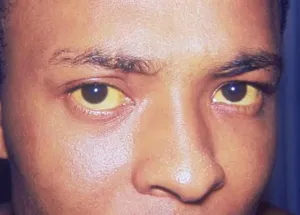
A hurt liver stops clearing bile, the yellow-green juice it makes to digest fat, and the pigment backs up into the blood. The whites of the eyes yellow first, then the skin. Urine goes the colour of strong tea.
Most cases began a few weeks to a few months in, and Dutch reports describe it arriving almost two years in. Getting better is slow, too: weeks or months.
The TGA also warns of sudden, violent vomiting and diarrhoea, sometimes after one dose, easily blamed on a bad meal. It has put people in hospital, and it settles once the product stops.
If any of the eight signs show up, stop that day and get liver blood tests, with the pack in your bag. Then report it to the TGA: reports are how a problem this rare gets caught.
Leave it on the shelf if this is you
For some people the answer is no.
People with liver trouble now or in the past; the TGA is plain about that. We would count a fatty liver and heavy drinking too, though that is our reading of how the risk works, not a TGA rule.
Anyone pregnant, trying for a baby or breastfeeding. Almost nobody has studied it in pregnancy, and many packs here already have to carry a pregnancy warning by law.
Anyone with an overactive thyroid or on thyroid tablets, because the herb tends to push thyroid hormone up and has been linked to cases of an overactive thyroid. Anyone on sleeping tablets, strong painkillers or other sedatives, or who drinks heavily, where we reason the drowsiness could stack up, though nobody has tested it. Anyone with an autoimmune illness, a transplant or on immune-suppressing medicines, since in lab and animal work the herb may stir the immune system. Anyone with a hormone-sensitive cancer or polycystic ovary syndrome. And anyone due for an operation: tell the anaesthetist about any herbal product taken in the weeks before.
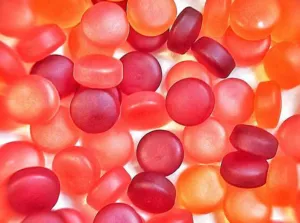
Then the kids. Several of the plain-ashwagandha products sold here are gummies, and a gummy looks exactly like a lolly to a four-year-old.
A gummy looks exactly like a lolly to a four-year-old.
If one of those fits, the careful choice is to stop. Keep gummy tubs up high; if a child gets into one, phone 13 11 26. “Withania” on a label is the same plant, often buried in sleep blends. Online buys from overseas have had no Australian quality check, and an AUST L number means the product is on the national register, not that the TGA has checked it works.

For stress and sleep, a small maybe
And the people selling it ran most of the tests.
There are real trials, with dummy pills for comparison. In them the root extract eases how stressed and anxious people say they feel, helps sleep a little and lowers the morning level of cortisol, the body’s stress hormone. The trials are mostly small, short and run in India, and in nearly every one the company selling the extract supplied it or paid.
Australia ran its own, in Perth. People on the herb felt less stressed. So did the people on the dummy pill, by the same amount.
For sleep, one trial found people nodded off about five minutes sooner. Whether that matters at two in the morning is yours to judge.
Testosterone rose a little in healthy men, never leaving the usual range. Weight loss rests on one maker’s extract, never repeated by an outside group. “Cortisol face” is a social media phrase that no trial has measured, and nothing in the research shows a capsule reshaping anyone’s face.
None of it tells you about the liver. Pool every trial and there are still far too few people to catch a reaction that strikes one in many thousands.
For sleep or nerves you are weighing a small, uncertain benefit against a rare, serious risk. Take that to the kind of herbalist named in the red box, with a list of everything else in your cupboard. Then go and pick up the tub by the toothbrushes, turn it round, and read the back.
This page is the short version of Dr Thomas Ridley’s review. The evidence is all there:
- Jesse Kirby — Took notes from Dr Ridley’s review in his own shorthand, then wrote this page from them with the review closed: chose the four things a reader with a tub of gummies needs, set the order and wrote every sentence, and redrafted the TGA warning box without softening any of it
- Zoe Bennett — Wrote the page title, the search description and the labels, pitched at someone who already takes ashwagandha for stress or sleep and is searching for what the liver warning means for them
- Theo Karras — Picked the ripe-berry cover, the four section banners and the jaundice photograph from the review’s own licensed set, and rewrote each alt line to describe what the photograph actually shows
- Leah Bianchi — Built the page: the red warning box with the eight signs, the one-minute card, the two pull quotes, the four what-this-means cards and the card back to the full review, checked for reading on a phone
Contributors
- Dr Thomas Ridley — Wrote AIP Literature Review LR-11, the article this page retells, and checks this edition against it
Research authorised by
- Dr Luke Iggulden, Chief Scientific Officer and lead researcher — Commissioned the Explainer series, set its direction and approved it
Image credits. All photographs via Wikimedia Commons, as used in the full review. Cover, developing fruit and ripe berry: SAplants, CC BY-SA 4.0. Leaves: JMK, CC BY-SA 4.0. Dried roots: Piyush Kothari, CC BY-SA 4.0. Gummies: Suzanne Schroeter, CC BY-SA 2.0. Jaundiced eye: CDC Public Health Image Library, public domain. Resized and re-encoded for the web by AIP; no other changes.
AIP Explainers are the plain-language editions of the Institute’s technical articles, published alongside the original. Everything on this page is carried by the full review, where the evidence, the references and the regulatory sources are set out. Regulatory information was read on 28 and 29/09/2026 and may change; it is the Institute’s published reading and not legal advice. No product or sponsor is named or recommended. Spotted an error? Write to our contact form. We would rather correct a claim than repeat it.
Jesse Kirby
Head of Community Outreach
Australian Institute of Pharmacognosy
Cardwell QLD, Australia
australian-pharmacognosy.org · our contact form
The Institute sets and publishes its own monographs. The catalogue is in Publications.