
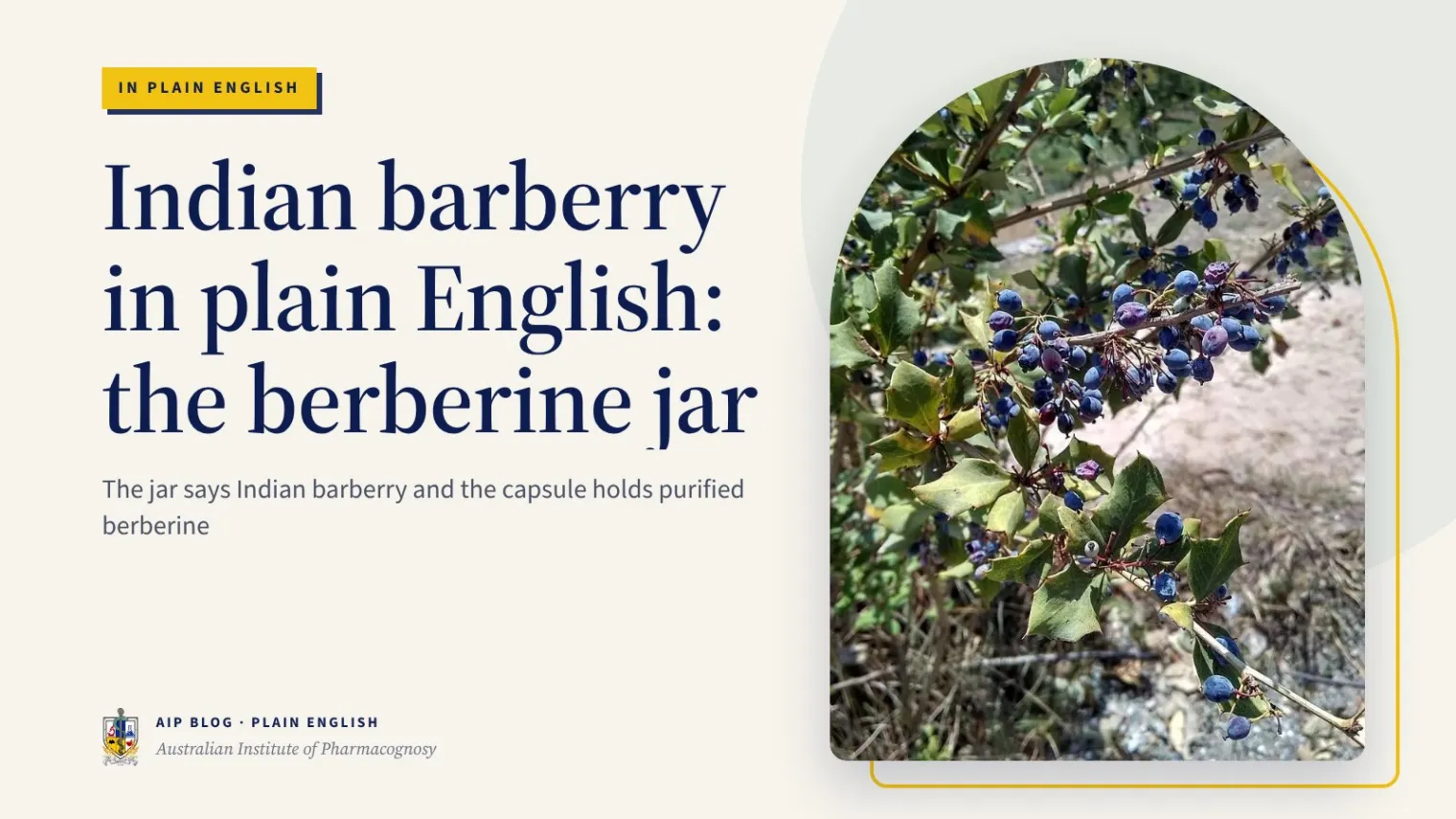
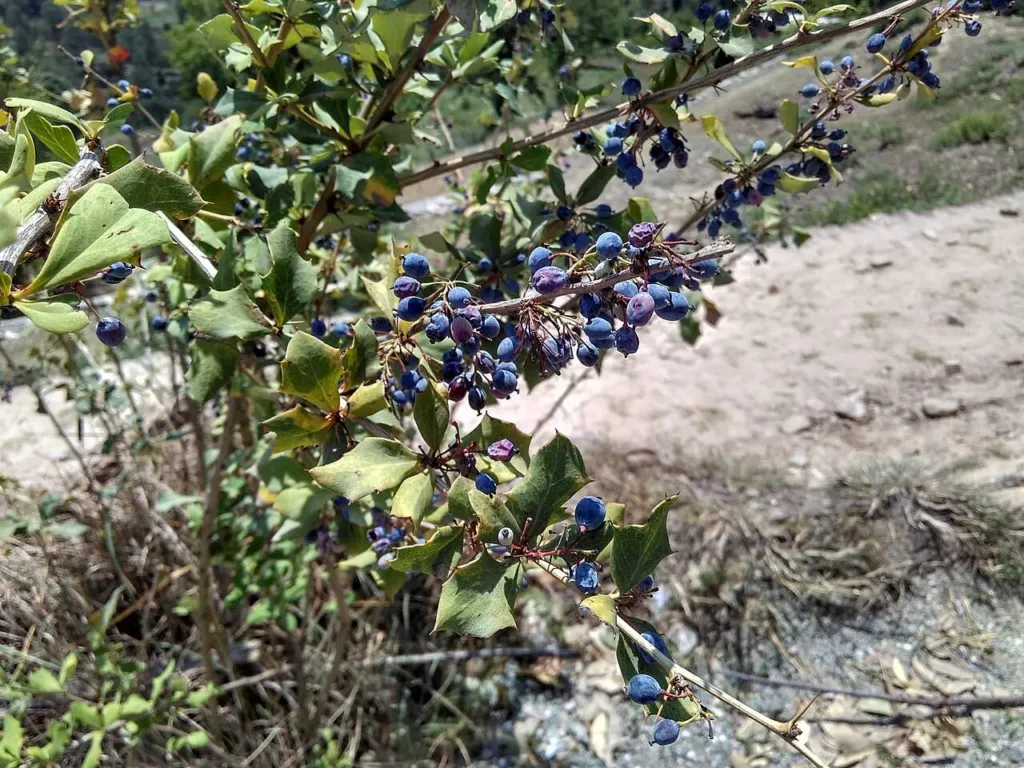
Cover: Indian barberry fruiting in Uttarakhand, India. Photo: Ramwik, under a CC BY-SA 3.0 licence, from Wikimedia Commons.
On a kitchen bench somewhere near you there is a jar of berberine, beside the blood pressure tablets. It came off a chemist shelf or out of a reel on a phone, with a nickname attached: nature’s Ozempic.
The trials do suggest it moves blood sugar and cholesterol a little. It also changes how the tablets beside it behave, and no Australian label has to say so. If you take anything on prescription, that is the half that concerns you.
Educational only. No doses, no preparations, nothing to buy. The legal passages are the Institute’s published reading of Australian rules at 27/09/2026, and are not advice.
Never a newborn or a baby. Berberine knocks bilirubin off the protein that carries it in the blood, and in an infant the loose bilirubin can reach the brain. That injury is permanent, and there is nothing that treats it once it is done. A second unsettled question is red cells breaking down in people with the inherited G6PD deficiency. It was reported in babies, and it is a caution for anyone who has it. The cautious reading is the only defensible one.
Not in pregnancy, not while breastfeeding. Australian law requires that warning on Indian barberry products, and it is not a paperwork one. The newborn cases above were reported after the baby was reached through the placenta and through breast milk, as well as after a dose given straight to the baby.
Tell whoever prescribes for you. Berberine blocks liver enzymes and a gut pump that handle a large share of prescription medicines, and it has pushed up the blood level of a transplant anti-rejection medicine. Statins, blood thinners, anti-rejection medicines, heart-rhythm and blood-pressure tablets, some antibiotics and anything else that stretches the heart’s electrical reset are all in scope. With insulin and the older sulfonylurea tablets your sugar can go too low; with metformin it may run the other way.
The heart-rhythm signal is unsettled. The blood-pressure one is not. In laboratory work berberine stretches the heart’s electrical reset, and one woman taking several supplements at once collapsed with a dangerous rhythm. Separately from that, and on human evidence going back decades, berberine lowers blood pressure and slows the pulse by itself, so it adds to whatever a beta blocker or a blood pressure tablet is already doing. Going lightheaded when you stand up is the sign, and it is a sign to act on. Anyone on a heart-rhythm medicine, a beta blocker or a blood pressure tablet has most to lose.
Do not use it to put off a diagnosis. Thirst, weight change, tiredness, blurred vision or diabetes in the family need looking into properly. Delay is the worst harm here.
In an emergency call Triple Zero (000). For a suspected poisoning or overdose call the Poisons Information Centre on 13 11 26, twenty-four hours, Australia-wide. Before taking any botanical medicine, consult a degree-qualified herbalist with competencies and adequate training in pharmacognosy, and tell them every prescription medicine you take.
- The plant name says where the chemical came from, and nothing about how much you hold.
- As a weight product it has almost nothing to show.
- It may move blood sugar and cholesterol a little; the trials are small and short.
- The real hazard is interactions with prescription medicines.
- Never for newborns or babies, and not in pregnancy or while breastfeeding.
What is actually in the jar
A shrub printed outside, one purified compound inside.
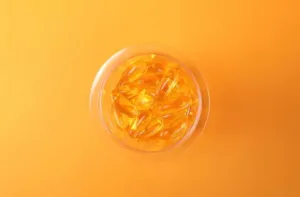
Turn the pack around. Australian berberine products lead with a plant: Indian barberry, tree turmeric, or daruharidra, its Sanskrit name. Inside is berberine, a bitter yellow alkaloid taken from a Himalayan shrub’s roots and stripped of nearly everything that grew with it.
A plant extract is a crowd of compounds. This is one compound, and it behaves like a drug: a set list of targets, a set list of medicines it collides with. And one figure is missing. Every Australian pack the review checked leaves out how much berberine is in a capsule.
Every Australian pack the review checked leaves out how much berberine is in a capsule.
Look for an AUST L number on the pack, and for a berberine figure, which usually is not there.
Nature’s Ozempic, and the arithmetic
One sentence of marketing, two different pharmacologies.
The nickname promises the same machinery and the same result, and both halves give way. The injections act on a gut-hormone switch that tells the brain you have eaten. Berberine has never been shown to act on it.
Then the size. Pool the trials that weighed people and the average change lands between nothing measurable and under a kilogram. The big semaglutide trial everyone cites took, on average, about a seventh of body weight off its participants. No tradition that used this root used it for thinness.
Someone who buys capsules instead of getting tested has bought a delay, and delay gets paid for in retinas and kidneys.
If weight is why you bought it, expect close to nothing. If blood sugar is the reason, get tested.
Where it does earn something
Modest, repeatable, resting on a thin stack of small trials.
Take the weight story away and real evidence is left. In people with metabolic disease, pooled trials show fasting blood sugar and the longer-run sugar average easing down a little, and LDL cholesterol, the sort that gets called bad, coming down too. The cholesterol part had a mechanism worked out at the bench before the trials found it.
The problems sit under those numbers. The trials are small, often only a few months long, and they disagree badly with each other. A large share come from one country and have never been repeated anywhere else.
What it does to you while you are taking it is mostly gut trouble: constipation or loose bowels, cramping and nausea, usually mild and usually worse the more you take. People who push the amount up report dizziness, nosebleeds and breathlessness. Germany’s official herbal verdict on this group of plants is a negative one.
A small shift in a number is worth having. It is still not a treatment for diabetes or high cholesterol, and it is no reason to skip getting tested.
It changes how your other medicines behave
Gentle is the wrong word for this one.
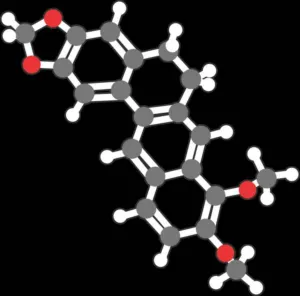
Berberine blocks the liver’s busiest drug-clearing enzyme and a pump in the gut wall that decides how much of a tablet gets through. Between them they handle a large share of everything on a script. How large, we will not guess: no source we could open gives one. Laboratory work points at a second liver enzyme as well.
The firmest human evidence is in kidney transplant patients. Those who took berberine with ciclosporin, the anti-rejection medicine a transplant depends on, ended up with blood levels about a third higher. For a medicine with no room either side of the right dose, that is a great deal.
Metformin runs backwards from the obvious guess. Berberine blocks the transporters that carry it about, and less metformin got where it was needed. Losing grip on your sugar is at least as likely as your sugar dropping too far.
Then the heart. In cells, berberine blocks a channel that resets the heartbeat and stretches the reset an ECG measures; stretched far enough, that sets off a dangerous rhythm. One case describes a woman in her fifties using a hemp oil well past its labelled dose, with a berberine supplement beside it; she collapsed, and came right days after stopping the lot. Berberine cannot be blamed alone, and the dish concentrations sit far above anything a capsule reaches in blood. A real mechanism of unknown size in people.
There is a quieter half to this that is not bench work at all. Berberine lowers blood pressure and slows the pulse on its own, and that has been watched in people since the 1980s, so it stacks on top of what a beta blocker or a blood pressure tablet is already doing. Going lightheaded when you stand up is how it shows, and the tablets it stacks on are the commonest ones in the age group buying the jar.
Put the jar on the list of what you take, and say so at the pharmacy counter. Ask the herbalist in the red box first.
Who must not take it, and the warning lottery
The part the trend never mentions, and the part Australian law has acted on.
The newborn warning in the red box is the most serious thing on this page. The mechanism is strong; the human evidence is thinner and openly contested, resting on cases reported with a Chinese relative of this plant that two authors later challenged with animal work. The cautious answer is the only defensible one.
Children have been given berberine in trials, all of it for diarrhoea and most of it given as an enema rather than swallowed. That says nothing about an adult capsule swallowed daily for months. No paediatric evidence exists for sugar or weight, and herbal practice keeps these plants away from very young children as well as from newborns.
Australian law has a quirk. Berberine on its own is not on the permitted list; the plants are, and only Indian barberry must carry a pregnancy and breastfeeding warning. The same molecule reaches a buyer warned or unwarned, according to which shrub the maker bought. And a pack sold here may offer to help a healthy number stay healthy; it cannot dress itself up as bringing an abnormal number down, which is what the nickname claims.
Pregnant, breastfeeding, or a baby in the house: this one is a no, and the jar goes up high where small hands do not reach. Otherwise take it along next time you see whoever looks after your medicines. If a supplement harms you, ring the Poisons Information Centre on 13 11 26 first, then report it to the TGA, which anyone is allowed to do.
The short version of Dr Thomas Ridley’s evidence review, where every figure and reference sits:
- Jesse Kirby — Read the evidence review, shut it, and wrote this edition from his own notes: chose the five things a reader with a jar on the bench needs, set the running order, wrote every sentence, and cut the review’s figures back to what they mean without weakening a single warning
- Zoe Bennett — Wrote the page title, the search line and the labels around the jar and the nickname a reader has already heard, which is how this page will be found and shared
- Theo Karras — Picked and cropped the cover and the five section banners from the review’s own licensed images, and rewrote every alt text to describe what is actually in the frame
- Leah Bianchi — Built the page: the red safety box, the one-minute card, the pull quote, the five what-this-means cards and the card back to the review, and made the whole thing read on a phone
Contributors
- Dr Thomas Ridley — Head of Education and Research; wrote evidence review LR-9, the article this page retells
Research authorised by
- Dr Luke Iggulden, Chief Scientific Officer and lead researcher — Commissioned the Explainer series, set its direction and approved it
Image credits. All photographs are reused from the parent evidence review, where each is credited in full. Cover, Indian barberry in fruit, Uttarakhand: Ramwik, CC BY-SA 3.0, via Wikimedia Commons. Capsules: Jernej Furman, CC BY 2.0. Ripe fruit: Buddhika.jm, CC BY-SA 3.0. Foliage: Dinesh Valke, CC BY-SA 2.0. Berberine molecule: courtesy of NIAID, Ryan Kissinger, public domain. Goldenseal plate: Charles F. Millspaugh, 1887, public domain.
AIP Explainers are the plain-language editions of the Institute’s technical articles, published alongside the original. Everything on this page is carried by the full evidence review, where the studies, the figures, the regulatory instruments and the references are set out and checked. Australian regulatory material was read on 27/09/2026 and may change. Spotted an error? Write to our contact form. We would rather correct a claim than repeat it.
Jesse Kirby
Head of Community Outreach
Australian Institute of Pharmacognosy
Cardwell QLD, Australia
australian-pharmacognosy.org · our contact form
The Institute sets and publishes its own monographs. The catalogue is in Publications.