

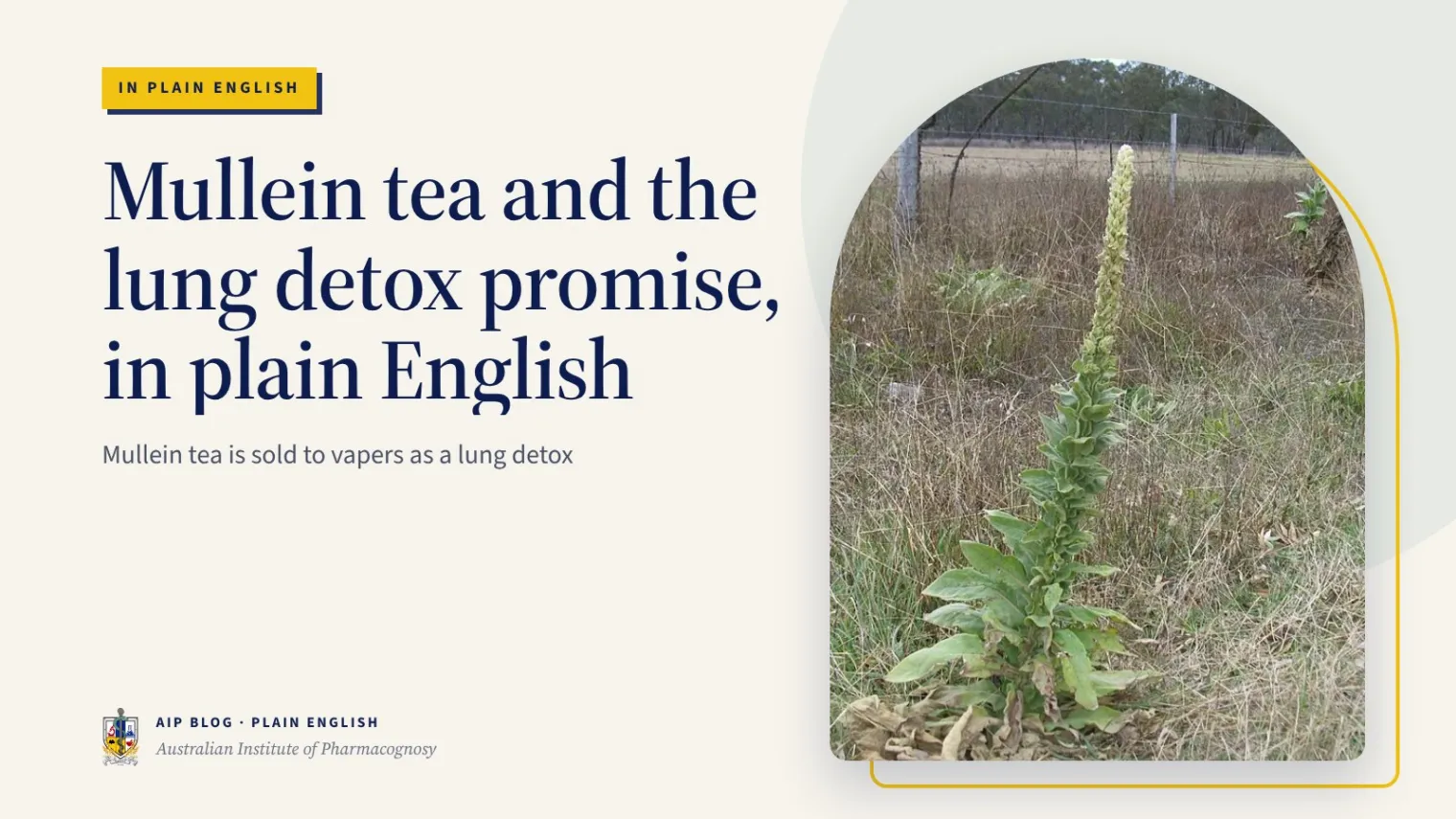
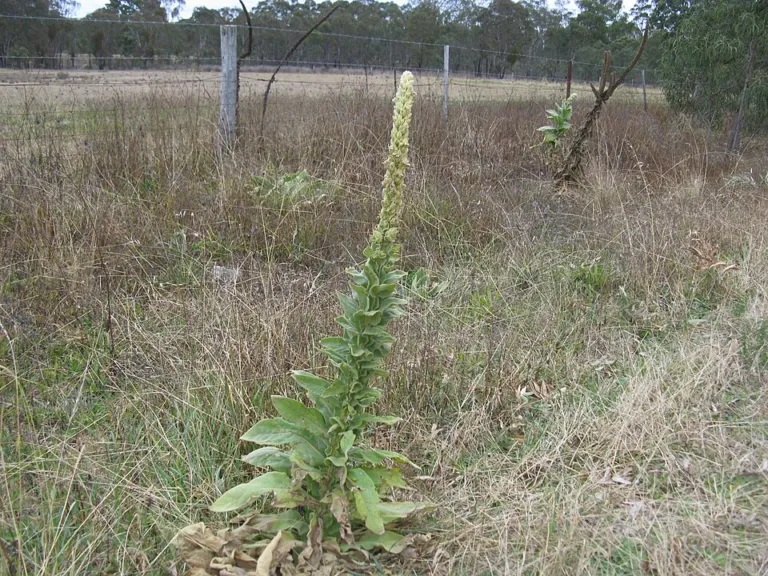
Cover: South West Rocks, NSW · Photo: Harry Rose · CC BY 2.0 · Wikimedia Commons
A week after your sister puts the vape down, her chest still feels tight. Then a pouch of grey-green “lung detox” tea turns up in her letterbox, promising to scrub out the damage.
Those leaves are mullein, a furry weed you’ve likely driven past on a country road. People have sipped it for sore throats for centuries. Nobody has shown it cleans a lung; your own body does that, free.
Educational only: no advice, preparation or dosing. Legal lines are the Institute’s reading as of October 2026, not legal advice.
Difficulty breathing: phone 000.
Seeds or a lot of the plant eaten, or any reaction: phone the Poisons Information Centre, 13 11 26, 24 hours, and follow its advice.
Quitting: mullein is no quit treatment, and smoking any plant makes carbon monoxide and tar. Quitline 13 7848 is free and confidential.
A cough lasting over a week, or with breathlessness, fever or pus-coloured phlegm, needs prompt clinical assessment, not tea.
No oil drops in an ear that is discharging, may have a burst eardrum, or has grommets. Ear pain with high fever, swelling or redness behind the ear, or a drowsy, very unwell child: assessment the same day.
For any question about taking mullein, consult a degree-qualified herbalist with competencies and adequate training in pharmacognosy.
- A sore-throat comfort by tradition; never trialled for coughs.
- Nothing shows it clears tar or vape residue from lungs.
- Lungs clean themselves; stopping smoke lets them recover. Quitline 13 7848.
- Strain it, no seeds, not if pregnant, breastfeeding or under twelve.
- Never pick it off a roadside.
Your lungs already have a cleaner
It runs all day. Smoke is what jams it.
Your airways are lined with microscopic hairs, cilia, standing in a film of mucus. They beat in waves, like a crowd passing a beach ball, rolling grime up to your throat.
Studies of smokers show smoke slows them. In a lab dish of human nose cells, vape mist without nicotine did too, and the cells recovered within days once it stopped. Our reading: take the smoke away and you give the cleaner its chance.
Take the smoke away and you give the cleaner its chance.
A cup of mullein coats your throat, then heads to your stomach. Nobody has measured any of it reaching your lungs.
The tea won’t give you your lungs back; stopping is what lets them recover. Quitline, 13 7848, helps with vapes too.
What a cup can honestly do, and what a label may say
Old comfort, never tested.
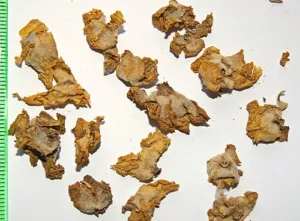
Europeans have steeped its yellow flowers and furry leaves for coughs and colds since at least the 1500s. Europe’s medicines regulator accepted one narrow use, easing a sore throat with a dry cough and a cold, and said plainly it rests on long use, with no trial. Those rules don’t govern Australia.
The comfort probably comes from mucilage, a slippery gel the flowers give up in hot water: sensible, still unproven. Antiviral results come only from lab dishes. The children’s ear-drop trials, rated weak, mixed four or more herbs, so they can’t speak for mullein, let alone a chest.
Here it’s unscheduled, sold as food tea or in a few TGA-listed medicines allowed only traditional claims such as easing a cough or soothing a throat; none mentions vaping, quitting or detox. Under Australia’s food code a food tea may not claim to cure or ease a disease or condition, and in the Institute’s reading “clears vape damage” is such a claim.
A strained cup is gentle traditional comfort for a scratchy throat. For a cough, see the herbalist in the red box.
Before the kettle goes on
A mild tea, with a few habits.
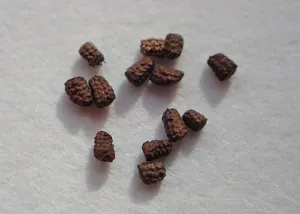
European reviewers found the flower tea safe enough in the amounts long used, with no clashes with medicines on record. Its gel might slow a tablet taken alongside, so space them; a general caution, untested for mullein. Its tiny leaf hairs catch in the throat: a coffee filter stops them, a tea strainer may not. The seeds once stunned fish, no safety study of them was found, and they stay out of the pot.
Untested in pregnancy, breastfeeding and children, it isn’t recommended in Europe for those groups or by mouth under twelve. That is a gap in the data; no harm is on record. One question stays open: a European food-safety panel judged it likely, on chemistry alone, that a compound in it could harm DNA. No test of mullein has checked. It argues for moderation.
Strain it, skip the seeds, and pass if pregnant, breastfeeding or buying for under-twelves.
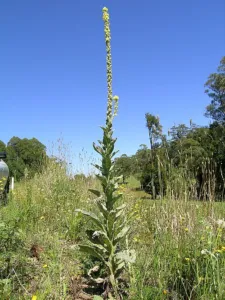
Know the plant, and where it grew
Grey felt, and a clean patch.
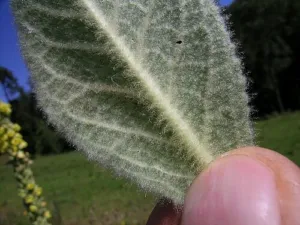
First year, a flat rosette of grey leaves soft as flannel. Second year, one yellow spike often taller than you, then it dies. It lines roads and fences in the south and east; in Queensland, only the south-east. Three other mulleins grow wild, greener or near hairless. Its best clue is a coat of grey felt over every leaf; a rosette with no flowers tells you far less, and other hairy rosettes share its paddocks.
Roadsides gather exhaust grime, and councils may spray mullein as a weed.
Pick only from a patch you know is clean, or buy from a reputable seller. Never harvest a council verge.
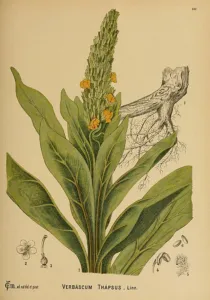
The cough cure in Dublin’s chemist shops
An old hope, looked at honestly.
Before any drug could beat tuberculosis, Irish growers raised fields of mullein and Dublin’s best chemists sold it. A doctor there in the 1800s thought six of his seven patients improved. With no comparison, and a disease that waxes and wanes, that proves little.
A warm cup can ease a sore throat; your lungs’ own cleaner gets its chance once the smoke stops.
The short version of Dr Thomas Ridley’s review, with every study and the law:
- Dr Luke Iggulden, Chief Scientific Officer — Senior author. Commissioned the Explainer series, set its direction and approved it
- Jesse Kirby — Wrote this edition from his own notes with the review closed: chose the six things a reader with a detox pouch needs, set the order, wrote every sentence and carried the safety box across without softening it
- Zoe Bennett — Wrote the title, the search description and the labels around the vaper’s detox pouch, the angle the page will be shared on
- Theo Karras — Picked the paddock cover and the five section banners from the review’s licensed photographs, and rewrote each alt text to describe what the picture shows
- Leah Bianchi — Built the page: red safety box, one-minute card, a pull quote, the what-this-means cards and the card back to the review, checked for reading on a phone
Contributors
- Dr Thomas Ridley — Wrote the AIP review this page retells
Image credits. Verbascum thapsus field photographs (cover, leaf, roadside spike, fence line): Harry Rose, South West Rocks NSW, CC BY 2.0. Dried flowers: Danny Steven S., CC BY-SA 3.0. Seeds: Krzysztof Ziarnek (Kenraiz), CC BY-SA 4.0. Botanical plate: Charles Frederick Millspaugh, American Medicinal Plants, public domain. All via Wikimedia Commons.
AIP Explainers are the plain-language editions of the Institute’s technical articles, published alongside the original. Everything on this page is carried by the full review, where the evidence, the references and the regulatory sources are set out. Regulatory information was read in October 2026 and may change. Spotted an error? Write to our contact form. We would rather correct a claim than repeat it.
Jesse Kirby
Head of Community Outreach
Australian Institute of Pharmacognosy
Cardwell QLD, Australia
australian-pharmacognosy.org · our contact form
The Institute sets and publishes its own monographs. The catalogue is in Publications.