
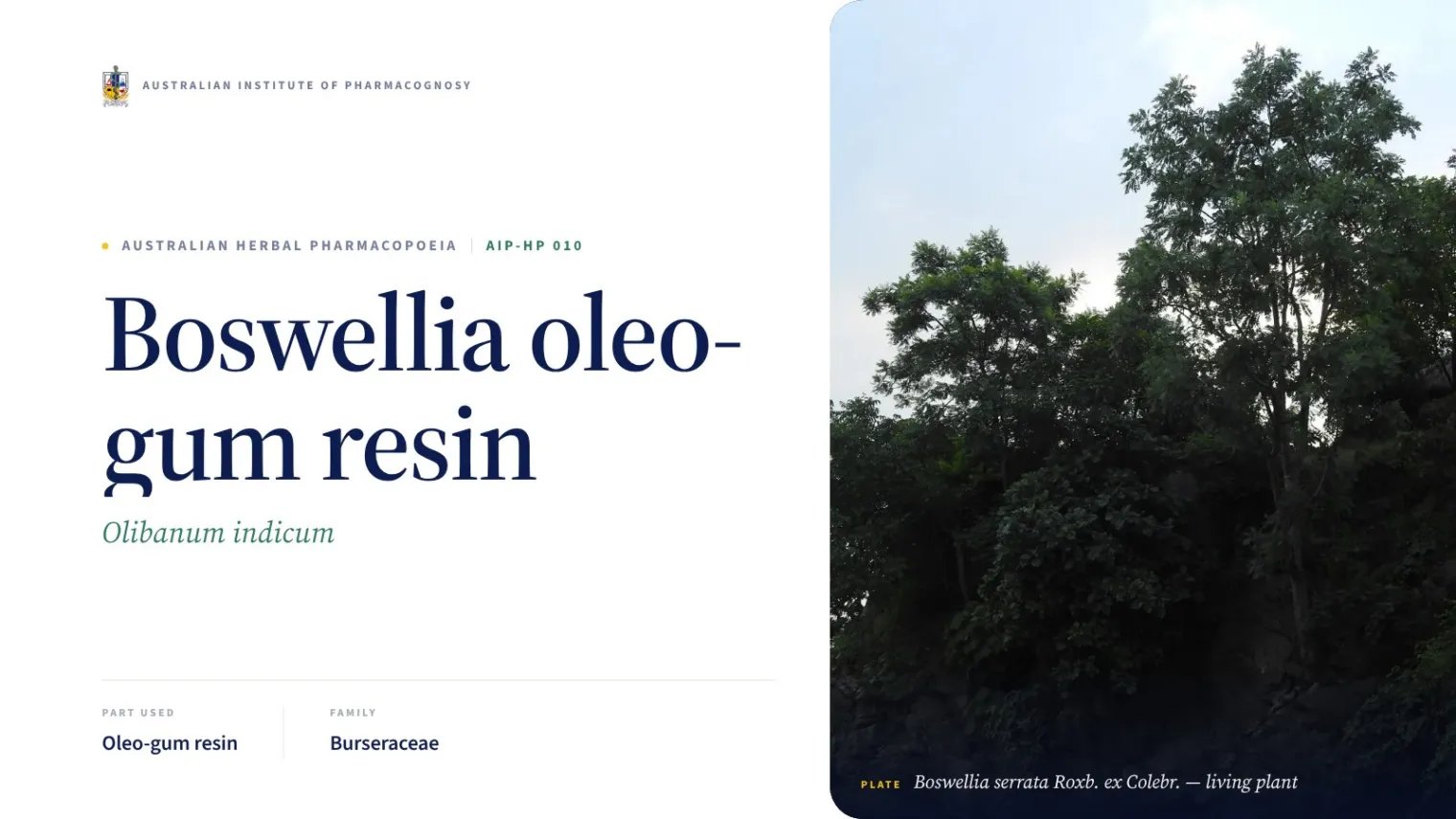
Boswellia oleo-gum resin (Boswellia serrata Roxb. ex Colebr.), Burseraceae
Australian Herbal Pharmacopoeia (working title) · Monograph AIP-HP 011 · Version 1.0 draft
Date: 2026
Status: internal draft — not public. Not a statutory standard.
Prepared by: Dr Thomas Ridley, Head of Education and Research, Australian Institute of Pharmacognosy, Cardwell, Queensland.
0. Free-teaser block
0.1 Identity card
| Monograph number | AIP-HP 011 (MediHerb A–Z list No. 22). Commissioned as AIP-HP 010; that number was already issued to Rhodiola rosea, and the register issued 011 to this drug on 27/09/2026. See section 20 |
| Title | Boswellia oleo-gum resin (Boswellia serrata Roxb. ex Colebr.), Olibanum indicum |
| Version / year | 1.0 draft, 2026. Next review 2029, or sooner if the ATLAS trial reports or the Ph. Eur. monograph is revised |
| Accepted binomial | Boswellia serrata Roxb. ex Colebr., Asiatick Researches 9: 379 (1807). Accepted; nomenclatural status established; IPNI urn:lsid:ipni.org:names:127067-1, protologue Asiat. Res. 9: 379, t. 5 (1807). Checked on 27/09/2026 against the Kew World Checklist of Vascular Plants — the dataset Plants of the World Online publishes — served through ChecklistBank, and against IPNI [1,46]. POWO’s own web interface refused automated access on that date, so the check was made against the underlying Kew dataset and is recorded that way rather than as a POWO page read [1] |
| Family | Burseraceae Kunth (APG IV). Order Sapindales [1,2,8] |
| Plant part | The air-dried oleo-gum resin, obtained by incision in the stem or branches. Not the leaf, bark or wood [5] |
| Latin drug name | Olibanum indicum (Ph. Eur. 8.0, monograph 2310) [5]. The Ayurvedic Pharmacopoeia of India calls the same drug Kunduru [6] |
| Principal synonyms | Homotypic: Libanotus asiaticus Stackh. (illegitimate). Heterotypic: Boswellia glabra Roxb., Boswellia thurifera Roxb., Boswellia hirsuta Sm., B. serrata var. glabra (Roxb.) A.W.Benn., B. serrata var. bivalvis Kuntze, Chloroxylon dupada Buch.-Ham., Libanus thurifer Colebr. (invalid) [1]. Mills and Bone give B. glabra as the botanical synonym on the label [9]; the TGA lists B. thurifera as a separate permissible ingredient (see below) |
| Common names | English: Indian frankincense, Indian olibanum [9]. Sanskrit: Śallakī [6,9]. Hindi: salai, labana [6]. Bengali: luban, salai, salgai [6]. Marathi: salai cha dink [6]. Gujarati: shaledum, saleda, saladi, gugal, saledhi [6]. Kannada: madimar, chilakdupa, tallaki, maddi [6]. Telugu: parangi sambrani, anduga, kondagugi tamu [6]. Urdu: kundur [6]. German: Salaibaum [9]. The Ayurvedic drug name Salai guggal is in wide practitioner use [9]. Names circulating on image-sharing and plant-photograph sites are not used here; see section 1 |
| Pharmacopoeial status elsewhere | Ph. Eur.: yes — Indian frankincense, Olibanum indicum, monograph 2310, first published 01/2013, read here in the 8.0 edition held in the AIP library [5]. Ayurvedic Pharmacopoeia of India: yes — Part I, Volume IV, monograph 24, Kunduru (exudate), pp. 50–51 [6]. BP: yes by operation of the Ph. Eur. USP–NF: no. WHO: no. EMA/HMPC: no EU herbal monograph. BHP 1996: no |
| Australian status | Poisons Standard: not scheduled. The full text of the Therapeutic Goods (Poisons Standard — June 2026) Instrument 2026 (F2026L00633, 674 pp.) was searched on 27/09/2026 for "boswell", "olibanum", "frankincense" and "boswellic": no entry in any Schedule or Appendix [16]. Permissible Ingredients Determination: item 936 BOSWELLIA SERRATA, purposes A (active), E (excipient) and H (homoeopathic preparation ingredient), with no specific requirements — no dose ceiling, no warning statement, no route restriction. Items 935 BOSWELLIA CARTERII (A, E, H) and 937 BOSWELLIA THURIFERA (A, H) sit beside it, and item 3580 OLIBANUM OIL (A, E, H) [15]. ARTG: 159 entries for the keyword "boswellia" on 27/09/2026, among them MediHerb Boswellia Complex, ARTG 517947 (Integria Healthcare Australia Pty Ltd, ARTG date 31/10/2025; ingredients Apium graveolens, Boswellia serrata, Curcuma longa, Zingiber officinale) and the earlier entry 384265 [17,18]. Not native to Australia. Not a declared weed in Queensland. Zero occurrence records for the genus in the Atlas of Living Australia (searched 27/09/2026) [4]. No CITES listing: no Boswellia species is in Appendix I, II or III; CoP20 (Samarkand, 24/11–05/12/2025) adopted decisions encouraging range States to consider Appendix III listings in preference to a genus-wide one [7] |
| Named markers | 11-Keto-β-boswellic acid (KBA), CID 9847548, C₃₀H₄₆O₄, Mr 470.7 — Ph. Eur. assay marker, minimum 1.0 per cent on the dried drug. 3-O-Acetyl-11-keto-β-boswellic acid (AKBA), CID 11168203, C₃₂H₄₈O₅, Mr 512.7 — Ph. Eur. assay marker, minimum 1.0 per cent on the dried drug. Both limits are the Ph. Eur.’s, not AIP’s; AIP has set no limit of its own. See 7 [5] |
| Evidence snapshot | Knee osteoarthritis, combination products: Tier B, 8 of 15 pooled data sets significant, low certainty. Hand osteoarthritis, curcumin plus boswellia: Tier B, 1 RCT (n = 162), low certainty. Knee osteoarthritis, Boswellia alone: Tier C, two syntheses that disagree. Collagenous colitis: Tier B, 1 RCT (n = 31), low certainty. Peritumoural cerebral oedema during radiotherapy: Tier B, 1 RCT (n = 44), surrogate endpoint. Crohn’s disease maintenance: Tier C, 1 RCT (n = 108), null. Ulcerative colitis: Tier C, open-label only. Bronchial asthma: Tier C, 1 RCT (n = 80, 1998), unreplicated. Rheumatoid arthritis: Tier C. Topical use in knee osteoarthritis, acute diarrhoea, IBS bloating, cognition and chronic low back pain: Tier C each, one study apiece. Ayurvedic use as Śallakī: Tier T. Cancer, Alzheimer’s disease, diabetes: Tier P. No use reaches Tier A |
| Suggested citation | Ridley T. Olibanum indicum (Boswellia oleo-gum resin, Boswellia serrata Roxb. ex Colebr.). AIP-HP 011, version 1.0 draft. Cardwell: Australian Institute of Pharmacognosy; 2026. DOI to be assigned |
| Provenance | Original AIP data: none. Every analytical figure, limit, method and trial result in this monograph belongs to the source cited beside it. Sections 4, 5, 7, 8, 9 and 10 carry AIP bench data pending: AIP has not vouchered a sample, cut a section, run a plate or run a chromatogram for this drug. F1–F3, F3c, F6–F6j and F9b are licensed or public-domain third-party images; F3b, F5, F7, F8, F9, F11 and F12 are AIP drawings redrawn from cited published data; F10 and F13 are AIP charts drawn from this monograph’s own graded evidence |
| Compiler and review | Compiled by Dr Thomas Ridley (Education and Research). Technical review: Dr Fiona MacAllister (Botanical, sections 1-5 and the adulterant part of 10), reviewed in 2026; Dr Hana Suzuki (Botanical QA, sections 6-10), reviewed in 2026; Dr Eleanor Whitcombe (Medicine, sections 12, 13 and 15), reviewed in 2026. Evidence and citation audit (sections 0, 11-19 and the sources behind 6-9): Dr Thomas Ridley (Education and Research), reviewed in 2026 — a self-audit of his own compilation on the citation-integrity axis, which is why the Librarian’s independent reference audit of section 19 stays outstanding. Layout, figures and free sample (visual review, last in the chain): Jesse Kirby, Head of Community Outreach, reviewed in 2026. Published: not yet. Last modified: 2026. Version 1.0 draft |
| Canonical URL | /pharmacopoeia/boswellia-serrata/ (on publication) |
0.2 Summary
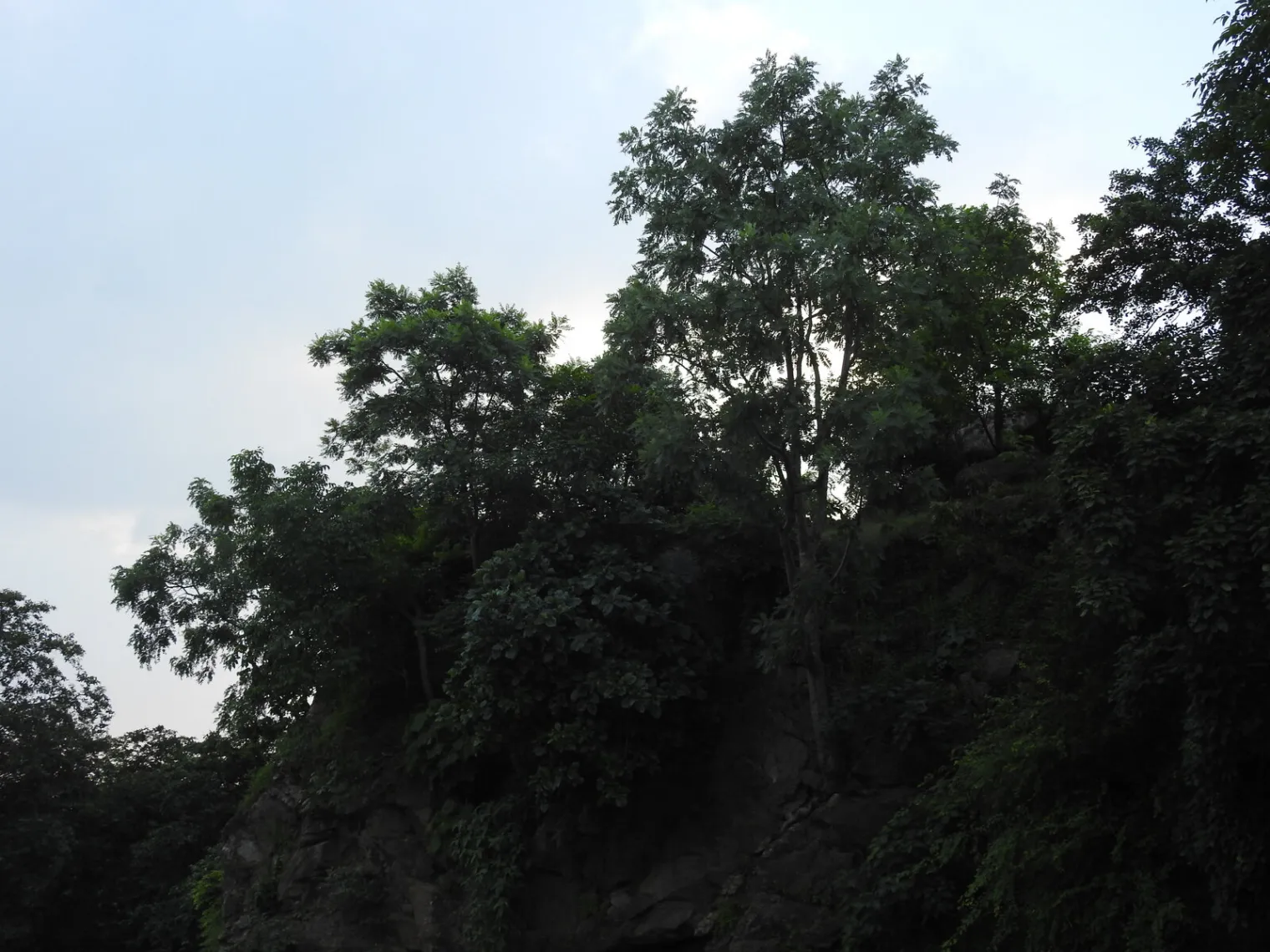
Boswellia is the air-dried oleo-gum resin that bleeds from the cut stem of Boswellia serrata, a deciduous tree of the dry forests of India. The Ph. Eur. calls the drug Olibanum indicum and sets a double assay minimum of 1.0 per cent each of 11-keto-β-boswellic acid and its 3-O-acetyl ester; the Ayurvedic Pharmacopoeia of India describes the same exudate as Kunduru and adds extractive and ash limits. Identity rests on macroscopy and on chromatography, because an exudate carries no tissue of its own and microscopy shows only incidental bark debris. That matters commercially: the Indian resin is the one with the lowest AKBA content of the traded frankincenses, so a buyer who chases AKBA will drift towards African and Arabian species that are not this drug. Quality in the marketplace is poor and documented as poor. In a 2024 analysis of fourteen commercial extracts, only two met the keto-acid criteria, and ten carried 6 to 11 per cent citric acid, which does not occur in the resin and which inflates the titration that many suppliers still use to certify "total boswellic acids" — the exact fraud Mills and Bone predicted in print eleven years earlier. Across sixteen nutraceuticals the total measured triterpenic-acid content ranged from 0.4 to 35.7 per cent. The clinical case is real but modest. Two 2024–2025 syntheses of knee osteoarthritis reach opposite conclusions, and the one that separated formulations found that Boswellia on its own gave a very small effect while combinations containing it gave a moderate one. Single trials support collagenous colitis, radiotherapy-associated cerebral oedema and asthma; a maintenance trial in Crohn’s disease was null. In Australia the drug is unscheduled and permitted without restriction as an active in listed medicines, and it is sold here almost entirely as tablets, because the resin needs about 90 per cent ethanol to extract and a clinical dose as a tincture would carry an impossible alcohol load. Anyone considering boswellia, in any form, should consult a degree-qualified herbalist with competencies and adequate training in pharmacognosy.
0.3 Contents with extent
| Section | Content | Pages (est.) |
|---|---|---|
| 0 | Free-teaser block: identity card, summary, contents, contributors | 4 |
| 1 | Nomenclature | 3 |
| 2 | Definition | 1 |
| 3 | Source and Australian supply | 5 |
| 3.1 | Where it must be grown: origin, climate and chemistry | 6 |
| 4 | Macroscopy | 3 |
| 5 | Microscopy | 3 |
| 6 | Chemistry | 5 |
| 7 | Named markers and assay limits | 3 |
| 8 | TLC fingerprint | 3 |
| 9 | HPLC fingerprint | 3 |
| 10 | Identity, purity, adulterants and contaminants | 6 |
| 11 | Traditional use | 3 |
| 12 | Current practice: use, preparations and doses | 4 |
| 13 | Clinical evidence | 9 |
| 14 | Pharmacology | 5 |
| 15 | Safety | 4 |
| 16 | Discussion | 4 |
| 17 | Conclusions | 2 |
| 18 | Research still needed | 2 |
| 19 | References | 4 |
| 20 | Document control | 3 |
| Totals | 22 sections · ~80 pages · 31 figure slots, 30 of them filled (11 licensed photographs and plates, 10 PubChem structures, 7 AIP schematics redrawn from published data, 2 AIP charts drawn from this monograph’s own graded evidence, 1 pending slot) · 0 AIP photomicrographs · 0 AIP chromatograms · 23 tables · 27 entries graded in the clinical table: 23 human studies, 3 syntheses and 1 narrative review, plus 10 further studies identified and named but not graded because AIP does not hold their full text · 57 references, every PMID and DOI resolved live on 27/09/2026 |
Known gaps in this version, stated plainly.
- F4, photomicrographs, is a pending slot. AIP holds no vouchered sample of this drug and has cut no section. Wikimedia Commons and the Europe PMC open-access literature were searched on 27/09/2026 for a reusable photomicrograph of B. serrata oleo-gum resin and none was found, so no licensed alternative exists to use in its place. The section is filled from the published descriptions instead, and F5 is a drawing from those descriptions, labelled as one.
- No AIP TLC plate and no AIP chromatogram. F7 and F8 are schematics redrawn from the printed zone sequences, Rf tables, retention times and gradient of the two pharmacopoeias. Neither is an image of a plate or a recorded run, and both say so on the figure.
- Fourteen cited items were read only as the account given in a full text AIP holds, not in the publisher’s own full text. They are listed by number in section 20 and the text says, at each point, whose account is being relied on. All fourteen are on the library-fetch queue.
- Two figure captions in the first draft described contents their images did not show, and one botanical description was carried over from a practitioner text without checking it. Both were corrected at botanical review on 27/09/2026 and are recorded in section 20. No image was replaced by a different one to make a caption true, and no image here is generated or altered.
- No Australian market survey of this drug exists. The adulteration and content figures in sections 10 and 16 are European and Indian. Nobody has asked what is in the Australian supply, and this monograph does not pretend otherwise.
0.4 Contributors and paywall notice
Prepared by: Dr Thomas Ridley, Head of Education and Research.
Contributors: listed in meta.json and resolved from the Legal byline roster by the publication pipeline for each department that reviews the draft. Dr Luke Iggulden set the scope of the Pharmacopoeia in the directive of 22/09/2026; he did not write this monograph.
Paywall notice (wording pending from Legal and Community Outreach): the first five printed A4 pages of every monograph are free to read. The remainder is available to Scholar-level members and above under a revocable personal licence.
The Australian Herbal Pharmacopoeia is the name of a reference series published by the Australian Institute of Pharmacognosy. It is not a statutory standard under the Therapeutic Goods Act 1989 and carries no official, government or national-standard status.
1. Nomenclature
Accepted name. Boswellia serrata Roxb. ex Colebr., published in Asiatick Researches 9: 379, t. 5 (1807). The Kew World Checklist of Vascular Plants — the taxonomic dataset that Plants of the World Online publishes — read through ChecklistBank on 27/09/2026, records the name as accepted, nomenclatural status established, IPNI identifier urn:lsid:ipni.org:names:127067-1, parent genus Boswellia Roxb. ex Colebr., distribution note "Indian Subcontinent" [1]. The International Plant Names Index, queried the same day, returns the one record, 127067-1, with family Burseraceae and the protologue Asiat. Res. 9: 379, t. 5 (1807) [46].
How the POWO check was made, since the template asks for it by name. The POWO web service at powo.science.kew.org refused automated requests on 27/09/2026, returning a bot challenge rather than the taxon page. The name was therefore checked against the two Kew sources that sit behind POWO and that did respond — WCVP through ChecklistBank, and IPNI — and the result is recorded as that, not as a POWO page read [1,46]. Both give the same answer, and nothing here rests on the difference.
55 more pages follow · 27,617 words, 29 figures, 21 tables
Still to come in this monograph
- 2. Definition
- 3. Source and Australian supply
- 3.1 Where it must be grown: origin, climate and chemistry
- 4. Macroscopy
- 5. Microscopy
- 6. Chemistry
- 7. Named markers and assay limits
- 8. TLC fingerprint
- 9. HPLC fingerprint
- 10. Identity, purity, adulterants and contaminants
- 11. Traditional use
- 12. Current practice: use, preparations and doses
- 13. Clinical evidence
- 14. Pharmacology
- 15. Safety
- 16. Discussion
- 17. Conclusions
- 18. Research still needed
- 19. References
- 20. Document control
The rest of this monograph is open to members. One membership covers every members’ feature on the site.
Checking your membership…
Report an error or submit evidence
If something in this monograph is wrong, out of date or missing, tell us and show us the evidence. Every report is logged under the AIP Evidence Charter and assessed on the evidence alone; the outcome is kept on the record, and an upheld report is corrected with a dated notice on this page.
Open the report form
The Institute sets and publishes its own monographs. The catalogue is in Publications.