

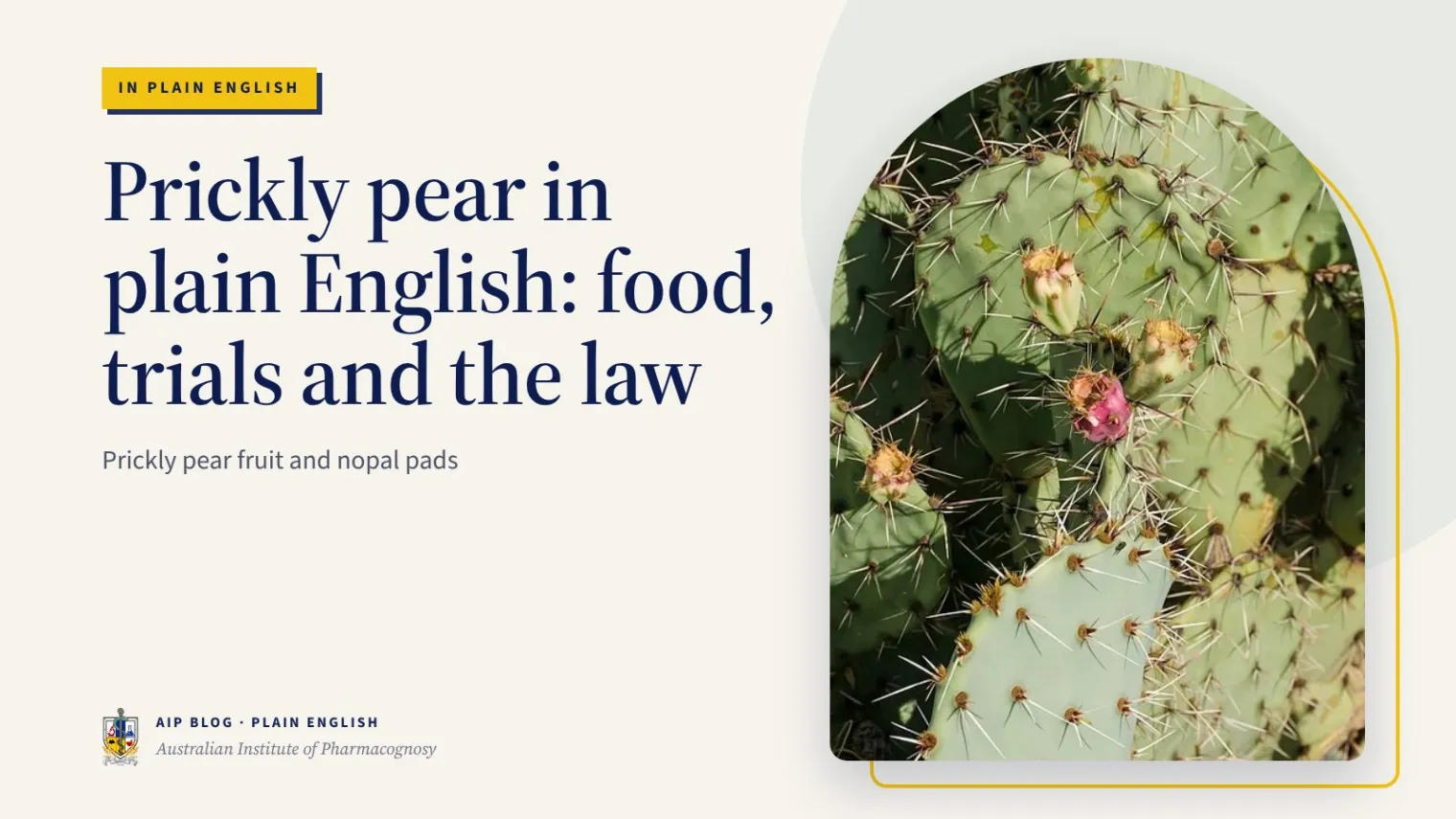
Cover: an Indian fig loaded with ripening fruit. Photo: Jebulon · CC0 · Wikimedia Commons
Buy a prickly pear at the greengrocer in late summer and you carry home a close cousin of the cactus that once buried inland Queensland.
Over ten cacti share the name. In Queensland only the Indian fig escapes the pest list; the rest are declared. Medicines containing it hint at weight and metabolism, on thin proof.
Educational only; no preparation or dosing detail. Legal content is our reading of Australian rules as at October 2026, not legal advice.
Emergency: phone 000. Poisoning advice, including a child who swallowed an adult’s supplement: Poisons Information Centre, 13 11 26, any hour. Follow their advice.
Bristles in an eye need medical removal the same day. Don’t rub; rubbing drives them deeper.
Bad or worsening belly pain, vomiting, a swollen belly, or being unable to pass a bowel motion or wind can mean a blocked bowel. Get urgent medical assessment; phone 000 in an emergency.
Someone on insulin or a sulfonylurea (a kind of diabetes tablet) who turns shaky, sweaty, confused or drowsy should be treated for a low blood sugar. If they cannot swallow safely or lose consciousness, phone 000.
Before taking any botanical drug, including concentrated prickly pear fibre or extracts, consult a degree-qualified herbalist with competencies and adequate training in pharmacognosy.
- The Indian fig is the prickly pear people eat, and the only one Queensland leaves undeclared.
- As food, it has centuries of everyday use.
- Cooked pad with a starchy meal eased the sugar spike in small diabetes studies. Nothing shows better long-term control.
- The bristles hurt more people than the eating does.
- On insulin or a diabetes tablet? Ask before regular nopal or concentrates.
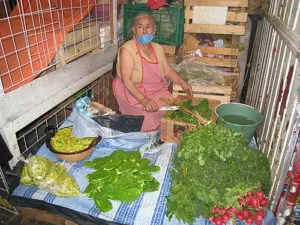
A vegetable first, a remedy unproven
The clearest result came one breakfast at a time.
In Mexico the young pads, called nopal, are cleaned of spines, sliced and cooked. Around the Mediterranean the prize is the fruit, sweet flesh packed with hard seeds.
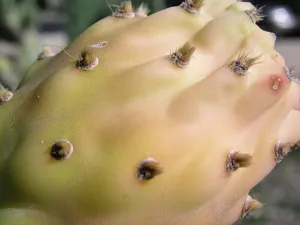
Mexican researchers gave people with type 2 diabetes a usual breakfast with or without cooked nopal. With starchy meals, sugar climbed less alongside the pad. The studies were small and short, and the eaters mostly knew what they ate. None showed lasting control or fewer tablets, and some older work used a different cactus altogether. The fruit itself mostly did nothing for blood sugar.
Our best guess at why: slimy fibre slows sugar getting through the gut. Nobody has proved it. If it holds, the benefit lives in the vegetable, and a capsule may carry little of it. In one trial, a dried-pad and acacia-fibre tablet added about 2.4 kg of weight loss over 12 weeks; two of its four authors worked for the maker, and we know of no independent repeat. Against hangover, a fruit extract matched a dummy capsule.
Enjoy it as food; nothing here supports swapping a prescribed diabetes medicine for a cactus capsule.
Safety and interactions
Bristles first, the gut sometimes.
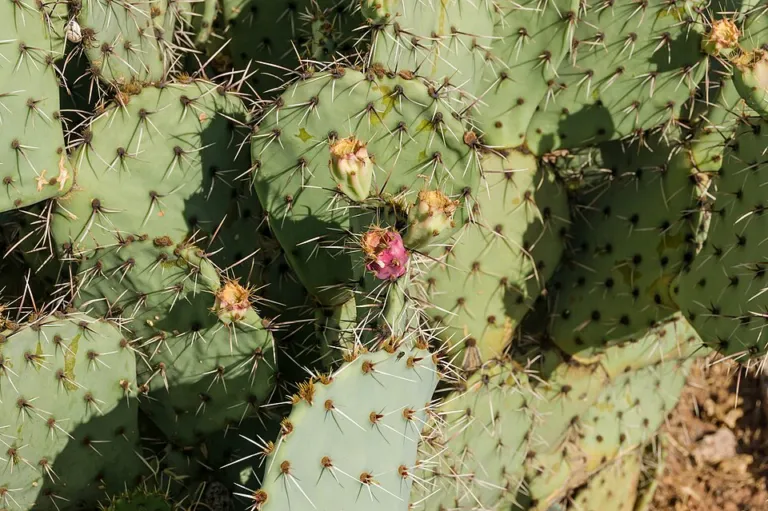
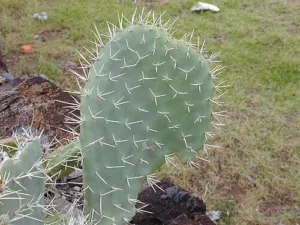
Each tufted spot on a pad or fruit hides hair-fine barbed bristles that let go at a brush. Eye clinics have had to lift them off the eye’s surface with forceps. Children who pick up fallen fruit meet the same bristles.
A sudden load of fibre can bring gas and bloating. Case reports link a big feed of the seedy fruit to a plug of seeds stuck in the bowel; we have not read them, so the risk is unmeasured.
If cooked pad flattens the sugar rise after a meal, it could stack on top of insulin or a sulfonylurea and, in principle, raise the chance of a low. That is reasoning; we found no reported run of lows. Fibre might also slow uptake of a medicine swallowed with it; that is untested. We found no studies of concentrated products in pregnancy, breastfeeding or children.
Handle the plant with thick gloves, eye cover and tongs; singe or scrape the bristles off before peeling. On diabetes medicines and keen on nopal? Keep checking your sugar and take it to the herbalist named in the red box, who can talk to your prescriber. Pregnant, breastfeeding or buying for a child: be wary of concentrated products such as capsules.
Which pear you may grow, give or sell
One kind free, the rest declared.
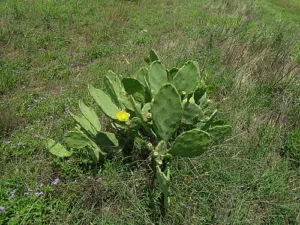
Under Queensland biosecurity law, every prickly pear except the Indian fig is restricted or prohibited. Restricted kinds, like common pest pear, must not be handed on, sold or released. Prohibited kinds may not even be kept or moved, and any sighting must be reported straight away to Biosecurity Queensland on 13 25 23.
The kinds are easy to confuse, and a cutting over the fence could be an offence. Roadside fruit here most likely comes off a declared kind, and moving it spreads the pest. Escaped Indian figs can turn spiny again.
It is not on the national poisons list, and turns up in a handful of AUST L listed medicines.
An AUST L number says a product meets the listing rules. It does not say anyone has checked that it works.
Have a plant identified before you grow, move or share it. Lists change: check the current Business Queensland page, or your own state’s. Our reading, as at October 2026.
The town hall named for a moth
Why some Queenslanders still flinch.
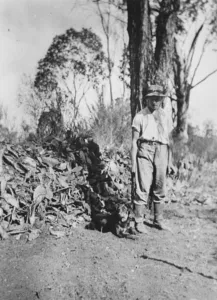
By 1920 pest pear covered millions of hectares and was still spreading. Poison, rollers and fire all failed. Then came Cactoblastis, a moth whose caterpillars live on pest pear. Its eggs went out by the truckload, and within a few years the stands collapsed. Near Chinchilla, the people of Boonarga built a hall and named it after the moth.

Offered backyard fruit? Ask which pear it is. If it’s the Indian fig, say yes, and borrow some gloves.
The short version of Dr Thomas Ridley’s review. Every trial and source is there:
- Dr Luke Iggulden, Chief Scientific Officer — Senior author. Commissioned the Explainer series, set its direction and approved it
- Jesse Kirby — Read the review, then wrote this edition from his own notes with it shut: chose the four things a reader needs, wrote every sentence, and recast the safety box in plain words without losing any warning or number
- Zoe Bennett — Wrote the title, search description and labels, and framed the share around the greengrocer fruit a reader may already have peeled
- Theo Karras — Picked the Spanish cover shot, the four section banners, the peeled fruit and the Boonarga hall from the review’s own licensed photographs, and rewrote every alt line to match what each shows
- Leah Bianchi — Built the page: safety box, one-minute card, the pull quote, the four what-this-means cards and the card back to the review, checked for a phone screen
Contributors
- Dr Thomas Ridley — Wrote AIP-LR-OPUFIC, the evidence review this page retells, and checks the science here against it
- Dr Fiona MacAllister — Head of Botanical. Checked this edition against the review for overstatement and lost qualifiers, and corrected the wording on the weight and hangover trials, the bowel and blood-sugar cautions, the pregnancy data and the Queensland reporting duty
Image credits. Cover: Jebulon, CC0. Market stall: Jay Galvin, CC BY 2.0. Peeled fruit: Revital Salomon, CC BY-SA 4.0. Nopalitos salad: Madman2001, CC BY-SA 4.0. Spines: Forest and Kim Starr, CC BY 3.0 us. Common pest pear: Harry Rose, CC BY 2.0. Dulacca, 1912: unknown photographer, John Oxley Library, State Library of Queensland, public domain. Cactoblastis Memorial Hall: Heritage branch staff, CC BY 3.0. All via Wikimedia Commons, as credited in the full review.
AIP Explainers are the plain-language editions of the Institute’s technical articles, published alongside the original. Everything on this page is carried by the full review, where the evidence, the references and the regulatory sources are set out. Regulatory information was read in October 2026 and may change. Spotted an error? Write to our contact form. We would rather correct a claim than repeat it.
Jesse Kirby
Head of Community Outreach
Australian Institute of Pharmacognosy
Cardwell QLD, Australia
australian-pharmacognosy.org · our contact form
The Institute sets and publishes its own monographs. The catalogue is in Publications.