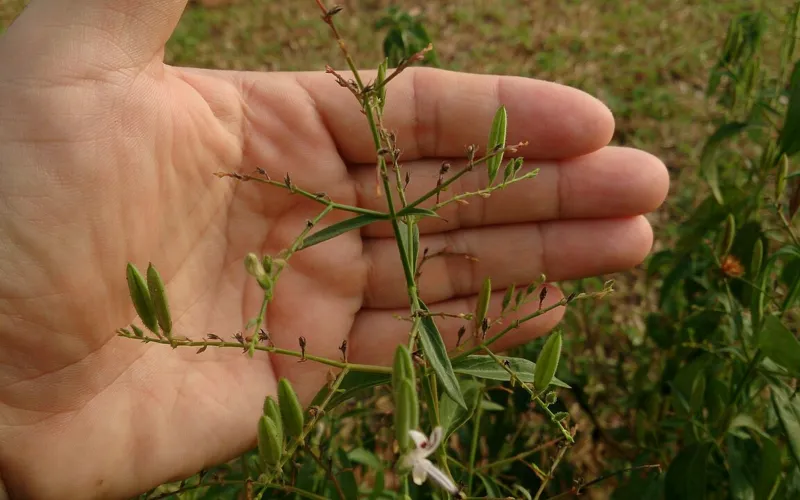

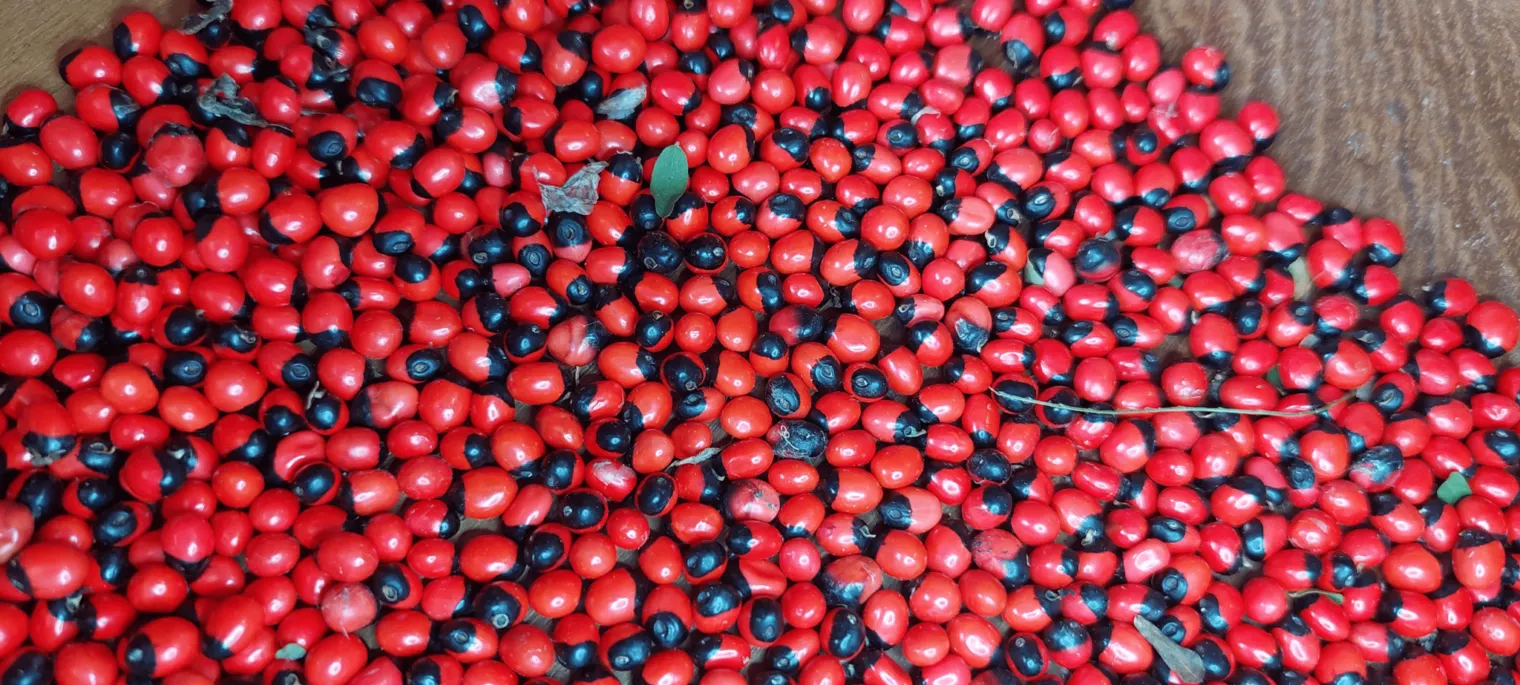
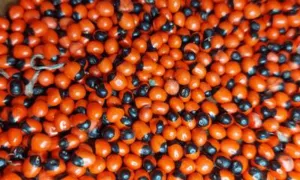
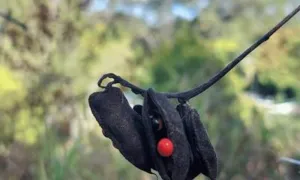
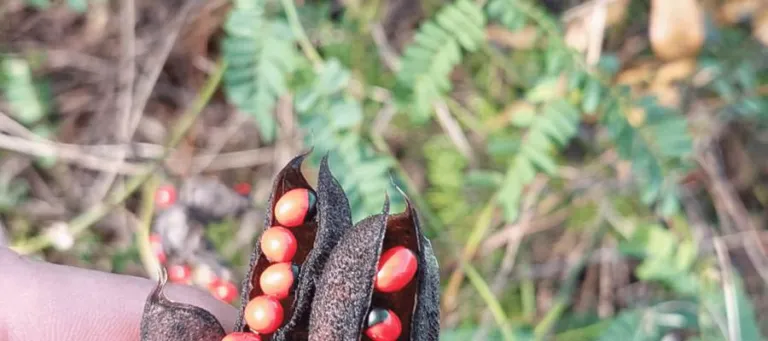
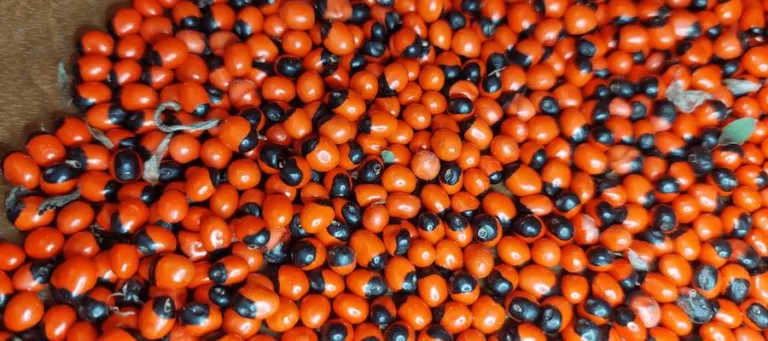
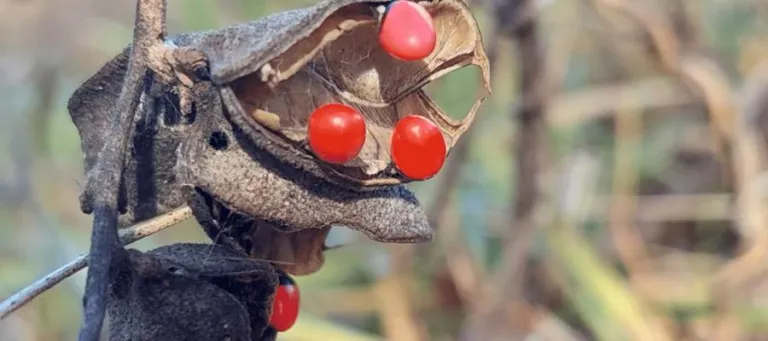
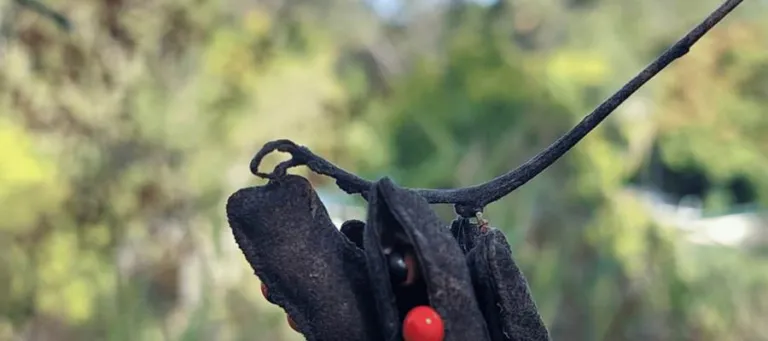
Cover: collected rosary pea seed, scarlet with the black cap over the hilum, photographed as part of the Institute’s own field record at Woombye, south-east Queensland, on 05/07/2023. Photo: Australian Institute of Pharmacognosy · CC BY 4.0 · iNaturalist 173142791
It is the prettiest seed most Australians will ever pick up: glossy scarlet, dipped at one end in black, hard as a bead and the size of a match head. Children put them in their pockets; jewellers in India weighed gold against them. Traditional Inside each one sits abrin, a protein that switches off a cell’s ability to make protein at all, and crushed seed has killed adults and children (PMID 39231905, PMID 27134959). Confirmed Both sentences are true at once, and this monograph is about holding them together.
Rosary pea, crab’s eye, jequirity, gidee gidee, gunja, ratti: Abrus precatorius L. is a slender climbing legume of the tropics, and it grows in Australia. Every photograph of the plant here is the Institute’s own, from a research-grade record we lodged publicly on iNaturalist. This is No. 1 in AIP’s evidence-graded monograph series, rebuilt in full: what the plant is, how to tell it from the harmless red seeds it is sold beside, what is inside it, what abrin does to a cell, what poisoning looks like, and where Australian law puts it.
This article is educational. It is not medical, legal or regulatory advice, and nothing in it is a recommendation to obtain, prepare, handle or use any part of this plant. It names no seed counts and gives no preparation, extraction or dosing detail, by design.
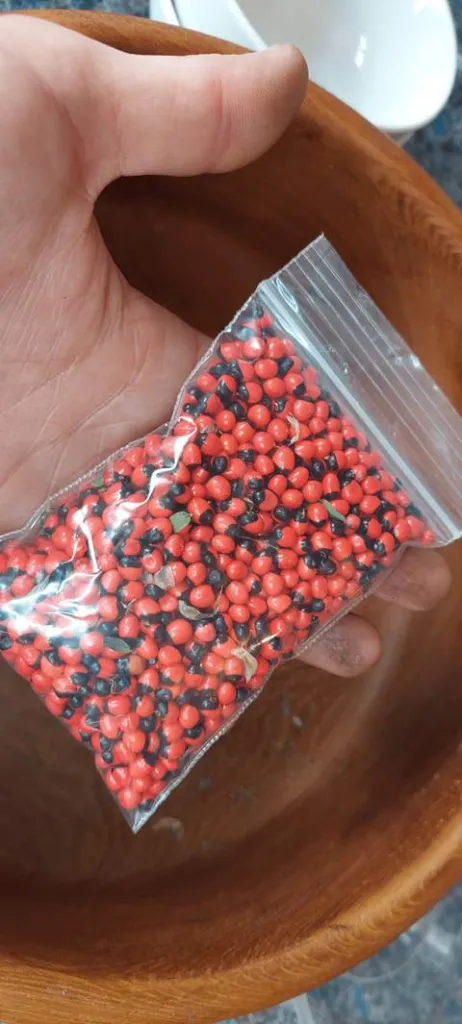
1. Crushed or chewed seed is the danger. The coat is glassy and close to impermeable, so an intact seed swallowed whole often passes through without releasing much toxin. Break it — chewing, crushing, grinding, drilling — and the protection is gone. The fatal cases are overwhelmingly crushed or chewed seed (PMID 39231905, PMID 31456429, PMID 41481126). Confirmed
2. Therapeutic use is prohibited in Australia. Abrus precatorius seed or root for therapeutic use sits in Schedule 10 of the Poisons Standard (SUSMP) — substances “of such danger to health as to warrant prohibition of supply and use” (Poisons Standard, June 2026 instrument, read 17/09/2026); Queensland law makes that an S10 prohibited substance and dealing with one an offence. Confirmed See §9.
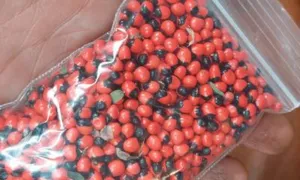
3. Seed jewellery is how it usually reaches an Australian house. Drilling a bead breaches the coat and leaves a permeable seed on a string a small child can mouth. A toddler who swallowed seeds from a “peace bracelet” and needed hospital treatment is a published case (PMID 24522983). Confirmed
4. Children and pets are who this actually happens to. A bead is mouth-sized, a dog chews what it finds, and chewing is the act that breaks the coat. Abrin’s B chain binds sugars on the surface of essentially any mammalian cell, so there is no reason to expect a pet to be spared what a person is not. Mechanism See §8.
Emergency. If someone has swallowed, chewed or crushed a seed, do not wait for symptoms and do not try to make them vomit: ring the Poisons Information Centre on 13 11 26 (24 hours, Australia-wide), or 000 if the person is unwell. Dust from drilling or grinding, and anything that reaches an eye, count as exposures too. For an animal, ring a veterinarian straight away. Keep the seeds or the packet — identification matters. Full first aid at §8.
| Botanical name | Abrus precatorius L., Fabaceae Confirmed §1 |
| Common names | Rosary pea, crab’s eye, jequirity, gidee gidee, Indian liquorice; gunja and ratti (India) Traditional §1 |
| Our field record | Twelve photographs, Woombye, south-east Queensland, 05/07/2023, research grade, iNaturalist 173142791 AIP-observed §2 |
| Australian status | Native (subsp. precatorius) in the north; introduced subsp. africanus naturalised in SE Queensland and NE NSW Confirmed §3 |
| Principal toxin | Abrin, a type 2 ribosome-inactivating protein of the ricin family, concentrated in the seed Confirmed §6 |
| How it harms | The A chain removes one adenine from 28S rRNA; protein synthesis stops and the cell dies Confirmed §7 |
| Poisons Standard | Schedule 10 — prohibited: “ABRUS PRECATORIUS (Jequirity) seed or root for therapeutic use”; an S10 prohibited substance in Queensland law Confirmed §9 |
| Security status | Abrin is a Tier 1 Security Sensitive Biological Agent, reportable at 5 mg of purified toxin Confirmed §9 |
| Weed status | Not prohibited or restricted matter in Queensland; an environmental weed in SE Queensland and NE NSW Confirmed §3 |
| Clinical evidence | None found: no controlled human trial of any preparation, for any indication Confirmed §10 |
| Look-alikes | Adenanthera and Ormosia seeds: red, but no discrete black cap Confirmed §4 |
| Antidote | None registered in Australia; care is supportive Evidence suggests §8 |
- Confirmed Established in humans, or an unambiguous analytical, chemical or official-record fact (for example, the wording of a schedule).
- Evidence suggests Real published data, but preclinical, observational, small or not replicated in people.
- Mechanism A plausible mechanistic inference, not an outcome.
- Traditional Historical, ethnobotanical or ritual use. Evidence of practice, not of efficacy or safety.
- Attested A documentary fact attested in a named published source. A textual reading, not a claim about what the plant does.
- AIP-observed Recorded by the Institute in the field or the clinic. An observation, not trial evidence.
Every PMID in this article links to its PubMed record and was checked against PubMed on 17/09/2026. Every compound links to its PubChem CID. Every regulatory statement was read in the regulator’s own document on the same day. Where a figure is widely repeated but we could not trace it to a primary source, it is marked unsourced and stays that way.
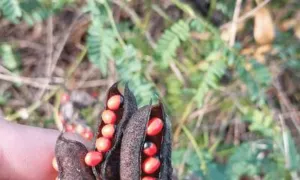
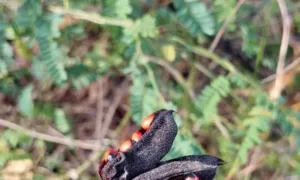
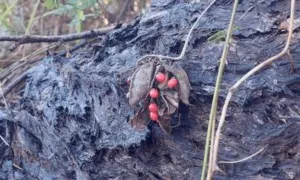
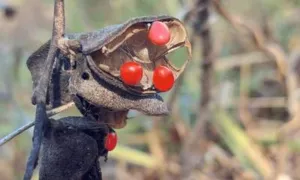
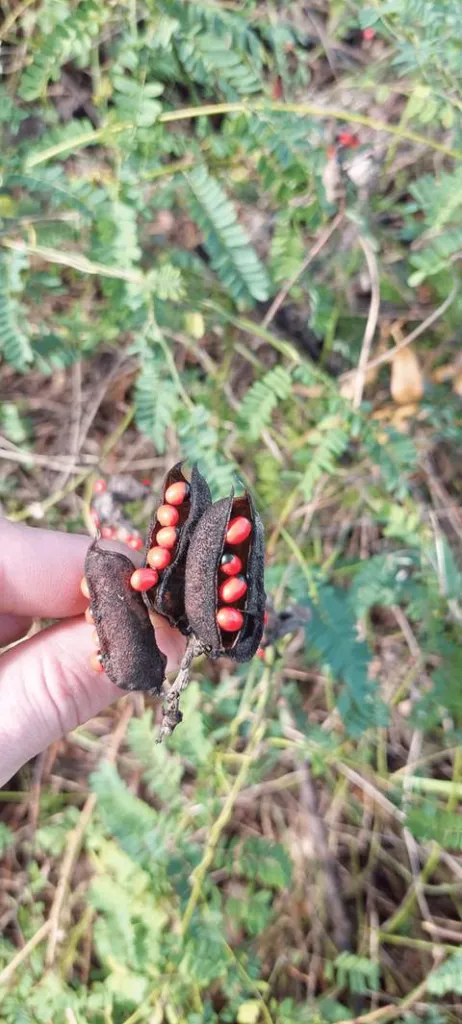
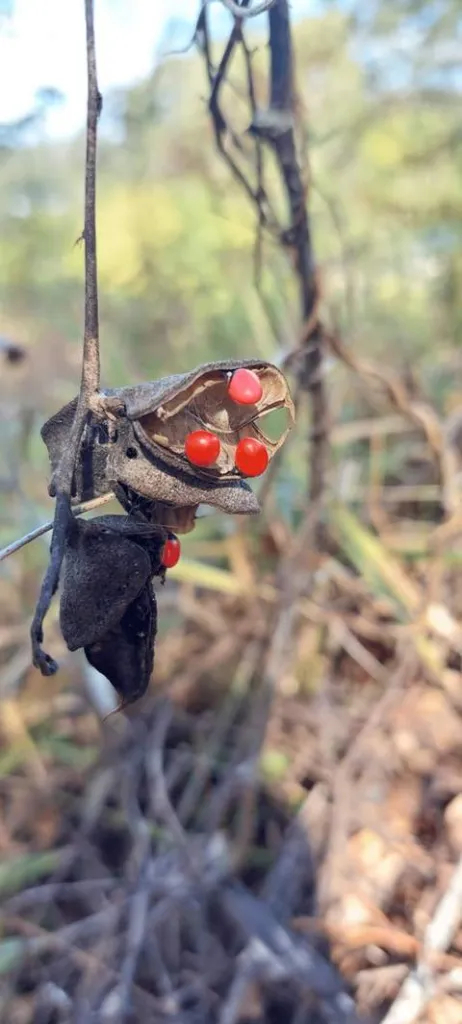
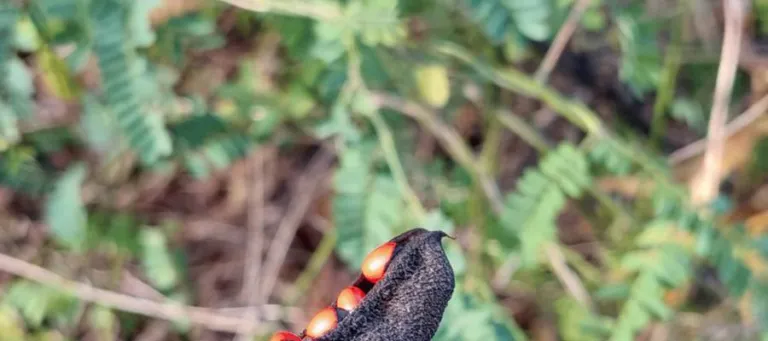
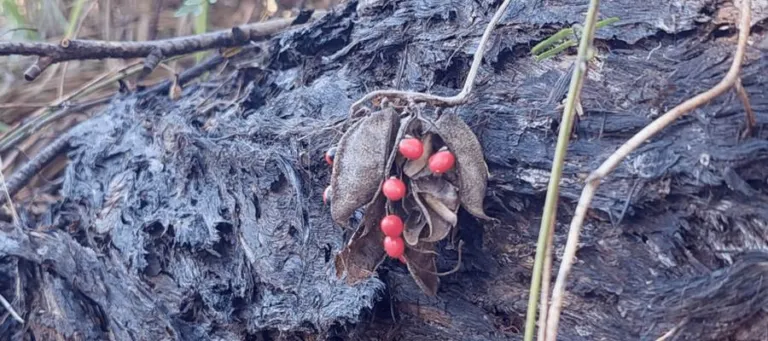
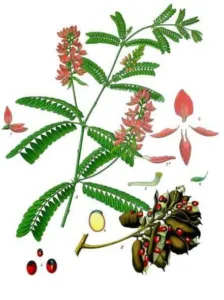
What it is. A slender twining legume with fine ferny leaves, small pink pea flowers, and a flat pod that dries, curls back and displays three to eight hard scarlet seeds, each with a black cap around the attachment scar. Northern Australia has a native subspecies; the form spreading through south-east Queensland and north-east New South Wales is an African introduction. Confirmed
Why it matters. The seed contains abrin. One molecule of its A chain can inactivate thousands of ribosomes, which is why so little is needed to cause harm. Poisoning runs a cruel course: hours of feeling fine, then violent gastrointestinal illness, then liver, kidney and brain injury over days. There is no antidote. Confirmed
What is not true. That every red seed with a black eye is rosary pea — several harmless species look similar, and telling them apart takes two seconds once you know the trick (§4). That “Indian liquorice” means liquorice. And that the plant has a proven medicinal use: the ethnomedical record is genuine and old, and the clinical evidence is absent. Traditional Confirmed
Where the law puts it. Schedule 10 of the Poisons Standard prohibits supply and use of seed or root for therapy, and abrin is a Tier 1 Security Sensitive Biological Agent. Neither makes a vine on a fence line illegal — both change completely the moment anyone tries to extract something from it. Confirmed If a seed has been swallowed or chewed, ring the Poisons Information Centre on 13 11 26, or 000 if the person is unwell. For any question about taking a herbal medicine, consult a degree-qualified herbalist with competencies and adequate training in pharmacognosy.
1. What it is called, and two traps in the names
Linnaeus named Abrus precatorius in Species Plantarum in 1753 and the name has stood since; the Atlas of Living Australia carries it as the accepted name for the Australian flora, with 2,734 occurrence records when we checked. Confirmed Precatorius means “of prayer”, which tells you what Europeans noticed first: the seed was already on rosaries. Attested Almost every language that meets the plant reaches for an eye — crab’s eye in English, macho ya kuku (chicken’s eyes) in Swahili, olho-de-cabra (goat’s eye) in Brazil, where the name jequirity comes from. In India it is gunja, raktika and ratti, which is also a unit of mass (§5); in China xiāng sī zǐ, the seed of longing; in Australia crab’s eye, rosary pea, gidee gidee and, on older labels, jequirity. Traditional
The first trap: liquorice
“Indian liquorice” and “wild liquorice” are real, widely used names for this plant, and they are dangerous ones. The root is genuinely sweet and has been chewed as a liquorice substitute; a major review records Indian use of the root as a substitute for Glycyrrhiza uralensis, and even as a raw material for glycyrrhizin extraction (PMID 35714881). Traditional But this is not Glycyrrhiza glabra, and the seed of one is lethal where the root of the other is confectionery. A herbal source that says “liquorice” with no binomial is ambiguous until you know which plant it means. Confirmed See §12.
The second trap: the wrong Abrus
Search the pharmacology databases for Abrus and most of what comes back — hepatoprotection, liver fibrosis, gut microbiota, influenza — is about Abrus cantoniensis and Abrus mollis, two Chinese medicinal species in the same genus that are not comparably toxic (PMID 38508326, PMID 38986752, PMID 40658812). Confirmed Their pharmacology does not transfer here. It is the commonest error in secondary writing about rosary pea: check the binomial before you believe a claim about “Abrus”.
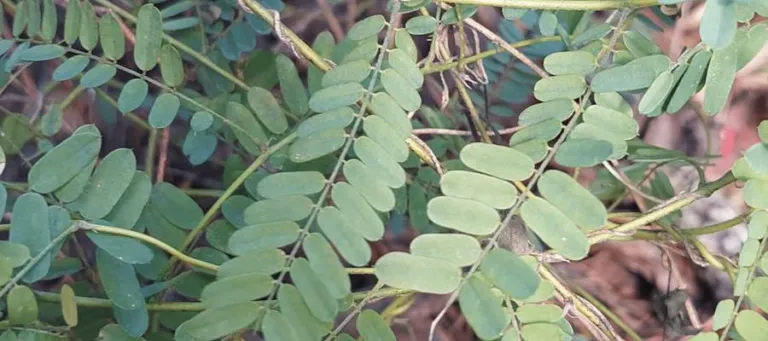
2. The plant itself, from our own field record
Observed 05/07/2023 at 13:07 AEST · Place as published Woombye QLD 4559, Australia · Observer Australian Institute of Pharmacognosy (iNaturalist user australian-pharmacognosy) · Submitted 16/07/2023 at 13:23 AEST · Twelve photographs, licensed CC BY 4.0 · Quality research grade, the identification supported by an independent iNaturalist identifier · Recorded fruits or seeds present, green leaves · Record iNaturalist observation 173142791, mirrored to the Atlas of Living Australia and GBIF. AIP-observed
The plants were in fruit, not flower: dehisced pods with seed attached in the first week of July, mid-winter at that latitude. The description below is written against those frames. AIP-observed
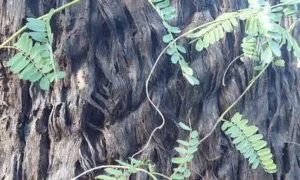
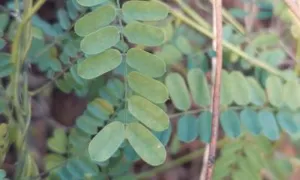
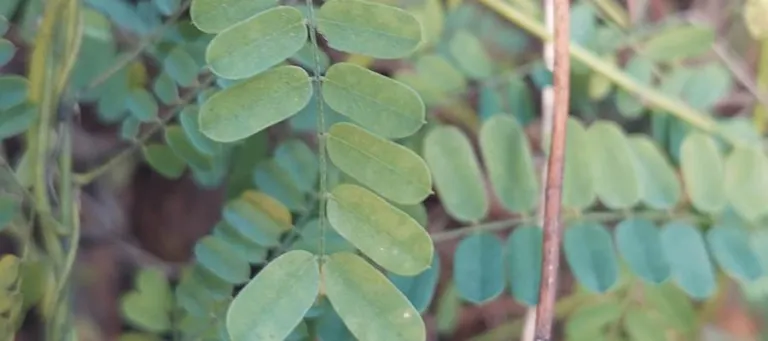
Abrus precatorius is a slender, long-lived twining vine, woody at the base, climbing by winding its stem rather than by tendrils and reaching ten metres or more through a host shrub (Environmental Weeds of Australia). Confirmed It is a legume throughout: taproot with nitrogen-fixing nodules, evenly pinnate leaves, pea flowers, dehiscent pod. What you notice in the field is the foliage — fine, ferny, faintly Mimosa-like on a wiry stem — until the pods open and the colour gives it away.
| Character | What it is |
|---|---|
| Habit | Slender perennial twining vine, woody at the base; a few metres to ten or more, through shrubs and small trees. |
| Root | Woody taproot with nitrogen-fixing nodules; resprouts after damage or fire. |
| Stem | Wiry, finely hairy when young, becoming smooth and brown-barked; twining, not tendrilled. |
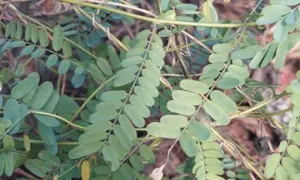
| Leaves | Evenly pinnate, 5–13 cm, with about 5–17 opposite pairs of oblong leaflets 5–25 mm long, rounded and minutely pointed; no terminal leaflet. |
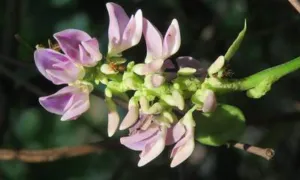
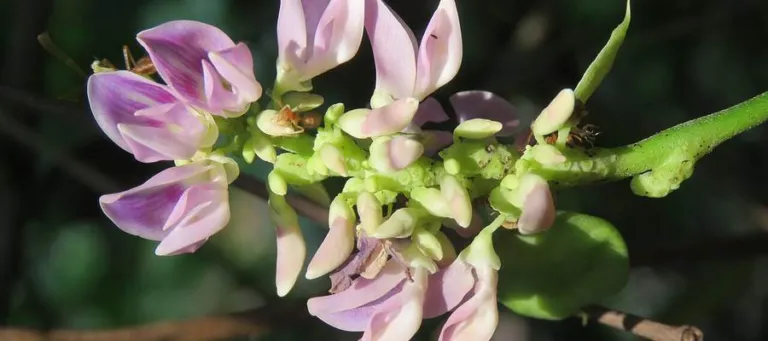
| Flowers | Short crowded axillary clusters; each about 10 mm, pea-shaped, whitish to pink, mauve or purplish. Not in our July frames. |
| Pod | Flat, 20–35 mm in the naturalised African subspecies, beaked, drying brown, splitting and curling back to show 3–7 seeds. |
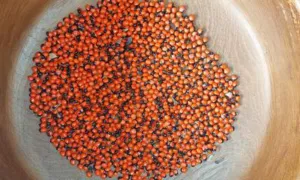
| Seed | Ovoid, 5–7 mm, glassy-hard, scarlet with a sharply demarcated black cap around the hilum. |
| Our phenology note | Mature dehisced fruit on the vine in early July in south-east Queensland, seed persisting in the litter beneath. AIP-observed |
Characters follow the Environmental Weeds of Australia account for the naturalised subspecies, checked against our own frames. Confirmed
Our iNaturalist record carries an ethnobotanical-use annotation, kept here exactly as published: “Medicine: Decoction of leaves is soothing to mucus membranes. Flavour of Nettles x Licorice root.” AIP-observed That is a field note about a traditional use and a taste, made by one observer on one day. It is not evidence of efficacy, not evidence of safety, and not an instruction — we give no preparation detail for any part of this plant. Its interest is that the taste is chemically real: the leaf carries sweet cycloartane glycosides (§6), which is why so many languages call this plant a liquorice. Confirmed
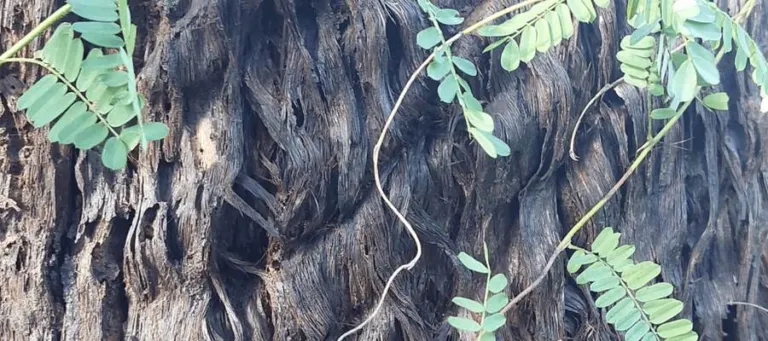
3. Native, naturalised, or weed? In Australia the answer is all three
The seed is hard-coated, long-lived, buoyant and beautiful, and those four properties explain most of the world distribution map: birds move it, water moves it, and for two thousand years people have carried it deliberately because it is pretty. Evidence suggests
Australia is more interesting than the usual native-or-introduced question allows, because the answer is both. Subsp. precatorius is the form of northern Australia. Subsp. africanus Verdc. is native to tropical Africa, Madagascar and the western Indian Ocean islands, was widely planted here as an ornamental for the sake of the seeds, and is the form now naturalised through south-east Queensland and north-east New South Wales (Environmental Weeds of Australia). Confirmed The pod separates them: subsp. africanus has shorter, rough-surfaced pods of 20–35 mm, subsp. precatorius longer and smoother ones of 30–50 mm. Confirmed Our Woombye record sits in the middle of the naturalised range, so on distribution these plants are most likely subsp. africanus — but we identified them to species only and did not measure pod texture against the key, so we are not claiming the subspecies here. A voucher specimen would close that gap, and it is in the research list at the end. AIP-observed
Being a weed and being declared a weed are different things. The Environmental Weeds of Australia account records the species as not declared or noxious in any state or territory, while treating it as an environmental weed of real concern in south-east Queensland and north-east New South Wales, where “invasion and establishment of exotic vines and scramblers” is a key threatening process listed under the New South Wales Biodiversity Conservation Act 2016. Confirmed We can confirm the Queensland half of that from the instrument itself: it does not appear in the prohibited matter or restricted matter schedules of the Biosecurity Regulation 2016 (Qld) — the subordinate instrument that actually carries those lists under the Biosecurity Act 2014 — as we read them on 17/09/2026. The wider “not declared anywhere in Australia” statement is that fact sheet’s, not ours: we have not checked every state and territory list against its own legislation, and anyone who needs that answer for a particular jurisdiction should get it from that jurisdiction’s authority. Not being declared is also not the same as harmless, because Queensland’s general biosecurity obligation binds anyone who knows, or ought to know, that what they are moving carries a biosecurity risk. Confirmed Overseas it behaves worse: in Florida it is a category I invasive that smothers vegetation and resprouts after fire. That is overseas ecology and overseas law, and it governs nothing here. Confirmed
4. Telling it apart: the look-alikes that actually matter
If you take one practical thing from this monograph, take this chapter. Several unrelated tropical legumes make hard red seeds, they are sold interchangeably as “lucky beans”, and most of them are harmless. Confusing them in either direction causes trouble: needless alarm about a coral bead tree seed, or a rosary pea handed to a child as a bead.
Look for the black cap, and for where the seed was attached. Rosary pea is scarlet over most of the seed with a discrete, sharply bounded black patch at one end, and the attachment scar sits inside that patch. Then look at the plant: a slender twining vine with fine, evenly pinnate leaves. A red-and-black seed on a vine is the one to be careful with; a uniformly red seed from a tree is almost certainly something else. Confirmed
| Seed | How to tell it |
|---|---|
| Abrus precatorius — rosary pea, crab’s eye | 5–7 mm, ovoid, glossy scarlet with a discrete black cap around the hilum; from a flat 20–35 mm pod on a slender twining vine. Acutely toxic if the coat is broken. |
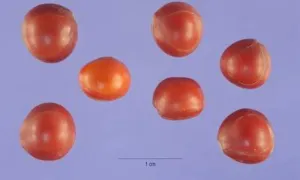
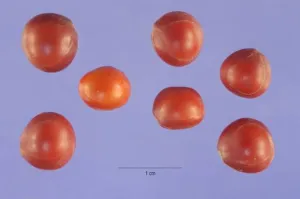
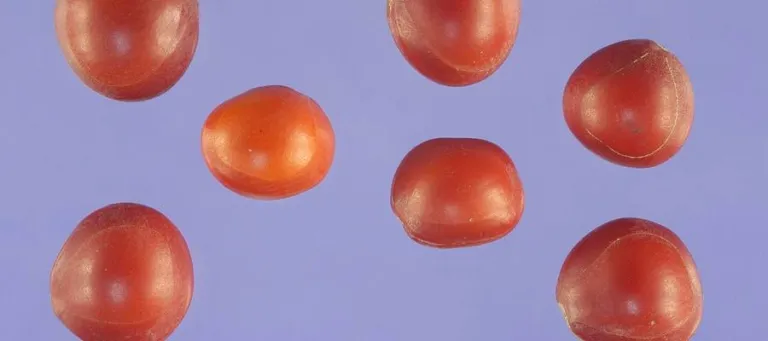
| Adenanthera pavonina — red sandalwood, coral bead tree | Larger, lens-shaped, uniformly scarlet with no black cap; from a curled woody pod on a tree with twice-compound leaves. The commonest harmless look-alike. |
| Adenanthera abrosperma — gidee gidee | A native north Queensland tree whose red-and-black seeds are nearly identical — but it is a tree, with globular flower clusters and twice-compound leaves. |
| Ormosia spp. — necklace trees | Larger and glossy, red or red-and-black with the colours in irregular blocks rather than a neat cap; tree-borne, also strung as beads. |
| Erythrina spp. — coral trees | Kidney-shaped, scarlet to orange-red, no black cap; trees and shrubs with three-part leaves. |
| Abrus cantoniensis, A. mollis | Vines of similar habit used in Chinese medicine as Abri Herba; not comparably toxic, and not interchangeable in the literature (PMID 38508326). |
Once it is powdered, your eyes are no help
Macroscopic and organoleptic examination will not distinguish powdered Abrus seed from an adulterant; in forensic or quality work the identification has to be chemical or immunological. Confirmed Seed-coat anatomy under the microscope confirms a seed but says nothing about toxin. The small alkaloid abrine, by LC-MS/MS, is what forensic laboratories actually chase in biological samples, because abrin itself clears quickly and is hard to find (PMID 38513827). Confirmed Immunoassays, mass spectrometry, lateral-flow and aptamer methods detect the toxin, with the recurring difficulty of telling it from ricin (PMID 40278675, PMID 39057952, PMID 42188635). Confirmed Only activity assays — adenine release, cytotoxicity — answer the question the others cannot: is the toxin still active (PMID 38922132). Confirmed
5. The seed that became a unit of weight, and a prayer bead
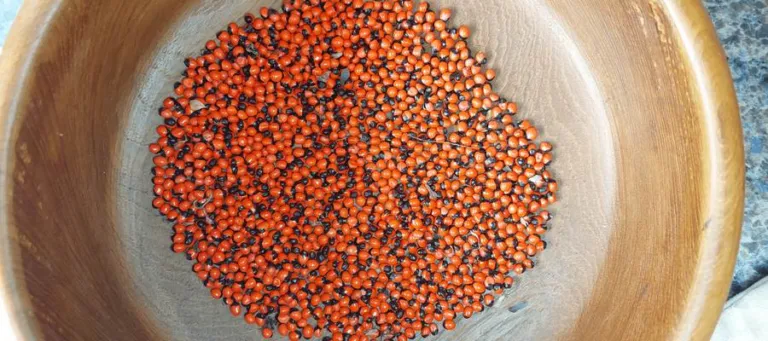
Long before anyone knew what was inside it, this seed had a job: it was a standard. In the Indian subcontinent the ratti — from Sanskrit raktika, “the red one” — was the rosary pea seed used as a mass unit for gold, silver and gemstones, and jewellers in India and Pakistan still quote ratti today. Traditional The usual explanation, that the seeds are exceptionally uniform in weight, is half right: individual seeds vary substantially, so one seed is a poor standard, while the mean of a handful is stable and stays stable in storage. We could not trace the per-seed weight figures that circulate online to a primary measurement, so we leave them out — as usually told, the uniformity story is unsourced. That traders counted out a handful rather than trusting one seed suggests they had noticed. Evidence suggests
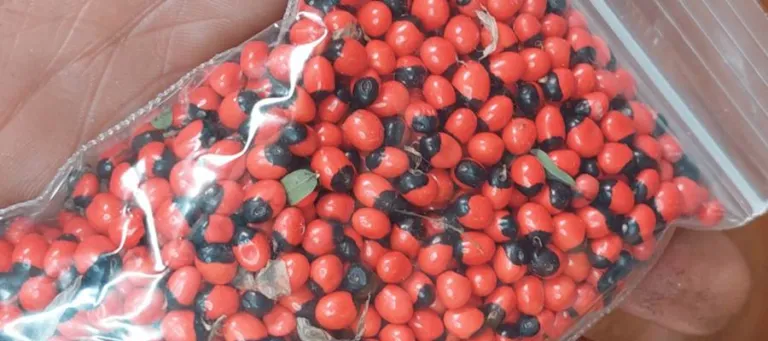
The same properties — hard, glossy, permanent, easily drilled through the soft hilum — made the seed a bead across three continents: rosaries and prayer beads, which is where both precatorius and “rosary pea” come from; gunja beads in Hindu and Buddhist practice; Seminole necklaces in Florida; rattles in Latin America; tourist jewellery anywhere warm. Traditional That craft use is not a footnote to the toxicology — it is the toxicology. Seed jewellery is the most likely way this plant enters an Australian house, and drilling a bead is precisely the act that breaks the seed coat. Confirmed
6. What is inside it: three chemistries that barely speak to each other
Which organ you mean matters more in this plant than in almost any other medicinal species. Three chemical stories run through it and they are largely independent: a protein toxin concentrated in the seed, small nitrogenous compounds that are pharmacologically unremarkable but analytically decisive, and a sweet triterpene glycoside system in the leaf that explains the liquorice names. The reviews to start from are PMID 35714881 and PMID 40658812. Confirmed
6.1 Abrin, the protein that does the killing
Abrin is a type 2 ribosome-inactivating protein: a heterodimeric glycoprotein of roughly 63–67 kDa, two chains joined by a single disulphide bridge. The A chain is an enzyme, an rRNA N-glycosidase; the B chain is a galactose-binding lectin that latches onto cell-surface sugars and gets the whole molecule taken inside (PMID 7608980). Confirmed It is a family rather than one molecule — abrin-a to -d differ in potency, alongside the much less toxic Abrus agglutinin — and its B chains were sequenced in the early 1990s (PMID 7763422), with a certified European reference material now characterised in detail (PMID 40137881, PMID 30521151). Confirmed
Seed abrin content is usually quoted at around a tenth of a per cent by weight — a ballpark, and we would rather say so, because content varies with provenance, maturity and storage and published assays do not all measure the same thing. Evidence suggests The toxin is tougher than people expect: pH extremes left its toxicity unchanged in cell-free, cell-culture and mouse assays, and only heating to 74 °C or above abolished its effects — even then the A chain kept blocking protein synthesis, which points at the B chain’s binding as the heat-sensitive step (PMID 29027937). Evidence suggests Mechanism
6.2 The small alkaloids: the analyst’s friends
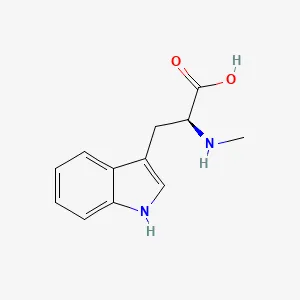
C12H14N2O2 · 218.25 · N-methyl-L-tryptophan, the forensic marker
Depiction: PubChem CID 160511 · public domain
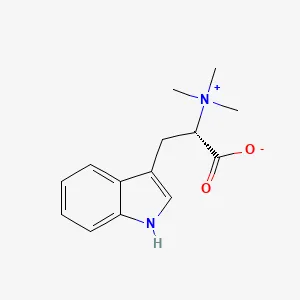
C14H18N2O2 · 246.30 · the trimethylated relative
Depiction: PubChem CID 442106 · public domain
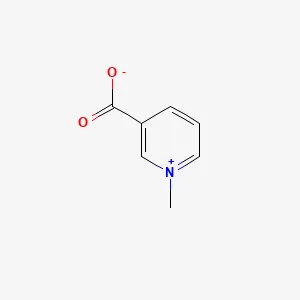
C7H7NO2 · 137.14 · a common plant betaine
Depiction: PubChem CID 5570 · public domain
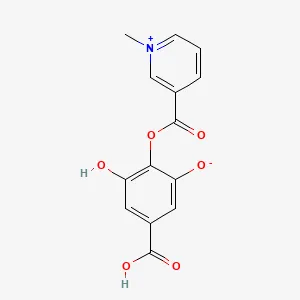
C14H11NO6 · 289.24 · reported from the seed
Depiction: PubChem CID 54704420 · public domain
Structures as depicted by PubChem, each linked to its CID record; formulae and masses as recorded there, read 17/09/2026. Confirmed
Abrine is simply N-methyl-L-tryptophan — a methylated amino acid, not the reason anyone dies. Its importance is forensic: small, stable, orally absorbed and measurable in blood and urine long after abrin itself has gone, which makes it the practical biomarker of ingestion, and the first confirmed paediatric case was proven that way (PMID 24522983, PMID 38513827). Confirmed Hypaphorine, trigonelline and precatorine round out the minor nitrogenous fraction. Older sources also list “abralin” and “abrasine”; these appear in secondary literature with no traceable primary characterisation, and we mark them unsourced rather than repeat them.
6.3 The sweet fraction, and the liquorice question answered
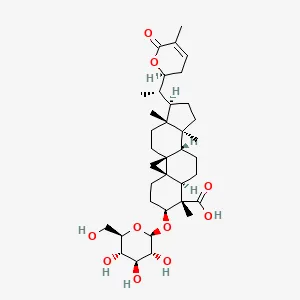
C36H54O10 · 646.8 · cycloartane glycoside from the leaf
Depiction: PubChem CID 6857683 · public domain
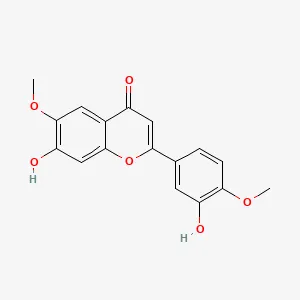
C17H14O6 · 314.29 · one of the isoflavonoids
Depiction: PubChem CID 44257585 · public domain
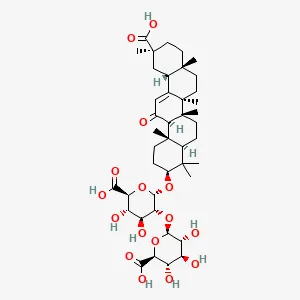
C42H62O16 · 822.9 · for contrast: liquorice’s sweetener, an oleanane saponin
Depiction: PubChem CID 14982 · public domain
Four sweet cycloartane-type triterpene glycosides, abrusosides A–D, were isolated from the leaves in 1989; a human taste panel put their sweetness at 30 to 100 times sucrose, and they were neither acutely toxic in mice nor mutagenic in the bacterial strain tested (PMID 2691636). Confirmed That is the chemistry behind “Indian liquorice”, and the detail matters: the leaf is sweet by a different mechanism from Glycyrrhiza, whose glycyrrhizin is an oleanane saponin with its own blood-pressure and potassium effects. Two sweet plants, two unrelated molecules, one shared name. Confirmed
Beyond those: isoflavonoids including abrectorin and the abruquinones; anthocyanins colouring the seed coat; sterols; pentacyclic triterpenes; immunomodulatory polysaccharides; and a seed fixed oil of linoleic, oleic and palmitic acids. Leaf apigenin can now be quantified by a validated HPTLC method with mass spectrometry (PMID 40156873). Confirmed None of that fraction is why the plant is dangerous, and none of it has been shown to be useful in a person.
7. How abrin works — and why it is so unforgiving
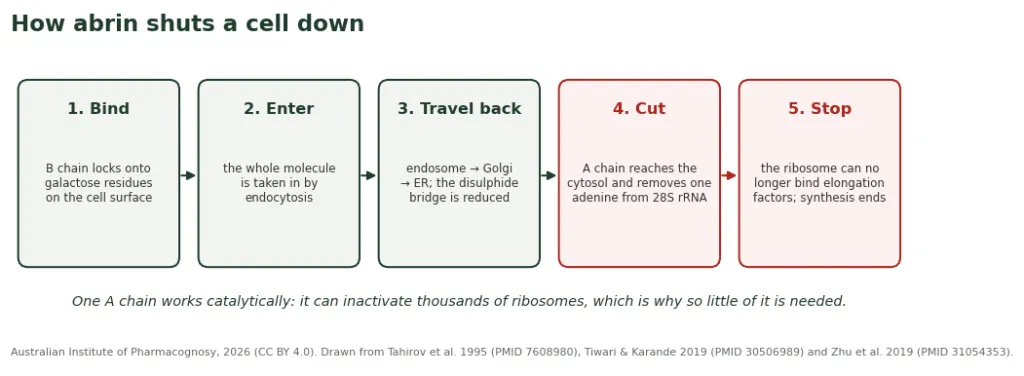
Abrin does one thing, catalytically. The B chain binds galactose residues on the surface of essentially any mammalian cell and the molecule is taken inside. It is routed backwards through the cell — endosome to Golgi to endoplasmic reticulum — the disulphide bridge is reduced, and the A chain slips into the cytosol. There it removes a single specific adenine from the sarcin–ricin loop of 28S ribosomal RNA. That one cut stops the ribosome binding elongation factors, and protein synthesis ends (PMID 7608980). Confirmed Because the A chain is an enzyme rather than a stoichiometric poison, one molecule can inactivate thousands of ribosomes, and nothing about the dose–response behaves like a conventional poison. Cell death follows by apoptosis: the ribotoxic stress response, caspase activation and oxidative injury are documented downstream of the depurination (PMID 30506989, PMID 31054353). Confirmed
The obvious comparison is ricin, from the castor bean — the same kind of molecule doing the same job. Both are routinely described as among the most potent biological toxins known, and the two are close enough that most analytical methods are built to detect them together and then struggle to tell them apart (PMID 41150195, PMID 40278675). Confirmed Which of the two is more toxic by weight is asserted in both directions in the secondary literature, and the answer depends entirely on species, route and preparation; we could not trace it to a primary head-to-head measurement, so we leave that comparison unsourced. Inhaled, both produce severe lung inflammation and respiratory insufficiency in mice on a broadly similar course — but in the one careful murine comparison, abrin injured alveolar type II epithelium less than ricin, caused no direct damage to lung endothelium, and was the more treatable of the two with post-exposure antibody (PMID 36136552). Evidence suggests
Abrin is routinely called one of the most toxic substances known, and published lethal estimates are very small — a paediatric case report gives an estimated fatal human dose of under one microgram per kilogram (PMID 25754813). Evidence suggests Most figures circulating online, though, are a muddle of species, routes and endpoints, and most trace back to animal work rather than human data. Two things are solid and sufficient: route matters enormously, with injection and inhalation far worse than swallowing; and the number of seeds in reported poisonings is small. The estimate above describes the potency of the toxin, and we publish no seed counts and no preparation or dosing detail, by design. Confirmed
Why a swallowed seed is not the same as a chewed one
The seed coat is the reason this plant has not killed far more people. It is hard, waxy and close to impermeable, and an intact seed swallowed whole frequently passes through the gut without releasing a meaningful quantity of toxin — a 22-month-old who swallowed seeds from a “peace bracelet” vomited, was rehydrated and went home well 24 hours later (PMID 24522983), and in a separate case the seeds an 18-month-old had swallowed were found intact in successive nappies (PMID 25754813). Confirmed Damage that coat and the protection is gone. It is exactly why seed jewellery is the hazard it is: drilling a bead breaches the coat, makes dust, and leaves a permeable seed on a string. Mechanism
8. Poisoning in people: what actually happens
The human record is case reports and case series — there is no controlled human evidence and there never will be. It is dominated by deliberate self-poisoning in South Asia, where crushed seed has a grim traditional association with suicide, alongside accidental ingestion by children and a small number of unusual exposures. Confirmed Read across those reports and a consistent shape emerges.
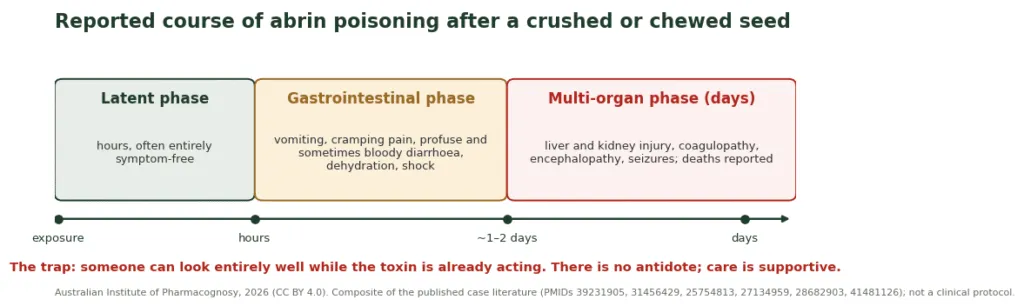
| Phase | What the case literature reports |
|---|---|
| Latent phase (hours) | Often entirely symptom-free — the trap (PMID 41481126, PMID 32475191). |
| Gastrointestinal phase | Vomiting, cramping pain, profuse and sometimes bloody diarrhoea, dehydration, electrolyte derangement, shock (PMID 39231905, PMID 20563676). |
| Multi-organ phase (days) | Liver and kidney injury, coagulopathy, cardiac effects; intensive supportive care, and in reported cases renal replacement therapy and haemoperfusion (PMID 28682903). |
| Neurological complications | Encephalopathy is well described; the literature includes acute disseminated encephalomyelitis, central pontine myelinolysis, bilateral basal ganglia haemorrhage and acute haemorrhagic leucoencephalitis (PMID 31249468, PMID 29675076, PMID 36061310, PMID 40209132). |
| Confirmation | Clinical and circumstantial, supported where available by measuring abrine in urine; routine toxicology screens do not detect abrin (PMID 24522983, PMID 37459705). |
Two features recur and both are traps. The first is that latent period: someone can be entirely well many hours after a serious exposure, which makes “they seem fine” a meaningless reassurance. The second is that the visible illness is gastrointestinal while the lethal injury is multi-organ. A 37-year-old woman who swallowed crushed seed presented with vomiting and diarrhoea, was resuscitated, and died five days later with renal failure and liver injury (PMID 39231905). Confirmed A 20-year-old man who ordered seeds online and crushed them developed a progressive encephalopathy with symmetrical basal ganglia and brainstem changes on MRI (PMID 31456429). Confirmed Deaths are also recorded in children after accidental ingestion (PMID 27134959) and after injection of seed extract (PMID 32475191). Confirmed
There is no antidote in clinical use anywhere, and none registered in Australia; management is supportive and organ-directed. Neutralising monoclonal and humanised antibodies protect cells and animals, and DNA aptamers neutralising both abrin and ricin have been designed, but these are research tools rather than treatments and nobody should read them as a safety net (PMID 42297243, PMID 35324661, PMID 35185923, PMID 41529602). Evidence suggests
Children, and animals
The published human cases divide into two populations: adults who crushed seed deliberately, and small children who found a bead. Nothing about the second group is exotic — a seed is 5–7 mm and glossy, a strung bracelet is mouth-sized, and the drilled bead on it is already breached. Confirmed Teething and chewing are the risk-defining behaviours, which is also why the same hazard applies to a dog. Abrin’s B chain binds galactose residues on the surface of essentially any mammalian cell (PMID 7608980), so there is no mechanistic reason to expect a pet to be spared an injury a person is not, and a dog that chews a seed does in one bite what a child’s intact swallow does not. Mechanism We could not trace a published Australian veterinary case series for this species, and we are not going to invent one: the species-specific animal data we would want — oral toxicity by species, and how many pet exposures Australian services actually see — is unsourced as far as we can establish, and sits in the research list at the end. Treat a chewing animal as an emergency on the mechanism, not on a case count.
Ring first, and ring early. A seed swallowed, chewed or crushed, or a child found with red-and-black beads: ring the Poisons Information Centre on 13 11 26 (24 hours, Australia-wide) straight away, and let them triage it — do not wait to see whether symptoms develop, and do not decide at home that the exposure was trivial. Ring 000 instead if the person is drowsy, collapsed, fitting, breathing badly, or vomiting or passing blood.
Do not try to make them vomit, and give nothing to induce vomiting. Wipe or rinse any seed material out of the mouth. Ring for advice before doing anything else.
Broken seed is the urgent one. Chewed, crushed, ground or drilled seed, and any exposure by injection or inhaled dust, warrant urgent hospital assessment however well the person looks — the latent phase makes “they seem fine” worthless as reassurance. Dust from drilling or grinding: move to fresh air, and 000 for any breathing difficulty. In the eye: irrigate with running water or saline for 15 minutes and ring 13 11 26 — the jequirity ophthalmia episode (§10) is what the conjunctival route can do. Confirmed
Take the seeds, the packet or the bracelet with you. Identification matters, and routine toxicology screens do not detect abrin (PMID 37459705). Confirmed
For an animal, ring a veterinarian immediately. The Animal Poisons Helpline also takes calls on 1300 869 738, 24 hours (a consultation fee applies); 13 11 26 is the human service. Take the seed or the bead to the vet too.
9. The Australian law, read properly
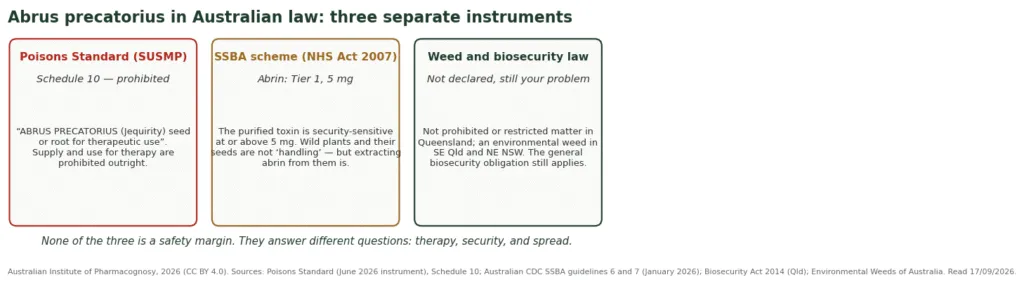
Three instruments touch this plant here. They were written for three different purposes, they are constantly conflated online, and none of them is a safety margin.
9.1 The Poisons Standard: Schedule 10 means prohibited
The Poisons Standard (SUSMP) lists, in Schedule 10, “ABRUS PRECATORIUS (Jequirity) seed or root for therapeutic use”. Confirmed Schedule 10 is the old Appendix C, reserved for substances “of such danger to health as to warrant prohibition of supply and use” — substances, in the Standard’s own words, “which are prohibited for the purpose or purposes listed for each poison”. This is not a restricted medicine; it is a prohibited one, and there is no therapeutic supply or prescribing pathway for it. Confirmed We read that entry in the consolidated Poisons Standard (June 2026 instrument) on 17/09/2026; the Standard is amended several times a year, so check the current instrument rather than any summary, including this one. Confirmed
The Poisons Standard is a Commonwealth instrument, but on its own it creates no offence: it takes legal force through each state and territory’s medicines and poisons law. In Queensland that is the Medicines and Poisons Act 2019 (Qld), which defines a substance to which Schedule 10 applies as an “S10 prohibited substance” (s 13) and makes it an offence to deal with a prohibited substance otherwise than in the authorised way or with a reasonable excuse (s 32, maximum penalty 750 penalty units). Confirmed So the operative prohibition on a Queensland reader is the state one, and the limited authorisations that exist under that Act — substance authorities for defined dealings — are not a therapeutic pathway. Interstate readers should read their own jurisdiction’s equivalent Act, because the wording and the penalties differ. If any of this could touch what you are planning, get your own legal advice: this is a published reading of the instruments, not advice you can rely on.
Two details in the wording deserve attention, because precision is the point of a schedule. It names the seed or root, and it names them for therapeutic use. The entry is not a blanket ban on the plant, on seed in a bead, or on the leaf. Confirmed We are not turning that into a suggestion: the leaf of a plant whose seed carries abrin has no established human safety data and there is no evidence-based case for ingesting any part of it. But reading a schedule accurately is a professional obligation, and “the whole plant is banned” is wrong in a way that will eventually be used to argue something worse.
9.2 The SSBA scheme: abrin is security-sensitive, the plant is not
Abrin is a Tier 1 Security Sensitive Biological Agent under the National Health Security Act 2007 — one of only three toxins on the list, with ricin and botulinum toxin — with a reportable quantity of 5 mg (SSBA Guideline 6: SSBA toxins, January 2026). Confirmed Those quantities refer to purified toxin, not crude extracts or source material, and a facility handling abrin at or above 5 mg must register with the Australian Centre for Disease Control and meet Tier 1 security requirements.
The scheme is explicit that this does not criminalise the plant. The guideline on agents in the natural environment names rosary pea directly: castor bean and rosary pea plants growing wild on public or private land, and inadvertent possession of their seeds, are not “handling” an SSBA — “although any attempt to extract ricin or abrin from these plants would constitute handling” (SSBA Guideline 7: SSBAs in the natural environment, January 2026). Confirmed That sentence is the line. A vine on a fence, a photograph in a field notebook: not handling. An extraction: handling, with everything that follows.
The same guideline draws the line for deliberate acts, and it is worth quoting rather than paraphrasing, because this is where people guess. It lists, as examples that do not constitute handling, “cultivation of castor bean or rosary pea plants for research purposes not related to toxin production” and “cultivation of rosary pea plants or collection of rosary pea seeds for artistic or cultural purposes”. It lists, as examples that do, “collection of seeds from these plants growing in the wild, for the purposes of producing a toxin that is an SSBA” and “any attempt to extract toxin from castor beans or rosary peas”. Confirmed On that wording a reference or teaching collection held for identification work sits on the permitted side — but the guideline does not use the words “teaching collection”, so that is our reading of it and not the regulator’s; the scheme’s own advice is to ask, and the guideline gives an address for the purpose. Purpose is what the scheme turns on, and purpose is judged on the evidence, not on what a collector says afterwards.
9.3 Weed and biosecurity law, and the overseas noise
As set out in §3, the species does not appear in the prohibited matter or restricted matter schedules of the Biosecurity Regulation 2016 (Qld), the instrument that carries those lists under the Queensland Act, as we read them on 17/09/2026; the Environmental Weeds of Australia account goes further and records it as not declared or noxious in any state or territory, which is that account’s statement rather than one we have verified list by list. Confirmed Queensland’s general biosecurity obligation still applies to anyone dealing with a plant that can spread, and councils in northern New South Wales list it as an environmental weed; weed lists are amended far more often than schedules, so check the current position with your state or territory authority. The United States regulates abrin under its own select-agent rules and Florida treats the plant as a category I invasive — context only, and no part of Australian law. Confirmed
10. Medicine: tradition, laboratory, and the gap between them
This is where an honest monograph earns its keep, because the ethnomedical record for this plant is broad and old and the clinical evidence for it is absent. Both need saying in the same breath, and neither cancels the other.
| Tradition | What is recorded |
|---|---|
| Ayurveda and Siddha (India) | Gunja or raktika: leaf, root and purified seed, the purification (shodhana) procedures existing precisely because the raw seed was known to be dangerous (PMID 24696580, PMID 23930039). Traditional |
| East and West Africa | Leaf and root preparations for respiratory complaints, fever, pain and wounds; seed as an arrow and ordeal poison. Tanzanian healers record the plant among those used for epilepsy (PMID 15707773, PMID 41862218). Traditional |
| South and South-East Asia | Leaf and root as a liquorice-flavoured soothing remedy for cough and sore throat; seed almost exclusively ornamental, or a weight (PMID 25183095). Traditional |
| Fertility control | The most-cited traditional claim and the one with the largest animal literature: seed extracts show antiovulatory, anti-implantation and post-testicular effects in rodents from the 1970s on (PMID 840932, PMID 6752588, PMID 3439410, PMID 2329808, PMID 20150030). Evidence suggests Rat work, with a toxic protein in the same extract, never translated into a human study. |
The strangest chapter: jequirity ophthalmia
In the early 1880s the seed had a brief and startling career in European eye medicine. Following Brazilian reports of folk use against trachoma, an infusion of ground seed — “jequirity” — was applied to the conjunctiva. It produced a violent membranous inflammation, and when that subsided the vessel-invaded corneal scarring of chronic trachoma was often reduced and the cornea clearer. The literature of those years is real and readable: Arthur von Hippel gave thirty pages to “Ueber die Jequirity-Ophthalmie” in Graefe’s Archiv in 1883 (DOI 10.1007/BF01693719), and the Chicago surgeon F. C. Hotz published his own case experience the following year (PMID 37618148); Louis de Wecker, in whose Paris clinic the method took hold, later wrote its introduction history for the same journal (DOI 10.1007/BF01960289). Attested Within a decade it was abandoned as too dangerous and too unpredictable. It is an early example of counter-irritation as therapy, and a demonstration of the toxicology: it worked, when it worked, because abrin destroyed tissue. Nobody should read that paragraph as a suggestion.
The experiment that helped found immunology
In 1891 Paul Ehrlich published a pair of papers, Experimentelle Untersuchungen über Immunität, using exactly two antigens: ricin and abrin — the second of them in the Deutsche Medizinische Wochenschrift for that year (DOI 10.1055/s-0029-1206825). Attested Mice given small, increasing doses became protected; the protection was specific to the toxin used and did not cross to the other; and with Brieger he went on to show that immunity passed to the young through milk (DOI 10.1007/BF02284282). Attested Active immunity, antibody specificity and maternal transfer — load-bearing ideas of immunology — were worked out on this seed and a castor bean. It remains the best argument we know for taking poisonous plants seriously as research material rather than simply avoiding them.
What the evidence does and does not support
Confirmed: the seed contains a lethal toxin; abrine is a reliable marker of ingestion; the leaf contains sweet cycloartane glycosides; extracts have measurable activity in cell and animal models. Confirmed Evidence suggests: some of that preclinical activity is real and mechanistically coherent — Abrus agglutinin, the less toxic lectin, inhibits oral carcinogenesis in a hamster model through NRF2 inactivation and autophagy (PMID 31715238); leaf extracts are antiproliferative against cancer cell lines (PMID 42064439); aqueous extracts inhibit Streptococcus mutans and Candida albicans in vitro (PMID 42553357); network-pharmacology work has been published on hepatocellular carcinoma (PMID 41528025). Evidence suggests All of it is cell or animal work.
Traditional only: every therapeutic use in the table above, without exception. Traditional What we could not find at all: a single controlled clinical trial of any Abrus precatorius preparation, for any indication, in humans. Confirmed If a source tells you this plant “is used to treat” something, it is describing custom, not outcome data — and in Australia Schedule 10 means such a trial will not happen without a specific regulatory pathway.
Nothing therapeutic, and nothing involving the seed as a medicine. AIP’s interest is identification, toxicology and public safety: a documented Australian field record, a photographic identity set that lets the seed be told from its harmless look-alikes, and clear public information about a plant children pick up. AIP-observed For any question about taking a herbal medicine, consult a degree-qualified herbalist with competencies and adequate training in pharmacognosy.
11. Where the research is actually heading
Very little current work on Abrus precatorius is about using it as a medicine. Four lines dominate, and three of them treat abrin as a hazard to be measured.
| Line of work | Where it stands |
|---|---|
| Detection and biosecurity | Analytical chemistry dominates: separating abrin from ricin by differential thermal inactivation, mass spectrometry, SERS lateral flow, aptamers and optofluidic biosensors (PMID 41150195, PMID 42188635, PMID 40953543). Confirmed |
| Medical countermeasures | Neutralising monoclonal and humanised antibodies with protection in vitro and in vivo, and spectrum-neutralising DNA aptamers (PMID 42297243, PMID 35324661, PMID 35185923, PMID 41529602). Evidence suggests |
| Forensic toxicology | Closing the gap that lets abrin poisoning be missed at autopsy — the “veiled abrin” problem, and the reliance on abrine as proxy (PMID 38513827, PMID 37459705). Confirmed |
| Targeted oncology | The A chain as an immunotoxin warhead, with an antibody supplying the targeting the B chain would otherwise apply indiscriminately, and the agglutinin as an antitumour lectin (PMID 31715238). Long-standing, still preclinical, and the one genuinely therapeutic thread. Evidence suggests |
There is also steady phytochemical work on the leaf, and a stream of “green synthesis” nanoparticle papers using plant extract as a reducing agent (PMID 42162072) — fashionable rather than clinically consequential. Evidence suggests What is missing from all of it is Australian material: almost every chemical figure quoted for this species comes from African or Asian plants.
12. Relatives, neighbours, and the liquorice trap
| Species | Relationship |
|---|---|
| Abrus cantoniensis Hance | Chinese medicinal species, Abri Herba (jī gǔ cǎo), used for liver complaints and the subject of most modern “Abrus” pharmacology. Not the same plant, not comparably toxic (PMID 38508326, PMID 38986752). |
| Abrus mollis Hance | The other Chinese congener; similar literature, same caution about transferring findings (PMID 40658812). |
| Ricinus communis L. (castor) | Botanically unrelated, but the pharmacological twin: ricin is the other classic type 2 ribosome-inactivating protein, and the two are studied, detected and regulated as a pair. |
| Adenanthera pavonina L. and A. abrosperma F.Muell. | Red sandalwood and gidee gidee: trees, not vines, with twice-compound leaves. The commonest harmless look-alikes (§4). |
| Glycyrrhiza glabra L. | True liquorice. Shares a common name with Abrus in several languages and shares nothing else that matters. |
| Peganum harmala L. | Unrelated, but the subject of AIP Monograph No. 2 — another plant whose cultural life is much larger than its medical one, and which is handled just as badly in secondary sources. |
The liquorice confusion deserves the last word, because it is the one authentication problem this plant poses outside its seed. Abrus precatorius root is sweet, has been chewed as a liquorice substitute, and is recorded in a major review as a source of glycyrrhizin in India (PMID 35714881). Traditional It is still not Glycyrrhiza, it is still Schedule 10 here when supplied for therapy, and a product labelled only “liquorice” and sourced carelessly is a risk worth taking seriously in quality assurance. Confirmed
Discussion: conclusions, hypotheses and research still required
This section was first added to the article in September 2026 and is kept here, rewritten to sit with the evidence above. Its job is to separate what this monograph supports from what it can only propose, and to say where a researcher should start.
What this monograph supports
- Confirmed Abrus precatorius is a real and serious poison plant. The seed contains abrin, a type 2 ribosome-inactivating protein of the same family as ricin, and human poisonings — accidental, deliberate and paediatric — are documented in the clinical and forensic literature, including deaths (PMID 39231905, PMID 32475191, PMID 27134959, PMID 31456429).
- Confirmed The intact seed coat is the difference between an ornament and a poisoning. Swallowed whole and unbroken, seeds commonly pass; chewed, crushed or drilled, they do not. That is a fact about a physical barrier, not a margin of safety.
- Confirmed The mechanism is settled: the A chain depurinates 28S rRNA, protein synthesis stops, and the cell dies by apoptosis. Because the A chain acts catalytically, very little toxin is needed.
- Traditional Attested The ethnomedical record across Africa, South Asia and South-East Asia is genuine and old, and is overwhelmingly about leaf and root rather than seed. So is the ratti weight standard, and the jequirity ophthalmia episode of the 1880s. None of that is evidence of efficacy or safety in a person today.
- Evidence suggests Everything therapeutic in the modern literature — the agglutinin in oncology, the immunotoxin work, the antifertility and anti-inflammatory extract studies — is laboratory or animal work. We found no controlled clinical trial of any preparation of this plant for any indication, and Schedule 10 means there will not be one in Australia without a specific regulatory pathway.
- Confirmed Australian law treats the plant, the toxin and the weed as three separate questions, and the SSBA guidance draws the line at extraction rather than at possession of a wild plant.
Hypotheses and musings — these are not findings
- The seed’s chemistry is defensive first. Abrin, the lectins and the phenolic fraction plausibly work together as herbivore and pathogen deterrence, with the scarlet-and-black coat as aposematic signalling on a seed that mimics a fleshy fruit. A coherent reading of the ecology, not a tested finding. Mechanism
- The non-protein constituents may be separable from abrin, and separately interesting. The polysaccharides and the indole derivatives (abrine, precatorine, hypaphorine) differ by tissue and may be pharmacologically useful independently of the toxin. Whether any fraction can reliably be obtained abrin-free is an open laboratory question, not a therapeutic one — and under the SSBA scheme, attempting it is regulated activity. Mechanism
- Australian material may not match the published chemistry. Constituent levels vary by tissue, provenance, season and maturity across the Fabaceae, and the naturalised south-east Queensland populations (subsp. africanus) may differ chemically from the northern native subspecies and from the African and Asian material nearly all the published chemistry rests on. Until someone measures it here, overseas figures should not be assumed to describe Queensland plants. Mechanism
- Heat may not be the reassurance it looks like. Abrin survived pH extremes and lost activity only above 74 °C in one careful study, and the A chain kept blocking protein synthesis even then (PMID 29027937). If that generalises, “it was cooked” is not a safety argument. Mechanism
- The exposure that matters in Australia is probably imported craftwork, not gardens. Drilled seed in jewellery, rosaries and rattles is the pathway that puts a breached seed coat in a house with a toddler. We have not measured this, and it is the single easiest gap to close. Mechanism
Where research should begin
- Botany and taxonomy: voucher specimens from Australian populations lodged with the Queensland Herbarium with accession numbers, including the Woombye stand behind this article; subspecies determination on pod characters; morphological and genetic comparison of native subsp. precatorius against naturalised subsp. africanus.
- Identification and quality analysis: a documented macroscopic and microscopic identity profile that separates the seed from Adenanthera, Ormosia and Erythrina material in trade, and a survey of imported jewellery, rosaries, rattles and craft goods reaching Australia — where most domestic exposure risk actually sits.
- Phytochemistry: validated LC-MS/MS quantitation of abrin isoforms by tissue, season and subspecies in Australian material, against the certified reference material now characterised in Europe (PMID 40137881); the same for the alkaloid and polysaccharide fractions.
- Pharmacology: mechanistic work on the non-abrin fractions with abrin content measured and reported rather than assumed absent — the recurring flaw in the existing extract literature (PMID 40658812).
- Toxicology and medicine: dose–response and time-course characterisation by exposure route; collation of Australian Poisons Information Centre calls and coronial records into a published case series, which does not exist; the same for veterinary and Animal Poisons Helpline exposures, since the companion-animal risk here rests on mechanism rather than on any published Australian case series; and a clinician-facing summary of supportive management, since no antidote is registered here. Antibody and aptamer neutralisation remain preclinical (PMID 42297243, PMID 41529602).
- Forensic and analytical science: abrin is under-detected by routine toxicology screening, which is a live gap in Australian casework (PMID 38513827, PMID 37459705).
- Regulatory science: a plain-language read of how the Schedule 10 entry, the SSBA scheme and state biosecurity law interact for teaching collections, herbaria and analytical laboratories — written before anyone plans specimen handling, not after.
- History and ethnobotany: sourced documentation of traditional use, including the ratti weight standard and the jequirity ophthalmia episode, kept strictly separate from any pharmacological claim. The per-seed weight figures that circulate need tracing to a primary measurement or dropping.
If you are a researcher with access to Australian material or clinical records, those are the gaps we would most like to see closed. Correspondence to the Institute: our contact form.
Abrus precatorius seed is acutely toxic. Crushed or chewed seed has caused serious poisoning and death. Do not ingest, chew, crush, grind or prepare any part of this plant. Suspected exposure in Australia: ring the Poisons Information Centre on 13 11 26, or 000 in an emergency. For an animal, ring a veterinarian immediately, or the Animal Poisons Helpline on 1300 869 738. First aid: §8.
About the Australian Institute of Pharmacognosy and this series
The Australian Institute of Pharmacognosy is a clinic and research laboratory in Cardwell, in the wet tropics of far north Queensland, studying medicinal plants and natural products to the same evidentiary standard as any other branch of pharmacology: traditional knowledge taken seriously, and tested honestly. Visit the Institute at australian-pharmacognosy.org.
Series: AIP Monographs. This is No. 1, rebuilt in full in September 2026. See also No. 2, Syrian rue (Peganum harmala), which deals with a plant whose cultural life is likewise much larger than its medical one. Each monograph grades every claim by the evidence behind it, so you can see what is tradition, what is laboratory work, and what has actually been tested in people.
Corrections: if you find an error, or a source we have missed, write to the Institute at our contact form. We would rather correct a claim than repeat it.
Head of Education and Research
Australian Institute of Pharmacognosy
Cardwell QLD, Australia
australian-pharmacognosy.org · our contact form
Suggested citation: Ridley T. Rosary pea (Abrus precatorius L.): an evidence-graded monograph on the seed, abrin and the Australian law. AIP Monograph No. 1. Cardwell (QLD): Australian Institute of Pharmacognosy; 2026.
Educational content only; not medical, legal or regulatory advice. Regulatory information reflects the Poisons Standard, the SSBA guidelines, the Medicines and Poisons Act 2019 (Qld) and Queensland biosecurity law as read on 17/09/2026 and may change. Anyone whose plans could be affected by any of it should obtain their own legal advice.
References
69 references: tap to open
Listed by type, then in order of first citation. All 55 PubMed records were verified against PubMed on 17/09/2026; the historical citations were verified through Crossref and PubMed on the same day; regulatory and botanical records were read the same day.
- Therapeutic Goods Administration. Poisons Standard (Therapeutic Goods (Poisons Standard—June 2026) Instrument 2026), Schedule 10: “ABRUS PRECATORIUS (Jequirity) seed or root for therapeutic use”. Canberra: TGA; read 17/09/2026. tga.gov.au — the Poisons Standard (SUSMP)
- Australian Centre for Disease Control. SSBA Guideline 6 — SSBA toxins (January 2026): abrin is a Tier 1 SSBA with a reportable quantity of 5.0 mg of purified toxin. cdc.gov.au — SSBA Guideline 6
- Australian Centre for Disease Control. SSBA Guideline 7 — SSBAs in the natural environment (January 2026): castor bean and rosary pea growing wild, and inadvertent possession of their seeds, are not “handling”; attempted extraction of ricin or abrin is. cdc.gov.au — SSBA Guideline 7
- Medicines and Poisons Act 2019 (Qld), s 13 (meaning of prohibited substance: a substance to which the Poisons Standard, schedule 10 applies is an S10 prohibited substance) and s 32 (offence to deal with a prohibited substance; maximum penalty 750 penalty units); read 17/09/2026. legislation.qld.gov.au
- National Health Security Act 2007 (Cth). legislation.gov.au
- Biosecurity Act 2014 (Qld) and Biosecurity Regulation 2016 (Qld), sch 1 (prohibited matter) and sch 1A (restricted matter and categories); searched for Abrus and found no entry, read 17/09/2026. legislation.qld.gov.au
- Atlas of Living Australia. Abrus precatorius L.: accepted name, common names and occurrence records (2,734 records at access). Accessed 17/09/2026. bie.ala.org.au
- Environmental Weeds of Australia (Biosecurity Queensland edition). Fact sheet: Abrus precatorius subsp. africanus — origin, naturalised distribution, environmental impact, legislation and similar species. Accessed 17/09/2026. keyserver.lucidcentral.org
- Animal Poisons Helpline (Australian Animal Poisons Centre). 24-hour telephone advice for suspected poisoning in animals, 1300 869 738; a consultation fee applies. Accessed 17/09/2026. animalpoisons.com.au
- Australian Institute of Pharmacognosy. Observation 173142791: Abrus precatorius, Woombye QLD, 05/07/2023, research grade, twelve photographs, CC BY 4.0. iNaturalist. inaturalist.org/observations/173142791
- Ayyappan S, N A, Jayakumar AN, Jinkala S. A fatal poisoning due to consumption of crushed Abrus precatorius seeds: an autopsy case report. Forensic Sci Med Pathol. 2025 Jun;21(2):763-767. PMID 39231905. DOI 10.1007/s12024-024-00880-x.
- Patil MM, Patil SV, Akki AS, Lakhkar B, Badiger S. An Arrow Poison (Abrus Precatorius) Causing Fatal Poisoning in a Child. J Clin Diagn Res. 2016 Mar;10(3):SD03-4. PMID 27134959. DOI 10.7860/JCDR/2016/18234.7439.
- Horowitz BZ, Castelli R, Hughes A, Hendrickson RG, Johnson RC, Thomas JD. Massive fatal overdose of abrin with progressive encephalopathy. Clin Toxicol (Phila). 2020 May;58(5):417-420. PMID 31456429. DOI 10.1080/15563650.2019.1655150.
- Ali AM, Zawilla NH, Samir AM, Fouad MM, Negm AM. From folk remedy to toxic emergency: a case of acute abrin toxicity. Drug Chem Toxicol. 2026 Mar;49(2):453-457. PMID 41481126. DOI 10.1080/01480545.2025.2606107.
- Wooten JV, Pittman CT, Blake TA, Thomas JD, Devlin JJ, Higgerson RA, et al. A case of abrin toxin poisoning, confirmed via quantitation of L-abrine (N-methyl-L-tryptophan) biomarker. J Med Toxicol. 2014 Dec;10(4):392-4. PMID 24522983. DOI 10.1007/s13181-013-0377-9.
- Qian H, Wang L, Li Y, Wang B, Li C, Fang L, et al. The traditional uses, phytochemistry and pharmacology of Abrus precatorius L.: A comprehensive review. J Ethnopharmacol. 2022 Oct 5;296:115463. PMID 35714881. DOI 10.1016/j.jep.2022.115463.
- Liu CJ, Li HX, Chen ZH, Li JJ, Shi W, Zhang FX. A review of the ethnopharmacology, phytochemistry, pharmacology, pharmacokinetics and toxicology of Abri Herba (Ji-Gu-Cao). Phytochemistry. 2024 May;221:114064. PMID 38508326. DOI 10.1016/j.phytochem.2024.114064.
- Zhang G, Hao E, Xiao J, Yao C, Wang Y, Luo H, et al. Abrus cantoniensis Hance: Ethnopharmacology, phytochemistry and pharmacology of a promising traditional herb. J Ethnopharmacol. 2024 Nov 15;334:118543. PMID 38986752. DOI 10.1016/j.jep.2024.118543.
- Lin X, Li H, Wang T, Xiao X, Huang B. The Traditional Uses, Nutrition, Phytochemistry, and Pharmacology of the Medicinal Abrus Species: A Comprehensive Review. Chem Biodivers. 2025 Nov;22(11):e00182. PMID 40658812. DOI 10.1002/cbdv.202500182.
- Chen Y, Liu J, Song T, Zou X, Li L, Nie Q, et al. Gaps in forensic toxicological analysis: The veiled abrin. Toxicon. 2024 May 6;242:107684. PMID 38513827. DOI 10.1016/j.toxicon.2024.107684.
- Dong L, Liu T, Li J, Wang C, Lv J, Wang J, et al. Establishment and Comparison of Detection Methods for Ricin and Abrin Based on Their Depurination Activities. Toxins (Basel). 2025 Apr 3;17(4):177. PMID 40278675. DOI 10.3390/toxins17040177.
- Xiao L, Luo L, Liu J, Liu L, Han H, Xiao R, et al. A Glycoprotein-Based Surface-Enhanced Raman Spectroscopy-Lateral Flow Assay Method for Abrin and Ricin Detection. Toxins (Basel). 2024 Jul 11;16(7):312. PMID 39057952. DOI 10.3390/toxins16070312.
- Jeong WH. Differential Thermal Inactivation Enables Simultaneous Quantitation of Ricin and Abrin. Toxins (Basel). 2026 May 19;18(5):233. PMID 42188635. DOI 10.3390/toxins18050233.
- Li Z, Ma B, Gong M, Guo L, Wang L, Xu H, et al. Sensitive Detection and Differentiation of Biologically Active Ricin and Abrin in Complex Matrices via Specific Neutralizing Antibody-Based Cytotoxicity Assay. Toxins (Basel). 2024 May 23;16(6):237. PMID 38922132. DOI 10.3390/toxins16060237.
- Tahirov TH, Lu TH, Liaw YC, Chen YL, Lin JY. Crystal structure of abrin-a at 2.14 A. J Mol Biol. 1995 Jul 14;250(3):354-67. PMID 7608980. DOI 10.1006/jmbi.1995.0382.
- Kimura M, Sumizawa T, Funatsu G. The complete amino acid sequences of the B-chains of abrin-a and abrin-b, toxic proteins from the seeds of Abrus precatorius. Biosci Biotechnol Biochem. 1993 Jan;57(1):166-9. PMID 7763422. DOI 10.1271/bbb.57.166.
- Josuran R, Wenger A, Worbs S, Kampa B, Rummel A, Dorner BG, et al. N-Glycosylation Profile of Abrin Certified EU Reference Material. Toxins (Basel). 2025 Feb 26;17(3):108. PMID 40137881. DOI 10.3390/toxins17030108.
- Bansia H, Bagaria S, Karande AA, Ramakumar S. Structural basis for neutralization of cytotoxic abrin by monoclonal antibody D6F10. FEBS J. 2019 Mar;286(5):1003-1029. PMID 30521151. DOI 10.1111/febs.14716.
- Tam CC, Henderson TD, Stanker LH, He X, Cheng LW. Abrin Toxicity and Bioavailability after Temperature and pH Treatment. Toxins (Basel). 2017 Oct 13;9(10):320. PMID 29027937. DOI 10.3390/toxins9100320.
- Choi YH, Hussain RA, Pezzuto JM, Kinghorn AD, Morton JF. Abrusosides A-D, four novel sweet-tasting triterpene glycosides from the leaves of Abrus precatorius. J Nat Prod. 1989 Sep-Oct;52(5):1118-27. PMID 2691636. DOI 10.1021/np50065a032.
- Ansari HI, Dave RA, Trivedi PG, Naji AK, Thummar KN, Sindhav GM. Estimation of apigenin from Abrus precatorius Linn. leaves extract by validated HPTLC densitometric method coupled with mass spectrometry. Nat Prod Res. 2025 Apr;39(7):1841-1855. PMID 40156873. DOI 10.1080/14786419.2023.2280165.
- Tiwari V, Karande AA. Correlation of abrin-mediated inhibition of protein synthesis and apoptosis. IUBMB Life. 2019 Mar;71(3):357-363. PMID 30506989. DOI 10.1002/iub.1980.
- Zhu W, Yu H, Wang Y, Chang Y, Wan J, Xu N, et al. Integration of transcriptomics, proteomics and metabolomics data to reveal the biological mechanisms of abrin injury in human lung epithelial cells. Toxicol Lett. 2019 Sep 15;312:1-10. PMID 31054353. DOI 10.1016/j.toxlet.2019.04.033.
- Zajaczkowski W, Bojarska E, Furtak E, Bijak M, Szelenberger R, Niemcewicz M, et al. Ricin and Abrin in Biosecurity: Detection Technologies and Strategic Responses. Toxins (Basel). 2025 Oct 3;17(10):494. PMID 41150195. DOI 10.3390/toxins17100494.
- Sapoznikov A, Gal Y, Alcalay R, Evgy Y, Sabo T, Kronman C, et al. Characterization of Lung Injury following Abrin Pulmonary Intoxication in Mice: Comparison to Ricin Poisoning. Toxins (Basel). 2022 Sep 2;14(9):614. PMID 36136552. DOI 10.3390/toxins14090614.
- Alhamdani M, Brown B, Narula P. Abrin poisoning in an 18-month-old child. Am J Case Rep. 2015 Mar 10;16:146-8. PMID 25754813. DOI 10.12659/AJCR.892917.
- Rinner GR, Watkins SA, Shirazi FM, Fernández MC, Hess G, Mihalic J, et al. Fatal abrin poisoning by injection. Clin Toxicol (Phila). 2021 Feb;59(2):169-171. PMID 32475191. DOI 10.1080/15563650.2020.1771360.
- Jang DH, Hoffman RS, Nelson LS. Attempted suicide, by mail order: Abrus precatorius. J Med Toxicol. 2010 Dec;6(4):427-30. PMID 20563676. DOI 10.1007/s13181-010-0099-1.
- Huang J, Zhang W, Li X, Feng S, Ye G, Wei H, et al. Acute abrin poisoning treated with continuous renal replacement therapy and hemoperfusion successfully: A case report. Medicine (Baltimore). 2017 Jul;96(27):e7423. PMID 28682903. DOI 10.1097/MD.0000000000007423.
- Ninan EC, James E. Acute disseminated encephalomyelitis due to abrus precatorius poisoning – A case report. Saudi Pharm J. 2019 May;27(4):521-524. PMID 31249468. DOI 10.1016/j.jsps.2018.11.016.
- Sarkar S, Basu K, Das J, Datta S. Abrus Precatorius Poisoning and Central Pontine Myelinolysis. J Pediatr Neurosci. 2017 Oct-Dec;12(4):353-355. PMID 29675076. DOI 10.4103/jpn.JPN_84_17.
- Rajaratnam A, Dissanayake K, Kularatne K, Bowattage S. A Case of Poisoning with Abrus precatarius Complicated with Bilateral Basal Ganglia Haemorrhage. Case Rep Neurol Med. 2022;2022:3318197. PMID 36061310. DOI 10.1155/2022/3318197.
- Venkateswaran R, Dinakar G, Abin H, Sunitha VC, Hariswar PT, Hamide A. Acute Hemorrhagic Leucoencephalitis: A Rare CNS Complication of Abrus precatorius Poisoning. Neurology. 2025 May 13;104(9):e213600. PMID 40209132. DOI 10.1212/WNL.0000000000213600.
- Sharma S, Kaur G, Kumar A, Singh R. Trends in the analysis of abrin poisoning for forensic purposes. J Forensic Leg Med. 2023 Aug;98:102564. PMID 37459705. DOI 10.1016/j.jflm.2023.102564.
- Qin F, Chen SY, Lin P, Wang B, Fu X, Jiang JL, et al. A fully human antibody A140 neutralizes abrin toxin via lysosomal intracellular mechanisms, confers potent protection in vitro and in vivo, and reverses transcriptomic dysregulation with a favorable safety profile. Toxicol Appl Pharmacol. 2026 Sep;514:117913. PMID 42297243. DOI 10.1016/j.taap.2026.117913.
- Li Z, Xu H, Ma B, Luo L, Guo L, Zhang P, et al. Neutralizing Monoclonal Antibody, mAb 10D8, Is an Effective Detoxicant against Abrin-a Both In Vitro and In Vivo. Toxins (Basel). 2022 Feb 23;14(3):164. PMID 35324661. DOI 10.3390/toxins14030164.
- Peng J, Wu J, Shi N, Xu H, Luo L, Wang J, et al. A Novel Humanized Anti-Abrin A Chain Antibody Inhibits Abrin Toxicity In Vitro and In Vivo. Front Immunol. 2022;13:831536. PMID 35185923. DOI 10.3389/fimmu.2022.831536.
- Xu Z, Zhang J, Liu S, Wang X, Chen Y, Wang F, et al. Design and evaluation of DNA aptamers with “stem-loop-chain” structures for spectrum neutralization of ricin and abrin. Bioorg Chem. 2026 Mar;170:109488. PMID 41529602. DOI 10.1016/j.bioorg.2026.109488.
- Yi Z, Hu W, Hua H, Liu D, Zhao Y, Zhou T, et al. A dual-fluorescence analytical strategy using nano fiber probe mediated optofluidic dual-laser biosensor for simultaneous and sensitive detection of ricin and abrin. Talanta. 2026 Feb 1;298(Pt A):128843. PMID 40953543. DOI 10.1016/j.talanta.2025.128843.
- Roy S, Acharya R, Shukla VJ. Comparative physico-chemical profile of Gunja (Abrus precatorius Linn.) seeds processed through water and Nimbu Swarasa (lemon juice). Ayu. 2013 Oct;34(4):411-6. PMID 24696580. DOI 10.4103/0974-8520.127725.
- Barve KH, Ojha N. Effective detoxification of Abrus precatorius Linn. seeds by Shodhana. J Ayurveda Integr Med. 2013 Apr;4(2):82-5. PMID 23930039. DOI 10.4103/0975-9476.113875.
- Moshi MJ, Kagashe GA, Mbwambo ZH. Plants used to treat epilepsy by Tanzanian traditional healers. J Ethnopharmacol. 2005 Feb 28;97(2):327-36. PMID 15707773. DOI 10.1016/j.jep.2004.11.015.
- Kacholi DS. Ethnomedicinal Practices of the Fabaceae Family in Tanzania: A Systematic Review. ScientificWorldJournal. 2026;2026(1):e6918847. PMID 41862218. DOI 10.1155/tswj/6918847.
- Garaniya N, Bapodra A. Ethno botanical and phytopharmacological potential of Abrus precatorius L.: A review. Asian Pac J Trop Biomed. 2014 May;4(Suppl 1):S27-34. PMID 25183095. DOI 10.12980/APJTB.4.2014C1069.
- Munshi SR, Shetye TA, Nair RK. Antifertility activity of three indigenous plant preparations. Planta Med. 1977 Feb;31(1):73-5. PMID 840932. DOI 10.1055/s-0028-1097494.
- Kamboj VP, Dhawan BN. Research on plants for fertility regulation in India. J Ethnopharmacol. 1982 Sep;6(2):191-226. PMID 6752588. DOI 10.1016/0378-8741(82)90004-6.
- Rao MV. Antifertility effects of alcoholic seed extract of Abrus precatorius Linn. in male albino rats. Acta Eur Fertil. 1987 May-Jun;18(3):217-20. PMID 3439410.
- Sinha R. Post-testicular antifertility effects of Abrus precatorius seed extract in albino rats. J Ethnopharmacol. 1990 Feb;28(2):173-81. PMID 2329808. DOI 10.1016/0378-8741(90)90027-q.
- Okoko II, Osinubi AA, Olabiyi OO, Kusemiju TO, Noronha CC, Okanlawon AO. Antiovulatory and anti-implantation potential of the methanolic extract of seeds of Abrus precatorius in the rat. Endocr Pract. 2010 Jul-Aug;16(4):554-60. PMID 20150030. DOI 10.4158/EP09011.OR.
- Panigrahi DP, Bhol CS, R N, Nagini S, Patil S, Maiti TK, et al. Abrus agglutinin inhibits oral carcinogenesis through inactivation of NRF2 signaling pathway. Int J Biol Macromol. 2020 Jul 15;155:1123-1132. PMID 31715238. DOI 10.1016/j.ijbiomac.2019.11.079.
- Ibrahim WSW, Mohd-Salleh SF, Rajaratinam H, Nazri NA, Igoli JO, Kamal N, et al. Phytoconstituents Analysis and In Vitro Antiproliferative Activity of Abrus precatorius Leaves on Cancer Cells. Trop Life Sci Res. 2026 Mar;37(1):241-271. PMID 42064439. DOI 10.21315/tlsr2026.37.1.12.
- Zakkula S, Premalatha A, Inteti S, Bhagyalakshmi P, Manyam PK, Thammareddy T. Antimicrobial Efficacy of Aqueous Extracts of Abrus precatorius and Achyranthes aspera Against Streptococcus mutans and Candida albicans: An In Vitro Study. Cureus. 2026 Jul;18(7):e112063. PMID 42553357. DOI 10.7759/cureus.112063.
- Sutar S, Patil A, Bhimanwar R, Nadaf S, Gaikwad D. Integrative network pharmacology and molecular docking analysis of Abrus precatorius L. for hepatocellular carcinoma: experimental validation and insights. Nat Prod Res. 2026 Jan 13:1-8. PMID 41528025. DOI 10.1080/14786419.2026.2614408.
- Mohan S, Karuppusamy I, Manickam A, Sivakumar S, Elangomannan S. Phyto-mediated synthesis of Ni-Fe bimetallic nanoparticles using Abrus precatorius for antioxidant, antimicrobial and photocatalytic dye degradation applications. Sci Rep. 2026 May 20;16(1):19918. PMID 42162072. DOI 10.1038/s41598-026-51691-9.
- Hotz FC. My Experience with Jequirity in the Treatment of Granular Eyelids. Chic Med J Exam. 1884 Feb;48(2):121-128. PMID 37618148.
- von Hippel A. Ueber die Jequirity-Ophthalmie. Albrecht von Graefes Archiv für Ophthalmologie. 1883;29:231-260. 10.1007/BF01693719
- de Wecker L. Die Einführung des Jequirity in die ophthalmologische Therapie. Albrecht von Graefes Archiv für Ophthalmologie. 1901;52:566-570. 10.1007/BF01960289
- Ehrlich P. Experimentelle Untersuchungen über Immunität. II. Ueber Abrin. Deutsche Medizinische Wochenschrift. 1891;17:1218-1219. 10.1055/s-0029-1206825
- Brieger L, Ehrlich P. Beiträge zur Kenntniss des Milch immunisirter Thiere. Zeitschrift für Hygiene und Infektionskrankheiten. 1893;13:336-346. 10.1007/BF02284282
Image credits
- All field photographs of Abrus precatorius (cover, chapter banners, contents thumbnails and in-body figures except where stated) — Australian Institute of Pharmacognosy, Woombye, Queensland, 05/07/2023; iNaturalist observation 173142791, licensed CC BY 4.0. Photograph identifiers 300649920, 300649980, 300650029, 300650069, 300650121, 300650171, 300650211, 300650249, 300650297, 300650346, 300650389, 300650426; cropped and resized for the page.
- Abrus precatorius flowers at Neeliyarkottam (1).jpg — Vinayaraj, CC BY-SA 4.0, Wikimedia Commons.
- Adenanthera pavonina seeds.jpg — Steve Hurst @ USDA-NRCS PLANTS Database, public domain, Wikimedia Commons.
- Abrus precatorius — Köhler’s Medizinal-Pflanzen plate (1897) — Franz Eugen Köhler, public domain, Wikimedia Commons.
- Chemical structure depictions — PubChem, US National Library of Medicine (CIDs 160511, 442106, 5570, 54704420, 6857683, 44257585, 14982, as captioned). Public domain.
- Diagrams (abrin mechanism, poisoning time course, Australian law) — Australian Institute of Pharmacognosy, 2026, CC BY 4.0, drawn from the sources named in each figure.