

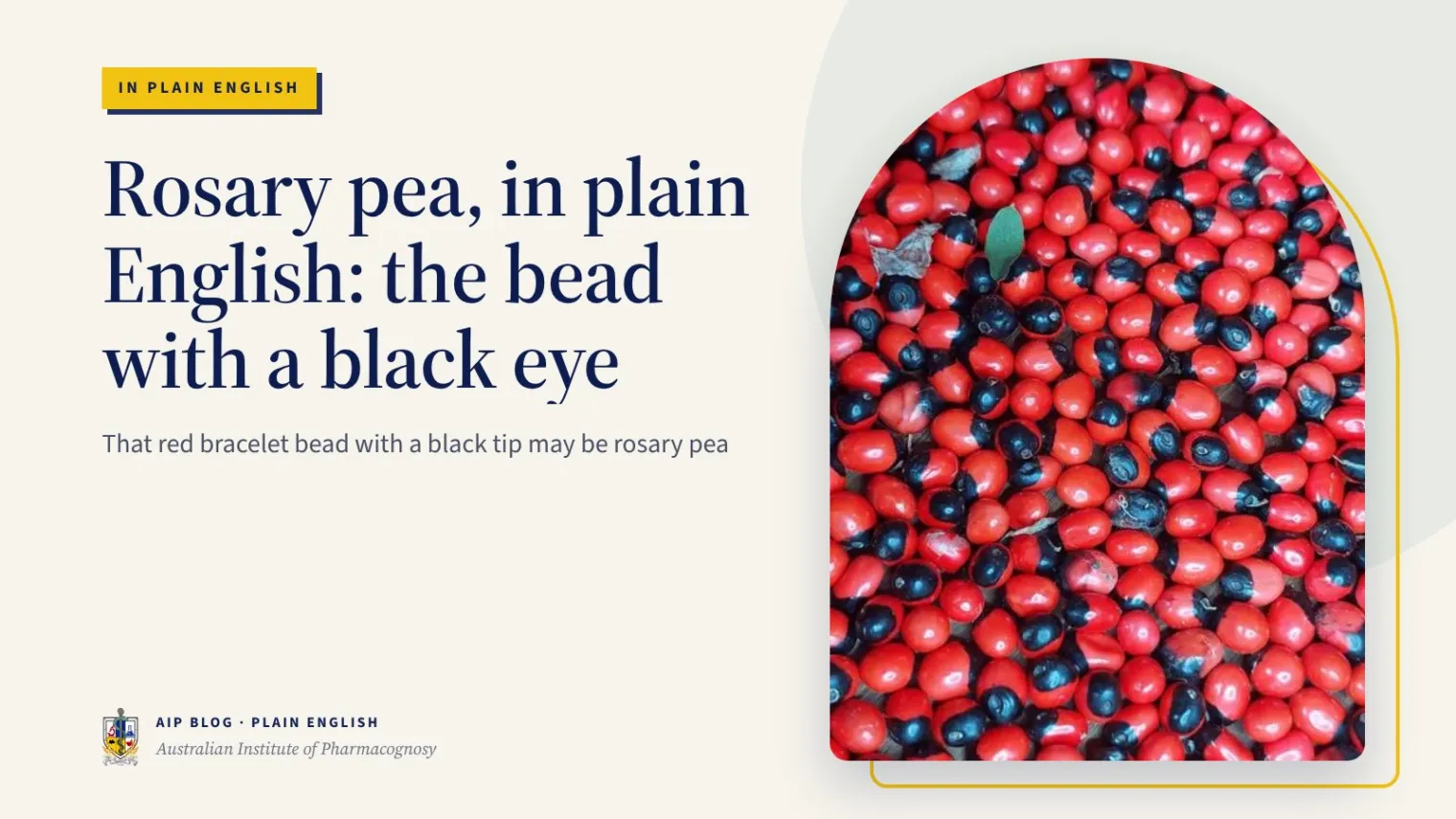
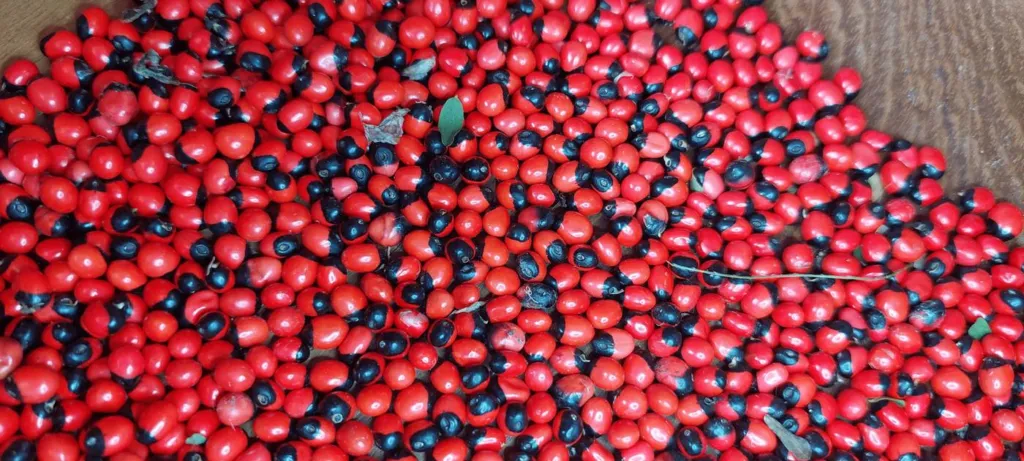
Photo: seed from our own field record, Woombye QLD · CC BY 4.0 · iNaturalist 173142791
Somebody in your street owns one: a holiday bracelet of shiny red beads, each with a black spot at one end like an eye. Toddlers reach for them. Dogs chew them.
Those beads are the seeds of a climbing pea that also grows wild in Queensland, and each holds abrin, a poison that has killed children and adults. Plenty get swallowed without harm. Nobody can look at a child and tell which kind of swallow it was.
Educational only: no advice, and no preparation or dosing detail. Legal passages are the Institute’s published reading of Australian rules in September 2026.
Phone 13 11 26, the Poisons Information Centre, now. Open 24 hours, Australia-wide; follow its advice. Phone 000 instead if the person is drowsy or collapsed, having a fit, struggling to breathe, or vomiting or passing blood.
Don’t wait for symptoms, and don’t decide yourself that it was nothing. Don’t make them vomit or give them anything meant to. Wipe or rinse any seed out of the mouth, then phone.
Seed that was chewed, crushed, ground or drilled, and any seed matter injected or breathed in as dust, needs urgent hospital assessment however well the person seems. Dust: get into fresh air, and phone 000 if breathing is hard. In the eye: wash it with running water or saline for 15 minutes and phone 13 11 26.
Bring the seeds, the bag or the bracelet. Routine hospital drug tests miss this poison.
An animal: phone your vet straight away, or the Animal Poisons Helpline on 1300 869 738, 24 hours (a fee applies). 13 11 26 is for people. Take the seed or bead to the vet too.
For any question about taking a herbal medicine, consult a degree-qualified herbalist with competencies and adequate training in pharmacognosy.
- Red seed, sharp black cap, off a thin vine: treat it as rosary pea.
- Whole seeds often go straight through, but nobody can see that one stayed whole; broken ones are the danger, and beads on a string are drilled.
- Swallowed, chewed or crushed: phone 13 11 26 now, before anyone feels sick.
- There is no antidote.
- We found no trial in people; seed and root are banned as medicine here.
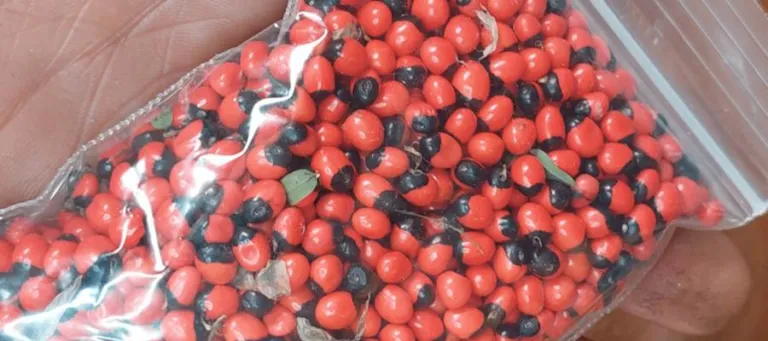
A glass shell with a poison inside
Everything turns on one question: is it broken?
Abrin gets into cells and jams the tiny factories that build the proteins a cell lives on. One molecule can wreck thousands of them in turn, so very little does great harm.
What saves most people is the seed’s glassy, near-watertight skin. Swallowed in one piece, a seed often leaves in one piece: one toddler who swallowed bracelet beads vomited, had fluids in hospital and went home well next day. The deaths have mostly followed chewed or crushed seed. Phone anyway.
To string a bead, someone drills through it, breaching that skin and making dust. The seed a child chews on a bracelet is already open.
The seed a child chews on a bracelet is already open.
Tonight, check the jewellery box, dress-up box and craft drawer. Anything strung with black-tipped red seeds goes out of reach of small hands and the dog.
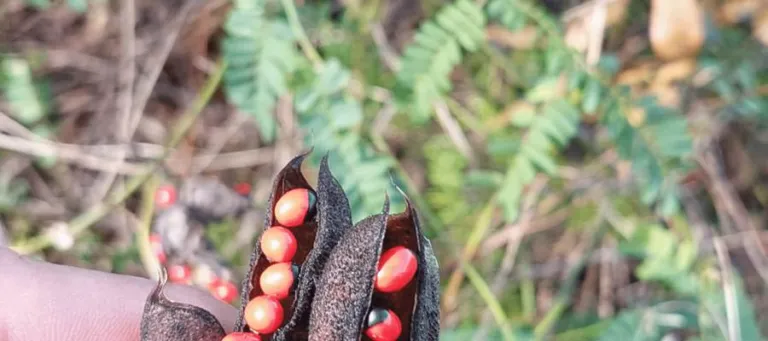
Look for the black cap, then look at the plant
Most red seeds are harmless. This one isn’t.
Rosary pea is bright red with a neat, sharp-edged black cap on one end, and the tiny scar where it hung in the pod sits inside the black. The plant is a thin vine twisting through shrubs, with feathery leaves and short flat pods that split and curl back.
Its commonest double, the coral bead tree seed, is red all over with no cap and grows on a tree; stalls sell both as “lucky beans”. Trickier is gidee gidee, a north Queensland tree whose red-and-black seeds look almost the same; it grows on a tree. Rosary pea is also called gidee gidee, so that name settles nothing.
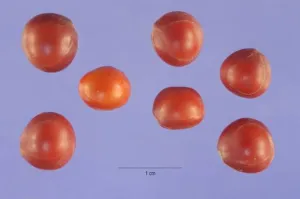
A bracelet bead has no vine to check, so treat any red bead with a black cap as rosary pea until someone who knows seeds says otherwise.
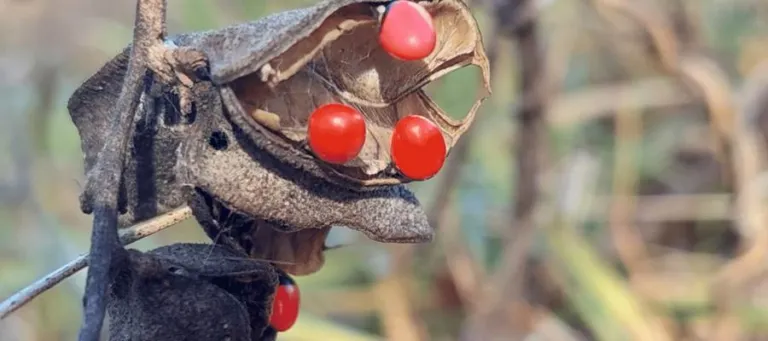
The quiet hours are the dangerous ones
Looking well means nothing yet.
Case reports start with hours when nothing seems wrong. Then vomiting, cramps, heavy diarrhoea that may carry blood, dehydration and shock. Over days the damage reaches the liver, kidneys, clotting and heart, and in some reported cases the brain. Vomiting that settles is not the all-clear. One woman who swallowed crushed seed died five days later, despite hospital care.
There is no antidote anywhere; hospitals prop up each failing organ. Antibodies made in labs are research tools only; nobody should count on them.
Dogs: the poison latches onto almost any mammal’s cells, and one crunch breaks the seed. We found no published Australian animal case series, so that is reasoning from how it works; treat it as an emergency anyway.
Phone while everyone still looks fine, and save 13 11 26 and your vet’s number today.
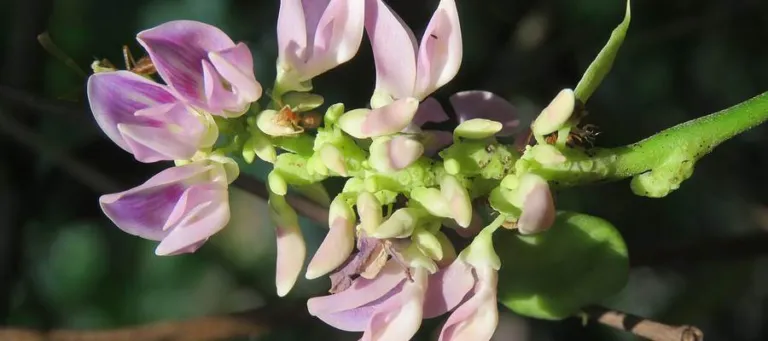
Old remedies, no trials, a firm law
Long used, never tested.
In parts of Africa and Asia the leaf and root are old remedies for coughs, sore throats and fevers. The sweet root gets it called Indian liquorice, though real liquorice is another plant. Fertility claims rest on experiments in rats and mice. We found no controlled trial in people, of any preparation, for anything; “used to treat” describes a custom.
The national Poisons Standard bans rosary pea seed and root as medicine; nobody may sell, supply or prescribe them for treatment. In Queensland, dealing in them as medicine is an offence; other states have their own Acts, so check yours. The leaf is not named in that entry, which is no green light: no part has been shown safe to take.
Purified abrin is a security-sensitive toxin under Commonwealth rules. A vine growing wild, seeds you have without meaning to, and seed gathered for art or culture do not count as handling it; any attempt to extract the poison does. Our reading, as at September 2026; not legal advice.
A back-fence vine breaks no Queensland law; elsewhere, check yours. Refuse any remedy made from the seed or root, and take herbal questions to the herbalist named in the red box.
The short version of Dr Thomas Ridley’s AIP Literature Review and Critical Analysis LR No. 1. The evidence is all there:
- Jesse Kirby — Wrote this edition fresh from his own notes with the review shut: picked the four things a reader needs, the running order and every sentence, and reworded the safety box without softening it
- Zoe Bennett — Set the page title, the search description and the labels, framed around the bracelet a reader might already own, which is how the page will be shared
- Theo Karras — Chose the cover heap of seed, the four section banners and the coral bead tree comparison, checked each photograph by eye and rewrote the alt text to match what it actually shows
- Leah Bianchi — Assembled the page: the red safety box, the one-minute card, the pull quote, the four what-this-means cards and the card back to the review, laid out to read on a phone
- Dr Luke Iggulden, Chief Scientific Officer — Senior author. Authorised the research this edition retells, as lead researcher
Contributors
- Dr Thomas Ridley — Wrote AIP Literature Review and Critical Analysis LR No. 1, the article this page retells
Image credits. Field photographs of Abrus precatorius: Australian Institute of Pharmacognosy, Woombye QLD, 05/07/2023; iNaturalist 173142791, CC BY 4.0. Flowers: Vinayaraj, CC BY-SA 4.0, via Wikimedia Commons. Adenanthera pavonina (coral bead tree) seeds: Steve Hurst @ USDA-NRCS PLANTS Database, public domain, via Wikimedia Commons.
AIP Explainers are the plain-language editions of the Institute’s technical articles, published alongside the original. Everything on this page is carried by the full article, where the evidence, the references and the regulatory sources are set out. Regulatory information was read in September 2026 and may change. Spotted an error? Write to our contact form. We would rather correct a claim than repeat it.
Jesse Kirby
Head of Community Outreach
Australian Institute of Pharmacognosy
Cardwell QLD, Australia
australian-pharmacognosy.org · our contact form
The Institute sets and publishes its own monographs. The catalogue is in Publications.