
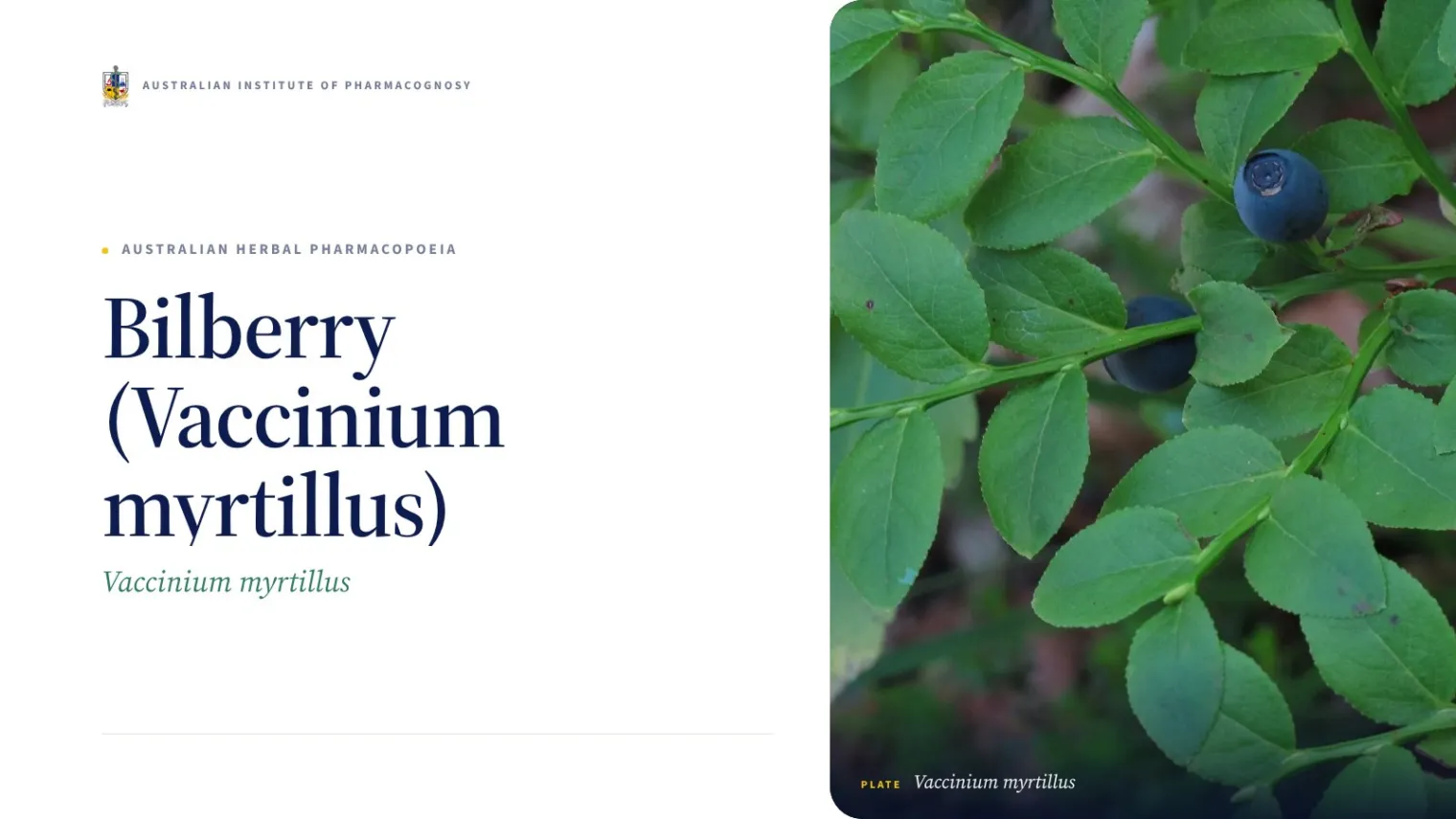
Bilberry fruit (Vaccinium myrtillus L.), Ericaceae
Australian Herbal Pharmacopoeia (working title) · Monograph AIP-PH-VACMYR · Version 1.0 draft
Date: 2026
Status: working document, version 1.0. Not a statutory standard.
Prepared by: Dr Thomas Ridley, Head of Education and Research, Australian Institute of Pharmacognosy, Cardwell, Queensland.
0. Free-teaser block
0.1 Identity card
| Series number | AIP-PH-VACMYR (MediHerb A–Z list No. 15) |
| Title | Bilberry fruit (Vaccinium myrtillus L.), Myrtilli fructus |
| Version / year | 1.0 draft, 2026. Next review 2029, or sooner if the BIOAMI trial (NCT03620266) reports or the European Pharmacopoeia bilberry texts change |
| Accepted binomial | Vaccinium myrtillus L., Sp. Pl. 1: 349 (1753). Accepted. IPNI 30006039-2; lectotype LINN (Herb. Linn. No. 497.1). Checked on 30/09/2026 against the Plants of the World Online / World Checklist of Vascular Plants data (ChecklistBank dataset version 2026-09-23) and IPNI [1,2] |
| Family | Ericaceae Juss. (APG IV), order Ericales [1] |
| Plant part | The ripe fruit: dried (Myrtilli fructus siccus) or fresh or frozen (Myrtilli fructus recens); the refined dry extract of the fresh fruit is a separate pharmacopoeial preparation [3] |
| Latin drug name | Myrtilli fructus (siccus, recens) [3,4,5] |
| Principal synonyms | Homotypic: Vitis-idaea myrtillus (L.) Moench. Heterotypic names sunk into the species include Myrtillus niger Lindstr., Myrtillus sylvaticus Drejer and V. myrtillus var. oreophilum (Rydb.) Dorn [1]. Barnes prints Myrtilus niger Gilib. [8] |
| Common names | English: bilberry, whortleberry, blaeberry, huckleberry, and in some sources blueberry [7,8,9]. German: Heidelbeere, Blaubeere; French: myrtille; Italian: mirtillo nero; Danish and Norwegian: blåbær [4,7] |
| Pharmacopoeial status elsewhere | Ph. Eur.: yes, three monographs: 1588 Bilberry fruit, dried; 1602 Bilberry fruit, fresh; 2394 Fresh bilberry fruit dry extract, refined and standardised (edition read: 8.0) [3]. BP: yes, the Ph. Eur. texts (as listed by Trease and Evans and by Barnes) [8,9]. EMA/HMPC: yes, two EU herbal monographs, traditional use only, both adopted 29/09/2015 [4,5,6]. Commission E: positive (dried fruit, 1987, as tabulated by the HMPC) [6,7]. ESCOP: yes (2003, as tabulated) [6]. American Herbal Pharmacopoeia: yes (listed by Barnes) [8]. WHO: not covered by any of the WHO volumes on selected medicinal plants held in the AIP reference library (the four main volumes and the NIS volume) |
| Australian status | Permissible Ingredients Determination (No. 2) 2026: item 5120 VACCINIUM MYRTILLUS, purposes A (active), E (excipient) and H (homoeopathic), no specific requirement; item 875 BILBERRY, purpose E only [11]. Poisons Standard (June 2026): not named [12]. ARTG: listed medicines naming the plant are numerous (public search 30/09/2026 returned 204 entries for "vaccinium myrtillus" and 57 for "bilberry"), among them MediHerb Bilberry Forte, ARTG 370078, listed 23/06/2021 [13]. Not native. Not named in the Queensland Biosecurity Regulation 2016. No wild Australian records in the Atlas of Living Australia [14,15] |
| Named markers | Tannins, as pyrogallol (CID 1057): assay marker for the dried fruit, not less than 1.0 per cent, dried drug (Ph. Eur. 1588). Anthocyanins, as chrysanthemin (cyanidin 3-O-glucoside chloride, CID 197081): assay marker for the fresh fruit, not less than 0.30 per cent, calculated on the dried drug (Ph. Eur. 1602), and for the refined extract, 32.4 to 39.6 per cent (Ph. Eur. 2394). Anthocyanidins, as cyanidin chloride (CID 68247): purity marker for the extract, not more than 1.0 per cent (Ph. Eur. 2394) [3] |
| Evidence snapshot | Night vision in healthy people: Tier B, no benefit shown, 3 small crossover RCTs. Eye fatigue after screen work: Tier B, 2 RCTs, inconsistent objective signals, both industry-linked. Ulcerative colitis: Tier B, 1 RCT, primary endpoint not met. Blood lipids with purified anthocyanins: Tier B, no effect, 1 RCT. Diabetic retinopathy, venous insufficiency, capillary fragility: Tier C, old controlled trials known through the EU assessment report. Mild diarrhoea and minor mouth inflammation (dried fruit): Tier T, EU traditional use. Vasoprotective and antiplatelet actions: Tier P |
| Suggested citation | Ridley T. Bilberry fruit (Vaccinium myrtillus L.), Myrtilli fructus. AIP-PH-VACMYR, version 1.0 draft. Cardwell: Australian Institute of Pharmacognosy; 2026. DOI to be assigned |
| Provenance | Original AIP data: none. Every limit, method, analytical figure and trial result in this monograph belongs to the source cited beside it. Sections 4, 5, 7, 8, 9 and 10 carry AIP bench data pending: AIP has not vouchered a sample, made a powder mount, run a plate or run a chromatogram of this drug. Photographs and the plate are licensed or public-domain works credited in each caption; F2b, F8 to F8e and F10h are journal figures reused under CC BY 4.0; F3c, F5 and F7 are AIP schematics redrawn from cited descriptions; F6c and F10g are AIP replots labelled "schematic redrawn from ref 6"; the other F6, F9 and F10 charts are AIP charts drawn from published data |
| Compiler and review | Compiled by Dr Thomas Ridley (Education and Research). Technical review: Dr Fiona MacAllister (Botanical, sections 1-5, 10), reviewed in 2026; Dr Hana Suzuki (QA, sections 6-10), reviewed in 2026; Dr Eleanor Whitcombe (Medicine, sections 12, 13, 15), reviewed in 2026; Jesse Kirby (Community Outreach, whole-document layout, figure placement and credit lines F1-F10), reviewed in 2026; evidence and citation audit of every section and reference by Dr Thomas Ridley (Education and Research), who is also the compiler, reviewed in 2026. Published: not yet. Last modified: 2026. Version 1.0 draft |
| Canonical URL | /pharmacopoeia/vaccinium-myrtillus/ (on publication) |
0.2 Summary
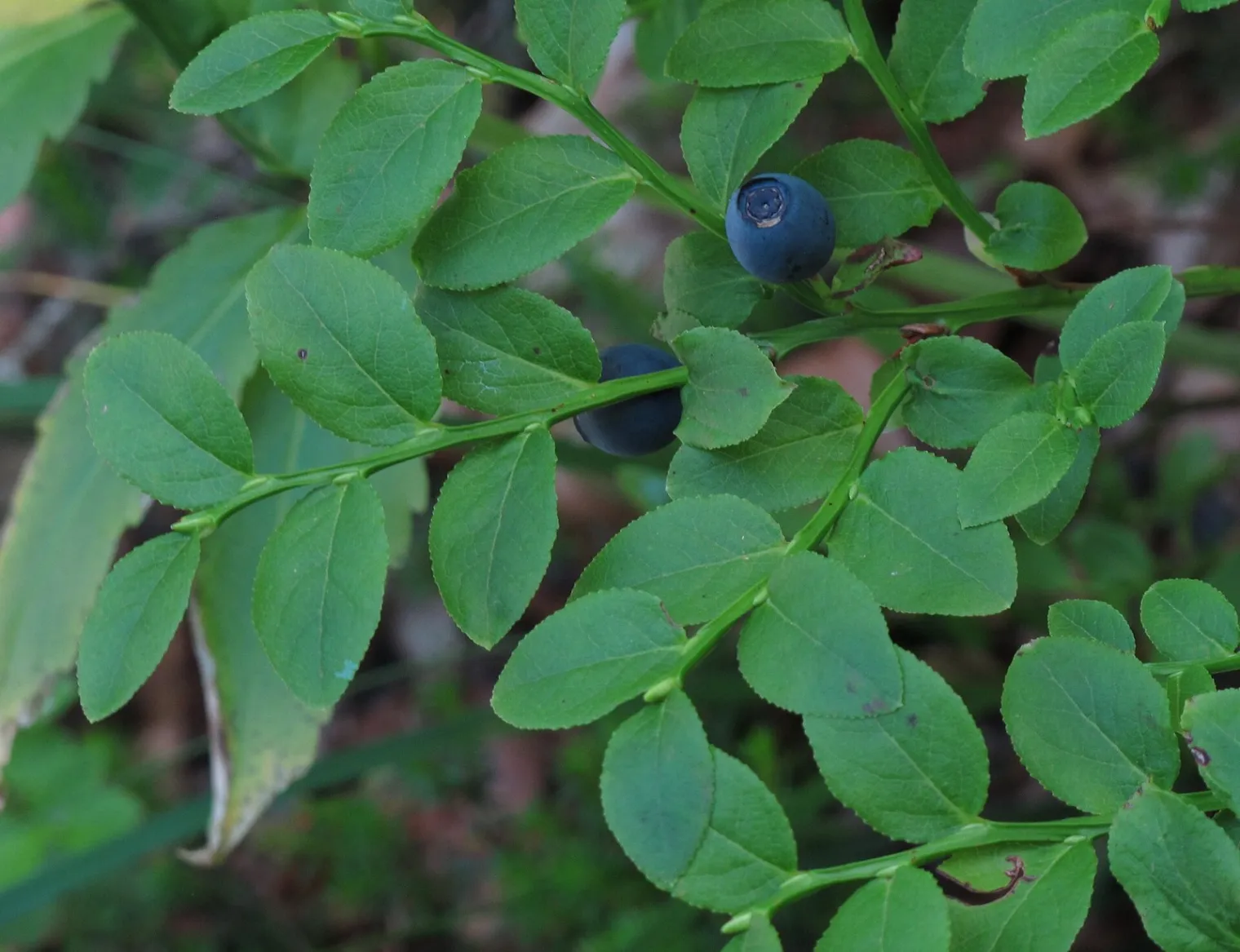
Bilberry fruit is the ripe berry of Vaccinium myrtillus, a low deciduous shrub of acid heath and conifer forest across Europe, northern Asia and western North America. Three European Pharmacopoeia texts cover it: the dried fruit, assayed for tannins (not less than 1.0 per cent); the fresh or frozen fruit, assayed for anthocyanins (not less than 0.30 per cent of the dried drug); and a refined dry extract made from the fresh fruit and held between 32.4 and 39.6 per cent anthocyanins by liquid chromatography. The berry is identified by its dark-fleshed, many-seeded fruit crowned by a ring-shaped calyx, by violet-pink sclereids and U-thickened testa cells in the powder, and by the violet-red zones of its thin-layer chromatogram. The European Union accepts the dried fruit only as a traditional remedy for mild diarrhoea and mouth inflammation, and one Italian extract only as a traditional remedy for heavy legs and fragile skin capillaries. The night-vision story from the Second World War did not survive controlled testing, and the modern trials on eye strain, colitis and blood lipids are small, mixed or negative. The largest practical problem is authenticity: commercial "bilberry" extracts have been found coloured with a synthetic dye or made from cheaper anthocyanin sources. Anyone considering bilberry medicinally should consult a degree-qualified herbalist with competencies and adequate training in pharmacognosy.
0.3 Contents with extent
| Section | Content | Pages |
|---|---|---|
| 0 | Free-teaser block: identity card, summary, contents, contributors | 4 |
| 1 | Nomenclature | 2 |
| 2 | Definition | 1 |
| 3 | Source and Australian supply, with 3.1 origin, climate and chemistry | 3 |
| 4 | Macroscopy | 4 |
| 5 | Microscopy | 1 |
| 6 | Chemistry | 3 |
| 7 | Named markers and assay limits | 3 |
| 8 | TLC fingerprint | 2 |
| 9 | HPLC fingerprint | 3 |
| 10 | Identity, purity, adulterants and contaminants | 4 |
| 11 | Traditional use | 1 |
| 12 | Current practice: use, preparations and doses | 2 |
| 13 | Clinical evidence | 5 |
| 14 | Pharmacology | 2 |
| 15 | Safety | 3 |
| 16 | Discussion | 1 |
| 17 | Conclusions | 1 |
| 18 | Research still needed | 1 |
| 19 | References | 2 |
| 20 | Document control | 3 |
| Totals | 22 sections · 51 printed pages in the current layout · 50 figures (13 licensed or public-domain photographs and plates, 7 journal figures reused under CC BY 4.0, 12 PubChem structure panels, 3 AIP schematics redrawn from published descriptions, 2 AIP replots of tabulated data, 12 AIP charts, 1 captioned placeholder) · 0 AIP photomicrographs · 0 AIP chromatograms · 22 tables · 12 randomised trials graded (8 from full text, 4 through the EU assessment report, two of them co-formulated with beta-carotene), 4 older controlled trials and 1 open pilot graded through the EU assessment report, 3 further controlled trials graded through Bone and Mills and Barnes, 6 combination trials described and not graded · 49 references; all 24 PMIDs and DOIs resolved on 30/09/2026, and the full text of every cited journal article read except refs 37 and 38, the RoB 2 and GRADE method papers |
Known gaps in this version, stated plainly.
- F4, the photomicrographs, is a captioned placeholder. AIP holds no vouchered sample. Europe PMC open-access literature and Wikimedia Commons were searched on 30/09/2026 for a reusable photomicrograph of bilberry fruit powder and none was found. Section 5 is written from the Ph. Eur. text, and F5 is a drawing from it, labelled as one.
- No AIP plate or chromatogram. F7 is a zone-order schematic redrawn from the Ph. Eur. tests; F8 to F8e are published chromatograms reproduced under CC BY 4.0. They are other people’s work.
- Several older trials reach this monograph through the EU assessment report [6]: the night-vision trials of Muth (2000), Zadok (1999) and Levy and Glovinsky (1998), the Canter and Ernst systematic review (2004), the Italian retinopathy and venous trials, the bilberry-juice trial of Karlsen (2010), the ulcerative colitis pilot of Biedermann (2013) and the warfarin case reports. The dysmenorrhoea, nosebleed and post-haemorrhoidectomy trials and a cataract trial of bilberry with vitamin E reach it through Bone and Mills and Barnes. The text names each and says which secondary source it comes from. The primary papers are on the library fetch list, and the integrity screen has not been run on them.
- Trials found and not graded, because their full text is not yet in hand: Kolehmainen 2012 (whole bilberries, metabolic syndrome), Kamiya 2013 (fermented extract, myopia), Riva 2017 (extract, dry eye), Chan 2021 (extract, type 2 diabetes), Arevström 2019 (freeze-dried bilberry after myocardial infarction), Habanova 2016 (whole berries, lipids) and the Talebi 2025 meta-analysis of cardiometabolic outcomes. Two adulteration studies, Govindaraghavan 2014 and Gardana 2014, are in the same position. None of them is cited for a result.
- Searches not completed: ANZCTR, TGA safety alerts and the TGA Database of Adverse Event Notifications were searched on 30/09/2026 (sections 13.1 and 15); the DAEN reaction filter could not be applied to the 208 reports for products containing the plant. WHO ICTRP’s public search page returned no records for any bilberry term on 30/09/2026 while returning records for control terms, so ICTRP still needs a working search. Cochrane CENTRAL and Embase were not searched; DAFF BICON import conditions, the IUCN Red List and the CITES checklist were not queried.
- The composition of MediHerb Bilberry Forte was not read. The ARTG public summary did not download to an automated session, and no manufacturer technical sheet is held.
- Nobody has tested the Australian market. A 2024 online survey of Australian anthocyanin supplements recorded labels and claims [22]; no Australian laboratory survey of bilberry product identity or anthocyanin content was found.
- Limits read from Ph. Eur. 8.0 (2013), not from the edition in force. The EDQM reference-standard list of 29/09/2026 shows the dried- and fresh-fruit monographs have since been revised (section 7). The limits in sections 7 to 10, and the TGO 100 microbial schedule values, still need checking against the current texts before any AIP release test relies on them.
0.4 Contributors and paywall notice
Prepared by: Dr Thomas Ridley, Head of Education and Research.
Contributors: listed with the monograph and resolved from the Legal byline roster by the publication pipeline for each department that reviews the draft. Dr Luke Iggulden set the scope of the Pharmacopoeia in the directive of 22/09/2026; he did not write this monograph.
What is free and what is not. Everything above the free-sample line is free to every reader. The remaining sections, macroscopy and microscopy, chemistry and markers, the identity tests, purity and adulterants, tradition, doses, graded evidence, pharmacology, safety and references, are read by Scholar-level members and above under a revocable personal licence. Nothing behind the line contradicts anything in front of it.
The Australian Herbal Pharmacopoeia is the name of a reference series published by the Australian Institute of Pharmacognosy. It is not a statutory standard under the Therapeutic Goods Act 1989 and carries no official, government or national-standard status.
34 more pages follow · 17,170 words, 49 figures, 21 tables
Still to come in this monograph
- 1. Nomenclature
- 2. Definition
- 3. Source and Australian supply
- 4. Macroscopy
- 5. Microscopy
- 6. Chemistry
- 7. Named markers and assay limits
- 8. TLC fingerprint
- 9. HPLC fingerprint
- 10. Identity, purity, adulterants and contaminants
- 11. Traditional use
- 12. Current practice: use, preparations and doses
- 13. Clinical evidence
- 14. Pharmacology
- 15. Safety
- 16. Discussion
- 17. Conclusions
- 18. Research still needed
- 19. References
- 20. Document control
The rest of this monograph is open to members. One membership covers every members’ feature on the site.
Checking your membership…
Report an error or submit evidence
If something in this monograph is wrong, out of date or missing, tell us and show us the evidence. Every report is logged under the AIP Evidence Charter and assessed on the evidence alone; the outcome is kept on the record, and an upheld report is corrected with a dated notice on this page.
Open the report form
The Institute sets and publishes its own monographs. The catalogue is in Publications.