
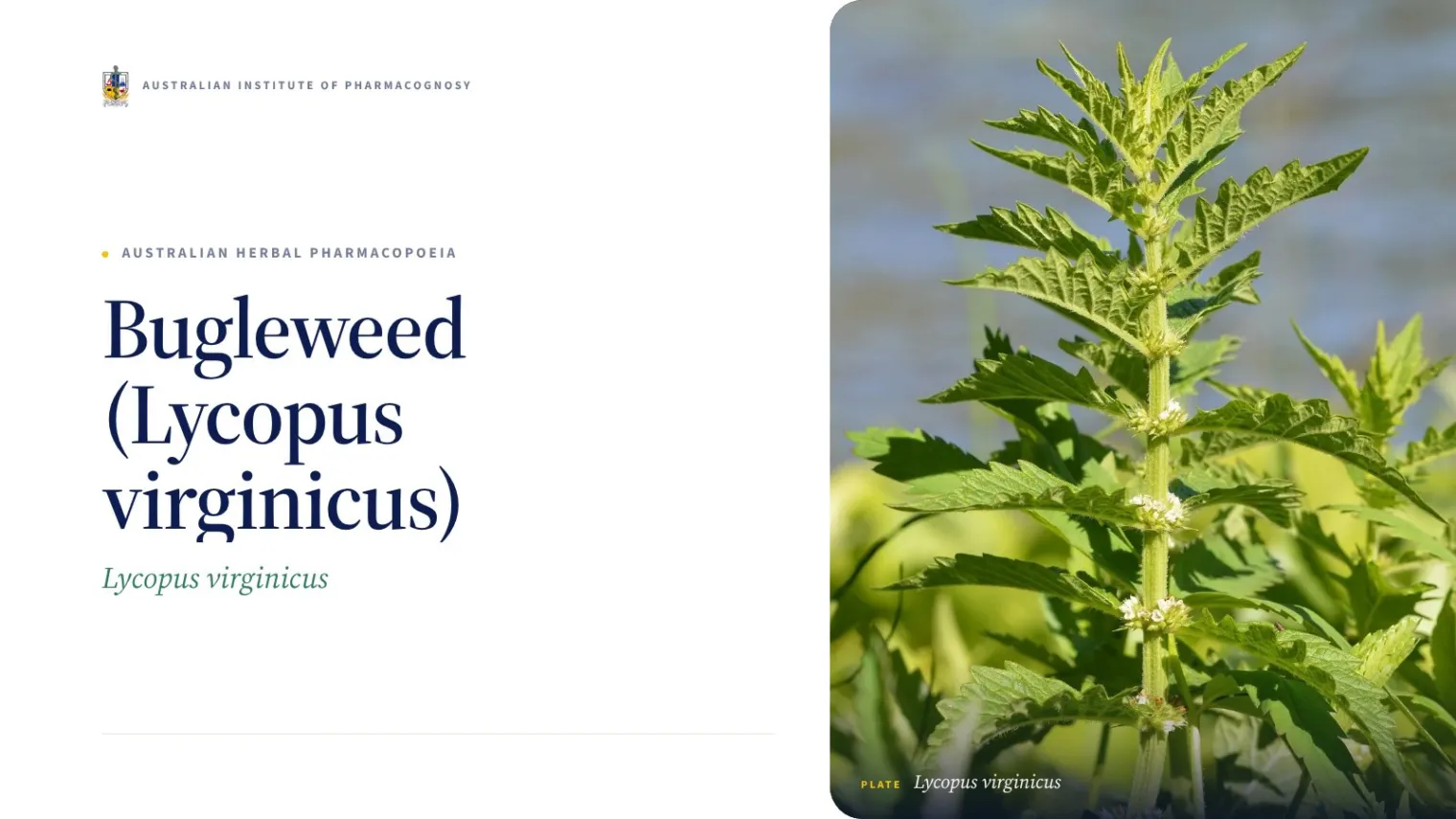
Bugleweed and gypsywort, dried aerial parts (Lycopus virginicus L. and Lycopus europaeus L.), Lamiaceae
Australian Herbal Pharmacopoeia (working title) · Monograph AIP-PH-LYCSPP · Version 1.0 draft
Date: 2026
Status: working document, version 1.0. Not a statutory standard.
Prepared by: the Australian Institute of Pharmacognosy, Far North Queensland, Australia. Every author and contributor is named at the end of the monograph.
0. Free-teaser block
0.1 Identity card
| Register number | AIP-PH-LYCSPP (MediHerb A–Z list No. 24) |
| Title | Bugleweed herb (Lycopus virginicus L., Lycopus europaeus L.), Lycopi herba |
| Version / year | 1.0 draft, 2026. Next review 2029, or sooner when AIP bench data exist or a controlled human study reports |
| Accepted binomials | Lycopus virginicus L., Species Plantarum: 21 (1753), IPNI 449692-1; and Lycopus europaeus L., Species Plantarum: 21 (1753), IPNI 449641-1. Both accepted in the World Checklist of Vascular Plants (WCVP) version 16.0 of 04/06/2026, the dataset Plants of the World Online displays, read through ChecklistBank in September 2026 and re-read in October 2026 with no change [1]. The trade name "Lycopus spp." covers these two species only in this monograph |
| Family | Lamiaceae (mint family), the APG IV placement, which WCVP follows for flowering-plant families [1,50]; subfamily Nepetoideae [28]. No family change affects the genus |
| Plant part | Dried aerial parts (stems, leaves and flowering tops), harvested at or just before flowering [9,12,28] |
| Latin drug name | Lycopi herba (German and European usage, as reported [12]). The US Pharmacopoeia called the drug "Lycopus" until its 1870 revision [15] |
| Principal synonyms | L. virginicus: L. macrophyllus Benth., Euhemus officinalis Raf., E. sylvaticus Raf., L. virginicus var. pauciflorus Benth., var. quercifolius Pursh and var. macrophyllus (Benth.) A.Gray. L. europaeus: L. vulgaris Pers., L. palustris Burm.f., L. aquaticus Moench, L. riparius Salisb., L. mollis A.Kern. and 30 more names at species and lower rank [1]. The name "L. europaeus Walter" is a misapplication and belongs to L. americanus, and "L. europaeus var. argutus Benth." is the native Australian L. australis (section 1) [1] |
| Common names | L. virginicus: bugleweed, Virginia bugleweed, sweet bugleweed, Virginia water horehound, water bugle, gypsy-weed, Paul’s betony [9,14,16]. L. europaeus: gypsywort (gipsywort), European bugleweed, water horehound, bitter bugle, gypsy herb, marsh horehound [9,28]; German Wolfstrappkraut [28] |
| Pharmacopoeial status elsewhere | US Pharmacopoeia: L. virginicus official until the 1870 revision [15], on the "secondary list" in 1860 [18]. British Herbal Pharmacopoeia 1983: cited for bugleweed by Mills and Bone [9]; BHP 1996: not in the list of monographs reproduced by Trease and Evans [8]. German Commission E: positive monograph, 1990, as reported [9,12]. Ph. Eur. 8.0, WHO volumes 1–4, Japanese Pharmacopoeia 18: no monograph in the library copies searched [25,46]. EMA/HMPC: no monograph found (section 1). Chinese Pharmacopoeia: a different drug, Herba Lycopi (Zelan), from L. lucidus var. hirtus [22] |
| Australian status | Permissible Ingredients Determination: yes, item 3105 LYCOPUS EUROPAEUS and item 3107 LYCOPUS VIRGINICUS, each for purposes A (active) and H (homoeopathic); for L. virginicus "Pulegone is a mandatory component" and "the concentration of pulegone in the medicine must be no more than 4%" [2]. Item 3106 LYCOPUS LUCIDUS is listed separately [2]. Poisons Standard: Lycopus is not named; d-pulegone is Schedule 6 except in preparations with 4 per cent or less [3]. ARTG: a keyword search found six listed medicines, all Chinese formulas containing L. lucidus; none named either bugleweed species [7]. Neither species grows wild in Queensland; L. europaeus has 11 Australian records, 10 in South Australia and 1 in Western Australia [4]. Australia has its own native species, L. australis R.Br. (sections 3 and 10) [1,4]. Not a prohibited or restricted invasive plant under the Biosecurity Act 2014 (Qld) [5] |
| Named markers | Rosmarinic acid (CID 5281792): proposed assay marker; no limit set; one published value, 1.96 per cent of dried aerial parts [29]. Luteolin-7-O-glucuronide (CID 5280601): proposed identity marker; no limit [28]. Pulegone (CID 442495): safety marker set by the TGA for L. virginicus, not more than 4 per cent in the medicine [2]; no analysis of pulegone in either species was found |
| Evidence snapshot | Mild hyperthyroidism and its cardiac symptoms (palpitations, tachycardia): Tier C, 0 RCTs; one open controlled study (n = 62) and uncontrolled series, known here through secondary reports; very low certainty [9,11]. Autonomic ("vegetative") dystonia with palpitations: Tier C, 0 RCTs, two uncontrolled series [9]. Graves’ disease: Tier C, two case reports of a bugleweed and lemon balm product [32]. Breast tension (mastodynia): Tier T, 0 trials [12]. Nervous tachycardia, insomnia, small haemorrhages, cough: Tier T, 0 trials [14,16]. Lowering of TSH, thyroid hormones and prolactin: Tier P, animal and in vitro [9] |
| Suggested citation | Ridley T, Iggulden L. Bugleweed herb (Lycopus virginicus L., Lycopus europaeus L.), Lycopi herba. AIP-PH-LYCSPP, version 1.0 draft. Cardwell: Australian Institute of Pharmacognosy; 2026. DOI to be assigned |
| Provenance | Original AIP data: none. Every analytical figure, limit, method and dose belongs to the source cited beside it. Every photograph of the living plant, dried specimen and plant parts is a licensed photograph named by its photographer or institution, and its identification is the photographer’s or the herbarium’s. Sections 4, 5, 7, 8, 9 and 10 carry AIP bench data pending (no AIP voucher, section, plate or run yet). The map (Figure 9), charts (Figures 7b, 8b, 10–13), TLC schematic (Figure 7), microscopy drawing (Figure 5) and structure composite (Figure 6) are AIP drawings from cited data |
| Compiler and review | Compiled by Dr Thomas Ridley (Education and Research). Technical review: Dr Fiona MacAllister (Botanical, sections 1-5 and the adulterant species of 10) reviewed in 2026; Dr Hana Suzuki (QA, sections 6-10) reviewed in 2026; Dr Eleanor Whitcombe (Medicine, sections 12, 13, 15) reviewed in 2026; Dr Thomas Ridley (Education and Research, evidence and citation audit of every section, references and figure licences) reviewed in 2026; Jesse Kirby (Community Outreach, free-teaser and whole-document layout, figure placement, captions and credit lines) reviewed in 2026. Published: not yet. Last modified: 2026. Version 1.0 draft |
| Canonical URL | /pharmacopoeia/lycopus-spp/ (on publication) |
0.2 Summary
Bugleweed is the dried aerial part of two wetland mints: Lycopus virginicus, native to the eastern and central United States, and L. europaeus, gypsywort, native from the Azores and Morocco across Europe to western China. Neither grows wild in Queensland, and the drug is imported. Australia has a native species of its own, L. australis, which is not the drug. No current pharmacopoeia publishes a quality monograph for either species. The US Pharmacopoeia dropped L. virginicus after 1870, the British Herbal Pharmacopoeia 1996 omits it, and the only published TLC and HPLC fingerprints of a Lycopus drug are for the Chinese drug made from L. lucidus.
The chemistry is phenolic. Rosmarinic acid and luteolin-7-O-glucuronide dominate leaf infusions of L. europaeus, and one sample held 1.96 per cent rosmarinic acid. The older pharmacology proposes that oxidation products of these caffeic-acid esters bind thyroid-stimulating hormone (TSH) and Graves’ antibodies; most of that work used injections or cell membranes.
Australian practitioners give a 1:2 liquid extract at 15 to 40 mL a week for an overactive thyroid and its palpitations. No randomised trial exists. The human evidence is a set of German open studies from 1943 to 2008 and two recent case reports: Tier C, very low certainty. The main safety points: avoid in an underactive thyroid, in pregnancy and while breastfeeding; do not combine with thyroid hormone or radio-iodine tests; stop gradually. Anyone considering it should consult a degree-qualified herbalist with competencies and adequate training in pharmacognosy.
0.3 Contents with extent
| Section | Extent (A4 pages in this printing) |
|---|---|
| 0 Free-teaser block | 5 |
| 1 Nomenclature | 2 |
| 2 Definition | 2 |
| 3 Source and Australian supply, with 3.1 origin, climate and chemistry | 4 |
| 4 Macroscopy | 4 |
| 5 Microscopy | 3 |
| 6 Chemistry | 3 |
| 7 Named markers and assay limits | 2 |
| 8 TLC fingerprint | 3 |
| 9 HPLC fingerprint | 4 |
| 10 Identity, purity, adulterants and contaminants | 3 |
| 11 Traditional use | 2 |
| 12 Current practice | 2 |
| 13 Clinical evidence | 3 |
| 14 Pharmacology | 2 |
| 15 Safety | 2 |
| 16–18 Discussion, conclusions, research needed | 2 |
| 19 References | 3 |
| 20 Document control | 3 |
| Totals (draft) | 41 A4 pages. 36 embedded figures: 12 licensed photographs of the living plants (the two drug species and, for comparison, L. lucidus and the look-alike Chaiturus marrubiastrum); 4 licensed photographs of plant parts; 2 licensed photographs of dried herbarium specimens with scale (L. europaeus and the native L. australis); 1 licensed photograph of a cut stem and 1 of the leaf underside; 5 public-domain plates (1794, 1887, 1913 twice, 1917–1926); 1 licensed HPLC chromatogram of L. europaeus from an open-access paper; 1 AIP composite of PubChem structures; 1 AIP microscopy drawing and 1 AIP TLC schematic, each redrawn from a cited source; 6 AIP charts and replots; 1 AIP map. About 22 tables. 0 AIP photomicrographs, 0 AIP chromatograms, 0 AIP plates. 0 randomised trials to grade; 7 human studies (all known through secondary reports) and 2 case reports described; 3 trial registers searched (no registered trial of the herbal drug); 3 literature databases searched. 53 numbered references |
Gaps stated plainly. AIP holds no voucher, photomicrograph, TLC plate or chromatogram of bugleweed. No openly licensed photomicrograph of either species was found; the light micrographs of L. europaeus in ref 31 carry a CC BY-NC-ND 4.0 licence, which does not cover a paid copy, so they are not reproduced here without the publisher’s permission; Figure 4 is a licensed photograph of a cut stem and Figure 4b a close photograph of the leaf underside, and Figure 5 is an AIP drawing redrawn from a published light-microscopy study of L. europaeus. No powder description of either species was found in the sources read. No published TLC or HPLC fingerprint of bugleweed herb exists in the library texts, so Figure 7 is a schematic redrawn from the published TLC of the Chinese drug from L. lucidus and labelled as that; Figure 8 is a licensed HPLC chromatogram of L. europaeus underground parts, which are not the drug, and Figure 8b a replot of retention times from leaf infusions. The crude-drug photograph with a scale bar (Figure 3) is a herbarium sheet of naturalised L. europaeus from New Zealand; an AIP photograph of the dried trade drug is pending. Every clinical study of bugleweed and every animal study of its thyroid effects is known here through two practitioner texts [9,11]; 32 primary papers have been requested in full text and none had arrived for this edition, so no trial carries a formal risk-of-bias judgement. The German Commission E monograph and the British Herbal Pharmacopoeia 1983 are reported through those texts and have not been read directly. ANZCTR, ClinicalTrials.gov and the WHO trial register were searched with positive controls in October 2026, and the TGA adverse-event database (DAEN) on the same day (0 reports; section 15). The CITES checklist and the DAFF BICON case for dried Lycopus herb were not searched for this edition and are listed for a hand search (section 18).
0.4 Contributors and access
Compiled by Dr Thomas Ridley, Head of Education and Research, who ran the searches, read the library texts and open full texts, drew the AIP figures and wrote every section. Technical review: Dr Fiona MacAllister, Head of Botanical, for sections 1–5 and the adulterant species of section 10, with Figures 1–5 and 9 (reviewed); Dr Hana Suzuki, Head of Botanical QA, for sections 6–10, with Figures 6–8 (reviewed); Dr Eleanor Whitcombe, Head of Medicine, for sections 12, 13 and 15, with Figures 10–13 (reviewed). Education and Research audited every reference and figure licence last in the chain (reviewed); because Education and Research also compiled the text, sections 11, 14 and 16–18 still need a reader from outside the department. Jesse Kirby, Head of Community Outreach, reviewed the free-teaser and whole-document layout, the placement of every figure in its section and each caption and credit line against the image record (reviewed). Legal will advise before public release. Contributors are credited once their review is on record. Dr Luke Iggulden, Chief Scientific Officer, is senior author: he set the scope of the pharmacopoeia series and made the research possible. A preview of the monograph and all of section 15 (Safety) are free to every reader; the full text is for Scholar members and above, or the AUD $20 copy of this one title.
Free to every reader. The safety section of every monograph is open to everyone, signed in or not. In an emergency call 000. For poisoning, call the Poisons Information Centre on 13 11 26.
15. Safety
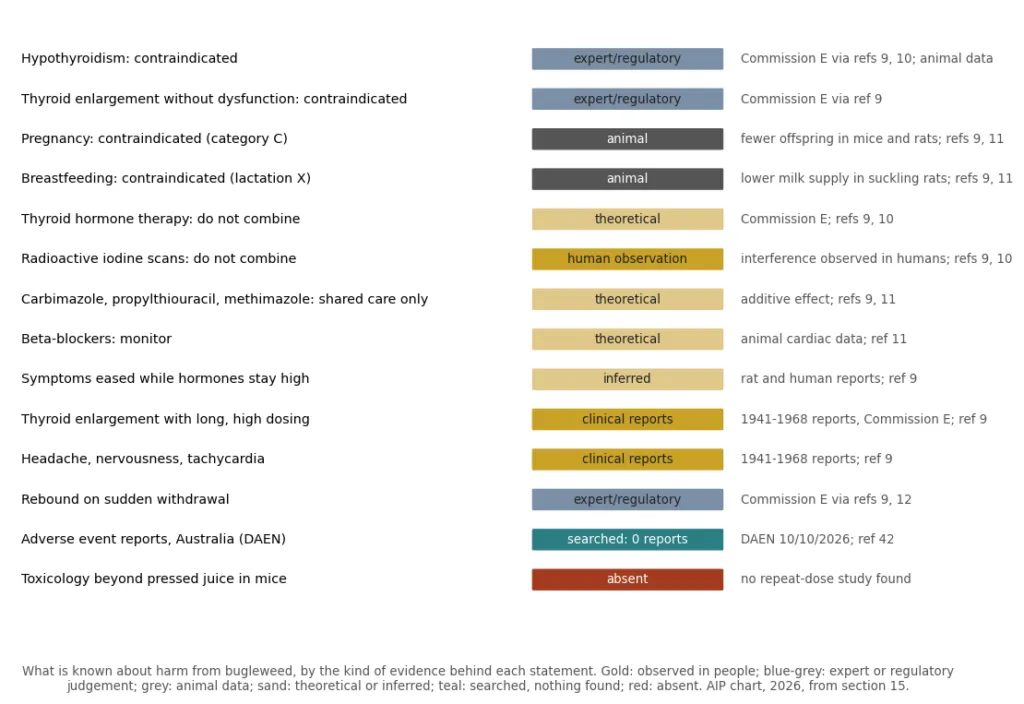
Adverse effects. Mills and Bone, drawing on Commission E and on De Smet’s review of reports from 1941 to 1968, list: in rare cases, enlargement of the thyroid with extended use at high (undefined) doses; a return of hyperthyroid symptoms on sudden withdrawal; headache, which dose reduction could probably prevent; and occasionally increased nervousness, tachycardia and weight loss; thyroid size increased in patients with a goitre not due to thyroid malfunction [9]. Schulz and colleagues add that sudden withdrawal "may lead to increased prolactin secretion" [12]. Mills and Bone’s summary of the 2008 open study does not mention adverse effects, and they note that not all trials produced the side effects listed [9]. Causality: the older reports cannot be assessed without their full texts; they are recorded as possible.
Toxicology. Pressed juice of L. europaeus killed male mice at 0.75 mL, equal to 7.5 g of fresh plant, route unknown but probably injection; 1 mL of L. virginicus juice intravenously was lethal, and 3 mL orally caused no toxic signs [9]. No repeat-dose, genotoxicity or reproductive study meeting current guidelines was found. Mills and Bone judge the IARC classification of caffeic acid, from lifetime feeding at grams per kg, unlikely to apply to therapeutic doses [9].
Contraindications. An underactive thyroid; thyroid enlargement without functional disorder; pregnancy; breastfeeding [9,10]. Caution in women trying to conceive [9,10]. MediHerb also advises stopping 7 days before a general anaesthetic [10], a caution the guide applies to many of its herbs.
Interactions.
| Drug | Effect | Basis | Grade | Advice in the sources |
|---|---|---|---|---|
| Thyroid hormone (levothyroxine) | Bugleweed may oppose it | Commission E deliberation [9,10]; "interaction inconclusive" [11] | Theoretical | Do not combine [9,10]; low risk, monitor thyroid levels [11] |
| Radioactive iodine and other isotopes for thyroid tests | Uptake interference | "Observed in humans" [9]; "case report" [10] | Clinical (case level) | Do not use during the test [9,10] |
| Antithyroid drugs (carbimazole, propylthiouracil, methimazole) | Additive effect | Theoretical [11] | Theoretical | "High risk: concomitant use not recommended" [11]. Mills and Bone’s own case history combined them under medical care [9]. AIP position (Medicine): only under shared care with the prescriber, who alone changes the antithyroid drug, with thyroid function tests at the prescriber’s usual intervals |
| Beta-blockers (propranolol) | Additive slowing of heart rate and blood pressure | Rat cardiac data [11] | Theoretical | Low risk; monitor [11] |
| Iodine supplements | May oppose | Theoretical [9] | Theoretical | Avoid [9] |
Stockley’s Drug Interactions (2008) and Barnes’ Herbal Medicines (2007) have no entry for Lycopus or bugleweed [41,47].
Pregnancy and lactation. Category C in Mills and Bone ("has caused or is associated with a substantial risk of causing harmful effects on the fetus or neonate without causing malformations"): lower thyroid hormones in animals, and fewer offspring in treated mice and rats [9]. Hechtman lists bugleweed in pregnancy category C and lactation category X, using the Mills and Bone classification (Appendix 2, pp. 1487 and 1490) [11], and MediHerb marks it contraindicated in pregnancy and lactation [10]. In suckling rats L. virginicus reduced milk supply, and Mills and Bone advise against use while breastfeeding because of possible prolactin reduction and passage of antithyroid constituents into milk [9]. Mills, Dugoua and Perri’s Herbal Medicines in Pregnancy and Lactation (2006) has no entry [44].
Children and older people. No data. Thyroid disease in children needs medical management; bugleweed should not be given to a child outside the care of a degree-qualified herbalist working with the child’s medical team (AIP comment).
Monitoring (AIP comment). In hyperthyroid rats an oral extract slowed the heart without changing thyroid hormones, and in the human reports palpitations and pulse improved while serum hormones did not change [9]. Bugleweed may therefore ease symptoms while the thyroid stays overactive. Relief of palpitations is not evidence that the disease is controlled: thyroid function tests should guide care, and new or worsening palpitations, an irregular pulse, weight loss, tremor or eye changes need prompt medical assessment.
Overdose. Mills and Bone found no overdose incidents in the published literature [9]. No case of overdose was found in the other sources read.
Driving. "No negative influence is expected" [9].
TGA safety alerts and adverse-event reports. A search of the TGA website page index in September 2026 (7,147 addresses, 777 safety-alert pages) found no page for Lycopus or bugleweed; control searches for kava found its alerts [42]. The TGA website search in October 2026 returned, for "lycopus", only the six ARTG entries for L. lucidus formulas [7] and, for "bugleweed", nothing; no safety alert, advisory or recall names either species [42]. The Database of Adverse Event Notifications (DAEN – medicines) was searched in October 2026 over its full range (01/01/1971 to 26/09/2026): no medicine in the database lists Lycopus, bugleweed or gypsywort, so there are 0 reports; the control term Melissa returned listed products with reports [42]. Few products contain bugleweed and adverse events are under-reported, so an empty record is weak evidence of safety.
Referral. An overactive thyroid can be dangerous, and bugleweed has no controlled evidence of benefit. Anyone with thyroid symptoms, or taking thyroid medicines, who is considering bugleweed should consult a degree-qualified herbalist with competencies and adequate training in pharmacognosy.
36 more pages follow · 18,055 words, 33 figures, 12 tables
Still to come in this monograph
- 1. Nomenclature
- 2. Definition
- 3. Source and Australian supply
- 4. Macroscopy
- 5. Microscopy
- 6. Chemistry
- 7. Named markers and assay limits
- 8. TLC fingerprint
- 9. HPLC fingerprint
- 10. Identity, purity, adulterants and contaminants
- 11. Traditional use
- 12. Current practice: use, preparations and doses
- 13. Clinical evidence
- 14. Pharmacology
- 16. Discussion
- 17. Conclusions
- 18. Research still needed
- 19. References
- 20. Document control
The rest of this monograph is open to members. One membership covers every members’ feature on the site.
Checking your membership…
Report an error or submit evidence
If something in this monograph is wrong, out of date or missing, tell us and show us the evidence. Every report is logged under the AIP Evidence Charter and assessed on the evidence alone; the outcome is kept on the record, and an upheld report is corrected with a dated notice on this page.
Open the report form
The Institute sets and publishes its own monographs. The catalogue is in Publications.