
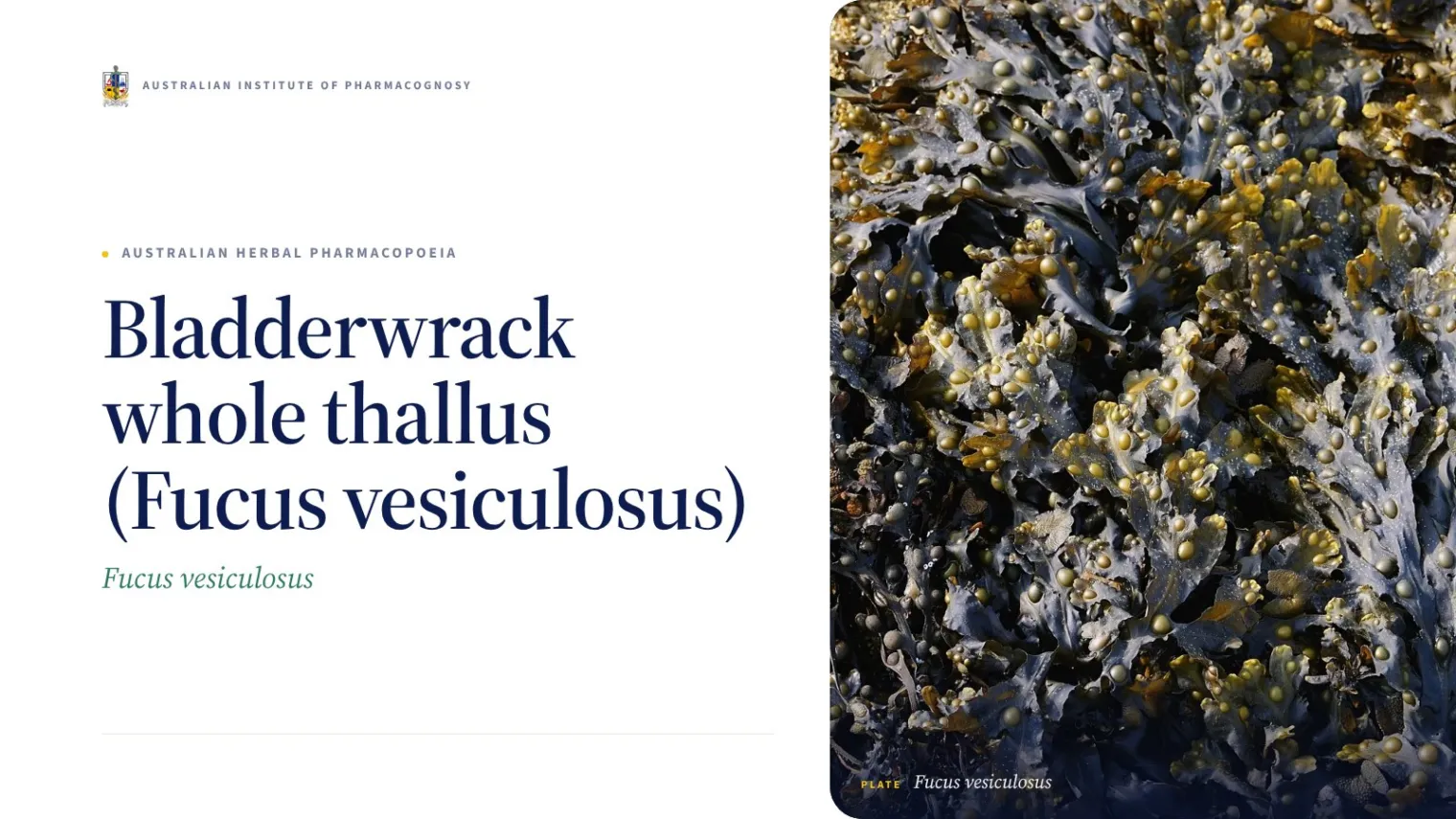
Bladderwrack whole thallus (Fucus vesiculosus L.), Fucaceae (brown alga)
Australian Herbal Pharmacopoeia (working title) · Monograph AIP-PH-FUCVES · Version 1.0 draft
Date: 2026
Status: working document, version 1.0. Not a statutory standard.
Prepared by: Dr Thomas Ridley, Head of Education and Research, Australian Institute of Pharmacognosy, Cardwell, Queensland.

0. Free-teaser block
0.1 Identity card
| Series number | AIP-PH-FUCVES (MediHerb A–Z list No. 19) |
| Title | Bladderwrack whole thallus (Fucus vesiculosus L.), Fuci thallus |
| Version / year | 1.0 draft, 2026. Next review 2029, or sooner if a pharmacopoeia revises its kelp monograph, or if an Australian survey of iodine in bladderwrack products is published |
| Accepted binomial | Fucus vesiculosus L. (Linnaeus, 1753). Accepted. WoRMS AphiaID 145548, taxonomy from AlgaeBase; checked 30/09/2026 [1]. Plants of the World Online does not cover algae, so the algal registers were used in its place |
| Family and higher rank | Fucaceae, order Fucales, class Phaeophyceae (brown algae), phylum Ochrophyta, kingdom Chromista [1]. A brown seaweed |
| Plant part | The whole thallus (the frond, midrib, bladders and fertile tips), dried and fragmented [2,3] |
| Latin drug name | Fuci thallus, the name used by the British Herbal Compendium as HMPC reports it [4]. HMPC heads its monograph Fucus vesiculosus L., thallus [3]; Ph. Eur. admits three species under Kelp, Fucus vel Ascophyllum [2] |
| Principal synonyms | Fucus inflatus L., F. divaricatus L., F. balticus C.Agardh, F. excisus Forsskål, Halidrys vesiculosus (L.) Stackhouse and many infraspecific names, 55 in all [1] |
| Common names | English: bladderwrack, bladder wrack, black tang, rockweed, popweed, sea wrack; often, and loosely, "kelp" [1,5]. Other: Blasentang (German), fucus vésiculeux, varech vésiculeux (French), blaaswier (Dutch), blæretang (Danish, Norwegian), blåstång (Swedish), quercia marina (Italian) [1,3]. TGA ingredient name: FUCUS VESICULOSUS [6] |
| Pharmacopoeial status elsewhere | Ph. Eur.: yes, Kelp (text 1426), which also covers F. serratus and Ascophyllum nodosum [2]. BP: yes, Kelp, as reported [5,7]. EMA/HMPC: yes, traditional-use monograph, 2014 [3]. BHP: yes, 1983 and 1996, restricted to F. vesiculosus [4,7]. BHC 1992: yes [4]. WHO, USP-NF, Chinese and Indian pharmacopoeias: no monograph found in the texts read |
| Australian status | Permissible Ingredients Determination (No. 2) 2026: item 2259 FUCUS VESICULOSUS, purposes A (active), E (excipient) and H (homoeopathic); requirement: "Iodine is a mandatory component of Fucus vesiculosus" [6]. Poisons Standard (June 2026): the plant is not named; iodine is Schedule 2 in preparations for internal use containing 300 µg or more per recommended daily dose [8]. ARTG: MediHerb ThyroCo, ARTG 400153, listed 25/11/2022, 150 mg standardised dry extract per tablet, equivalent to 750 mg dried thallus [9]. Native status: not native to Australia and not known to be established here [10,11]. Queensland: not named in the Biosecurity Regulation 2016 [12] |
| Named markers | Total iodine 0.03 to 0.2 per cent of the dried drug (Ph. Eur. assay) [2]. Iodine from Fucus products not more than 400 µg a day (EMA) [3]. Identity: alginic acid precipitation and swelling index not less than 6 [2]. Safety: arsenic ≤ 90 ppm, cadmium ≤ 4 ppm, lead ≤ 5 ppm, mercury ≤ 0.1 ppm [2]. Proposed, no limit: fucoxanthin (freshness), total phlorotannins |
| Evidence snapshot | Weight loss as an adjunct to a reduced-calorie diet: Tier T, traditional use (EMA). Hypothyroidism and goitre: Tier T, with iodine physiology behind it and no trial of the drug. Post-meal glucose in healthy adults, F. vesiculosus extract: Tier B, no effect, 2 RCTs. Type 2 diabetes, whole dried thallus: Tier C, no effect, 1 pilot RCT. Osteoarthritis, F. vesiculosus fucoidan: Tier B, no effect, 1 RCT. Glycaemia with Ascophyllum–Fucus blends: Tier C, mixed, 4 RCTs (2 read in full). Strength and body composition with an Undaria–Fucus fucoidan blend: Tier C, 1 small RCT. Antioxidant, anticoagulant and anticancer actions: Tier P |
| Suggested citation | Ridley T. Bladderwrack whole thallus (Fucus vesiculosus L.), Fuci thallus. AIP-PH-FUCVES, version 1.0 draft. Cardwell: Australian Institute of Pharmacognosy; 2026. DOI to be assigned |
| Provenance | Original AIP data: none. Every limit, method, analytical figure, trial result and case report here belongs to the source cited beside it. Sections 4, 5, 7, 8, 9 and 10 carry AIP bench data pending: AIP holds no vouchered lot of this drug and has made no section, powder mount, plate, chromatogram or iodine assay of it. Photographs and plates are licensed or public-domain works credited in each caption; F4 is a licensed scanning electron micrograph; F8, F8b, F8c, F9b and F9c are journal figures reused under CC BY 4.0; F3b and F5 are AIP schematics redrawn from cited descriptions; F9 and the F10 series are AIP charts drawn from published data |
| Compiler and review | Compiled by Dr Thomas Ridley (Education and Research). Technical review: Dr Fiona MacAllister (Botanical, sections 1-5, 10), reviewed in 2026; Dr Hana Suzuki (QA, sections 6-10), reviewed in 2026; Dr Eleanor Whitcombe (Medicine, sections 12, 13, 15), reviewed in 2026; Education and Research evidence and citation audit (Dr Thomas Ridley, all references, sections 11, 13, 14 and 16-19 against sources), reviewed in 2026; Jesse Kirby (Community Outreach, page design, figure placement, captions and credit lines, all sections), reviewed in 2026. Published: not yet. Last modified: 2026. Version 1.0 draft |
| Canonical URL | /pharmacopoeia/fucus-vesiculosus/ (on publication) |

0.2 Summary
Bladderwrack is Fucus vesiculosus, a brown seaweed of the cold and temperate North Atlantic and the Baltic. It does not grow in Australia; every gram used here is imported. The drug is the dried whole thallus, the forked, olive-brown frond with its midrib, paired air bladders and swollen fertile tips. The European Pharmacopoeia treats it as one of three species of "kelp", identifies it by its fronds, its powder characters and an alginic-acid test, and assays it for total iodine, which must lie between 0.03 and 0.2 per cent. The thallus is mostly polysaccharide (alginic acid, fucoidan, laminarin), with phlorotannins, the carotenoid fucoxanthin, sterols and minerals; it concentrates arsenic and other metals from the water it grows in. Its medicinal use has always turned on iodine: for goitre, for slow thyroid function and for weight loss. HMPC accepts it as a traditional herbal medicine to help weight loss alongside a reduced-calorie diet. The trials that exist do not show that bladderwrack alone lowers blood glucose, and the one controlled trial of its fucoidan in osteoarthritis was negative. The main safety issue is iodine: a practitioner dose can deliver several times the recommended intake, and case reports link kelp products to thyroid over- and under-activity. People with thyroid disease, those on thyroid medicines or lithium, and women who are pregnant or breastfeeding should not use it without professional supervision. Anyone considering bladderwrack medicinally should consult a degree-qualified herbalist with competencies and adequate training in pharmacognosy.
0.3 Contents with extent
| Section | Content | Pages |
|---|---|---|
| 0 | Free-teaser block: identity card, summary, contents, contributors | 4 |
| 1 | Nomenclature | 2 |
| 2 | Definition | 1 |
| 3 | Source and Australian supply, with 3.1 origin, climate and chemistry | 3 |
| 4 | Macroscopy | 1 |
| 5 | Microscopy | 1 |
| 6 | Chemistry | 2 |
| 7 | Named markers and assay limits | 2 |
| 8 | TLC fingerprint | 1 |
| 9 | HPLC fingerprint | 2 |
| 10 | Identity, purity, adulterants and contaminants | 2 |
| 11 | Traditional use | 1 |
| 12 | Current practice: use, preparations and doses | 2 |
| 13 | Clinical evidence | 5 |
| 14 | Pharmacology | 1 |
| 15 | Safety | 3 |
| 16 | Discussion | 1 |
| 17 | Conclusions | 1 |
| 18 | Research still needed | 1 |
| 19 | References | 4 |
| 20 | Document control | 1 |
| Totals | 21 sections · about 62 printed pages · 42 figures (11 licensed or public-domain photographs, plates and a micrograph, 5 journal figures reused under CC BY 4.0, 8 PubChem structure panels, 2 AIP schematics redrawn from published descriptions, 15 AIP charts and tables, 1 captioned placeholder) · 0 AIP photomicrographs · 0 AIP chromatograms · 20 tables · 8 randomised trials read in full and graded (4 of F. vesiculosus material alone), 3 open or uncontrolled studies and 3 case reports read in full · 49 references; every PMID and DOI resolved on 30/09/2026, and the full text of every cited journal article read |
Known gaps in this version, stated plainly.
- F7, the TLC plate, is a captioned placeholder. No pharmacopoeia has a TLC test for this drug; Ph. Eur. identifies it by macroscopy, microscopy and an alginic-acid precipitation [2]. Europe PMC open-access papers and Wikimedia Commons were searched on 30/09/2026 for a reusable TLC plate of F. vesiculosus; none was found. AIP holds no vouchered lot.
- F4 is a scanning electron micrograph of part of a conceptacle, licensed from Wikimedia Commons. No reusable light-microscope transverse section or powder photomicrograph of the drug was found; the powder characters are shown as an AIP diagram (F5). F3, the dried thallus, is a public-domain herbarium sheet with no scale bar; an AIP photograph of a vouchered lot with a scale bar will replace it. AIP bench data pending.
- Several primary papers are reported second-hand. The Clark 2003 kelp and thyroid trial, the Paradis 2011 crossover trial, the Derosa 2019 trial in dysglycaemia, the Zaragozá 2008 rat toxicity study, the Arbaizar 2011 lithium case and other case reports reach this monograph through the HMPC assessment report, Barnes, or the Keleszade review, each read in full. Their primary papers, with the Murray 2021 twelve-week trial, the Crawford 2010 Australian iodine-toxicity report, the Nitschke 2018 and Teas 2004 iodine-variability studies and the Harrell 1976 acne letter, are on the library fetch list and have not had the integrity screen. The 1976 Italian controlled trial of bladderwrack in obesity (Curro and Amadeo) is known only as Mills and Bone cite it [13].
- Searches not completed. ANZCTR and ClinicalTrials.gov were searched on 30/09/2026 (section 13.1), but the WHO ICTRP portal returned incomplete results and was not relied on; Cochrane CENTRAL and Embase were not searched; the TGA Database of Adverse Event Notifications could not be queried, so Australian spontaneous reports are unreviewed; DAFF BICON import conditions, the IUCN Red List and CITES were not queried; PubPeer was not checked for the cited papers; GBIF could not be reached, so the distribution map uses OBIS.
- The British Herbal Pharmacopoeia and British Herbal Compendium were not read directly. Their doses and indications are quoted as HMPC reports them [4]. The Ph. Eur. text read is the 8.0 edition held in the library; the edition in force, the 12th (reported effective 01/01/2026), was not read, so every Ph. Eur. figure is to be checked against the current text before AIP releases a lot (section 7).
- No Australian measurement of iodine in bladderwrack products was found. Section 12’s iodine arithmetic uses the Ph. Eur. range, which is a specification, not a survey.
0.4 Contributors and paywall notice
Prepared by: Dr Thomas Ridley, Head of Education and Research.
Contributors: listed with the monograph and resolved from the Legal byline roster by the publication pipeline for each department that reviews the draft. Dr Luke Iggulden set the scope of the Pharmacopoeia in the directive of 22/09/2026; he did not write this monograph.
What is free and what is not. Everything above the free-sample line is free to every reader. The remaining sections, macroscopy and microscopy, chemistry and markers, the identity tests, purity and contaminants, tradition, doses, graded evidence, pharmacology, safety and references, are read by Scholar-level members and above under a revocable personal licence. Nothing behind the line contradicts anything in front of it.
The Australian Herbal Pharmacopoeia is the name of a reference series published by the Australian Institute of Pharmacognosy. It is not a statutory standard under the Therapeutic Goods Act 1989 and carries no official, government or national-standard status.
35 more pages follow · 17,355 words, 40 figures, 17 tables
Still to come in this monograph
- 1. Nomenclature
- 2. Definition
- 3. Source and Australian supply
- 4. Macroscopy
- 5. Microscopy
- 6. Chemistry
- 7. Named markers and assay limits
- 8. TLC fingerprint
- 9. HPLC fingerprint
- 10. Identity, purity, adulterants and contaminants
- 11. Traditional use
- 12. Current practice: use, preparations and doses
- 13. Clinical evidence
- 14. Pharmacology
- 15. Safety
- 16. Discussion
- 17. Conclusions
- 18. Research still needed
- 19. References
- 20. Document control
The rest of this monograph is open to members. One membership covers every members’ feature on the site.
Checking your membership…
Report an error or submit evidence
If something in this monograph is wrong, out of date or missing, tell us and show us the evidence. Every report is logged under the AIP Evidence Charter and assessed on the evidence alone; the outcome is kept on the record, and an upheld report is corrected with a dated notice on this page.
Open the report form
The Institute sets and publishes its own monographs. The catalogue is in Publications.