

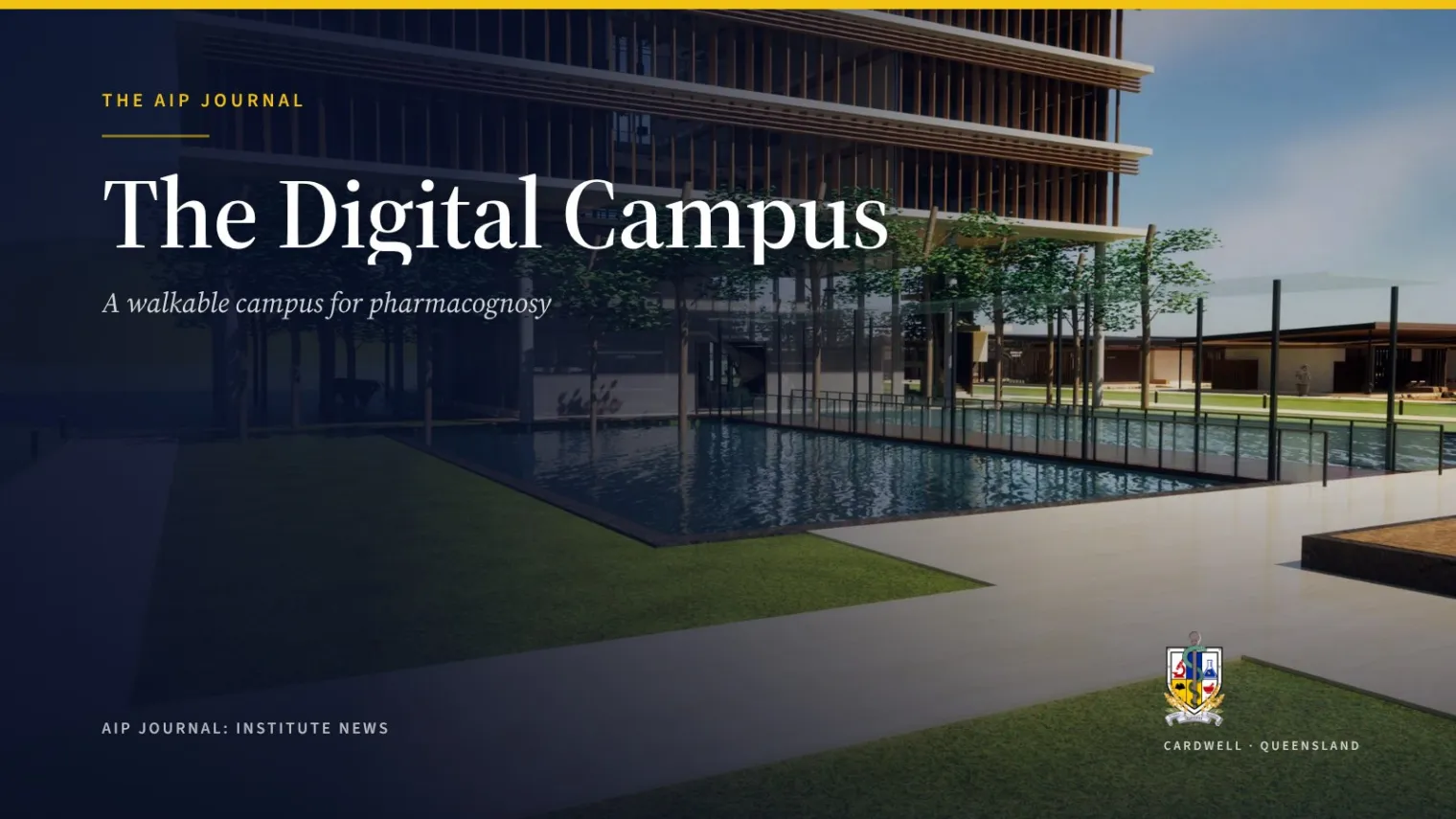
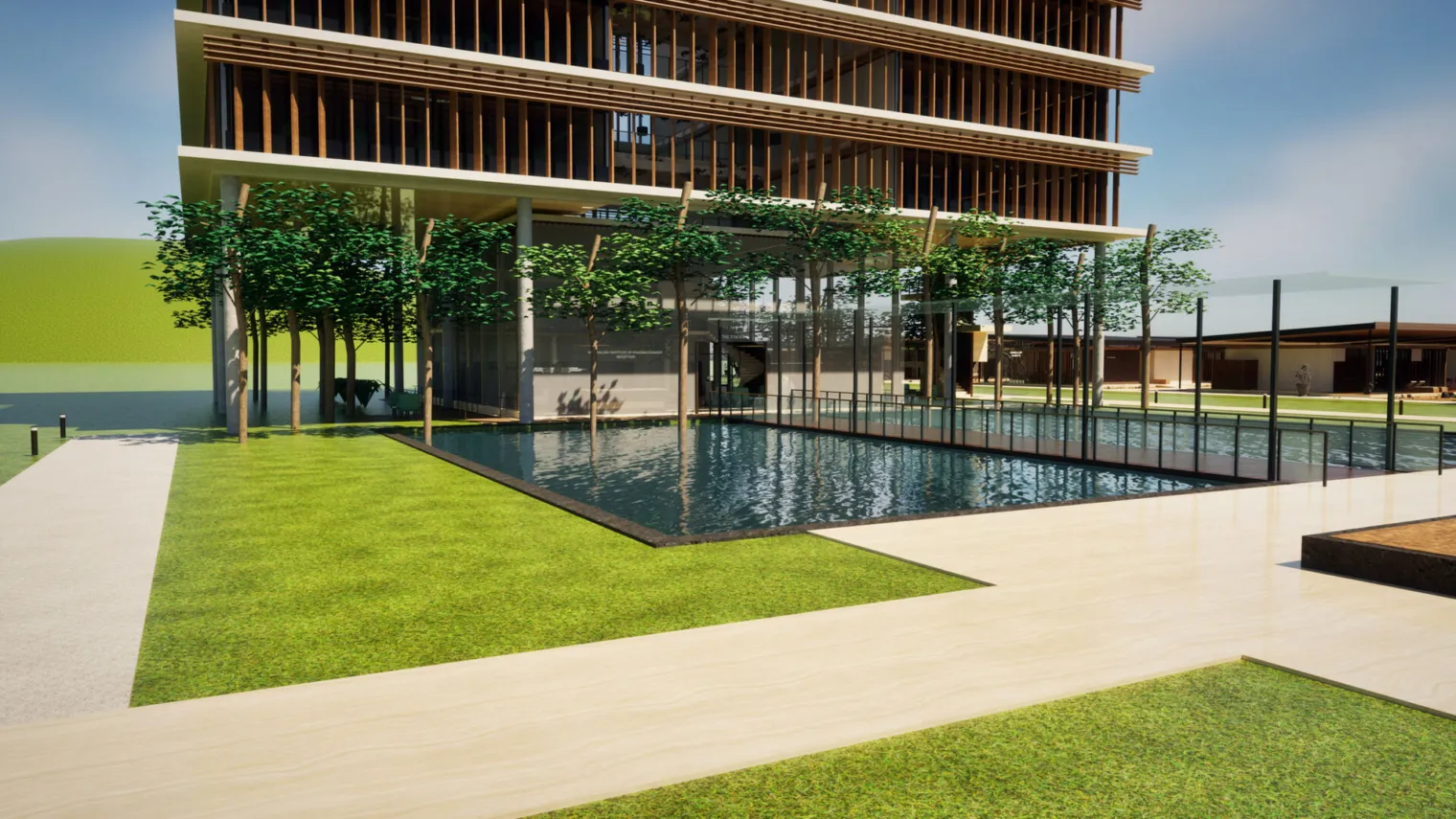
Cover: The Digital Campus today. The Institute’s entrance, the reflecting pool and the forecourt, rendered with the path tracer in the current Unreal Engine build. Image: Australian Institute of Pharmacognosy, October 2026.
Walk along a path beside a long reflecting pool, cross to a building of timber and glass, and go in. On the ground floor is a library, and every book on its shelves stands for a real record in the Institute’s catalogue. Upstairs are lecture theatres and teaching laboratories. This is the Digital Campus, and parts of it already run.[1] Confirmed
The Australian Institute of Pharmacognosy is building a complete, walkable campus in Unreal Engine, the real-time engine behind many large games and a good deal of film and television work.[2] Attested It is set on a stretch of tropical Queensland coast, the wet-tropics country around Cardwell where the Institute is based. Dr Iggulden’s direction for it is short: it is a working campus and the front door to the Institute, and it must never be a toy, a showpiece or a picture of a campus. Everything in it has to do something real.[3] Attested
This article sets out the concept, why the Institute is building it, what we think is new in it, what the research on virtual laboratories does and does not tell us, and the honest difficulty of doing in-house a kind of job that is normally done by very large teams. A lot of it is still to come. We say so as we go, and every picture is labelled one of two ways.
Institute news. The campus is in development and is not yet open to students. Plans and timelines described here are plans, and may change. Every source was read by the Institute in October 2026.
The Digital Campus today means the picture was captured from the current working build of the campus, or rendered from models that are already in it. It shows the campus as it is now, unfinished parts included.
Some of these stills are path-traced in the build’s photo mode and colour graded, so they look more finished than the campus does in real-time play.
Concept is the label the Institute uses for pictures of design work on parts of the campus that have not been built yet. Every picture in this article is of the first kind: the campus as it stands today.
| Where it stands | ||
|---|---|---|
| What it is | A walkable campus built in Unreal Engine on the Institute’s real library system, with the course system still to be connected; the design rule is that nothing in it is there for show | Attested §1 |
| The library | All 801 catalogue records stand on the shelves as spines; 240 public books open in the Institute’s library reader, which can read them aloud | Confirmed §5 |
| Teaching floors | Two lecture theatres (48 and 30 seats), seminar rooms and laboratories are built; lectures, enrolment and attendance are not connected yet | Confirmed §5 |
| Laboratory practice | A botanical handling exercise runs in guided, sandbox and assessment modes; the chemistry engine for real extractions is still a plan | Confirmed §5 |
| What the research says | Virtual labs improve test results and motivation on average, with very uneven study quality, and support hands-on lab work best when combined with it | Evidence suggests §4 |
| The hard part | Comparable worlds are built by teams in the thousands; the Institute is working with a small team, the engine, open assets and automation | Attested §6 |
| Timeline | Roughly two years to a campus open to students, in four phases; indicative only | §7 |
- Confirmed Checked by running the current build, or read from the Institute’s own build records and measurements.
- Evidence suggests Real published data, but with small, uneven or unreplicated studies behind it.
- Mechanism A reasoned inference about how something should work, short of a measured outcome.
- Attested A documentary fact stated in a named record: a published source, a licence, a manufacturer’s documentation or one of the Institute’s written directions.
Plans are written as plans and carry no tag. Every PubMed ID (PMID) links to its record.
The Digital Campus is a complete world in Unreal Engine: an Institute building on the tropical Queensland coast, with a library, lecture theatres, teaching laboratories, a village for the research staff and forest around it. Underneath it sits the Institute’s real library and records system, and the rule is that the world never fakes anything. A shelf holds real catalogue records. A feature that is not yet wired to a real system is marked as not yet connected.[3] Attested
Some of it runs today. The building, the library with all 801 catalogue records on its shelves, the lecture theatres and laboratories, a laboratory handling exercise that checks quantities and the order of steps, a village of 24 villas and 24 staff characters are all in the working build. Lectures, visitor sign-in, many users at once and the chemistry engine are still to come.[1] Confirmed
The reason is teaching. Pharmacognosy asks a student to connect the living plant, the dried drug, the extract and its chemistry, and few places anywhere put a forest, a herbarium, a laboratory, a library and a dispensary within walking distance of each other. The campus is meant to give students that place, wherever they live.
Published reviews suggest virtual laboratories raise test results and, by a wide margin, motivation, though the studies are uneven and the authors find they support physical labs best when the two are combined. The Institute will treat its own campus the same way, as a hypothesis, and will propose a proper study before claiming any learning gain.[4, 5] Evidence suggests
The largest game-development team on record ran to about 2,000 people. The Institute is attempting work of a comparable kind in-house with a small team, a modern engine, freely licensed assets and a build driven by scripts. Faces, forests, the chemistry engine and getting the campus to students on ordinary computers are the hardest parts, and the plan runs to about two years.[6, 7, 8] Attested
1. The concept: a campus that does real work
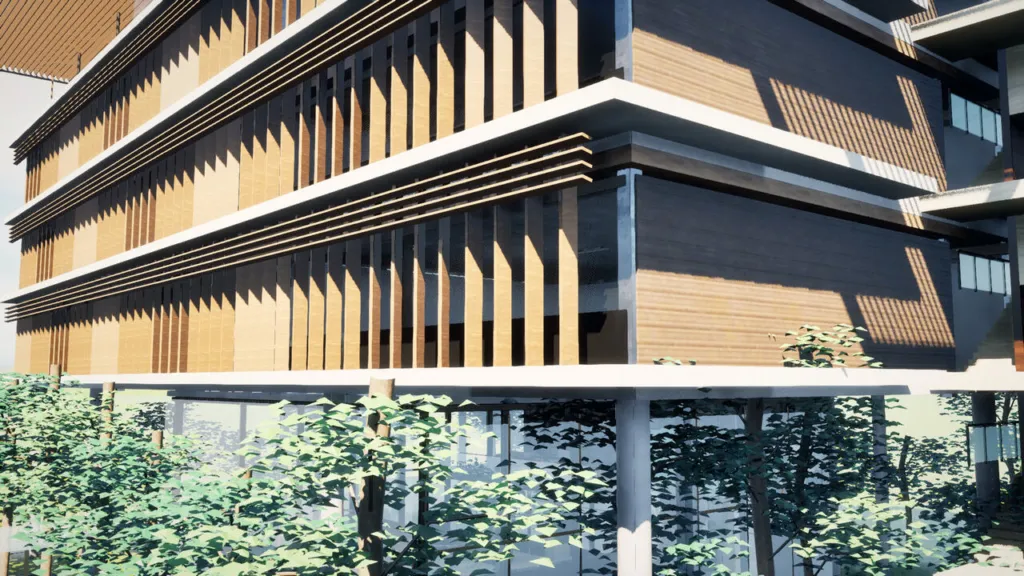
Picture the approach. A path comes in through forest and opens onto a long reflecting pool. A bridge crosses the water to the front doors. The building rises in five levels of glass behind timber fins, and inside, a staffed reception desk faces the door, with a directory listing every department by floor. That arrival sequence is already in the build: the bridge, the pool, the forecourt, the reception desk and the directory are all there.[1] Confirmed The forest around it is not finished yet, and section 6 explains why.
Two layers and one rule
The campus has two layers. Underneath is the Institute’s own system: the library catalogue, the files, the accounts, the access control and the work records of each department. On top is the world people walk through. Dr Iggulden designed the arrangement so that the world never invents anything of its own. A shelf holds real catalogue records. A catalogue terminal searches the live catalogue. An office shows its owner’s real work. A printer prints once it is wired to the real printing service, and until then it says “not yet connected”.[3] Attested
We call this the no-fakes rule. If a feature is not wired to a real system yet, it stays closed or is marked as under construction. Decorations, characters and animation sit on top and can never change a real record. The world does not make up its own permissions either: who can see or open what is decided by the Institute’s clearance rules and its personnel decisions, exactly as it is outside the campus.[3] Attested
Dr Iggulden has also ruled that nothing in the campus should open as a page or a window. Information is meant to build up in the space around you as light and form, the way a book will one day open in your hands. Where the current build still opens a page, that page is on the list to be replaced.[3, 1] Attested
Three places
The world holds three places, each with its own job. The Institute stands on the coastline and holds the library, lecture theatres, laboratories and seminar rooms. It is a place of research and teaching, and its laboratories carry modern equipment. A short walk away is the scientists’ village, where each member of the research staff has a home built around their discipline and interests: a home lab for a chemist, a glasshouse for a botanist. Out in the hills is the Sacred Herbology settlement, with its ceremonial grove on the ridge, governed by Ambrose Fenwick. It holds the ceremonial and esoteric side of the tradition under its own name and brand, and nothing is built there until he has checked it for accuracy.[3] Attested
Keeping the three apart matters to a scientific institute. A student should always know which kind of knowledge they are standing in front of: laboratory science in the Institute, the living tradition in the settlement, each given its due.
2. Why the Institute is building it
Pharmacognosy is hard to teach
The Institute exists because we love herbal medicine and the plants it comes from. Pharmacognosy, the study of medicines from natural sources, joins botany, chemistry, pharmacology and clinical practice. A student has to hold all of them at once: the living plant in the forest, the dried material on the bench, the extract in the flask, the compounds in the extract and the person who will take it.
That breadth is what makes it hard to teach. A pharmacognosy student needs a herbarium, a laboratory with extraction and chromatography equipment, a library deep in both modern and historical literature, a dispensary and, ideally, a forest. Few institutions bring all of those together. A student in a regional town, or on another continent, may have none of them nearby.
Why a place you can walk into
Online courses already exist, and they are useful. Most of them are videos, slides and quizzes. They tell a student about an extraction, and they describe a library. The campus is meant to let the student do the extraction and browse the library. You learn where things are by walking to them. You learn a procedure by carrying it out in the right order and being stopped when you skip a step. You meet the plant before you meet its chemistry.
Cost and access are part of the case. Reviews of the field list the same practical advantages for virtual laboratories again and again: lower cost than equipment, space and technical staff, access at any hour from anywhere, no exposure to hazardous set-ups, and the freedom to change a variable and run an experiment again in minutes.[5, 4] Attested For a small institute in far north Queensland that wants to teach people who will never visit Cardwell, those advantages decide a great deal.
A student’s day, as it is designed to work
Maya is an illustrative student in Townsville, enrolled in a short course on extraction methods. She signs in, chooses a character and appears on the forest path. At the reception directory she finds her lecture on Level 3, takes the lift, sits down, and the course system marks her present. Afterwards she goes down to the library, searches a terminal for a text on percolation, takes the book off the shelf and has it read aloud as she walks.
In the teaching laboratory she starts the practical in guided mode. She weighs her dried plant material, measures the solvent and sets up the percolator, the same method the Journal has described in Cold Percolation: Apparatus, Mechanics and Practice. When she tries to add the solvent before packing the column, the bench stops her and explains why. Next week she runs the practical again in assessment mode with no hints, and her notebook goes into the Institute’s records labelled as a simulation. When she finishes the course, her certificate of completion comes from the real course system; it is not an accredited qualification.
Some of that day exists now: the reception directory, the lift, the lecture theatre, the library shelves, the catalogue search, the read-aloud voice and the guided and assessment modes of the bench exercise. The rest is the plan: sign-in for visitors, lectures playing in the theatre, the book opening in the space around her, and a bench that computes an extraction.[1] Confirmed
3. What is new about it
Virtual laboratories are decades old; one bibliometric review counted 9,523 publications on them in higher education between 1991 and 2021.[5] Attested The Institute thinks five things about its campus are new for herbal medicine and pharmacognosy teaching. They are claims about what the campus will make possible, and section 4 explains how we intend to test them.
- Every room does a real job. Many virtual campuses are models of a building with a video player inside. In this one the library holds the real catalogue, the seats are designed to record attendance, and the notebook keeps real records. The campus is a way into the Institute itself.[3] Attested
- Hands-on extraction practice at any distance. A student in Cardwell, in Cairns or overseas can practise setting up a maceration or a percolation step by step, on a bench that checks their quantities and their order of work. Today’s bench checks the handling; the extraction chemistry is still to be built.[1] Confirmed
- The chemistry will be computed and the sources shown. The planned chemistry engine starts from RDKit, an established open-source chemistry toolkit, to work out structures and properties. Yields, outcomes and hazards are to come from referenced data, and anything the engine cannot compute stays labelled as illustrative. A virtual lab that tells you when it is guessing teaches better science.[9, 3] Attested
- The whole discipline in one place. Forest, herbarium, library, laboratory, dispensary and lecture theatre stand within walking distance of each other, the way a student’s understanding ought to connect them.
- Tradition and science side by side, and clearly labelled. The Institute teaches the science, and the Sacred Herbology settlement holds the ceremonial and esoteric tradition under Ambrose Fenwick’s governance, each in its own place under its own name and brand.[3] Attested
Plants drawn live, from the record
One more piece belongs here. In the deeper layer of the system, which Dr Iggulden calls the vector OS, plants are never shown as photographs. When a plant is opened, a generator is to draw a botanical plate of that species on the spot from its library record: leaf shape, venation, leaf arrangement, flowers and habit, in fine line work. The drawing builds itself in front of you, line by line, in the order it is made. If the record does not hold enough detail to draw the species accurately, the drawing says so and stays partial. It never invents a feature.[3] Attested This is a plan, and it has not been built yet.
A safeguard for a scientific institute
When a student’s notebook is sent into the Institute’s records, it is tagged as a simulation; that export path is built and tested, though no student notebook has been sent yet. A virtual extraction can never become a scientific finding. The campus can teach how an extraction is done; it cannot stand in for the bench work that produces evidence.[1] Confirmed
4. What the research on virtual laboratories says
Before the Institute claims anything about learning, it is worth reading what the existing research shows. Two open-access reviews, both read in full, frame it well.
The largest recent pooled estimate
Li and Liang pooled 46 studies from 22 publications that compared students taught with a virtual laboratory against students taught without one, in engineering education. They screened 709 records to get there. Across all outcomes the pooled effect was a Hedges’ g of 0.686 (95% CI 0.414 to 0.959), a moderate-to-large effect by the usual rule of thumb.[4] Evidence suggests
The effect was very uneven by outcome. Motivation (g = 3.571) and engagement (g = 2.888) were far ahead of knowledge acquisition (0.865), cognitive ability (0.639), operational skill (0.620) and exam results (0.574). Heterogeneity was extreme (I² = 94.8%), the funnel plot suggested publication bias, and most studies gave no detail of randomisation or blinding. Effects ranged from about 3.0 in studies from Nigeria to effectively zero (0.006) in studies from the United States.[4] Evidence suggests
The authors’ own conclusion is measured. Virtual labs have not replaced hands-on laboratories in engineering education. They make up for shortfalls in physical facilities and lift motivation, and the authors see deliberate blending of virtual and physical work as the way forward.[4] Evidence suggests
Thirty years of the literature
Raman and colleagues mapped 9,523 publications on virtual laboratories in higher education from 1991 to 2021. More than 72% appeared from 2011 onward, with the most in 2020 and 2021, when the pandemic closed physical labs. Their review collects the practical case (lower cost, access at any time and place, safety, easy changes to an experiment) and records a recurring finding that combined physical and virtual labs are frequently needed, blended to suit the learning objective.[5] Evidence suggests
What this means for the campus
Three things follow, and they shape how the Institute will describe its own work. First, the evidence is strongest for motivation and engagement and weaker for skills and examination results, so a beautiful campus cannot be assumed to teach better. Second, almost none of this literature is in pharmacognosy or herbal medicine; it is mostly engineering and general science, and it may not transfer. Third, the consistent advice is to combine virtual practice with real bench work. The campus is designed for that: it teaches the order and handling of a procedure, and a supervised bench session remains where competence is shown.
So the five claims in section 3 are hypotheses. Education and Research will propose a study before any public claim about learning outcomes is made. A sensible design would compare students who practise an extraction procedure in the campus with students taught the same procedure from video and written instructions, then measure procedural accuracy, knowledge and confidence before a supervised bench session. Any study with human participants needs review under the National Statement on Ethical Conduct in Human Research before it starts, and the decision to run it and to publish rests with Dr Iggulden. Until results exist, we will describe the campus by what it does.
5. What is built today
The campus runs today as a native Unreal Engine 5.8 build on a single workstation at the Institute in Cardwell. It is a playable development build for one operator at a time. It has been run and checked, and it has not been released to anyone outside the Institute.[1] Confirmed
Working and checked
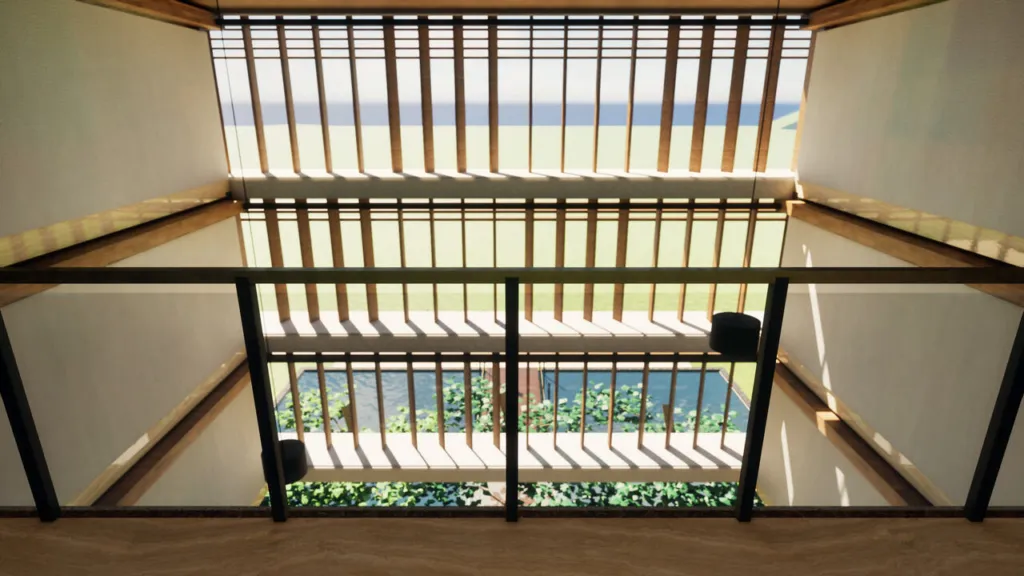
- The building. The library on the ground floor, a staffed reception, fourteen departments on Levels 2 to 5 around a glazed light well that brings daylight down into the library, switchback stairs, a working lift whose landing gates open only where the car stands, and a roof terrace.[1] Confirmed
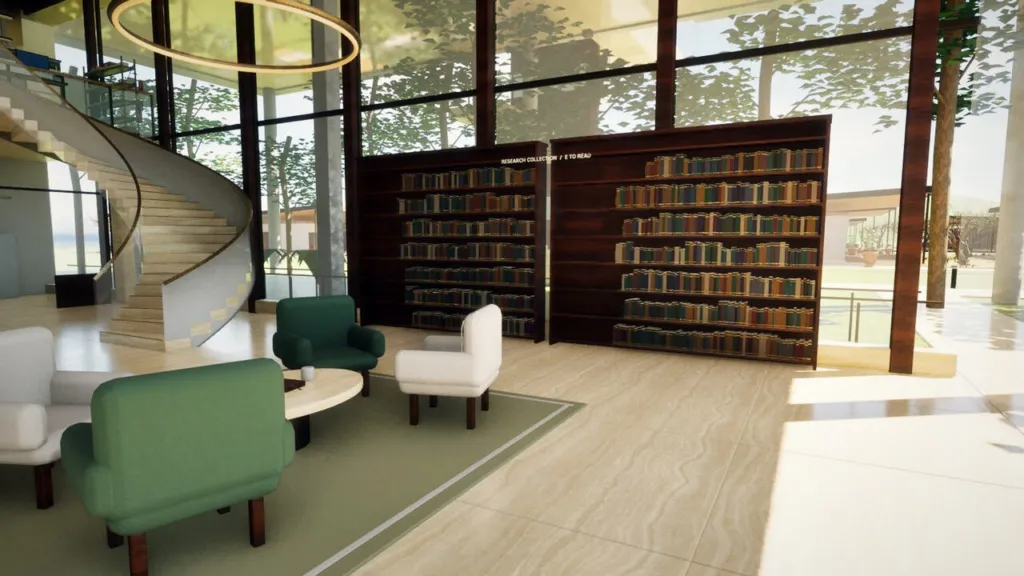
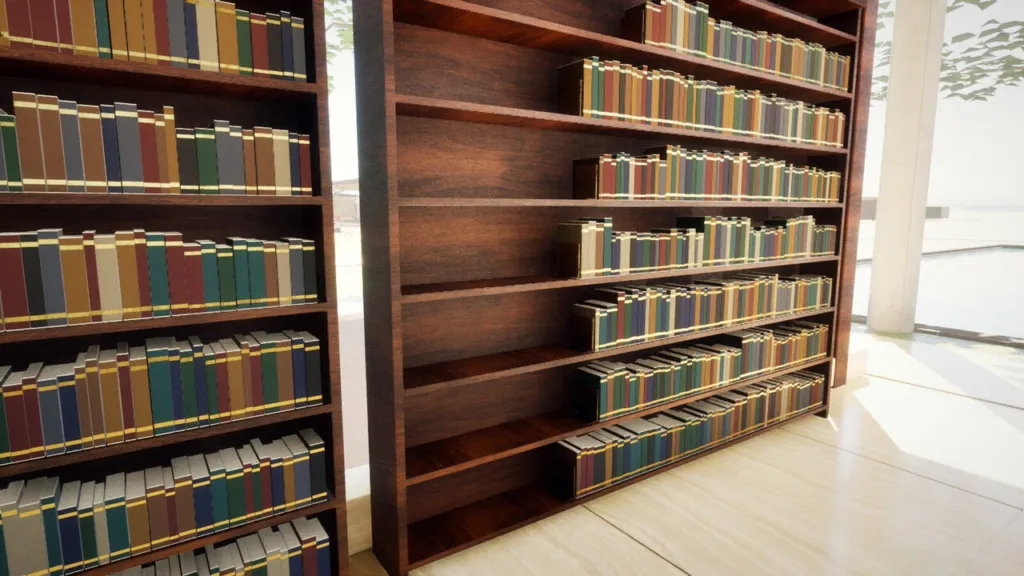
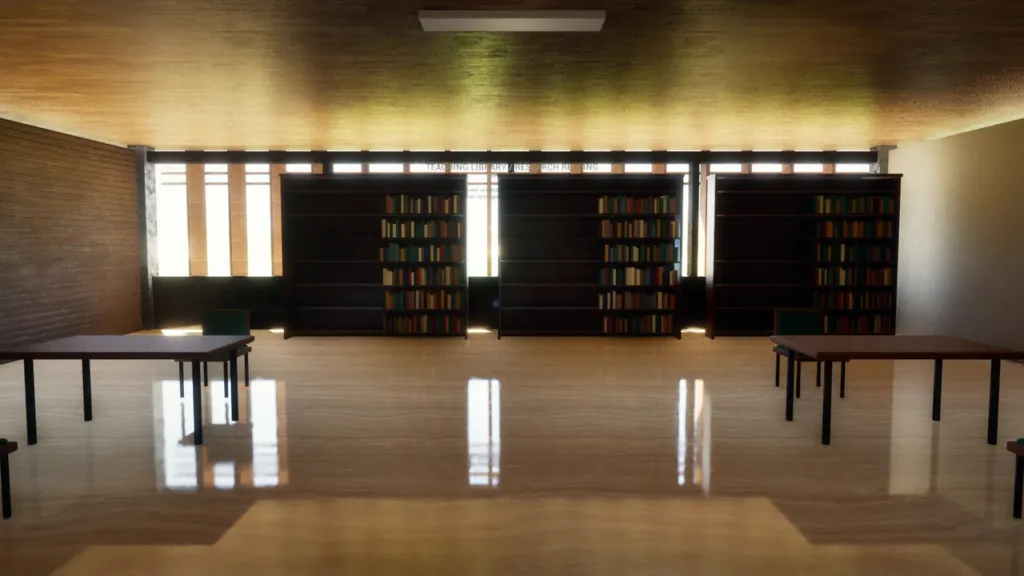
- The library. All 801 records in the Institute’s catalogue stand on the public shelves as cloth-bound spines, each belonging to its own record. 240 public books are wired to open in the Institute’s library reader, which reads aloud in natural-sounding voices, highlights each sentence as it is spoken and can export a book as audio. The catalogue terminals search the live catalogue through the library’s own sign-in.[1] Confirmed
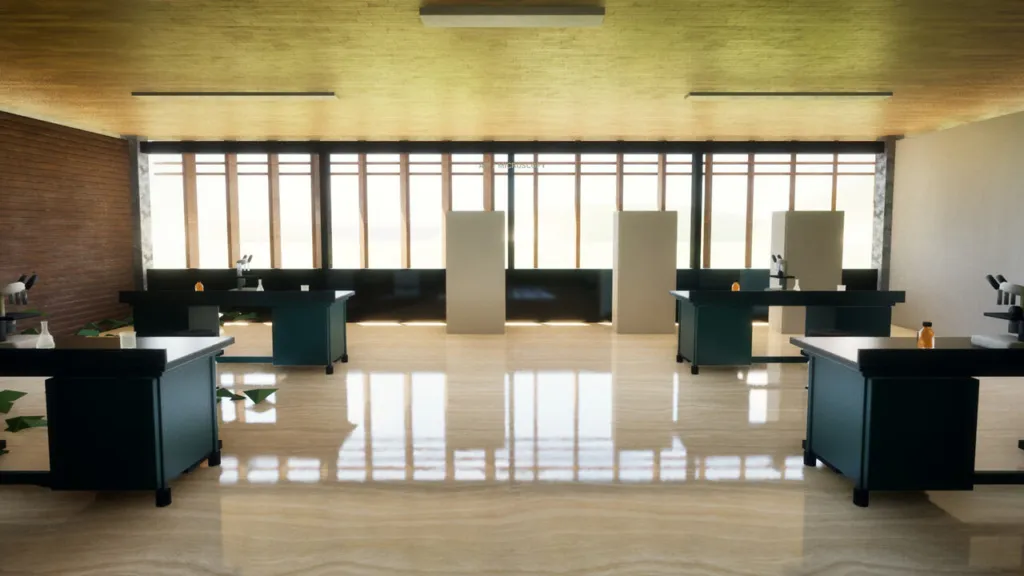
- The teaching floors. Two lecture theatres seating 48 and 30, seminar and tutorial rooms, a teaching library, and laboratories for wet chemistry, analytical chemistry including thin-layer and high-performance liquid chromatography, microscopy, the herbarium, dispensing practice and electronics, fitted with authored instruments.[1] Confirmed
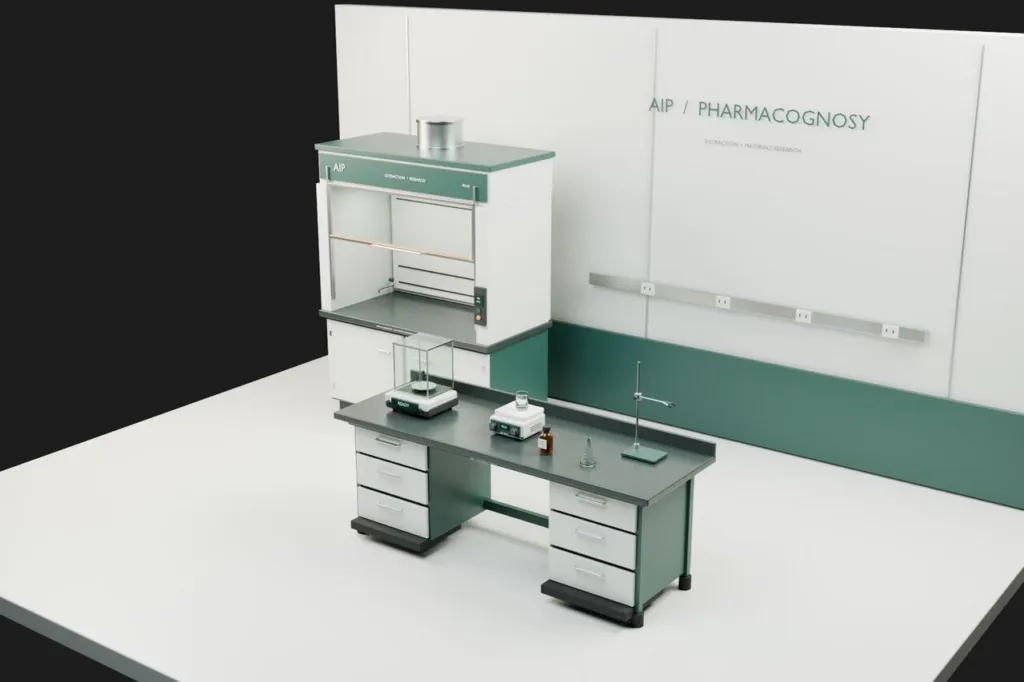
- The laboratory exercise. A botanical handling exercise in which the student selects a material, weighs it, transfers it, mixes it and records it, and the system checks the quantities and the order of steps and refuses a wrong one. It runs in guided mode with hints, sandbox mode for free practice, and assessment mode with the hints hidden. The notebook persists between sessions. The exercise logic runs in the campus laboratory service and has been tested there; a complete run-through at the bench inside the 3D world is still to be checked. Eight pieces of chemistry equipment were modelled for the campus: fume hood, bench, balance, hotplate, retort stand, beaker, flask and specimen bottle.[1] Confirmed
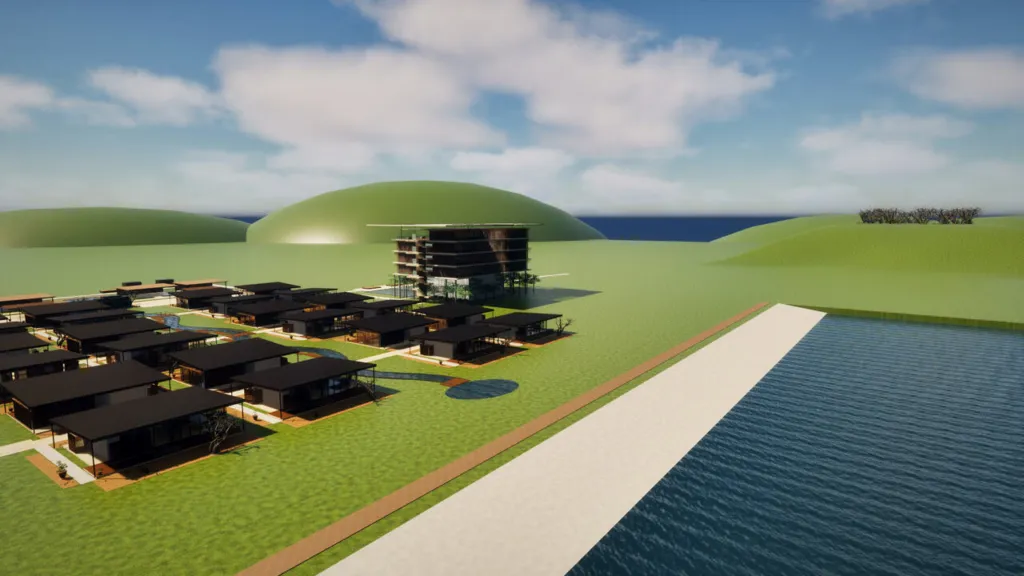
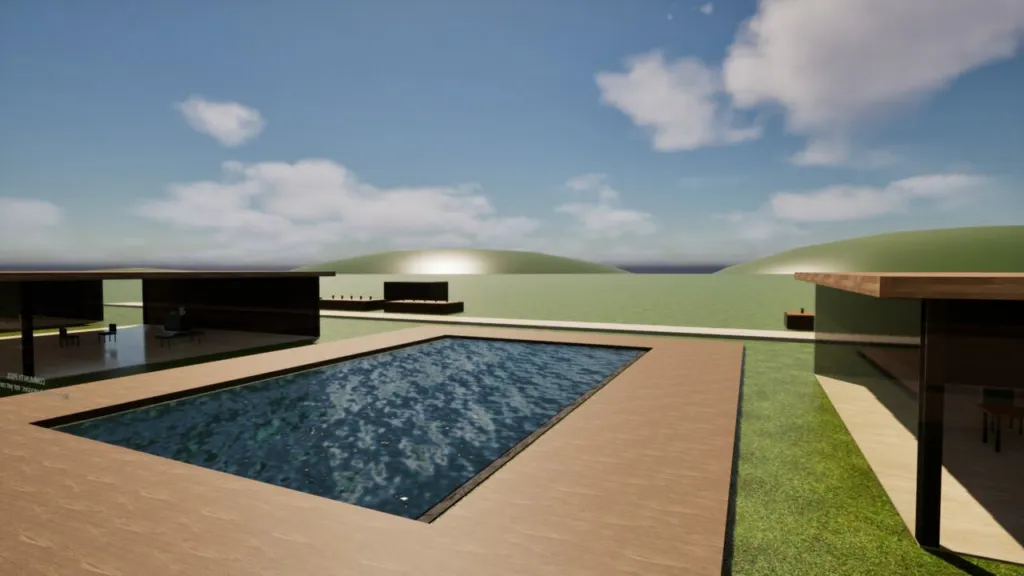
- The village and the hills. 24 villas with kitchens, living rooms, studies, decks and plunge pools, the village lanes, a stream, a waterfall and a pond, and the layouts of the Sacred Herbology settlement and its ceremonial grove on the ridge.[1] Confirmed Every ritual detail of the grove and the settlement is still concept and waits for History and Philosophy’s accuracy review.
- People. 24 individual staff characters, each built from the person’s portrait, who walk, sit, type, read and gesture. The campus works with keyboard and mouse and with PlayStation controllers.[1] Confirmed
- Picture quality and speed. Hardware ray-traced lighting and reflections, Nanite geometry, volumetric clouds and fog, a full day and night cycle, and a photo mode that path-traces a still image. In a 3,600-frame trace at 1080p on 11/10/2026, walking the library, its stair and the garden before hardware ray tracing was switched on, the build ran at its 30 frames per second cap at the median, with the graphics card busy for a median 11.3 milliseconds of each 33-millisecond frame; with the cap removed it ran at a median of about 121 frames per second. The whole campus as it stands now has not yet been traced the same way.[1] Confirmed
The honest gaps
The build team keeps a candid list of what falls short, and it belongs in any fair account of the project.[1] Confirmed
- The forest. In the build of 12/10/2026 the 1,204 trees placed across the wider landscape did not render, and the land past the forecourt is still bare lawn; the grey villa planting seen in that build has since been repaired. The hills are smooth. The forest is the largest single piece of art still to do.
- Faces and movement. The staff characters are recognisable from the front and are not yet true likenesses. Hair is simplified, poses are stiff up close, and there are no first-person arms yet. For that reason the Institute is not using footage of the current characters in public material.
- Furniture and finish. Upper-floor rooms use simple development furniture, and the library spines do not yet carry titles.
- Connections. Course playback, enrolment, attendance, visitor sign-in, many users at once, spoken interaction inside the campus and the chemistry engine are all still to be connected or built.
- Pages. In places the build still opens a page or a window, which Dr Iggulden has ruled out. Each one will be replaced with an in-world form.
6. The challenges of a studio-sized job, done in-house
How big these jobs usually are
The largest development team on record for a single video game worked on Red Dead Redemption 2: according to the game’s producer, about 2,000 Rockstar employees worked on it over the years 2010 to 2018, around 1,600 of them directly on development.[6] Attested Open worlds of that kind are made by artists, programmers, animators, designers and testers in their hundreds or thousands. The Institute is attempting work of a comparable kind with a small team. That is the central challenge of the project, and it is worth saying plainly.
Why it can be attempted at all
Four things make it possible. The first is the engine. Unreal Engine comes with lighting and geometry systems that once took a studio years to write. Its Lumen system computes global illumination and reflections dynamically, from millimetres to kilometres, and its Nanite system draws very detailed geometry by doing work only on the detail visible on screen.[10, 7] Attested The same engine rendered more than 60 photoreal virtual environments in real time for the first season of The Mandalorian.[2] Attested
The second is open assets. Freely licensed textures and models from libraries such as Poly Haven and ambientCG, both released under the CC0 public-domain dedication for any use, furnish much of the campus.[8, 11] Attested The third is automation. The build is driven by scripts that import, check, capture and measure, so one person can run work that would otherwise need a department.[1] Confirmed The fourth is that the hard part underneath already exists: a real library, a real catalogue, real access control and the Institute’s records. The campus is a new way into systems that already work.
The specific hurdles
- Hardware. The whole campus runs on one workstation, and its graphics card is shared with the Institute’s other work. The build has already crashed for lack of graphics memory when another task took the card mid-session, so render and video work is scheduled around everything else.[1] Confirmed
- Faces. Believable faces are among the hardest problems in computer graphics. Masahiro Mori observed in 1970 that a figure which is nearly human, and then found to be artificial, gives an eerie sensation, and he advised designers to aim for a lower degree of human likeness that people find comfortable.[12] Attested Getting the staff, and eventually every visitor, to look like themselves without falling into that valley is long, careful work.
- The forest. A rainforest is millions of leaves. Rendering it well at a frame rate a student’s computer can manage is a serious technical problem, and it is where the current build is weakest. Mechanism
- Scientific accuracy. A chemistry engine that tells the truth, cites its sources and admits what it cannot compute is a research project in its own right. Its scope and the choice of engine go to Dr Iggulden, as Chief Scientific Officer, as a proposal before any build starts.[3] Attested
- Many users. Today’s build serves one person at a time. Opening it to classes means secure sign-in, privacy for profile photos and records, and servers to carry the load. A visitor’s profile photo will be used only to make their character, with their consent, under the Australian Privacy Principles and the Institute’s privacy policy, and never to identify anyone by their face.[3] Attested
- Getting it to students. A campus of this quality needs a capable computer. The Institute still has to decide how students reach it: by download, by streaming, or both.
- The no-fakes rule itself. It makes the project slower, because nothing can be dressed up to look finished. It is also what will make the campus worth trusting.
7. Where it is going
The timeline below is indicative and set out for planning. It is not a commitment. The order of the work is clearer than the dates, and Dr Iggulden sets the priorities.
| Phase | Indicative timing | The work |
|---|---|---|
| 1. Foundations made beautiful | Late 2026 to early 2027 | Finish the forest and landscape. Bring the library to full quality, with titled spines and the first book that opens in the space around you. Replace the remaining pages with in-world forms. Improve faces and movement. |
| 2. The teaching floors switch on | First half of 2027 | Connect the lecture theatres to the course system for recorded lectures and attendance. Put the chemistry engine proposal to Dr Iggulden as Chief Scientific Officer and, on approval, build its first stage. Run the first extraction practical on it in guided and assessment modes. |
| 3. People arrive | Second half of 2027 | Visitor sign-in and characters made from profile photos, under the privacy rules. Several users in the world at once. Live lectures. A small pilot group of students, with an evaluation study designed, put to Dr Iggulden, and submitted for human research ethics review. |
| 4. The full campus | 2028 | Field botany walks in the forest, with botanical plates drawn live from the library’s records. More practicals in microscopy, chromatography and dispensing. The village completed, and the Sacred Herbology settlement and its grove completed under Ambrose Fenwick’s direction and checked by him for accuracy. Workshops held in the world, and the campus opened to students. |
You can follow the work on the Digital Campus page, which carries the latest pictures and the preview film. The campus is one of the ways the Institute hopes to reach the people it serves, and our earlier article on why a small research institute needs its community explains how that community keeps this kind of work going. The plant knowledge the campus will teach is already being published, monograph by monograph, in the Australian Herbal Pharmacopoeia.
Discussion: conclusions, hypotheses and research still required
What the evidence supports
- A working development build of the campus exists, with the building, the library holding all 801 catalogue records, the teaching floors, a checked laboratory handling exercise, a village and 24 staff characters, measured in October 2026, in a walkthrough of the library area, at a median of 30 frames per second at 1080p on one workstation.[1] Confirmed
- Across 46 controlled studies in engineering education, virtual laboratories improved outcomes on average (g = 0.686), most strongly for motivation and engagement, with high heterogeneity, signs of publication bias and weak reporting of randomisation and blinding.[4] Evidence suggests
- The literature repeatedly recommends combining virtual and physical laboratory work, blended to the learning objective.[4, 5] Evidence suggests
- Building worlds of this kind has usually taken very large teams; the largest on record numbered about 2,000 people.[6] Attested
What we can reasonably hypothesise
- Practising a pharmacognosy procedure such as percolation in the campus, with step and quantity checks, will improve procedural accuracy at a first supervised bench session compared with video and written instruction alone. Mechanism
- Placing the forest, herbarium, laboratory, library and dispensary within walking distance of each other will help students connect a plant’s botany with its chemistry and its preparation. Mechanism
- A virtual laboratory that labels what it cannot compute will leave students with a more accurate sense of experimental uncertainty than one that presents every result as certain. Mechanism
- The motivation effect seen in engineering studies will appear in herbal medicine students too, and may fade as the novelty wears off; only a study that runs over a full course can tell. Mechanism
Research still required
- Education research. A controlled comparison of campus practice against video and written instruction for one extraction procedure, with procedural accuracy at a supervised bench session as the main outcome, knowledge and confidence as secondary outcomes, and follow-up beyond the first week. It needs ethics approval before it starts.
- Pharmacognosy and phytochemistry. Validation of the chemistry engine against referenced data for the herbs and procedures it is used to teach, with every illustrative output listed and labelled.
- Botany. A check of the live botanical plates against herbarium specimens and published floras for the wet-tropics species the forest walks will use.
- Human factors. Testing of the student characters and staff faces for comfort and recognition, and of controls and motion for accessibility, including students with disabilities.
- Access. A study of the computers and internet connections Australian students, including those in regional Queensland, actually have, to decide between download and streaming.
- Privacy and regulation. A review of profile-photo handling and student records against Australian privacy law before visitor sign-in opens.
About the Australian Institute of Pharmacognosy and this series
The Australian Institute of Pharmacognosy is a clinic and research laboratory in Cardwell, far north Queensland, studying medicinal plants and natural products to the same evidentiary standard as any other branch of pharmacology: traditional knowledge taken seriously, and tested honestly. Visit the Institute at australian-pharmacognosy.org.
Series: AIP Journal, Institute news: articles about the Institute’s own work and progress. Related reading: cold percolation · kava (Piper methysticum) in Australia · the Digital Campus page. Follow the Journal for progress on the campus.
Corrections: if you find an error or a source we have missed, write to the Institute at our contact form. We would sooner correct a claim than repeat it.
About the images. Every picture in this article was made by the Institute and is labelled “The Digital Campus today”: each was captured from the current build, or rendered from models already in it. None of the pictures shows Dr Iggulden’s private rooms or anything from his real laboratory, and no footage of the current characters is used.
Chief Scientific Officer
Australian Institute of Pharmacognosy
Cardwell QLD, Australia
australian-pharmacognosy.org · our contact form
Dr Thomas Ridley
Head of Education and Research
Australian Institute of Pharmacognosy
Cardwell QLD, Australia
australian-pharmacognosy.org · our contact form
Priya Raghunathan
Head of Information Technology
Australian Institute of Pharmacognosy
Cardwell QLD, Australia
Suggested citation: Iggulden L, Ridley T, et al. The Digital Campus: a walkable campus for pharmacognosy. AIP Journal, Institute news. Cardwell (QLD): Australian Institute of Pharmacognosy; 2026.
Institute news; not medical, legal or educational-accreditation advice. The Digital Campus is in development and is not open to students. Build figures are from the Institute’s records as read in October 2026. Overseas sources on game and film production are cited for scale and technology only. No course, qualification or learning outcome is offered or claimed in this article. Unreal Engine is a trademark of Epic Games, Inc. Other product and company names are trademarks of their respective owners; no affiliation or endorsement is implied.
References
12 references: tap to open
Listed in order of first citation. Every PMID was checked against PubMed in October 2026, and both reviews were read in full. Web pages were read by the Institute in October 2026.
- Australian Institute of Pharmacognosy, Information Technology. Digital Campus build records, performance traces and status reports, October 2026 (internal records; the figures quoted here were checked against them in October 2026).
- Industrial Light & Magic. The Mandalorian (Season 1). ilm.com. Read by the Institute in October 2026.
- Australian Institute of Pharmacognosy, Information Technology. Digital campus: standing design principle, recorded from Dr Iggulden’s direction, October 2026 (internal record).
- Li J, Liang W. Effectiveness of virtual laboratory in engineering education: a meta-analysis. PLoS One. 2024;19(12):e0316269. doi:10.1371/journal.pone.0316269. PMID 39775269. Open access, read in full.
- Raman R, Achuthan K, Nair VK, Nedungadi P. Virtual laboratories: a historical review and bibliometric analysis of the past three decades. Educ Inf Technol. 2022;27(8):11055–11087. doi:10.1007/s10639-022-11058-9. PMID 35502162. Open access, read in full.
- Guinness World Records. Largest development team for a videogame (Red Dead Redemption 2, Rockstar Games, 2010–2018). guinnessworldrecords.com. Read by the Institute in October 2026.
- Epic Games. Nanite virtualized geometry in Unreal Engine [documentation]. dev.epicgames.com. Read by the Institute in October 2026.
- Poly Haven. License: CC0. polyhaven.com. Read by the Institute in October 2026.
- RDKit: open-source cheminformatics. An overview of the RDKit [documentation]. rdkit.org. Read by the Institute in October 2026.
- Epic Games. Lumen global illumination and reflections in Unreal Engine [documentation]. dev.epicgames.com. Read by the Institute in October 2026.
- ambientCG. License: Creative Commons CC0 1.0 Universal. docs.ambientcg.com. Read by the Institute in October 2026.
- Mori M. The uncanny valley. MacDorman KF, Kageki N, translators. IEEE Robot Autom Mag. 2012;19(2):98–100. doi:10.1109/MRA.2012.2192811. First published in Japanese in Energy. 1970;7(4):33–35. Authorised translation read in full at IEEE Spectrum. Read by the Institute in October 2026.
Image credits
- Cover, facade, light well, library shelving, reading salon, microscopy laboratory, teaching library and aerial view: The Digital Campus today. Australian Institute of Pharmacognosy, captured in the current Unreal Engine build, October 2026; colour graded by Theo Karras, Community Outreach. Village centre: the same, ungraded.
- Teaching-bench kit: The Digital Campus today. Australian Institute of Pharmacognosy, render of the original equipment models made for the campus, October 2026.
- Textures and models in the build include CC0 assets from Poly Haven and ambientCG; the architecture and equipment models are the Institute’s own work.
The Institute sets and publishes its own monographs. The catalogue is in Publications.