

Andrographis herb (Andrographis paniculata (Burm.f.) Wall. ex Nees), Acanthaceae
Australian Herbal Pharmacopoeia (working title), Monograph AIP-PH-ANDPAN (formerly AIP-HP 002)
Status: version 1.0 draft, live at https://www.australian-pharmacognosy.org/pharmacopoeia/andrographis-paniculata/ as a working document; the page names the stage it is at. Published at first draft under the CEO’s order. Botanical review (sections 1-5 and the adulterants in 10), QA review (sections 6-10), Medicine review (sections 12, 13, 15) and the Education and Research evidence and citation audit done in 2026; not reviewed by Legal.
Date: 2026. Next review: on sign-off; brought forward to no later than 2027 because the Australian regulatory position changed in 2026 (section 15.9).
Prepared by: the Australian Institute of Pharmacognosy, Far North Queensland, Australia. Every author and contributor is named at the end of the monograph.
Contributors: Dr Thomas Ridley (library and literature search, registry search, TGA document review, synthesis, drafting, reference verification). Technical review: Dr Fiona MacAllister (Botanical, sections 1-5 and 10), Dr Hana Suzuki (QA, sections 6-10), Dr Eleanor Whitcombe (Medicine, sections 12, 13 and 15), each on record 2026. Page design and textbook layout: Jesse Kirby (Community Outreach), 2026. Dr Luke Iggulden, Chief Scientific Officer, is senior author: he set the scope of the series in the CEO directive and made the research possible.

0. Free teaser
Names
- Accepted name: Andrographis paniculata (Burm.f.) Wall. ex Nees
- Family: Acanthaceae (APG IV)
- Drug name: Andrographidis herba (dried aerial parts); WHO title Herba Andrographidis
- Basionym: Justicia paniculata Burm.f.
- Synonyms: Justicia latebrosa Russell ex Wall.; Justicia stricta Lam. ex Steud.; Andrographis paniculata var. glandulosa Trimen; Andrographis subspathulata C.B.Clarke (POWO/WCVP release of 14/10/2026, read in October 2026)
- English: andrographis; king of bitters; chiretta; creat
- Ayurveda: kalmegh, bhunimba (Sanskrit and Hindi)
- Unani: kiryat
- Siddha: nilavembu (Tamil)
- Chinese: chuan xin lian
- South-East Asian: faathalaaichon (Thai); sambiloto (Indonesian); xuyen tam lien (Vietnamese)
- Name status: accepted in POWO/WCVP (release of 14/10/2026, read in October 2026) and in the Australian Plant Census (checked in September 2026); IPNI 45226-1. The MediHerb work list, WHO and Mills and Bone write the authority as "(Burm.f.) Nees".
- Name trap: chiretta and chirayta are also names of Swertia chirayita (Gentianaceae). A label reading "chiretta" does not identify the species (section 1).
Botanical diagram

Parts to check (WHO description, ref. 2; section 4 has the full account):
- Stem acutely quadrangular, much branched.
- Leaves simple, opposite, lanceolate, glabrous.
- Inflorescence a terminal and axillary panicle.
- Corolla tube about 6 mm, two-lipped, white with violet markings on the lower lip.
- Capsule erect, linear-oblong, 1-2 cm long, 2-5 mm wide.
- Taste intensely bitter.
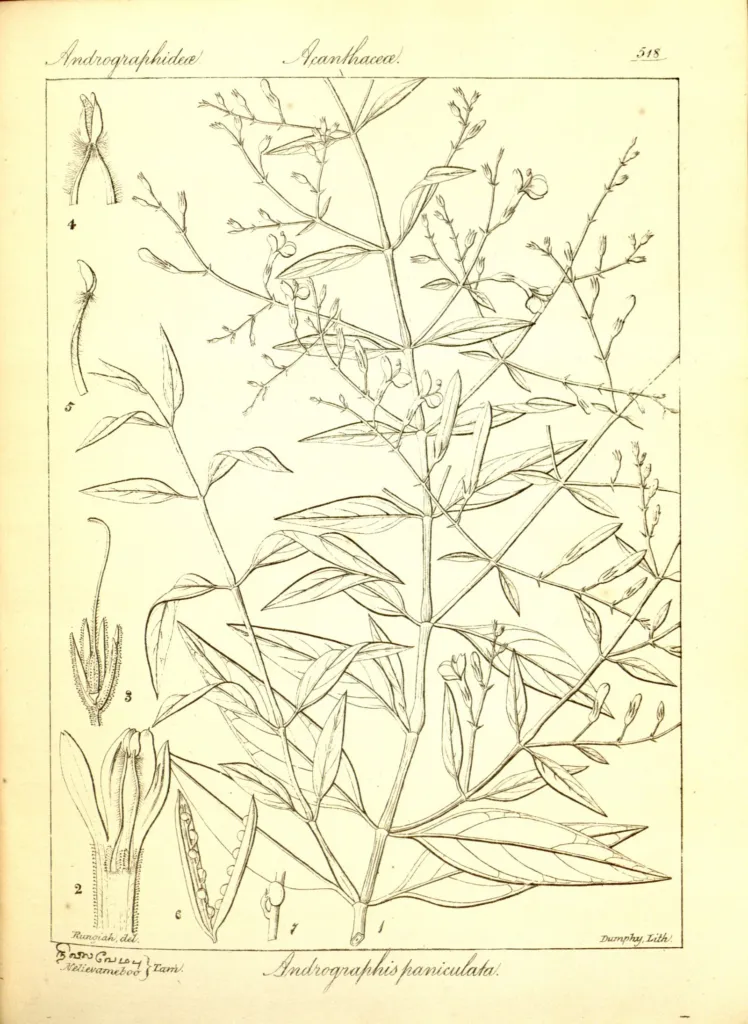
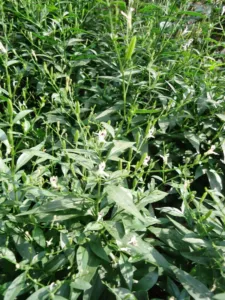
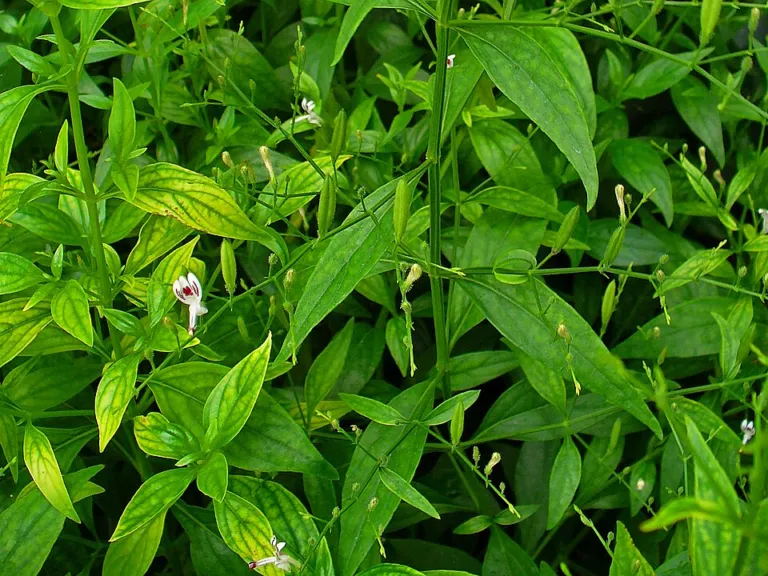
Figures 4-5 (habit). Unaltered Wikimedia Commons photographs of living plants for orientation only; unvouchered and not reference images for identity. Full credit and licence lines for every figure are kept in the licence record behind this monograph.
0.1 Identity card
| Monograph | AIP-PH-ANDPAN (formerly AIP-HP 002), Andrographis herb. Version 1.0 draft, 2026. Next review: on sign-off, and no later than 2027 |
| Pharmacopoeial status | WHO monographs vol. 2 (2002): yes; Chinese Pharmacopoeia: yes (2000 and 2005 English editions cited); Indian Pharmacopoeia: listed (edition not confirmed); Thai Herbal Pharmacopoeia and ASEAN standard: yes; USP-NF: yes, 3 monographs (texts not held); Ph. Eur.: yes, monograph 2712 (text not held) [76]; EMA/HMPC: no EU herbal monograph (2013); BHP 1996: not confirmed. Detail in section 2 |
| Australian status | Removed from the Therapeutic Goods (Permissible Ingredients) Determination on 17/09/2026 because of anaphylaxis risk. New listed medicines can no longer contain it; existing ARTG listings (about 80-86) are not cancelled automatically, and sponsor recalls of listed products began on 01/10/2026, 33 products from 22 sponsors by 23/10/2026, MediHerb Andrographis Complex among them (section 15.9) [90]. Since 2020, listed products have carried mandatory warnings on allergic reactions and taste disturbance. Not scheduled: the Poisons Standard October 2026 (F2026L01327, in force 01/10/2026) has no entry for andrographis or andrographolide [84]. Not native; naturalised in the Northern Territory and on Christmas Island; Queensland Herbarium specimens since 2017 from Mareeba, Cairns and Erub Island (Torres Strait) [83]; not on the Queensland prohibited or restricted invasive plant lists |
| Assay marker | Total diterpene lactones calculated as andrographolide (CID 5318517): not less than 6.0% on the dried drug (WHO limit, adopted provisionally). Alternative: andrographolide plus 14-deoxy-11,12-didehydroandrographolide not less than 0.80% (Chinese Pharmacopoeia 2000/2005 as cited by Wagner) |
| Identity markers | Andrographolide (CID 5318517), 14-deoxy-11,12-didehydroandrographolide (CID 5708351), neoandrographolide (CID 9848024), 14-deoxyandrographolide (CID 11624161). Possible age indicator: 14-deoxy-11,12-didehydroandrographolide is reported to rise in stored plants and products, and amorphous andrographolide can convert to it [9]; not yet a validated test |
| Evidence snapshot | Symptom relief in uncomplicated acute upper respiratory tract infection, standardised extracts alone or with Eleutherococcus: Tier B, 33 RCTs pooled in one meta-analysis (7175 participants), low certainty. Prevention of the common cold: Tier C, 1 small RCT. Sore throat and fever against paracetamol: Tier C, 1 RCT. Sore throat, throat spray against chamomile spray: Tier C, 1 small RCT. Mild COVID-19: Tier C, very low certainty, 3 RCTs and 1 meta-analysis with conflicting results. Mild to moderate ulcerative colitis (one extract, HMPL-004): Tier C, 2 RCTs, 1 phase III trial stopped for futility and 1 meta-analysis finding no difference at 1200 mg. Rheumatoid arthritis: Tier C, 1 RCT. Familial Mediterranean fever (four-herb combination): Tier C, 1 pilot RCT. Appetite and digestion (bitter tonic): Tier T. Liver protection: Tier P |
| Main safety point | Anaphylaxis: 287 reports to the TGA to 31/12/2025, one death (2024); unpredictable, often on first use, usually within 30 minutes. Taste loss and taste disturbance are common reports. Avoid in pregnancy |
| Suggested citation | Ridley T, Iggulden L. Andrographidis herba (andrographis herb, Andrographis paniculata (Burm.f.) Wall. ex Nees). Australian Herbal Pharmacopoeia monograph AIP-PH-ANDPAN (draft v1.0). Cardwell (QLD): Australian Institute of Pharmacognosy; 2026. DOI to be assigned |
| Compiler and review | Compiled by Dr Thomas Ridley (Education and Research). Technical review: Dr Fiona MacAllister (Botanical, sections 1-5, 10), reviewed in 2026; Dr Hana Suzuki (QA, sections 6-10), reviewed in 2026; Dr Eleanor Whitcombe (Medicine, sections 12, 13, 15), reviewed in 2026; Dr Thomas Ridley (Education and Research, evidence and citation audit of sources for sections 6-9 and of sections 11-19), reviewed in 2026, as compiler, so an independent audit of section 19 by the Librarian is still required; Jesse Kirby (Community Outreach, figures, captions, credit lines and whole-document layout), reviewed in 2026. Published: 2026. Last modified: 2026. Version 1.0 draft |
| Provenance | Original AIP data: none. Every limit, method, measurement and trial result here comes from the cited pharmacopoeias, regulators and papers; sections 4, 5, 7, 8, 9 and 10 are marked "AIP bench data pending" |
| Canonical URL | /pharmacopoeia/andrographis-paniculata/ |
0.2 Summary
Andrographis is the dried aerial part of a bitter annual herb of the acanthus family, native to southern India and Sri Lanka and grown across tropical Asia. It is used in Ayurveda, Siddha, Unani and Chinese medicine as a bitter, febrifuge and liver remedy, and in Western practice mainly for colds and sore throats.
The drug is identified by its square stems, lanceolate leaves, cystoliths and diacytic stomata under the microscope, and a thin-layer and liquid chromatographic profile of labdane diterpene lactones led by andrographolide. Andrographolide is reported to convert to a related lactone in storage, so marker content may depend on age and handling as well as source.
Trials of standardised extracts show a modest reduction in cold and sore-throat symptoms, but most were small, manufacturer-linked and of poor quality. In Australia the safety picture changed the regulatory position: after 287 reports of anaphylaxis and one death, the TGA removed andrographis from the list of ingredients allowed in listed medicines on 17/09/2026, and sponsors began recalling listed products on 01/10/2026, 33 of them by 23/10/2026.
Anyone considering it, or already taking it, should consult a degree-qualified herbalist with competencies and adequate training in pharmacognosy.
0.3 Contents and extent (draft)
| Section | Approx. pages |
|---|---|
| 1-3 Nomenclature, definition, source and Australian supply | 2.5 |
| 4-5 Macroscopy and microscopy | 1.5 |
| 6-7 Chemistry, markers and limits | 2.5 |
| 8-9 TLC and HPLC fingerprints | 2 |
| 10 Identity, purity, adulterants, contaminants | 2 |
| 11 Traditional use | 1.5 |
| 12 Current practice and doses | 1.5 |
| 13 Clinical evidence (search, graded trials, registered trials) | 5 |
| 14 Pharmacology | 2 |
| 15 Safety, interactions, pregnancy, Australian regulatory action | 4 |
| 16-18 Discussion, conclusions, research needed | 2.5 |
| 19-20 References and document control | 4 |
| Totals (draft) | @@PAGES@@ A4 pages in the textbook-layout PDF of 2026 (section page counts above are estimates for the final layout); 27 tables; 37 figures (12 openly licensed photographs of the living plant, 2 public-domain botanical plates (Wight, t. 518 and t. 467), 4 PubChem structures, 4 AIP schematics each labelled as redrawn from a cited description, 2 AIP diagrams, 9 AIP data charts, 1 AIP occurrence map plotted from Atlas of Living Australia records, 3 openly licensed published HPLC chromatograms) and 1 captioned placeholder for the photomicrographs. Gaps: figure slot F4 (photomicrographs) is AIP bench data pending; F8 is filled with openly licensed published chromatograms (section 9), and no photomicrograph, TLC plate or chromatogram of our own exists yet; 24 clinical studies tabulated, 6 with a risk-of-bias judgement of our own made from the full text; 92 references. Older trials are described from the library textbooks and the full-text reviews until their own papers, requested through the library, have been read (sections 13 and 19) |
0.4 Contributors and access
Prepared by the Australian Institute of Pharmacognosy. Reviewed by Botanical, QA and Medicine (2026). A Legal read is advisory only and does not gate publication (CEO order 22/09/2026). Page design and textbook layout by Community Outreach (Jesse Kirby). The Australian Herbal Pharmacopoeia is AIP’s own series and carries no statutory, TGA or government standing. A preview of the monograph and all of section 15 (Safety) are free to every reader; the full text is for Scholar members and above, or the AUD $20 copy of this one title.
Free to every reader. The safety section of every monograph is open to everyone, signed in or not. In an emergency call 000. For poisoning, call the Poisons Information Centre on 13 11 26.
15. Safety
Key points
- Anaphylaxis: 287 TGA reports to 31/12/2025 and one death; 71% after first or earlier uneventful use, 74% within 30 minutes.
- The TGA removed andrographis from the Permissible Ingredients Determination on 17/09/2026. Sponsor recalls of listed products began on 01/10/2026, and 33 products were on the TGA recall list by 23/10/2026, including MediHerb Andrographis Complex.
- Taste loss and taste disturbance are among the most common reports.
- Avoid in pregnancy and lactation, and after any previous reaction to andrographis or an Acanthaceae plant.
- Signs of anaphylaxis need emergency care at once: call 000.
15.1 Adverse effects in trials
- In the 33-trial review of acute respiratory infection, 23 trials reported on adverse events or safety. None reported acute toxicity, 11 found no adverse event in either arm, no serious adverse event was seen, and minor events were mainly gastrointestinal. The authors still advise caution until fuller safety data exist [27].
- In ulcerative colitis, adverse-event rates were the same as placebo (60% and 53% vs 60%) [54]. Mild diarrhoea at 180 mg andrographolide daily in COVID-19, with no liver or kidney toxicity over 5 days [51]; across the COVID-19 trials raised liver enzymes were the most common adverse event, and in one trial mild hepatitis occurred in 24.6% of patients taking the extract with favipiravir, all resolving within 28 days [31]. The review found no difference in adverse events from the comparator groups and notes that SARS-CoV-2 can itself raise liver enzymes [31].
- Isolated andrographolide at 5 then 10 mg/kg three times a day (far above usual doses) gave headache, fatigue, itch or rash, metallic or reduced taste and diarrhoea, and one anaphylactic reaction; the trial was interrupted at 6 weeks [3,67].
- Large doses may cause gastric discomfort, vomiting and loss of appetite [2,3]. Andrographolide 2 g daily for 4 days raised ALT transiently in volunteers (Chinese report cited by Mills and Bone) [3].
- Trials were small and short; none could detect a reaction as rare as anaphylaxis (TGA review) [19].
15.2 Anaphylaxis and severe allergic reactions (Australian and international reports)
Causality: the TGA considers the association established; its Advisory Committee on the Safety of Medicines advised in 2014 that there was sufficient information to confirm it [64].
| Measure | Figure | Source |
|---|---|---|
| All TGA adverse event reports for andrographis medicines, 2005-2025 | 1368 | [65] |
| Anaphylaxis reports, 2005 to 31/12/2025 | 287 (anaphylactic reaction 277, anaphylactic shock 12, anaphylactoid 2) | [65] |
| Share received 2019-2025 | 217 of 287 (76%) | [65] |
| Deaths | 1, reported June 2024 | [6,19] |
| Products also containing Echinacea | 237 of 287 (83%); only 10 anaphylaxis reports for Echinacea products without andrographis since 2005 | [65] |
| Single-ingredient andrographis products | 15 of 287 (5%) | [65] |
| One sponsor’s five same-formulation products | 189 of 287 (66%) | [65] |
| First use or earlier uneventful use | 83 of 117 cases with data (71%) | [19] |
| Onset within 30 minutes | 99 of 133 (74%) | [19] |
| Treated with adrenaline | 105 of 155 (68%) | [19] |
| Presented to hospital | 130 of 163 (80%) | [19] |
| History of allergy / asthma | 41 of 88 (47%) / 15 of 64 (23%) | [19] |
| Tentative rate | 0.01-0.1% per unit supplied (one event per 1000-10,000 containers), with stated limitations | [19] |
| WHO VigiBase, oral andrographis as sole suspect, outside Australia | 52 anaphylaxis cases; broader search 334 sole-suspect cases, 49 serious, none fatal; positive disproportionality (IC025 3.5 anaphylactic reaction, 2.3 anaphylactic shock) | [19] |
| Thailand, 2001-2012 | 106 hypersensitivity reports with andrographis as sole suspect; 13 critical (5 anaphylactic shock, 4 anaphylactic reaction, 4 angioedema); onset 5 min to 1 day; doses 352-1750 mg dry powder | [66] |


No preparation type, extract ratio (14:1 to 200:1 were implicated), solvent (ethanol, methanol, water), plant part, maker or andrographolide dose per unit was free of reports in the TGA’s analysis of the 20 most-supplied products [19]. The TGA also received one report from a traditional herbal liquid extract [19].
The mechanism is unknown; cell and in-silico work suggests some constituents could release allergic mediators [19]. The TGA’s expert adviser listed cofactors that raise the chance or severity of allergic reactions: viral infection, NSAIDs such as ibuprofen, alcohol and exercise around the time of the dose [6,19].
Highest-risk setting. Andrographis is usually taken during a viral infection, often with an NSAID, which is the setting of highest risk.
Injectable andrographolide derivatives (China, overseas products not supplied in Australia) had adverse-reaction incidences of 3.7-5.5% in pooled studies. In the 152 patients of the case reports, 55 had life-threatening anaphylactic shock and 3 died of anaphylaxis; 2 more, older patients with serious heart and lung disease, died after a fall in platelet count, so 5 died in all [67]. WHO warns that crude extracts must not be injected [2]. Oral herbal preparations had mainly mild gastrointestinal and skin reactions in the same review [67].
15.3 Taste disturbance
Ageusia (325 reports) and dysgeusia (236) were the first and third most common reaction terms among the 1368 Australian reports [65]. Listed products have had to carry a taste-disturbance warning [19]. The herb’s bitterness does not explain loss of taste; duration and reversibility are not reported in the sources we read.
15.4 Contraindications (each with source and grade)
| Contraindication | Basis | Grade |
|---|---|---|
| Previous allergic reaction to andrographis, or known allergy to Acanthaceae | TGA reports; WHO | Clinical (pharmacovigilance) [2,19] |
| Pregnancy | Conflicting animal data; WHO contraindication; manufacturer advice | Theoretical to animal [2,3,5] |
| Lactation | No human data; WHO contraindication; MediHerb suggests professional supervision | Precautionary [2,5] |
| Hyperacidity, active peptic or duodenal ulcer; caution in reflux | Bitter action; Mills and Bone contraindicate bitters in hyperacidity and duodenal ulcer, MediHerb advises caution in peptic ulcer and hyperacidity | Traditional and theoretical [3,5] |
| Injection of crude extracts | Anaphylaxis | Clinical (overseas) [2,67] |
15.5 Herb-drug interactions
| Drug or class | Evidence | Grade | Source |
|---|---|---|---|
| Anticoagulants (warfarin), antiplatelets | Antiplatelet effect ex vivo in patients taking an extract (1994 Chinese report cited by Mills and Bone); andrographis with Siberian ginseng showed no interaction with warfarin in rats | Theoretical, with one negative animal study | [3] |
| CYP3A4 and CYP2C9 substrates | Extract and andrographolide inhibited both in isolated human and rat liver microsomes; Mills and Bone judge the clinical relevance uncertain | In vitro only; plasma levels after usual doses are low (section 14.4) | [3] |
| CYP1A2 substrates (theophylline, caffeine) | Pretreatment of rats with extract or andrographolide for 3 days increased theophylline clearance, at doses well above human use | Animal PK | [3] |
| Immunosuppressants | Immune activity in animals; no case report | Theoretical | [3,11] |
| Antihypertensives | Hypotensive in rats | Theoretical | [3] |
| Hypoglycaemic agents | Glucose lowering in diabetic rodents | Theoretical | [3,11] |
| Barbiturates | Longer pentobarbitone sleep in mice | Theoretical (animal) | [3,11] |
| NSAIDs | Cofactor for allergic reactions (no PK interaction) | Clinical context, expert advice | [19] |
| Isoniazid | WHO: extracts "may have a synergistic effect"; the primary report was not seen by us | Theoretical (single secondary statement) | [2] |
| General anaesthesia, high-risk surgery | Manufacturer advises stopping 7 days before general anaesthesia; Braun and Cohen advise 1 week before high-risk surgery (platelet effect) | Precautionary | [5,11] |
15.6 Pregnancy, lactation and fertility
- Pregnancy. WHO: should not be used in pregnancy [2]. Mills and Bone: Australian category B3, best avoided in early pregnancy [3]. MediHerb: avoid in early pregnancy; professional supervision in mid to late pregnancy [5]. Braun and Cohen: insufficient reliable evidence [11]. Animal data conflict: a whole-plant decoction given by injection prevented implantation and ended pregnancy in mice and rabbits; oral extract below 2 g/kg in the first 9 days of gestation did not interrupt pregnancy in rats; oral extract at 200-2000 mg/kg for the first 19 days of pregnancy did not change progesterone in rats [2,3]. AIP position: avoid throughout pregnancy.
- Lactation. No human data on transfer into breast milk or effects on the infant were found in the sources read [2,3,5]. WHO: should not be used in lactation [2]. MediHerb: professional supervision suggested [5]. AIP position: avoid.
- Male fertility. Early studies of leaf powder and of andrographolide in rats reported testicular damage [3]. Later rat studies of an extract at 20, 200 and 1000 mg/kg a day for 60-65 days found no change in testicular histology, testosterone, or sperm count, motility and form, and andrographolide at 50 mg/kg a day for 2-8 weeks had no significant effect; the authors of one study put the difference from the early work down to the plant material used [3]. A phase I study of Kan Jang at three times the usual dose in healthy men found a slightly positive effect on sperm count, sperm activity and other fertility indices [3].
15.7 Children and older people
No adverse events were reported in a 3-month prevention trial in healthy children (extract 200 mg a day) or in a 10-day trial of Kan Jang in children aged 4-11 (both as reported by Mills and Bone) [3]; these trials were far too small to detect anaphylaxis. WHO advises against use in children without supervision [2]. Older people: no specific data; interactions (section 15.5) are more likely with more medicines.
15.8 Toxicology and overdose
Acute toxicity is low: oral LD50 of an alcohol extract in mice above 15 g/kg; andrographolide above 40 g/kg [3]. A methanolic extract showed no significant genotoxicity in three in vitro tests, and female rats given 5 g/kg of a methanolic extract by mouth for 14 days showed no adverse effects [3]. A nitrosated ethanol extract was mutagenic in Salmonella (1989 conference abstract cited by Mills and Bone) [3]. No overdose case found; high doses cause gastric upset, anorexia and vomiting [3].
15.9 Australian regulatory action

- 2014-2015: ACSOM confirmed the association with allergic reactions; the TGA published a safety review and alert [64].
- 2019-2020: a mandatory label warning ("Andrographis may cause allergic reactions in some people. If you have a severe reaction (such as anaphylaxis) stop use and seek immediate medical attention") for all listed medicines released from 02/05/2020 [64]. A taste-disturbance warning is also required [19].
- June-July 2024: a fatal anaphylactic reaction was reported to the TGA in June 2024, and the TGA published an updated safety advisory on 02/07/2024 [19,85].
- 08/04/2026: updated safety review and supplementary report published; targeted consultation 08/04/2026 to 08/05/2026 [6,19].
- 17/09/2026: andrographis removed from the Therapeutic Goods (Permissible Ingredients) Determination (No. 2) 2026 by an amendment under section 26BC of the Therapeutic Goods Act 1989, on the ground that the anaphylaxis risk "is not adequately mitigable within the listed medicines framework" [6]. New listed medicines can no longer contain it. Existing listings are not cancelled automatically; the TGA will recommend voluntary cancellation or recall and may compel it [6]. Access remains possible through the registered-medicines pathway [6].
- 01/10/2026 onward: the TGA published a recall notice for listed andrographis medicines on 01/10/2026 and has added to it as sponsors act; it was last updated 23/10/2026 and re-read in full that day [90]. It then listed 33 ARTG-listed products from 22 sponsors under 22 recall records, each recalled for all unexpired batches (table below). The first version, of 01/10/2026 to 06/10/2026, named only the four Arrotex and PBA Wholesale products; the version of 20/10/2026 listed 24 products from 18 sponsors, and the update of 23/10/2026 added nine, from Integria Healthcare (MediHerb and Eagle), Metagenics (including Ethical Nutrients), Nuchev Practitioner (BioPractica) and Homart Wellness (Thompson’s). People holding any listed product are told not to use it and to return it to the place of purchase or the sponsor. The notice repeats that a reaction can follow a first dose or earlier uneventful use, and that anyone who may be having anaphylaxis should call 000 [90]. Listed andrographis products not on the list stay on the ARTG until their sponsors cancel or recall them. The TGA page lists the recalls to date, so check it for later additions.
Products on the TGA andrographis recall list, as updated 23/10/2026 (read in October 2026) [90]. All unexpired batches.
| Product | ARTG | Sponsor | Recall record |
|---|---|---|---|
| Eagle Defence Support Tablets | AUST L 334708 | Integria Healthcare Australia Pty Ltd | RC-2026-RN-00840-1 |
| MediHerb Andrographis Complex | AUST L 389735 | Integria Healthcare Australia Pty Ltd | RC-2026-RN-00840-1 |
| MediHerb Bacto-Cand GI | AUST L 398416 | Integria Healthcare Australia Pty Ltd | RC-2026-RN-00840-1 |
| BioPractica ImmunePro Plus | AUST L 393514 | Nuchev Practitioner Pty Ltd | RC-2026-RN-00836-1 |
| Ethical Nutrients Immune Defence Capsules 30s, 60s and 90s | AUST L 447722 | Metagenics (Aust) Pty Ltd | RC-2026-RN-00830-1 |
| Metagenics Andro NK 40s | AUST L 351799 | Metagenics (Aust) Pty Ltd | RC-2026-RN-00830-1 |
| Metagenics Gut InflamX 60s | AUST L 382592 | Metagenics (Aust) Pty Ltd | RC-2026-RN-00830-1 |
| Metagenics Immune Active NK 40s | AUST L 470385 | Metagenics (Aust) Pty Ltd | RC-2026-RN-00830-1 |
| Thompson’s Immunofort | AUST L 405616 | Homart Wellness Aust Pty Ltd | RC-2026-RN-00803-1 |
| Wagner Professional Immunity Force 60 hard capsules | AUST L 345563 | RF Six Pty Ltd | RC-2026-RN-00821-1 |
| Swisse Ultiboost Immune Action | AUST L 326345 | Swisse Wellness Pty Ltd | RC-2026-RN-00749-1 |
| Swisse Nutra+ Andro Max | AUST L 330145 | Swisse Wellness Pty Ltd | RC-2026-RN-00749-1 |
| Immune Defence 120 tabs | AUST L 313993 | Nature’s Care Manufacture Pty Limited | RC-2026-RN-00732-1 |
| Immune Forte 1-A-Day 90 and 100 caps | AUST L 466425 | Nature’s Care Manufacture Pty Limited | RC-2026-RN-00732-1 |
| Biosource Immune Force | AUST L 453106 | Soul Pattinson Manufacturing Pty Ltd | RC-2026-RN-00810-1 |
| Pharmacy Health PLUS Immune Force | AUST L 453125 | Australian Pharmaceutical Industries Pty Ltd | RC-2026-RN-00802-1 |
| MEDIX Cold & Flu Day & Night | AUST L 353367 | Nova Pharmaceuticals Australasia Pty Ltd | RC-2026-RN-00809-1 |
| COLES Cold & Flu Day & Night | AUST L 353545 | Nova Pharmaceuticals Australasia Pty Ltd | RC-2026-RN-00809-1 |
| Fusion Health VIRAFORCE 30 and 60 capsules | AUST L 391340 | McPherson’s Consumer Products Pty Ltd | RC-2026-RN-00765-1 |
| Chuan Xin Lian Antiphlogistic Tablet | AUST L 432432 | Shen Neng Herbal Medicines Group Pty Ltd | RC-2026-RN-00805-1 |
| Vitaceuticals Immunity Boost Forte (30s and 60s) | AUST L 443110 | Pharmacy Healthcare Pty Ltd | RC-2026-RN-00818-1 |
| Immunitone Plus | AUST L 383995 | Designs for Health Pty Ltd | RC-2026-RN-00811-1 |
| Phytologic Activated Immune Enhance; Phytologic PhytoBio Immune Enhance (10 and 30 capsules) | AUST L 451826 | Phytologic Holdings Pty Ltd | RC-2026-RN-00775-1 |
| AYUNA AMA CARE 60/100 veg capsules | AUST L 284724 (listing already cancelled) | Cheella Healthcare Pty Ltd | RC-2026-RN-00791-1 |
| BioCeuticals ArmaForce 30, 60 and 120 | AUST L 340712 | FIT-BioCeuticals Pty Ltd | RC-2026-RN-00743-1 |
| BioCeuticals Clinical ImmuneForce 60 | AUST L 299066 | FIT-BioCeuticals Pty Ltd | RC-2026-RN-00743-1 |
| Faulding Immune Combat, 100s pack | AUST L 385872 | Symbion Pty Ltd | RC-2026-RN-00792-1 |
| PM Lung Support II | AUST L 330060 | Universal Pharmaceuticals | RC-2026-RN-00781-1 |
| Immune Support Echinacea Plus, 60 film-coated tablets | AUST L 465465 | Australian NaturalCare Products | RC-2026-RN-00755-1 |
| Chemists’ Own Provance Immune Defence | AUST L 303672 | Arrotex Pharmaceuticals | RC-2026-RN-00762-1 |
| 28 Plus Immune Defence | AUST L 519427 | Arrotex Pharmaceuticals | RC-2026-RN-00762-1 |
| Nourex Professional Immune Defence 30 and 60 | AUST L 314703 | PBA Wholesale Pty Ltd | RC-2026-RN-00747-1 |
| Nourex Professional Immune Force 30 and 60 | AUST L 365278 | PBA Wholesale Pty Ltd | RC-2026-RN-00747-1 |
The list takes in practitioner-channel brands (MediHerb, Eagle, Metagenics, BioPractica, BioCeuticals, Designs for Health, Phytologic) and a Chinese-medicine tablet named for the herb (Chuan Xin Lian), as well as supermarket and pharmacy cold and flu products. MediHerb Andrographis Complex, the tablet in the section 12 table, is now recalled. The MediHerb Andrographis 1:2 liquid was not on the list as read in October 2026, and its ARTG status was not checked (AIP comment).
- Practitioner supply. The TGA’s review states that implications for traditional practitioners were outside its scope [19]. In the consultation the TGA rejected practitioner-only supply as a mitigation, noting that the product with the most anaphylaxis reports was already restricted to practitioner access by its sponsor [74]. How the decision affects practitioner-dispensed liquids and extemporaneous preparations (including any exemption under the Therapeutic Goods Regulations 1990) has not been checked by us; Legal is asked to advise. MediHerb’s 2015 guide lists the 1:2 liquid [5]; its current ARTG status was not checked.
- Overseas (not applicable in Australia): the EMA could not establish an EU herbal monograph (2013) [7]; New Zealand’s Medsafe (2017) and Health Canada (2020) issued allergy communications, as cited by the TGA [19,64].
Poisons Standard. We found no entry for Andrographis paniculata or andrographolide in a web search in September 2026, and the TGA review lists no restriction on the ingredient other than the two label warnings [19]. The instrument in force from 01/10/2026 was searched in full in October 2026 and has no entry for andrographis, Andrographis paniculata or andrographolide [84].
TGA safety alerts (read in full by Medicine on tga.gov.au, October 2026; the 2024 advisory and the recall notice re-read in October 2026). Four pages are relevant: three safety alerts and the 2026 recall notice.
- "Safety review of Andrographis paniculata and anaphylactic/allergic reactions" (published 08/10/2015) [87]. It links the 2015 safety review and records that ACSOM considered the issue on 11/07/2014.
- "Products containing Andrographis paniculata: safety advisory – risk of allergic reactions" (published 08/10/2015) [86]. It reports 43 anaphylaxis reports and 78 other allergic-type reactions received between December 2002 and April 2014, and states that no label warnings were required at that time.
- "Medicines containing Andrographis paniculata safety advisory" (published 02/07/2024) [85]. Its main points:
- about 100 ARTG-listed medicines contained andrographis;
- more than 300 anaphylaxis or hypersensitivity reports had been received since 2005, more than 200 of them since 2019;
- a fatal anaphylactic reaction was reported in June 2024;
- more than 80% of reports involve products that also contain Echinacea;
- severe reactions have followed earlier uneventful use;
- anyone with symptoms of a severe allergic reaction should call 000, and anyone who has had any allergic reaction to an andrographis medicine should avoid all of them.
- "Andrographis recalls: Concerns over allergy risk" (published 01/10/2026, last updated 23/10/2026, re-read in full by Medicine October 2026). It lists the 33 recalled products in the table above [90].
These pages [85-87,90] agree with the later TGA documents cited above [6,19,64,65].
TGA Database of Adverse Event Notifications (DAEN). Searched by Medicine in October 2026 (search term "andrographis", all dates, data to September 2026). The search matched 91 medicines by trade name or active ingredient, nearly all of them multi-ingredient listed products. Results:
- 1472 cases in total;
- 1435 cases in which the andrographis product was the single suspected medicine;
- 1 case with a reported death.
The most frequent reaction terms:
| Reaction term | Cases |
|---|---|
| Ageusia | 333 |
| Anaphylactic reaction | 311 (the 1 death) |
| Pruritus | 267 |
| Dysgeusia | 239 |
| Urticaria | 207 |
| Hypersensitivity | 193 |
How to read the DAEN figures:
- DAEN cases are reports. They do not establish that the medicine caused the event, and one case can carry several reaction terms.
- The counts run to a later date than the TGA’s case-reviewed analyses above (287 anaphylaxis reports to 31/12/2025 [65]), so the two sets of figures do not match exactly. They agree in pattern: taste loss and anaphylaxis lead, and one death.
Referral. Anyone who is pregnant, has had any allergic reaction to andrographis or an Acanthaceae plant, takes anticoagulant, antiplatelet, immunosuppressant or antihypertensive medicines, or is considering andrographis during an infection, should consult a degree-qualified herbalist with competencies and adequate training in pharmacognosy before use. Anyone with signs of anaphylaxis (difficult or noisy breathing, swelling of the tongue or throat, wheeze, persistent dizziness or collapse) needs emergency care at once: call 000 [6].
50 more pages follow · 24,899 words, 29 figures, 23 tables
Still to come in this monograph
- 1. Nomenclature
- 2. Definition
- 3. Source and Australian supply
- 4. Macroscopy
- 5. Microscopy
- 6. Chemistry
- 7. Named markers and assay limits
- 8. TLC fingerprint
- 9. HPLC fingerprint
- 10. Identity, purity, adulterants and contaminants
- 11. Traditional use
- 12. Current practice: use, preparations and doses
- 13. Clinical evidence
- 14. Pharmacology
- 16. Discussion
- 17. Conclusions
- 18. Research still needed
- 19. References
- 20. Document control
The rest of this monograph reads in the AIP Reader: every page in your name, always the current version, on a Scholar membership or the AUD $20 copy of this one title.
Checking your membership…
The typeset edition of this monograph, set for print with the plates and chromatograms at full size, is $20 AUD in Publications.