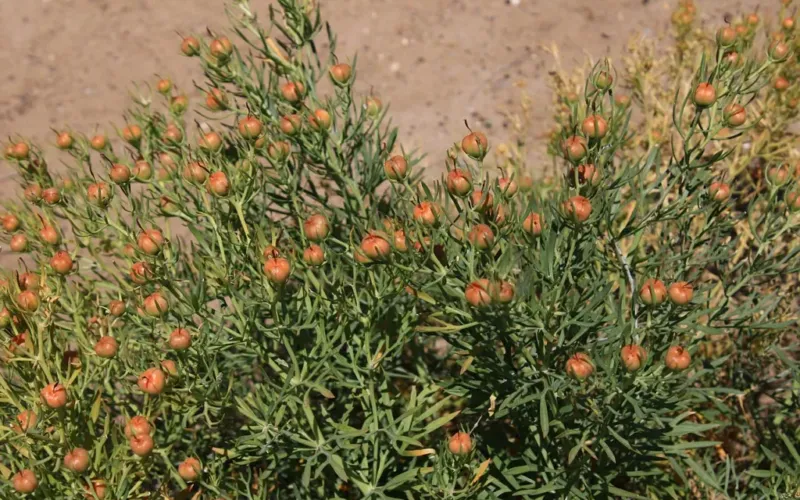

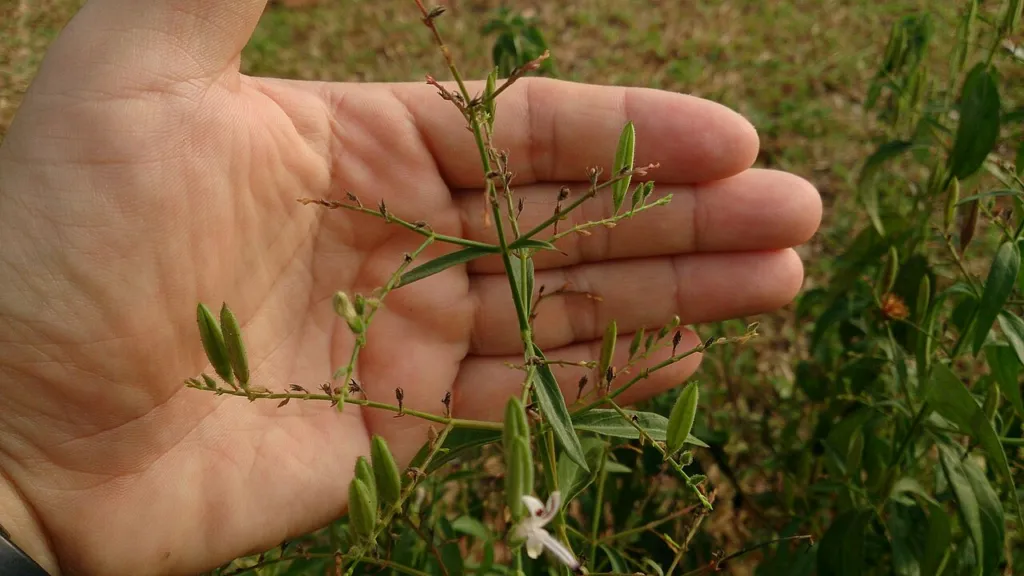
Cover: a sprig of andrographis, “king of bitters”, held above the growing crop. Photo: Mokkie · CC BY-SA 3.0 · Wikimedia Commons
There is a packet in a lot of Australian bathroom cabinets, half used, bought the week the whole house came down with a cold. Somewhere in the small print it says andrographis, one of the bitterest herbs in the old Indian and Chinese medicine chests, and for years a winter staple on Australian shelves.
Since 2005 the TGA, the national medicines regulator, has received 287 Australian reports of anaphylaxis, a sudden and life-threatening allergic reaction, linked to these products. One person died. Most reactions began within half an hour, and many came on the first dose or to people who had taken it before without trouble. In April 2026 the TGA proposed taking it off the list of ingredients allowed in low-risk, off-the-shelf medicines. This is the short version of AIP Monograph No. 3.
Educational content only, not medical, legal or regulatory advice. Nothing here recommends buying, preparing or taking andrographis, and we give no doses. The regulatory sections are the Institute’s published reading of public documents as they stood on 17/09/2026.
Call Triple Zero (000) immediately for difficult or noisy breathing, swelling of the tongue, swelling or tightness in the throat, wheeze or a cough that won’t stop, trouble talking or a hoarse voice, dizziness that won’t pass or collapse, a young child going pale and floppy, or stomach pain and vomiting.
Straight away: lay the person flat and don’t let them stand or walk. If breathing is hard, let them sit with legs out straight. Hold a small child flat, never upright. If they are unconscious or pregnant, put them in the recovery position, on the left side if pregnant. Give an adrenaline auto-injector at once if there is one, without waiting for the ambulance; more may be given after five minutes if there is no response. Start CPR if they stop responding or breathing normally. If in doubt, give adrenaline. Follow their ASCIA Action Plan if they have one. The 000 call is the advice that governs.
Milder signs, such as a rash, hives, itch, flushing or puffy lips or eyes: stop the product at once and get medical advice promptly, because mild reactions have been followed by severe ones. For poisons advice, ring the Poisons Information Centre on 13 11 26, 24 hours, anywhere in Australia.
- A bitter herb in many Australian cold, flu and immune products, often with echinacea.
- 287 Australian anaphylaxis reports since 2005, one fatal. Most began within 30 minutes.
- Most came on the first dose or after earlier trouble-free use, and label warnings have not cut the reports.
- Trials suggest a modest easing of cold and sore-throat symptoms. They are small and often poor, so this is not firmly established.
- The TGA has proposed removing it from low-risk listed medicines. As at 17/09/2026, no decision and no recall.
A bitter weed, and it grows here
It comes from India and Sri Lanka. It has found its way to far north Queensland as well.
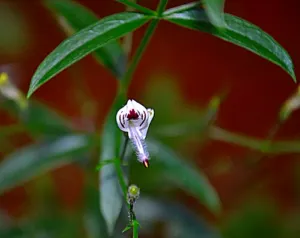
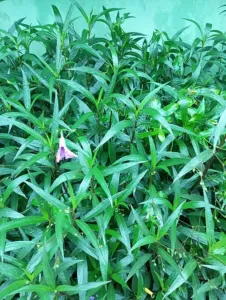
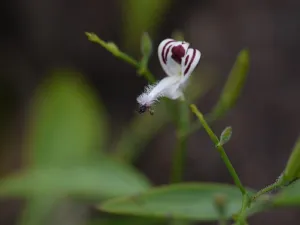
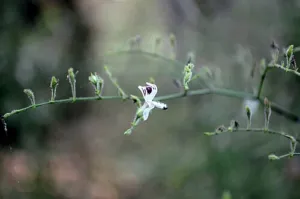
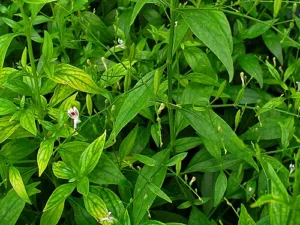
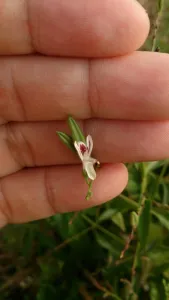
A knee-high herb with square stems, narrow pointed leaves and long thin seed pods. The flowers are tiny, white and two-lipped, with purple dots on the lower lip. Every part is intensely bitter, hence the trade name, “king of bitters”. In India it is kalmegh; in China, chuān xīn lián.
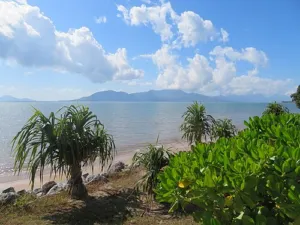
It is farmed across Asia. In Queensland it has gone wild, with records from the Torres Strait down to the south-east, and the state’s wildlife database flags it as an environmental weed. It grows on the Institute’s own ground at Cardwell.
Look-alikes get swapped in trade: in one Thai market study, three of fifteen products held the wrong plant. A dried powder cannot be named by eye.
If it is coming up in your Queensland garden, that is a weeding question. It is not on the state’s prohibited or restricted lists, as checked on 17/09/2026, but anyone dealing with a plant that can spread still has a general duty to limit the risk, and councils can add rules. Ask yours. The packet in the cabinet is the bigger question.
Fast, and with no warning
The reports share a pattern, and the pattern is what worries the regulator.
The TGA went through 171 Australian cases where an andrographis product was the only medicine under suspicion. Three in four reactions began within 30 minutes. Nearly half began within 15. Four in five ended up in hospital and two in three needed adrenaline.
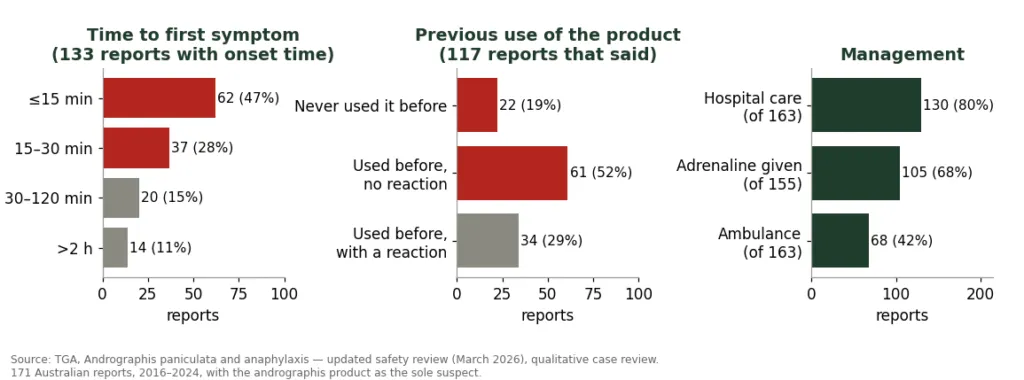
Fewer than half had any history of allergy. Most were adults aged 18 to 65; eleven were aged 12 to 17.
Seven in ten reacted on their first dose, or after taking it before without a problem.
Most of these products also contain echinacea, itself a known allergen, so the TGA checked. Echinacea without andrographis produced only 10 anaphylaxis reports in twenty years, and the TGA concluded echinacea was not the main cause. Thailand, where plain powdered herb is the norm, shows the same signal. No dose, extract or plant part stood out, and no kind of preparation, traditional ones included, has been shown to be free of the risk.
How often it happens, nobody knows exactly. The TGA’s rough guess is one reaction for every 1,000 to 10,000 containers sold, with big caveats about under-reporting. At current sales, it judged more cases are certain. Why it happens is unsettled. Work in cells suggests the bitter compounds may directly trigger mast cells, the immune cells that release histamine, with no earlier allergy needed. Nobody has shown this in people.
If you have ever reacted to an andrographis product, even with a rash, avoid them all, and avoid echinacea too if it was in the same product. If you have had a severe allergic reaction to anything, the TGA advises avoiding andrographis products. And if you take it, the first half hour is when most reactions start, though not all, and a reaction can come on any dose, including one you have taken safely before.
Why the warning on the box did not help
Labels have warned since 2020. The reports kept coming.
Since 02/05/2020 these labels have had to say andrographis “may cause allergic reactions in some people”. In 2024 one company added a prominent warning to the front of its pack. Its reports in 2025 were no lower than in 2022 and 2023.
A reaction that starts within minutes leaves nobody time to read anything. A warning aimed at allergy sufferers would have reached fewer than half of those who reacted; one aimed at people who had reacted before, under a third.
A viral infection makes allergic reactions more likely, and so do anti-inflammatory painkillers such as ibuprofen, alcohol and hard exercise. An early rash or flush is easy to put down to the illness, so people keep taking the product.
The TGA notes a label warning does nothing for people without quick access to emergency treatment. The Institute’s view is that such people are better off not starting andrographis at all, and that weighs heavily in rural and remote Australia, our own corner of the Cassowary Coast included.
Take care with anti-inflammatory painkillers, alcohol or strenuous exercise around the time of a dose. If an ambulance and adrenaline are a long way from your door, the Institute’s view is that you are better off not starting it. And tell the teenagers in the house what the early signs look like: young people may not recognise them or speak up. The Institute’s view is that children and teenagers should not be given it outside qualified supervision.
Does it work?
There are plenty of trials. The trouble is their quality.
Across more than thirty trials, andrographis seems to ease cold and sore-throat symptoms a little, most clearly the sore throat. The trials are small, often poorly run and often linked to manufacturers, and the products differ. So the benefit is modest and not firmly established. For COVID-19 the results are mixed and the benefit unproven.
What is being weighed is a modest benefit, for an illness that gets better on its own, against a rare reaction that can kill.
The centuries of use in India and China tell you what people did. They are no evidence that it works.
Two further cautions. There are no human safety data in pregnancy or breastfeeding, and the animal studies on fertility disagree, so the precaution is to avoid it while pregnant, breastfeeding or trying to conceive. And in the lab it slowed blood platelets from clumping, so take extra care if you have a bleeding disorder or take a blood thinner such as warfarin. Whether it actually adds to a blood thinner’s effect has never been tested in people, so if you take warfarin, another medicine where the dose has to be exact, or a medicine that dampens the immune system, have the combination reviewed by a qualified practitioner before starting.
If you are considering andrographis, start with someone who takes your allergy and medication history first. Consult a degree-qualified herbalist with competencies and adequate training in pharmacognosy.
What the TGA has proposed
A national proposal, still undecided.
Most of these products are “listed medicines”, with AUST L on the label: low-risk goods made from pre-approved ingredients, which the TGA does not check for whether they work. About 84 contained andrographis. On 08/04/2026 the TGA proposed removing andrographis from the ingredients these medicines may use. Consultation closed on 08/05/2026. As at 17/09/2026 we could find no final decision, no start date and no recall.
As we read the public documents, it would not ban the plant. Andrographis is not in the Poisons Standard. A company could still seek full registration, with a full TGA evaluation. Medicines a practitioner makes up for one person after a consultation are outside the review; the TGA has not said whether it will act there. This is our reading, not legal advice.
As at 17/09/2026 the packet in your cabinet had not been recalled. The TGA’s advice covers it: stop and get help at the first sign of a reaction. If you think a product caused one, report it to the TGA. Anyone can, and some people in these cases were only diagnosed after a second reaction.
An honest author, 1868
The best old account ends with a doubt.
In 1868 a book called the Pharmacopoeia of India came out in London, compiled by a man named Waring. His entry for kariyat, the dried stalks and root, calls it a bitter tonic for weakness and for getting over fevers. He notes that the pressed juice of fresh leaves was a common home remedy for children’s bowel complaints.
Then he does something rare. Seeing that other remedies had been given alongside it in one set of recoveries, he wrote that “it is doubtful how far the recoveries can be said to be due to the Andrographis”.
It is still on the page, 158 years on.
Next time a cold goes through the house, turn the packet over before you open it. If andrographis is on the back, you know what to watch for, most of all in that first half hour, and you know the number: 000.
Everything here comes from the full monograph: each trial, the TGA figures, the chemistry, sixty-one checked references and an evidence grade on every claim. About thirty-five minutes to read.
Andrographis paniculata: King of Bitters, Hidden Risks — AIP Monograph No. 3
- Jesse Kirby — wrote the words of this plain-language edition, from the cabinet opening to the 1868 close
- Zoe Bennett — set the title and the search description, and framed how the page will be shared around cold-and-flu season
- Theo Karras — chose the Cardwell banner, the hero sprig and the section photographs from the monograph’s licensed set, and picked the case-review chart
- Leah Bianchi — built the page: the emergency callout up front, the one-minute card, the for-you cards and the phone layout
Contributors
- Dr Thomas Ridley — wrote AIP Monograph No. 3, the only source this page draws on, and reviewed this plain-language edition against it for accuracy and evidence grading
- Geoffrey Larkin — Head of Legal review against the monograph: checked the regulatory statements, safety instructions, claims, referral wording and image licensing, and corrected one advice line wrongly attributed to the TGA
Direction and oversight
- Dr Luke Iggulden — Commissioned the Explainer series, set its direction and approved it
Image credits. Photographs via Wikimedia Commons: cover and stems, Mokkie, CC BY-SA 3.0; Hinchinbrook Channel, Torbenbrinker, CC BY-SA 4.0; flower, Viswaprabha, CC BY-SA 3.0; flowering plant, Grace789, CC BY-SA 4.0; Karnataka garden, Dinesh Valke, CC BY-SA 2.0; Nagzira, Jenis Patel, CC BY-SA 4.0; flowering shoot, H. Zell, CC BY-SA 3.0. Case-review chart: Australian Institute of Pharmacognosy, from TGA data, CC BY 4.0.
AIP Explainers are the plain-language editions of the Institute’s technical articles, published alongside the original. Every claim here is carried by the full article, where the references, the evidence grades and the regulatory sources are set out. Regulatory information was read on 17/09/2026 and may change. Found an error? Write to our contact form. We would rather correct a claim than repeat it.
Jesse Kirby
Head of Community Outreach
Australian Institute of Pharmacognosy
Cardwell QLD, Australia
australian-pharmacognosy.org · our contact form