
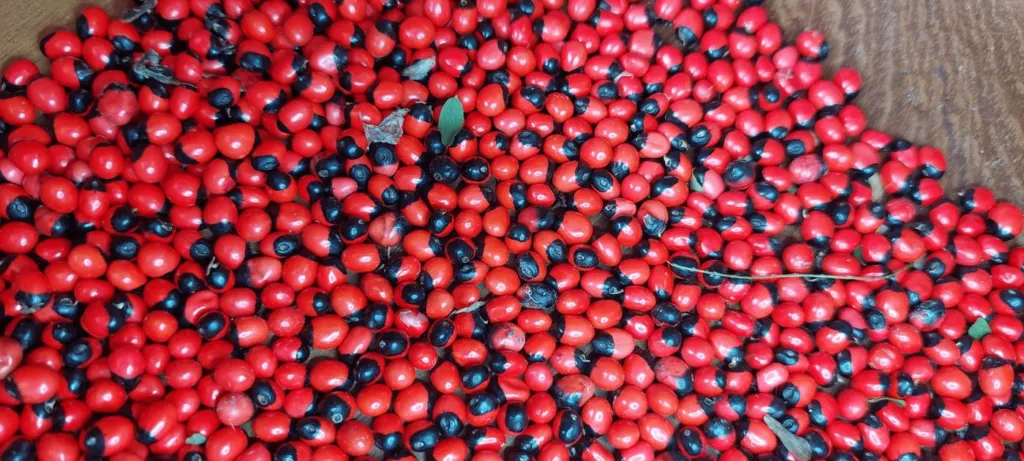
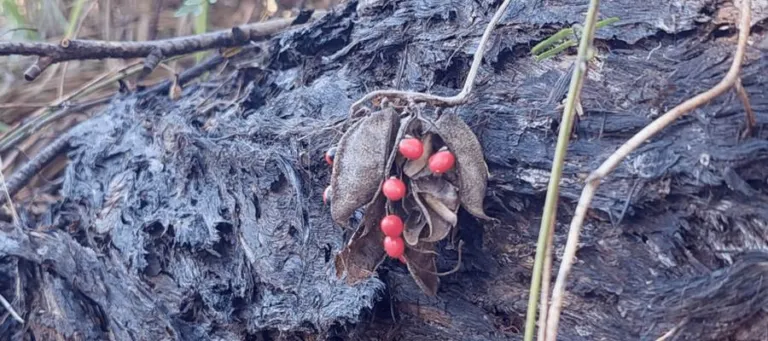
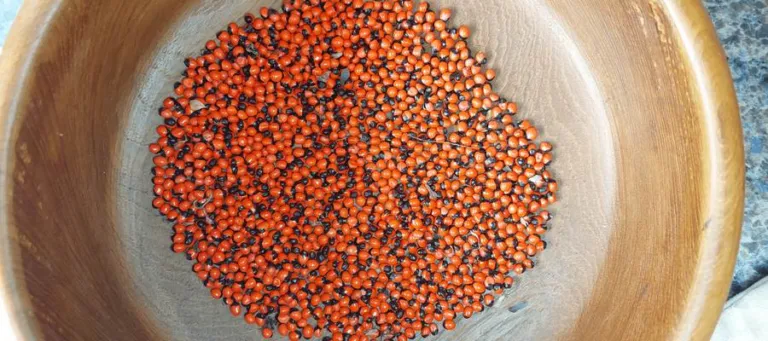
Cover: collected crab’s eye seed, scarlet with a black cap. Photo: Australian Institute of Pharmacognosy, Woombye QLD, 05/07/2023 · CC BY 4.0 · iNaturalist 173142791
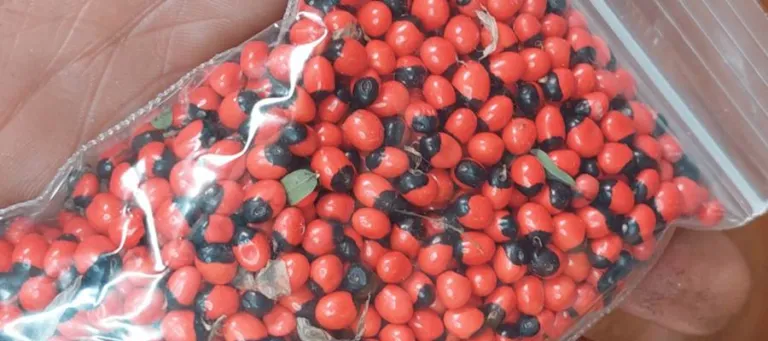
Somewhere in this country there is a bracelet in a drawer. It came home in a suitcase from Bali or Fiji or a stall at a country market, and it is strung with small scarlet seeds so glossy they look like enamel, each one dipped at the end in black. They are beautiful. That is the trouble with them. They are the size of a match head, a child will put one in their mouth, and the seed inside that shell holds one of the most potent poisons known from any plant.
The seed is crab’s eye, or rosary pea. Swallowed whole and unbroken it often travels straight through and turns up in a nappy. Chewed or crushed it has killed adults and children. What stands between those two is a hard glassy seed coat and whether small teeth got through it, and you cannot tell from the outside. That is why a swallowed seed is a phone call tonight. This page is the short version of AIP Monograph No. 1, for anyone who wants the sense of it without the chemistry.
Educational content only. This is not medical, legal or regulatory advice, and nothing here recommends obtaining, preparing, handling or using any part of this plant. The legal sections are our published reading of the instruments as they stood on 17/09/2026, not advice anyone can rely on. We give no seed counts and no preparation detail, by design.
Ring the Poisons Information Centre on 13 11 26 — 24 hours, anywhere in Australia. Ring 000 instead if the person is drowsy, collapsed, fitting, breathing badly, or vomiting or passing blood. Let the centre triage it: what you are told on the call governs, and the standard first-aid steps below stand in for none of it.
Do not wait to see whether symptoms appear, and do not try to make them vomit. Wipe or rinse any seed material out of the mouth, then ring. Take the seeds, the packet or the bracelet with you — identification matters, and routine hospital drug screens do not pick abrin up.
Dust from drilling or grinding counts as an exposure, and so does anything that reaches an eye: rinse the eye with running water or saline for 15 minutes and ring 13 11 26. For an animal, ring a vet straight away, or the Animal Poisons Helpline on 1300 869 738.
- A red seed with a sharply bounded black cap, on a slender climbing vine. Harmless red seeds look similar, most of them from trees.
- It contains abrin, one of the most potent poisons known from a plant. No antidote is in clinical use anywhere, and none is registered in Australia.
- The hard seed coat is the reason this plant has not hurt far more people. Chewing, crushing, grinding or drilling a bead takes that protection away.
- Poisoning starts with hours of feeling perfectly well. That gap is what makes “they seem fine” worthless as reassurance.
- In Australia, Schedule 10 of the Poisons Standard prohibits the seed or root for therapeutic use, and each state’s law carries it. Whether a vine may grow on a fence line is a separate question, answered by weed law.
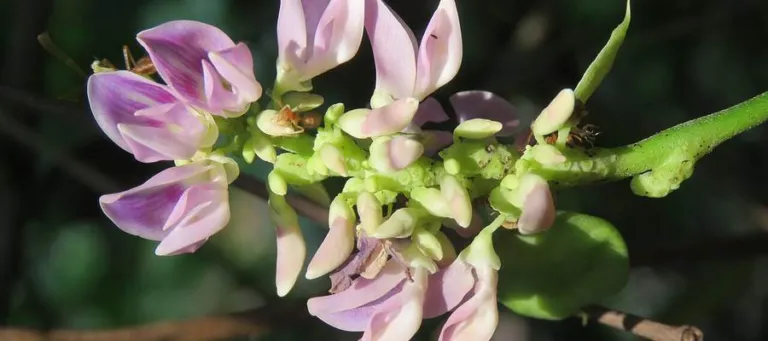
The vine, and the two-second test
Before it is a bead on a string it is a weed on a fence line, and most red seeds sold as lucky beans are harmless.
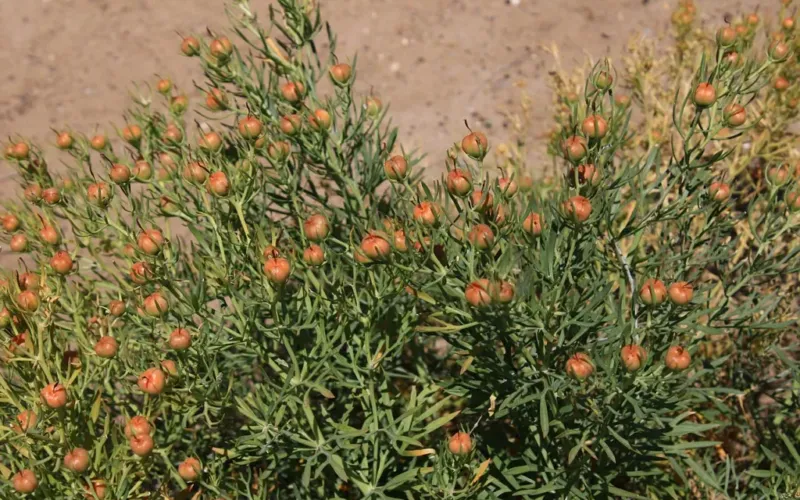
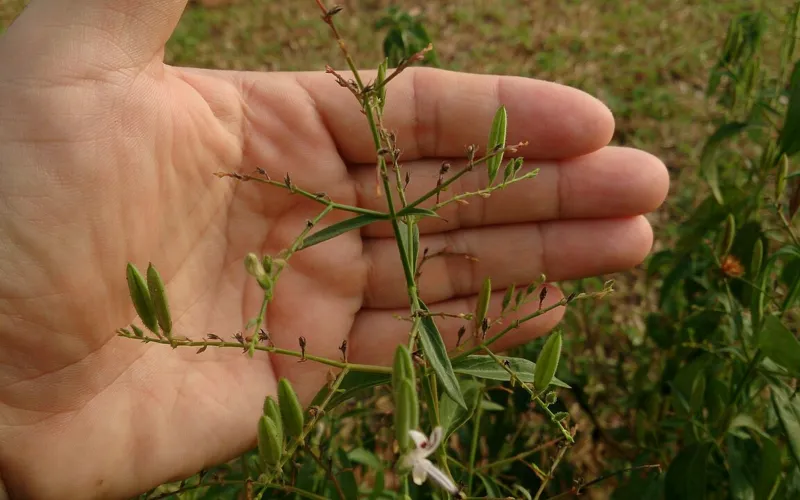
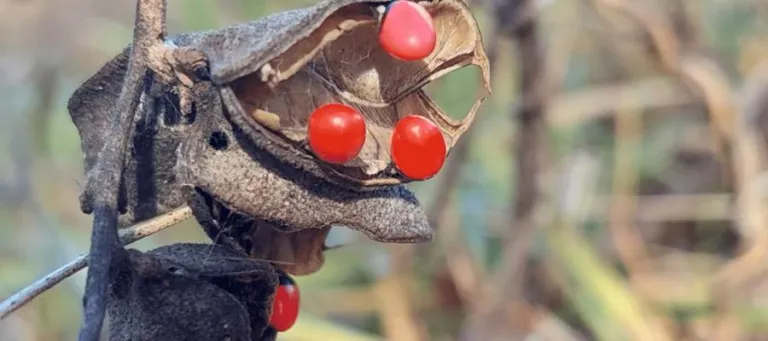
A slender climbing legume of the tropics, and a pretty one. It winds up through shrubs and small trees, sometimes ten metres of it, on a wiry stem carrying fine ferny leaves in opposite pairs, with small pea flowers from whitish through pink to mauve. You would walk past it. Then the pod: flat, 20 to 35 millimetres, it dries and splits and curls back on itself, and there they are — glassy scarlet, each with a black cap where it was attached. Anyone who has found one understands why people thread them.
A native form grows across the tropical north. The plants spreading through south-east Queensland and northern New South Wales are an African subspecies, planted as an ornamental for those seeds and now well and truly loose. Every field photograph here comes from a stand the Institute photographed at Woombye, on the Sunshine Coast, in July 2023. We identified those plants to species and left the subspecies question open.
Plenty of unrelated tropical legumes make hard red seeds, they get sold together as “lucky beans”, and most are harmless. Getting it wrong either way costs you: a sleepless night over a coral bead tree seed, or a crab’s eye handed to a child.
Look for the black cap, then look at the plant. Crab’s eye is scarlet over most of the seed with one discrete black patch at one end, sharply bounded, with the attachment scar sitting inside that patch. And it grows on a slim twining vine. A seed that is red all over, with no black cap, off a tree, is almost certainly something else.
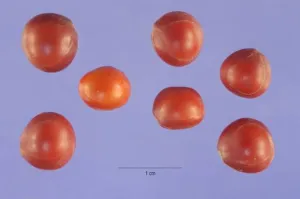
One genuine catch: gidee gidee (Adenanthera abrosperma), a native north Queensland tree, makes red-and-black seeds that look almost identical. Tree or vine is the tell. A bead on a string has no plant left to check, so treat a red-and-black bead as crab’s eye until somebody who knows has looked at it. Ground to powder, identification is a laboratory job.
Go and look at the souvenir jewellery in the house tonight. Red bead, black cap, on a string: take it out of the dress-up box. And learn the pod, if that vine is on your back fence where the kids and the dog go.
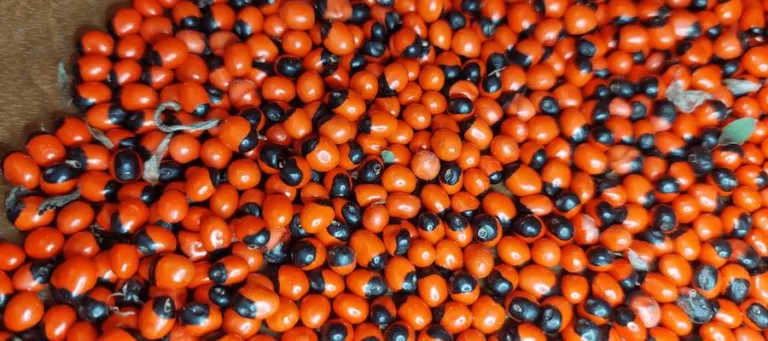
Why a broken seed is the whole story
The shell is the reason this plant has not hurt far more people than it has.
Every living cell builds its proteins on small machines called ribosomes. Inside the seed sits abrin, which switches those machines off: it gets into a cell, makes one precise cut, and the cell stops making protein and dies. Abrin acts like an enzyme, so a single molecule works through thousands of ribosomes one after another. That is how so little does so much harm.
Castor beans carry a close relative called ricin. The two are similar enough that laboratories detect them together and then struggle to tell them apart.
Now the one piece of luck in this subject. The seed coat is glassy, waxy and close to waterproof. A whole unbroken seed swallowed by a toddler often passes through without releasing a meaningful amount of toxin — in one published case, intact in successive nappies. In another, a child who swallowed seeds off a bracelet vomited, needed fluids in hospital, and went home well the next day. That shell is why the death toll is not higher.
The shell is the whole defence. A drill bit takes it away in a moment.
It is still no reason to watch and wait, because you cannot tell from outside whether a coat was breached. Chew, crush, grind or drill it and the protection has gone.
Which is why jewellery is the problem, and why this page exists. Drilling a bead breaches the coat, makes dust, and leaves a permeable seed on a string a small child can put in their mouth. A dog chewing one breaks the coat in a single bite. We say that from how the toxin works, since nobody has published an Australian case series on pets. Treat a chewing animal as an emergency either way.
Cooking is no reassurance. In one careful laboratory study the toxin shrugged off strong acid and strong alkali, and heating above 74 °C stopped its effect in those tests — even then the part that makes the cut went on working. One study, on purified toxin, so “it was cooked” settles nothing.
An intact seed in a jar is a low-drama object. A drilled bead on a bracelet, a seed in a dog’s mouth, or anything that has been ground is the version that hurts people. If the coat may have been broken, ring 13 11 26 and let them decide.
What poisoning actually looks like
It begins with hours of feeling completely fine. That is the part that catches families out.
The human record is case reports and case series. There is no controlled human evidence and never will be. Read across them and the same shape keeps appearing.
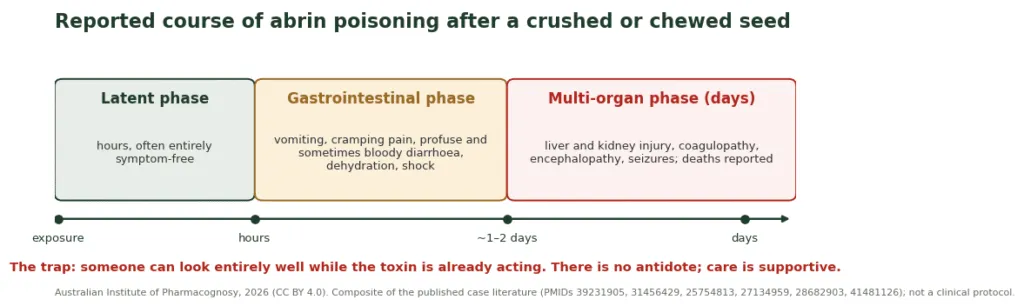
First, hours of nothing. Often the person feels completely well, plays, eats dinner, goes to bed. That is the trap, and it is why waiting to see what happens is the wrong call.
Then the gut. Vomiting, cramping pain, heavy and sometimes bloody diarrhoea, dehydration, shock.
Then, over days, the organs. Feeling better once the vomiting settles does not mean the danger has passed. Liver and kidney injury, problems with blood clotting, effects on the heart, and in some reported cases serious damage to the brain. Hospitals treat what they can see and support the patient through it. There is no antidote in use anywhere in the world, and none registered in Australia.
“They seem fine” is the most dangerous sentence on this page.
Two kinds of people turn up in the published cases: adults who crushed seed deliberately, and small children who found a bead. Nothing about the second group is exotic. A bead is mouth-sized, teething children chew, and chewing breaks the coat.
Never let a calm hour talk you out of the call. Ring 13 11 26 the moment you know, take the bead or the seeds with you, and tell the hospital what the plant is — routine drug screens will not find abrin on their own.
What the law actually says
Three separate rules touch this plant, and they get muddled together constantly online.
The Poisons Standard
Schedule 10 is the prohibited shelf: substances dangerous enough that supply and use are banned outright, with no prescription pathway. The entry names the seed or root, and names them for therapeutic use. Those words do a lot of work — the schedule is no blanket ban on the plant, the leaf, or a seed sitting in a bead. It is a Commonwealth document and creates no offence by itself; each state gives it force through its own medicines and poisons law. In Queensland that is the Medicines and Poisons Act 2019, where dealing with a prohibited substance is an offence unless you are authorised or have a reasonable excuse. Interstate readers have their own Act, worded differently — read yours.
The security rules
Abrin itself — the purified toxin, and not the plant — is listed as a Tier 1 Security Sensitive Biological Agent. The national guidelines name rosary pea directly: wild plants, and seeds you happen to have, are not “handling”, and neither is growing the plant or collecting seed for artistic or cultural purposes. Collecting seed in order to produce the toxin is handling, and so is any attempt to extract it. Purpose is what the scheme turns on.
Weed law
Queensland does not list it as prohibited or restricted matter in the Biosecurity Regulation 2016, as we read that instrument, though it behaves as an environmental weed through the south-east and over the border. Undeclared is a long way from unregulated: the general biosecurity obligation still binds anyone dealing with a plant that can spread. Every other state keeps its own list — check yours.
So none of the three turns a vine on a Queensland fence line into a prohibited thing, and trying to extract something from the seed changes all three answers at once. We read these instruments on 17/09/2026, and this is our published reading rather than legal advice.
A vine over your fence is a gardening question. Setting out to extract something from the seed is where it turns serious, and the security scheme that covers the toxin is a national one.
Does it work as a medicine?
The tradition is old and real. The clinical evidence is a different story, and you deserve the straight answer.
The traditional record is genuine and ancient. Leaf and root preparations appear across Africa, India and South-East Asia for coughs, sore throats, fever, pain and wounds. Ayurveda and Siddha know the seed as gunja, with elaborate purification procedures attached. Those procedures exist because everyone involved knew the raw seed was dangerous.
Here is what we could not find, after going through the literature properly: a single controlled human trial of any preparation of this plant, for any condition. Everything therapeutic in the modern research is cells in dishes and animals in laboratories. When a herbal source says this plant “is used to treat” something, it is describing a custom. And nothing made from the seed or root is lawfully supplied here as a therapy, which is what the Schedule 10 entry above does.
Two name traps if you go searching. “Indian liquorice” is a real common name for this plant and has nothing to do with confectionery liquorice, which is Glycyrrhiza. And most modern papers with “Abrus” in the title are about two Chinese species, Abrus cantoniensis and Abrus mollis, which are not comparably toxic. Their findings do not transfer.
If a shop, a website or a practitioner offers you anything made from this seed, walk away and tell us about it. For any question about taking a herbal medicine, consult a degree-qualified herbalist with competencies and adequate training in pharmacognosy.
One good story before you go
Jewellers’ weights, and one experiment in 1891 that changed medicine.
In India the seed had a job long before anyone knew what was inside it. The ratti, from a Sanskrit word meaning “the red one”, was this seed used as a unit of mass for gold and gemstones, and jewellers in India and Pakistan still quote ratti today. The old story that every seed weighs the same is half right: single seeds vary, and it is the average of a handful that holds steady.
Then in 1891, Paul Ehrlich ran the experiments that helped lay the foundations of immunology using exactly two substances: abrin and ricin. Mice given small, increasing doses became protected, and the protection was specific to the toxin used. With Brieger, two years later, he showed a mother mouse passes that protection to her young through milk. Active immunity, antibody specificity, maternal transfer — worked out on this seed and a castor bean.
Those ideas sit underneath the vaccines your family has had, and the seed on the bracelet in the drawer sits at one end of the line.
Respect beats fear with a plant like this. Know the black cap, keep the beads away from small hands and dogs, and keep 13 11 26 in your phone.
Everything here comes out of our full monograph: the chemistry, the published poisoning cases, the regulatory reading, sixty-nine checked references and the evidence grade on every claim. About an hour to read. The detail has been left behind here; the meaning has not.
Rosary pea (Abrus precatorius): pretty seed, deadly protein — AIP Monograph No. 1
- Jesse Kirby — wrote this plain-language edition
- Zoe Bennett — titled the page, wrote the search description and the lines it will be shared with
- Theo Karras — chose and treated the photographs, the hero and the section banners, and drew the time-course diagram
- Leah Bianchi — built the page – the safety callout, the cards and how it reads on a phone
Contributors
- Dr Thomas Ridley — wrote the full monograph it is drawn from, and checked this version for accuracy
- Geoffrey Larkin — reviewed the toxicology, regulatory and image-licensing wording for legal and advertising compliance
Direction and oversight
- Dr Luke Iggulden — Commissioned the Explainer series and set its direction
Image credits. Field photographs of Abrus precatorius — Australian Institute of Pharmacognosy, Woombye QLD, 05/07/2023; iNaturalist 173142791, CC BY 4.0. Adenanthera pavonina seeds — Steve Hurst @ USDA-NRCS PLANTS Database, public domain, via Wikimedia Commons. Time-course diagram — AIP, 2026, CC BY 4.0.
AIP Explainers are the plain-language editions of the Institute’s technical articles, published alongside the original. Every claim here is carried by the full article, where the references, the evidence grades and the regulatory sources are set out. Regulatory information was read on 17/09/2026 and may change. Found an error? Write to our contact form — we would rather correct a claim than repeat it.
Jesse Kirby
Head of Community Outreach
Australian Institute of Pharmacognosy
Cardwell QLD, Australia
australian-pharmacognosy.org · our contact form