
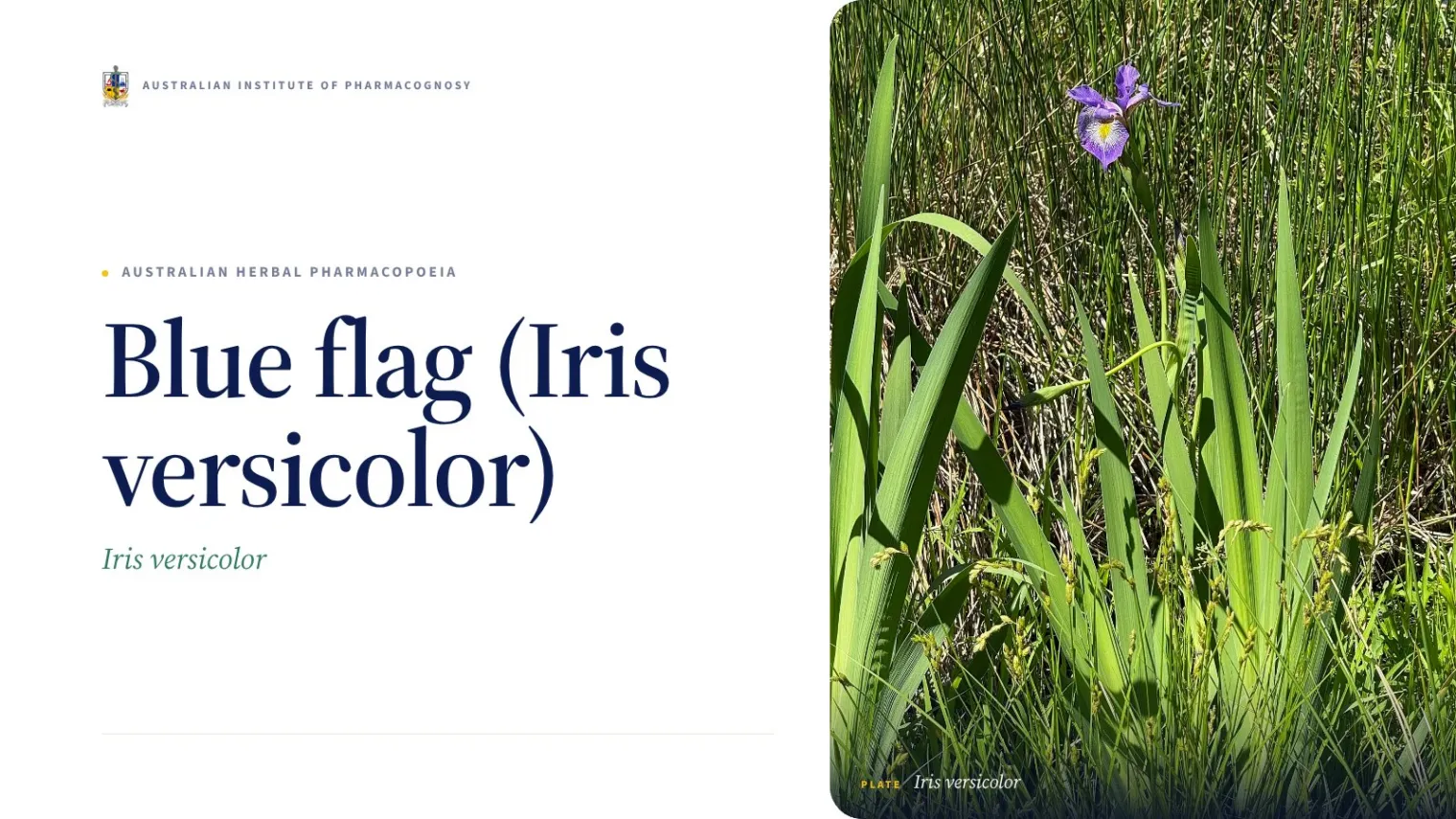
Blue flag rhizome (Iris versicolor L.), Iridaceae
Australian Herbal Pharmacopoeia (working title) · Monograph AIP-PH-IRIVER · Version 1.0 draft
Date: 2026
Status: working document, version 1.0. Not a statutory standard.
Prepared by: Dr Thomas Ridley, Head of Education and Research, Australian Institute of Pharmacognosy, Cardwell, Queensland.
0. Free-teaser block
0.1 Identity card
| Register number | AIP-PH-IRIVER (MediHerb A–Z list No. 21) |
| Title | Blue flag root (Iris versicolor L.), Iridis versicoloris rhizoma |
| Version / year | 1.0 draft, 2026. Next review 2029, or sooner when AIP bench data exist or a human study reports |
| Accepted binomial | Iris versicolor L., Species Plantarum 1: 39 (1753). Accepted in the World Checklist of Vascular Plants (WCVP) version 16.0 of 04/06/2026, the dataset Plants of the World Online displays, read through ChecklistBank on 30/09/2026; IPNI 439235-1 [1]. Not to be confused with the later homonym Iris versicolor Thunb. (1784), a synonym of I. laevigata [1] |
| Family | Iridaceae [1], order Asparagales in the APG IV system as maintained on the Angiosperm Phylogeny Website [39]; subgenus Limniris in the chemical literature [25]. No family change affects the genus |
| Plant part | Dried rhizome, with not more than 5 per cent of roots and leaf bases (NF IV, 1916) [12]; sold in the Australian practitioner trade as "root" [13] |
| Latin drug name | Iridis versicoloris rhizoma (AIP form). The US National Formulary IV (1916) called the drug "Iris Versicolor" [12]; the US Pharmacopoeia called it "Iris" [11] |
| Principal synonyms | Iris boltoniana Regel, I. caurina Herb. ex Hook., I. dierinckii K.Koch, I. flaccida Spach, I. picta Mill., I. pulchella Regel, Limniris versicolor (L.) Rodion., Xiphion versicolor (L.) Alef., and several varieties and forms [1]. Not synonyms: I. virginica L. and I. caroliniana S.Watson (the latter a synonym of I. virginica), which some pharmacy texts treat as the same drug [1,2,8,9] |
| Common names | English: blue flag, larger blue flag, harlequin blueflag, flag lily, water flag, liver lily, snake lily, poison flag, flower-de-luce [2,7,11,20]. French (Canada): iris versicolore [2] |
| Pharmacopoeial status elsewhere | US Pharmacopoeia, last official in the 1890 revision, and US National Formulary IV (1916), with macroscopy, powder microscopy, ash not more than 7 per cent and roots and leaf bases not more than 5 per cent [12]. British Herbal Pharmacopoeia 1996: yes, listed as Iris versicolor and I. caroliniana [9]; British Herbal Compendium 1992: yes [8]. The BHP and BHC texts themselves are not among the sources read. Ph. Eur., BP, WHO, EMA/HMPC, ChP, API: no monograph found in the sources searched |
| Australian status | Permissible Ingredients Determination: yes, item 2724 IRIS VERSICOLOR, and items 914 BLUE FLAG RHIZOME DRY and 915 BLUE FLAG RHIZOME POWDER, each for purposes A (active) and H (homoeopathic), no specific requirements [3]. Poisons Standard: blue flag is not named; its minor constituent furfural is Schedule 6 except in preparations with 0.1 per cent or less, and sweet flag (Acorus calamus), its historic look-alike, is Schedule 10 for human therapeutic use (section 10) [4]. ARTG: a product-name search found no product called Iris versicolor [38]. Not recorded growing in Australia: the 10 specimens in Australian and New Zealand herbaria were collected in North America and New Zealand [5]. Not native, so no Nature Conservation Act 1992 (Qld) permit applies; not a prohibited or restricted invasive plant under the Biosecurity Act 2014 (Qld) [6] |
| Named markers | Iriversical (CID 71587326): identity, rhizome-specific, proposed; no limit. Irilone (CID 5281779): supporting identity at genus level, proposed; no limit. Furfural (CID 7362): safety marker, proposed; no limit exists anywhere. Total ash: not more than 7 per cent (NF IV) [12] |
| Evidence snapshot | Chronic skin disease (acne, eczema, psoriasis): Tier T, 0 trials. Liver and gallbladder complaints, constipation: Tier T, 0 trials. Enlarged lymph nodes: Tier T, 0 trials. Goitre: Tier T, 0 trials. Oral biofilm, anti-adhesion: Tier P, one in vitro study. Weight loss: Tier P, one rat study of a three-herb mixture [8,11,13,24,27] |
| Suggested citation | Ridley T. Blue flag root (Iris versicolor L.), Iridis versicoloris rhizoma. AIP-PH-IRIVER, version 1.0 draft. Cardwell: Australian Institute of Pharmacognosy; 2026. DOI to be assigned |
| Provenance | Original AIP data: none. Every analytical figure, limit, method and dose belongs to the source cited beside it. Every photograph of the living plant, rhizome and microscopy is a licensed photograph named by its photographer or institution, and its identification is provisional. Sections 4, 5, 7, 8, 9 and 10 carry AIP bench data pending (no AIP voucher, section, plate or run yet). The map (Figure 9), charts (Figures 6b, 7b, 8, 10–13) and drawings (Figures 5, 6) are AIP drawings from cited data |
| Compiler and review | Compiled by Dr Thomas Ridley (Education and Research). Technical review: Dr Fiona MacAllister (Botanical, sections 1-5, 10; reviewed in 2026), Dr Hana Suzuki (QA, sections 6-10; reviewed in 2026), Dr Eleanor Whitcombe (Medicine, sections 12, 13, 15; reviewed in 2026). Layout, figure placement and figure credits: Jesse Kirby (Community Outreach, Figures 1–13 and the page design; reviewed in 2026). Evidence and citation audit of all sections, references and figure sources: Dr Thomas Ridley (Education and Research; reviewed in 2026; as the compiler, this audit is not independent, and sections 11, 14 and 16–18 still await a reader outside Education and Research). Published: not yet. Last modified: 2026. Version 1.0 draft |
| Canonical URL | /pharmacopoeia/iris-versicolor/ (on publication) |
0.2 Summary
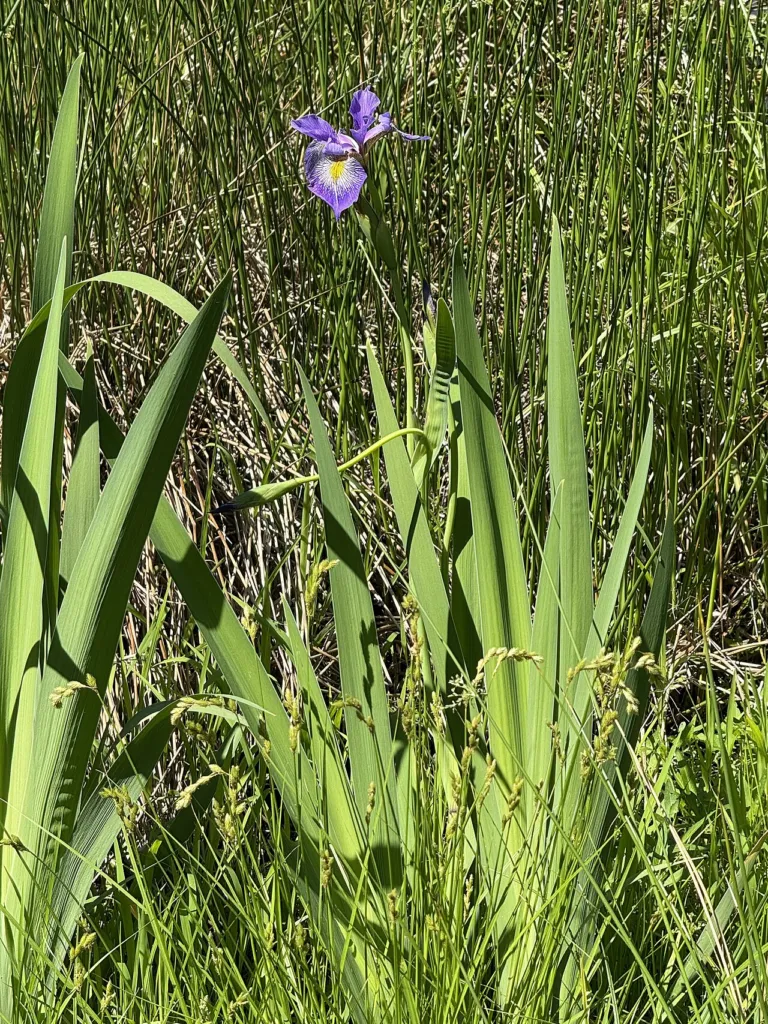
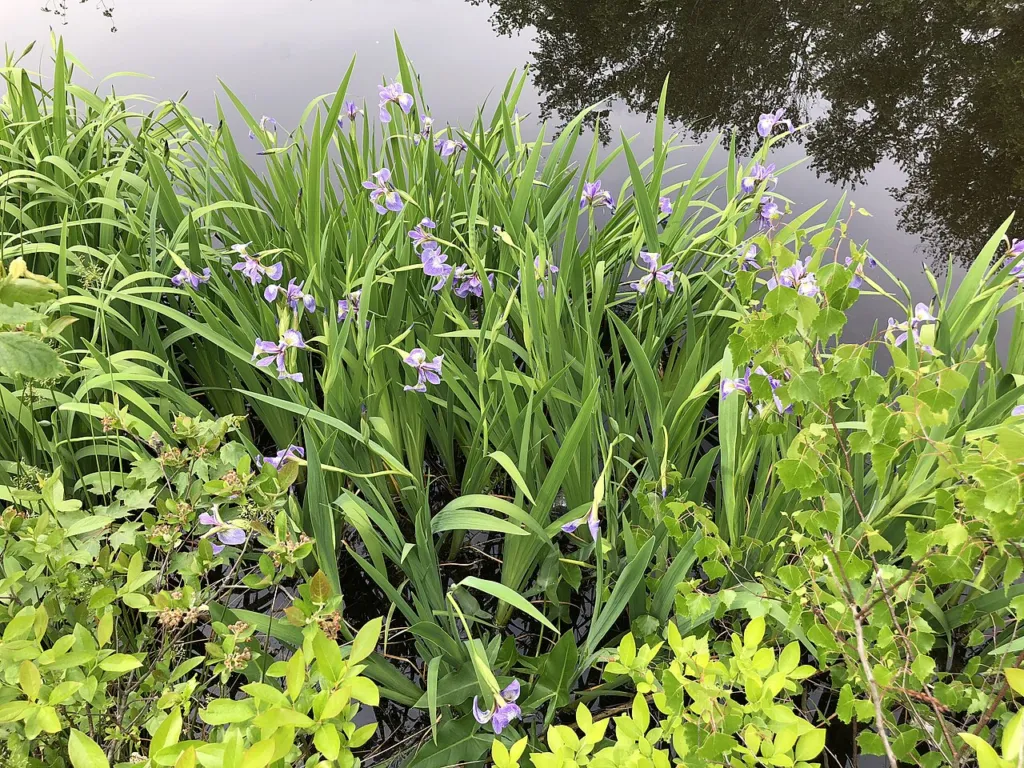
Blue flag is the dried rhizome of Iris versicolor, a wetland iris of north-eastern North America from Newfoundland and Labrador to Virginia and west to Manitoba and Minnesota. It is a natural allopolyploid that arose from ancestors of the southern blue flag, I. virginica, and the Arctic I. setosa group. It does not grow wild in Australia and is imported. The last official standard was the US National Formulary IV (1916): a branched, annulate, grey- to purplish-brown rhizome whose powder shows resin cells, calcium oxalate prisms and sparse starch, with ash not more than 7 per cent. The British Herbal Pharmacopoeia 1996 kept a monograph that also admitted I. caroliniana, which botanists now treat as I. virginica.
The rhizome contains iridal-type triterpenoids, including iriversical, first isolated from this species, with isoflavones, benzophenones, xanthones, phenolic acids and a trace of volatile oil containing furfural. The isoflavone glucoside iridin, often listed for blue flag, was found in the leaves and not in the rhizome in the two profiling studies read; the "iridin" of nineteenth-century pharmacy was an oleoresin extract.
Australian practitioners prescribe a 1:2 liquid extract at 20 to 40 mL a week for skin disease, sluggish liver and bile flow, and enlarged lymph nodes. That use rests on North American First Nations, Eclectic and later practitioner tradition. No clinical trial has been found. The main safety points are dose-dependent nausea, vomiting and purging; avoidance in pregnancy, while breastfeeding, and in active bowel inflammation or a blocked bile duct; no use in children outside a degree-qualified herbalist’s care; and confusion with sweet flag, a Schedule 10 plant in Australia.
0.3 Contents with extent
| Section | Extent (A4 pages in this printing) |
|---|---|
| 0 Free-teaser block | 5 |
| 1 Nomenclature | 2 |
| 2 Definition | 1 |
| 3 Source and Australian supply, with 3.1 origin, climate and chemistry | 3 |
| 4 Macroscopy | 5 |
| 5 Microscopy | 3 |
| 6 Chemistry | 2 |
| 7 Named markers and assay limits | 1 |
| 8 TLC fingerprint | 2 |
| 9 HPLC fingerprint | 2 |
| 10 Identity, purity, adulterants and contaminants | 2 |
| 11 Traditional use | 4 |
| 12 Current practice | 1 |
| 13 Clinical evidence | 2 |
| 14 Pharmacology | 1 |
| 15 Safety | 2 |
| 16–18 Discussion, conclusions, research needed | 6 |
| 19 References | 2 |
| 20 Document control | 3 |
| Totals (draft) | 49 A4 pages. 33 embedded figures: 11 licensed photographs of the living plant, fruit and seed; 3 licensed photographs of the fresh rhizome; 2 licensed photomicrographs and prints (a root cross-section and a leaf epidermis); 4 public-domain plates (1787, 1817, 1887, 1918); 2 licensed photographs of look-alike species; 1 AIP composite of PubChem structures; 1 AIP schematic redrawn from the 1916 description; 7 AIP charts and replots; 1 AIP map; 1 captioned placeholder for the AIP TLC plate. About 20 tables. 0 AIP photomicrographs, 0 AIP chromatograms, 0 AIP plates. 0 clinical trials to grade; 1 trial register searched in full and 2 more attempted; 2 literature databases searched. 43 numbered references |
Gaps stated plainly. AIP holds no voucher, photomicrograph, TLC plate or chromatogram of blue flag. No openly licensed photomicrograph of the rhizome was found; Figure 4 is a licensed stained cross-section of the root, which the NF IV allows at up to 5 per cent of the drug, and Figure 5 is an AIP schematic redrawn from the 1916 description of the rhizome. No published TLC method for this drug was found in the sources read, so the Figure 7 slot carries a captioned placeholder. No openly licensed chromatogram of this species was found; Figure 8 is an AIP retention-time map redrawn from a published table, labelled as such, and is not a chromatogram. The BHP 1996 and BHC 1992 monographs are reported through Barnes and Trease and Evans and have not been read directly. The crude-drug photographs (Figures 3, 3b) are of fresh rhizome and carry no scale bar; an AIP photograph of the dried drug with a scale bar is pending. The APG IV paper has been requested in full text; the family placement is cited meanwhile to the Angiosperm Phylogeny Website. The ANZCTR search page refused scripted access on 30/09/2026, and the WHO trial register search failed its positive control, so neither counts as searched. TGA safety alerts and recalls were searched (section 15), but the CITES checklist, the TGA adverse-event database (DAEN) and the DAFF BICON case for dried rhizome were not searched for this edition. Three earlier Indian reports that claim weight loss in people with a mixture containing blue flag have not been located (section 13). All are listed for a hand search (section 18).
0.4 Contributors and access
Compiled by Dr Thomas Ridley, Head of Education and Research. Dr Fiona MacAllister, Head of Botanical, reviewed sections 1–5 and the adulterant species of section 10, with Figures 1–5 and 9. Dr Hana Suzuki, Head of Botanical QA, reviewed sections 6–10, with Figures 6, 6b, 7, 7b and 8. Dr Eleanor Whitcombe, Head of Medicine, reviewed sections 12, 13 and 15, with Figures 10–13. Jesse Kirby, Head of Community Outreach, reviewed the layout: the placement of every figure in its section, each caption and credit line against the image record, and the printed page design. Dr Thomas Ridley audited every reference, quotation and figure source against the source itself; because he also compiled the monograph, that audit is not independent, and sections 11, 14 and 16–18 still await a reader outside Education and Research. Dr Luke Iggulden set the scope of the pharmacopoeia series; he did not write this monograph. The free sample is the first five printed pages; the full text is available to Scholar members and above.
33 more pages follow · 16,465 words, 31 figures, 14 tables
Still to come in this monograph
- 1. Nomenclature
- 2. Definition
- 3. Source and Australian supply
- 4. Macroscopy
- 5. Microscopy
- 6. Chemistry
- 7. Named markers and assay limits
- 8. TLC fingerprint
- 9. HPLC fingerprint
- 10. Identity, purity, adulterants and contaminants
- 11. Traditional use
- 12. Current practice: use, preparations and doses
- 13. Clinical evidence
- 14. Pharmacology
- 15. Safety
- 16. Discussion
- 17. Conclusions
- 18. Research still needed
- 19. References
- 20. Document control
The rest of this monograph is open to members. One membership covers every members’ feature on the site.
Checking your membership…
Report an error or submit evidence
If something in this monograph is wrong, out of date or missing, tell us and show us the evidence. Every report is logged under the AIP Evidence Charter and assessed on the evidence alone; the outcome is kept on the record, and an upheld report is corrected with a dated notice on this page.
Open the report form
The Institute sets and publishes its own monographs. The catalogue is in Publications.