
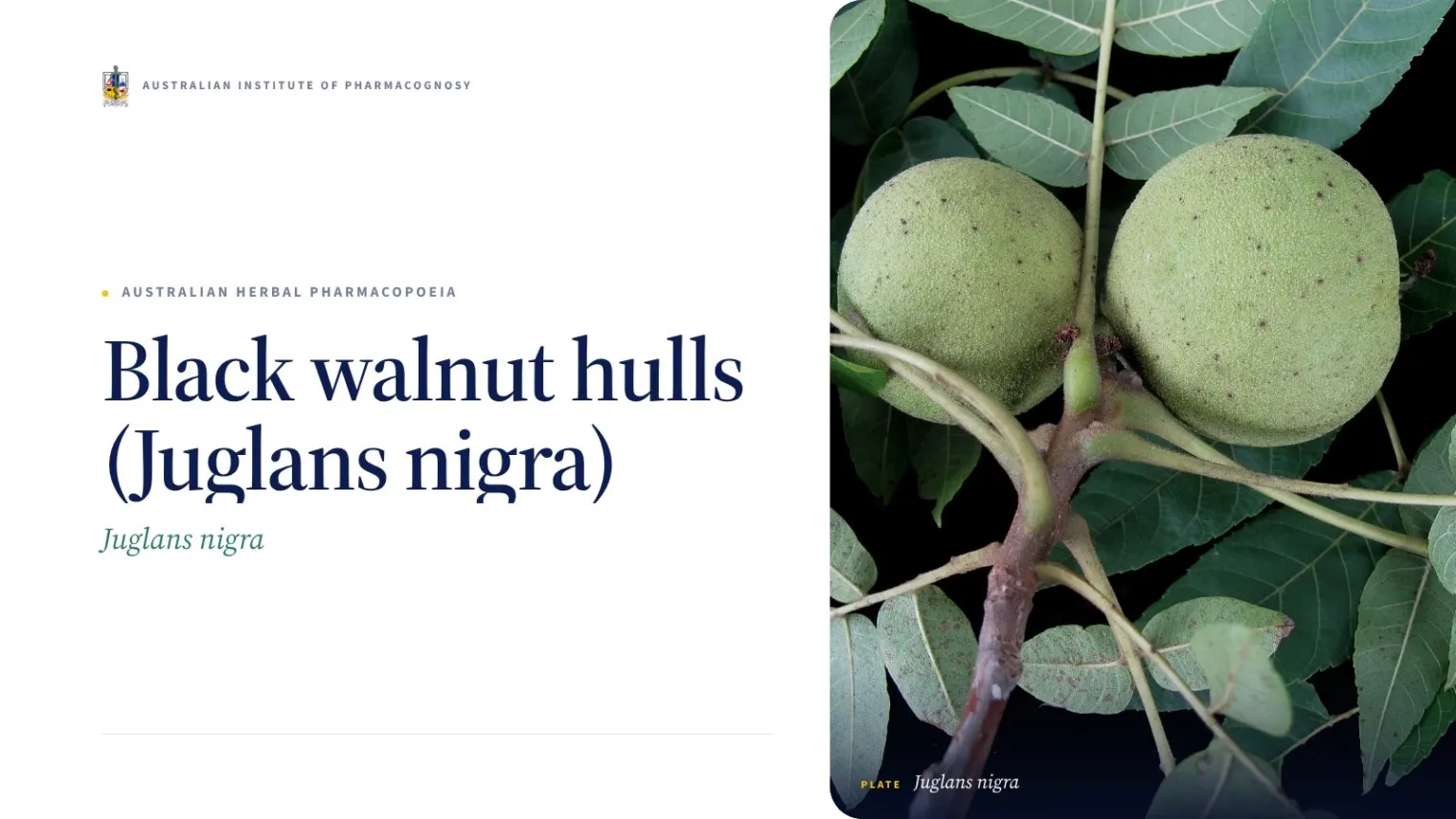
Black walnut hulls (Juglans nigra L.), Juglandaceae
Australian Herbal Pharmacopoeia (working title) · Monograph AIP-PH-JUGNIG · Version 1.0 draft
Date: 2026
Status: working document, version 1.0. Not a statutory standard.
Prepared by: Dr Thomas Ridley, Head of Education and Research, Australian Institute of Pharmacognosy, Cardwell, Queensland.
0. Free-teaser block
0.1 Identity card
| Register number | AIP-PH-JUGNIG (MediHerb A–Z list No. 18) |
| Title | Black walnut hulls (Juglans nigra L.), Juglandis nigrae pericarpium |
| Version / year | 1.0 draft, 2026. Next review 2029, or sooner if a human study of the hull reports or AIP bench data become available |
| Accepted binomial | Juglans nigra L., Species Plantarum: 997 (1753). Accepted in the World Checklist of Vascular Plants (WCVP), version 16.0 of 04/06/2026, the dataset shown by Plants of the World Online, read through ChecklistBank on 30/09/2026; IPNI 279034-2 [1] |
| Family | Juglandaceae, order Fagales (APG IV, as followed by WCVP) [1,46,47] |
| Plant part | The fruit hull: the fleshy outer layers of the fruit (exocarp and mesocarp) that enclose the hard nut, used fresh-green or dried. Sold in Australia as "hulls" or "green hulls" [5,9,10,14] |
| Latin drug name | Juglandis nigrae pericarpium (AIP form). No pharmacopoeia has set a Latin name for this drug; the European walnut hull was called Cortex fructus juglandis in older European pharmacy [12] |
| Principal synonyms | Wallia nigra (L.) Alef. (homotypic); Juglans pitteursii C.Morren, J. rugosa Dode, J. nigra [unranked] oblonga Marshall, J. nigra f. laciniata Rehder, J. nigra f. oblonga (Marshall) Fernald (heterotypic) [1] |
| Common names | English: black walnut, eastern black walnut, American walnut [3,20]. French: noyer noir, noyer noir d’Amérique [17]. German: Schwarznuss [17] |
| Pharmacopoeial status elsewhere | Ph. Eur.: no monograph for any J. nigra drug in the edition held (8.0) [32]. EMA/HMPC: a monograph exists for the leaf of a different species, Juglans regia (Juglandis folium, cutaneous use), and none for J. nigra [24]. USP–NF, BP, WHO, ChP, API: no monograph found in the sources read. The US Dispensatory of 1918 carries butternut (J. cinerea) bark, with the other walnuts as notes [13]. The British Herbal Pharmacopoeia was not among the sources read for this edition (section 18) |
| Australian status | Permissible Ingredients Determination: yes, item 2846 JUGLANS NIGRA, purposes A (active), E (excipient) and H (homoeopathic), no specific requirements [7]. ARTG: at least 25 listed medicines contain J. nigra, among them a single-herb hull capsule and MediHerb Wormwood Complex [9,10]. Poisons Standard: not named, and juglone is not scheduled [6]. Queensland: the fresh fruit is a listed Mediterranean fruit fly carrier; dried hulls count as processed and fall outside that rule [4]. Not native; no Australian record in Queensland [2] |
| Named markers | Hydrojuglone glucoside (CID 477404): identity, proposed; limit to be set. Juglone (CID 3806): safety marker, proposed upper limit not yet set. Ellagic acid (CID 5281855), total after hydrolysis: assay, proposed; no limit. No pharmacopoeial limit exists for any of them (sections 7, 18) |
| Evidence snapshot | Threadworm and other intestinal worms: Tier T, 0 trials. Protozoal gut infection: Tier T, 0 trials. Fungal skin infection (topical): Tier T, 0 trials (laboratory work exists only for European walnut leaf). Laxative: Tier T, 0 trials. Antibacterial, antiprotozoal and antiproliferative effects: Tier P, laboratory studies only [5,9,18,20,24,28,30] |
| Suggested citation | Ridley T. Black walnut hulls (Juglans nigra L.), Juglandis nigrae pericarpium. AIP-PH-JUGNIG, version 1.0 draft. Cardwell: Australian Institute of Pharmacognosy; 2026. DOI to be assigned |
| Provenance | Original AIP data: none. Every analytical figure, limit, method and dose belongs to the source cited beside it. Sections 4, 5, 7, 8, 9 and 10 carry AIP bench data pending (no AIP voucher, section, plate or run yet). The map (Figure 9), charts (Figures 10–13) and drawings (Figures 3d, 5, 6) are AIP drawings from cited data |
| Compiler and review | Compiled by Dr Thomas Ridley (Education and Research). Technical review: Dr Fiona MacAllister (Botanical, sections 1-5, 10), reviewed in 2026; Dr Hana Suzuki (QA, sections 6-10), reviewed in 2026; Dr Eleanor Whitcombe (Medicine, sections 12, 13, 15), reviewed in 2026; Dr Thomas Ridley (Education and Research, evidence and citation audit of all sections and figures), reviewed in 2026; Jesse Kirby (Community Outreach, figures, captions, credit lines and whole-document layout), reviewed in 2026. Published: not yet. Last modified: 2026. Version 1.0 draft |
| Canonical URL | /pharmacopoeia/juglans-nigra/ (on publication) |
0.2 Summary
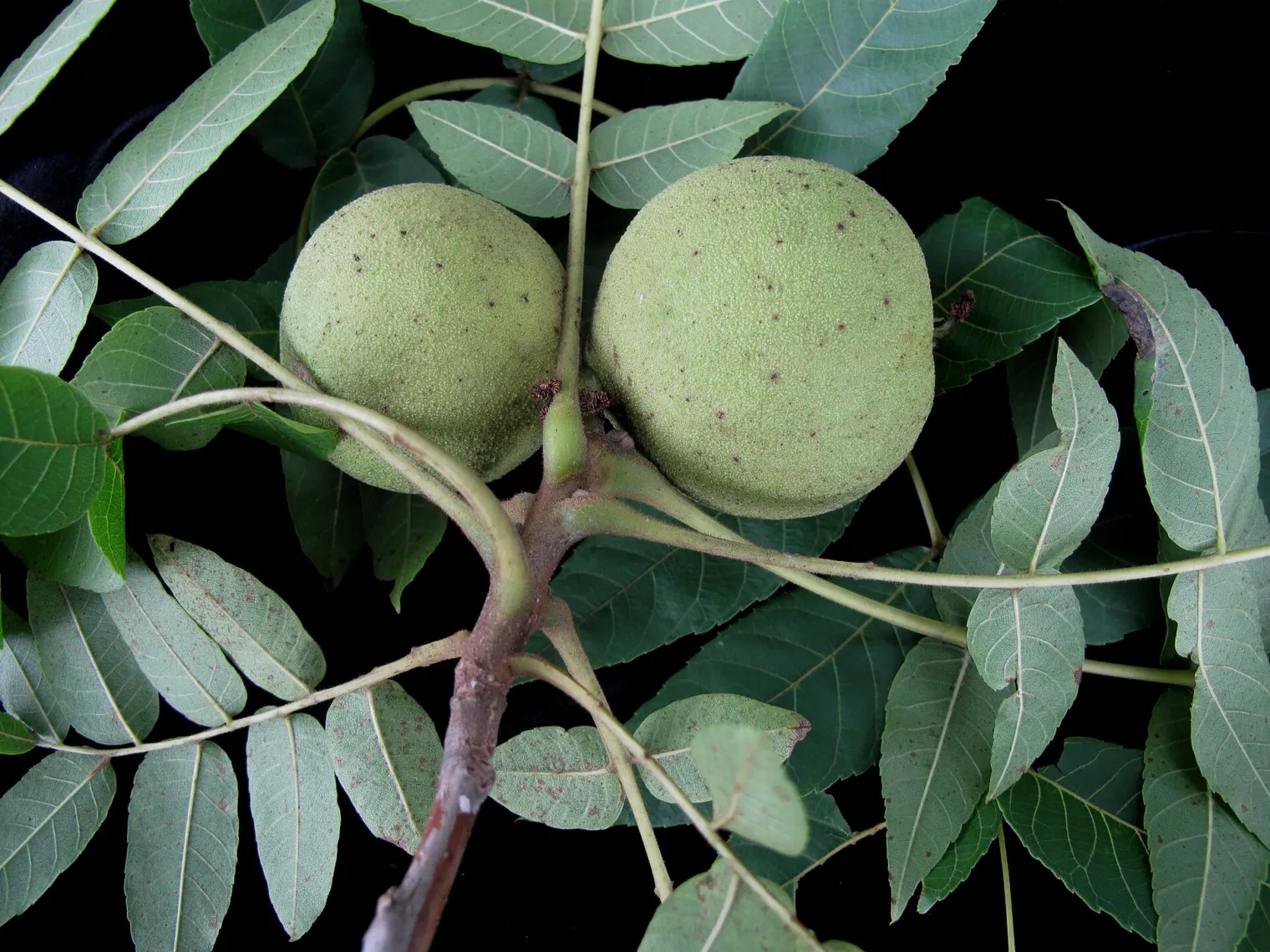
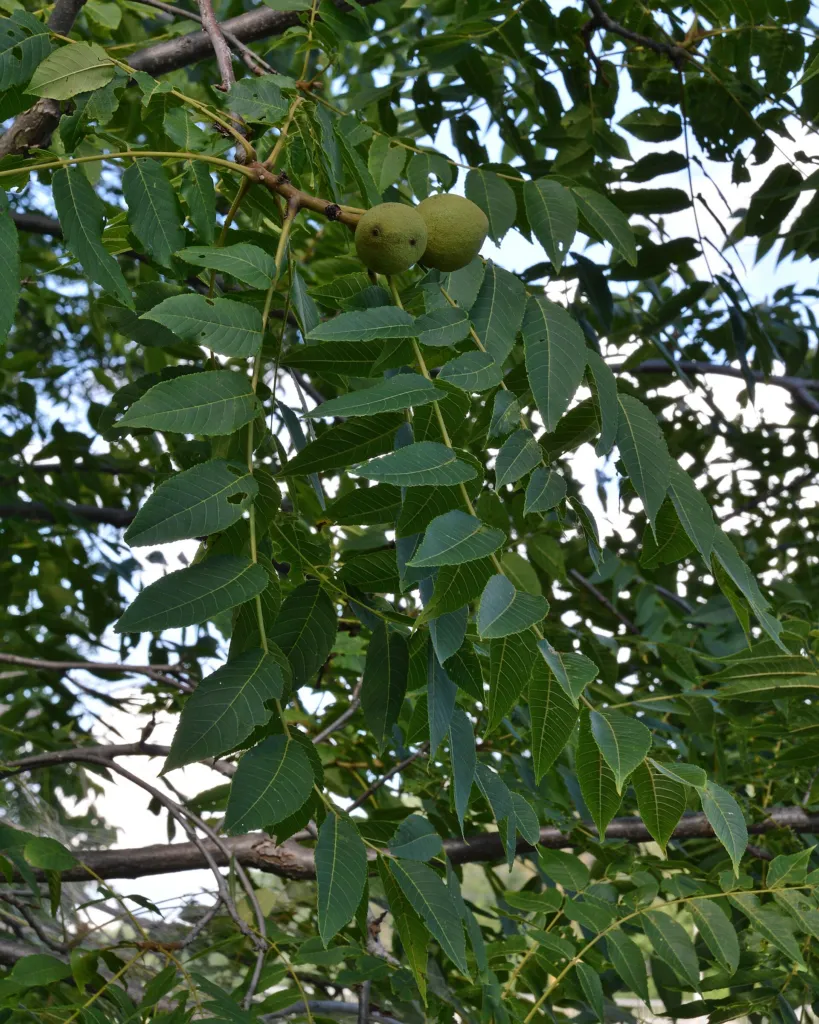
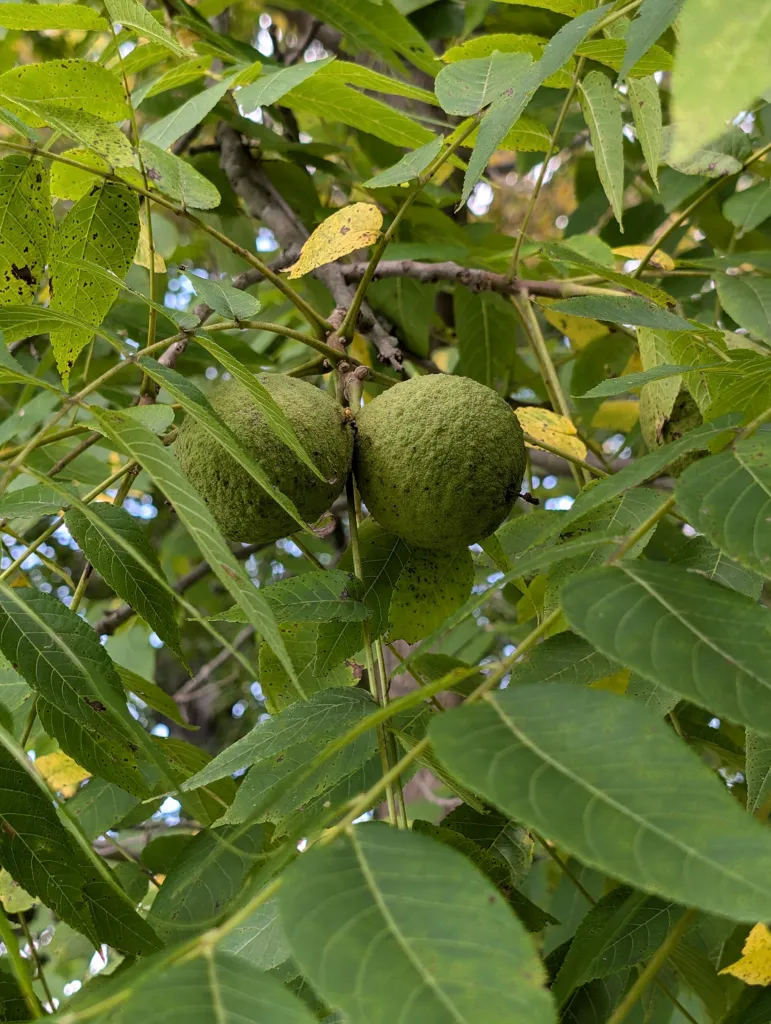
Black walnut hull is the fleshy outer coat of the fruit of Juglans nigra, a large timber and nut tree of the eastern and central United States and southern Ontario. The hull is green and firm when the fruit falls in autumn. It turns black and soft within weeks and stains skin a lasting brown-black. Herbal practice uses the hull, green or dried, and discards the hard nut inside. The tree is grown in Europe and in a few gardens in south-eastern Australia. No Queensland record exists, and Australian supply is imported.
No pharmacopoeia carries this drug, so there is no official definition, no identity test and no limit. The chemistry is well described in the last few years. Vouchered pericarp from Hungary yielded 161 tentatively identified phenolic compounds. Gallotannins and ellagitannins dominate the pericarp, and the naphthalene compounds typical of walnuts are present as well. The most abundant of these is hydrojuglone glucoside, the stored precursor of juglone. Juglone itself forms when the tissue is bruised, cut or extracted. Free juglone in intact hull is close to zero.
Australian practitioners prescribe a 1:10 liquid extract at 10 to 40 mL a week as an anthelmintic. That use comes from nineteenth-century American practice, and older European use of the European walnut’s hull. No clinical trial of the hull was found. The laboratory evidence is antibacterial, antiprotozoal and antiproliferative work on extracts and pure compounds. The safety questions are juglone, pregnancy, tree-nut allergy, mould, and toxicity to horses from black walnut wood.
0.3 Contents with extent
| Section | Extent (A4 pages, estimated for this printing) |
|---|---|
| 0 Free-teaser block | 6 |
| 1 Nomenclature | 2 |
| 2 Definition | 1 |
| 3 Source and Australian supply, with 3.1 origin, climate and chemistry | 4 |
| 4 Macroscopy | 4 |
| 5 Microscopy | 2 |
| 6 Chemistry | 2 |
| 7 Named markers and assay limits | 2 |
| 8 TLC fingerprint | 1 |
| 9 HPLC fingerprint | 2 |
| 10 Identity, purity, adulterants and contaminants | 2 |
| 11 Traditional use | 2 |
| 12 Current practice | 1 |
| 13 Clinical evidence | 2 |
| 14 Pharmacology | 2 |
| 15 Safety | 3 |
| 16–18 Discussion, conclusions, research needed | 4 |
| 19 References | 2 |
| 20 Document control | 3 |
| Totals (draft) | 46 A4 pages in this printing. 37 embedded figures: 13 licensed or public-domain photographs of the living tree, leaves, flowers and fruit; 4 licensed photographs of the crude drug and the nut; 5 public-domain plates, drawings and paintings; 2 licensed micrographs and fruit sections of the European walnut (J. regia, labelled so); 1 licensed HPTLC plate (other plants, including walnut leaf of J. regia); 1 licensed UHPLC chromatogram of black walnut pericarp; 2 licensed chemistry figures; 1 licensed photograph of hull staining; 1 AIP composite of PubChem structures; 7 AIP drawings, maps and charts. About 22 tables. 0 AIP photomicrographs, 0 AIP chromatograms, 0 AIP plates. 0 clinical trials of the hull to grade; ClinicalTrials.gov and the WHO trials portal searched, ANZCTR direct search still to be done by hand; 2 literature databases searched; ARTG, the TGA adverse event database and the TGA website checked. 52 numbered references |
Gaps stated plainly. AIP holds no voucher, photomicrograph, TLC plate or chromatogram of black walnut hull. No published microscopical description of the hull was found. Figure 4 therefore shows licensed sections of the European walnut’s husk, and Figure 5 is an AIP schematic from descriptions of related species. No published TLC fingerprint of the hull was found; Figure 7 shows a published HPTLC plate that includes walnut leaf of J. regia, labelled so. The photographs of the crude drug carry no scale bar. About twenty older papers on hull toxicity in horses and dogs, skin reactions, hull pharmacology and fungicide residues are being obtained in full text; none is used here. The CITES checklist, DAFF BICON import conditions, the ANZCTR site and the TGA recalls database could not be read or fully queried by our tools on 30/09/2026 and are to be checked by hand.
0.4 Contributors and access
Compiled by Dr Thomas Ridley, Head of Education and Research: literature and register searches, source reading, all sections, AIP drawings and charts, and the evidence record behind this monograph. Technical review has been requested from Botanical (Dr Fiona MacAllister, sections 1–5 and 10), QA (Dr Hana Suzuki, sections 6–10) and Medicine (Dr Eleanor Whitcombe, sections 12, 13 and 15). The Botanical, QA and Medicine reviews are on record, and each reviewer is credited once their review is. Education and Research then audited every reference, identifier and figure licence against its source; because the same department compiled the monograph, the Librarian’s reference audit is still to come. Dr Luke Iggulden set the scope of the pharmacopoeia series; he did not write this monograph. The free sample is the first five printed pages; the full text is available to Scholar members and above.
33 more pages follow · 16,331 words, 34 figures, 22 tables
Still to come in this monograph
- 1. Nomenclature
- 2. Definition
- 3. Source and Australian supply
- 4. Macroscopy
- 5. Microscopy
- 6. Chemistry
- 7. Named markers and assay limits
- 8. TLC fingerprint
- 9. HPLC fingerprint
- 10. Identity, purity, adulterants and contaminants
- 11. Traditional use
- 12. Current practice: use, preparations and doses
- 13. Clinical evidence
- 14. Pharmacology
- 15. Safety
- 16. Discussion
- 17. Conclusions
- 18. Research still needed
- 19. References
- 20. Document control
The rest of this monograph is open to members. One membership covers every members’ feature on the site.
Checking your membership…
Report an error or submit evidence
If something in this monograph is wrong, out of date or missing, tell us and show us the evidence. Every report is logged under the AIP Evidence Charter and assessed on the evidence alone; the outcome is kept on the record, and an upheld report is corrected with a dated notice on this page.
Open the report form
The Institute sets and publishes its own monographs. The catalogue is in Publications.