
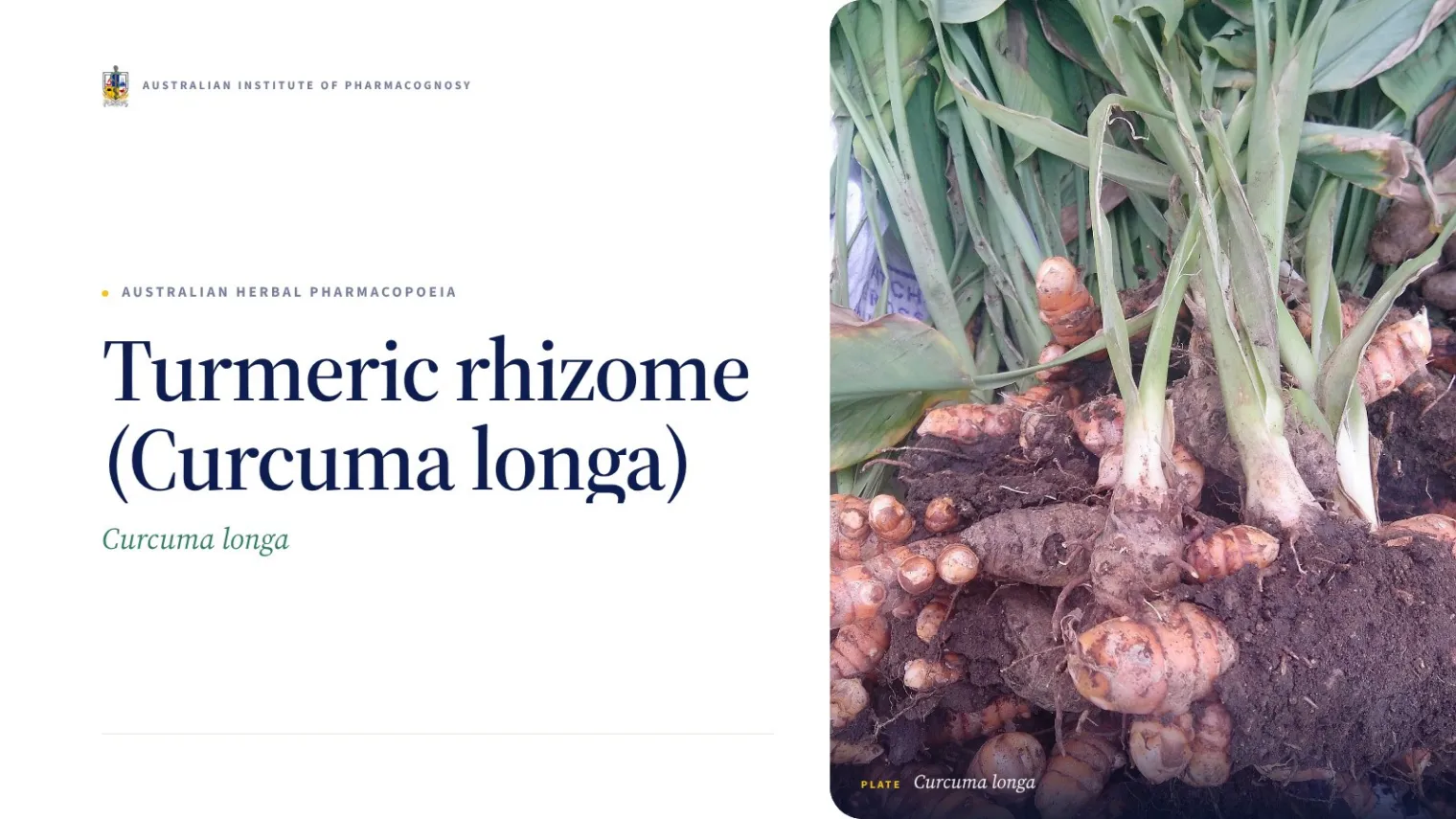
Turmeric rhizome (Curcuma longa L.), Zingiberaceae
Australian Herbal Pharmacopoeia (working title) · Monograph AIP-PH-CURLON (formerly AIP-HP 014) · Version 1.0 draft
Date: 2026
Status: working draft, published while in build. Not a statutory standard.
Prepared by: Dr Thomas Ridley, Head of Education and Research, Australian Institute of Pharmacognosy, Cardwell, Queensland.
0. Free-teaser block
0.1 Identity card
| Monograph number | AIP-PH-CURLON (formerly AIP-HP 014) (MediHerb A–Z list No. 153) |
| Title | Turmeric rhizome (Curcuma longa L.), Curcumae longae rhizoma |
| Version / year | 1.0 draft, 2026. Next review 2029, or sooner if the Permissible Ingredients Determination changes item 1647, if the Ph. Eur. revises monograph 2543, or if a large controlled trial reports |
| Accepted binomial | Curcuma longa L., Species Plantarum 1: 2 (1753). Accepted. IPNI urn:lsid:ipni.org:names:796451-1. Checked on 27/09/2026, and re-checked the same day by Botanical, against the World Checklist of Vascular Plants dataset itself (Kew, WCVP version 2026-09-16, DOI 10.48580/d4dz) read through ChecklistBank, and against IPNI [1,2]. The Plants of the World Online web front end refused automated access on both attempts; the underlying Kew checklist was read directly instead, which is the same dataset POWO serves, and the name, authority, place of publication and full synonymy agreed in both |
| Family | Zingiberaceae Martinov (APG IV). Order Zingiberales [1,2] |
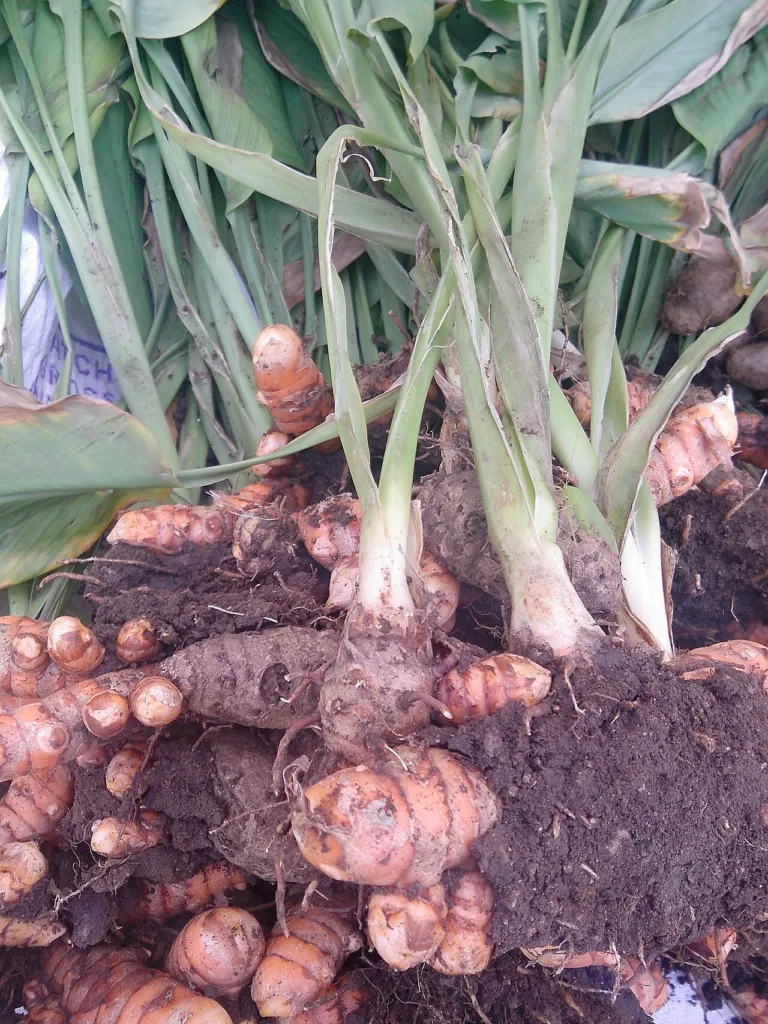
| Plant part | The rhizome, cured by boiling or steaming, then dried, with the roots and the outer surface removed. Curing is part of the definition of the drug in Ph. Eur. 8.0 monograph 2543 and in the Ayurvedic Pharmacopoeia of India, and uncured dried rhizome is a different article [3,4] |
| Latin drug name | Curcumae longae rhizoma (Ph. Eur. 2543; EMA/HMPC). Rhizoma Curcumae Longae in the WHO monograph. Haridrā in the Ayurvedic Pharmacopoeia of India. Jianghuang (薑黃) in the Chinese materia medica [3,4,5,6] |
| Principal synonyms | Homotypic: Kua domestica Medik., Stissera curcuma Giseke. Heterotypic: Curcuma domestica Valeton (the name MediHerb prints as the botanical synonym and the name several trials use), Amomum curcuma Jacq., Amomum latifolium Lam., Curcuma brog Valeton, Curcuma ochrorhiza Valeton, Curcuma soloensis Valeton, Curcuma tinctoria Guibourt, C. longa var. vanaharidra Velay. & al. [1]. The TGA uses Curcuma longa [7] |
| Common names | English: turmeric, Indian saffron, common turmeric [5,6]. Hindi/Urdu: haldi, haldar; Sanskrit: haridrā, rajanī, niśā; Tamil: manjal; Telugu: pasupu; Bengali: halud; Kannada: arishina; Malayalam: manjal [4,5]. Chinese: jianghuang [6]. Indonesian/Malay: kunyit, koenjet; Thai: khamin chan; Vietnamese: nghệ; Japanese: ukon; German: Kurkumawurzelstock, Gelbwurzel; French: rhizome de curcuma, safran des Indes [5,6,8] |
| Pharmacopoeial status elsewhere | Ph. Eur.: yes, monograph 2543, Turmeric rhizome, first published 04/2013; the library copy is the 8th Edition (2013, in force 01/01/2014) and every Ph. Eur. figure in this monograph is quoted from that edition and flagged for QA to re-check against the edition now in force [3]. Ph. Eur. also carries 1441, Turmeric, Javanese (Curcuma xanthorrhiza), whose identification includes a limit test for C. longa [3]. EMA/HMPC: yes, European Union herbal monograph on Curcuma longa L., rhizoma, EMA/HMPC/329755/2017, adopted 25/09/2018, traditional use only, no well-established-use column [8]. WHO: yes, Rhizoma Curcumae Longae, WHO Monographs on Selected Medicinal Plants vol. 1, 1999, pp. 115–124 [5]. Ayurvedic Pharmacopoeia of India: yes, Part I, Haridrā (rhizome), monograph 30 [4]. Chinese Pharmacopoeia: yes, as Jianghuang [5,6]. Indian Pharmacopoeia: official in the 2nd edition (1966), dropped from the 3rd (1985) [6]. USP–NF: yes, four monographs — Turmeric and Powdered Turmeric (each not less than 3.0 per cent curcuminoids on the anhydrous basis), Powdered Turmeric Extract (not less than 20 per cent curcuminoids, dried basis) and Curcuminoids (not less than 95.0 per cent total curcuminoids, of which curcumin 70–80, demethoxycurcumin 15–25 and bisdemethoxycurcumin 2.5–6.5 per cent). AIP does not hold the USP–NF text; these definitions and limits are quoted as the USP’s own expert committee reports them in its 2026 review, and QA must read them in the USP–NF itself before any of them is used as a specification [19]. BP: no herbal-drug monograph found. Commission E (Germany): yes, a positive monograph, 1985, for dyspeptic conditions [5,6] |
| Australian status | Permissible Ingredients Determination: yes, with conditions that are unusually specific. Therapeutic Goods (Permissible Ingredients) Determination (No. 2) 2026 (Cth), F2026L00707, Schedule 1 item 1647 CURCUMA LONGA, purposes A (active), E (excipient), H (homoeopathic). Any oral medicine using it as an active must carry the CURC label warning: "In very rare cases, Curcuma species may harm the liver. Stop use and see a doctor if you have yellowing skin/eyes or unusual: fatigue, nausea, appetite loss, abdominal pain, dark urine, or itching." The same item caps the daily dose of curcumin ((1E,6E)-1,7-bis(4-hydroxy-3-methoxyphenyl)-1,6-heptadiene-3,5-dione) in the medicine at 36 mg for children 2–3 years, 48 mg for 4–11 years and 123 mg for 12–17 years, and bars the ingredient entirely below 2 years of age. Items 1646 C. aromatica, 1648 C. zanthorrhiza, 1649 C. zedoaria and 1650 CURCUMIN carry the same conditions [9]. Poisons Standard: not scheduled. The full text of the Therapeutic Goods (Poisons Standard, June 2026) Instrument 2026 (Cth), F2026L00633, was searched on 27/09/2026 for "curcuma", "curcumin" and "turmeric": no entry in any Schedule or Appendix [10]. ARTG: 531 entries returned for the keyword "curcuma longa" on 27/09/2026 and 71 for "turmeric", among them MediHerb Curcuma Forte (ARTG 407525, Integria Healthcare Australia, 12/04/2023), MediHerb Turmeric Forte Tablet (314237, 14/02/2019, with Trigonella foenum-graecum), MediHerb Vitanox (377571), Mediherb PulmaCo (392873) and MediHerb Boswellia Complex (517947) [11]. Introduced, cultivated, not naturalised and not a declared or restricted weed in Queensland. The Atlas of Living Australia holds 83 occurrence records, 38 of them Queensland, 51 of the 83 preserved herbarium specimens, every one a planting or a sheet rather than a wild population [12] |
| Named markers | Curcumin (diferuloylmethane), CID 969516, C₂₁H₂₀O₆, M_r 368.4, the assay marker. Ph. Eur. 2543 assays "dicinnamoyl methane derivatives, expressed as curcumin", minimum 2.0 per cent on the anhydrous drug, by absorbance at 425 nm with a specific absorbance of 1607 [3]. WHO sets not less than 3.0 per cent total curcuminoids [5]. Demethoxycurcumin, CID 5469424, C₂₀H₁₈O₅, and bisdemethoxycurcumin, CID 5315472, C₁₉H₁₆O₄, the other two curcuminoids; their ratio to curcumin is the identity marker that matters commercially, because a normal 60–80 : 15–27 : 5–15 profile is what a synthetic-curcumin adulterant is blended to imitate [13]. Essential oil, minimum 25 mL/kg on the anhydrous drug (Ph. Eur. 2543) or 4 per cent v/w (API, WHO) [3,4,5]. ar-Turmerone, CID 160512, and the α- and β-turmerones, CIDs 14632996 and 196216, the sesquiterpene ketones that dominate the oil. Bisdemethoxycurcumin doubles as the discriminating marker against C. xanthorrhiza, and xanthorrhizol, CID 93135, against C. longa, in the reciprocal Ph. Eur. limit tests [3]. AIP has set no limit of its own; see section 7 |
| Evidence snapshot | Knee osteoarthritis pain, bioavailability-enhanced curcuminoid preparation against placebo: Tier B, 7 trials, n = 913, WOMAC pain mean difference −2.47 (95% CI −3.27 to −1.67 network, −3.25 to −1.68 pairwise), a 29.7 per cent change from baseline that clears the authors’ pre-specified 20 per cent minimum clinically important difference, GRADE certainty low to very low for the network estimates [14]. Knee osteoarthritis function: Tier B [14]. Knee osteoarthritis stiffness: no preparation beat placebo [14]. Turmeric against an NSAID or paracetamol in knee osteoarthritis: Tier C, no significant difference either way and non-inferiority never formally tested [14,15]. Dyspepsia: Tier C, one 1989 three-arm trial of 116 patients that the EMA assessor criticised for unreported protocol and unreported blinding, plus a Tier T registered traditional indication in the EU [5,8]. Peptic ulcer, rheumatoid arthritis, postoperative inflammation, gallbladder contraction: Tier C each, small and old [5,8]. Everything else, the anticancer, neuroprotective, hepatoprotective and antimicrobial literature, is Tier P. Nothing about this drug reaches Tier A |
| Suggested citation | Ridley T. Turmeric rhizome (Curcuma longa L.), Curcumae longae rhizoma. AIP-PH-CURLON, version 1.0 draft. Cardwell: Australian Institute of Pharmacognosy; 2026. DOI to be assigned |
| Provenance | Original AIP data: none. Every analytical figure, limit, method and trial result in this monograph belongs to the source cited beside it. Sections 4, 5, 7, 8, 9 and 10 carry AIP bench data pending: AIP has not vouchered a sample of this drug, cut a section, run a plate or run a chromatogram. F1, F1b, F1c, F2, F2b, F3, F3b, F3c, F3d, F4 and F8 are licensed, public-domain or CC-BY third-party images, every licence checked at the file or article page on 27/09/2026; the twelve constituent structures F6 to F6l are PubChem depictions, public domain, credited to PubChem with the CID in each caption; F3a, F5 and F7 are AIP drawings redrawn from cited published descriptions and printed tables; F6m, F9, F10, F10b, F10c and F10d are AIP charts drawn from published tabulated data or from this monograph’s own graded evidence |
| Compiler and review | Compiled by Dr Thomas Ridley (Education and Research). Technical review: Dr Fiona MacAllister (Botanical, sections 1-5 and the adulterant species in 10), reviewed in 2026; Dr Hana Suzuki (QA, sections 6-10), reviewed in 2026; Dr Eleanor Whitcombe (Medicine, sections 12, 13, 15), reviewed in 2026. Visual layout and figures (placement, captions, source and licence lines, the figure manifest and the designed PDF): Jesse Kirby (Community Outreach), reviewed in 2026. Independent evidence and citation audit (sections 11–14 and 16–20, every reference, and the figure sources and licences): Dr Thomas Ridley (Education and Research), reviewed in 2026 — the compiler’s own audit, so it is not a second pair of eyes on the sections he drafted; the Librarian’s independent reference audit is still outstanding. Published: not yet. Last modified: 2026. Version 1.0 draft |
| Canonical URL | /pharmacopoeia/curcuma-longa/ (on publication) |
0.2 Summary
Turmeric is the cured, dried rhizome of Curcuma longa, a sterile cultigen that has been carried by human hands out of tropical South Asia and grown across the tropics for at least four thousand years. India grows about 80 per cent of the world crop. Of all the herbs in the MediHerb range, this is the one with the largest modern research literature and one of the weakest returns on it. The chemistry is well characterised: two to nine per cent curcuminoids, of which curcumin is the majority, and an essential oil dominated by turmerones. The pharmacology is enormous and largely in vitro, and a 2017 medicinal-chemistry analysis showed why that literature needs reading with care, because curcumin behaves in assays as an interference compound and no double-blind placebo-controlled trial of curcumin itself had at that point produced a conclusive positive result. The clinical picture as it stands in 2026 is narrower than the volume of publication suggests. A 2025 network meta-analysis of seventeen randomised trials in knee osteoarthritis found that every turmeric preparation beat placebo for pain, that the bioavailability-enhanced curcuminoid preparations cleared the minimum clinically important difference, and that the certainty of the evidence was low to very low throughout. No preparation improved joint stiffness. For dyspepsia, the European registration rests on tradition, and the one supporting trial is from 1989 and poorly reported. Two problems dominate the quality side. The first is adulteration: a 2026 scoping review of 2,235 commercial samples found one in five non-authentic, and when the analysis was restricted to validated methods, supplements came out worse than spice at 27.1 per cent, mostly through undeclared synthetic curcumin. The second is liver injury. Australia now requires a liver warning on the label of every oral listed medicine containing this ingredient, caps the curcumin dose for children and bars it below two years of age, which makes the Australian requirement one of the strictest in the world. Anyone considering turmeric as a medicine, particularly at extract doses, should consult a degree-qualified herbalist with competencies and adequate training in pharmacognosy.
60 more pages follow · 29,785 words, 32 figures, 27 tables
Still to come in this monograph
- 1. Nomenclature
- 2. Definition
- 3. Source and Australian supply
- 4. Macroscopy
- 5. Microscopy
- 6. Chemistry
- 7. Named markers and assay limits
- 8. TLC fingerprint
- 9. HPLC fingerprint
- 10. Identity, purity, adulterants and contaminants
- 11. Traditional use
- 12. Current practice: use, preparations and doses
- 13. Clinical evidence
- 14. Pharmacology
- 15. Safety
- 16. Discussion
- 17. Conclusions
- 18. Research still needed
- 19. References
- 20. Document control
The rest of this monograph is open to members. One membership covers every members’ feature on the site.
Checking your membership…
Report an error or submit evidence
If something in this monograph is wrong, out of date or missing, tell us and show us the evidence. Every report is logged under the AIP Evidence Charter and assessed on the evidence alone; the outcome is kept on the record, and an upheld report is corrected with a dated notice on this page.
Open the report form
The Institute sets and publishes its own monographs. The catalogue is in Publications.