

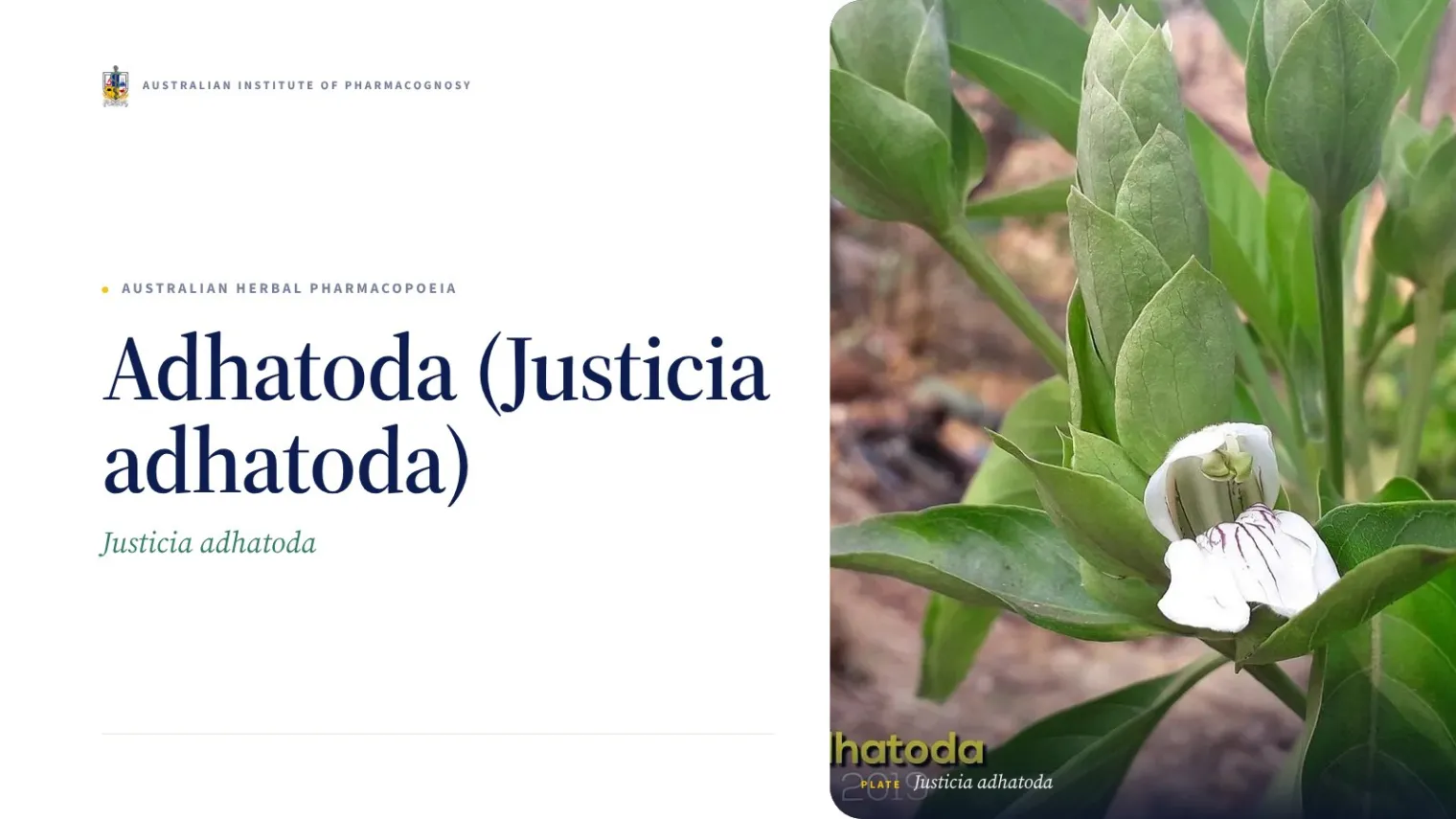
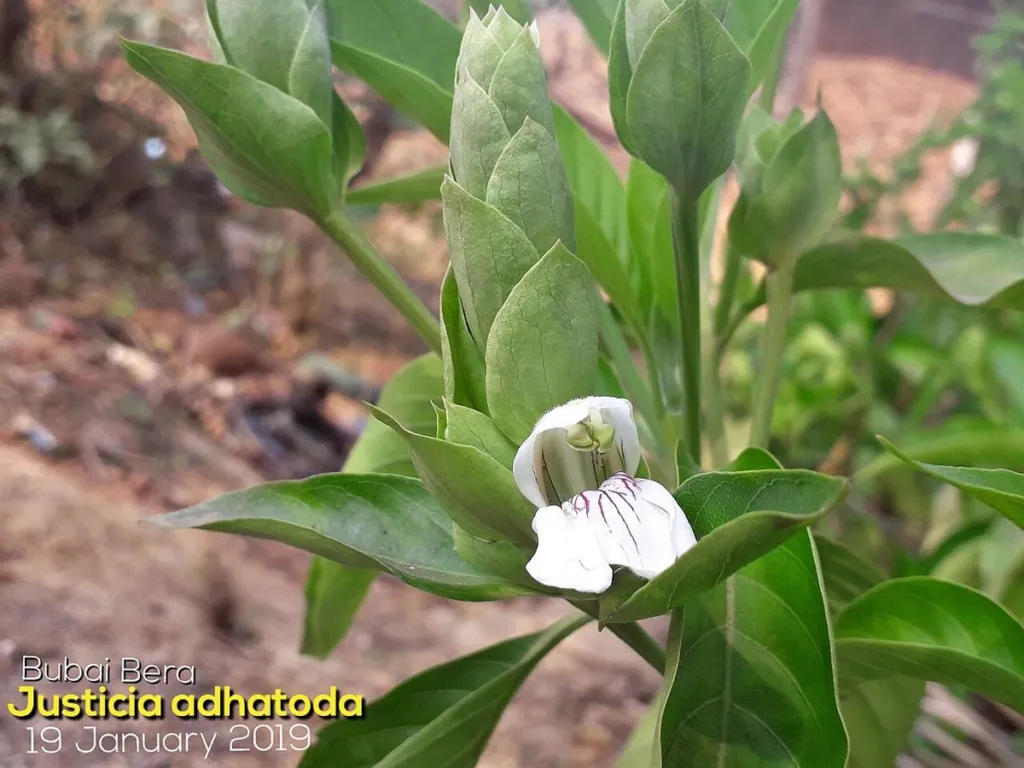
Adhatoda leaf (Justicia adhatoda L.), Acanthaceae
Australian Herbal Pharmacopoeia (working title) · Monograph AIP-PH-JUSADH (formerly AIP-HP 001) · Version 1.0 draft
Date: 2026
Status: working document, version 1.0. Published while in build; technical reviews pending. Not a statutory standard.
Prepared by: the Australian Institute of Pharmacognosy, Cardwell, Far North Queensland, Australia. Every author and contributor is named at the end of the monograph.
A living document. This monograph will never be finished. It is a living document: we review it continually and expand it as new research comes in, and every revision is dated and kept on record. Current revision: version 1.0, 2026.
0. Free teaser
0.1 Identity card
| Number and version | AIP-PH-JUSADH, Adhatoda leaf. Version 1.0 draft, 2026. Next review: on sign-off, then three-yearly |
| Accepted name | Justicia adhatoda L., Sp. Pl.: 15 (1753), Acanthaceae; accepted in the World Checklist of Vascular Plants (WCVP 16.0, IPNI 50237-1), the dataset that Plants of the World Online (POWO) displays, read in November 2026 [1] |
| Principal synonyms | Adhatoda vasica Nees (the name of most pharmacological papers, the EMA and the Ph. Eur. title), Adhatoda zeylanica Medik., Adhatoda adhatoda (L.) Huth, Ecbolium adhatoda (L.) Kuntze [1] |
| Drug name | Adhatodae vasicae folium [2]; the dried leaf |
| Common names | Adhatoda, Malabar nut, vasaka (English); Vaasaa, Vaasaka, Vrisha, Aataruushaka (Ayurveda); Arusaa (Unani); Aadaathodai (Siddha, Tamil); adusa, arusa (Hindi); adulsa (Marathi) [3,4] |
| Pharmacopoeial status | Ph. Eur.: monograph 2738 "Adhatoda vasica leaf", a new text in Supplement 11.3, implemented by 01/01/2024 at the latest [5]. USP-NF: "Malabar-Nut-Tree, Leaf", dried leaves, NLT 0.6% vasicine on the dried basis [6]. EMA/HMPC: no EU herbal monograph; public statement of 09/07/2013 that one cannot be set on present data [2] |
| Australian status | Therapeutic Goods (Permissible Ingredients) Determination (No. 3) 2026, Schedule 1 item 2858, JUSTICIA ADHATODA, permitted as an active (A) or homoeopathic (H) ingredient, no specific requirements [7]. No entry in the Poisons Standard October 2026 [8]. Not native; not named in the Queensland biosecurity legislation [9,10] |
| Assay marker | Vasicine (CID 667496): not less than 0.6% on the dried drug (USP-NF definition) [6,56]; Ph. Eur. 2738 limits not yet read |
| Identity markers | Vasicine and vasicinone (CID 442935) by TLC and HPLC against reference substances; a full fingerprint is needed because vasicine also occurs in Peganum harmala and Sida species [11,12] |
| Evidence snapshot | Acute cough in upper respiratory tract infection, as one of three herbs in a fixed combination: Tier B for the combination, 2 RCTs, low certainty; the share owed to Adhatoda cannot be separated (Tier C). COPD quality of life, probiotic capsule with vasaka extract: Tier C for that product, 1 small RCT analysed only within groups. Cough in children (polyherbal syrup), mild COVID-19, asthma, dyspepsia: Tier C. Productive cough with thick sputum, leaf alone: Tier T, with Tier C historical observation |
| Main safety point | Contraindicated in pregnancy (traditional abortifacient use, uterotonic alkaloid, animal data, and the EMA’s reproductive-safety concern). Few adverse effects have been reported in the small trials |
| Suggested citation | Australian Institute of Pharmacognosy. Adhatodae vasicae folium (Adhatoda leaf, Justicia adhatoda L.). Australian Herbal Pharmacopoeia monograph AIP-PH-JUSADH (version 1.0). Cardwell (QLD): AIP; 2026. DOI to be assigned |
| Compiler and review | Compiled by Dr Thomas Ridley (Education and Research). Technical review: Dr Fiona MacAllister (Botanical, sections 1-5 and adulterants in 10), reviewed in 2026; Dr Hana Suzuki (QA, sections 6-10), reviewed in 2026; Dr Eleanor Whitcombe (Medicine, sections 12, 13, 15), reviewed in 2026. Evidence and citation audit: Dr Thomas Ridley (Education and Research, sections 3.1, 11, 12.1, 14, 16-19, every reference and figure), reviewed in 2026; this audit is by the compiler’s own department, and sections 11 and 19 still await History and Philosophy and the Librarian. Visual layout review: Jesse Kirby (Community Outreach, figure placement, captions, credit lines and page design), reviewed in 2026. Published: not yet. Last modified: 2026. Version 1.0 draft |
| Provenance | Original AIP data: none. Every limit, method, measurement and trial result comes from the cited pharmacopoeias, regulators, reference works and papers; sections 4, 5, 7, 8, 9 and 10 are marked "AIP bench data pending" |
| Canonical URL | /pharmacopoeia/justicia-adhatoda/ (on publication) |
0.2 Summary
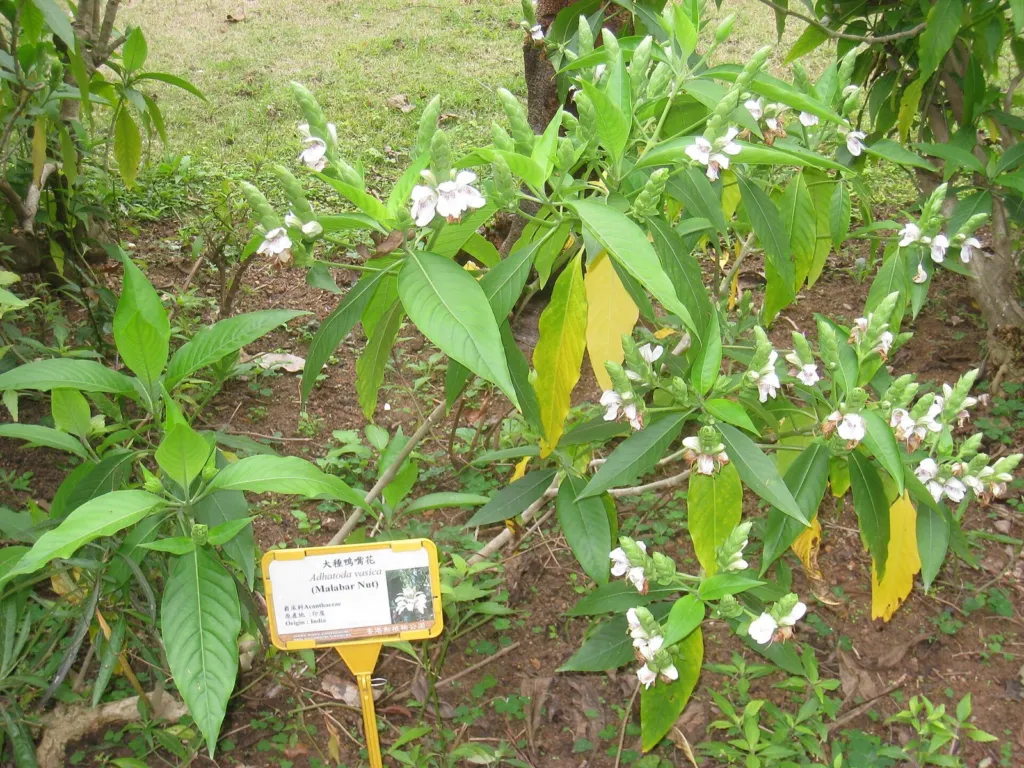
Adhatoda is the dried leaf of Justicia adhatoda, an evergreen shrub of the Indian subcontinent and the lower Himalaya that also grows in Sri Lanka, Myanmar and Malaysia. It has been one of Ayurveda’s main remedies for cough and breathlessness for a very long time, and its main alkaloid, vasicine, was the chemical starting point for the mucolytic drugs bromhexine and ambroxol. The leaf is large, lanceolate and pinnately veined; under the microscope it is a dorsiventral leaf with wavy-walled epidermal cells, uniseriate covering trichomes and glandular trichomes with a four-celled head; the two published descriptions disagree on the stomatal type, on whether the upper surface carries stomata and on calcium oxalate in the mesophyll. Vasicine is the assay marker: the USP-NF asks for at least 0.6 per cent, and in one market check two of three commercial leaf powders fell below it. Vasicine also occurs in Syrian rue and in some Sida roots, so a vasicine result alone does not prove identity. Australian herbalists prescribe a 1:2 liquid as an expectorant and mild bronchodilator for bronchitis and cough. The best trials tested a three-herb combination; trials of Adhatoda on its own are small, old or uncontrolled. The herb is contraindicated in pregnancy. Anyone thinking of using it should consult a degree-qualified herbalist with competencies and adequate training in pharmacognosy.
0.3 Contents and extent (draft)
| Section | Approx. pages |
|---|---|
| 0 Free teaser | 3 |
| 1-3.1 Nomenclature, definition, source and Australian supply, origin and chemistry | 4 |
| 4-5 Macroscopy and microscopy | 3 |
| 6-7 Chemistry, markers and limits | 3 |
| 8-9 TLC and HPLC | 3 |
| 10 Identity, purity, adulterants, contaminants | 2 |
| 11 Traditional use | 2 |
| 12-12.1 Current practice, doses and manufacture | 3 |
| 13 Clinical evidence (search, graded trials, registries) | 5 |
| 14 Pharmacology | 2 |
| 15 Safety, interactions, pregnancy | 3 |
| 16-18 Discussion, conclusions, research needed | 3 |
| 19-20 References and document control | 5 |
| Totals (draft) | 50 A4 pages in the laid-out print edition (4 opening pages, then sections 1-20); 17 tables; 34 embedded figures: 19 licensed or public-domain photographs, plates and paintings, 4 licensed figures from open-access papers (a photomicrograph panel of in vitro material, a powder photomicrograph panel of authenticated field-collected leaf, one TLC plate, one HPLC chromatogram), 2 AIP schematics redrawn from cited descriptions, 2 AIP TLC and HPTLC schematics redrawn from published methods and Rf values, 2 PubChem structure panels, 1 AIP range map and 4 AIP data charts; 0 AIP photomicrographs, plates or chromatograms (AIP bench data pending). Clinical studies: 9 reports describing 8 studies screened in and appraised (one duplicate report excluded); 6 registry records listed. 62 references, each read in full |
Gaps carried in this version: AIP photomicrographs (F4 shows a licensed section of in vitro-grown material and F4b licensed powder photomicrographs of authenticated leaf from one Indian collection, neither of them the commercial drug), the AIP TLC plate and the AIP HPLC chromatogram (F7 and F8 are licensed published figures from other methods and other plant parts) are AIP bench data pending.
0.4 Contributors and access
Prepared by the Australian Institute of Pharmacognosy. The Botanical, QA and Medicine reviews are on record; contributors are credited once their reviews are on record. A Legal read advises the CEO and does not gate publication. The Australian Herbal Pharmacopoeia is AIP’s own series and carries no statutory, TGA or government standing. The full monograph past the free sample is for subscribers (paywall wording to come from Legal and Community Outreach).
Free to every reader. The safety section of every monograph is open to everyone, signed in or not. In an emergency call 000. For poisoning, call the Poisons Information Centre on 13 11 26.
15. Safety
Adverse effects in trials. None attributed to Adhatoda-containing preparations: no adverse effects in the COVID-19 trial [47]; no adverse events in the open probiotic study [45]; no serious events and only mild treatment-emergent events, none judged related, in the COPD trial [44]; fewer side effects with Linkus than with the drug comparators [46]. The trials are small and short (5 days to 12 weeks, a few hundred participants in all), so uncommon effects could have been missed. In the COVID-19 trial, eosinophils rose and PT/INR changed within the normal range in the Adhatoda arm; the paper describes the PT/INR change in opposite directions in two places [47].
Case reports and pharmacovigilance. No case report of harm from Adhatoda leaf was found in the searches above. Braun and Cohen record "insufficient reliable information" on adverse reactions [14]. The TGA Database of Adverse Event Notifications (DAEN, medicines) was searched in November 2026 for adhatoda, justicia, vasaka, malabar, PulmaCo, Lung Care and Kan Jang, covering reports from 01/01/1971 to October 2026 [60]. One product containing Justicia adhatoda appears: a topical head-lice product that also contains echinacea, tea tree oil and Stemona, with two reports (2003, "hair texture abnormal"; 2009, "application site reaction"). No report names an oral Adhatoda product. A DAEN entry does not show that a medicine caused the event, and these two cannot be assigned to Adhatoda among four ingredients. A search of the TGA website for adhatoda and justicia in November 2026 returned four ARTG product entries and no safety alert, advisory or recall [61].
Toxicology. No full-text repeat-dose toxicity study of the leaf or of vasicine was read for this version. A chronic toxicity study of vasicine in rats and monkeys (1987), a 2000 critical review of the toxicology and a 1997 rat study whose title reports no abortive effect of an oral leaf extract exist and have been requested in full text for the next revision; nothing is concluded from them here.
Pregnancy: contraindicated.
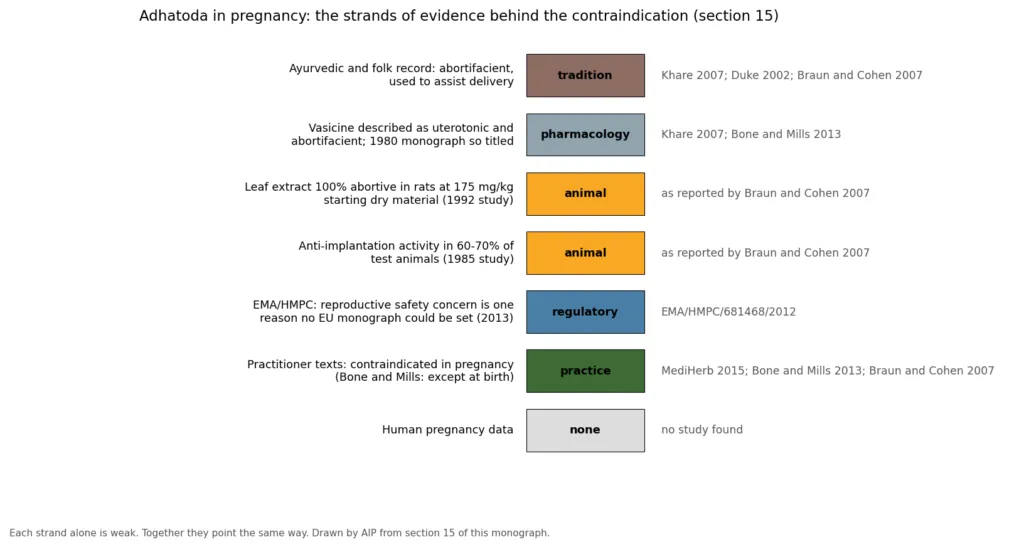
- Practice texts and labels (grade: expert practice opinion): MediHerb: contraindicated in pregnancy [13]. Bone and Mills: contraindicated, "except at birth" [19]. Braun and Cohen: contraindicated, as the herb may have abortifacient activity [14]. The ARTG entries for PulmaCo carry the warning "Do not use if pregnant or likely to become pregnant" [20,59].
- Animal evidence (grade: animal, known only through a secondary source), as reported by Braun and Cohen: leaf extract was 100 per cent abortive in rats at a dose equivalent to 175 mg/kg of starting dry material, and another extract showed anti-implantation activity in 60-70 per cent of animals; the authors note that in vivo results have been inconsistent [14].
- Pharmacology and tradition (grade: preclinical description and traditional use): vasicine is described as uterotonic and abortifacient [3]; a 1980 monograph from the Jammu laboratory is titled A New Oxytocic and Abortifacient [19]; the folk and Ayurvedic record includes abortifacient use and use to assist delivery [14,31].
- Regulatory (grade: regulatory assessment of the same animal and traditional data): the EMA’s committee found information on possible abortive, anti-implantation and uterotonic effects, asked for further reproductive-toxicity data, and gave reproductive-safety concerns as one reason no EU monograph could be established [2]. A 2018 call for new data has not, on the EMA record, led to a revised outcome [53].
- No human pregnancy data were found. Each strand is weak alone; together they point the same way, and the contraindication stands.
Lactation: avoid. No human or animal data on vasicine in breast milk or on exposure of the breastfed infant were found. MediHerb advises professional supervision [13]; the ARTG entries for PulmaCo say "Do not use while breastfeeding" [20,59]. AIP position (Medicine): avoid while breastfeeding, as a precaution in the absence of data and in line with the Australian label (grade: no data; precautionary).
Children and older people. The WHO South-East Asia manual cited by Bone and Mills recommends long-term use in children [19], and one open trial treated children with a polyherbal syrup containing Adhatoda [46]. The PulmaCo ARTG entry says use in children under 12 years is not recommended [20]; the Lung Care entry says not for children under 5 [21]. No paediatric safety study of the leaf was found (grade: no data beyond one open trial of a polyherbal syrup). No data for older people.
Surgery. MediHerb says to stop 7 days before general anaesthesia [13]. The same sentence appears on other herbs on the same page (Agrimony, Albizia), so it reads as a range-wide precaution; no evidence specific to Adhatoda was found.
Australian labelling. The Permissible Ingredients Determination sets no specific requirement or warning for Justicia adhatoda [7]. Two listed products carry no pregnancy warning on their ARTG records: a tablet with 500 mg of dried-leaf equivalent [21] and a capsule with 1.8 g, whose record states "No Warnings included on Record" [58]. The practitioner tablet carries one [20,59]. AIP comment: given the EMA’s concern, the absence of a mandatory pregnancy warning for this ingredient is a gap in the labelling rules.
Interactions (each graded; none is supported by a human interaction study).
| Interacting drug or class | Basis | Grade |
|---|---|---|
| Oxytocics, prostaglandins | Vasicine uterotonic [3,19] | Theoretical (animal) |
| Bronchodilators (theophylline, aminophylline, beta-agonists) | Vasicinone potentiated aminophylline and isoprenaline in mice and dogs [3] | Theoretical (animal) |
| Antitussives such as codeine | Additive antitussive effect possible [14] | Theoretical |
| Antihypertensives | Vasicine hypotensive in animals [17] | Theoretical |
| Antiplatelet and anticoagulant drugs | Leaf extract, 200 mg/kg intraperitoneally, shortened bleeding time in mice given aspirin or warfarin compared with the drug alone, and increased platelet aggregation in human blood in vitro [51]; PT/INR changes inconsistently reported in one trial [47] | Theoretical (animal, in vitro); direction of any effect is pro-haemostatic, which could oppose the drug |
| CYP1A1 substrates | Vasaka tea induced CYP1A1 mRNA in airway cells [27] | Theoretical (in vitro) |
| Cholinesterase inhibitors and anticholinergic drugs | Vasicine inhibited acetylcholinesterase and butyrylcholinesterase in vitro [11] | Theoretical (in vitro) |
| Piperine-containing formulas | Reported to accentuate vasicine’s potency [31]; primary study not traced. One listed Australian capsule combines Adhatoda with long pepper and black pepper [58] | Theoretical |
Overdose. No reports found.
Referral wording. Anyone considering Adhatoda while pregnant or trying to conceive, while breastfeeding, for a child, or alongside prescribed medicines should consult a degree-qualified herbalist with competencies and adequate training in pharmacognosy.
32 more pages follow · 15,897 words, 31 figures, 15 tables
Still to come in this monograph
- 1. Nomenclature
- 2. Definition
- 3. Source and Australian supply
- 3.1 Where it must be grown: origin, climate and chemistry
- 4. Macroscopy
- 5. Microscopy
- 6. Chemistry
- 7. Named markers and assay limits
- 8. TLC fingerprint
- 9. HPLC fingerprint
- 10. Identity, purity, adulterants and contaminants
- 11. Traditional use
- 12. Current practice: use, preparations and doses
- 12.1 Manufacture: how to make this herb's preparations
- 13. Clinical evidence
- 14. Pharmacology
- 16. Discussion
- 17. Conclusions
- 18. Research still needed
- 19. References
- 20. Document control
The rest of this monograph is open to members. One membership covers every members’ feature on the site.
Checking your membership…
The Institute sets and publishes its own monographs. The catalogue is in Publications.