
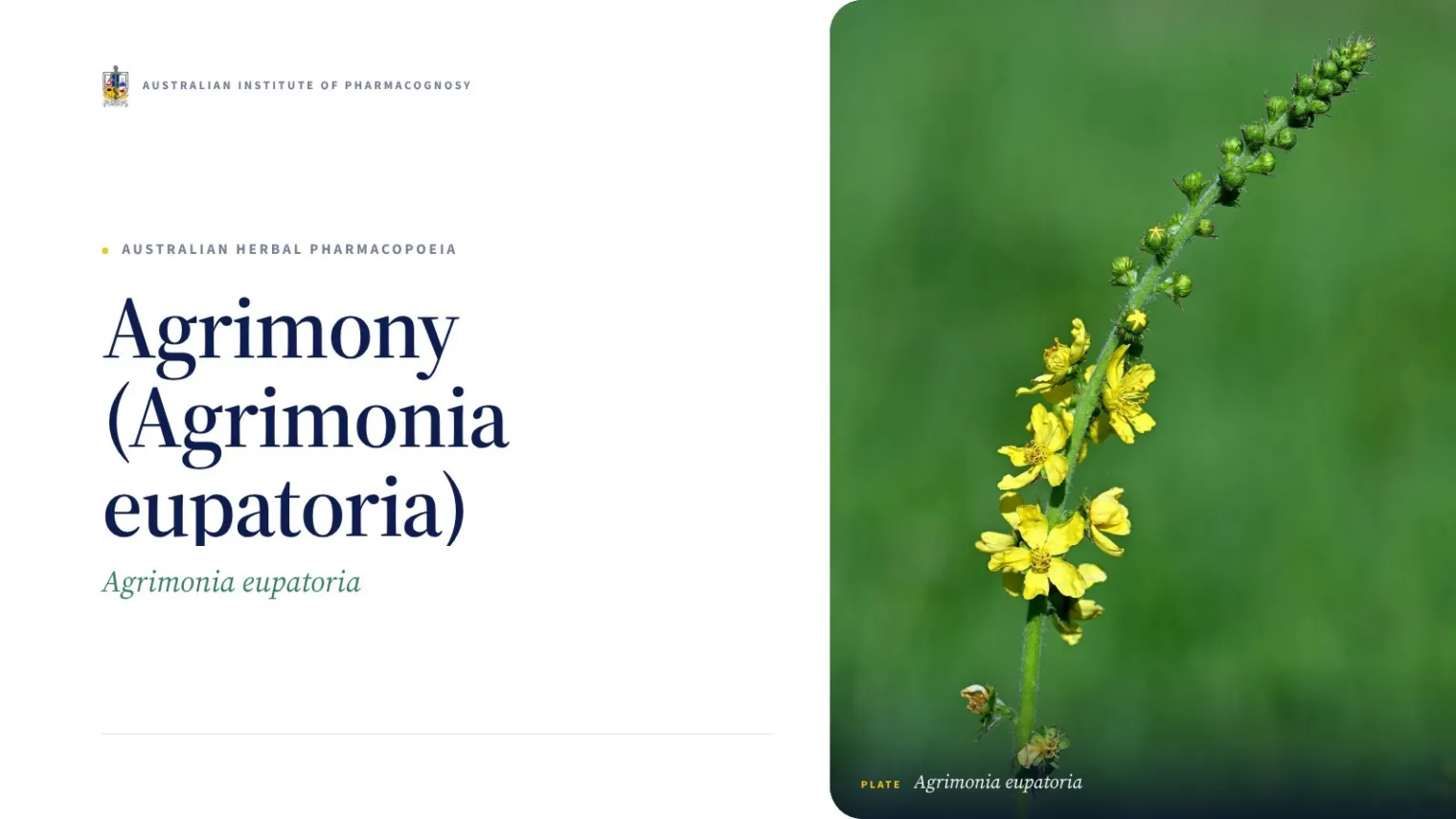
Agrimony herb (Agrimonia eupatoria L.), Rosaceae
Australian Herbal Pharmacopoeia (working title) · Monograph AIP-HP 015 · Version 1.0 draft
Date: 2026
Status: working document, version 1.0. Not a statutory standard.
Prepared by: Dr Thomas Ridley, Head of Education and Research, Australian Institute of Pharmacognosy, Cardwell, Queensland.
0. Free-teaser block
0.1 Identity card
| Monograph number | AIP-HP 015 (MediHerb A–Z list No. 2) |
| Title | Agrimony herb (Agrimonia eupatoria L.), Agrimoniae herba |
| Version / year | 1.0 draft, 2026. Next review 2029, or sooner if the primary papers on order change a tier (section 13) or a regulator acts |
| Accepted binomial | Agrimonia eupatoria L., Species Plantarum 1: 448 (1753). Accepted in the World Checklist of Vascular Plants (WCVP 16.0, read 29/09/2026). IPNI 316550-2 [1,2] |
| Family | Rosaceae (APG IV, as applied in WCVP); no recent family change [1,47] |
| Plant part | The dried flowering tops (Ph. Eur.) [3]; MediHerb labels the part "Herb" [9] |
| Latin drug name | Agrimoniae herba (Ph. Eur. 1587; EMA/HMPC) [3,5] |
| Principal synonyms | Homotypic: Agrimonia officinarum Lam., Agrimonia vulgaris Gray, Agrimonia elata Salisb., Agrimonia sulcata Dulac, Eupatorium dioscoridis Bubani [1]. IPNI also holds a separate record, Agrimonia eupatoria Michx. (Fl. Bor.-Amer. 1: 287), for North American plants; it is not in WCVP and does not refer to this drug [2]. The names A. eupatoria subsp. procera and var. procera belong to A. procera, a different species (section 1) [1] |
| Common names | English: agrimony, common agrimony. German: Odermennigkraut (drug). French: aigremoine. Dutch: gewone agrimonie. Italian: agrimonia. Polish: rzepik (ziele rzepiku) [5]. "Hemp agrimony" and "water agrimony" are different plants (section 1) |
| Pharmacopoeial status elsewhere | Ph. Eur.: yes, monograph 01/2011:1587 Agrimony, library copy 8th Edition [3]. EMA/HMPC: yes, EU herbal monograph (traditional use), adopted 28/01/2015 [4,5]. BP: carries the Ph. Eur. text (Barnes lists BP 2007) [6]. BHP 1996: listed by Barnes [6]; not read by AIP. WHO, USP, ChP, API: no monograph found for this species |
| Australian status | Permissible Ingredients Determination: yes, item 425 AGRIMONIA EUPATORIA, purposes A (active), E (excipient), H (homoeopathic), no specific requirements [33]. Poisons Standard: not scheduled (June 2026 instrument searched 29/09/2026); the unrelated Eupatorium cannabinum ("hemp agrimony") is in Schedule 10 for therapeutic use [34]. ARTG: 4 listed medicines returned for "agrimonia", 29/09/2026 [35]. Introduced, naturalised on the New England Tablelands of NSW; not native, so no Nature Conservation Act 1992 (Qld) permit applies; not listed in the Biosecurity Regulation 2016 (Qld) [1,36,37] |
| Named markers | Tannins, expressed as pyrogallol (CID 1057): assay, minimum 2.0 per cent on the dried drug, Ph. Eur. 1587 [3]. Rutin (CID 5280805) and isoquercitroside (isoquercitrin, CID 5484006): TLC identity, Ph. Eur. 1587 [3]. Agrimoniin (CID 16129621): proposed chemotaxonomic marker against A. procera; no pharmacopoeial limit [10] |
| Evidence snapshot | Acute diarrhoea in children, agrimony-tormentil-chamomile device: Tier C, 1 open RCT, n = 60, very low certainty, duration of diarrhoea not shortened [18]. Urinary incontinence, eight-herb tablet: Tier C, 1 uncontrolled study, n = 42, very low certainty, no significant change [53]. Mild diarrhoea, sore throat and mouth (gargle), minor skin inflammation: Tier T, tradition accepted by the HMPC [4,5]. Raised ALT: 1 RCT, ungraded until AIP reads it [17]. Glucose, liver and vascular effects: Tier P [12,13,22,23] |
| Suggested citation | Ridley T. Agrimony herb (Agrimonia eupatoria L.), Agrimoniae herba. AIP-HP 015, version 1.0 draft. Cardwell: Australian Institute of Pharmacognosy; 2026. DOI to be assigned |
| Provenance | Original AIP data: none. Every analytical figure, limit, method and trial result belongs to the source cited beside it. Sections 4, 5, 7, 8, 9 and 10 carry AIP bench data pending (no AIP voucher, section, plate or run yet). The distribution map (Figure 9), charts (Figures 10–12) and drawings (Figures 5, 7) are AIP drawings from cited data |
| Compiler and review | Compiled by Dr Thomas Ridley (Education and Research). Technical review: Dr Fiona MacAllister (Botanical, sections 1-5, 10), reviewed in 2026; Dr Hana Suzuki (QA, sections 6-10), reviewed in 2026; Dr Eleanor Whitcombe (Medicine, sections 12, 13, 15), reviewed in 2026; Jesse Kirby (Community Outreach, page layout, figure placement and credit lines), reviewed in 2026; evidence and citation audit, Dr Thomas Ridley (Education and Research, all sections and figures), reviewed in 2026. Published: not yet. Last modified: 2026. Version 1.0 draft |
| Canonical URL | /pharmacopoeia/agrimonia-eupatoria/ (on publication) |
0.2 Summary
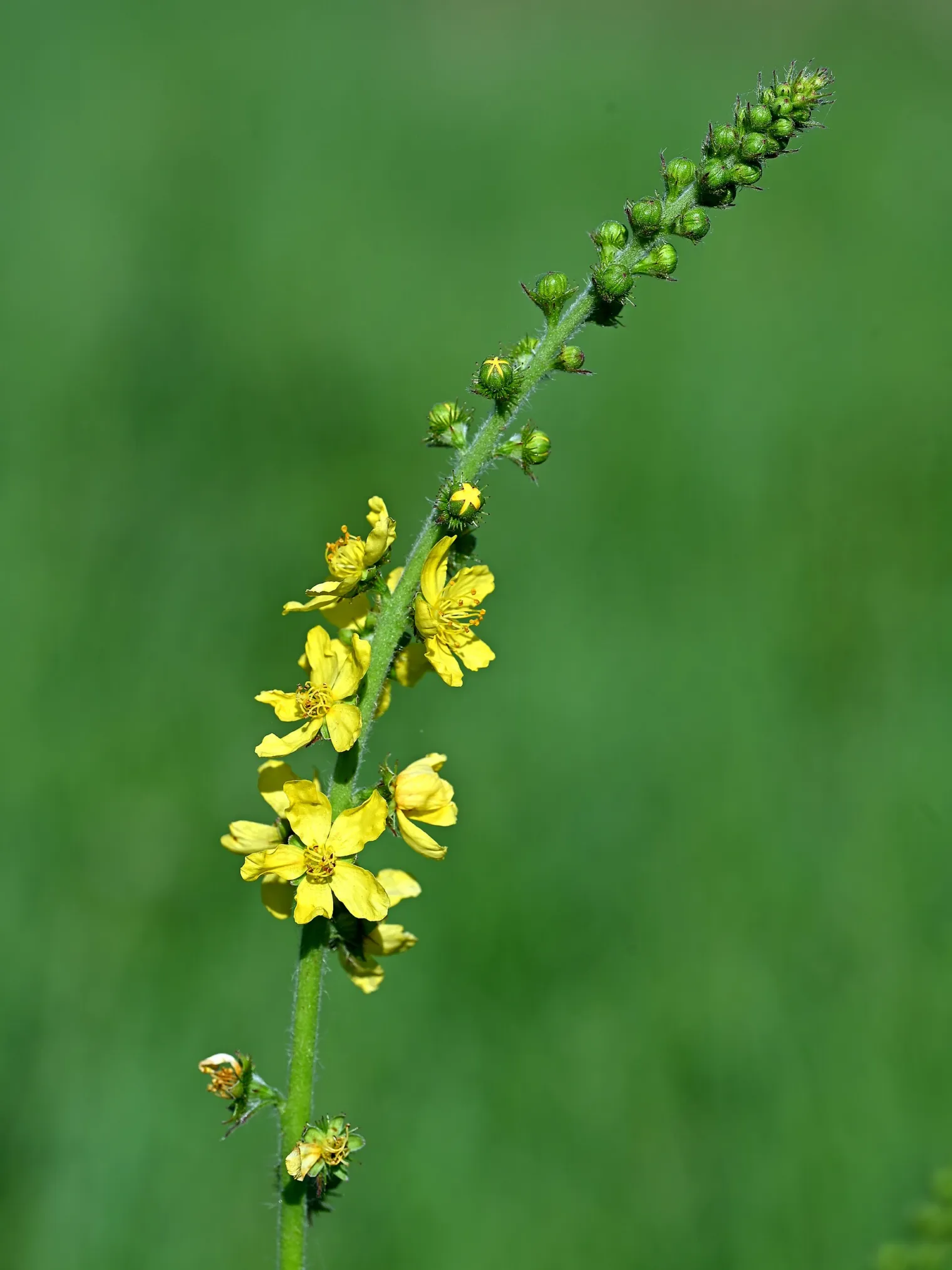
Agrimony is a hairy perennial of the rose family, native from western Europe and North Africa to Central Asia, whose dried flowering tops are an official drug in the European Pharmacopoeia. It is identified by its compound, deeply toothed leaves, its spike of small yellow flowers and, above all, its grooved, top-shaped fruiting receptacles crowned with hooked bristles; under the microscope by long thick-walled covering hairs, anomocytic stomata and three-pored pollen. The Ph. Eur. assays it for tannins (at least 2.0 per cent as pyrogallol) and identifies it by a TLC fingerprint of rutin, hyperoside and isoquercitroside. The main ellagitannin, agrimoniin, is present in A. eupatoria at a fraction of the level in its commonest substitute, A. procera.
European practice uses it as a mild astringent for diarrhoea, as a gargle for sore throat and as a wash for small wounds. The HMPC accepts these uses on tradition alone. The one completed randomised trial that reached AIP in full tested a three-plant device in children and did not shorten diarrhoea. No herb-specific adverse events are recorded; the practical cautions are tannin binding of iron and alkaloids, and the lack of data in pregnancy and in children under 12.
0.3 Contents with extent
| Section | Estimated extent (A4 pages, draft) |
|---|---|
| 0 Free-teaser block | 3 |
| 1 Nomenclature | 1.5 |
| 2 Definition | 0.5 |
| 3 Source and Australian supply, with 3.1 origin, climate and chemistry | 4 |
| 4 Macroscopy | 3 |
| 5 Microscopy | 3 |
| 6 Chemistry | 3.5 |
| 7 Named markers and assay limits | 1.5 |
| 8 TLC fingerprint | 1.5 |
| 9 HPLC fingerprint | 2.5 |
| 10 Identity, purity, adulterants and contaminants | 3 |
| 11 Traditional use | 2 |
| 12 Current practice | 2 |
| 13 Clinical evidence | 3.5 |
| 14 Pharmacology | 2.5 |
| 15 Safety | 2.5 |
| 16–18 Discussion, conclusions, research needed | 2.5 |
| 19 References | 3.5 |
| 20 Document control | 1 |
| Totals (draft) | About 47 pages. 33 embedded figures: 5 licensed field or specimen photographs, 2 public-domain plates, 2 licensed photomicrograph sets (neither is an AIP photomicrograph), 1 licensed HPTLC plate, 2 licensed HPLC chromatograms, 15 PubChem structures, 6 AIP drawings and charts. About 30 tables. 0 AIP photomicrographs, 0 AIP chromatograms, 0 AIP plates. 2 human studies graded; 3 further human studies listed but ungraded. 55 numbered references |
Gaps stated plainly. AIP holds no vouchered sample and has made no section, plate or run: sections 4, 5, 7, 8, 9 and 10 carry "AIP bench data pending". The photomicrographs in section 5 are licensed images of the leaf surface and pollen; a licensed transverse section and a whole-powder photomicrograph could not be found, and the gap stays open. A licensed published HPTLC plate with two agrimony tracks is reproduced as Figure 7b, but it has no reference track and was not run by the Ph. Eur. 1587 method; no licensed photograph of a Ph. Eur. 1587 plate was found, so Figure 7 is a zone-order drawing. The Ph. Eur. has no HPLC method for this drug, so section 9 gives two published research methods. Three human studies (Cho 2018, Ivanova 2013, Hawrelak and Myers 2010) are on the library fetch queue and are not graded in this version. WHO ICTRP failed a positive control, and Cochrane CENTRAL and Embase were not searched.
0.4 Contributors and access
Compiled by Dr Thomas Ridley, Head of Education and Research. Botanical, QA and Medicine reviews are on record; each reviewer is credited once their review is on record (section 20). The first five printed pages are free to read; the full text is for Scholar members and above, under the terms set out on the AIP site.
33 more pages follow · 16,362 words, 32 figures, 20 tables
Still to come in this monograph
- 1. Nomenclature
- 2. Definition
- 3. Source and Australian supply
- 4. Macroscopy
- 5. Microscopy
- 6. Chemistry
- 7. Named markers and assay limits
- 8. TLC fingerprint
- 9. HPLC fingerprint
- 10. Identity, purity, adulterants and contaminants
- 11. Traditional use
- 12. Current practice: use, preparations and doses
- 13. Clinical evidence
- 14. Pharmacology
- 15. Safety
- 16. Discussion
- 17. Conclusions
- 18. Research still needed
- 19. References
- 20. Document control
The rest of this monograph is open to members. One membership covers every members’ feature on the site.
Checking your membership…
Report an error or submit evidence
If something in this monograph is wrong, out of date or missing, tell us and show us the evidence. Every report is logged under the AIP Evidence Charter and assessed on the evidence alone; the outcome is kept on the record, and an upheld report is corrected with a dated notice on this page.
Open the report form
The Institute sets and publishes its own monographs. The catalogue is in Publications.