
Australian Herbal Pharmacopoeia (working title), Monograph AIP-HP 007
Status: version 1.0, live at https://www.australian-pharmacognosy.org/pharmacopoeia/hydrastis-canadensis/, all reviews and the pre-publication final test on record. Published at first draft under the CEO’s order of 23/09/2026. Botanical, QA, Medicine and layout reviews are on record (20.3); Librarian audit and Legal review to come.
Date: 23/09/2026 (AEST). Next review: on sign-off, then three-yearly or sooner if a major trial, safety signal or new pharmacopoeial text appears.
Prepared by: Dr Thomas Ridley, Head of Education and Research, Australian Institute of Pharmacognosy, Cardwell QLD.
Contributors: Dr Thomas Ridley (library and literature search, full-text retrieval, registry and regulatory instrument search, synthesis, drafting, figure sourcing and placement, AIP schematics and charts, reference verification). Technical reviews by Botanical, QA and Medicine are assigned and pending; their credit lines follow once each has reviewed. Dr Luke Iggulden set the scope of the series in the CEO directive of 22/09/2026; he did not write this monograph.
0. Free teaser
0.1 Identity card
| Monograph | AIP-HP 007, Golden seal (cultivated) root and rhizome. Version 1.0, 23/09/2026. Next review: on sign-off |
| Accepted name | Hydrastis canadensis L., Ranunculaceae, subfamily Hydrastidoideae Raf., order Ranunculales. First published in Linnaeus, Systema Naturae ed. 10, 2: 1088 (7 June 1759) (IPNI 305699-2) [2]. Accepted in the World Checklist of Vascular Plants release of 16/09/2026, read 23/09/2026 through ChecklistBank dataset 2000 [1] |
| Synonyms | Hydrastis trifolia Raf.; Warneria canadensis Mill., W. diphylla Raf. and W. tinctoria Raf. (all three illegitimate) [1]. The genus name is attributed Hydrastis J.Ellis ex L. [1]. "Yellow root" and Xanthorhiza simplicissima appear as a "synonym" in Barnes and colleagues [9]; WCVP treats Xanthorhiza simplicissima Marshall as a separate accepted species, so that entry is a shared common name, not a nomenclatural synonym (section 1) |
| Drug name | Hydrastis rhizoma, goldenseal rhizome: whole or cut, dried rhizome and root (Ph. Eur. 8.0, monograph 01/2011:1831) [3]. MediHerb and the TGA both label the part "root and rhizome" [6,14] |
| Common names | Golden seal, goldenseal, orange-root, orangeroot, yellow puccoon, yellow root, ground raspberry, Indian dye (English); hydraste du Canada (French); Kanadische Gelbwurzel, Goldsiegel, Kanadische Orangenwurzel (German); guldsegl (Danish) [7,9,10] |
| Pharmacopoeial status | Ph. Eur.: yes — monograph 01/2011:1831 Goldenseal rhizome, read in the library’s Ph. Eur. 8.0 [3]; also 01/2012:2500 Hydrastis canadensis for homoeopathic preparations [4]. Barnes and colleagues additionally record entries in the BHC 1992, BHP 1996, BP 2007, Martindale 35th edn, Ph. Eur. 2007, USP29/NF24 and the American Herbal Pharmacopoeia [9]. WHO Monographs on Selected Medicinal Plants vols 1-4: no entry. EMA/HMPC: no EU herbal monograph found |
| Australian status | Permitted as an ingredient in listed medicines: 11 ARTG entries name hydrastis canadensis, including MediHerb Golden Seal (423693), MediHerb Sinus Forte (450186) and Nature’s Sunshine Golden Seal (25442), all in the Listed Medicines approval area [6,15,16]. Every indication on those entries is a "traditionally used in Western herbal medicine" claim [6,15]. No poison schedule is recorded on any of the three ARTG public summaries read [6,15,16]. Not native to Australia and no Atlas of Living Australia occurrence record (queried 23/09/2026) [13]. CITES Appendix II since 18/09/1997 [7], so imported material is a regulated wildlife specimen under Part 13A of the Environment Protection and Biodiversity Conservation Act 1999 (Cth) [10,25] |
| Assay markers | Hydrastine (C21H21NO6, Mr 383.4): minimum 2.5 per cent of the dried drug. Berberine (C20H18NO4, Mr 336.4): minimum 3.0 per cent of the dried drug. Both by the Ph. Eur. 1831 liquid-chromatographic assay at 235 nm [3] |
| Identity marker | Hydrastine. It is the alkaloid that separates golden seal from every other yellow berberine-bearing root in trade (Coptis, Berberis, Mahonia, Chelidonium, Rumex) [9,14,20,21] |
| Purity limits | Loss on drying maximum 10.0 per cent; total ash maximum 8.0 per cent; ash insoluble in hydrochloric acid maximum 4.0 per cent (Ph. Eur. 1831) [3]; foreign matter maximum 2.0 per cent m/m by the Ph. Eur. general default for herbal drugs, monograph 1433, since 1831 sets none [3a]. No extractive limit exists in either text (section 10.2) |
| Evidence snapshot | Pharmacokinetic interaction with CYP3A and CYP2D6 substrates: Tier A, 4 crossover studies in healthy volunteers, moderate certainty, and the interaction is a harm, not a use. Interaction with metformin: Tier B, 2 crossover studies. Every therapeutic use — digestive, catarrhal, infective, menstrual, topical: Tier T, traditional use only; no controlled trial of golden seal for any condition was found in PubMed, ClinicalTrials.gov or the WHO ICTRP on 23/09/2026. Antibacterial, anti-virulence, lipid-lowering, wound-healing: Tier P, preclinical only. Masking a urine drug screen: unsupported; rejected by the reference texts, no study either way [7] |
| Main safety point | Golden seal is a clinically significant enzyme inhibitor. Fourteen to twenty-eight days of a standardised extract cut CYP2D6 activity by about 40-50 per cent and CYP3A activity by about 40-60 per cent in healthy volunteers, and raised midazolam exposure by 40-60 per cent [30,31,32,36]. It is contraindicated in pregnancy and lactation on the ARTG entries, in the MediHerb guide and in the reference texts [6,9,14,15]. Two-year feeding in rodents produced liver tumours at doses far above human use [41] |
| Suggested citation | Ridley T. Golden seal (cultivated) root and rhizome (Hydrastis canadensis L.). Australian Herbal Pharmacopoeia monograph AIP-HP 007 (v1.0). Cardwell (QLD): Australian Institute of Pharmacognosy; 2026. DOI to be assigned |
| Compiler and review | Compiled by Dr Thomas Ridley (Education and Research). Technical review: Dr Fiona MacAllister (Botanical, sections 1-5 and the adulterant part of 10) reviewed 23/09/2026; Dr Hana Suzuki (Botanical QA, sections 6-10 and figures F6, F7, F8) reviewed 23/09/2026; Dr Eleanor Whitcombe (Medicine, sections 12, 13 and 15) reviewed 23/09/2026; Dr Thomas Ridley (Education and Research, evidence and citation audit) reviewed 23/09/2026; Jesse Kirby (Community Outreach, layout and figures) reviewed 23/09/2026. Published: 23/09/2026. Last modified: 23/09/2026. Version 1.0 |
| Provenance | Original AIP data: none. Every limit, method, measurement, assay figure and trial result in this monograph comes from the cited pharmacopoeias, regulators, reference works and papers; sections 4, 5, 8, 9 and 10 are marked "AIP bench data pending" |
| Canonical URL | /pharmacopoeia/hydrastis-canadensis/ |
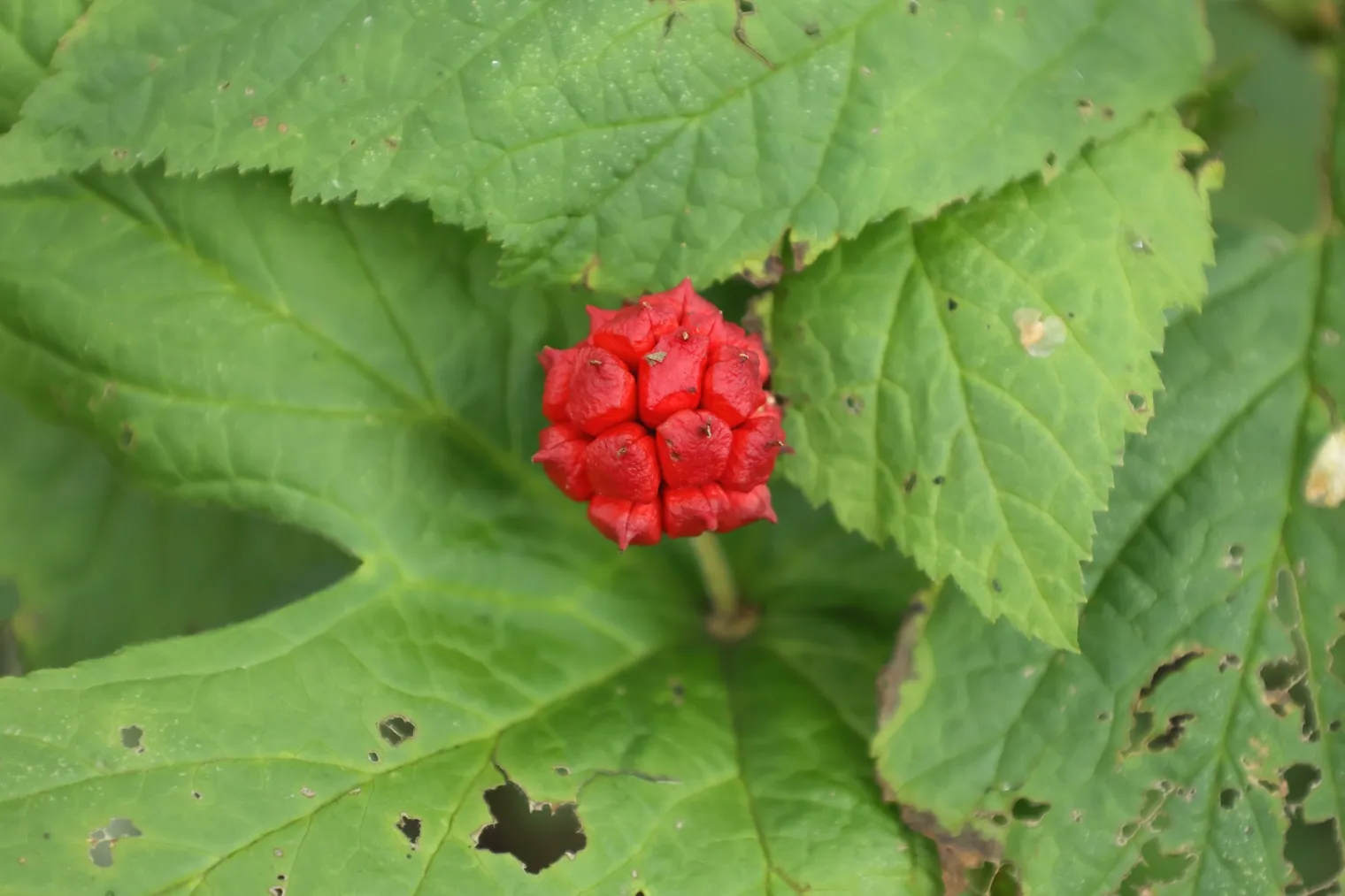
0.2 Summary
Golden seal is the dried rhizome and root of Hydrastis canadensis, a small woodland perennial of eastern North America and the only species in its genus. The European Pharmacopoeia carries a full quality monograph for it: a knotty rhizome about 5 cm long with a ring of 12 to 20 separated xylem bundles, a greenish-yellow powder with abundant starch and orange-brown granular masses, a two-band thin-layer fingerprint of berberine and hydrastine under UV 365 nm, and a liquid-chromatographic assay requiring at least 2.5 per cent hydrastine and 3.0 per cent berberine on the dried drug. Hydrastine is the character that separates real golden seal from the cheaper yellow berberine roots — Coptis, Berberis, Mahonia — that are substituted for it, and substitution is common enough that the Australian manufacturer publishes its own chromatographic comparison of the species. The plant is IUCN Vulnerable and on CITES Appendix II, which is why the Australian practitioner range is labelled cultivated. The therapeutic evidence is thin and old: the long tradition of use for catarrh, digestive complaints and uterine bleeding sits on Eclectic practice, and no controlled trial of golden seal for any of it was found. The best human evidence is about harm — four crossover studies show that golden seal inhibits CYP3A and CYP2D6 enough to change the exposure of co-administered drugs. Anyone considering golden seal should consult a degree-qualified herbalist with competencies and adequate training in pharmacognosy.
0.3 Contents and extent (draft)
| Section | Approx. pages |
|---|---|
| 1-3 Nomenclature, definition, source and Australian supply (1 map, 2 photographs) | 5 |
| 4-5 Macroscopy and microscopy (8 figures, 1 pending slot) | 5 |
| 6-7 Chemistry, markers and limits (11 structures, 1 chart) | 6 |
| 8-9 TLC and HPLC (2 schematics) | 4 |
| 10 Identity, purity, adulterants, contaminants | 4 |
| 11 Traditional use (1 historical plate) | 3 |
| 12 Current practice and doses | 3 |
| 13 Clinical evidence (search, graded studies, registries, 1 evidence chart) | 5 |
| 14 Pharmacology | 4 |
| 15 Safety, interactions, pregnancy (1 chart) | 6 |
| 16-18 Discussion, conclusions, research needed | 4 |
| 19-20 References and document control | 5 |
| Totals (draft) | about 48 A4 pages as rendered; 25 tables; 28 embedded figures (5 licensed photographs, 4 public-domain plates or photographs, 11 PubChem structures, 4 AIP schematics each labelled "schematic redrawn", 1 AIP map, 3 AIP data charts). Counted from the file 23/09/2026. Photomicrographs: none — AIP bench data pending, and no licensed photomicrograph of Hydrastis powder or transverse section was found on Wikimedia Commons or in an open-access paper on 23/09/2026, so slot F4 carries a captioned placeholder. Chromatograms: none measured — the TLC and HPLC figures are schematics redrawn from the Ph. Eur. text, and AIP bench data are pending for both. Studies graded: 8 human pharmacokinetic interaction studies and 1 single-dose pharmacokinetic study; 0 efficacy trials found. 84 references. Full-text position: end of section 19 |
0.4 Contributors and access
Prepared by Dr Thomas Ridley, Head of Education and Research. The Botanical, QA, Medicine and layout reviews are on record, all 23/09/2026, with their sections and reviewers in 0.1 and 20.3. Librarian reference audit pending. A Legal read is advisory only and does not gate publication (CEO order 22/09/2026). The Australian Herbal Pharmacopoeia is AIP’s own series and carries no statutory, TGA or government standing. Access to the full monograph beyond the free sample follows the membership rules set by the CEO (paywall wording to come from Legal and Community Outreach).
53 more pages follow · 26,503 words, 27 figures, 24 tables
Still to come in this monograph
- 1. Nomenclature
- 2. Definition
- 3. Source and Australian supply
- 3.1 Where it must be grown: origin, climate and chemistry
- 4. Macroscopy
- 5. Microscopy
- 6. Chemistry
- 7. Named markers and assay limits
- 8. TLC fingerprint
- 9. HPLC fingerprint and assay
- 10. Identity, purity, adulterants and contaminants
- 11. Traditional use
- 12. Current practice: use, preparations and doses
- 13. Clinical evidence
- 14. Pharmacology
- 15. Safety
- 16. Discussion
- 17. Conclusions
- 18. Research still needed
- 19. References
- 20. Document control
The rest of this monograph is open to members. One membership covers every members’ feature on the site.
Checking your membership…
Report an error or submit evidence
If something in this monograph is wrong, out of date or missing, tell us and show us the evidence. Every report is logged under the AIP Evidence Charter and assessed on the evidence alone; the outcome is kept on the record, and an upheld report is corrected with a dated notice on this page.