
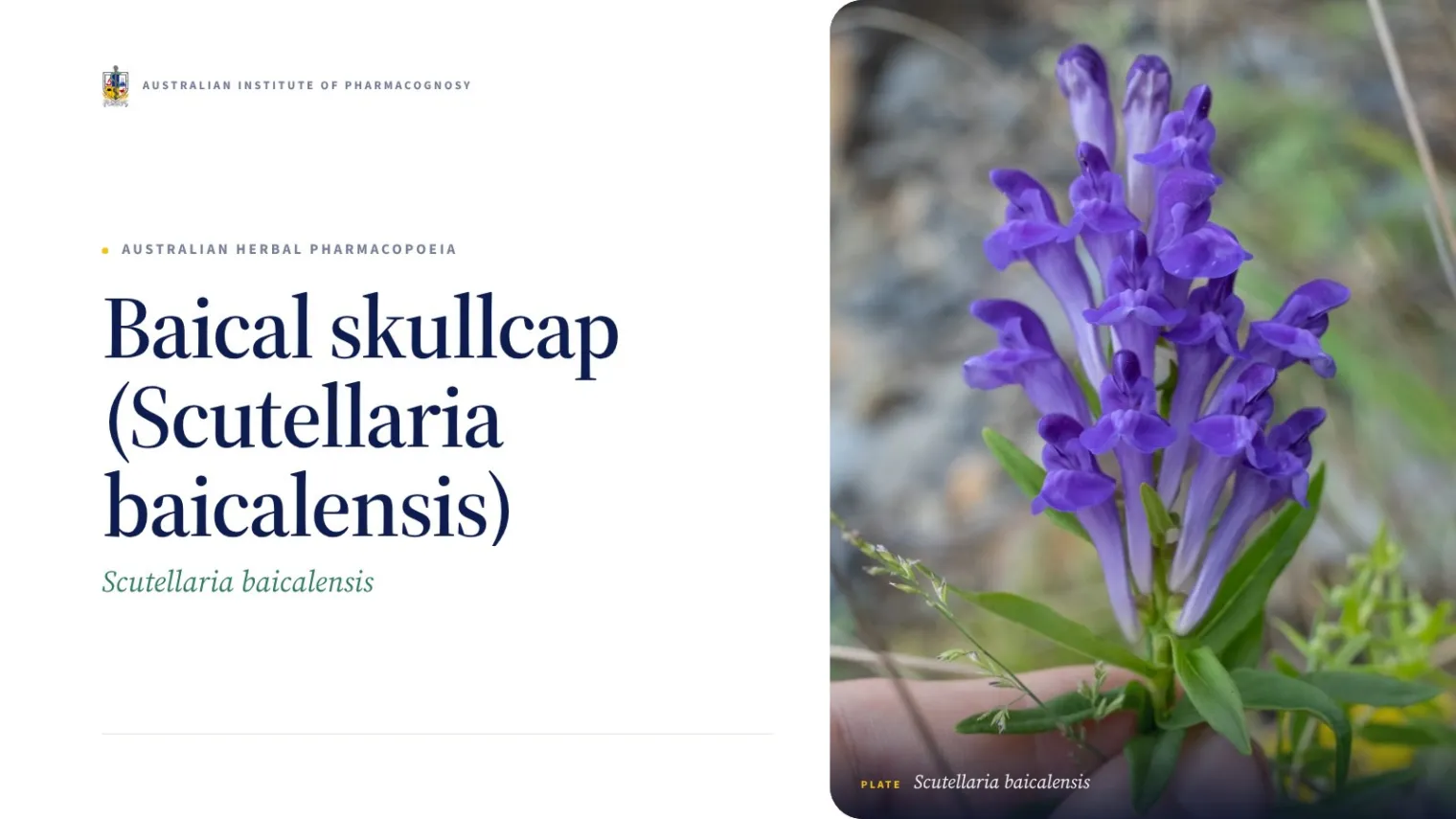
Baical skullcap root (Scutellaria baicalensis Georgi; Chinese huang qin, Japanese ōgon), Lamiaceae
Australian Herbal Pharmacopoeia (working title) · Monograph AIP-PH-SCUBAI · Version 1.0 draft
Date: 2026
Status: working document, version 1.0. Not a statutory standard.
Prepared by: Dr Thomas Ridley, Head of Education and Research, Australian Institute of Pharmacognosy, Cardwell, Queensland.
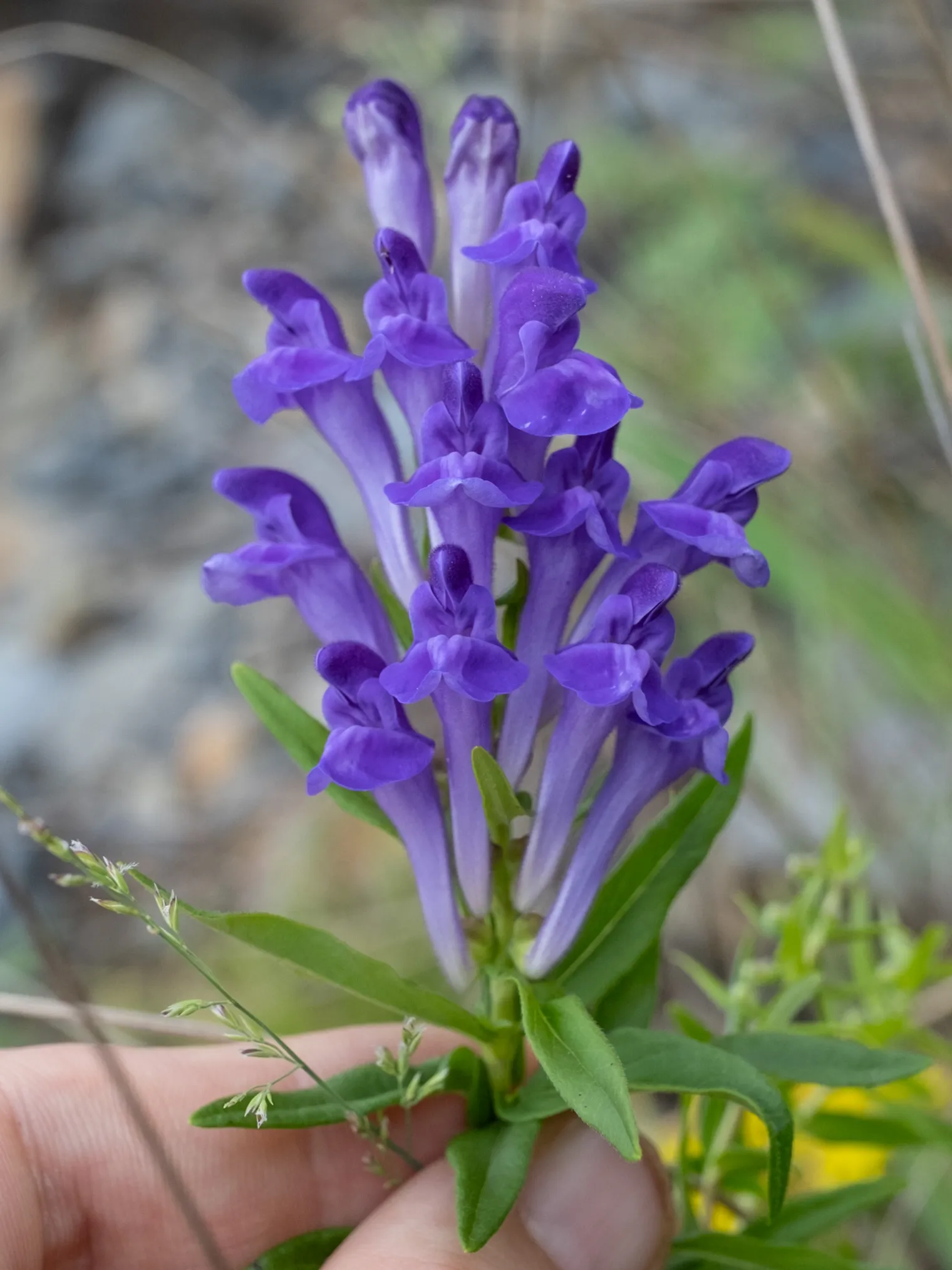
0. Free-teaser block
0.1 Identity card
| AIP code | AIP-PH-SCUBAI (MediHerb A–Z list, item ten) |
| Title | Baical skullcap root (Scutellaria baicalensis Georgi), Scutellariae baicalensis radix |
| Version / year | 1.0 draft, 2026. Next review 2029, or sooner if the registered baicalein influenza trial or any trial of the root itself reports (section 13) |
| Accepted binomial | Scutellaria baicalensis Georgi, Bemerkungen einer Reise im Russischen Reich 2: 223 (1775) in WCVP; IPNI 458155-1 prints volume 1. Accepted in the World Checklist of Vascular Plants (WCVP), the data behind Plants of the World Online, read through ChecklistBank on 29/09/2026 [1] |
| Family | Lamiaceae (Labiatae) [1,3,4] |
| Plant part | Root, dried and peeled, freed of rootlets; usually cut [2]. MediHerb lists the root [6] |
| Latin drug name | Scutellariae baicalensis radix (Ph. Eur. 2438) [2]; Scutellariae Radix (JP XVIII) [3]; Radix Scutellariae (WHO) [4] |
| Principal synonyms | Scutellaria macrantha Fisch. ex Rchb.; S. lanceolaria Miq.; S. davurica Pall. ex Ledeb.; S. adamsii A.Ham.; S. speciosa Fisch. ex Turcz. (all heterotypic, WCVP) [1]. The WHO also lists S. grandiflora Adams [4], a later homonym of the separate species S. grandiflora Sims and not used here (section 1) |
| Common names | English: Baical (Baikal) skullcap, Chinese skullcap, scute. Chinese: huang qin (黄芩). Japanese: ōgon (オウゴン); the plant is koganebana. Korean: hwanggum [3,4,7] |
| Pharmacopoeial status elsewhere | Ph. Eur.: yes, Baical skullcap root 04/2011:2438, library copy 8th Edition [2]. JP XVIII: yes, Scutellaria Root and Powdered Scutellaria Root [3]. WHO: yes, Radix Scutellariae, vol. 3, 2007 [4]. ChP: yes, Scutellariae Radix (reported by refs 5, 20, 23; the ChP itself not read for this draft). BP: not read. EMA/HMPC, BHP 1996, USP–NF: none found or not read |
| Australian status | Permissible Ingredients Determination: yes, item 4475 SCUTELLARIA BAICALENSIS, purposes A, E, H, no specific requirements [10]. Poisons Standard: not scheduled (June 2026 instrument searched 29/09/2026) [11]. ARTG: 158 entries for the keyword "baicalensis" on 29/09/2026, most of them multi-herb products [14]. Introduced: not native, not naturalised; no Nature Conservation Act 1992 (Qld) permit applies; not named in the Biosecurity Regulation 2016 (Qld) [12,38] |
| Named markers | Baicalin (CID 64982): assay, minimum 9.0 per cent on the dried drug, HPLC at 280 nm, Ph. Eur. 2438 [2]; JP XVIII sets minimum 10.0 per cent at 277 nm [3]; WHO minimum 9.0 per cent [4]. Verbascoside (acteoside) (CID 5281800): Ph. Eur. TLC reference [2]. No safety marker is set |
| Evidence snapshot | Fever, cough, diarrhoea and "damp-heat" in Chinese medicine: Tier T [4,5,9]. Anti-inflammatory, antiallergic and antiviral actions: Tier P [4,7,18]. Mild-to-moderate depressive symptoms, low-dose baicalin-rich extract alone: Tier C, 1 RCT, no difference from placebo on the primary outcome; very low certainty for the root (low for that extract) [31]. Stress and cognition, combination product: Tier C, 1 crossover RCT, effect not attributable to the herb [32]. No randomised trial of the crude root or of a practitioner liquid extract was found |
| Suggested citation | Ridley T. Baical skullcap root (Scutellaria baicalensis Georgi), Scutellariae baicalensis radix. AIP-PH-SCUBAI, version 1.0 draft. Cardwell: Australian Institute of Pharmacognosy; 2026. DOI to be assigned |
| Provenance | Original AIP data: none. Every analytical figure, limit, method and trial result belongs to the source cited beside it. Sections 4, 5, 7, 8, 9 and 10 carry AIP bench data pending (no AIP voucher, section, plate or run yet). The distribution map (Figure 9), charts (Figures 10–16) and drawings (Figures 2b, 3b, 5, 7) are AIP drawings from cited data; Figure 2 is a public-domain 19th-century plate |
| Compiler and review | Compiled by Dr Thomas Ridley (Education and Research). Technical review: Dr Fiona MacAllister (Botanical, sections 1-5 and adulterant species in 10), reviewed in 2026; Dr Hana Suzuki (QA, sections 6-10), reviewed in 2026; Dr Eleanor Whitcombe (Medicine, sections 12, 13, 15), reviewed in 2026; Dr Thomas Ridley (Education and Research, evidence and citation audit of all sections and figures), reviewed in 2026; Jesse Kirby (Community Outreach, figures and whole-document layout), reviewed in 2026. Published: not yet. Last modified: 2026. Version 1.0 draft |
| Canonical URL | /pharmacopoeia/scutellaria-baicalensis/ (on publication) |
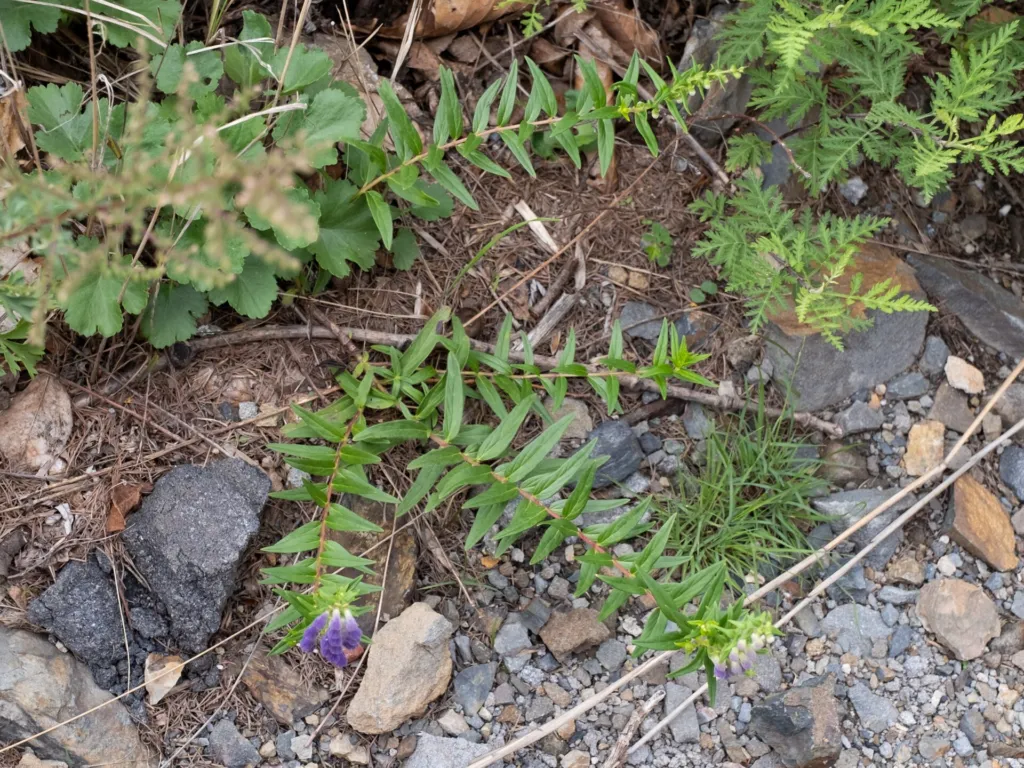
0.2 Summary
Baical skullcap root is the peeled, dried taproot of a perennial Asian mint-family herb, Scutellaria baicalensis, native from eastern Siberia and Mongolia through northern China to Korea. The "skullcap" of Western herbal tradition is a different drug, the aerial parts of the North American S. lateriflora; the two share a name and some flavones, and the confusion matters for safety reporting. The species is not native to Australia, no Australian crop is known to AIP, and the drug used here is imported, now mostly from cultivation in China.
The European and Japanese pharmacopoeias identify the drug by its conical, twisted yellow root with a reddish-brown or hollow centre, by fusiform phloem fibres and stone cells in the powder, and by a TLC fingerprint read against baicalin. Both assay baicalin by HPLC: not less than 9.0 per cent (Ph. Eur., WHO) or 10.0 per cent (JP). In one study, cultivated roots of every age tested (1 to 15 years) exceeded 12 per cent. That limit has a weakness: three substitute Scutellaria species pass it too, so identity needs a fingerprint or DNA test as well as the assay.
The clinical record for the root itself is close to empty. The trials that exist test isolated baicalin or baicalein, very low doses of purified extract, or combination products. Traditional use for fever, cough and diarrhoea is well recorded. The main safety points are rare idiosyncratic liver injury linked to baicalin-rich products, drug-induced pneumonitis attributed to the root in Japanese multi-herb formulas, possible interactions with losartan, rosuvastatin and ciclosporin, and the absence of pregnancy data.
0.3 Contents with extent
| Section | Estimated extent (A4 pages, draft) |
|---|---|
| 0 Free-teaser block | 3 |
| 1 Nomenclature | 2 |
| 2 Definition | 0.5 |
| 3 Source and Australian supply, with 3.1 origin, climate and chemistry | 5 |
| 4 Macroscopy | 3 |
| 5 Microscopy | 2.5 |
| 6 Chemistry | 3 |
| 7 Named markers and assay limits | 1.5 |
| 8 TLC fingerprint | 1.5 |
| 9 HPLC fingerprint | 2 |
| 10 Identity, purity, adulterants and contaminants | 3.5 |
| 11 Traditional use | 1.5 |
| 12 Current practice | 2 |
| 13 Clinical evidence | 4 |
| 14 Pharmacology | 2.5 |
| 15 Safety | 3.5 |
| 16–18 Discussion, conclusions, research needed | 3.5 |
| 19 References | 3 |
| 20 Document control | 1.5 |
| Totals (draft) | About 48 pages. 37 embedded figures: 11 licensed plant photographs from Wikimedia Commons; 1 public-domain 19th-century botanical plate; 11 licensed figures from six open-access papers, among them 2 section panels (none is an AIP photomicrograph) and 1 HPLC chromatogram (not an AIP run); 2 AIP composites of PubChem structures; 12 AIP drawings, replots and data charts. About 20 tables. 0 AIP photomicrographs, 0 AIP chromatograms, 0 AIP plates. 4 randomised trials examined, 2 graded, 1 excluded on the integrity screen, 1 used for safety and pharmacokinetics only; 7 registered trials listed, plus 6 flavocoxid records summarised. 48 numbered references |
Gaps stated plainly. AIP holds no vouchered sample and has made no section, plate or run: sections 4, 5, 7, 8, 9 and 10 carry "AIP bench data pending". No licensed photograph of a developed Ph. Eur. 2438 TLC plate was found, so Figure 7 is a zone-order drawing. The licensed chromatogram (Figure 8) is a research HPLC run under different conditions from the Ph. Eur. assay. The Chinese Pharmacopoeia was not read; ChP limits are given as reported by others and labelled so. Europe PMC and GBIF were unavailable on 29/09/2026. ANZCTR refused automated access that day and has still to be searched by hand; the WHO ICTRP portal was searched but returned an incomplete set (section 13). Cochrane CENTRAL, Embase, DAFF BICON and the CITES and IUCN lists were not searched for this draft. The TGA Database of Adverse Event Notifications and the TGA safety alerts were searched on 29/09/2026 (section 15). Seventeen primary papers are on the library fetch queue and are not cited until read (section 19).
0.4 Contributors and access
Compiled by Dr Thomas Ridley, Head of Education and Research. Botanical (Dr Fiona MacAllister, sections 1–5 and adulterant species in section 10), QA (Dr Hana Suzuki, sections 6–10) and Medicine (Dr Eleanor Whitcombe, sections 12, 13 and 15) have reviewed their sections, and Education and Research has audited every reference and figure against its source (section 20). The first five printed pages are free to read; the full text is for Scholar members and above, under the terms set out on the AIP site.
30 more pages follow · 15,113 words, 35 figures, 19 tables
Still to come in this monograph
- 1. Nomenclature
- 2. Definition
- 3. Source and Australian supply
- 4. Macroscopy
- 5. Microscopy
- 6. Chemistry
- 7. Named markers and assay limits
- 8. TLC fingerprint
- 9. HPLC fingerprint
- 10. Identity, purity, adulterants and contaminants
- 11. Traditional use
- 12. Current practice: use, preparations and doses
- 13. Clinical evidence
- 14. Pharmacology
- 15. Safety
- 16. Discussion
- 17. Conclusions
- 18. Research still needed
- 19. References
- 20. Document control
The rest of this monograph is open to members. One membership covers every members’ feature on the site.
Checking your membership…
Report an error or submit evidence
If something in this monograph is wrong, out of date or missing, tell us and show us the evidence. Every report is logged under the AIP Evidence Charter and assessed on the evidence alone; the outcome is kept on the record, and an upheld report is corrected with a dated notice on this page.
Open the report form
The Institute sets and publishes its own monographs. The catalogue is in Publications.