
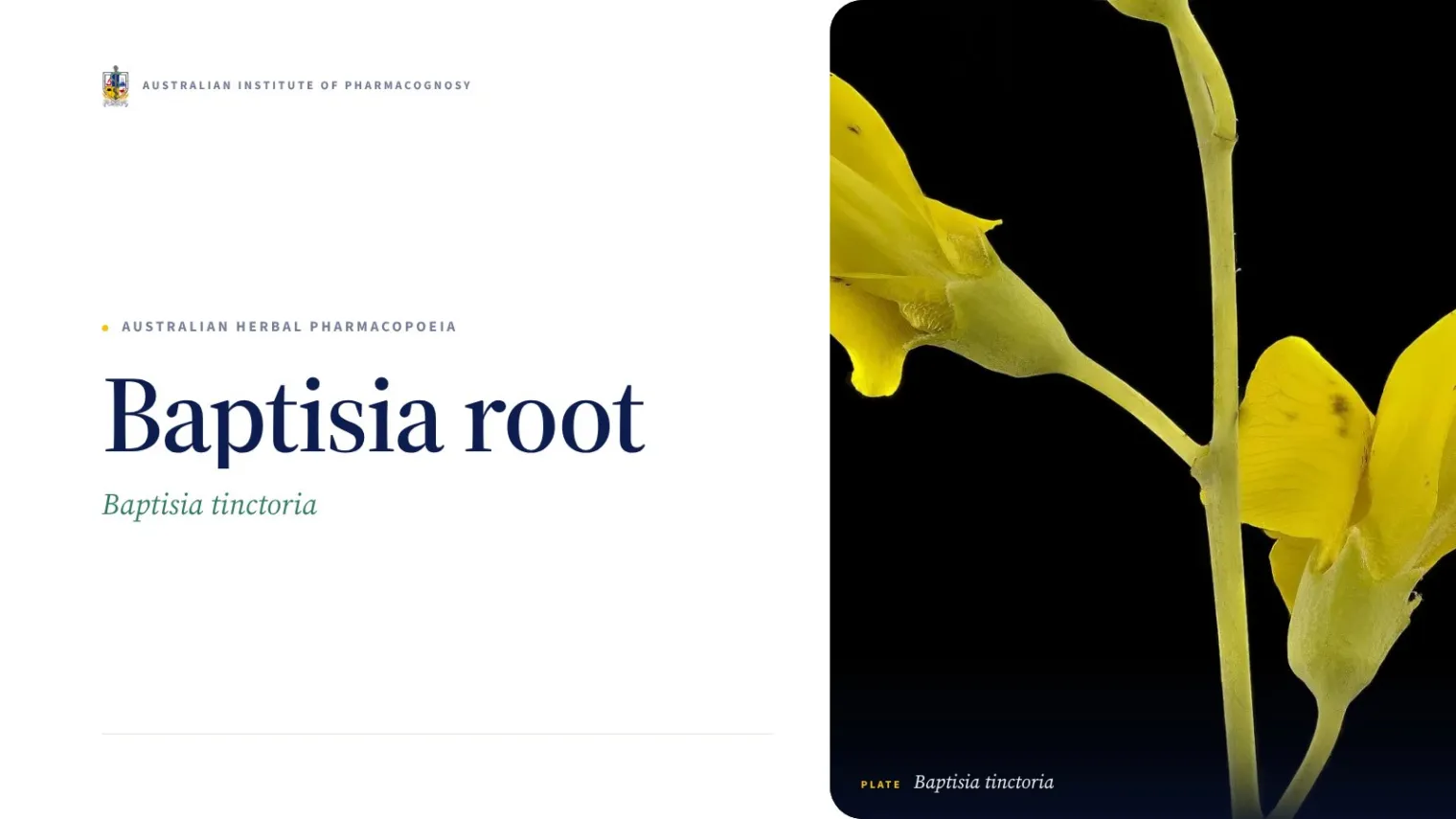
Baptisia root (Baptisia tinctoria (L.) R.Br.), Fabaceae
Australian Herbal Pharmacopoeia (working title) · Monograph AIP-PH-BAPTIN · Version 1.0 draft
Date: 2026
Status: working document, version 1.0. Not a statutory standard.
Prepared by: Dr Thomas Ridley, Head of Education and Research, Australian Institute of Pharmacognosy, Cardwell, Queensland.
0. Free-teaser block
0.1 Identity card
| Register number | AIP-PH-BAPTIN (MediHerb A–Z list No. 11) |
| Title | Baptisia root (Baptisia tinctoria (L.) R.Br.), Baptisiae tinctoriae radix |
| Version / year | 1.0 draft, 2026. Next review 2029, or sooner if a trial of Baptisia root alone reports, or if the primary reports of the combination-product trials change a grade |
| Accepted binomial | Baptisia tinctoria (L.) R.Br., combination published in W.T. Aiton, Hortus Kewensis, 2nd edn, 3: 6 (1811), as cited by WCVP; basionym Sophora tinctoria L., Species Plantarum: 373 (1753). Accepted in the World Checklist of Vascular Plants, Fabaceae 2026 v.7, read through ChecklistBank on 29/09/2026; IPNI 1198899-2, whose record (read 29/09/2026) gives the same authority, "(L.) R.Br. in W.T.Aiton" [1] |
| Family | Fabaceae (Leguminosae), subfamily Papilionoideae; no family change affects the genus [1] |
| Plant part | Dried root and root-head (crown), with not more than 10 per cent of crown, stem or other foreign matter in the historical US National Formulary definition [8] |
| Latin drug name | Baptisiae tinctoriae radix (Kraemer 1920 heads the drug "Radix Baptisiae Tinctoriae") [9] |
| Principal synonyms | Sophora tinctoria L. and Podalyria tinctoria (L.) Lam. (homotypic); Baptisia gibbesii Small, B. tinctoria var. crebra Fernald, B. tinctoria var. gibbesii (Small) Fernald (heterotypic) [1]. Authority also written "(L.) Vent." in some herbals [3] |
| Common names | English: wild indigo, yellow indigo, horsefly weed, indigo weed, rattle bush, yellow broom, clover broom [10,12]. French: indigo sauvage. German: Baptisie [8]. Trade name in Australia: Baptisia [2] |
| Pharmacopoeial status elsewhere | US National Formulary IV (1916): yes, "Baptisia", quoted in full in the US Dispensatory, 1918 [8]; no longer in the USP–NF. Ph. Eur., BP, WHO, EMA/HMPC, ChP, API: no monograph found. No German Commission E or ESCOP monograph was found. The British Herbal Pharmacopoeia is not among the sources read for this edition, so its status is left open (section 18) |
| Australian status | Permissible Ingredients Determination: yes, item 764 BAPTISIA TINCTORIA, purposes A and H, no specific requirements in column 4 [4]. Poisons Standard: the plant is not named; the alkaloids cytisine (Schedules 3 and 4) and sparteine (Schedule 4) are, and the Standard’s section 7 extends a substance entry to that substance "prepared from natural sources" (section 15.6) [5]. Introduced: no occurrence collected in Australia in the Atlas of Living Australia [6]; not native, so no Nature Conservation Act 1992 (Qld) permit applies; not listed in the Biosecurity Regulation 2016 (Qld) [7] |
| Named markers | Cytisine (CID 10235): identity and safety marker; no limit has been set anywhere; an AIP upper limit is proposed as research (sections 7, 18) [8,10,18]. Genistein (CID 5280961) and biochanin A (CID 5280373): isoflavones named in the root; identity only; no limit [3]. Ash: not more than 5 per cent (NF IV) [8] |
| Evidence snapshot | Common cold, three-herb product (Baptisia with Echinacea and Thuja): Tier B, 2 RCTs (n = 259 and n = 94), low certainty, known through a manufacturer-authored review and a handbook abstract [16,42]. Adjunct to antibiotics in acute exacerbation of chronic bronchitis, same product: Tier C, 1 RCT (n = 53), very low certainty [16]. Acute rhinosinusitis, same product with doxycycline: Tier C, 1 comparative study (n = 90), very low certainty [17]. Baptisia root alone for throat, mouth and lymph-gland infections: Tier T [2,3,10,13]. Immune and antibacterial activity: Tier P [15,16]. No trial has tested Baptisia root alone |
| Suggested citation | Ridley T. Baptisia root (Baptisia tinctoria (L.) R.Br.), Baptisiae tinctoriae radix. AIP-PH-BAPTIN, version 1.0 draft. Cardwell: Australian Institute of Pharmacognosy; 2026. DOI to be assigned |
| Provenance | Original AIP data: none. Every analytical figure, limit, method and trial result belongs to the source cited beside it. Sections 4, 5, 7, 8, 9 and 10 carry AIP bench data pending (no AIP voucher, section, plate or run yet). The distribution map (Figure 9), charts (Figures 10, 11, 12, 14, 15) and drawings (Figures 3b, 5, 6) are AIP drawings from cited data |
| Compiler and review | Compiled by Dr Thomas Ridley (Education and Research). Technical review: Dr Fiona MacAllister (Botanical, sections 1-5, 10), reviewed in 2026; Dr Hana Suzuki (QA, sections 6-10), reviewed in 2026; Dr Eleanor Whitcombe (Medicine, sections 12, 13, 15, with 16–18 checked), reviewed in 2026; Dr Thomas Ridley (Education and Research, evidence and citation audit of the whole document and its figures; also the compiler, so this audit is not independent of the text), reviewed in 2026; Jesse Kirby (Community Outreach, layout and figures of the whole document), reviewed in 2026. Published: not yet. Last modified: 2026. Version 1.0 draft |
| Canonical URL | /pharmacopoeia/baptisia-tinctoria/ (on publication) |
0.2 Summary
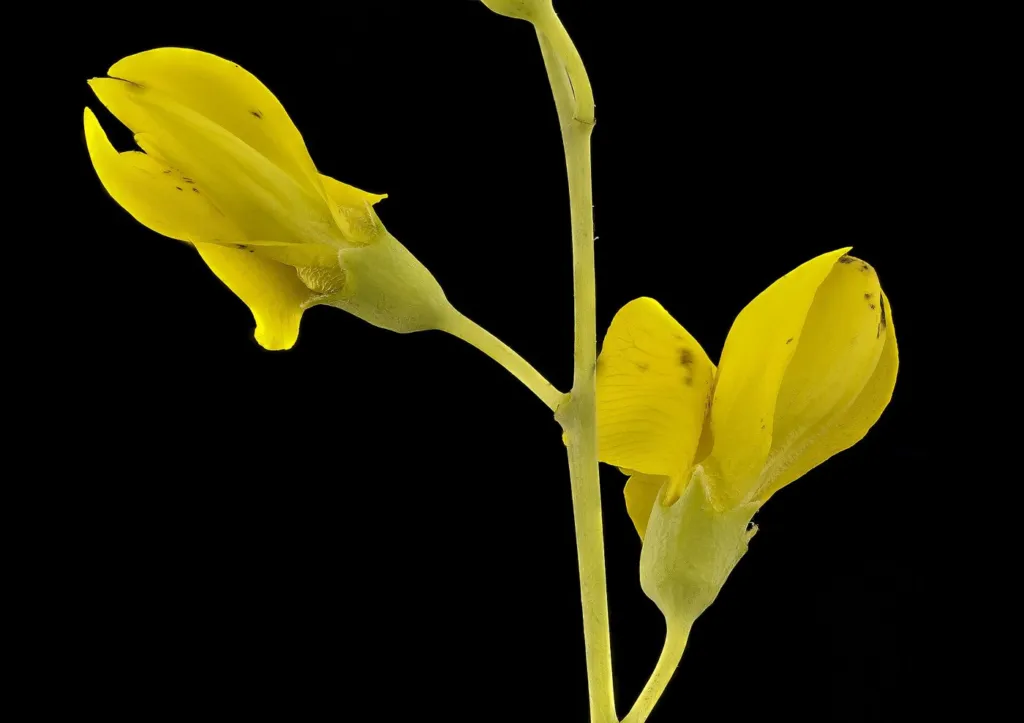
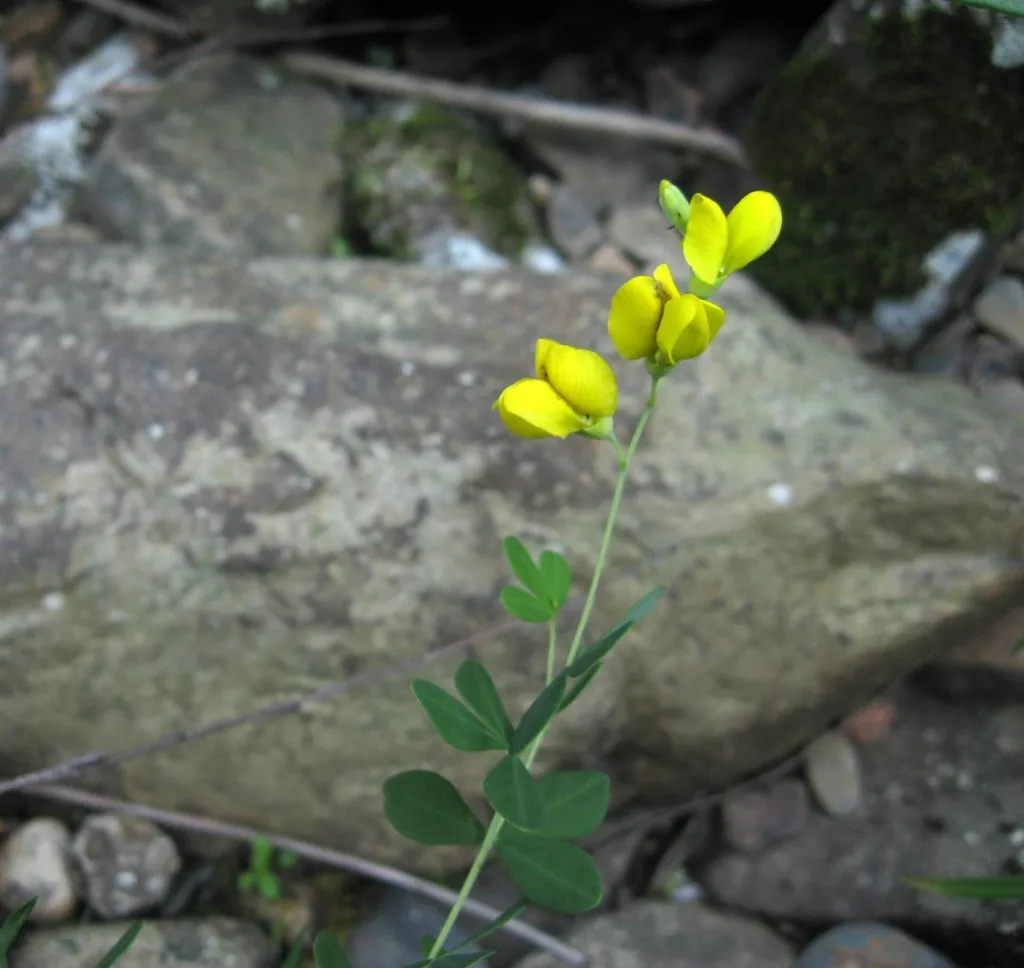
Baptisia root is the dried root and root-head of wild indigo, a bushy perennial pea of dry, poor, sunny ground in eastern North America. It does not grow wild in Australia and is imported. No current pharmacopoeia carries it. The last official standard was the United States National Formulary IV (1916), which described the root, its powder under the microscope and an ash limit of 5 per cent. Nobody has published an assay limit for any of its constituents.
The root contains the quinolizidine alkaloid cytisine (the "baptitoxine" of the nineteenth century), isoflavones including genistein and biochanin A, glycoproteins and arabinogalactan-proteins, and polysaccharides. Cytisine is the safety concern. It is a scheduled poison in Australia when used as a pure substance, and no published source gives a measured figure for it in the root.
Australian practitioners use a 1:2 liquid extract at 8 to 20 mL a week, with a firm ceiling of 3 mL a day, for throat, mouth and lymph-gland infections and feverish colds. That use rests on Eclectic tradition. The clinical trials all tested a German three-herb product in which Baptisia is one ingredient, so they cannot show what Baptisia does on its own. Large doses cause vomiting and purging.
0.3 Contents with extent
| Section | Extent (A4 pages, measured from this printing) |
|---|---|
| 0 Free-teaser block | 4 |
| 1 Nomenclature | 1 |
| 2 Definition | 1 |
| 3 Source and Australian supply, with 3.1 origin, climate and chemistry | 2 |
| 4 Macroscopy | 3 |
| 5 Microscopy | 3 |
| 6 Chemistry | 2 |
| 7 Named markers and assay limits | 1 |
| 8 TLC fingerprint | 2 |
| 9 HPLC fingerprint | 1 |
| 10 Identity, purity, adulterants and contaminants | 2 |
| 11 Traditional use | 2 |
| 12 Current practice | 1 |
| 13 Clinical evidence | 3 |
| 14 Pharmacology | 1 |
| 15 Safety | 2 |
| 16–18 Discussion, conclusions, research needed | 3 |
| 19 References | 2 |
| 20 Document control | 2 |
| Totals (draft) | This printing runs to 38 A4 pages. 31 embedded figures: 11 licensed or public-domain photographs, 9 public-domain plates and drawings (3 of them from a 1920 drawing that includes a root transverse section), 1 licensed HPTLC plate and 1 licensed HPLC chromatogram (both of related plants, not Baptisia), 1 AIP composite of PubChem structures and 8 AIP drawings and charts. About 22 tables. 0 AIP photomicrographs, 0 AIP chromatograms, 0 AIP plates. 5 human studies given a provisional risk-of-bias judgement and 3 outcomes graded with GRADE; 1 older trial and 4 adjunct studies listed but not graded; 3 trial registers searched. 46 numbered references |
Gaps stated plainly. AIP holds no voucher, photomicrograph, TLC plate or chromatogram of Baptisia root. No published TLC or HPLC fingerprint of the root itself was found in the sources read, so sections 8 and 9 are proposed methods assembled from published work on related Fabaceae, and Figures 7 and 8 show those published systems run on other plants. No licensed photograph of the dried root was found; Figure 3 is a 1920 drawing and Figure 3b an AIP schematic. The primary reports of the combination-product trials, the arabinogalactan-protein papers and the 2015 poisoning case report are being obtained in full text for version 1.1; this edition reports the trials as published reviews and a handbook describe them, with provisional risk-of-bias judgements. The TGA safety-alert and adverse-event database searches could not be completed on 29/09/2026 and are to be repeated.
0.4 Contributors and access
Compiled by Dr Thomas Ridley, Head of Education and Research. The Botanical review (sections 1–5 and 10), the QA review (sections 6–10), the Medicine review (sections 12, 13 and 15, with 16–18 checked) and the Education and Research evidence and citation audit (whole document) are on record. The compiler also did the audit, so the traditional-use section and the reference list still await independent checks by History and Philosophy and by the Librarian. Dr Luke Iggulden set the scope of the pharmacopoeia series; he did not write this monograph. The free sample is the first five printed pages; the full text is available to Scholar members and above.
27 more pages follow · 13,574 words, 29 figures, 20 tables
Still to come in this monograph
- 1. Nomenclature
- 2. Definition
- 3. Source and Australian supply
- 4. Macroscopy
- 5. Microscopy
- 6. Chemistry
- 7. Named markers and assay limits
- 8. TLC fingerprint
- 9. HPLC fingerprint
- 10. Identity, purity, adulterants and contaminants
- 11. Traditional use
- 12. Current practice: use, preparations and doses
- 13. Clinical evidence
- 14. Pharmacology
- 15. Safety
- 16. Discussion
- 17. Conclusions
- 18. Research still needed
- 19. References
- 20. Document control
The rest of this monograph is open to members. One membership covers every members’ feature on the site.
Checking your membership…
Report an error or submit evidence
If something in this monograph is wrong, out of date or missing, tell us and show us the evidence. Every report is logged under the AIP Evidence Charter and assessed on the evidence alone; the outcome is kept on the record, and an upheld report is corrected with a dated notice on this page.
Open the report form
The Institute sets and publishes its own monographs. The catalogue is in Publications.