
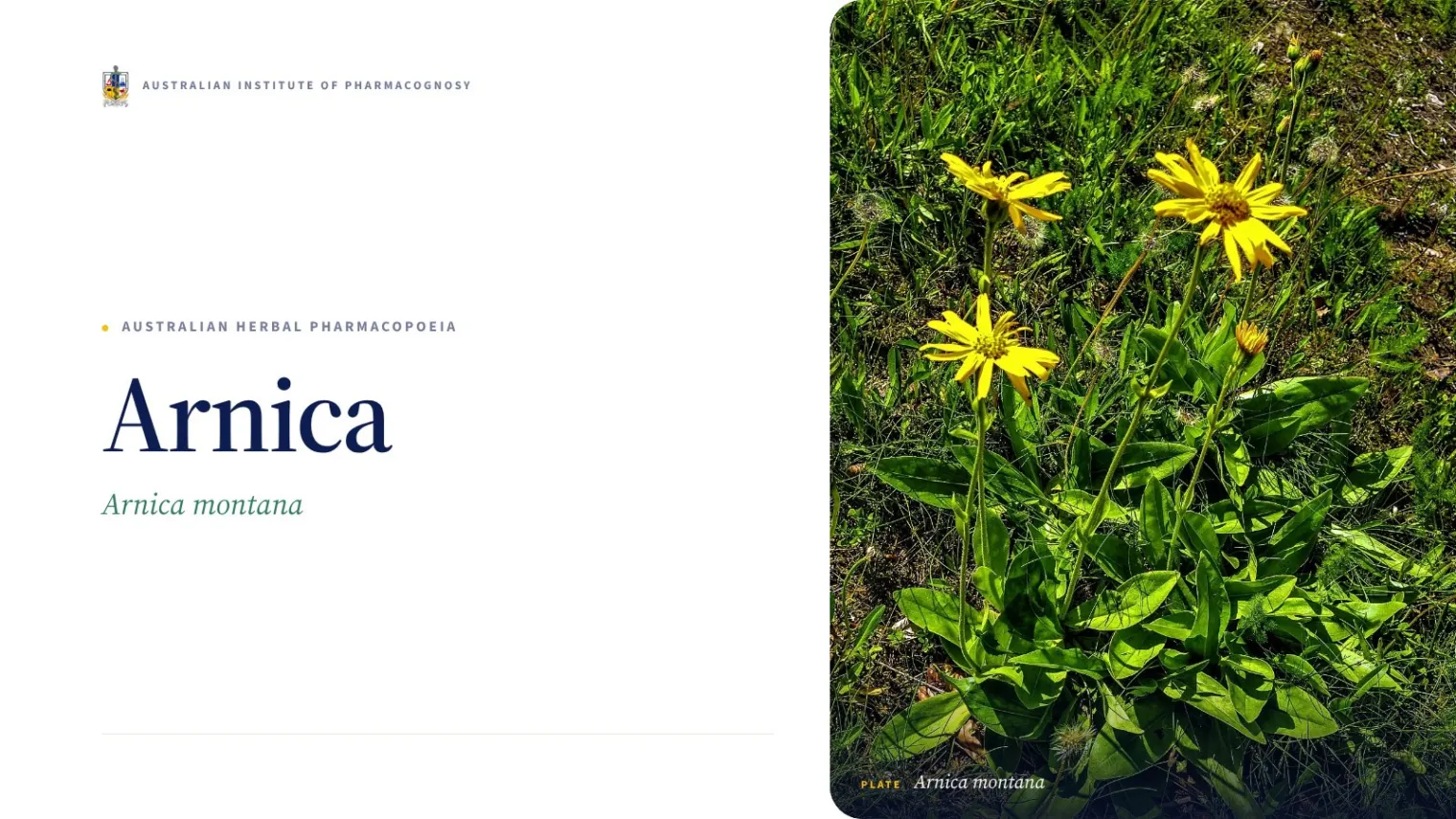
Arnica (topical) flower (Arnica montana L.), Asteraceae
Australian Herbal Pharmacopoeia (working title) · Monograph AIP-PH-ARNMON · Version 1.0 draft
Date: 2026
Status: working document, version 1.0. Not a statutory standard.
Prepared by: Dr Thomas Ridley, Head of Education and Research, Australian Institute of Pharmacognosy, Cardwell, Queensland.
0. Free-teaser block
0.1 Identity card
| Monograph number | AIP-PH-ARNMON (MediHerb A–Z list No. 7) |
| Title | Arnica (topical) flower (Arnica montana L.), Arnicae flos |
| Version / year | 1.0 draft, 2026. Next review 2029, or sooner if the registered phase III trial (NCT06822478) reports or a regulator acts |
| Accepted binomial | Arnica montana L., Species Plantarum: 884 (1753). Accepted in the World Checklist of Vascular Plants (WCVP), read through ChecklistBank 29/09/2026; IPNI 30090722-2. The Plants of the World Online page, which publishes the same dataset, could not be opened on 29/09/2026 (it served a browser check). WCVP also accepts two subspecies, subsp. montana and subsp. atlantica A.Bolòs [1] |
| Family | Asteraceae (Compositae), order Asterales; no family change affects Arnica (section 1) [1] |
| Plant part | Whole or partially broken, dried flower-heads (capitula), including involucre and receptacle [3] |
| Latin drug name | Arnicae flos (Ph. Eur. 1391; EMA/HMPC) [2,3] |
| Principal synonyms | Doronicum oppositifolium Lam. (homotypic); Doronicum arnica Desf., Doronicum montanum Lam., Arnica petiolata Schur and others under subsp. montana (heterotypic) [1,5] |
| Common names | English: arnica, mountain arnica, leopard’s bane, wolf’s bane, mountain tobacco. German: Arnikablüten (drug), Bergwohlverleih. French: arnica (fleur d’). Dutch: valkruid, wolverlei [2,5,6] |
| Pharmacopoeial status elsewhere | Ph. Eur.: yes, Arnica flower 01/2012:1391 and Arnica tincture 01/2008:1809, library copy 8th Edition [3]. EMA/HMPC: yes, EU herbal monograph, traditional use, cutaneous only, adopted 06/05/2014 [2,4]. WHO: yes, Flos Arnicae, vol. 3, 2007 [5]. BP: carries the Ph. Eur. text (Barnes lists BP 2007) [6]. BHP 1996: listed by Barnes and WHO [5,6]; not read by AIP. USP, ChP, API: no monograph found for this species |
| Australian status | Permissible Ingredients Determination: yes, items 680 ARNICA FLOWER DRY and 682 ARNICA MONTANA (A, H), each with the requirement that, when used other than topically on unbroken skin, the maximum recommended daily dose is no more than 1 mg of the equivalent dry flower or dry herbal material [10]. Poisons Standard: not scheduled (June 2026 instrument searched 29/09/2026) [11]. ARTG: 116 entries returned for the keyword "arnica", 29/09/2026 (topical and homoeopathic products among them) [30]. Introduced: no Australian occurrence recorded [24]; not native, so no Nature Conservation Act 1992 (Qld) permit applies; not listed in the Biosecurity Regulation 2016 (Qld) [12] |
| Named markers | Total sesquiterpene lactones, as 11α,13-dihydrohelenalin tiglate (CID 5281483): assay, minimum 0.40 per cent m/m on the dried drug, Ph. Eur. 1391 [3]. Chlorogenic acid (CID 1794427), astragalin (CID 5282102), isoquercitrin (CID 5484006), luteolin 7-glucoside (CID 5280637): TLC identity [3]. Rutin (CID 5280805): must be absent (exclusion of Calendula and Heterotheca) [3]. Helenalin/dihydrohelenalin ratio: chemotype marker; no pharmacopoeial limit [13] |
| Evidence snapshot | Hand osteoarthritis pain, fresh-plant gel against ibuprofen gel: Tier B, 1 RCT, n = 204, no difference between arms [4,21]. Knee osteoarthritis, venous insufficiency, bruising: Tier C, 6 small or uncontrolled studies, very low certainty [4]. Ankle sprain, tincture spray: Tier C, 1 RCT arm comparison (n = 114), very low certainty [34]. Cutaneous leishmaniasis, tincture: Tier C, 1 phase Ib/II study, n = 16, no comparator [19]. Bruises, sprains, localised muscle pain: Tier T, tradition accepted by the HMPC [2]. Anti-inflammatory mechanism (NF-κB, C/EBPβ): Tier P [13]. Oral use: toxic; not a use [5,6,10] |
| Suggested citation | Ridley T. Arnica (topical) flower (Arnica montana L.), Arnicae flos. AIP-PH-ARNMON, version 1.0 draft. Cardwell: Australian Institute of Pharmacognosy; 2026. DOI to be assigned |
| Provenance | Original AIP data: none. Every analytical figure, limit, method and trial result belongs to the source cited beside it. Sections 4, 5, 7, 8, 9 and 10 carry AIP bench data pending (no AIP voucher, section, plate or run yet). The distribution map (Figure 9), charts (Figures 10–12) and drawings (Figures 5, 7) are AIP drawings from cited data |
| Compiler and review | Compiled by Dr Thomas Ridley (Education and Research). Technical review: Dr Fiona MacAllister (Botanical, sections 1-5 and adulterant species in 10), reviewed in 2026; Dr Hana Suzuki (QA, sections 6-10), reviewed in 2026; Dr Eleanor Whitcombe (Medicine, sections 12, 13, 15), reviewed in 2026. Evidence and citation audit: Dr Thomas Ridley (Education and Research, sources for sections 6–9, sections 12–19 and all figures), reviewed in 2026; as compiler he is not independent of the text, so the Librarian’s reference audit remains the independent check on section 19. Layout: Jesse Kirby (Community Outreach, whole-document layout, figure placement, captions and credit lines), reviewed in 2026. Published: not yet. Last modified: 2026. Version 1.0 draft |
| Canonical URL | /pharmacopoeia/arnica-montana/ (on publication) |
0.2 Summary
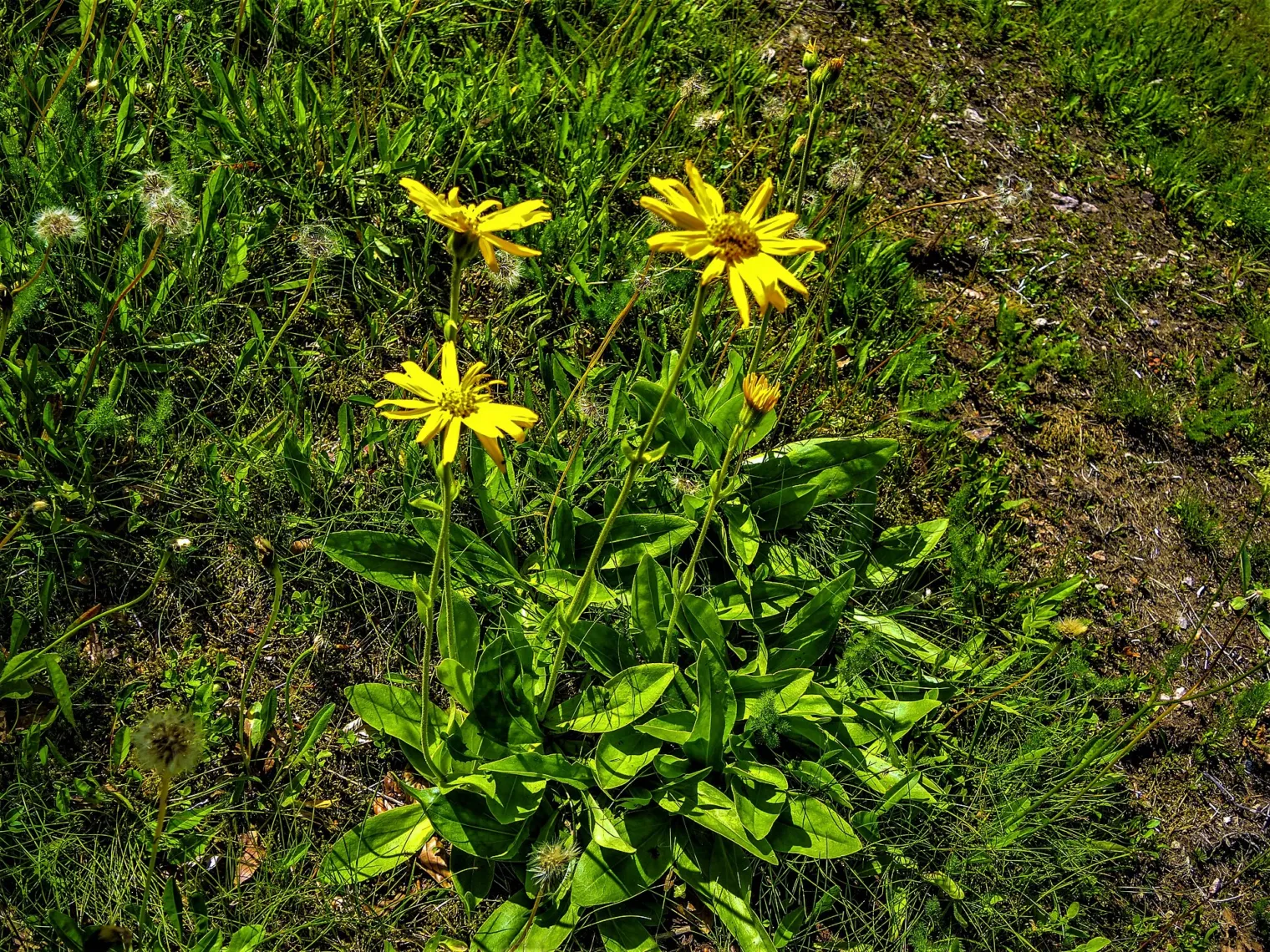
Arnica flower is the dried flower-head of Arnica montana, a perennial daisy of acid, nutrient-poor mountain grassland from Portugal and Spain to Norway and Ukraine. It does not grow wild in Australia and is imported. The European Pharmacopoeia identifies it by the flower-head’s structure, by its hairs and spiny pollen, and by a TLC fingerprint that must show chlorogenic acid and a set of flavonol zones while showing no rutin, which excludes the two commonest substitutes, pot marigold and Mexican "arnica" (Heterotheca inuloides). The assay is total sesquiterpene lactones, at least 0.40 per cent, calculated as dihydrohelenalin tiglate.
Two chemotypes are traded under the one name. Central European flowers are rich in helenalin esters; most Spanish flowers carry dihydrohelenalin esters instead. Helenalin is the more potent anti-inflammatory in laboratory tests, and the pharmacopoeial assay does not tell the two apart.
Arnica is used on unbroken skin for bruises, sprains and muscle pain, a use the HMPC accepts on tradition. One well-run trial found that a fresh-plant gel gave results similar to ibuprofen gel for hand osteoarthritis; the rest of the clinical evidence is small or uncontrolled. The main safety points are contact allergy (about 1 user in 100 in European marketing data) and serious toxicity if swallowed, including miscarriage when taken in pregnancy.
0.3 Contents with extent
| Section | Estimated extent (A4 pages, draft) |
|---|---|
| 0 Free-teaser block | 3 |
| 1 Nomenclature | 1.5 |
| 2 Definition | 0.5 |
| 3 Source and Australian supply, with 3.1 origin, climate and chemistry | 5 |
| 4 Macroscopy | 3 |
| 5 Microscopy | 3 |
| 6 Chemistry | 3.5 |
| 7 Named markers and assay limits | 1.5 |
| 8 TLC fingerprint | 1.5 |
| 9 HPLC fingerprint | 2.5 |
| 10 Identity, purity, adulterants and contaminants | 3 |
| 11 Traditional use | 1.5 |
| 12 Current practice | 2.5 |
| 13 Clinical evidence | 4 |
| 14 Pharmacology | 2.5 |
| 15 Safety | 3 |
| 16–18 Discussion, conclusions, research needed | 3 |
| 19 References | 3 |
| 20 Document control | 1 |
| Totals (draft) | The section estimates sum to about 49 pages; this printing runs to 40 A4 pages. 22 embedded figures: 8 licensed field, specimen or drug photographs, 1 public-domain plate, 2 licensed photomicrograph panels (neither is an AIP photomicrograph), 1 licensed UHPLC-MS chromatogram, 2 licensed figures from a review (chemotype map, structures), 2 AIP composites of PubChem structures, 6 AIP drawings and charts. About 25 tables. 0 AIP photomicrographs, 0 AIP chromatograms, 0 AIP plates. 9 human studies graded; 6 further trials and 1 appraisal listed but ungraded. 34 numbered references |
Gaps stated plainly. AIP holds no vouchered sample and has made no section, plate or run: sections 4, 5, 7, 8, 9 and 10 carry "AIP bench data pending". No licensed photograph of a developed Ph. Eur. 1391 TLC plate was found, so Figure 7 is a zone-order drawing. The licensed chromatogram (Figure 8) is a UHPLC-MS research run on a tincture, not the Ph. Eur. HPLC-UV assay. Seven of the nine graded trials are graded from the HMPC assessment report and the Cochrane review; their primary reports are on the library fetch queue with other papers (listed in section 19), and those grades are provisional. The DAFF BICON import case, the TGA Database of Adverse Event Notifications and safety-alert list (the TGA pages could not be queried on 29/09/2026), ANZCTR (refused access from our network on 29/09/2026), WHO ICTRP (the portal returned an implausible result), Cochrane CENTRAL and Embase were not searched.
0.4 Contributors and access
Compiled by Dr Thomas Ridley, Head of Education and Research. The Botanical review (Dr Fiona MacAllister, Head of Botanical: sections 1–5, adulterant species in section 10, and the botanical figures), the QA review (Dr Hana Suzuki) and the Medicine review (Dr Eleanor Whitcombe, Head of Medicine: sections 12, 13 and 15, and Figures 10 and 11) are on record; each reviewer is credited once their review is on record (section 20). The first five printed pages are free to read; the full text is for Scholar members and above, under the terms set out on the AIP site.
30 more pages follow · 14,906 words, 21 figures, 24 tables
Still to come in this monograph
- 1. Nomenclature
- 2. Definition
- 3. Source and Australian supply
- 4. Macroscopy
- 5. Microscopy
- 6. Chemistry
- 7. Named markers and assay limits
- 8. TLC fingerprint
- 9. HPLC fingerprint
- 10. Identity, purity, adulterants and contaminants
- 11. Traditional use
- 12. Current practice: use, preparations and doses
- 13. Clinical evidence
- 14. Pharmacology
- 15. Safety
- 16. Discussion
- 17. Conclusions
- 18. Research still needed
- 19. References
- 20. Document control
The rest of this monograph is open to members. One membership covers every members’ feature on the site.
Checking your membership…
Report an error or submit evidence
If something in this monograph is wrong, out of date or missing, tell us and show us the evidence. Every report is logged under the AIP Evidence Charter and assessed on the evidence alone; the outcome is kept on the record, and an upheld report is corrected with a dated notice on this page.
Open the report form
The Institute sets and publishes its own monographs. The catalogue is in Publications.