
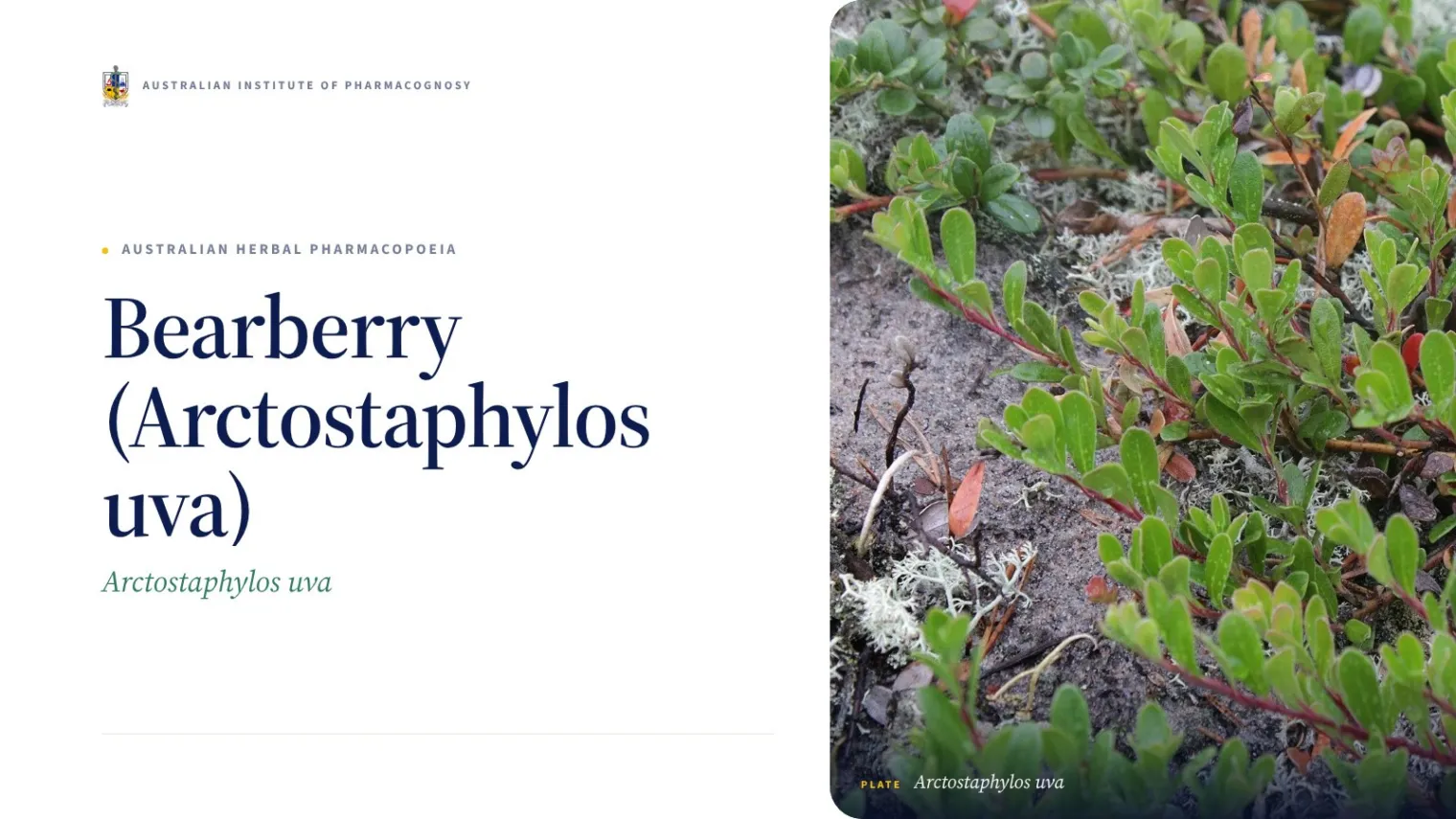
Bearberry leaf (Arctostaphylos uva-ursi (L.) Spreng.), Ericaceae
Australian Herbal Pharmacopoeia (working title) · Monograph AIP-PH-ARCUVA · Version 1.0 draft
Date: 2026
Status: working document, version 1.0. Not a statutory standard.
Prepared by: Dr Thomas Ridley, Head of Education and Research, Australian Institute of Pharmacognosy, Cardwell, Queensland.
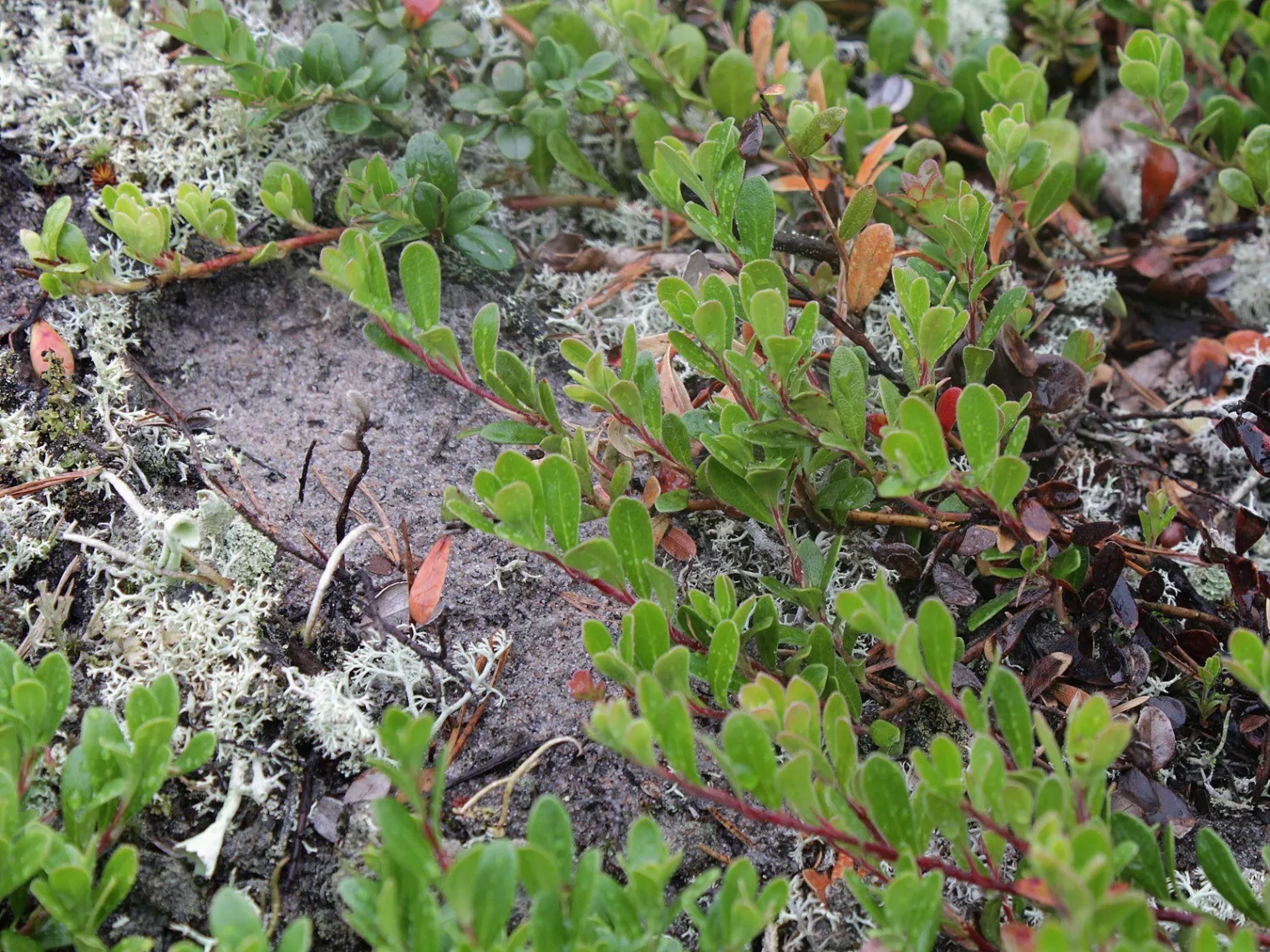
0. Free-teaser block
0.1 Identity card
| Monograph number | AIP-PH-ARCUVA (MediHerb A–Z list No. 13) |
| Title | Bearberry leaf (Arctostaphylos uva-ursi (L.) Spreng.), Uvae ursi folium |
| Version / year | 1.0 draft, 2026. Next review 2029, or sooner if the BRUMI trial reports or the Permissible Ingredients arbutin requirement changes |
| Accepted binomial | Arctostaphylos uva-ursi (L.) Spreng., Syst. Veg., ed. 16, 2: 287 (1825). Accepted. IPNI 1024084-2; basionym Arbutus uva-ursi L., Sp. Pl. 1: 395 (1753), IPNI 17566-2. Checked on 30/09/2026 against the Plants of the World Online / World Checklist of Vascular Plants data (ChecklistBank dataset version 2026-09-23) and IPNI [1,2] |
| Family | Ericaceae Juss. (APG IV), order Ericales [1] |
| Plant part | The dried leaf, whole or fragmented [3] |
| Latin drug name | Uvae ursi folium [3,4] |
| Principal synonyms | Homotypic: Arbutus uva-ursi L. (basionym), Mairania uva-ursi (L.) Desv., Uva-ursi procumbens Moench, Uva-ursi uva-ursi (L.) Cockerell ex Daniels. Heterotypic (42 in WCVP) include Arctostaphylos officinalis Wimm. & Grab., Arctostaphylos procumbens Patze, E.Mey. & Elkan and the infraspecific names subsp. adenotricha, coactilis, crassifolia and stipitata [1] |
| Common names | English: bearberry, uva-ursi, kinnikinnick, mountain box, red bearberry, hog cranberry [6]. German: Bärentraubenblätter; French: busserole, raisin d’ours; Spanish: gayuba; Italian: uva ursina [4,6] |
| Pharmacopoeial status elsewhere | Ph. Eur.: yes, monograph 1054 Bearberry leaf (the edition read, 8.0, text dated 07/2013) [3]. BP: yes [7]. USP–NF: no longer; official 1820 to 1950 [12]. WHO: yes, vol. 2 (2002) [6]. EMA/HMPC: yes, EU herbal monograph, traditional use, EMA/HMPC/750269/2016 (30/01/2018) [4]. BHP: yes (1983 and 1996, as cited by the HMPC) [5]. Commission E: positive monograph [5,9]. ESCOP: yes (2003, as cited) [5]. Japanese Pharmacopoeia: listed in the edition WHO cites [6] |
| Australian status | Permissible Ingredients Determination (No. 2) 2026, item 670 ARCTOSTAPHYLOS UVA-URSI (purposes A, E, H): beta-arbutin is a mandatory component; for oral use the maximum recommended daily dose must not provide more than 500 mg beta-arbutin [14]. Items 5112 UVA URSI LEAF DRY and 5113 UVA URSI LEAF POWDER carry no requirement [14]. Poisons Standard (June 2026): the herb is not named; beta-arbutin is Schedule 4 in oral preparations except herbal preparations containing 500 mg or less per recommended daily dose, and Schedule 6 in other circumstances; hydroquinone is scheduled separately [15]. ARTG: 11 listed medicines name Arctostaphylos uva-ursi (search 30/09/2026) [16]. Not native. Not a declared or restricted matter under the Queensland Biosecurity Regulation 2016. No wild records in the Atlas of Living Australia [17,18] |
| Named markers | Arbutin (hydroquinone β-D-glucopyranoside), CID 440936, C₁₂H₁₆O₇, M_r 272.3: identity (TLC) and assay marker, not less than 7.0 per cent anhydrous arbutin, dried drug, by HPLC (Ph. Eur. 1054) [3]. Gallic acid, CID 370: TLC identity reference [3]. Hydroquinone, CID 785: safety marker and the system-suitability partner in the assay; no limit is set on the leaf [3] |
| Evidence snapshot | Acute uncomplicated cystitis, symptom relief against placebo: Tier B, 1 RCT (n = 382), no effect found. Acute cystitis treated with bearberry instead of an immediate antibiotic, 1 RCT (n = 398): Tier A that recovery is worse (more incomplete recoveries) and Tier A that antibiotic courses fall; the signal towards more pyelonephritis is Tier B. A tier grades certainty, so these Tier A findings do not support using bearberry for acute cystitis. Prevention of recurrent cystitis: Tier C, 1 small combination RCT known second-hand. Mild recurrent lower urinary tract symptoms in women: Tier T, EU traditional use. Diuretic, anti-inflammatory, skin lightening: Tier P |
| Suggested citation | Ridley T. Bearberry leaf (Arctostaphylos uva-ursi (L.) Spreng.), Uvae ursi folium. AIP-PH-ARCUVA, version 1.0 draft. Cardwell: Australian Institute of Pharmacognosy; 2026. DOI to be assigned |
| Provenance | Original AIP data: none. Every limit, method, analytical figure and trial result in this monograph belongs to the source cited beside it. Sections 4, 5, 7, 8, 9 and 10 carry AIP bench data pending: AIP has not vouchered a sample, cut a section, run a plate or run a chromatogram of this drug. Photographs and plates are licensed or public-domain works credited in each caption; F3b, F5 and F7 are AIP schematics redrawn from cited descriptions; F6c, F10b and F10d are AIP replots labelled "schematic redrawn from ref n"; F6b, F7b, F9, F10, F10c, F10e and F10f are AIP charts drawn from published data |
| Compiler and review | Compiled by Dr Thomas Ridley (Education and Research). Evidence and citation audit: Dr Thomas Ridley (Education and Research, all sections, figures and references), reviewed in 2026. Technical review: Dr Fiona MacAllister (Botanical, sections 1-5 and the adulterant species in 10), reviewed in 2026; Dr Hana Suzuki (QA, sections 6-10), reviewed in 2026; Dr Eleanor Whitcombe (Medicine, sections 12, 13, 15), reviewed in 2026. Layout and figure credits: Jesse Kirby (Community Outreach, figures F1–F10 and page design), reviewed in 2026. Published: not yet. Last modified: 2026. Version 1.0 draft |
| Canonical URL | /pharmacopoeia/arctostaphylos-uva-ursi/ (on publication) |
0.2 Summary
Bearberry leaf is the dried leaf of Arctostaphylos uva-ursi, a trailing evergreen shrub of the boreal and mountain zones of Europe, northern Asia and North America. It has been used for bladder complaints since at least the thirteenth century, was official in the United States Pharmacopeia and National Formulary from 1820 to 1950, and is official today in the European Pharmacopoeia. The drug is identified by its small obovate, coriaceous leaf with a finely sunken adaxial network, by an epidermis with anomocytic stomata on the lower surface only, and by a thin-layer chromatogram showing an intense blue arbutin zone. It is assayed by HPLC for arbutin, not less than 7.0 per cent of the dried drug. The leaf also carries 10 to 20 per cent tannin, which is why it upsets the stomach and why teas are made cold or by short infusion. The rationale is that arbutin reaches the urine as hydroquinone conjugates that bacteria can split. Two modern randomised trials tested bearberry-only products in women with acute cystitis. Against placebo it did not relieve symptoms; used instead of fosfomycin it cut antibiotic courses but left more women unrecovered, with a signal towards more kidney infections. The European Union accepts it only as a traditional medicine for mild recurrent symptoms in women, for one week at most. In Australia beta-arbutin is scheduled and oral herbal products are capped at 500 mg a day, below several European doses. Anyone considering bearberry should consult a degree-qualified herbalist with competencies and adequate training in pharmacognosy.
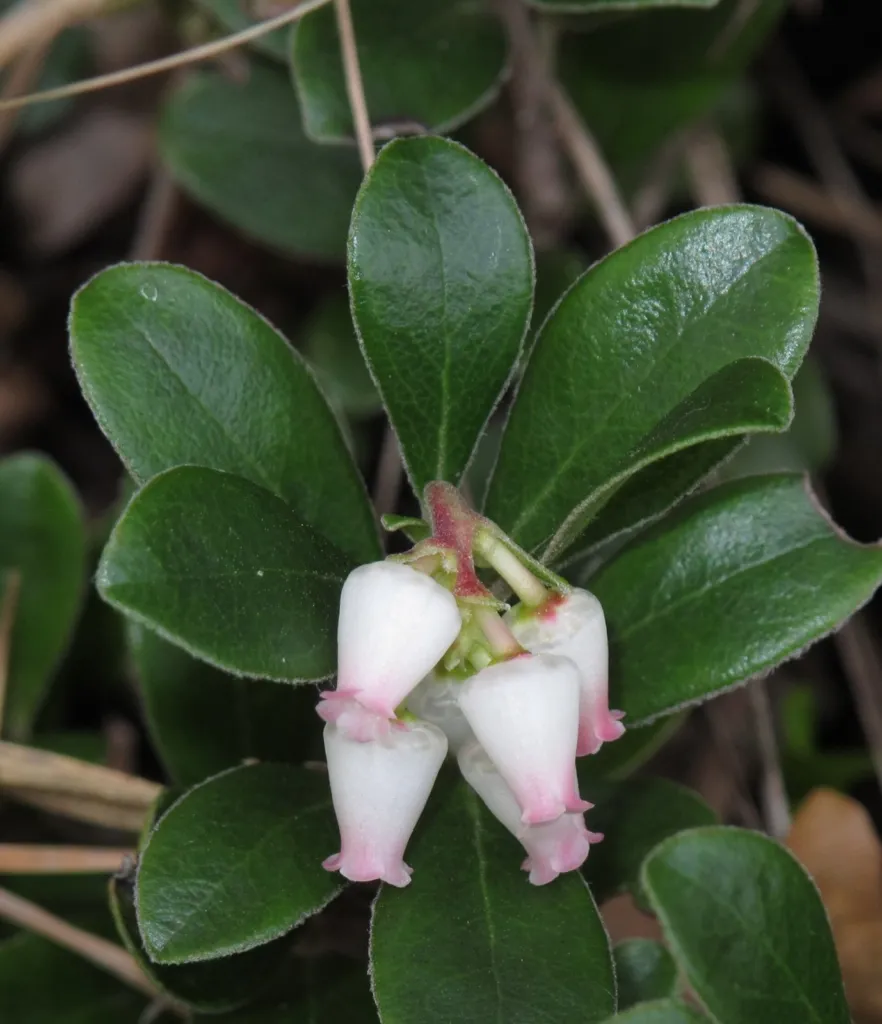
0.3 Contents with extent
| Section | Content | Pages (est.) |
|---|---|---|
| 0 | Free-teaser block: identity card, summary, contents, contributors | 4 |
| 1 | Nomenclature | 3 |
| 2 | Definition | 1 |
| 3 | Source and Australian supply, with 3.1 origin, climate and chemistry | 6 |
| 4 | Macroscopy | 3 |
| 5 | Microscopy | 3 |
| 6 | Chemistry | 5 |
| 7 | Named markers and assay limits | 3 |
| 8 | TLC fingerprint | 2 |
| 9 | HPLC fingerprint | 3 |
| 10 | Identity, purity, adulterants and contaminants | 4 |
| 11 | Traditional use | 3 |
| 12 | Current practice: use, preparations and doses | 3 |
| 13 | Clinical evidence | 6 |
| 14 | Pharmacology | 4 |
| 15 | Safety | 5 |
| 16 | Discussion | 3 |
| 17 | Conclusions | 1 |
| 18 | Research still needed | 2 |
| 19 | References | 4 |
| 20 | Document control | 2 |
| Totals | 22 sections · about 66 pages · 46 figures (19 licensed or public-domain photographs, plates and journal figures, 13 PubChem structure panels, 3 AIP schematics redrawn from published descriptions, 10 AIP charts and replots of published data, 1 captioned placeholder) · 0 AIP photomicrographs · 0 AIP chromatograms · 24 tables · 3 randomised trials graded (2 bearberry-only, 1 combination) · 40 references, every PMID and DOI resolved on 30/09/2026 |
Known gaps in this version, stated plainly.
- F4, the photomicrographs, is a captioned placeholder. AIP holds no vouchered sample. Wikimedia Commons and the Europe PMC open-access literature were searched on 30/09/2026 for a reusable photomicrograph of bearberry leaf and none was found. Section 5 is written from the Ph. Eur. and WHO descriptions, and F5 is a drawing from them, labelled as one.
- No AIP plate or chromatogram. F7 is a zone-order schematic redrawn from the Ph. Eur. test; F8 is a published HPLC chromatogram reproduced under its CC BY licence. Both are somebody else’s work.
- The full report of the REGATTA trial’s results (Gágyor and colleagues, 2021) could not be retrieved by an automated session; the publisher’s site refused it. Its design is taken from the published protocol [27] and its trial-level results from the open-access individual-participant meta-analysis that re-analysed it [28]. The results paper is on the library fetch list.
- Several pharmacokinetic and toxicology papers reach this monograph through the HMPC assessment report [5] (Schindler 2002, Siegers 2003, Quintus 2005, Garcia de Arriba 2013, Chauhan 2007, the 2004 maculopathy case). The text names each and says it is reported through the assessment report; the primaries are on the fetch list.
- Searches not completed: ANZCTR, WHO ICTRP and Cochrane CENTRAL refused automated sessions on 30/09/2026; the TGA Database of Adverse Event Notifications is a report that returns nothing to a script; DAFF BICON import conditions and the CITES checklist were not queried successfully. Two NCBI Bookshelf entries (LiverTox, "Uva Ursi"; an IQWiG report on herbal remedies for recurrent cystitis) were behind a browser check and are not cited. Each of these needs a person with a browser.
- Nobody has tested the Australian market. No survey of arbutin content, hydroquinone content or species identity in Australian bearberry products was found.
0.4 Contributors and paywall notice
Prepared by: Dr Thomas Ridley, Head of Education and Research.
Contributors: listed with the monograph and resolved from the Legal byline roster by the publication pipeline for each department that reviews the draft. Dr Luke Iggulden set the scope of the Pharmacopoeia in the directive of 22/09/2026; he did not write this monograph.
What is free and what is not. Everything above the free-sample line is free to every reader. The remaining sections, macroscopy and microscopy, chemistry and markers, the identity tests, purity and adulterants, tradition, doses, graded evidence, pharmacology, safety and references, are read by Scholar-level members and above under a revocable personal licence. Nothing behind the line contradicts anything in front of it.
The Australian Herbal Pharmacopoeia is the name of a reference series published by the Australian Institute of Pharmacognosy. It is not a statutory standard under the Therapeutic Goods Act 1989 and carries no official, government or national-standard status.
31 more pages follow · 15,259 words, 44 figures, 22 tables
Still to come in this monograph
- 1. Nomenclature
- 2. Definition
- 3. Source and Australian supply
- 4. Macroscopy
- 5. Microscopy
- 6. Chemistry
- 7. Named markers and assay limits
- 8. TLC fingerprint
- 9. HPLC fingerprint
- 10. Identity, purity, adulterants and contaminants
- 11. Traditional use
- 12. Current practice: use, preparations and doses
- 13. Clinical evidence
- 14. Pharmacology
- 15. Safety
- 16. Discussion
- 17. Conclusions
- 18. Research still needed
- 19. References
- 20. Document control
The rest of this monograph is open to members. One membership covers every members’ feature on the site.
Checking your membership…
Report an error or submit evidence
If something in this monograph is wrong, out of date or missing, tell us and show us the evidence. Every report is logged under the AIP Evidence Charter and assessed on the evidence alone; the outcome is kept on the record, and an upheld report is corrected with a dated notice on this page.
Open the report form
The Institute sets and publishes its own monographs. The catalogue is in Publications.