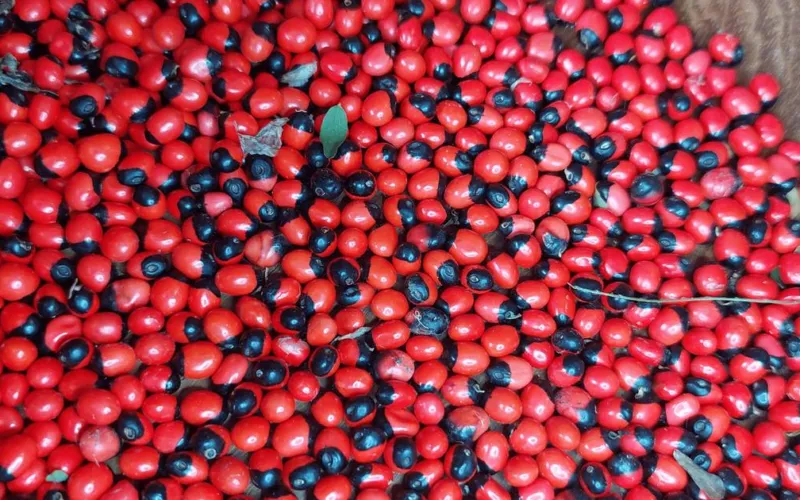

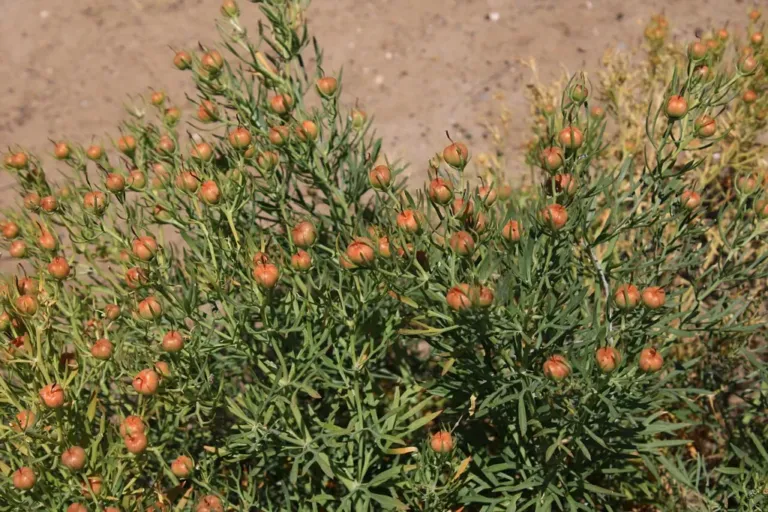
Cover: harmal in fruit, capsules turning orange, Bukhara region, Uzbekistan. Photo: Humoyun Mehridinov · CC BY-SA 4.0 · Wikimedia Commons
The seeds go onto hot charcoal a few at a time and they pop like small fireworks. A grey smoke comes up with a smell nobody forgets, and somebody walks it around a newborn, a bride, a shop doorway, a new car. From Morocco to Xinjiang that smoke is esfand, burnt against the evil eye, and it is a living household practice today. If you have been to a Persian, Turkish or Afghan wedding, you have stood in it.
The seed that makes the smoke has a second life in the medical literature, in case reports of people who died. About a tenth of its dry weight is alkaloid that shuts down an enzyme your body needs to clear certain medicines, which is why it collides with antidepressants, migraine tablets and cold-and-flu remedies. In Australia those alkaloids are prohibited. This is the short version of our full article.
Educational content only, and not medical, legal or regulatory advice. Nothing here recommends obtaining, preparing, handling or using this plant, and we give no doses and no preparation detail. The legal passages are the Institute’s published reading of the rules as they stood in September 2026.
Ring 000 in an emergency. Otherwise ring the Poisons Information Centre on 13 11 26 — 24 hours, anywhere in Australia. Let them triage it: what you are told on that call governs.
The overdose picture in the literature is nausea and vomiting, tremor, unsteadiness, a slow heart, agitation, disturbed vision and hallucination.
The dangerous combinations are everyday ones: SSRI and SNRI antidepressants, other MAOI antidepressants, migraine triptans, tramadol, pethidine, the cough suppressant dextromethorphan, St John’s wort, 5-HTP or tryptophan, linezolid, and the decongestants in cold and flu tablets. Serotonin toxicity from one of those is the realistic path to a death. Pregnancy is an absolute contraindication — fatal poisonings of pregnant women are documented.
- Burnt as esfand against the evil eye from Morocco to Xinjiang. Standing in the smoke and swallowing a seed brew are different events.
- The seed is the loaded part: measured at 5.6% harmaline and 4.3% harmine by dry weight.
- Those alkaloids block MAO-A, an enzyme that clears serotonin and many medicines. That one fact is the whole interaction risk.
- Harmala alkaloids are Schedule 9, prohibited in Australia, bar two narrow trace-amount exemptions. In Queensland harmaline and harmalol are dangerous drugs too.
- As at September 2026 there is no controlled clinical trial of this plant, for any condition.
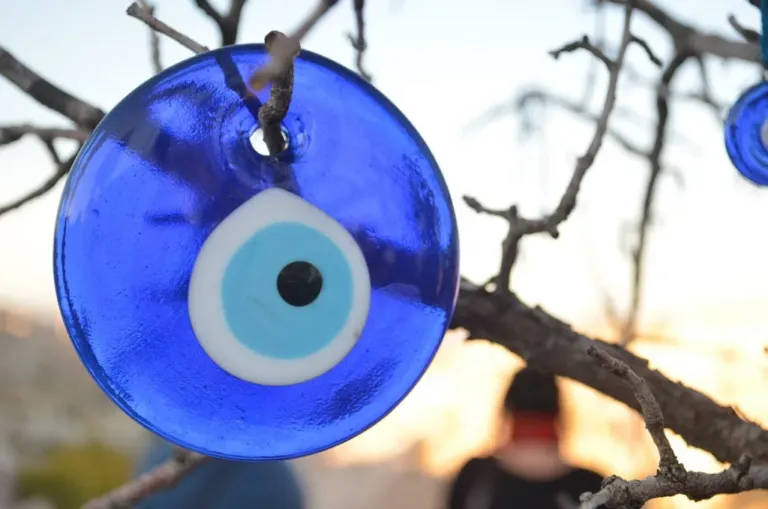
A handful of seed on the coals
Long before harmal was a pharmacology problem it was a smell at the door of a house.
Across Iran, Afghanistan, Central Asia, Turkey, the Kurdish regions and the Maghreb, dried seed capsules are burnt on charcoal and the smoke passed over people, doorways, shops, newborns, brides and new cars, against the evil eye. It is sold on street corners and given at weddings, with a spoken formula over it.
Standing in that smoke and drinking something made from the seed are two different pharmacological events. A brazier is a low-dose exposure dominated by smell and the crackle of the capsules. Writing that treats the incense tradition as proof of traditional dosing is overreading it.
The ritual use and the pharmacological use are not the same event.
One naming trap: “rue” in English usually means Ruta graveolens, an unrelated plant with different chemistry and different toxicity. A source that says rue without a botanical name could mean either.
Nothing here passes judgement on your family’s custom. Hold the smoke and the swallowing apart in your head: they are different events. And if an old herbal tells you to use rue, find out which plant it meant.
The plant, and what a market bundle might be
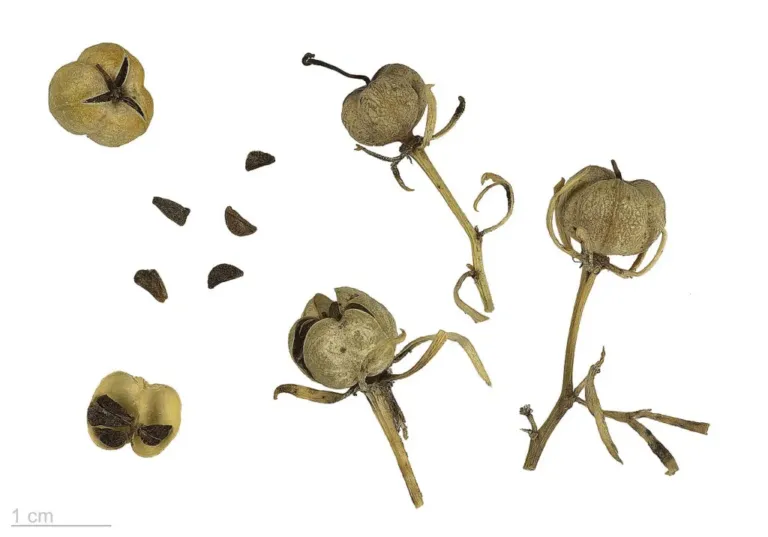
White flowers, a three-chambered capsule, dark angular seed – and after that, a laboratory.
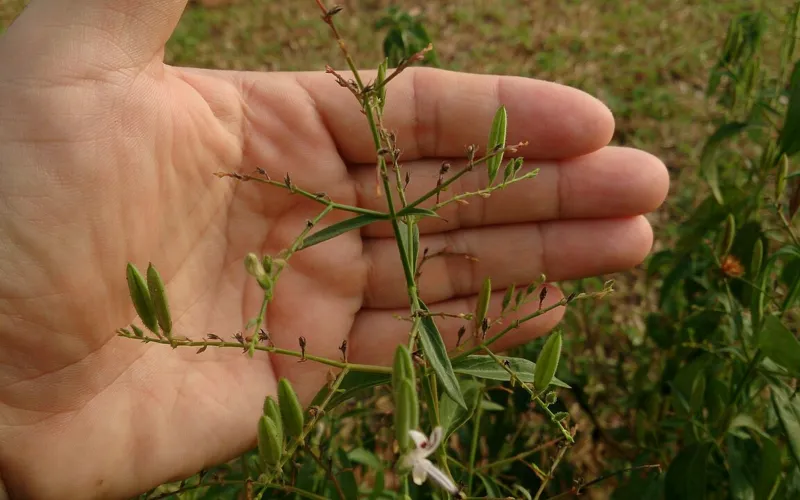
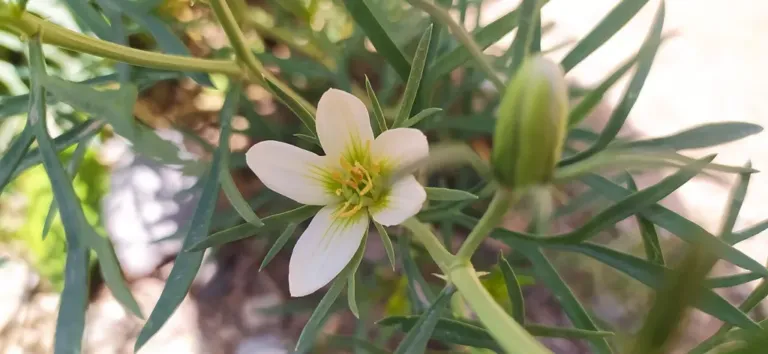
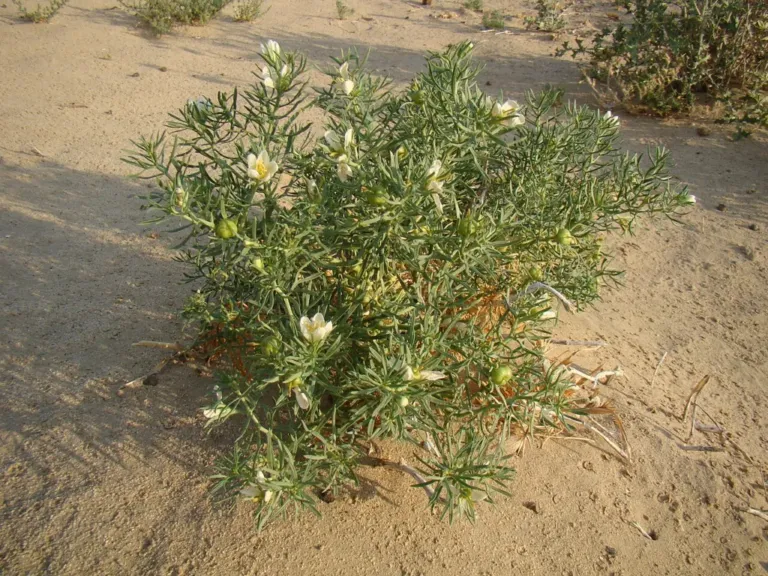
A bushy perennial of dry, salty, knocked-about country, 30 to 80 cm tall, on a woody taproot that can reach several metres — which is why it shrugs off drought and why, as a weed, it is close to impossible to remove. Narrow, deeply cut leaves that smell unpleasant when crushed. Solitary white to cream flowers. A round capsule that splits when ripe, three chambers, packed with small dark angular seed.
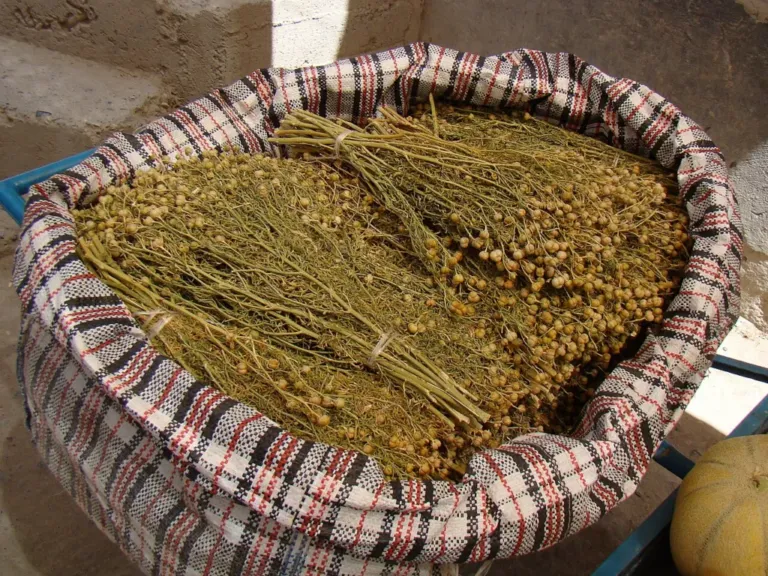
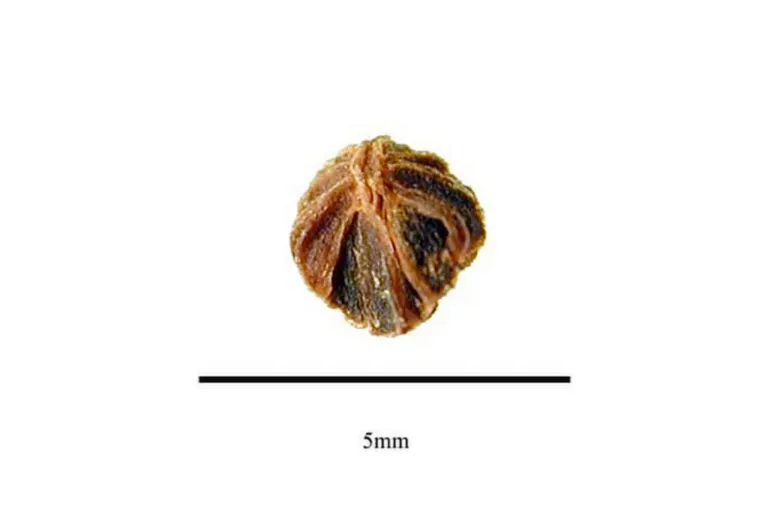
Traded material is where identification gets hard, and our monograph will not invent microscope measurements nobody took. Genuine harmal is capsule-and-seed, the capsules three-chambered and split; the seed 2 to 4 mm, angular, dark brown to blackish, the coat distinctly pitted, the smell acrid on crushing. Never taste-test: this is a toxic plant. Under long-wave UV light an extract of real seed glows blue, which separates it from an inert filler cheaply, though not from other plants in the same chemical family. Identity and strength together take a laboratory assay.
The plant is naturalised in Australia and treated as an agricultural weed, recorded chiefly in South Australia with records from drier parts of Victoria and New South Wales, and it is toxic to livestock. Declared-weed status differs from state to state.
A packet of seed tells you nothing about itself, and neither does the person selling it. Find the plant on dry country and you have a weed and a stock-poisoning problem: do not dig it up, move it or keep it without legal advice and any authority the law requires.
What is actually in the seed
Two chemical families, in different parts of the plant, doing different jobs.
The seed carries the beta-carbolines — harmine, harmaline and their relatives. The best measurement we have puts dry seed at 5.6 per cent harmaline and 4.3 per cent harmine by weight: about a tenth of the seed’s mass is alkaloid that blocks the MAO-A enzyme. Harmaline is the bigger share, and the more vomit-inducing, tremor-producing and acutely toxic of the two.
Leaves, flowers and green fruit carry a different family, the quinazolines. Those are the plausible carriers of the cough and airway effects the plant is known for, and the study that measured them showed they do nothing to MAO at all.
Wild-collected seed varies from batch to batch, so the strength of any sample is unknown until a laboratory measures it. A small pinch of seed is not a small dose.
A small pinch of seed is not a small dose.
You cannot judge the strength of harmal by eye, by smell, or by how much of it sits in a spoon. Neither can whoever sold it to you, without an assay for that batch.
What it does in a body, and how it hurts people
One blocked enzyme, and the collisions that follow.
MAO-A is an enzyme that breaks down serotonin and similar messengers, clearing a long list of drugs on the way through. Harmine and harmaline block it powerfully. The block is reversible — it lifts as the compounds clear — which makes the old aged-cheese problem of prescription MAOI antidepressants smaller here. Smaller is not gone, and reversibility does nothing to soften the drug interactions while the exposure lasts.
Fatal poisonings are documented, including reports of pregnant women who died. The old use of harmal to bring on a period or end a pregnancy is the direct road to that harm, and the leaf-and-fruit alkaloids also act on the womb. Pregnancy is an absolute contraindication. The chemist whose measurements anchor most of this page also recorded the plant turning up in toxic cases more often as home-made ayahuasca substitutes spread. Harmal seed is the commonest stand-in for the South American vine because it is widely traded and far more alkaloid-dense, and its side effects are worse than the vine’s at a comparable dose of the enzyme block. It is no lawful substitute in Australia.
If you take an antidepressant, a migraine triptan, tramadol, St John’s wort or a cold-and-flu decongestant, that is the dangerous combination. If you are pregnant or might be, there is no safe version of this. Anyone unwell after taking harmal: 000, or 13 11 26.
Where Australian law sits
Prohibited nationally, a dangerous drug in Queensland, and amended often enough that you check it yourself.
Harmala alkaloids sit in Schedule 9 of the Poisons Standard — the prohibited shelf — with two narrow exemptions for preparations carrying only trace amounts for therapeutic use. Dry seed has been measured at around a hundred times above that trace level, so on the Institute’s reading, raw seed and any meaningful extract fall outside both exemptions. DMT is separately prohibited.
In Queensland, harmaline, harmalol and DMT are also dangerous drugs under the Drugs Misuse Regulation 1987, and the state’s Drugs Misuse Act defines a dangerous drug to include a listed substance contained in a natural substance, such as seed. Possessing, producing (a word the Act says includes cultivating) or supplying a dangerous drug without authority is a serious criminal offence. Every other state and territory has its own instruments, worded differently.
These rules are amended regularly. This is the Institute’s published reading as it stood in September 2026, and not legal advice: the current Poisons Standard and the current state legislation are the documents that count.
Do not grow it, collect it, move it or hold it without legal advice and whatever authority the law requires. The Schedule 9 listing is national; the dangerous-drug wording here is Queensland’s. Your own state or territory has its own laws, worded differently: read yours.
Does it work as a medicine?
The straight answer, as at September 2026: no controlled clinical trial of this plant exists, for anything.
Going through the literature properly, our monograph found no controlled clinical trial of Peganum harmala, or of any whole-plant preparation of it, for any therapeutic use. The only human trial data on its constituents is work on isolated harmine given with DMT to healthy volunteers under clinical supervision: safety and exposure studies inside psychedelic drug development, and no test of the herb as a treatment. The antidiabetic, antiparasitic, anti-inflammatory and anticancer work is all cells in dishes and animals in laboratories.
The most serious modern work is on harmine, the isolated compound, as a blocker of an enzyme called DYRK1A — currently the leading route to making human insulin-producing cells multiply again. In mice carrying human cells, harmine with a second drug expanded that cell mass, and chemists are deliberately engineering the psychoactive side out of the molecule. None of that is evidence that swallowing seed regenerates anything in a person.
The traditional indications are real as practice, evidence of a custom and not of an effect. Migraine is the clearest case: our monograph could not trace a classical text prescribing harmal for one-sided headache, and marks the claim unsourced.
Anyone offering you harmal for diabetes, cancer, arthritis, depression or migraine is well ahead of the evidence. For any question about a herbal medicine alongside your own medicines, consult a degree-qualified herbalist with competencies and adequate training in pharmacognosy.
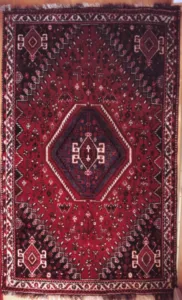
One last thing: the red in an old carpet
A dye, a weaving tradition, and a jar dug up in Egypt.
Harmal seed yields a red-orange to yellow dye, used historically on wool for carpets across Anatolia, Iran and Central Asia, and that use is where the North American name “Turkish rue” comes from. Our monograph could not verify which part of harmal’s chemistry gives the colour, and leaves that open.
Further back still: analytical work on a Ptolemaic Egyptian vase reported residues consistent with harmal, alongside other psychotropic plants. One vessel, one residue study. It shows the plant was in that jar. It does not show what anyone did with it.
If a neighbour lights esfand at a wedding this summer, you will know what is on the coals: a custom older than most countries, and a seed whose chemistry belongs with a laboratory and whatever authority the law requires. Now you know why.
It all comes out of our full monograph: the chemistry organ by organ, the human poisoning reports, the regulatory reading and an evidence grade on every claim. About half an hour to read. The detail has been left behind here; the meaning has not.
Syrian Rue (Peganum harmala): Sacred Smoke, Serious Risks — AIP Monograph No. 2
- Jesse Kirby — wrote this plain-language edition from Monograph No. 2
- Zoe Bennett — named the page, wrote the search description and the lines it goes out on
- Theo Karras — chose and cropped the photographs – the fruiting hero, the nazar bead and the seven section banners
- Leah Bianchi — built the page: the red emergency callout at the top, the cards, and how it reads on a phone
Contributors
- Dr Thomas Ridley — wrote AIP Monograph No. 2, the single source for this page, and checked this edition against it for accuracy and evidence grades (Education and Research review, 21/09/2026)
- Geoffrey Larkin — reviewed the regulatory, safety, referral and image-licensing wording against the monograph for legal and advertising compliance (Legal review, 21/09/2026)
Direction and oversight
- Dr Luke Iggulden — Commissioned the Explainer series, set its direction and approved it
Image credits. All photographs via Wikimedia Commons, reused from the parent monograph and cropped for this page. Licences: CC BY-SA 4.0, CC BY-SA 3.0. Fruiting harmal, Bukhara region — Humoyun Mehridinov, CC BY-SA 4.0. Nazar bead, Cappadocia — Alev Akın, CC BY-SA 4.0. Capsules and loose seed, Muséum de Toulouse — Roger Culos, CC BY-SA 3.0. Market bundles, Kentau, and the flowering bush near Baikonur — Yuriy75, CC BY-SA 3.0. Seed cluster — J.H. Kirkbride Jr, C.R. Gunn & M.J. Dallwitz (2006), public domain. Flower and buds, Akmachit — Mirishkorlik, CC BY-SA 4.0. Cultivated plant, Poznań — Krzysztof Ziarnek, Kenraiz, CC BY-SA 4.0. Qashqai rug — Berndt Fernow, CC BY-SA 3.0.
AIP Explainers are the plain-language editions of the Institute’s technical articles, published alongside the original. Every claim here is carried by the full article, where the references, the evidence grades and the regulatory sources are set out. Regulatory material was read in September 2026 and changes often. Found an error? Write to our contact form — we would rather correct a claim than repeat it.
Jesse Kirby
Head of Community Outreach
Australian Institute of Pharmacognosy
Cardwell QLD, Australia
australian-pharmacognosy.org · our contact form