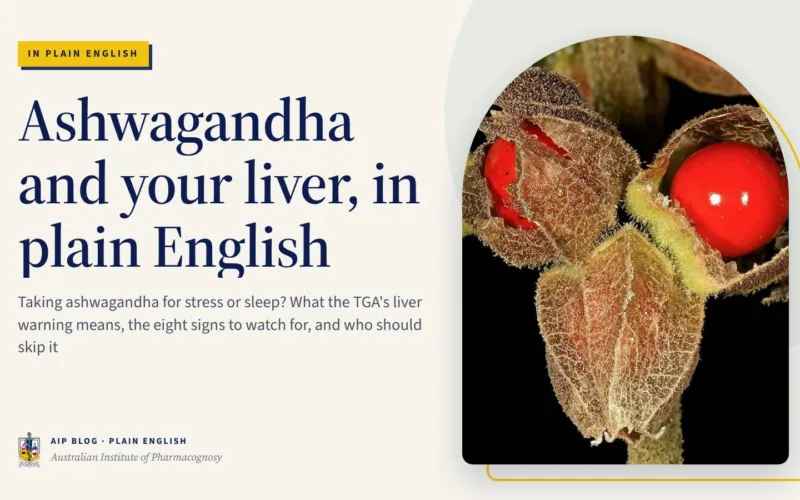

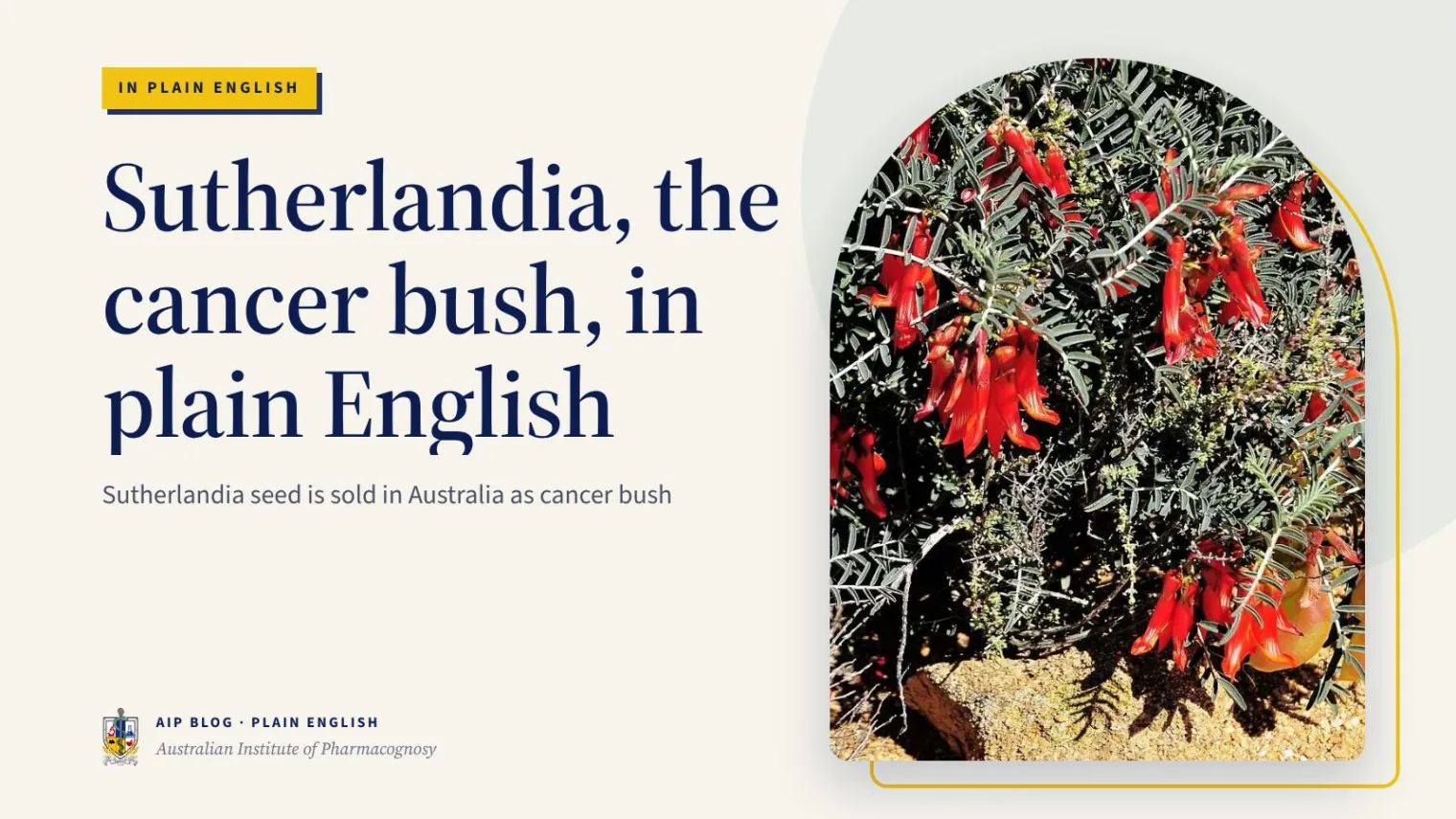
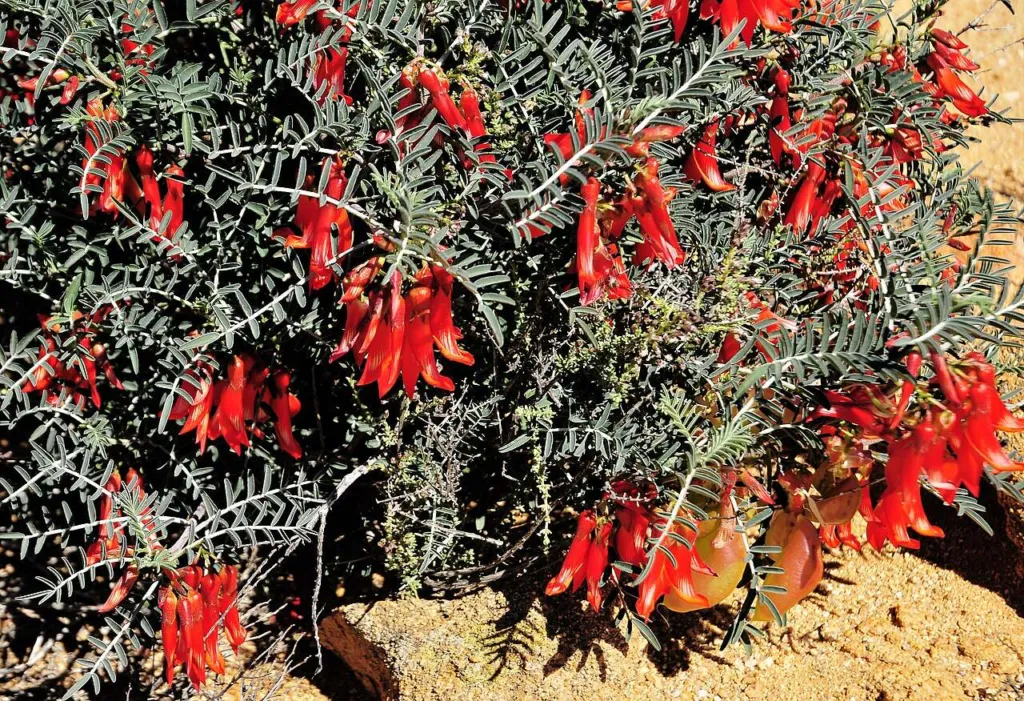
Cover photograph: LBM1948 · CC BY-SA 4.0 · Wikimedia Commons, in flower near Springbok, Northern Cape
A packet of seed turns up in the letterbox, ordered online for the garden, and the label reads “cancer bush”. Sow it and you get a silvery shrub hung with scarlet flowers and papery pods like tiny balloons.
Some hear a warning that it gives you cancer. Others hear a promise that it cures one. Neither holds up. Nobody has ever tested it against cancer in people, and it can upset medicines people depend on, HIV and TB treatment among them.
Educational only: no medical or legal advice, and no preparation or dosing detail. Legal passages are the Institute’s reading of Australian rules at 30/09/2026.
Emergency: phone 000. Suspected poisoning or overdose: the Poisons Information Centre, 13 11 26, 24 hours, Australia-wide.
It is not a cancer treatment. No human evidence says it prevents, treats or slows any cancer. Never use it instead of cancer care, or to put care off.
Do not take it with HIV or tuberculosis medicines, chemotherapy, transplant drugs or warfarin. Do not take it in pregnancy or breastfeeding, with lupus or another autoimmune disease, or with medicine that lowers blood sugar. Never give it to children.
On any regular medicine, get advice first: consult a degree-qualified herbalist with competencies and adequate training in pharmacognosy, and name every medicine you take. Report suspected side effects to the TGA.
- “Cancer bush” is a folk name. It says nothing about the plant giving you cancer, or curing it.
- Never tested against cancer in people, and the lab results are weak.
- Its one fair trial, in HIV, did nothing for what people took it for.
- It may clash with HIV, TB, cancer and transplant medicines and warfarin.
- Garden seed gives you a plant nobody has tested.
A name that records a belief
An old Cape hope, and nothing more.
“Cancer bush” translates the Afrikaans kankerbos. Cape families drank the bitter leaf as a tea against what old writers called “internal cancers”. A recent review dates the name to 1895, though second-hand; we could not find the original, so treat that year as unchecked.
The oldest Cape medical book we could open, printed in 1857, lists the plant for eye disease and nothing else. The cancer story came later. (Botanists now call it Lessertia frutescens; most papers still say Sutherlandia.)
The name neither warns that the plant causes cancer nor shows that it treats one. It records a belief.
Its one fair trial came up empty
Famous in the HIV years, then put to the test.
The plant made its name in South Africa’s HIV epidemic, taken for wasting and low mood before the drugs that hold the virus down were easy to get. Then a hospital in KwaZulu-Natal tested it: adults with early HIV took the leaf or a dummy capsule for six months. It did nothing for the virus in their blood, their immune cell counts or their weight.
Those were the very reasons people were taking it.
One result went the wrong way. Two people on the herb who were also on isoniazid, a tablet that stops TB taking hold, developed TB anyway; nobody on the dummy capsule did. Two people prove nothing about cause, but the risk is not worth taking.
If you live with HIV, or take anything to prevent or treat TB, leave this herb alone.
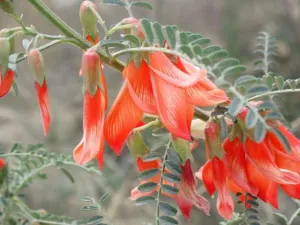
Cancer: nothing in people, shaky in the lab
A result in a dish is a long walk from a cure.
No one has run a controlled study of it in people with cancer. The lab work is weak. Against bowel cancer cells the extract had to be tens of thousands of times stronger than a chemotherapy drug, far past anything reachable in human blood. Against skin cancer cells it hurt healthy skin cells at least as readily.
It may also get in the way of chemotherapy, since in lab tests it slows the body’s systems for clearing drugs. The worst harm is the oldest: months lost on a useless remedy while a treatable cancer grows.
Months lost on a useless remedy while a treatable cancer grows.
If you or someone you love has cancer, never use this in place of care or as a reason to wait. On chemotherapy, targeted drugs or hormone therapy, steer clear.
The risk sits in the medicine cupboard
Few side effects alone in small trials. Beside other tablets, a real worry.
In the trials, healthy adults and people with early HIV took it for months with no more side effects than the dummy group. Only about a hundred people have had it in controlled studies, too few to catch a rare reaction.
Your gut and liver use enzymes and tiny pumps to clear drugs. In a test tube this plant slows many of them. Yet in rats it halved one HIV drug, and in twelve healthy men another fell by about a fifth on average. Either way is bad news for a drug that only works inside a narrow band, which puts warfarin and transplant drugs on our avoid list too, though nobody has tested those pairs.
The leaf also holds canavanine, a chemical twin of a protein building block, suspected of stirring up lupus, where the immune system attacks the body. In the HIV trial a blood marker of it turned positive in five on the herb, one on the dummy, with no illness. Pregnancy, breastfeeding and children were never studied, and in fish embryos it caused bleeding and harmed development.
Before trying it, take a full list of your medicines and supplements to the herbalist named in the red box. Pregnant, breastfeeding, living with lupus, or buying for a child: the answer is no.
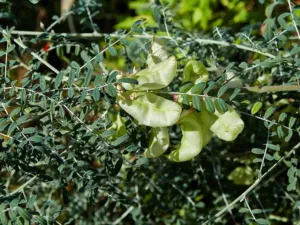
Grow it for the flowers, and leave the tea alone
Seed gives you a plant, with no promise about what is inside.
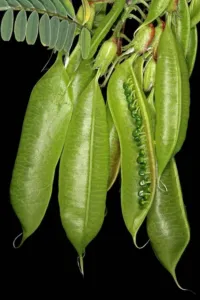
In a garden it is hard to mistake: silvery feathery leaves, long scarlet flowers and papery balloon pods that rattle when dry. Dried and powdered, it is grey-green dust your eyes can’t sort.
No medicine sold in Australia contains it. It has no poisons schedule, which says nothing about safety. You may import a small personal supply within TGA limits, if it clears biosecurity import conditions we could not confirm, so check first; or a practitioner can make it up for you after consulting you. Garden leaves come with no tests and no known strength.
There is no Queensland record of it, and in Cardwell’s wet summers we would expect it to sulk, a guess from the weather. Queensland’s Biosecurity Act does not name it as prohibited or restricted. Elsewhere, ask your state agency before planting.
Drying the leaves for a brew turns a garden shrub into an untested medicine. And if yours flowers happily through a Queensland wet season, we would love to hear about it.
This page is the short version of Dr Thomas Ridley’s evidence review. The trials, the chemistry, the law and every source are in the full article:
- Jesse Kirby — Read the evidence review, made his own notes, then wrote every sentence of this edition with the review closed: chose the five threads, the order and the headings, and kept the safety box at full strength
- Zoe Bennett — Wrote the page title, search description and labels, keeping the word cancer away from anything that could read as a promise when the page is shared
- Theo Karras — Picked the cover shrub and the five section banners from the review’s own licensed photographs, and wrote alt text describing what each one actually shows
- Leah Bianchi — Built the page: the red safety box, the one-minute card, two pull quotes, the five what-this-means cards and the card back to the full review, checked on a phone screen
Contributors
- Dr Thomas Ridley — Wrote the evidence review this page retells, AIP-LR-LESFRU
Research authorised by
- Dr Luke Iggulden, Chief Scientific Officer and lead researcher — Commissioned the Explainer series, set its direction and approved it
Image credits. All photographs of Lessertia frutescens via Wikimedia Commons: cover, LBM1948 (CC BY-SA 4.0); Barrydale, Winfried Bruenken (Amrum) (CC BY-SA 2.5); Bontebok National Park, Bernard DUPONT from FRANCE (CC BY-SA 2.0); Swartberg Pass, Andrawaag (CC BY-SA 4.0); opened pod, SAplants (CC BY-SA 4.0); Stockholm, C T Johansson (CC BY 3.0).
AIP Explainers are the plain-language editions of the Institute’s technical articles, published alongside the original. Everything on this page is carried by the full evidence review, where the trials, the references and the regulatory sources are set out. Regulatory information was read on 30/09/2026 and may change. South African practice is described as overseas material and does not govern Australia. Spotted an error? Write to our contact form. We would rather correct a claim than repeat it.
Jesse Kirby
Head of Community Outreach
Australian Institute of Pharmacognosy
Cardwell QLD, Australia
australian-pharmacognosy.org · our contact form
The Institute sets and publishes its own monographs. The catalogue is in Publications.