

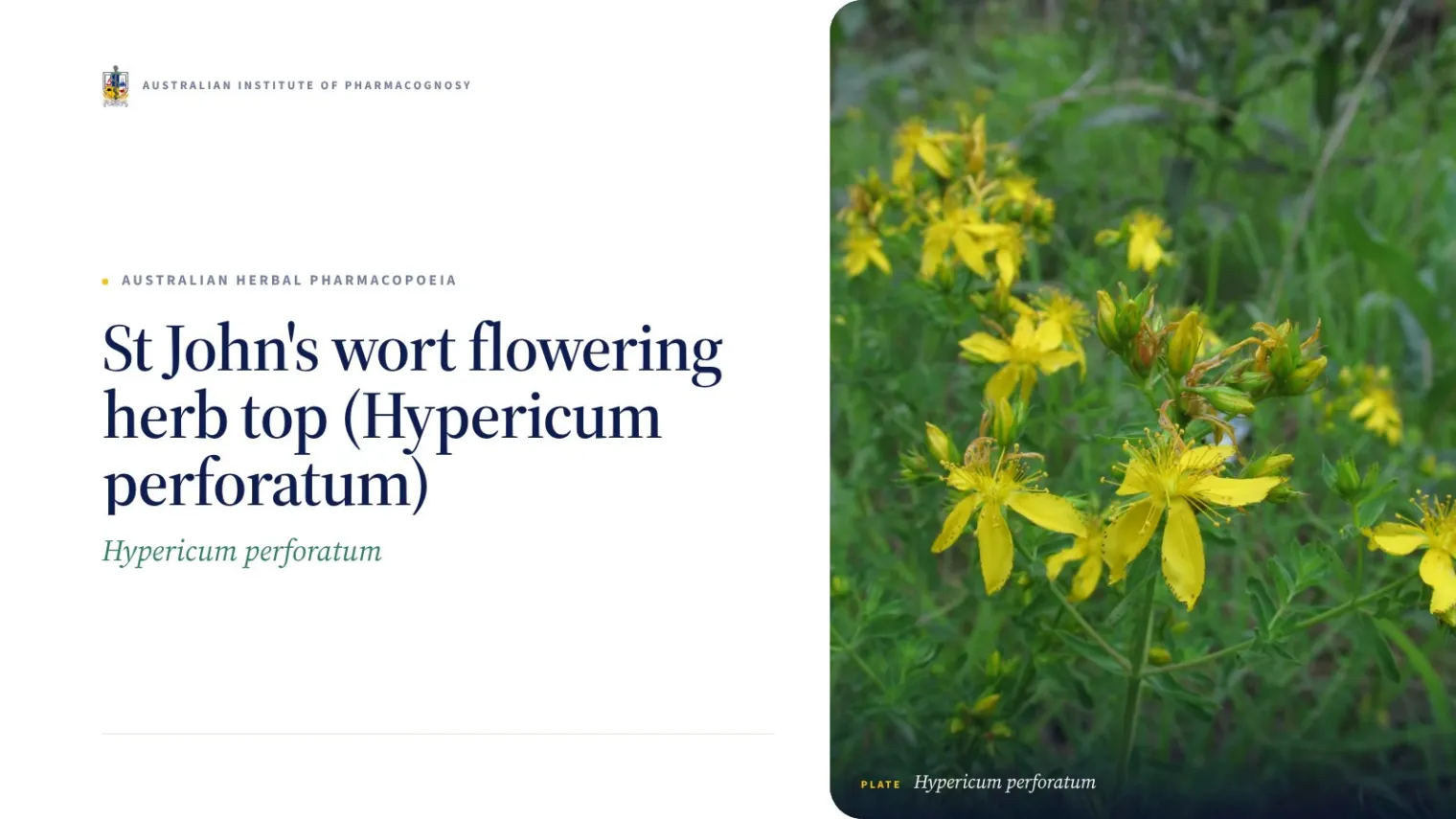
Australian Herbal Pharmacopoeia (working title), Monograph AIP-PH-HYPPER (formerly AIP-HP 012)
Version: 1.0 draft, working document, published while in build
Date: 2026
Prepared by: the Australian Institute of Pharmacognosy, Far North Queensland, Australia. Every author and contributor is named at the end of the monograph.
Series note: The Australian Herbal Pharmacopoeia is the name of AIP’s own monograph series. It is not a statutory standard under the Therapeutic Goods Act 1989 (Cth) and carries no official, government or national-standard status.

0. Free-teaser block
0.1 Identity card
| Monograph number | AIP-PH-HYPPER (formerly AIP-HP 012) |
| Title | St John’s wort flowering herb top (Hypericum perforatum L.), Hyperici herba |
| Version / year | 1.0 draft, 2026. Next review 2029, or sooner on any of the triggers in section 20.5 |
| Accepted binomial | Hypericum perforatum L., Sp. Pl. 2: 785 (1 May 1753). IPNI record 433719-1, checked live September 2026 [1] |
| Family | Hypericaceae (APG IV). Older texts, IPNI’s own family field and the WHO monograph still file it under Clusiaceae (= Guttiferae); the segregate family Hypericaceae is the current placement and the one the Ph. Eur. and the trade use [1,2,3,5,9] |
| Plant part | Whole or fragmented dried flowering tops, harvested during flowering time [3] |
| Latin drug name | Hyperici herba |
| Principal synonyms | Hypericum officinarum Crantz, H. officinale Gaterau, H. vulgare Lam., H. veronense Schrank, H. noeanum Boiss. [5,8], each name confirmed in IPNI with its author and place of publication on 27/09/2026 [1]. Infraspecific taxa in current use include subsp. angustifolium A.Fröhl. (1911), subsp. veronense (Schrank) H.Lindb. (1906), subsp. songaricum (Ledeb. ex Rchb.) N.Robson (2002) and subsp. chinense N.Robson (2002) [1]. Australian names: the TGA ingredient name is HYPERICUM PERFORATUM (Permissible Ingredients Determination (No. 3) 2026, in force from 16/10/2026, item 2674; item 2672 in the repealed No. 2) [11]; MediHerb lists it as St John’s wort, Hypericum perforatum L., Hypericaceae, flowering herb top (A–Z list no. 143) |
| Common names | English: St John’s wort, perforate St John’s wort, common St John’s wort, hardhay, Klamath weed. German: Johanniskraut, Tüpfelhartheu. French: millepertuis (sommité fleurie). Italian: iperico. Spanish: hipérico, corazoncillo. Danish: prikbladet perikon. Russian: zwieroboij. Twenty-two further EU-language names are listed by the EMA [5,6,7] |
| Pharmacopoeial status elsewhere | Ph. Eur.: yes — monograph 1438, St. John’s wort / Hyperici herba (read in the library copy, Ph. Eur. 8.0, pp. 1391–1392) [3]; and monograph 1874, St. John’s wort dry extract, quantified / Hyperici herbae extractum siccum quantificatum (pp. 1393–1394) [4]. BP: yes, by Ph. Eur. adoption [7,8]. USP–NF: yes [7,8]. WHO: yes — Herba Hyperici, WHO monographs vol. 2, pp. 149–171 [5]. EMA/HMPC: yes — EU herbal monograph on Hypericum perforatum L., herba, EMA/HMPC/7695/2021, Final Revision 1, adopted 23/11/2022, carrying both a well-established-use and a traditional-use column [6]. BHP 1996: yes [8]. American Herbal Pharmacopoeia: yes, 1997 [5,8]. Commission E: yes, positive [7]. ESCOP: yes [8] |
| Australian status | Permissible Ingredients Determination: yes — Therapeutic Goods (Permissible Ingredients) Determination (No. 3) 2026 (Cth), F2026L01382, in force from 16/10/2026, Schedule 1 item 2674 HYPERICUM PERFORATUM (item 2672 in the No. 2 Determination of 2026, F2026L00707, which No. 3 repealed, with the same purposes and warning), purposes A (active), E (excipient), H (homoeopathic), carrying a mandatory label warning (code STJOHN) for any medicine for oral ingestion: the label must state that St John’s wort affects the way many prescription medicines work, oral contraceptives included, followed by the prescribed referral sentence. Two congeners are separately permitted: item 2672 Hypericum ascyron and item 2673 Hypericum japonicum (2670 and 2671 in No. 2), both A and H only. Both instruments read in full at Schedule 1 in October 2026, with the register status checked the same day [11]. Poisons Standard: not scheduled — the full text of the Therapeutic Goods (Poisons Standard: June 2026) Instrument 2026 (Cth), F2026L00633, was searched in September 2026 for "hypericum", "St John", "hyperforin" and "naphthodianthrone": no entry in any Schedule or Appendix [12]. ARTG: 87 entries returned for the keyword "hypericum" on 27/09/2026, including MediHerb Nevaton Mood (ARTG 522352, 14/01/2026) [13]. Introduced, not native. Not restricted matter in Queensland — the Biosecurity Regulation 2016 (Qld) full text was searched in September 2026 and returns no entry for Hypericum or St John’s wort [14]; in New South Wales it carries the general biosecurity duty under the Biosecurity Act 2015 and regional asset-protection measures in the Central Tablelands, Central West and other regions [15]. 48,036 Australian occurrence records in the Atlas of Living Australia on 27/09/2026, 92.8 per cent of them in NSW; 438 in Queensland, every one of them in the cool southern highlands [16] |
| Named markers and limits | Total hypericins, expressed as hypericin (CID 3663, C₃₀H₁₆O₈, Mr 504.4): minimum 0.08 per cent, dried drug, by spectrophotometry at 590 nm, specific absorbance taken as 870, Ph. Eur. 1438 assay [3]. For the quantified dry extract, Ph. Eur. 1874: total hypericins 0.10–0.30 per cent; flavonoids expressed as rutin, minimum 6.0 per cent; hyperforin, maximum 6.0 per cent and not more than the labelled content, all on the anhydrous extract [4]. AIP sets no limit of its own: no AIP batch data exists (section 7) |
| Evidence snapshot | Mild to moderate major depression, standardised extract vs placebo: Tier A, 18 placebo-controlled RCTs, n = 2,922, RR 1.53 (95% CI 1.19–1.97), moderate certainty [18]. Vs SSRI or tricyclic in mild to moderate depression: Tier A, 17 RCTs, RR 1.01 (95% CI 0.90–1.14), with fewer adverse events (OR 0.67, 95% CI 0.56–0.81) [18]. Relapse prevention after response: Tier B, 1 continuation RCT (n = 398) and one re-analysis [7,31]. Severe depression: Tier C — no adequate trial. Menopausal psychological symptoms: Tier B [22]. Somatoform disorders: Tier B [7]. Topical oil for wounds and skin: Tier C. OCD, social phobia, IBS, childhood ADHD: Tier C, each a single negative RCT [31]. Antiviral: Tier C, two phase I studies showing no antiviral effect and dose-limiting phototoxicity [7]. Traditional European use for nervous complaints, sciatica and wounds: Tier T [7,9] |
| Suggested citation | Ridley T, Iggulden L. St John’s wort flowering herb top (Hypericum perforatum L.), Hyperici herba. Australian Herbal Pharmacopoeia (working title), monograph AIP-PH-HYPPER, version 1.0 draft. Cardwell: Australian Institute of Pharmacognosy; 2026. DOI to be assigned |
| Provenance | Original AIP data: none. Every analytical figure, limit, method, trial result and occurrence count in this monograph was produced by someone else and is attributed where it appears. Sections 5, 8 and 9 carry the AIP bench data pending flag: AIP has made no photomicrograph, run no TLC plate and run no HPLC of this drug. Figures F5, F7, F9, F9b, F10, F10b, F10c, F11, F12 and F13 are AIP drawings or replots of cited published numbers, and are labelled as such. No figure in this monograph is a generated, AI-made or altered image of a specimen, section, plate or chromatogram |
| Compiler and review | Compiled by Dr Thomas Ridley (Education and Research). Technical review: Dr Fiona MacAllister (Botanical, sections 1-5 and the adulterant part of 10, and figures F1-F5 and F9), reviewed in 2026; Dr Eleanor Whitcombe (Medicine, sections 12, 13, 15, and figures F10, F10b and F10c), reviewed in 2026; Dr Hana Suzuki (QA, sections 6-10, and figures F6, F7, F8 and F13), reviewed in 2026; Dr Thomas Ridley (Education and Research, evidence and citation audit of every reference, the evidence ledger, the figure sources and licences, and sections 11, 13, 14, 16-19, made twelve times in 2026, the last after the twelfth Botanical, eleventh QA and twelfth Medicine reviews and the tenth Community Outreach review), reviewed in 2026, which is a compiler’s audit of his own compilation and not an independent one under Evidence Charter rule 7, so a Librarian read of section 19 is still outstanding. Published: 2026, as a live working document that is refreshed as each review lands. Last modified: 2026. Version 1.0 draft. Visual layout and figure review: Jesse Kirby (Community Outreach, figure placement, captions, source and licence credit lines, and the page design of the printed edition), reviewed in 2026 |
| Canonical URL | /pharmacopoeia/hypericum-perforatum/ |

0.2 Summary
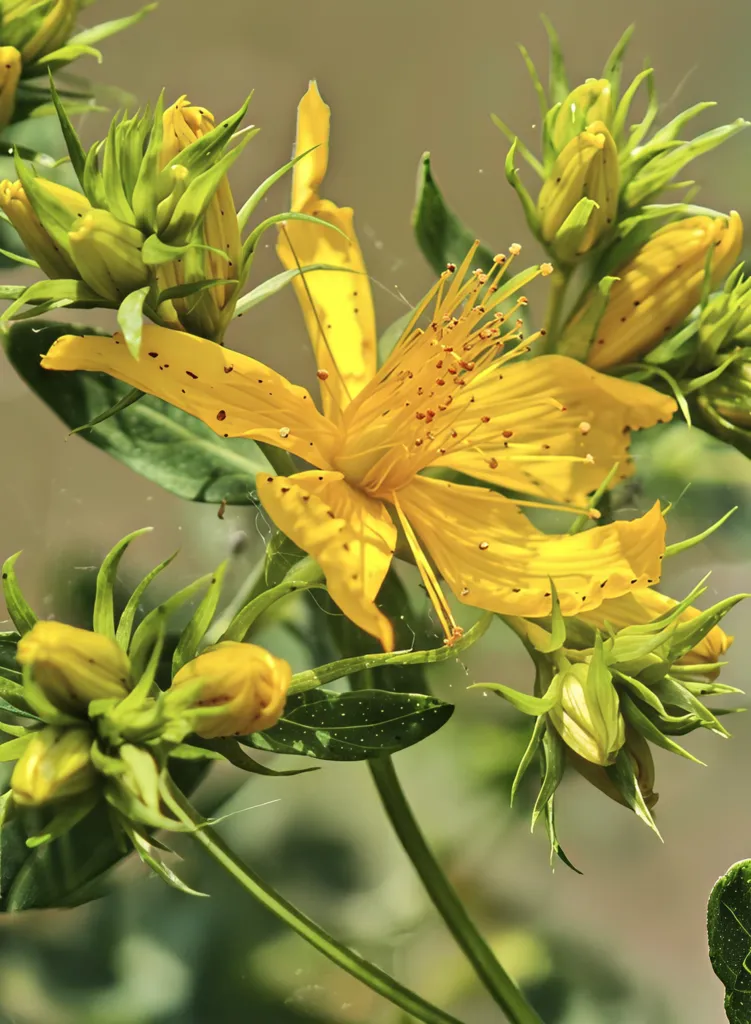
St John’s wort is the dried flowering top of Hypericum perforatum L., a perennial herb of Europe, Asia and North Africa that has naturalised across every temperate continent and is a serious pasture weed in south-eastern Australia. The drug is identified by a round stem bearing two opposite longitudinal ridges, opposite sessile leaves whose translucent secretory cavities look like perforations against the light, and black marginal glands on leaf, sepal and petal; under the microscope by the paracytic stomata, the red-pigmented dark glands and the complete absence of trichomes; and by a thin-layer chromatogram in which two reddish-orange flavonoid zones sit in the lower third and two red naphthodianthrone zones in the upper third. The European Pharmacopoeia assays it as total hypericins at 590 nm with a floor of 0.08 per cent on the dried drug.
Standardised hydroalcoholic and methanolic extracts have better evidence behind them in mild to moderate major depression than any other herbal medicine: 18 placebo-controlled randomised trials in 2,922 patients give a response risk ratio of 1.53, and 17 comparator trials show no difference from standard antidepressants with fewer adverse events. The certainty is moderate, not high, heterogeneity is large, and nothing adequate has been done in severe depression. A 2026 network meta-analysis reached the same conclusion by a different route and warned that the effect sizes it recovered were larger than any credible antidepressant trial produces, and that they tracked study quality downwards.
The main safety question is drug interaction. Hyperforin activates the pregnane X receptor and induces CYP3A4, CYP2B6, CYP2C9, CYP2C19 and P-glycoprotein in proportion to the daily hyperforin dose, and case reports link this to graft rejection in transplant patients and to contraceptive failure. Below about 1 mg of hyperforin a day no clinically relevant interaction has been reported in short-term use; above it, the effect rises with the dose. The daily hyperforin dose is therefore the figure a dispensary needs from a certificate of analysis, whatever the species or the indication. Anyone considering St John’s wort while taking prescribed medicines should consult a degree-qualified herbalist with competencies and adequate training in pharmacognosy.
Free to every reader. The safety section of every monograph is open to everyone, signed in or not. In an emergency call 000. For poisoning, call the Poisons Information Centre on 13 11 26.
15. Safety
15.1 Overall profile
St John’s wort is well tolerated. Its one clinically important safety issue is pharmacokinetic interaction with prescribed medicines (15.4), which is unrelated to toxicity. Adverse events in trials are mild and uncommon; dropout and adverse-effect rates with extracts are similar to placebo, lower than with older antidepressants and slightly lower than with SSRIs across 35 double-blind randomised trials [7]. Across observational studies of 34,804 patients, reported side effects ranged from 0 to 5.9 per cent, most commonly gastrointestinal, then photosensitivity and skin symptoms [7]. Apaydin and colleagues found adverse events comparable to placebo and fewer than with antidepressants, OR 0.67 (95% CI 0.56–0.81), while noting that reporting was poor and the studies were not designed to detect rare events [18].
15.2 Adverse effects
From trials and observational series [5,6,7]: gastrointestinal symptoms (nausea, abdominal pain, diarrhoea), allergic skin reactions, fatigue, restlessness; headache, palpitations; anxiety in a small number of participants (5 of 2,404 in one series, 8 of 3,250 in another); muscle and joint stiffness, tremor, sweating, muscle spasms and pain in one trial; frequent urination in 27 per cent on 900–1500 mg/day for 8 weeks against 11 per cent on placebo. Frequency not known (EMA) [6]. Extracts appear free of the cardiac and anticholinergic effects of standard antidepressants [7].
Photosensitivity. This is the adverse effect the drug is known for, and the honest account is more qualified than the reputation. Pharmacokinetic studies suggest the phototoxic threshold for hypericin is not reached at normal oral antidepressant doses [7]. A prospective randomised study in 72 volunteers of skin types II and III found no significant influence of LI 160 on erythema or melanin index at single doses of 5.4 or 10.8 mg hypericin or at steady state, with the single exception of a marginal effect on UVB-induced pigmentation (p = 0.0471); hypericin serum and skin levels after oral extract were always below the assumed phototoxic threshold of 1000 ng/mL [7]. Peak hypericin in skin blister fluid after 1800 mg, or 900 mg daily for 7 days, was at least 20 times below the estimated phototoxic concentration of 100 µg/mL [7]. Against that: a measurable increase in erythema after UVA was demonstrated in light-sensitive individuals on 600 mg three times daily for 15 days, at plasma hypericin double the usual therapeutic level [5]; EMA records that after 1800 mg/day for 15 days UVA sensitivity increased and the minimum pigmentation dose fell significantly, while at recommended doses no phototoxicity is reported [6]; and case reports exist of reversible photosensitivity, one after four days at 33 mg extract, one in a woman after three years of use, one in a patient undergoing laser treatment, and three after topical cream or oil [7]. Where phototoxicity has been dose-limiting it was at hypericin doses far above the antidepressant range: in phase I studies of purified hypericin at 0.05–0.5 mg/kg/day, 11 of 23 evaluable HIV patients developed severe cutaneous phototoxicity and 16 of 30 discontinued [7].
Veterinary hypericism is real and is not the same thing. Photosensitisation occurs in cattle grazing the plant; intragastric doses of 3 g/kg or more of dried aerial parts produced photosensitisation in 4–6 month calves within 3–4 hours of sun exposure, while 1 g/kg produced no detectable effect [7]. NSW WeedWise records the agricultural picture: weight loss, fewer pregnancies, stillbirths, weak young, reduced milk, and acute signs within five hours on a sunny day without shade; pigmented, woolly or thick-skinned animals are more tolerant; suckling young can be poisoned through the milk; affected stock should be kept in full shade for four to seven days [15]. The usual therapeutic doses in humans are about 30 to 50 times below the dose needed to induce phototoxicity in calves, and there have been no reliable reported cases of hypericism in humans taking oral doses [7].
Other reported reactions [7]: four cases of sensory nerve hypersensitivity with increased heat and cold sensitivity and pain in hands and feet, resolving in one to two weeks, attributed to late-harvested herb high in resinous constituents; one case of subacute toxic neuropathy; one of hyperaesthesia; one of delayed emergence from anaesthesia after three months at up to 3 g/day; one of cardiovascular collapse during anaesthesia after six months’ use; elevated thyroid-stimulating hormone in a criticised retrospective case-control study; reversible mild liver-enzyme elevation in 26 HIV-positive patients on the equivalent of 1 mg/day hypericin for four months, returning to baseline within a month of stopping; one case of hepatotoxicity; one of dynamic ileus; cases of sexual dysfunction and reduced libido, confounded by concurrent sertraline in one; one report of suicidal and homicidal thoughts linked to vitamin C plus extract, recurring on rechallenge by the patient’s own account. Fourteen reported cases of mania, in patients with and without a psychiatric history, some with concurrent products or drugs [7]; three reports of psychosis, in a patient with Alzheimer’s disease, in two with schizophrenia, and one first episode [7]; and a 2017 case report of St John’s wort-induced psychosis [39]. A suspected withdrawal syndrome after stopping 5.4 g/day of herb for 32 days, peaking at day 3 and resolving by day 8, is reported with the author’s own note that the picture is also consistent with a coincidental infection [7].
The Australian adverse-event record. One report to the Adverse Drug Reaction Advisory Committee in Australia attributed dyspnoea, hyperventilation, palpitations, tremor, flushing, mydriasis and rhinitis to Hypericum in a 47-year-old woman, a picture suggestive of an allergic reaction [7].
TGA safety alerts, checked at medicine review in September 2026 and again in October 2026. The TGA has published on this herb twice and both documents are still on the register:
- TGA alert to doctors, pharmacists and complementary health practitioners, published 15/03/2001: St John’s Wort: important interactions between St John’s Wort (Hypericum perforatum) preparations and prescription medicines [45]. It names strong evidence of reduced plasma concentrations of indinavir and cyclosporin; reasonable grounds for concern over warfarin, digoxin, theophylline, the other HIV protease inhibitors (saquinavir, ritonavir, nelfinavir), the non-nucleoside reverse transcriptase inhibitors (efavirenz, nevirapine, delavirdine) and the anticonvulsants phenytoin, carbamazepine and phenobarbitone; possible reduced contraceptive efficacy of oestrogen-containing oral contraceptives; and pharmacodynamic interaction with nefazodone, the SSRIs and the triptans. It makes the point that the content of St John’s wort varies between products and that patients may be taking them without their practitioner’s knowledge.
- TGA information sheet for health care professionals, published 13/03/2000: Interactions of St John’s Wort (Hypericum perforatum) preparations [46], summarising the advice the TGA received from the Adverse Drug Reactions Advisory Committee and the Complementary Medicines Evaluation Committee. It carries the interaction table reproduced in part at 15.4 and adds two points of management that nothing else in this monograph makes as plainly: when a patient stops a St John’s wort preparation, the plasma concentration of the interacting medicine may rise and cause toxicity, so the interacting drug’s dose may need adjusting in both directions; and because marker content varies between products and patients switch between them, the degree of induction changes over time. The sheet also records the classes the TGA considered unlikely to interact: topical medicines with limited systemic absorption, and non-psychotropic medicines cleared principally by the kidney.
Both documents predate the hyperforin dose-response work at 15.4 and neither distinguishes low-hyperforin from high-hyperforin preparations. They remain the Australian regulator’s published position, and a practitioner here should read them alongside, not instead of, the hyperforin figures.
TGA compliance reports on listed St John’s wort products, 2025. Searches of the TGA site in October 2026, October 2026 and October 2026 found no safety alert newer than the two above. The TGA’s register of listed-medicine compliance reports holds three reports on products containing the herb. Two, published in June 2025, are targeted reviews of Cenovis St John’s Wort (ARTG 128698) and Nature’s Own St John’s Wort 2700mg (ARTG 201937), both from Sanofi-Aventis Healthcare Pty Ltd, with outcomes dated 27/03/2025: the ARTG record, labels and website were reviewed, no safety issue was found, no action was taken, and both medicines were permitted to stay in supply [50,51]. The Nature’s Own product was later cancelled from the ARTG at the sponsor’s request, with effect from 16/06/2025 [51]; the notice gives no reason, and nothing on the TGA site connects the cancellation to safety. The third report, on the label warning, is a targeted review of Stress Guard (Pharma Botanica Pty Ltd, ARTG 183814), a valerian and St John’s wort product, with the outcome dated 20/11/2025 [49]. The label of one batch left out the mandatory valerian warning, and its St John’s wort warning neither mentioned oral contraceptives nor carried the referral sentence the STJOHN statement requires (0.1). Supply of that batch had stopped in May 2025, the sponsor corrected the label, and the TGA allowed the medicine to stay on the market. The report names no adverse event. Read together, the three reports show that the TGA checks the STJOHN warning on listed products and expects every batch label to carry the contraceptive wording in full.
The TGA Database of Adverse Event Notifications (DAEN – medicines), searched at medicine review in October 2026 and again in October 2026 [48]. Search term hypericum in the medicines search, which matched 34 products listing Hypericum or Hypericum perforatum as an active ingredient; full date range offered, 01/01/1971 to 23/09/2026, the last date the database then held. Result: 150 reports, 88 of them with a single suspected medicine, and no reported deaths. The most frequent reaction terms were nausea (21 reports, 11 with the St John’s wort product as sole suspect), photosensitivity reaction (13, all 13 sole suspect), serotonin syndrome (12, none sole suspect), diarrhoea (11, 7), and palpitations, abdominal pain and dizziness (10 each). Three reports each name drug interaction, intermenstrual bleeding and an increased prothrombin level, none with the herb as sole suspect. Three things limit what these counts can carry. The 34 products include multi-ingredient tablets and topical and homoeopathic preparations (Traumeel S, Fisiocrem, Brauer Arnicaeze among them), so the total overstates reports for the herb taken orally on its own. A DAEN entry records a suspicion, and the TGA states that inclusion does not mean the event was confirmed or caused by the medicine. And spontaneous reports give no denominator, so they yield no rate. The search was re-run at medicine review in October 2026, when the date range offered ran to October 2026: the same 34 products, 150 reports, 88 with a single suspected medicine, no deaths, and the same leading reaction terms with the same counts as before. Read in that light, the Australian record matches the published profile at 15.2 and 15.4: gastrointestinal upset and photosensitivity where the herb alone is suspected, and serotonergic and induction effects only where another medicine is also present.
15.3 Contraindications
| Contraindication | Basis |
|---|---|
| Hypersensitivity to the active substance, or to plants of the family | EMA, both columns; WHO [5,6] |
| Concomitant use with coumarin-type anticoagulants, cyclosporine, everolimus, sirolimus, tacrolimus for systemic use, fosamprenavir, indinavir and other protease inhibitors, nucleoside reverse transcriptase inhibitors, irinotecan, imatinib and other cytostatic agents metabolised by CYP3A4, CYP2B6, CYP2C9, CYP2C19 or transported by P-glycoprotein | EMA well-established use: contraindicated. EMA traditional use: contraindicated only where the daily hyperforin dose exceeds 1 mg; where it is ≤ 1 mg the only contraindication is hypersensitivity [6] |
| Severe depression with psychotic symptoms, suicidal risk, or symptoms severe enough to prevent family or work function | Mills and Bone: not suited to these; may be a valuable adjunct alongside drug therapy and psychotherapy, with informed consent, but not a substitute [7] |
| Known photosensitivity, or concurrent photosensitising agents | Mills and Bone [7] |
| Children and adolescents under 18 | EMA: not recommended, both columns, oral indications, for want of data. Under 12 for the cutaneous indication [6] |
| Pregnancy and lactation | EMA: use is not recommended; see 15.6 |
15.4 Herb–drug interactions
Mechanism. Hyperforin is a potent activator of the pregnane X receptor (the human steroid X receptor), discovered independently by two teams in 2000 [7]. PXR activation induces CYP3A4, CYP2B6, CYP2C9, CYP2C19 and, through the MDR1 gene, P-glycoprotein [6,7,29]. The result is faster metabolism and reduced intestinal uptake of a very wide range of drugs. Nicolussi and colleagues state it as the settled position: the degree of CYP3A4 induction correlates significantly with the hyperforin content of the preparation [29]. It is verified experimentally that it is hyperforin, and not hypericin, that increases P-glycoprotein expression in vitro [7]. The elevated enzyme activity returns to normal within one week of stopping [6].
The grading. Each interaction below is graded clinical (human clinical reports or trials), PK study (human pharmacokinetic study), or theoretical.
| Drug or class | Effect | Grade | Source |
|---|---|---|---|
| Cyclosporine | Reduced serum concentration; acute rejection in two heart transplant patients, 2000 — the index cases | Clinical | [5,7,29] |
| Tacrolimus, sirolimus, everolimus | Reduced concentration; contraindicated by EMA | Clinical / EMA position | [6] |
| Indinavir and other protease inhibitors; NNRTIs and NRTIs | Substantially reduced plasma concentration; risk of loss of virucidal activity and resistance; WHO records a report on indinavir publicised by the United States Food and Drug Administration (an overseas regulator; the Australian position is the TGA alert, 15.2) | Clinical | [5,6] |
| Oral contraceptives | Reduced plasma concentration of hormonal contraceptives, increased intermenstrual bleeding, reduced contraceptive protection; additional contraceptive measures required. This is the interaction the Australian label warning names | Clinical | [6,11] |
| Warfarin and phenprocoumon | Reduced anticoagulant concentration; contraindicated by EMA | Clinical | [5,6,7] |
| Rivaroxaban | AUC and C(max) reduced by 25 per cent (AUC geometric mean ratio 0.75, 90 % CI 0.68–0.84) after 12 days of an extract (Jarsin) at 300 mg three times daily, with wide variation between people; open-label, one-sequence phase I study in 12 healthy volunteers. The authors conclude the combination should best be avoided | PK study | [52] |
| Apixaban, dabigatran, edoxaban | No study of these with St John’s wort has been read for this monograph, so no effect is stated. Treat every oral anticoagulant as falling under the referral line at 15.8 | Not established | — |
| Digoxin | Reduced serum concentration after 10 days | Clinical / PK study | [5,7] |
| Irinotecan, imatinib, other CYP3A4/2B6/2C9/2C19 or P-gp cytostatics | Reduced exposure; contraindicated by EMA | Clinical | [6,7] |
| Theophylline | Reduced serum level, requiring a dose increase in a stabilised patient | Clinical case | [5] |
| Amitriptyline | Reduced plasma level (pharmacokinetic, not pharmacodynamic); presumed to extend to nortriptyline as its metabolite | Clinical | [7] |
| Alprazolam, midazolam, diazepam, methadone, simvastatin, fexofenadine, finasteride | Reduced plasma concentrations; special care required | PK study | [6,7] |
| SSRIs and other serotonergic agents (sertraline, paroxetine, buspirone) | Possible additive serotonergic effect; serotonin syndrome very rarely reported, with autonomic (sweating, tachycardia, diarrhoea, fever), mental (agitation, disorientation) and motor (tremor, myoclonus) features | Clinical, case reports | [6,7] |
| General and regional anaesthesia | Identify possible interactions before elective surgery; discontinue if necessary. Mills and Bone report a recommendation to stop one week before surgery | Clinical case reports | [6,7] |
| Anticonvulsants: carbamazepine, phenytoin, phenobarbitone | Reduced blood concentration with risk of seizures. The TGA’s management advice is to check the anticonvulsant concentration and stop the herb, then monitor, because the concentration may rise again on stopping and the dose may need adjusting | Clinical / regulator position | [45,46] |
| Triptans: sumatriptan, naratriptan, rizatriptan, zolmitriptan | Increased serotonergic effect with increased chance of adverse reactions | Clinical, pharmacodynamic | [45,46] |
| Stopping the herb, any induced drug | When a St John’s wort preparation is stopped, the plasma concentration of the interacting medicine rises again over about a week and can reach toxicity at the unchanged dose. Stopping the herb is itself a dose-review point | Clinical / regulator position | [6,46] |
| Tyramine-containing foods, L-dopa | No interaction. Avoidance is not necessary. The herb is not an MAOI in vivo | Refuted | [5,7] |
| Alcohol | No interaction with cognitive capability in a randomised double-blind placebo-controlled crossover study of 32 volunteers at 2.7 mg/day total hypericin for 7 days | PK/PD study, negative | [7] |
The dose–response, which is the practical answer. The size of the interaction follows the daily hyperforin dose. The EMA’s herbal committee and ESCOP, the European scientific cooperative on phytotherapy, both draw the boundary at 1 mg a day.
EMA/HMPC and ESCOP separate low-hyperforin preparations (≤ 1 mg hyperforin per day) from high-hyperforin preparations (> 1 mg per day). No clinically relevant pharmacokinetic interaction has been observed for low-hyperforin extracts at dosages giving up to 1 mg of hyperforin per day. [6,29]
The EMA position is read in the EU monograph itself [6]. The ESCOP 2018 position is as Nicolussi and colleagues report it, because AIP does not hold the ESCOP monograph [29]. The EU monograph applies the split in its traditional-use column only. There, its statement that no clinically relevant interactions are reported covers traditional indications 1, 3 and 4 (temporary mental exhaustion, mild gastrointestinal discomfort, nervous restlessness with difficulty falling asleep), at under 1 mg of hyperforin a day, for no longer than two weeks. The well-established-use column covers the extracts for depressive episodes, and it keeps the contraindications at any hyperforin content (15.3) [6]. For a low-hyperforin extract taken for depression over months, the 1 mg figure is evidence that the interaction risk is low. It does not lift the EMA contraindications.
The supporting numbers, each from a separate study and reported by Mills and Bone, are plotted at Figure 10b in the categories the source gives them:
| Daily hyperforin | Finding | Source |
|---|---|---|
| 0.13 mg/day | Midazolam bioavailability reduced by 21 per cent, probably not clinically significant | [7] |
| 2.6 mg/day (0.5 g herb) | No effect on digoxin bioavailability vs placebo | [7] |
| 3.5 mg/day (240 mg extract) | No significant difference in bioavailability of alprazolam, caffeine, tolbutamide or digoxin, in two randomised placebo-controlled studies, 28 volunteers | [7] |
| 5.3 mg/day (1 g herb) | No effect on digoxin bioavailability | [7] |
| 10.6 mg/day (2 g herb) | Significant effect on digoxin, described by the authors as borderline and potentially not clinically relevant | [7] |
| 21.1 mg/day (4 g herb) | Clear effect on digoxin | [7] |
| 41 mg/day | Midazolam bioavailability reduced by 79 per cent | [7] |
| Low-hyperforin preparation | Cyclosporine bioavailability fell 7 per cent, against 52 per cent for a high-hyperforin preparation, in 10 renal transplant patients, same herb dose, only hyperforin differing | [7] |
| Hyperforin-free extract | No significant effect on ethinyloestradiol or 3-keto-desogestrel serum levels, and no intracyclic bleeding, in 16 women on a low-dose oral contraceptive (unpublished study) | [7] |
| Ze 117 | No clinically relevant interaction with CYP1A2, 2B6, 2C9, 2C19, 3A4 or P-glycoprotein in a seven-probe drug cocktail, 20 healthy volunteers, at 500 mg a day (0.96 mg hyperforin) for 10 days. Phase I, open-label, non-randomised, single-sequence, ROBINS-I moderate (13.3.1). Dextromethorphan AUC rose weakly, mean ratio 147.99 per cent (CI 126.32–173.39 per cent; a 90 % interval in the paper’s Table 1, 95 % in its abstract), with the metabolic ratio unchanged, so CYP2D6 was not induced; the authors read the rise as weak CYP2D6 inhibition, which did not reach statistical significance on the metabolic ratio | [29,30] |

The regulatory consequence: Swissmedic was the first authority to approve the removal of contraindications, warnings and pharmacokinetic interactions for a low-hyperforin herbal medicinal product [29]. The EMA traditional-use column already applies the split [6].
Where this leaves a dispensary. Mills and Bone put it in one sentence: "the most sure and obvious way to avoid the metabolic drug interactions with Hypericum is to use the traditional liquid dosage forms", because hyperforin does not survive in them [7]. That is true and it is also an admission, because if hyperforin contributes to the antidepressant effect, a hyperforin-free galenical is a different drug from the one the trials tested. Section 16 takes that argument up.
15.5 Toxicology and overdose
Acute and repeated-dose toxicity: no signs of toxic effects [6]. Genotoxicity: hydroalcoholic extracts at 0.2–0.3 per cent hypericin gave some positive results in the Salmonella/microsome assay, which EMA assigns to quercetin and judges irrelevant to human safety; all in vivo tests: chromosome aberration in Chinese hamster bone marrow at 10 mL/kg, micronucleus in rodent bone marrow at 2 g/kg — were negative [5,6]. Carcinogenicity: not tested; EMA records that tests on carcinogenic potential have not been published [6]. Fertility and reproduction: a 26-week study in rats and dogs at 900 and 2700 mg/kg found no effect on fertility, embryonic development or pre- or postnatal development [5]; EMA nevertheless records that several studies on extracts and isolated compounds report in vitro and in vivo effects that could affect fetal development [6].
Overdose. EMA: after up to 4.5 g dry extract per day for two weeks plus 15 g immediately before presentation, seizures and confusion have been reported; after massive overdose the patient should be protected from sunlight and other UV sources for one to two weeks [6]. Mills and Bone report the corresponding case: convulsions in a 16-year-old girl who took up to 15 × 300 mg tablets a day for two weeks and a further 50 tablets before admission, with diffuse spike-wave activity on EEG that was normal at discharge on day 6 and no further seizures over six months [7]. Phototoxicity is the expected consequence of overdose: rash, pruritus and erythema 24 hours after UV exposure [7].
15.6 Pregnancy, lactation, children and older people
Pregnancy. EMA, both columns: safety in pregnancy has not been established; animal studies have shown signs of reproductive toxicity; use is not recommended; no fertility data available [6]. Mills and Bone assign Australian pregnancy category B1: no increase in malformations or other harmful fetal effects from limited use in women, and no evidence of increased fetal damage in animal studies other than minor adverse effects at high doses in one mouse study of unknown human relevance [7]. In a controlled comparison, 54 pregnant women taking extracts were compared with 108 pregnant women on other antidepressant therapy or unexposed, and major malformation rates were no different from the 3–5 per cent expected in the general population [7]. Avila, Whitten and Evans reviewed the rodent evidence systematically in 2018 [40]; the full text was not obtained for this draft (paper request 72) and no result from it is quoted.
Lactation. Clinical studies support relative safety. Constituents penetrate milk poorly: in one case study only hyperforin was excreted into breast milk and at a low level, with hyperforin and hypericin below the limit of quantification in infant plasma (hypericin 0.20 ng/mL, hyperforin 0.50 ng/mL), across four milk samples over 18 hours, with no side effects in mother or infant [7]. In five mothers on 900 mg/day LI 160, hyperforin was at the lower limit of quantification in two infants’ plasma (0.1 ng/mL), milk-to-plasma ratios 0.04–0.13 and relative infant doses 0.9–2.5 per cent, with no side effects [7]. Against that, one uncontrolled study found a significantly higher frequency of infant side effects — 16.6 per cent, colic, drowsiness, lethargy — in mothers taking the herb against 0 and 3.3 per cent in two control groups, with no difference in reported milk production or infant weight over the first year; the study was not placebo-controlled and self-selection bias is likely [7]. ESCOP’s position is that the herb should not be used in pregnancy or lactation without professional advice [7]. EMA’s is that use is not recommended [6].
Children and adolescents. EMA: use under 18 is not recommended for the oral indications, for want of data; under 12 for the cutaneous indication [6]. Two paediatric trials exist (NCT00100295 in ADHD, n = 59; NCT00782080 in ADHD, n = 155, a St John’s wort/valerian combination). Mills and Bone report three open-label studies in juvenile depression, none with a control arm: 101 children under 12 on LI 160 at 300–1800 mg/day for four to six weeks; 33 children with major depression of at least moderate severity on 450 mg/day, raised to 900 mg/day in 22, of whom 25 met the response criteria at eight weeks; and an eight-week study of 900 mg/day in adolescents with mild major depression (Simeon and colleagues), in which 9 of the 11 who completed improved and 8 others stopped early [7]. Uncontrolled studies carry no efficacy weight, and none of these changes the EMA position.
Older people. No specific restriction. One comparator trial in 149 patients aged 60–80 found LoHyp-57 at 800 mg/day equivalent to fluoxetine 20 mg/day, with HAM-D falling from 16.6 to 7.91 against 17.18 to 8.11 [7]. The relevant caution in this group is polypharmacy, and therefore section 15.4.
15.7 Driving and machinery
No adequate studies (EMA) [6]. Several reviews and trials report no adverse effect on the ability to drive or operate machinery; in one review of three trials the herb was devoid of sedative or anticholinergic effects and did not affect driving ability on the established psychometric procedure used to assess medical fitness to drive; LI 160 at 900 mg/day for four weeks did not impair vigilance or driving ability in 39 depressed patients; and the same extract preserved attention and reaction in mild-to-moderately depressed patients [7].
15.8 The referral line
Anyone taking a prescribed medicine, and in particular an anticoagulant, an immunosuppressant, an antiretroviral, a cytotoxic agent, an antiepileptic, a statin or a hormonal contraceptive, should not start St John’s wort without first having the interaction assessed. Consult a degree-qualified herbalist with competencies and adequate training in pharmacognosy. In Australia the label of any St John’s wort medicine for oral ingestion must carry the warning statement set by item 2674 of the Permissible Ingredients Determination (No. 3) 2026, in force from 16/10/2026 (item 2672 in the repealed No. 2, with the same wording), which states that the herb affects the way many prescription medicines work, oral contraceptives included, and then directs the reader onward in wording fixed by the instrument [11]. That statutory wording is the Commonwealth’s and it is not AIP’s referral wording; it is reproduced in substance here because it is a legal requirement on the label, and it is not adopted as this monograph’s own advice.
66 more pages follow · 32,851 words, 45 figures, 32 tables
Still to come in this monograph
- 1. Nomenclature
- 2. Definition
- 3. Source and Australian supply
- 4. Macroscopy
- 5. Microscopy
- 6. Chemistry
- 7. Named markers and assay limits
- 8. TLC fingerprint
- 9. HPLC fingerprint
- 10. Identity, purity, adulterants and contaminants
- 11. Traditional use
- 12. Current practice: use, preparations and doses
- 13. Clinical evidence
- 14. Pharmacology
- 16. Discussion
- 17. Conclusions
- 18. Research still needed
- 19. References
- 20. Document control
The rest of this monograph is open to members. One membership covers every members’ feature on the site.
Checking your membership…
The Institute sets and publishes its own monographs. The catalogue is in Publications.