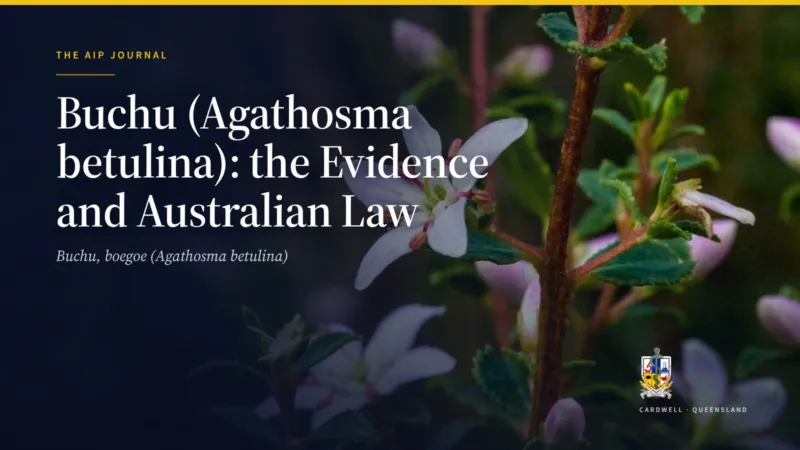


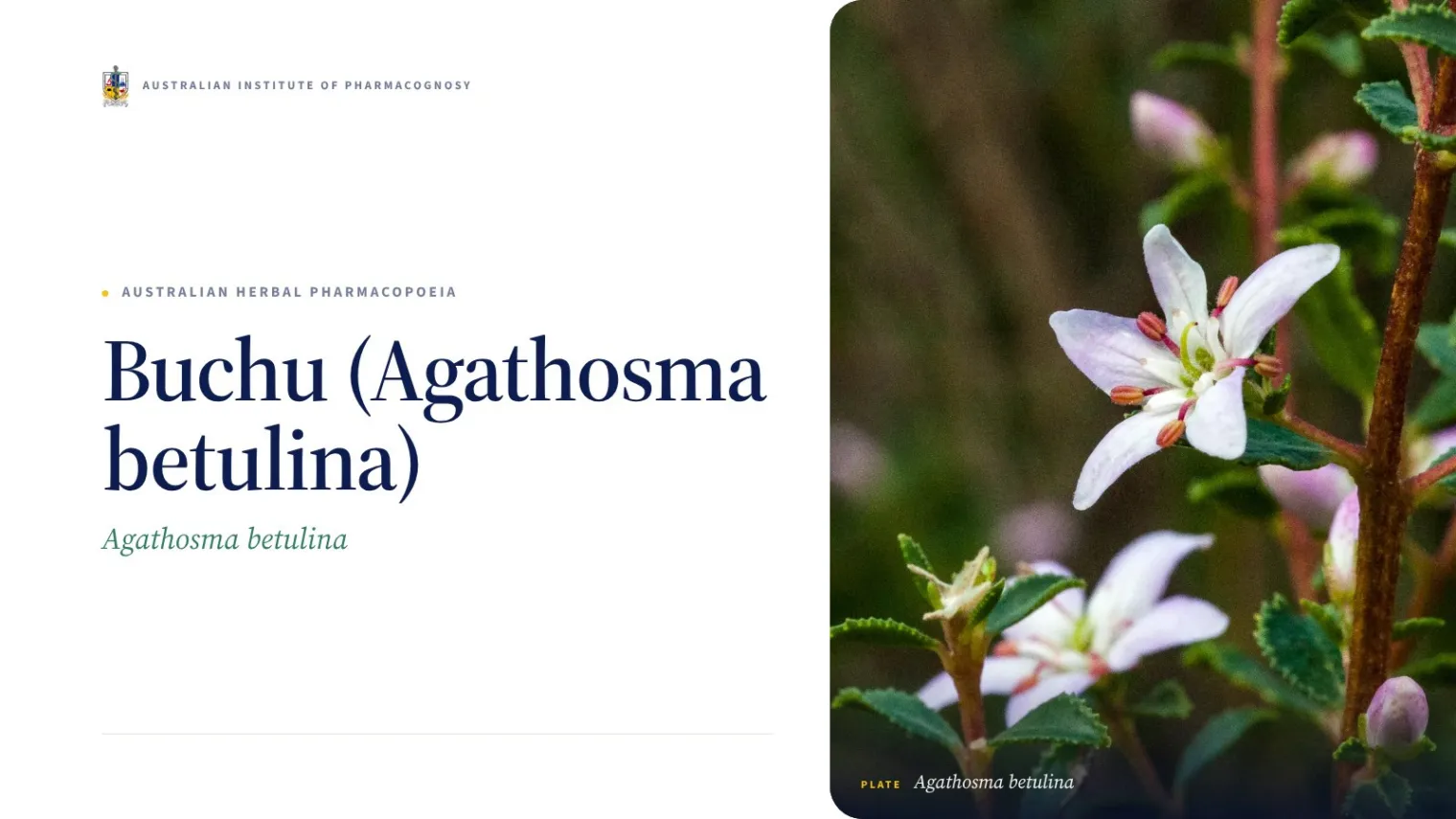
Buchu leaf (Agathosma betulina (P.J.Bergius) Pillans), Rutaceae
Australian Herbal Pharmacopoeia (working title) · Monograph AIP-PH-AGABET (formerly AIP-HP 013) · Version 1.0 draft
Date: 2026
Status: working draft, published while in build. Not a statutory standard.
Prepared by: the Australian Institute of Pharmacognosy, Far North Queensland, Australia. Every author and contributor is named at the end of the monograph.

0. Free-teaser block
0.1 Identity card
| Monograph number | AIP-PH-AGABET (formerly AIP-HP 013) (MediHerb A–Z list No. 23) |
| Title | Buchu leaf (Agathosma betulina (P.J.Bergius) Pillans), Barosmae folium |
| Version / year | 1.0 draft, 2026. Next review 2029, or sooner if the Permissible Ingredients pulegone requirement changes or a controlled trial reports |
| Accepted binomial | Agathosma betulina (P.J.Bergius) Pillans, J. S. African Bot. 16: 75 (1950). Accepted. IPNI urn:lsid:ipni.org:names:770863-1; basionym Hartogia betulina P.J.Bergius. Checked on September 2026 against the Plants of the World Online dataset itself (Kew, POWO Darwin Core Archive version 2026-09-16, DOI 10.48580/d4dz), read through ChecklistBank, and against IPNI [1,2]. POWO records the name as accepted, family Rutaceae, order Sapindales, native range "SW. Cape Prov.". Re-checked on October 2026 against the Kew World Checklist of Vascular Plants 16.0 (DOI 10.48580/d4nz), taxon 2625630: unchanged [1] |
| Family | Rutaceae Juss. (APG IV). Order Sapindales [1,4] |
| Plant part | The dried leaf, collected while the plant is flowering and fruiting. A small proportion of stem, flower and fruit is normal in the commercial drug; an excessive amount is an adulteration [4,5] |
| Latin drug name | Barosmae folium, from the long-superseded genus name Barosma [5,26]. The older pharmacopoeial forms Folia Bucco and Bucco folium appear in the nineteenth- and twentieth-century European compendia [3] |
| Principal synonyms | Homotypic: Barosma betulina (P.J.Bergius) Bartl. & H.L.Wendl., Bucco betulina (P.J.Bergius) Schult., Diosma betulina (P.J.Bergius) Thunb. (nom. illeg.), Hartogia betulina P.J.Bergius (basionym), Parapetalifera betulina (P.J.Bergius) Farw. Heterotypic: Barosma orbicularis Sweet, Diosma crenata G.Lodd. (nom. illeg.) [1]. MediHerb prints Barosma betulina as the botanical synonym; the TGA uses Agathosma betulina [5,9,12] |
| Common names | English: buchu, round buchu, short buchu, round-leaved buchu, bucco [3,4,6]. Afrikaans: boegoe, rondeblaarboegoe [3]. Khoisan and settler-record variants: boegoe, boechoe, boekoe, boggoa, bookoo, bouchou, bugu, buccho, bucco, bucku, buku [3]. German: Bukkostrauch, Buccoblätter; French: buchu; Italian: diosma; Danish: bukko [5] |
| Pharmacopoeial status elsewhere | Ph. Eur.: no — the library copy of the European Pharmacopoeia was searched in September 2026 for "buchu", "Agathosma", "Barosma" and "diosphenol" and returns nothing [28]. BP: no — dropped; buchu was in the British Pharmaceutical Codex 1949 and 1963 and was no longer compendial in the BP by 1992 [3]. USP–NF: no — buchu and its preparations left the USP at USP XI (1930) and the NF at NF XI (1960) [3]. BHP: yes — retained through all three editions from 1971 [3], and Barnes and colleagues list BHP 1996 among the pharmacopoeial monographs for this drug [6]. BHC 1992: yes, listed in the same place [6]. Commission E (Germany): yes, a negative monograph, 1990 [3,5]. EMA/HMPC: no EU herbal monograph. WHO: no. Pharmacopée Française: listed in an addendum, earmarked for omission in 2015 [3]. Homeopathic Pharmacopoeia of the United States: yes [3] |
| Australian status | Poisons Standard: the herb is not scheduled. The full text of the Therapeutic Goods (Poisons Standard—October 2026) Instrument 2026 (F2026L01327, 677 pp., in force from 01/10/2026) was searched in October 2026, as the June 2026 edition was on 27/09/2026, for "Agathosma", "Barosma", "buchu" and "diosphenol": no entry in any Schedule or Appendix. Two of its constituents are scheduled in their own right: d-pulegone, Schedule 6, except in preparations containing 4 per cent or less, with Appendix E first-aid instructions and a child-resistant closure for containers of 200 mL or less; and methyleugenol, Schedule 6, except in preparations containing 1 per cent or less [10]. Permissible Ingredients Determination (No. 3) 2026: four separate entries. Item 423 AGATHOSMA BETULINA — purposes A (active), E (excipient), H (homoeopathic), carries a specific requirement found on very few herbal entries: "Pulegone is a mandatory component of Agathosma betulina. The concentration of pulegone in the medicine must be no more than 4%." Item 977 BUCHU LEAF DRY (A, H); item 978 BUCHU LEAF OIL (E only, flavour or fragrance, flavour ≤ 5 per cent and fragrance ≤ 1 per cent of the medicine); item 979 BUCHU LEAF POWDER (A, E, H) [9]. ARTG: 3 entries on 27/09/2026 for the keyword "agathosma" — MediHerb UriCo Phytosynergist (ARTG 347190, Integria Healthcare Australia Pty Ltd, 04/11/2020), Mediherb Cranberry Complex (ARTG 239333, Integria, 29/05/2015) and MALE UP&GO (ARTG 477152, Natural Nutrition Plus Pty Ltd, 30/01/2025). The keyword "buchu" returns none, so a buyer searching the register by common name will miss all three [11]. Not native to Australia. Not a declared weed in Queensland. Zero occurrence records in the Atlas of Living Australia (searched in September 2026) [39] |
| Named markers | Pulegone, C₁₀H₁₆O, M_r 152.23 (CID 442495 for the (+)-isomer the Poisons Standard names, CID 638012 for the (−)-isomer the older buchu literature reports; section 7), a regulatory marker; nothing here makes it an efficacy marker: mandatory component under Permissible Ingredients item 423, with an upper limit of 4 per cent in the finished medicine [9]. Diosphenol (2-hydroxypiperitone), CID 79023, C₁₀H₁₆O₂, M_r 168.23, the genus-characteristic constituent and the practical identity marker separating A. betulina from A. crenulata; no pharmacopoeial assay limit exists anywhere [3,5,7]. (d,l)-Isomenthone, CID 6432469, and d-limonene, CID 440917, the two phytochemical markers used in the EFSA-assessed trade specification for the essential oil, 19–27 per cent and 19–26 per cent of GC peak area respectively [7]. Diosmin, CID 5281613, and rutin, CID 5280805, non-volatile markers for the leaf and its aqueous and alcoholic extracts [3,8]. AIP has set no limit of its own; see section 7 |
| Evidence snapshot | Urinary antiseptic and diuretic use (cystitis, urethritis, prostatitis, dysuria): Tier T, traditional and Eclectic use only, no completed clinical trial of buchu on its own found. Exercise-induced muscle soreness, topical buchu-oil gel: Tier C, one small unpublished 2002 institutional report of 30 men, known only through two second-hand accounts, never peer reviewed. Metabolic syndrome, blood pressure and glycaemia ("buchu water"): Tier P, rat models only. Antimicrobial, anti-inflammatory, analgesic and antioxidant actions: Tier P each. Khoisan ceremonial, cosmetic and medicinal use: Tier T. Nothing about this drug reaches Tier A or Tier B, and no trial is registered on ANZCTR, ClinicalTrials.gov, the WHO ICTRP or ISRCTN (all searched in September 2026) |
| Suggested citation | Ridley T, Iggulden L. Buchu leaf (Agathosma betulina (P.J.Bergius) Pillans), Barosmae folium. AIP-PH-AGABET, version 1.0 draft. Cardwell: Australian Institute of Pharmacognosy; 2026. DOI to be assigned |
| Provenance | Original AIP data: none. Every analytical figure, limit, method and trial result in this monograph belongs to the source cited beside it. Sections 4, 5, 7, 8, 9 and 10 carry AIP bench data pending: AIP has not vouchered a sample, cut a section, run a plate or run a chromatogram for this drug. Photographs, botanical plates, herbarium sheets and journal figures from outside AIP, among them F4 and F7 (another laboratory’s photomicrographs and HPTLC plate), are reproduced under the licence named in each caption, each licence checked at source in September 2026, October 2026 or October 2026; the PubChem structures are public domain; F3, F5 and F7b are AIP drawings from cited descriptions and methods; F6m, F6n, F6p, F9, F10, F10c to F10k and F10m are AIP charts and plots of published data, GBIF records or this monograph’s own tables. AIP’s own photomicrographs and plate are listed as gaps in 0.3 |
| Compiler and review | Compiled by Dr Thomas Ridley (Education and Research). Technical review: Dr Fiona MacAllister (Botanical, sections 1-5 and the adulterant part of 10) reviewed in 2026, twelve passes; Dr Hana Suzuki (QA, sections 6-10) reviewed in 2026, twelve passes; Dr Eleanor Whitcombe (Medicine, sections 12, 13 and 15) reviewed in 2026, twelve passes; Jesse Kirby (Community Outreach, whole-document layout, the figure set F1-F11 and the free-sample block) reviewed in 2026, twelve passes; Dr Thomas Ridley (Education and Research, evidence and citation audit of sections 1-3, 11, 13, 14 and 16-19, the source check on 6-10, 12 and 15, and the source and licence of every figure) reviewed in 2026, twelve passes. The reference audit is the compiler’s own; the Librarian’s independent audit and the History and Philosophy check of section 11 are still to come, which 20.3 records. Published: not yet. Last modified: 2026. Version 1.0 draft |
| Canonical URL | /pharmacopoeia/agathosma-betulina/ (on publication) |

0.2 Summary
Buchu is the dried leaf of Agathosma betulina, a low shrub of the Cape fynbos that grows wild nowhere else. It was a Khoisan medicine and ceremonial herb long before it was written down, reached London around 1815, and by 1865 Helmbold’s Extract Buchu was the best-selling patent medicine in the United States, its proprietor spending about US$500,000 a year on newspaper advertising in 1869 to 1871. Thirteen countries and territories carried it in their pharmacopoeias and dispensatories, from the Dublin Pharmacopoeia of 1826 on. Then it went out: the USP dropped it in 1930, the National Formulary in 1960, and in 1990 the German Commission E published a negative monograph because there was nothing to support the claims. That verdict has not changed. No completed randomised controlled trial of an oral buchu preparation could be found on 27/09/2026 in PubMed or on ClinicalTrials.gov, and none is registered. What exists is preclinical: a methanol–dichloromethane extract with minimum inhibitory concentrations of 2 to 4 mg/mL against urinary organisms, which is weak; essential oil that is weaker still; aqueous and ethanolic extracts with no measurable effect on Escherichia coli at all. Two quality problems dominate the drug. The first is species: A. crenulata, the oval-leaved buchu, is traded under the same common name and carries up to 50 per cent pulegone in its oil against about 3 per cent in A. betulina, and the two hybridise freely where they are grown together. The second is that A. betulina itself comes in two chemotypes, one rich in diosphenol and one rich in isomenthone, and nothing on a certificate of analysis usually says which. Australian regulation has taken an unusual line here: the Permissible Ingredients Determination makes pulegone a mandatory component of Agathosma betulina and caps it at 4 per cent of the finished medicine, which is the only enforceable buchu specification in the world that AIP has been able to find. Anyone considering buchu should consult a degree-qualified herbalist with competencies and adequate training in pharmacognosy.
Free to every reader. The safety section of every monograph is open to everyone, signed in or not. In an emergency call 000. For poisoning, call the Poisons Information Centre on 13 11 26.
15. Safety
15.1 The shape of the safety question
Buchu leaf has a benign clinical record and a constituent with a well-characterised hepatotoxicity. Those two statements are both true and the tension between them is the whole of this section. Mills and Bone record no reports of poisoning in the published literature and only in vitro toxicology data [5]. Barnes and colleagues record no documented side effects for buchu and note that the oil contains pulegone, a known hepatotoxin [6]. The Australian regulator has resolved the tension by capping the constituent: pulegone must be present and must not exceed 4 per cent of the medicine [9].
15.2 Adverse effects from human use
| Effect | Frequency | Source |
|---|---|---|
| Gastrointestinal irritation and intolerance, particularly on an empty stomach | "Occasional" | Mills and Bone [5]; MediHerb label caution [12]; Spiteri [26] |
| Renal irritation attributed to the volatile oil | Reported as a possibility, not as cases | Barnes and colleagues [6] |
| Poisoning | No reports in the published literature | Mills and Bone [5]; Barnes and colleagues [6] |
| Marked diuresis in a two-year-old (urine osmolality 53 mOsm/kg) after a four-herb tea of buchu, couch grass, marshmallow and plantain, given for a suspected urinary infection; a febrile infection with coliforms two days later | One case report; buchu not separable from the other three herbs | Ding and Perera 2012 [49] |
| Spontaneous reports to the TGA naming a medicine that contains buchu: 21 from 1998 to 2022, a gastrointestinal term in 10, no deaths | Reports only; every product a multi-ingredient formula; causality not assessed | TGA DAEN [50] |
Both of the first two rows come to the same place through different books. Mills and Bone attribute the gastrointestinal effect to the British Herbal Compendium 1992 rather than to observation of their own [5], and Barnes and colleagues attribute the renal and gastrointestinal irritation to the volatile oil rather than to the leaf [6]. Neither is a case series. Apart from the one case below, in which buchu was one of four herbs, the human adverse-effect record for this drug is a handful of sentences passed between reference books.
The one published case. Ding and Perera describe a two-year-old girl on holiday in England from Germany, brought to a paediatric emergency department in Brighton with two days of painful urination [49]. She passed about 400 mL of colourless urine with a specific gravity of 1.000 and an osmolality of 53 mOsm/kg, against normal serum sodium and osmolality, and was described as a "big drinker", which raised the question of diabetes insipidus. Only on the third history did her parents mention a tea of buchu, couch grass, marshmallow and plantain, bought from a London health shop the day before for a suspected urinary infection. The tea was stopped and the leucocytes in her urine were put down to vulvovaginitis. Two days later she came back with fever and worse dysuria; her urine was now positive for leucocytes, nitrites and blood, and she was treated with trimethoprim; the culture of this sample, like that of the first, grew a pure growth of coliforms [49]. The authors read the dilute urine as the herbs acting as a strong diuretic, and note that frequent voiding, made worse here by that diuresis, leaves too little time in the bladder for bacteria to turn nitrate into nitrite, so that a dipstick, already less sensitive under the age of three, can miss the infection [49]. AIP’s reading of causality: buchu cannot be singled out, since four herbs were in the tea and the volume drunk is not reported, and a large volume of any tea dilutes urine. The clinical lesson holds whichever herb was responsible. A herbal "flush" given for a suspected urinary infection in a small child can hide the infection from the first test and delay its treatment.
Tolerability in the one trial of a buchu-containing product. The 16-week Swinburne trial of a multivitamin containing 10 mg of buchu in the men’s tablet reported no significant adverse reactions and minor gastrointestinal symptoms only [48]. At that dose it says nothing about buchu (section 13.2).
No AIP clinic or dispensary adverse-event record for this herb exists.
TGA Database of Adverse Event Notifications (DAEN). The attempts of 27/09, 07/10 and 20/10/2026 got no result set, because the search is a Power BI report embedded in the page. On 26/10/2026 Medicine reached it through the terms-of-use page in a scripted browser and it returned results, with data to 12/10/2026 [50]. "buchu", "diosphenol" and "pulegone" match no medicine. "Agathosma" matches four products in the Swisse Men’s Ultivite range, with 15 reports (12 naming a single suspected medicine); "Barosma" matches the Nature’s Own Fluid Retention Formula and one more Ultivite product, with 6 reports (4 single suspected). A control search for "Hypericum" returned 150 reports, so the filter was working. That is 21 reports from 1998 to 2022, and no deaths (Figure F10n). Every product is a multi-ingredient formula: the Ultivite tablets list 46 to 53 actives each, and the fluid-retention formula six (bearberry, buchu, juniper, parsley, potassium sulfate and pyridoxine). Ten reports carry a gastrointestinal term (nausea, abdominal pain, vomiting, diarrhoea, constipation, flatulence), in line with the occasional gastrointestinal intolerance the texts above record. Two reports need naming. A 1999 report of cholestatic hepatitis with hepatic necrosis in a 22-year-old woman listed eight suspected products, greater celandine and the fluid-retention formula among them, so buchu cannot be singled out. A 1998 report in a 75-year-old woman, with indapamide and the fluid-retention formula both suspected, records low sodium, potassium and chloride; indapamide can do that on its own, and the report bears on the diuretic row in 15.5. A DAEN entry is an unverified report, and the TGA states that inclusion does not mean a medicine caused the event [50]. AIP reads the set as a very-low-certainty signal with no causality assessed, consistent with the record in 15.1. The case listing as read is kept in the evidence record behind this monograph.

TGA safety alerts. The TGA site was queried in September 2026 for "buchu" and "Agathosma". No safety alert, recall action or advisory naming this ingredient was located. Medicine repeated the query in October 2026; the TGA site search answered the automated session with a bot-verification page and its safety-alert listing returned no item naming buchu or Agathosma. Medicine ran both again in October 2026: the site search again served a bot-verification page, and the safety-alert listing for "buchu" showed six recent alerts, none naming buchu, Agathosma or pulegone, although AIP could not confirm that the keyword filter had been applied. The DAEN search in October 2026 was again the embedded Power BI report, with no result set returned to an automated session. On 26/10/2026 the alert listing gave the same six alerts for "buchu" as for a nonsense keyword, so the filter is not applied to a scripted session and the alert search still needs a person at a browser. The query was run from an automated session and AIP does not claim it was exhaustive; what can be said is that nothing turned up, and that no alert appears in any of the four practitioner texts either.
15.3 Toxicology
Cell viability. Moolla and colleagues tested methanol–dichloromethane (1:1) extracts of Agathosma species in the MTT assay; extracts of A. betulina and A. crenulata were not toxic up to 100 µg/mL [3]. The essential oils of both species were another matter: Viljoen and colleagues report IC₅₀ values of < 0.0001 µg/mL [3]. Brendler and Abdel-Tawab add, from Moolla’s 2005 thesis, that buchu essential oils at high doses were hepatotoxic in rats and affected liver and uterine function, attributed to R-(+)-pulegone depleting glutathione and producing centrilobular hepatocellular necrosis [3]. The same authors make a point that matters more in practice than any of the numbers: pulegone is not water soluble, so the caution attaches to the oil and to alcoholic extracts and not to a water infusion [3]. Mills and Bone, working from the same body of work in Graham cells (transformed human kidney epithelium), put it as the extract showing no toxicity at the concentrations tested (IC₅₀ > 100 µg/mL) while "the oil was highly active in disrupting the viability of test cells" [5]. AIP records the < 0.0001 µg/mL figure as published and notes that an IC₅₀ four orders of magnitude below the extract’s is an extraordinary result for a terpene mixture and would benefit from independent replication before it is built on.
Pulegone: the constituent that sets the safety margin. The EFSA FEEDAP Panel’s assessment is the most complete public toxicology on it that AIP holds in full text [7].
| Endpoint | Finding |
|---|---|
| Mechanism | Pulegone is metabolised to menthofuran; the furan epoxide and γ-ketoenal formed by oxidation of the furan ring are the reactive species. Glutathione conjugation neutralises them. Hepatotoxicity depends heavily on hepatic glutathione: depleting glutathione with buthionine sulfoximine increased pulegone hepatotoxicity roughly ten-fold — after an intraperitoneal 150 mg/kg bw dose of pulegone, more than 50 per cent hepatocellular necrosis and ALT of 2,743 ± 1,346 U/L in depleted rats, against more than 6 per cent necrosis and 163 ± 59 U/L in controls [7] |
| Genotoxicity | In vitro studies generally negative, with a few weak positives in the Ames test. IARC regarded pulegone as non-genotoxic in vitro; the EMA’s conclusion, quoted by EFSA, is that pulegone and menthofuran do not possess genotoxic potential, and a slight Comet-assay increase for high-dose menthofuran was attributed to cytotoxicity [7] |
| Carcinogenicity | Reported in full because it bears on long-term use. The US National Toxicology Program tested pulegone by gavage for two years (TR 563, NTP 2011a) at 0, 37.5, 75 or 150 mg/kg bw per day in mice and 0, 18.75 (males only), 37.5, 75 or 150 (females only) mg/kg bw per day in rats [7]. The IARC Working Group, reading that study, found increased hepatocellular adenoma, and adenoma and carcinoma combined, in male and female mice and increased urinary bladder papilloma and carcinoma in female rats, with no treatment-related tumour increase in male rats; it judged the evidence in experimental animals sufficient and the evidence in humans inadequate, and classified pulegone as possibly carcinogenic to humans, Group 2B [47]. EFSA’s summary of the same record says that NTP and IARC found clear evidence of carcinogenicity for "pulegone and its metabolite menthofuran" and that IARC classified both as Group 2B [7]. The IARC volume itself evaluates pulegone and gives no separate evaluation of menthofuran [47], so this monograph attributes the Group 2B classification to pulegone only; menthofuran enters the record as the metabolite through which pulegone’s toxicity is thought to run. The bladder finding deserves attention because the urinary tract is where buchu is used. Against that, the EMA’s weight-of-evidence reading is that cytotoxicity and regenerative proliferation driven by reactive metabolites and glutathione depletion are the probable mechanism, so that the toxicity and carcinogenicity of pulegone have a threshold rather than acting at any dose [7]; IARC likewise linked the liver and bladder tumours to glutathione depletion and chronic regenerative cell proliferation [47]. A threshold mechanism is what makes the margin calculation below meaningful, and it is also why the margin has to be respected rather than assumed. The female-rat bladder tumours sat at the top of the dose range, papilloma or carcinoma in 5 of 47 rats at 150 mg/kg against none of 50 controls, none of 49 at 37.5 and 1 of 50 at 75 mg/kg [7]. In the sexes and species in which tumours were found, the lowest dose tested was 37.5 mg/kg bw per day [7,47], about 160 to 440 times the 0.086 to 0.23 mg/kg a day calculated below for A. betulina at the top of the dose range |
| Subchronic toxicity | US National Toxicology Program TR 563: F344/N rats, 0 to 150 mg/kg bw by gavage 5 days a week for 14 weeks. Adverse effects at 75 and 150 mg/kg — weight reduction, increased liver and kidney weights, hyaline glomerulopathy, bile-duct changes. NOAEL 9.375 mg/kg bw, set on a dose-dependent reduction in red blood cells starting at 18.75 mg/kg [7]. Two earlier 28-day rat studies indicate an NOAEL of 20 mg/kg bw per day [7] |
| Human data | Menthofuran was not detected in a human study after a single dose of up to 70 mg pulegone, suggesting that at non-hepatotoxic doses pulegone is cleared by glucuronidation and glutathione conjugation [7] |
Menthofuran is present in buchu leaf oil in its own right at 0.22 to 0.37 per cent [7]. Methyleugenol, at 0.09 to 0.17 per cent, is the one constituent with experimentally proven genotoxicity and carcinogenicity in rodents; EFSA cites a BMDL₁₀ of 22.2 mg/kg bw per day from hepatocellular carcinoma in male rats [7]. α- and β-thujone are present at 0.003 to 0.010 and 0.015 to 0.038 per cent. The BMDL₁₀ of 8 mg/kg bw per day that EFSA retains is for α-thujone specifically, recalculated from 11 mg/kg bw per day derived from long-term rodent studies using clonic seizures as the response [7]. EFSA applies that same reference point to β-thujone as a worst-case assumption, because β-thujone is much the less neurotoxic of the two, and the calculation below follows EFSA and sums the two isomers against it [7].
Putting those numbers against a herbal dose. At the top of the practitioner range, 6 g of dry leaf a day [5,6], and taking the leaf at 2 per cent essential oil [5], the theoretical maximum oil intake is about 120 mg a day. The pulegone content of the oil is the variable. EFSA’s six commercial batches ran 2.13 to 7.81 per cent with a mean of 5.03, against a trade specification of 1.5 to 8 per cent [7]. At the mean that is roughly 6 mg of pulegone a day, about 0.086 mg/kg for a 70 kg adult, some 110-fold below the 14-week rat NOAEL of 9.375 mg/kg. At the highest batch EFSA measured it is about 9.4 mg a day, 0.13 mg/kg, and the margin falls to about 70-fold. Methyleugenol at the mean 0.12 per cent of the oil would be about 0.14 mg a day, roughly 0.002 mg/kg, some 10,800-fold below the rodent BMDL₁₀ of 22.2 mg/kg; at the top of its range, 0.17 per cent, about 7,600-fold. The thujones together, at their measured maxima, come to about 0.06 mg a day, roughly 0.0008 mg/kg, some 9,700-fold below the thujone BMDL₁₀ of 8 mg/kg [7].
A 70-fold margin on a subchronic rodent NOAEL is not a large one. Standard practice would divide by 10 for species difference and 10 again for human variability before calling a dose acceptable, and 70-fold does not cover that.
And the oil content is a second variable the margin is sensitive to. The 2 per cent figure above is a mid-range one. Barnes and colleagues give buchu leaf volatile oil at 1.0 to 3.5 per cent [6]. Recalculated at 3.5 per cent oil, the same 6 g daily dose carries about 210 mg of oil, which at the mean pulegone content is about 10.6 mg of pulegone a day, 0.15 mg/kg, and the margin falls from 110-fold to about 62-fold; at 3.5 per cent oil and EFSA’s highest-pulegone batch it is about 16 mg a day, 0.23 mg/kg, and 40-fold. So the honest statement of the margin for correctly identified A. betulina at the top of the dose range is a band of roughly 40- to 110-fold, not a single number, and the two things that move it are the oil yield of the batch and the pulegone content of the oil. Neither is on an Australian certificate of analysis today.
Those margins are reassuring and they are also fragile, and the reason is species. Every figure above assumes the drug is A. betulina. Substitute A. crenulata, at the Kaiser figure of 50 per cent pulegone in the oil [3], and the same 6 g daily dose delivers about 60 mg of pulegone a day, about 0.86 mg/kg — still under the rat NOAEL, but only about eleven-fold under it, which the interspecies and interindividual factors above consume entirely. Collins and colleagues put A. crenulata pulegone at 31.6 to 73.2 per cent [3]; at the top of that range the daily intake is about 88 mg, 1.3 mg/kg, seven-fold under a rodent NOAEL, and at that point nothing is left of the hundred-fold that the standard factors ask for. At the 1 to 4 g/day working range section 12.3 settles on, a mistaken A. crenulata at the Kaiser figure still comes to 0.14 to 0.57 mg/kg, 16- to 65-fold under the same NOAEL, so the species question does not go away by dosing low; it only gets less acute. A hybrid, where Mills and Bone say pulegone "varies enormously" [5], is unquantifiable. This is why the identity tests in section 10 are a safety matter as much as a purity one, and it is a fair reading of why the Australian Determination made pulegone a mandatory, capped component [9].

Interindividual variability. Zárybnický and colleagues measured the acute toxicity of R-pulegone and R-menthofuran in precision-cut human liver slices from different donors and found substantial interindividual variability, with associated miRNA expression changes, comparing the effect to paracetamol [17]. The practical point is that a population margin is not an individual margin: a person with depleted glutathione — from fasting, alcohol, paracetamol, or malnutrition — is not the average rat. The buthionine-sulfoximine result gives the size of that effect: around ten-fold [7].
15.4 Contraindications
Mills and Bone list no contraindications "on current evidence" and give their pregnancy and lactation position separately [5]. The table below sets out each text’s position beside AIP’s reading, and says where AIP is more cautious than its sources and why.
| Position | Source and AIP’s reading | |
|---|---|---|
| Pregnancy | Two of the four practitioner texts say no, and a third records the older contraindication. Mills and Bone report that the British Herbal Compendium 1992 "suggests that buchu is contraindicated in pregnancy" [5]. Barnes and colleagues, in their own words rather than at second hand, write that the safety of buchu has not been established and that "in view of this, together with the potential toxicity and irritant action of the volatile oil, the use of buchu during pregnancy and lactation should be avoided" [6]. Spiteri gives pregnancy as a contraindication [26]. Mills and Bone disagree in part: they classify buchu Category B2 — no increase in malformation or other harmful effects from limited use in women, animal studies lacking — and argue that the contraindication "would only be the case for buchu substitutions (such as A. crenulata) that contain much higher levels of pulegone" [5]. MediHerb advises professional supervision in pregnancy [12] | AIP’s position: treat buchu as contraindicated in pregnancy. Mills and Bone’s argument is sound in principle and cannot be acted on in practice, because nothing on an Australian label tells a prescriber which species or chemotype is in the bottle. Two things sit behind the caution and both are sourced. The first is the pulegone itself: Barnes and colleagues cross-refer buchu to pennyroyal for it [6, p. 101], and their pennyroyal entry records that pennyroyal oil, 60 to 90 per cent pulegone, has caused deaths when taken as an abortifacient, with hepatotoxicity and nephrotoxicity, and that the doses needed for an abortifacient effect are themselves toxic [6, pp. 470–471]. The second is that buchu essential oil at high doses in rats affected uterine as well as liver function [3, citing Moolla 2005]. Neither is a reproductive-toxicity study of buchu leaf at a therapeutic dose, and AIP does not present them as one; the pennyroyal cases involved millilitres of neat oil, orders of magnitude more pulegone than any buchu preparation carries. Where the argument for safety depends on an identity that cannot be verified, the conservative position is the correct one. The infusion is the least exposed preparation, because pulegone is not water soluble [3]; the tincture and anything containing the oil are the concern |
| Lactation | Mills and Bone say buchu is "compatible with breastfeeding but caution should be exercised" because the essential oil may pass into breast milk, and that the effects in infants are unknown but "probably benign" [5]; their own precautions line is firmer than that — "best not used during lactation without professional advice" [5]. MediHerb: caution advised in lactation [12]. Barnes and colleagues: avoid in lactation [6]. Spiteri gives no lactation entry [26] | AIP’s position: avoid, or if it is used, use the infusion and not the tincture. The same species uncertainty applies, and the constituent of concern partitions into the oil |
| Liver disease, and heavy alcohol or paracetamol use | None of the four texts addresses liver disease. Nothing found on 27/09/2026 or October 2026 | AIP comment, an inference from the chemistry and not a text’s position: use with caution and at the bottom of the dose range, because pulegone’s detoxication depends on hepatic glutathione and glutathione depletion raised pulegone hepatotoxicity about ten-fold in rats [7]. Recorded as a precaution; no case report links buchu leaf to liver injury |
| Kidney infection | Barnes and colleagues record a statement that buchu should be avoided in kidney infections, and add that "the scientific basis for this is not clear" [6]. Spiteri, by contrast, lists inflammation and infection of the kidneys and urinary tract among buchu’s indications [26] | Recorded as an unexplained traditional caution, not adopted as a contraindication |
| Children | Mills and Bone: no information available, adverse effects not expected [5]. No other text addresses it. One published case: a two-year-old given a four-herb tea containing buchu for a suspected urinary infection developed marked diuresis and then a febrile infection (15.2) [49] | No dose is established for children and none is given here. The reasoning that makes the adult margin acceptable is a milligram-per-kilogram one, and a child’s body weight shrinks it in direct proportion. A young child with urinary symptoms, fever, or unusual thirst or urine output needs same-day medical assessment with a urine culture, and is not a case for a herbal flush — we are not physicians, and this is not a herbal problem |
| Older people | No text addresses buchu in older people. Nothing found on 27/09/2026 | Recorded as a gap. The pulegone margin depends on hepatic glutathione and on renal clearance, both of which fall with age, and on polypharmacy, which rises. Nothing is known; nothing is claimed |
| Acute cystitis that is not settling | MediHerb’s own label: if pain or irritation persists beyond 48 hours, seek help; blood in the urine warrants immediate attention [12] | AIP endorses the clinical substance. Untreated pyelonephritis is the risk. Consult a degree-qualified herbalist with competencies and adequate training in pharmacognosy, and where there is fever, loin pain or haematuria, get emergency care — we are not physicians and this is not a herbal problem |

15.5 Interactions
| Interaction | Grade | Source and comment |
|---|---|---|
| Loop diuretics, thiazides, spironolactone, triamterene | Theoretical; one unassessed spontaneous report | Spiteri lists these as drug interactions for buchu [26]. No published case report, no pharmacokinetic study. One 1998 DAEN report records low sodium and potassium on indapamide with a six-ingredient diuretic formula containing buchu, causality not assessed (15.2) [50]. The mechanism assumed is additive diuresis — and buchu’s diuretic action has never been demonstrated in a human, so the interaction is theoretical on both sides |
| Lithium | Theoretical | Spiteri lists lithium as a caution [26]. The general principle that a diuretic herb can raise lithium levels is sound; there is no buchu-specific data |
| General | No precautions required on current evidence | Mills and Bone [5] |
| CYP2A6 substrates | Theoretical, mechanism-based | Pulegone is metabolised by human CYP2E1, CYP1A2 and CYP2C19 to menthofuran, and menthofuran irreversibly inhibits human CYP2A6, probably by covalent adduction [7]. At the exposures calculated in 15.3 this is unlikely to matter, and AIP records it because it is the only mechanistically plausible pharmacokinetic interaction the chemistry offers. No study has looked |
| Anaesthesia | Manufacturer caution | MediHerb advises discontinuing 7 days before general anaesthesia [12]. AIP could not locate a pharmacological basis for this specific to buchu; it appears to be a general precaution applied across the range |
Barnes and colleagues’ position is the one AIP adopts as the general statement: none documented, but the potential for buchu preparations to interact with concurrent medicines with similar or opposing effects should be considered [6]. One practical addition that is not in any of the texts and follows from the chemistry in 15.3: pulegone’s detoxication runs through glutathione, so anything that depletes it — a paracetamol overdose, heavy alcohol use, prolonged fasting, malnutrition — moves a person off the population margin. That is a reason to keep the dose modest in those situations rather than a reason to avoid the herb.
15.6 Overdose and occupational exposure
No reports of poisoning appear in the published literature [5,6]. The excess-dose caution in every text — Barnes: "excessive doses of buchu should not be taken in view of the potential toxicity of the volatile oil" [6] — is a precaution from constituent chemistry, not from cases.
The essential oil is a different material from the leaf and should be handled as one. EFSA concluded that buchu leaf oil "should be considered as irritant to skin and eyes, and as a skin and respiratory sensitiser", and added that when the oil is handled, exposure of unprotected users to methyleugenol cannot be excluded and should be minimised [7]. Anyone handling the neat oil in a dispensary should use gloves and eye protection and work with ventilation. In Australia the neat oil carries no schedule of its own. A preparation containing more than 4 per cent d-pulegone is a Schedule 6 poison, with Appendix E first-aid requirements and, for containers of 200 mL or less, a child-resistant closure [10]. A neat buchu oil at 2 to 8 per cent pulegone straddles that line, and a dispensary holding it should know which side of it their bottle sits on.
15.7 Australian regulatory safety position, summarised
Read against the instruments in force on 20/10/2026, the Poisons Standard October 2026 (F2026L01327, registered 30/09/2026, in force from 01/10/2026) and the Therapeutic Goods (Permissible Ingredients) Determination (No. 3) 2026 (F2026L01382, registered 13/10/2026, in force from 16/10/2026). They replaced the June 2026 Poisons Standard and the No. 2 Determination, which refs 9 and 10 also record. Every requirement below is worded as it was in the earlier editions; only some item numbers moved, and buchu leaf oil is now item 978.
- The herb is not scheduled [10].
- It is permitted as an active, excipient and homoeopathic ingredient in listed medicines, with the pulegone requirement at item 423 [9].
- Buchu leaf oil is permitted only as an excipient, as a flavour or fragrance, with the flavour at not more than 5 per cent and the fragrance at not more than 1 per cent of the medicine [9]. Australia does not permit buchu oil as an active in a listed medicine.
- d-Pulegone above 4 per cent, and methyleugenol above 1 per cent, are Schedule 6 [10].
That is a coherent regulatory position and, so far as AIP can tell, a stricter and better-targeted one than any other country’s. It is worth saying plainly because it runs against the usual assumption that Australian herbal regulation is looser than Europe’s: on this drug, it is not.
82 more pages follow · 40,834 words, 54 figures, 34 tables
Still to come in this monograph
- 1. Nomenclature
- 2. Definition
- 3. Source and Australian supply
- 3.1 Where it must be grown: origin, climate and chemistry
- 4. Macroscopy
- 5. Microscopy
- 6. Chemistry
- 7. Named markers and assay limits
- 8. TLC fingerprint
- 9. HPLC fingerprint
- 10. Identity, purity, adulterants and contaminants
- 11. Traditional use
- 12. Current practice: use, preparations and doses
- 13. Clinical evidence
- 14. Pharmacology
- 16. Discussion
- 17. Conclusions
- 18. Research still needed
- 19. References
- 20. Document control
The rest of this monograph is open to members. One membership covers every members’ feature on the site.
Checking your membership…
The Institute sets and publishes its own monographs. The catalogue is in Publications.