
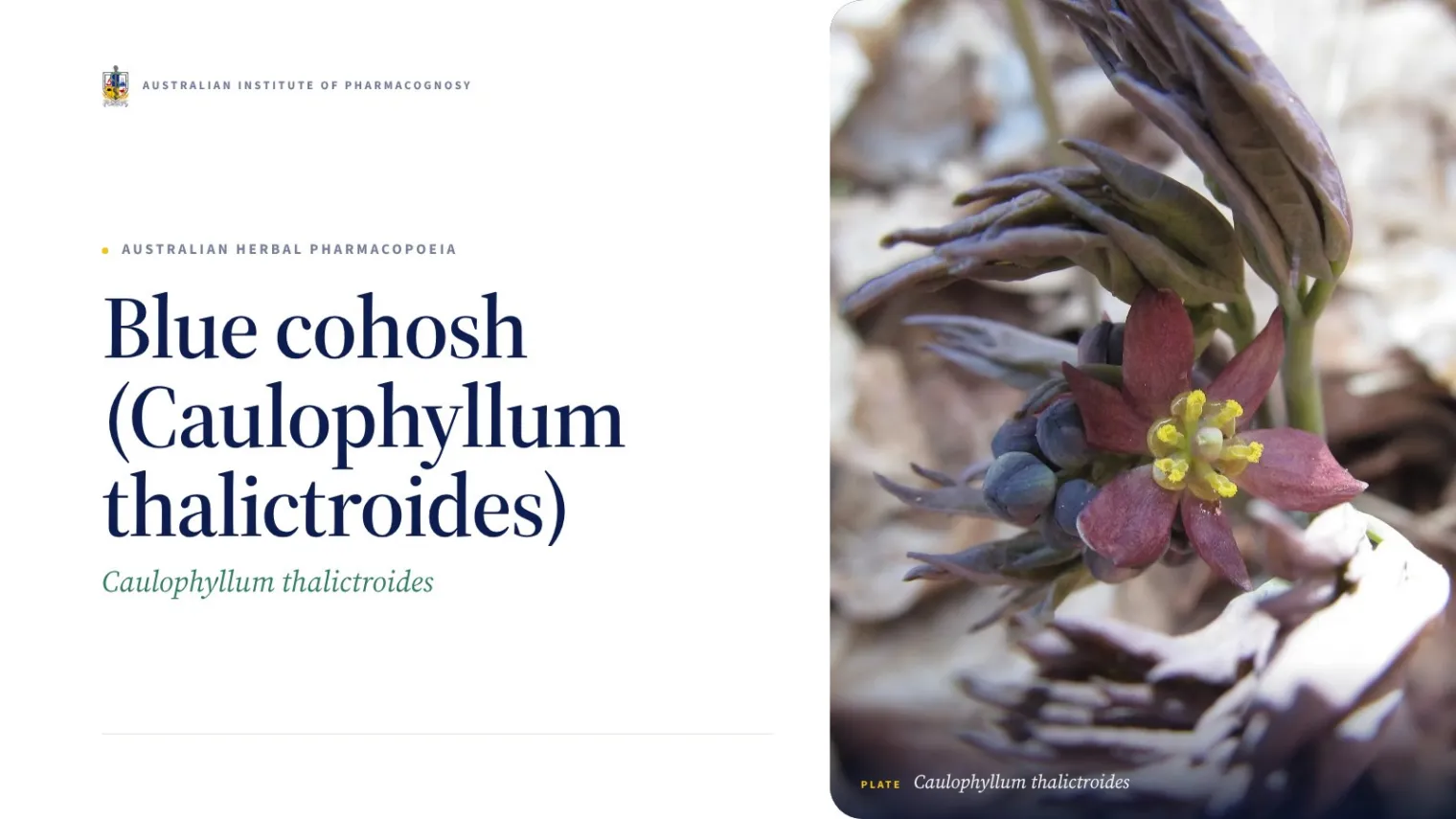
Blue cohosh root and rhizome (Caulophyllum thalictroides (L.) Michx.), Berberidaceae
Australian Herbal Pharmacopoeia (working title) · Monograph AIP-PH-CAUTHA · Version 1.0 draft
Date: 2026
Status: working document, version 1.0. Not a statutory standard.
Prepared by: Dr Thomas Ridley, Head of Education and Research, Australian Institute of Pharmacognosy, Cardwell, Queensland.
0. Free-teaser block
0.1 Identity card
| Register number | AIP-PH-CAUTHA (MediHerb A–Z list No. 20) |
| Title | Blue cohosh root (Caulophyllum thalictroides (L.) Michx.), Caulophylli rhizoma et radix |
| Version / year | 1.0 draft, 2026. Next review 2029, or sooner when the 27 primary papers now being obtained in full text have been read, or if a human study reports |
| Accepted binomial | Caulophyllum thalictroides (L.) Michx., Flora Boreali-Americana 1: 205 (1803). Basionym Leontice thalictroides L., Species Plantarum: 312 (1753). Accepted in the World Checklist of Vascular Plants (WCVP) version 16.0 of 04/06/2026, the dataset Plants of the World Online displays, read through ChecklistBank on 30/09/2026; IPNI 1056122-2 [1] |
| Family | Berberidaceae, order Ranunculales, as placed in APG IV, which WCVP follows for flowering-plant families [1,54]; subfamily Nandinoideae, tribe Leonticeae [34,55]. No family change affects the genus |
| Plant part | Dried rhizome and roots [9,10,11]; sold in the Australian practitioner trade as "root" [13] |
| Latin drug name | Caulophylli rhizoma et radix (AIP form). The US National Formulary IV (1916) called the drug "Caulophyllum", the dried rhizome and roots [11] |
| Principal synonyms | Leontice thalictroides L. (basionym); Leontice thalictrifolium Salisb. (illegitimate, superfluous name) [1]. Not synonyms: C. giganteum (Farw.) H.Loconte & W.H.Blackw. and C. robustum Maxim. are accepted as separate species by WCVP [1] |
| Common names | English: blue cohosh, squaw root, papoose root, false cohosh, blueberry (old regional name) [9,14]; blue ginseng, yellow ginseng [17]. French (Québec): caulophylle faux-pigamon [35]. The Asian sister species C. robustum is hong mao qi in Chinese [22] |
| Pharmacopoeial status elsewhere | US Pharmacopeia 1882–1905 (as reported) [22,32]; the USDA’s 1907 bulletin names the 1890 edition [57]. US National Formulary IV (1916): yes, "Caulophyllum", with macroscopy, powder microscopy and ash not more than 6 per cent, quoted in the US Dispensatory 1918 [11]. British Herbal Pharmacopoeia 1983: listed (as reported by Barnes; the BHP text itself is not among the sources read) [14]. Ph. Eur.: no monograph in the 8th edition read [39]. BP, WHO, EMA/HMPC, ChP, API: no monograph found in the sources searched |
| Australian status | Permissible Ingredients Determination: yes, item 1247 CAULOPHYLLUM THALICTROIDES, purposes A (active), E (excipient) and H (homoeopathic), no specific requirements [2]. Poisons Standard: blue cohosh is not named; two minor constituent alkaloids are, as substances: cytisine (Schedules 3 and 4) and sparteine (Schedule 4) (section 10) [3]. ARTG: a product-name search found no product called blue cohosh or Caulophyllum [51]. Not recorded growing in Australia: the 50 Caulophyllum specimens in Australian and New Zealand herbaria were all collected overseas [4]. Not native, so no Nature Conservation Act 1992 (Qld) permit applies; not a prohibited or restricted invasive plant under the Biosecurity Act 2014 (Qld) [5] |
| Named markers | Magnoflorine (CID 73337): identity, assay proposed; no limit. N-Methylcytisine (CID 670971): safety marker; no limit exists anywhere. Caulosides C and D, and hederagenin after hydrolysis (CIDs 13878151, 21630094, 73299): identity; no limit. Total ash: not more than 6 per cent (NF IV) [11] |
| Evidence snapshot | Dysmenorrhoea: Tier T, 0 trials. Amenorrhoea and irregular menstruation: Tier T, 0 trials. Preparing for or inducing labour: Tier T, 0 trials, and contraindicated (section 15). Rheumatic pain: Tier T, 0 trials. Anti-inflammatory: Tier P, cell and mouse studies of the saponins. Toxicity signals (teratogenic alkaloid, mitochondrial damage by saponins, neonatal case reports): preclinical and case-report evidence, graded in section 15 [13,15,22–24] |
| Suggested citation | Ridley T. Blue cohosh root (Caulophyllum thalictroides (L.) Michx.), Caulophylli rhizoma et radix. AIP-PH-CAUTHA, version 1.0 draft. Cardwell: Australian Institute of Pharmacognosy; 2026. DOI to be assigned |
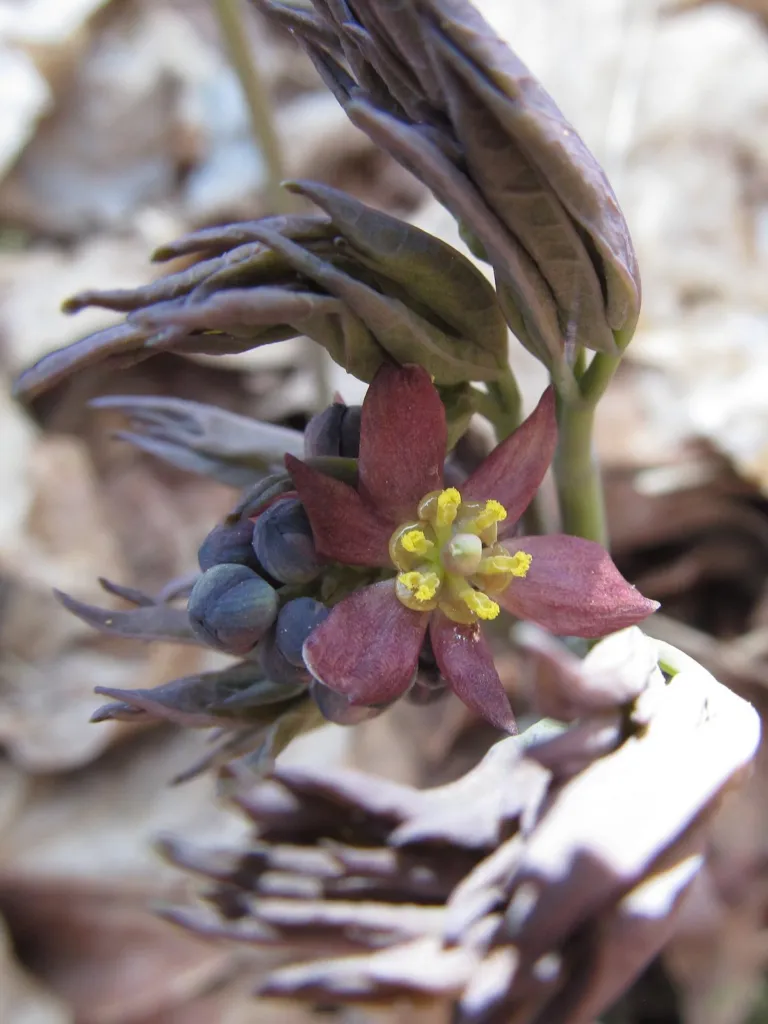
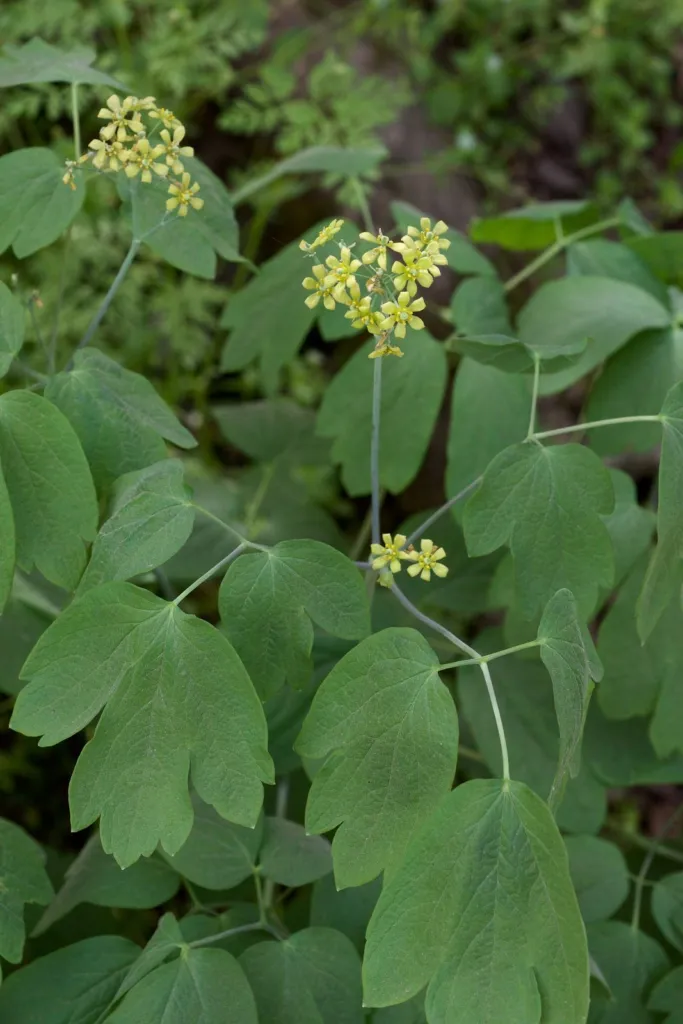
| Provenance | Original AIP data: none. Every analytical figure, limit, method and dose belongs to the source cited beside it. Every photograph of the living plant or fresh rhizome is a licensed photograph, named by its photographer, and its identification is provisional. Sections 4, 5, 7, 8, 9 and 10 carry AIP bench data pending (no AIP voucher, section, plate or run yet). The map (Figure 9), charts (Figures 10–15) and drawings (Figures 3c, 5, 6, 6b) are AIP drawings from cited data |
| Compiler and review | Compiled by Dr Thomas Ridley (Education and Research). Technical review: Dr Fiona MacAllister (Botanical, sections 1-5 and the adulterant species of 10), reviewed in 2026; Dr Hana Suzuki (QA, sections 6-10), reviewed in 2026; Dr Eleanor Whitcombe (Medicine, sections 12, 13, 15), reviewed in 2026. Layout and figures (Figures 1–15, captions, credit lines and page design): Jesse Kirby (Community Outreach), reviewed in 2026. Evidence and citation audit (every reference, the sources of sections 6–9, 12 and 15, and the conclusions against section 13): Dr Thomas Ridley (Education and Research), reviewed in 2026; as compiler he is not an independent reader of sections 11, 14 and 16–18, which still need a reader outside Education and Research. Published: not yet. Last modified: 2026. Version 1.0 draft |
| Canonical URL | /pharmacopoeia/caulophyllum-thalictroides/ (on publication) |
0.2 Summary
Blue cohosh is the dried rhizome and roots of Caulophyllum thalictroides, a spring-flowering woodland perennial of the barberry family, native to central and eastern Canada and the eastern United States. It does not grow wild in Australia and is imported. No current pharmacopoeia carries it. The last official standard was the US National Formulary IV (1916), which described a knotty, horizontal rhizome under a matted mass of wiry roots, a starch-rich powder, and an ash limit of 6 per cent.
The chemistry has two sides. Quinolizidine and aporphine alkaloids include magnoflorine, the most abundant, and N-methylcytisine, a nicotinic agonist that was teratogenic in rat embryo culture. Oleanane saponins built on hederagenin and caulophyllogenin (the caulosides) are the larger fraction by weight. No pharmacopoeia sets a content limit for any of them. The fingerprint methods published for the drug are being obtained in full text; this edition gives the two systems read in full, an HPLC fingerprint validated on the Asian sister species and an LC-MS profiling method used on US blue cohosh products, and flags AIP bench work as pending.
Australian practitioners who still use it prescribe a 1:2 liquid extract at 10 to 20 mL a week for painful or delayed periods. That use rests on Eclectic and later practitioner tradition; no clinical trial of the herb has been found. The main safety point is pregnancy: blue cohosh was long used to bring on labour, and neonatal heart failure, stroke and hypoxic injury have been reported after maternal use. It is contraindicated in pregnancy, while breastfeeding and when trying to conceive.
0.3 Contents with extent
| Section | Extent (A4 pages, estimated for this printing) |
|---|---|
| 0 Free-teaser block | 4 |
| 1 Nomenclature | 2 |
| 2 Definition | 1 |
| 3 Source and Australian supply, with 3.1 origin, climate and chemistry | 4 |
| 4 Macroscopy | 6 |
| 5 Microscopy | 3 |
| 6 Chemistry | 3 |
| 7 Named markers and assay limits | 2 |
| 8 TLC fingerprint | 2 |
| 9 HPLC fingerprint | 3 |
| 10 Identity, purity, adulterants and contaminants | 3 |
| 11 Traditional use | 3 |
| 12 Current practice | 2 |
| 13 Clinical evidence | 2 |
| 14 Pharmacology | 3 |
| 15 Safety | 3 |
| 16–18 Discussion, conclusions, research needed | 4 |
| 19 References | 3 |
| 20 Document control | 2 |
| Totals (draft) | About 55 A4 pages. 38 embedded figures: 16 licensed or public-domain photographs of the living plant, flower, fruit and seed; 2 licensed photographs of fresh rhizome and roots; 4 public-domain plates and drawings and 1 licensed herbarium sheet; 1 public-domain page of 1920 section drawings; 2 licensed HPLC chromatogram panels (of the Asian sister species, not blue cohosh); 2 AIP composites of PubChem structures; 9 AIP drawings, charts and replots; 1 captioned placeholder for the AIP TLC plate. About 22 tables. 0 AIP photomicrographs, 0 AIP chromatograms, 0 AIP plates. 0 clinical trials of the herb to grade (1 trial of a homoeopathic dilution graded for comparison); 1 trial register searched in full and 2 more attempted; 2 literature databases searched. 59 numbered references |
Gaps stated plainly. AIP holds no voucher, photomicrograph, TLC plate or chromatogram of blue cohosh. No openly licensed photomicrograph of the drug was found, so Figure 4 is a public-domain page of 1920 section drawings and Figure 5 an AIP schematic drawn from the 1916 and 1920 descriptions. No openly licensed TLC plate of the drug was found, so the Figure 7 slot carries a captioned placeholder and no plate. The HPLC figure is of C. robustum and is labelled so. Every photograph of the living plant and the fresh rhizome is a licensed photograph named by its photographer; where it was taken inside the range of C. giganteum, or on a cultivated plant, the species cannot be confirmed from the image, and the captions say so (section 1). No photograph of the dried drug with a scale bar is openly licensed; Figure 3c gives the published dimensions instead. The papers that describe the validated TLC, HPTLC and HPLC methods for blue cohosh, the isolation of its alkaloids and saponins, and the neonatal case reports are on AIP’s full-text request list; none of them is used here beyond what a text AIP has read in full reports about it. The ANZCTR register, the TGA website search and the TGA adverse-event database (DAEN) refused our tools on 30/09/2026; the WHO trial register answered but failed its control search; the CITES checklist and the DAFF BICON case could not be read. All are listed for a hand search (section 18).
0.4 Contributors and access
Compiled by Dr Thomas Ridley, Head of Education and Research. The Botanical review of sections 1–5 and the adulterant species of section 10, with Figures 1–5 and 9, was done by Dr Fiona MacAllister, Head of Botanical, in 2026. The QA review of sections 6–10, with Figures 6, 6b, 7 and 8, was done by Dr Hana Suzuki, Head of Botanical QA, in 2026. The Medicine review of sections 12, 13 and 15, with Figures 10, 11 and 12, was done by Dr Eleanor Whitcombe, Head of Medicine, in 2026. The evidence and citation audit of every reference was done by Dr Thomas Ridley, Head of Education and Research, in 2026. Each reviewer is credited by name once the review is on record. Dr Luke Iggulden set the scope of the pharmacopoeia series; he did not write this monograph. The free sample is the first five printed pages; the full text is available to Scholar members and above.
34 more pages follow · 16,876 words, 36 figures, 14 tables
Still to come in this monograph
- 1. Nomenclature
- 2. Definition
- 3. Source and Australian supply
- 4. Macroscopy
- 5. Microscopy
- 6. Chemistry
- 7. Named markers and assay limits
- 8. TLC fingerprint
- 9. HPLC fingerprint
- 10. Identity, purity, adulterants and contaminants
- 11. Traditional use
- 12. Current practice: use, preparations and doses
- 13. Clinical evidence
- 14. Pharmacology
- 15. Safety
- 16. Discussion
- 17. Conclusions
- 18. Research still needed
- 19. References
- 20. Document control
The rest of this monograph is open to members. One membership covers every members’ feature on the site.
Checking your membership…
Report an error or submit evidence
If something in this monograph is wrong, out of date or missing, tell us and show us the evidence. Every report is logged under the AIP Evidence Charter and assessed on the evidence alone; the outcome is kept on the record, and an upheld report is corrected with a dated notice on this page.
Open the report form
The Institute sets and publishes its own monographs. The catalogue is in Publications.