
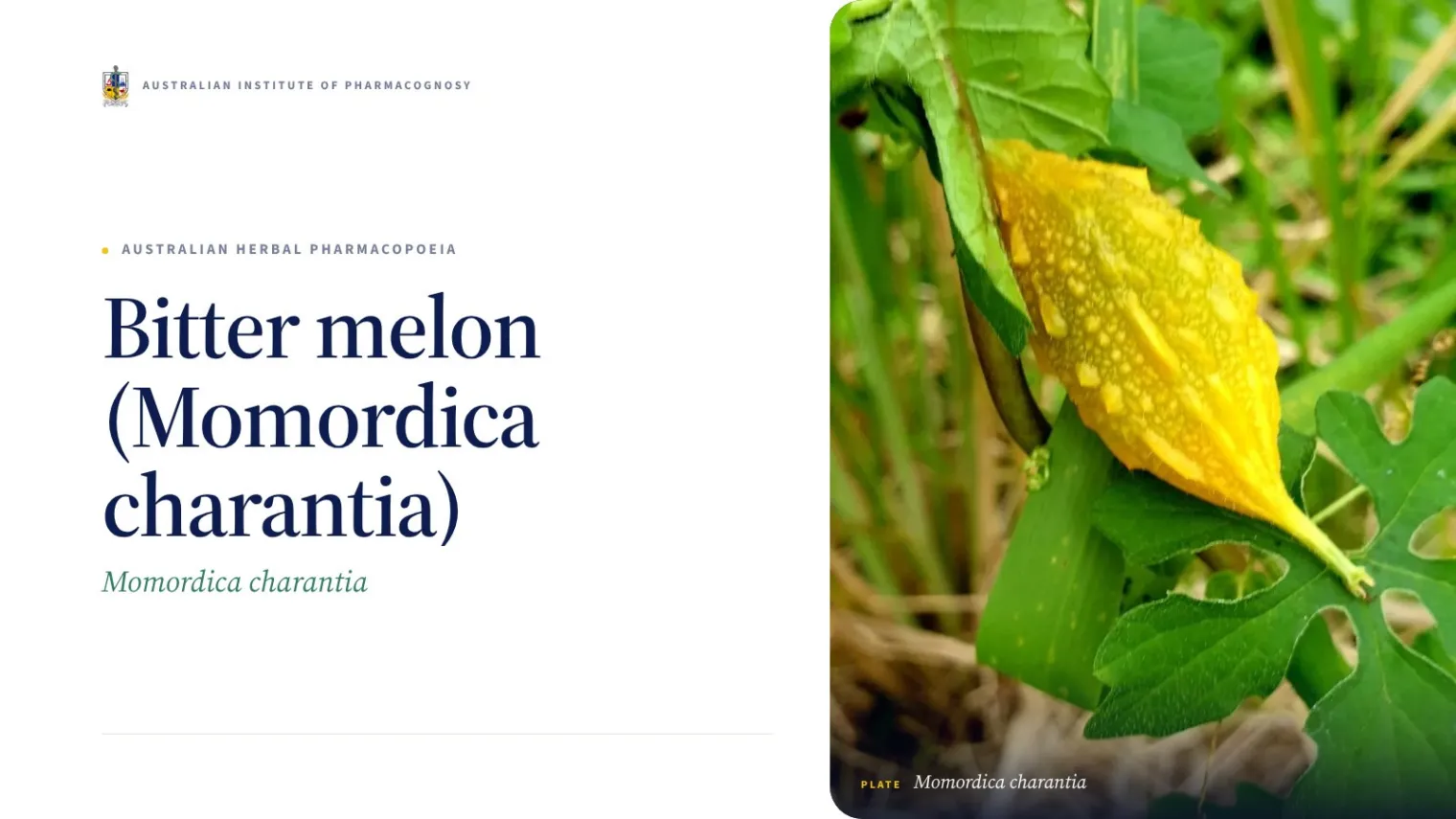
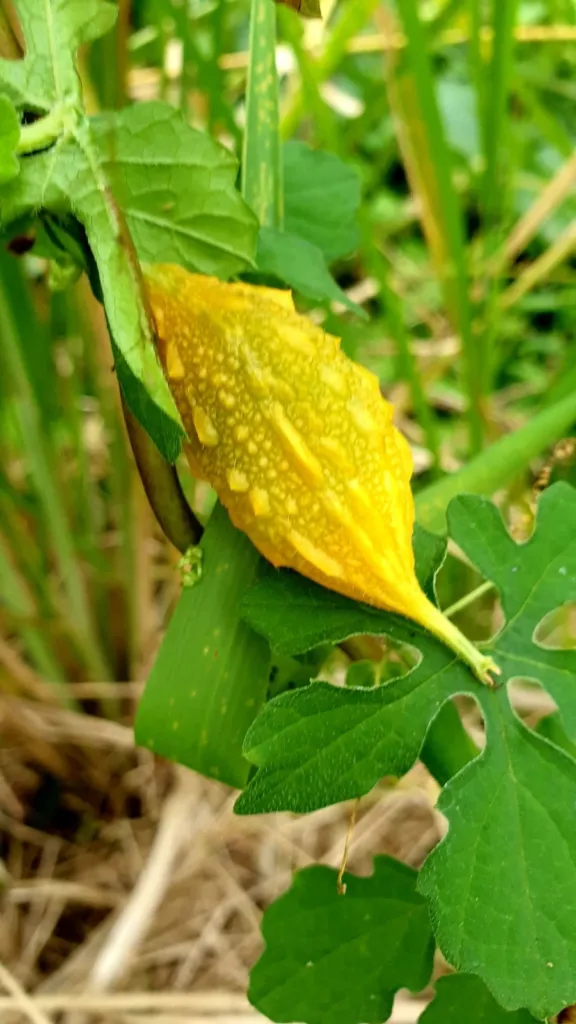
Bitter melon fruit (Momordica charantia L.), Cucurbitaceae
Australian Herbal Pharmacopoeia (working title) · Monograph AIP-PH-MOMCHA · Version 1.0 draft
Date: 2026
Status: working document, version 1.0. Not a statutory standard.
Prepared by: Dr Thomas Ridley, Head of Education and Research, Australian Institute of Pharmacognosy, Cardwell, Queensland.
0. Free-teaser block
0.1 Identity card
| Series number | AIP-PH-MOMCHA (MediHerb A–Z list No. 16) |
| Title | Bitter melon fruit (Momordica charantia L.), Momordicae charantiae fructus |
| Version / year | 1.0 draft, 2026. Next review 2029, or sooner if a registered trial listed in section 13.3 reports, or if a pharmacopoeia adopts an assay for the fruit |
| Accepted binomial | Momordica charantia L., Sp. Pl. 2: 1009 (1753). Accepted. IPNI 293413-1. Checked on 30/09/2026 against the World Checklist of Vascular Plants (the data behind Plants of the World Online, dataset version 2026-09-23) and IPNI [1,2] |
| Family | Cucurbitaceae (APG IV), order Cucurbitales [1,3] |
| Plant part | The fruit, fresh (as juice) or dried, usually harvested green and unripe; whole fruit with or without seeds, or the pulp without seeds [4,5]. The MediHerb tablet uses a dry extract of the fruit [6] |
| Latin drug name | Momordicae charantiae fructus; WHO heads its monograph Fructus Momordicae [4] |
| Principal synonyms | Momordica indica L., M. elegans Salisb., M. muricata Willd., M. zeylanica Mill., M. charantia var. abbreviata Ser. and 22 other names, 27 in all (24 in Momordica, 3 in Cucumis and Sicyos), placed under subsp. charantia [1]. WHO also lists M. balsamina Blanco and M. chinensis Spreng. [4]; see section 1 on why M. balsamina L. is a different species |
| Common names | English: bitter melon, bitter gourd, balsam pear, African cucumber, wild cucumber [4,7]. Other vernacular names include karela (India), kāravella, kuguazi, ku gua, goya, nigauri, ampalaya, cundeamor and cerasee [4,5,7]. Trade and regulatory names: TGA ingredient name MOMORDICA CHARANTIA [8]; the MediHerb Metabol Complex label names "Momordica charantia fruit Extract dry concentrate" [6] |
| Pharmacopoeial status elsewhere | WHO: yes, vol. 4 (2009), Fructus Momordicae [4]. Ayurvedic Pharmacopoeia of India: yes, Part I vol. II (1999), the source of the WHO purity limits, as cited by WHO [4]. Ph. Eur., BP, USP, EMA/HMPC, BHP: no monograph was found. Status in the Chinese Pharmacopoeia was not checked for this version |
| Australian status | Permissible Ingredients Determination (No. 2) 2026: item 3392 MOMORDICA CHARANTIA, purposes A (active) and H (homoeopathic), no specific requirement [8]. Poisons Standard (June 2026): not named [9]. ARTG: 33 entries name the plant (public search 30/09/2026), among them MediHerb Metabol Complex, ARTG 300236, listed 2/03/2018 [6,10]. Native status: the Australian Plant Census gives its distribution as Christmas Island and Queensland, naturalised in New South Wales [3]. Not named in the Queensland biosecurity legislation [11] |
| Named markers | No pharmacopoeia sets an assay limit. Purity limits only (WHO, from the Ayurvedic Pharmacopoeia of India): total ash not more than 8.5 per cent, acid-insoluble ash not more than 0.6 per cent, water-soluble extractive not less than 28 per cent, alcohol-soluble extractive not less than 6 per cent [4]. Proposed identity and assay markers: a five-compound set of cucurbitane triterpenoids [5]. Safety marker needing an upper limit: vicine (CID 135413566), in the seeds [5] |
| Evidence snapshot | Type 2 diabetes and prediabetes pooled, glucose and HbA1c: Tier B, no reliable effect in blinded trials of the fruit alone, 9 RCTs pooled (414 participants), low certainty. Prediabetes, fasting glucose: Tier C, inconsistent (a small fall in one 12-week trial, none in two others), 3 RCTs read in full, very low certainty. Blood lipids, weight, blood pressure: Tier B, no effect. Metabolic syndrome: Tier C, 1 open uncontrolled trial. Digestive, bitter-tonic, anthelmintic and fever uses: Tier T. Antiviral, anticancer and insulin-sensitising actions: Tier P |
| Suggested citation | Ridley T. Bitter melon fruit (Momordica charantia L.), Momordicae charantiae fructus. AIP-PH-MOMCHA, version 1.0 draft. Cardwell: Australian Institute of Pharmacognosy; 2026. DOI to be assigned |
| Provenance | Original AIP data: none. Every limit, method, analytical figure, trial result and case report in this monograph belongs to the source cited beside it. Sections 4, 5, 7, 8, 9 and 10 carry AIP bench data pending: AIP has not vouchered a sample, made a section or powder mount, run a plate or run a chromatogram of this drug. Photographs and plates are licensed or public-domain works credited in each caption; F6b, F8 and F10c are journal figures reused under CC BY 4.0; F3b and F5 are AIP schematics redrawn from cited descriptions; F6c and F6d are AIP replots of published tables; F9 and the other F10 charts are AIP charts drawn from published data |
| Compiler and review | Compiled by Dr Thomas Ridley (Education and Research). Technical review: Dr Fiona MacAllister (Botanical, sections 1-5 and the adulterant species in 10), reviewed in 2026; Dr Hana Suzuki (QA, sections 6-10), reviewed in 2026; Dr Eleanor Whitcombe (Medicine, sections 12, 13, 15), reviewed in 2026; evidence and citation audit, Dr Thomas Ridley (Education and Research, all sections, references and figure sources), reviewed in 2026; layout, figure placement and figure credits, Jesse Kirby (Community Outreach, whole document), reviewed in 2026. Published: not yet. Last modified: 2026. Version 1.0 draft |
| Canonical URL | /pharmacopoeia/momordica-charantia/ (on publication) |
0.2 Summary
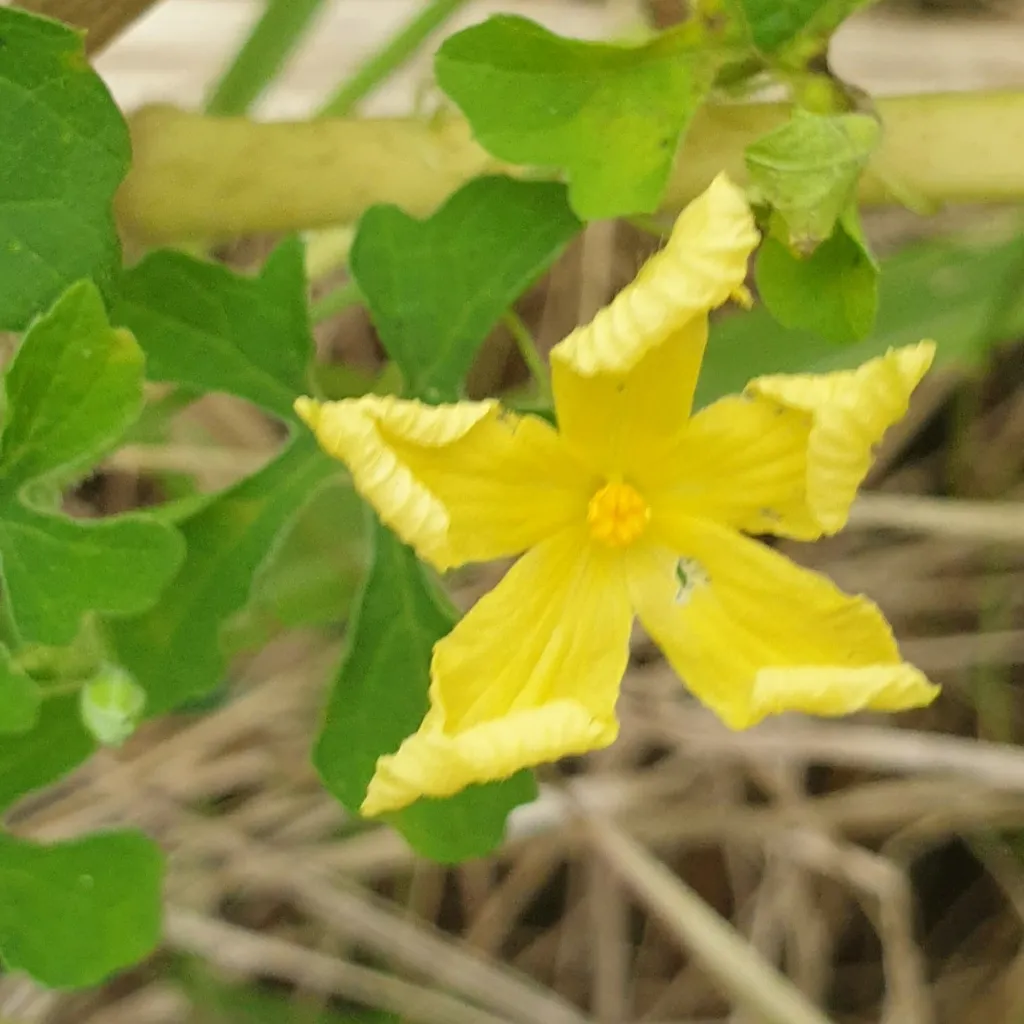
Bitter melon is the fruit of Momordica charantia, a scrambling annual vine of the tropics that is eaten as a vegetable across Asia, Africa and the Americas and grows wild on the Queensland coast around Cardwell. The drug is the green, warty fruit, used fresh as juice or dried in slices, powders and extracts. No European, British or United States pharmacopoeia has a monograph. The World Health Organization gives a botanical description and four purity limits taken from the Ayurvedic Pharmacopoeia of India, and leaves microscopy and assay "to be established". The chemistry is dominated by some two hundred cucurbitane-type triterpenoids, which vary seventeen-fold between cultivars supplied by a single research station; the older marker, charantin, is a pair of common plant sterol glucosides and a poor guide to quality. The fruit is best known as a traditional remedy for diabetes. Blinded trials of the fruit alone, pooled, do not show a reliable effect on glucose or HbA1c in type 2 diabetes; in prediabetes, one 2025 trial found a small fall in fasting glucose after twelve weeks, and two other trials found none. The fruit is widely eaten as food, and mild digestive upset is the usual adverse effect. The main safety points are additive glucose-lowering with diabetes medicines, avoidance in pregnancy and in children, and the seeds’ vicine, a risk in glucose-6-phosphate dehydrogenase deficiency. Anyone considering bitter melon medicinally should consult a degree-qualified herbalist with competencies and adequate training in pharmacognosy.
0.3 Contents with extent
| Section | Content | Pages |
|---|---|---|
| 0 | Free-teaser block: identity card, summary, contents, contributors | 4 |
| 1 | Nomenclature | 1 |
| 2 | Definition | 1 |
| 3 | Source and Australian supply, with 3.1 origin, climate and chemistry | 2 |
| 4 | Macroscopy | 1 |
| 5 | Microscopy | 1 |
| 6 | Chemistry | 1 |
| 7 | Named markers and assay limits | 1 |
| 8 | TLC fingerprint | 1 |
| 9 | HPLC fingerprint | 2 |
| 10 | Identity, purity, adulterants and contaminants | 2 |
| 11 | Traditional use | 1 |
| 12 | Current practice: use, preparations and doses | 2 |
| 13 | Clinical evidence | 5 |
| 14 | Pharmacology | 1 |
| 15 | Safety | 3 |
| 16 | Discussion | 1 |
| 17 | Conclusions | 1 |
| 18 | Research still needed | 1 |
| 19 | References | 3 |
| 20 | Document control | 1 |
| Totals | 21 sections · about 59 printed pages · 47 figures (16 licensed or public-domain photographs and plates, 3 journal figures reused under CC BY 4.0, 11 PubChem structure panels, 2 AIP schematics redrawn from published descriptions, 2 AIP replots of published tables, 11 AIP charts, 2 captioned placeholders) · 0 AIP photomicrographs · 0 AIP chromatograms · 15 tables · 5 studies graded from full text (4 randomised: Mes 2025 studies 1 and 2, Kim 2023, Yang 2022; 1 uncontrolled: Tsai 2012), 7 further blinded trials reported through a meta-analysis read in full · 43 references; every PMID and DOI resolved on 30/09/2026, and the full text of every cited journal article read |
Known gaps in this version, stated plainly.
- F4, the photomicrographs, and F7, the TLC plate, are captioned placeholders. AIP holds no vouchered sample. Europe PMC open-access literature and Wikimedia Commons were searched on 30/09/2026 for a reusable photomicrograph of the fruit or its powder, and for a reusable TLC plate of the fruit; none was found. WHO itself leaves microscopy "to be established" [4].
- No pharmacopoeial identity or assay test exists for the fruit in any text read for this monograph. Sections 7 to 9 set out published methods and an interim AIP proposal; none is a validated AIP method.
- Several trials reach this monograph only through a meta-analysis. Cortez-Navarrete 2018 and 2022, Dans 2007, John 2003, Kim 2020, Kinoshita 2018 and Trakoon-osot 2013 are reported as Laczkó-Zöld and colleagues tabulated them [12]; Fuangchan 2011, Krawinkel 2018 and Guarneiri 2025 as other papers read in full describe them. Their primary papers are on the library fetch list and have not had the integrity screen. The 2012 Cochrane review is reported as Braun and Cohen and Çiçek summarise it [5,7].
- Searches not completed: ANZCTR refused automated access on 30/09/2026, so its records were reached only through WHO ICTRP (searched 30/09/2026); Cochrane CENTRAL and Embase were not searched; the TGA safety alerts were searched, but the TGA Database of Adverse Event Notifications search could not be completed and needs a manual search (section 15); the full texts of the pazopanib interaction case and the osteoarthritis trial named in sections 13 and 15 are on order and unread; DAFF BICON import conditions, the IUCN Red List and CITES were not queried; PubPeer was not checked for the cited papers.
- Queensland collection law was not read. The Australian Plant Census treats the species as native in Queensland [3], so wild collection falls under the Nature Conservation Act 1992 (Qld); the regulation that governs taking protected plants was not read for this version.
- The Chinese Pharmacopoeia and the Ayurvedic Pharmacopoeia of India were not read directly. The Indian limits are quoted from WHO [4].
0.4 Contributors and paywall notice
Prepared by: Dr Thomas Ridley, Head of Education and Research.
Contributors: listed with the monograph and resolved from the Legal byline roster by the publication pipeline for each department that reviews the draft. Dr Luke Iggulden set the scope of the Pharmacopoeia in the directive of 22/09/2026; he did not write this monograph.
What is free and what is not. Everything above the free-sample line is free to every reader. The remaining sections, macroscopy and microscopy, chemistry and markers, the identity tests, purity and adulterants, tradition, doses, graded evidence, pharmacology, safety and references, are read by Scholar-level members and above under a revocable personal licence. Nothing behind the line contradicts anything in front of it.
The Australian Herbal Pharmacopoeia is the name of a reference series published by the Australian Institute of Pharmacognosy. It is not a statutory standard under the Therapeutic Goods Act 1989 and carries no official, government or national-standard status.
30 more pages follow · 15,210 words, 45 figures, 12 tables
Still to come in this monograph
- 1. Nomenclature
- 2. Definition
- 3. Source and Australian supply
- 4. Macroscopy
- 5. Microscopy
- 6. Chemistry
- 7. Named markers and assay limits
- 8. TLC fingerprint
- 9. HPLC fingerprint
- 10. Identity, purity, adulterants and contaminants
- 11. Traditional use
- 12. Current practice: use, preparations and doses
- 13. Clinical evidence
- 14. Pharmacology
- 15. Safety
- 16. Discussion
- 17. Conclusions
- 18. Research still needed
- 19. References
- 20. Document control
The rest of this monograph is open to members. One membership covers every members’ feature on the site.
Checking your membership…
Report an error or submit evidence
If something in this monograph is wrong, out of date or missing, tell us and show us the evidence. Every report is logged under the AIP Evidence Charter and assessed on the evidence alone; the outcome is kept on the record, and an upheld report is corrected with a dated notice on this page.
Open the report form
The Institute sets and publishes its own monographs. The catalogue is in Publications.