
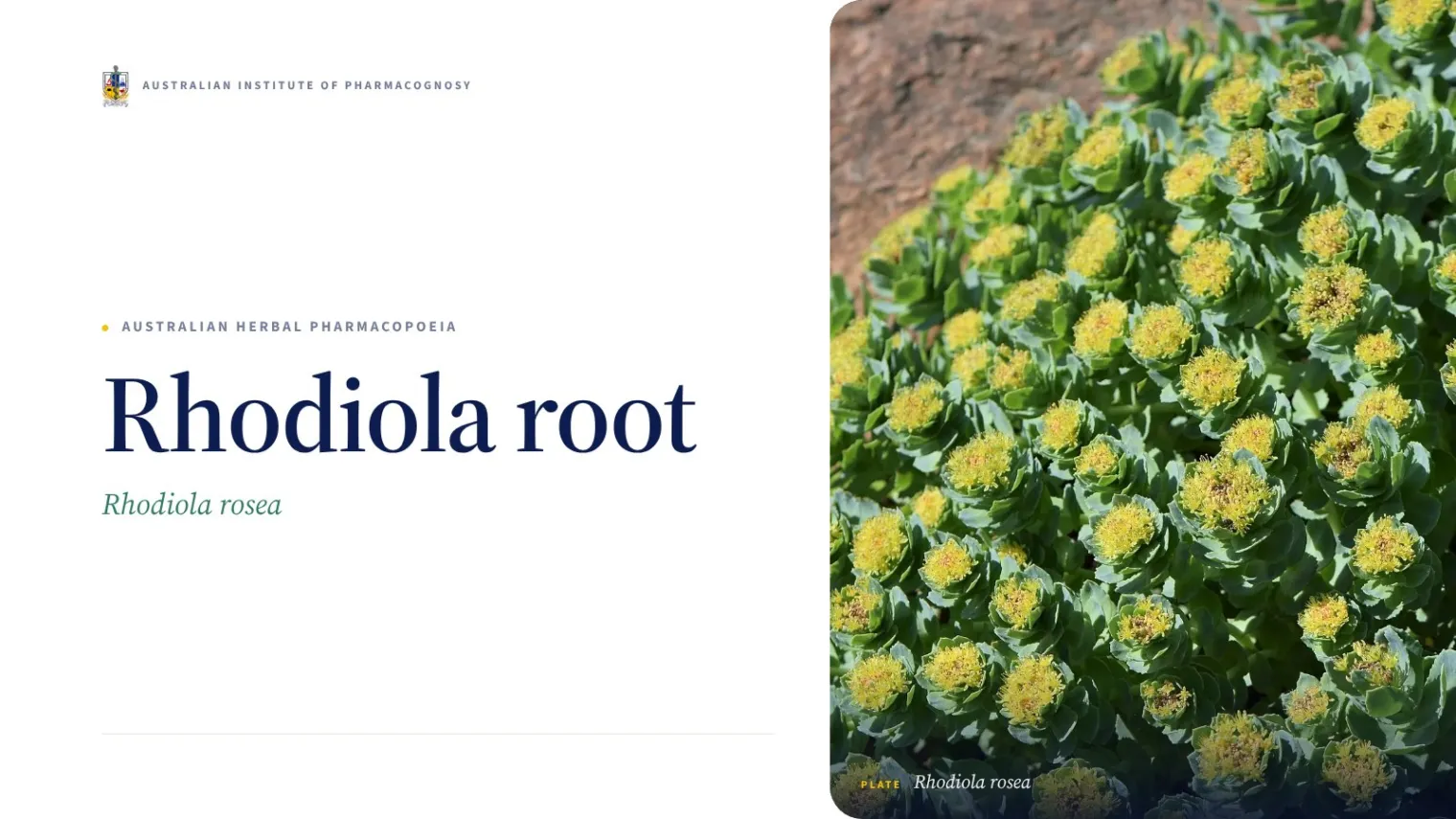
Rhodiola root (Rhodiola rosea L.), Crassulaceae
Australian Herbal Pharmacopoeia (working title) · Monograph AIP-PH-RHOROS (formerly AIP-HP 010) · Version 1.0 draft
Date: 2026
Status: working draft, published while in build. Not a statutory standard.
Prepared by: Dr Thomas Ridley, Head of Education and Research, Australian Institute of Pharmacognosy, Cardwell, Queensland.
0. Free-teaser block
0.1 Identity card
| Monograph number | AIP-PH-RHOROS (formerly AIP-HP 010) (MediHerb A–Z list No. 128) |
| Title | Rhodiola root (Rhodiola rosea L.), Rhodiolae roseae rhizoma et radix |
| Version / year | 1.0 draft, 2026. Next review 2029, or sooner if a large trial reports or the Ph. Eur. monograph is revised |
| Accepted binomial | Rhodiola rosea L., Species Plantarum 2: 1035 (1753). Accepted; nomenclatural status established. Checked against Plants of the World Online (Kew) — the World Checklist of Vascular Plants dataset that POWO serves, version 2026-09-16, doi:10.48580/d4dz — by Education on 23/09/2026 and again at botanical review on 28/09/2026 [1] |
| Family | Crassulaceae (APG IV). Order Saxifragales [2] |
| Plant part | Dried rhizome and root. The trade calls it "root"; the bulk of the drug is rhizome, underground stem with irregular secondary thickening [4] |
| Latin drug name | Rhodiolae roseae rhizoma et radix (EMA/HMPC form) [3]. Also written Rhodiolae roseae radix et rhizoma |
| Principal synonyms | 65 synonyms in the World Checklist of Vascular Plants that Plants of the World Online serves, among them Sedum rosea (L.) Scop., Sedum rhodiola Vill., Rhodiola arctica Boriss., Rhodiola iremelica Boriss., Rhodiola elongata (Ledeb.) Fisch. & C.A.Mey., Rhodiola scopolii A.Kern. ex Simonk., Rhodiola roanensis (Britton) Britton and Sedum roanense Britton [1]. MediHerb’s label carries "Rhodiola rosea (Sedum roseum)" [10]; "Sedum roseum" written without an authority is ambiguous. Sedum roseum (L.) Scop. is the same name as Sedum rosea (L.) Scop., based on Rhodiola rosea L.; Sedum roseum Steven is a later, unrelated name and belongs to Phedimus stevenianus, a different plant (see 1) |
| Common names | English: roseroot, rose root, rosewort, golden root, Arctic root, king’s crown. German: Rosenwurz. Norwegian/Danish/Swedish: rosenrot, rosenrod. Russian: золотой корень (zolotoy koren, golden root), родиола розовая. Chinese trade name Hong Jing Tian (紅景天) is used for the genus and most often for R. crenulata, not for R. rosea [5,6] |
| Pharmacopoeial status elsewhere | EMA/HMPC: yes — EU herbal monograph, traditional use, revision 1 adopted 20/03/2024 [3]. Ph. Eur.: monograph 07/2024:2893, Rhodiola root and rhizome [65]. The edition in force has not been read here; its two minimum contents are quoted in 7 at one remove, through the paper that reports them [65], and nothing else is taken from it (see 0.3). BHP 1996: no. USP: a USP reference standard for Rhodiola rosea root and rhizome exists and served as a comparator in one market study [17]; whether the USP–NF or the USP Herbal Medicines Compendium carries a monograph is not confirmed, because the Compendium refused access in 2026 (see 20.5). WHO: no. Ayurvedic Pharmacopoeia of India: no. Barnes recorded "Pharmacopoeial and other monographs: none" in 2007 [6] |
| Australian status | Poisons Standard: not scheduled. Rhodiola, salidroside and rosavin appear in no Schedule and no Appendix of the Therapeutic Goods (Poisons Standard, June 2026) Instrument 2026, searched 23/09/2026 [12]. Permissible Ingredients Determination: item 4321 RHODIOLA ROSEA, purpose A (active) only, not permitted as an excipient or a homoeopathic preparation, with two specific requirements: "Only for use in oral medicines" and "Only available for use when the plant preparation is dry root powder, dry root powder as an aqueous extract or dry root powder as a hydroethanolic extract with no more than 70% ethanol v/v" [11]. No other Rhodiola species is a permissible ingredient. ARTG: 118 entries for the keyword "rhodiola" on 23/09/2026, including MediHerb Rhodiola and Ginseng Complex (511686) and MediHerb Rhodiola & Schisandra (495585), both Integria Healthcare Australia Pty Ltd [13,14,15]. Not native to Australia. Not a declared weed in Queensland. Zero occurrence records in the Atlas of Living Australia (searched 23/09/2026) [2]. CITES Appendix II since February 2023, every Rhodiola species, so imported root, powder and bulk extract need CITES paperwork under Part 13A of the Environment Protection and Biodiversity Conservation Act 1999 (Cth) [20,21] |
| Named markers | Total rosavins (rosavin CID 9823887 + rosarin CID 10320370 + rosin CID 5280656), species-specific identity and assay marker. Salidroside (rhodioloside, CID 159278), genus-level assay marker, not species-specific. Compound records, formulae, molecular weights and structures from PubChem [60]. No AIP limit is set in this version; see 7 |
| Evidence snapshot | Stress-related fatigue syndrome: Tier B, 1 RCT (n = 60), low certainty. Mild to moderate depression: Tier C (interim), 2 RCTs (n = 89; n = 57), very low certainty: the larger is at high risk of bias and the smaller found no difference from placebo. Fatigue and mental performance in healthy and non-clinical people: Tier C, 6 RCTs, very low certainty, and one of the six favoured placebo. Burnout, chronic fatigue, mild anxiety: Tier C, open-label only. Endurance performance in healthy young people: Tier C (interim), very low certainty. A 2025 meta-analysis of 26 RCTs reports a small positive effect on VO₂max and time to exhaustion, but its pool mixes R. rosea with R. crenulata, compound products and isolated salidroside, so it cannot be read as a result for this drug alone. Both interim tiers were set at the second evidence audit in 2026 and wait on Medicine’s confirmation. Life-stress symptoms and attention or mental speed as outcomes in their own right: Tier C, open-label only. Adaptogen / general stress resistance: Tier T. Altitude sickness, cancer, cardioprotection for R. rosea: Tier P |
| Suggested citation | Ridley T. Rhodiolae roseae rhizoma et radix (rhodiola root, Rhodiola rosea L.). AIP-PH-RHOROS, version 1.0 draft. Cardwell: Australian Institute of Pharmacognosy; 2026. DOI to be assigned |
| Provenance | Original AIP data: none. Every analytical figure, limit, method and trial result in this monograph belongs to the source cited beside it. Sections 4, 5, 7, 8, 9 and 10 carry AIP bench data pending: AIP has not yet vouchered a sample, cut a section, run a plate or run a chromatogram for this drug. Figures F1–F3b, F7 and F8 are licensed third-party images; F5 and F9–F13 are AIP drawings from cited data. The author, date, subject and licence of every third-party image are at refs 57, 58, 59 and 62 and in the figure manifest held with this monograph |
| Compiler and review | Compiled by Dr Thomas Ridley (Education and Research). Technical review on record: Dr Fiona MacAllister (Botanical, sections 1-5, the adulterant species in 10.3, and figures F1-F5 and F9), reviewed in 2026; Dr Hana Suzuki (QA, sections 6-10, and figures F6-F8), reviewed in 2026; Dr Thomas Ridley (Education and Research, independent evidence and citation audit of the references, the graded evidence and the figure licences, first and second passes), reviewed in 2026; Jesse Kirby (Community Outreach, whole-document layout, figure placement, captions and credit lines), reviewed in 2026; Dr Eleanor Whitcombe (Medicine, sections 12, 13 and 15, and figures F10 and F13), reviewed in 2026. Still to come: the QA second read of 4-5, History and Philosophy on 11, Medicine’s check of 14 and 16-18 with its confirmation of the two interim tiers in 13.5 and its correction of the dry-herb arithmetic in 12, and the Librarian’s check of 19. Published: not yet. Last modified: 2026. Version 1.0 draft |
| Canonical URL | /pharmacopoeia/rhodiola-rosea/ (on publication) |
0.2 Summary
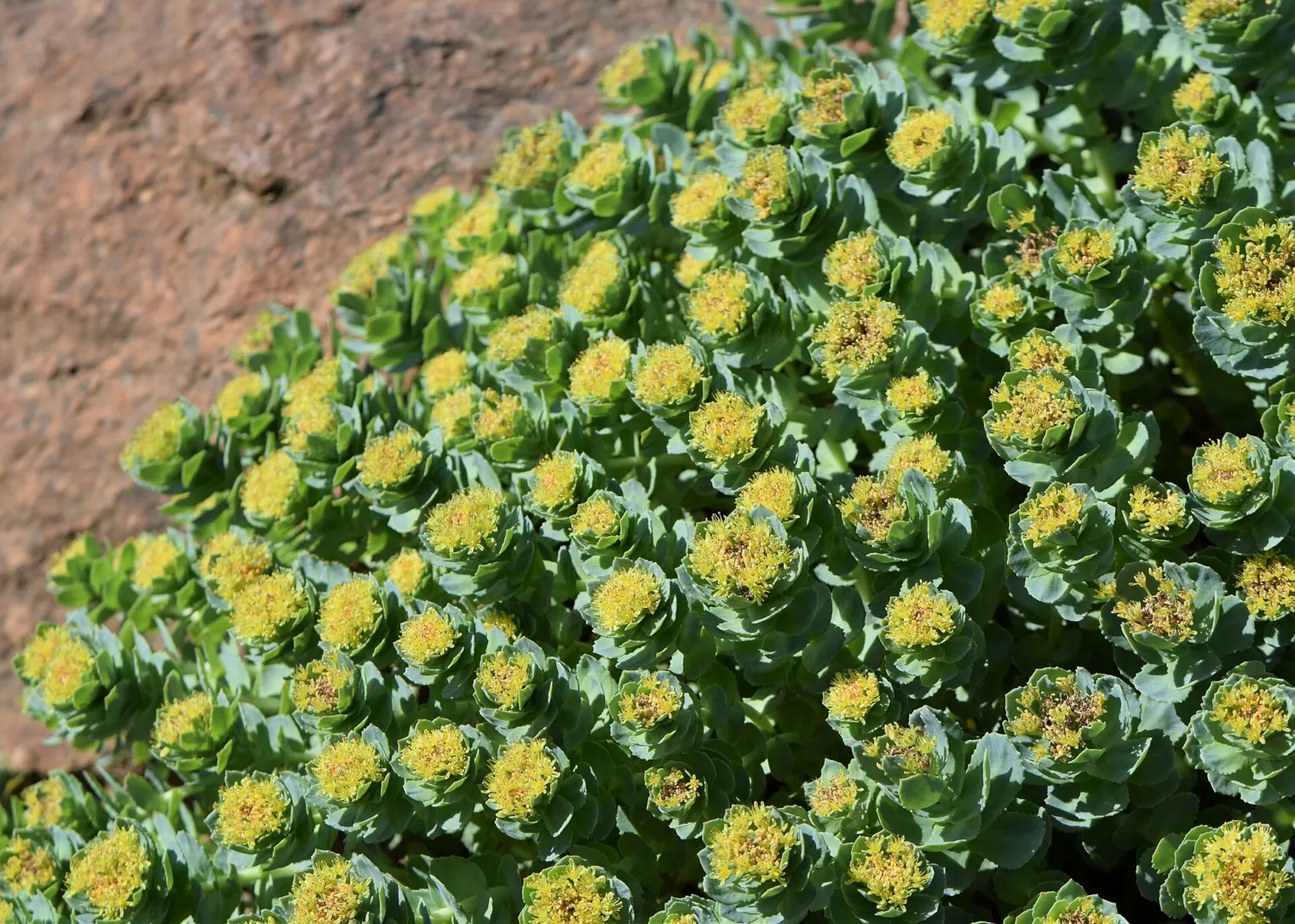
Rhodiola is the dried underground organ of Rhodiola rosea, a small dioecious succulent of Arctic and alpine rock, sea-cliff and scree across the Northern Hemisphere. The drug is mostly rhizome rather than true root, and its freshly cut surface smells of roses, which is where both the botanical and the common names come from. Identity rests on three cinnamyl alcohol glycosides (rosavin, rosarin and rosin, collectively the rosavins) which are found in this species and not in the Rhodiola species that share the trade with it. Salidroside occurs across the whole genus and cannot authenticate the species on its own. Substitution with R. crenulata and other congeners is documented by DNA barcoding and by chromatography, and a 2026 market survey found one product whose salidroside ran fifteen times its rosavins, which the authors read as undeclared synthetic salidroside or another species. In Australia the drug is unscheduled, but the Permissible Ingredients Determination allows it only as an active in oral medicines, and only as dry root powder or an aqueous or hydroethanolic extract of that powder at no more than 70 per cent ethanol. Every Rhodiola species has been in CITES Appendix II since February 2023, so imported material needs wildlife-trade paperwork as well as biosecurity clearance. The human evidence is thinner than the reputation. One small randomised trial in diagnosed fatigue syndrome carries the case at low certainty. The two depression trials disagree: one reports benefit with a doubtful placebo response, and the other found no difference from placebo. A 2025 meta-analysis of sports trials reports a small gain in endurance, but it pools other Rhodiola species and combination products with this one. The best-run trial in healthy shift workers found fatigue worse on rhodiola than on placebo. Everything else is open-label, preclinical, or tradition. The safety record is reassuring at the doses studied, with headache, nervousness, insomnia, dizziness and gastrointestinal upset reported and no serious event attributed. The open question is a pharmacokinetic one: this drug inhibits CYP3A4 and P-glycoprotein strongly in vitro, and the human study that looked for it found only a small CYP2C9 signal. Anyone considering rhodiola, in any form, should consult a degree-qualified herbalist with competencies and adequate training in pharmacognosy.
0.3 Contents with extent
| Section | Content | Pages (est.) |
|---|---|---|
| 0 | Free-teaser block: identity card, summary, contents, contributors | 4 |
| 1 | Nomenclature | 3 |
| 2 | Definition | 1 |
| 3 | Source and Australian supply | 4 |
| 3.1 | Where it must be grown: origin, climate and chemistry | 5 |
| 4 | Macroscopy | 3 |
| 5 | Microscopy | 2 |
| 6 | Chemistry | 5 |
| 7 | Named markers and assay limits | 3 |
| 8 | TLC fingerprint | 3 |
| 9 | HPLC fingerprint | 3 |
| 10 | Identity, purity, adulterants and contaminants | 6 |
| 11 | Traditional use | 3 |
| 12 | Current practice: use, preparations and doses | 4 |
| 13 | Clinical evidence | 9 |
| 14 | Pharmacology | 5 |
| 15 | Safety | 5 |
| 16 | Discussion | 4 |
| 17 | Conclusions | 2 |
| 18 | Research still needed | 2 |
| 19 | References | 4 |
| 20 | Document control | 2 |
| Totals | 22 sections · 63 A4 pages as laid out at the Community Outreach layout review in 2026 (the per-section estimates above are the compiler’s and have not been reset to the rendered page numbers) · 30 numbered figures · 27 tables · 15 human studies graded, each with a RoB 2 or ROBINS-I judgement · 66 references. Figures: 8 licensed photographs, plates and herbarium sheets (7 under CC BY or CC BY-SA, 1 public domain), 12 public-domain PubChem structures, 3 figures reproduced from open-access papers under CC BY 4.0 (2 HPTLC plates and 1 LC-DAD chromatogram, each credited to its authors and labelled as that paper’s work), 1 AIP schematic redrawn from published descriptions, 1 AIP distribution map, 2 AIP data charts drawn from this monograph’s own grading and dose table, and 2 AIP replots redrawn from published tables (refs 18 and 19). AIP photomicrographs: none. AIP chromatograms: none. One captioned placeholder box, Figure 12 (slot F4, photomicrographs), marks bench work not yet done. |
Known gaps in this version, stated plainly.
- F4, photomicrographs, is a pending slot. AIP holds no vouchered sample of this drug and has cut no section. Wikimedia Commons and the Europe PMC open-access literature were searched on 23/09/2026, and again at botanical review on 28/09/2026, for a reusable photomicrograph of R. rosea rhizome or powder. The one published set of photomicrographs of this drug is Figure 2 of Erst and colleagues [61], and its Europe PMC licence is the COVID-era PMC Open Access Subset grant, which ran only "for the duration of the World Health Organization (WHO) declaration of COVID-19 as a global pandemic" and so no longer carries a reuse permission. Its text is cited throughout section 5; its images are not reproduced. No licensed alternative exists to fill the slot.
- No AIP TLC plate and no AIP chromatogram. F7 and F8 are licensed figures from an open-access paper, labelled as that paper’s work.
- The Ph. Eur. monograph is not quoted. AIP’s library copy of the European Pharmacopoeia is the 8th edition (2013), which contains no Rhodiola monograph. The current monograph exists, and this document says so as a fact, but no limit, method or acceptance criterion is taken from it, because nobody here has read the edition in force. Acquiring the current Ph. Eur. herbal-drug volume is on the sources-needed list in section 20.
- No macroscopy photograph with a scale bar. The crude-drug photograph at Figure 6 is a licensed image and carries no rule, so no dimension can be read from it, and no source read for this monograph gives a measured size for the whole rhizome. A dimensioned macroscopy plate waits on an AIP-vouchered sample.
- Eighteen cited papers have not been read in the publisher’s copy. Twelve are quoted only through a full text AIP holds that reproduces the material (the EU assessment report or the library textbooks), one through its open supplementary file, and five are named as leads with nothing drawn from them. All eighteen are on the sources-needed list in section 20, each entry in section 19 says which applies, and under the full-text rule any still missing at release comes out with the sentence that cites it.
71 more pages follow · 35,504 words, 28 figures, 25 tables
Still to come in this monograph
- 1. Nomenclature
- 2. Definition
- 3. Source and Australian supply
- 3.1 Where it must be grown: origin, climate and chemistry
- 4. Macroscopy
- 5. Microscopy
- 6. Chemistry
- 7. Named markers and assay limits
- 8. TLC fingerprint
- 9. HPLC fingerprint
- 10. Identity, purity, adulterants and contaminants
- 11. Traditional use
- 12. Current practice: use, preparations and doses
- 13. Clinical evidence
- 14. Pharmacology
- 15. Safety
- 16. Discussion
- 17. Conclusions
- 18. Research still needed
- 19. References
- 20. Document control
The rest of this monograph is open to members. One membership covers every members’ feature on the site.
Checking your membership…
Report an error or submit evidence
If something in this monograph is wrong, out of date or missing, tell us and show us the evidence. Every report is logged under the AIP Evidence Charter and assessed on the evidence alone; the outcome is kept on the record, and an upheld report is corrected with a dated notice on this page.
Open the report form
The Institute sets and publishes its own monographs. The catalogue is in Publications.