
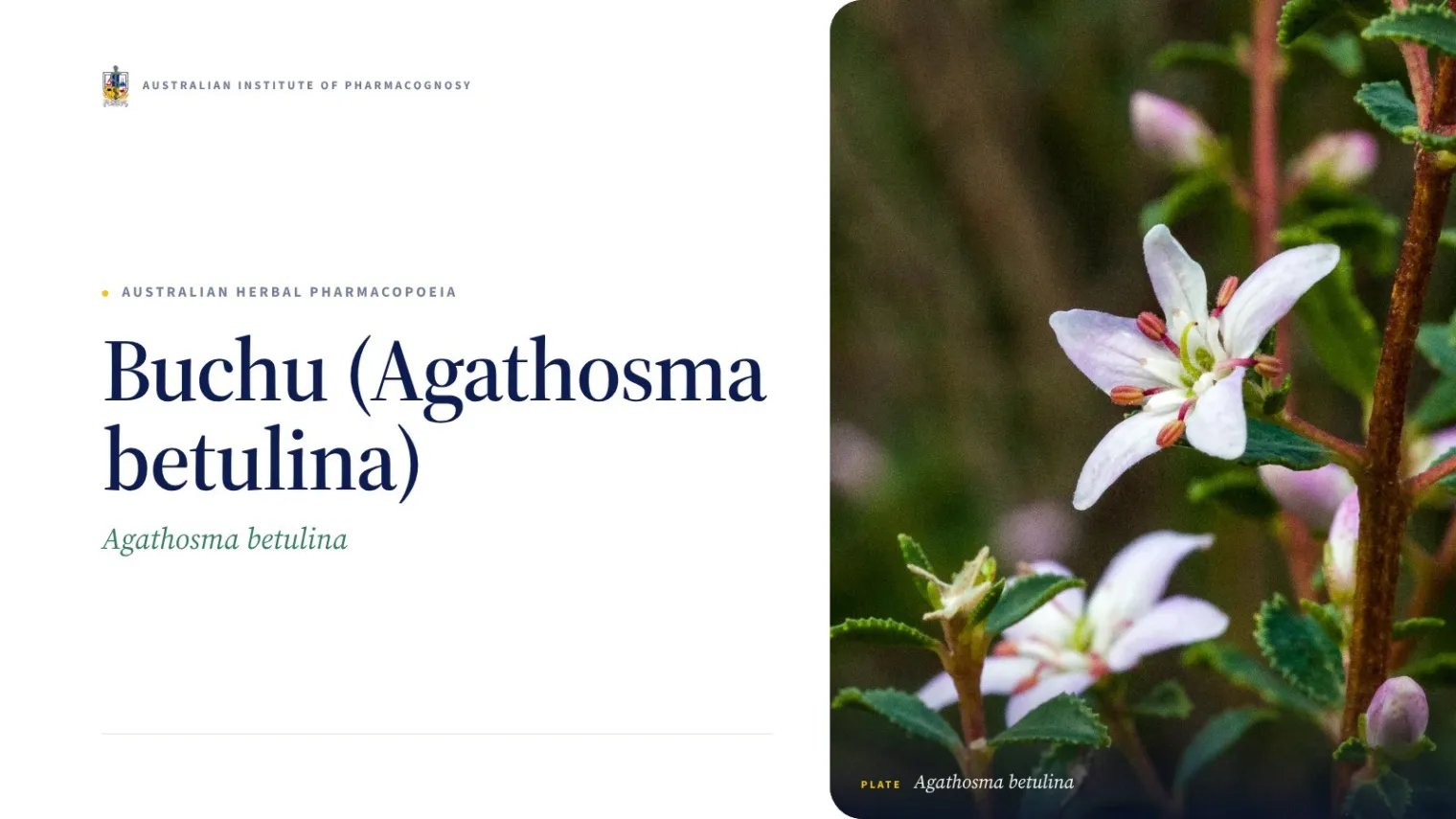
Buchu leaf (Agathosma betulina (P.J.Bergius) Pillans), Rutaceae
Australian Herbal Pharmacopoeia (working title) · Monograph AIP-PH-AGABET (formerly AIP-HP 013) · Version 1.0 draft
Date: 2026
Status: working draft, published while in build. Not a statutory standard.
Prepared by: Dr Thomas Ridley, Head of Education and Research, Australian Institute of Pharmacognosy, Cardwell, Queensland.
0. Free-teaser block
0.1 Identity card
| Monograph number | AIP-PH-AGABET (formerly AIP-HP 013) (MediHerb A–Z list No. 23). Drafted 27/09/2026 while the daily pipeline was still re-offering AIP-HP 010; the register had issued 010 to Rhodiola rosea and 011 to Boswellia serrata, and 012 was in build for Hypericum perforatum, so this drug took 013 |
| Title | Buchu leaf (Agathosma betulina (P.J.Bergius) Pillans), Barosmae folium |
| Version / year | 1.0 draft, 2026. Next review 2029, or sooner if the Permissible Ingredients pulegone requirement changes or a controlled trial reports |
| Accepted binomial | Agathosma betulina (P.J.Bergius) Pillans, J. S. African Bot. 16: 75 (1950). Accepted. IPNI urn:lsid:ipni.org:names:770863-1; basionym Hartogia betulina P.J.Bergius. Checked on 27/09/2026 against the Plants of the World Online dataset itself (Kew, POWO Darwin Core Archive version 2026-09-16, DOI 10.48580/d4dz), read through ChecklistBank, and against IPNI [1,2]. POWO records the name as accepted, family Rutaceae, order Sapindales, native range "SW. Cape Prov." |
| Family | Rutaceae Juss. (APG IV). Order Sapindales [1,4] |
| Plant part | The dried leaf, collected while the plant is flowering and fruiting. A small proportion of stem, flower and fruit is normal in the commercial drug; an excessive amount is an adulteration [4,5] |
| Latin drug name | Barosmae folium, from the long-superseded genus name Barosma [5,26]. The older pharmacopoeial forms Folia Bucco and Bucco folium appear in the nineteenth- and twentieth-century European compendia [3] |
| Principal synonyms | Homotypic: Barosma betulina (P.J.Bergius) Bartl. & H.L.Wendl., Bucco betulina (P.J.Bergius) Schult., Diosma betulina (P.J.Bergius) Thunb. (nom. illeg.), Hartogia betulina P.J.Bergius (basionym), Parapetalifera betulina (P.J.Bergius) Farw. Heterotypic: Barosma orbicularis Sweet, Diosma crenata G.Lodd. (nom. illeg.) [1]. MediHerb prints Barosma betulina as the botanical synonym; the TGA uses Agathosma betulina [5,9,12] |
| Common names | English: buchu, round buchu, short buchu, round-leaved buchu, bucco [3,4,6]. Afrikaans: boegoe, rondeblaarboegoe [3]. Khoisan and settler-record variants: boegoe, boechoe, boekoe, boggoa, bookoo, bouchou, bugu, buccho, bucco, bucku, buku [3]. German: Bukkostrauch, Buccoblätter; French: buchu; Italian: diosma; Danish: bukko [5] |
| Pharmacopoeial status elsewhere | Ph. Eur.: no — the library copy of the European Pharmacopoeia was searched on 27/09/2026 for "buchu", "Agathosma", "Barosma" and "diosphenol" and returns nothing [28]. BP: no — dropped; buchu was in the British Pharmaceutical Codex 1949 and 1963 and was no longer compendial in the BP by 1992 [3]. USP–NF: no — buchu and its preparations left the USP at USP XI (1930) and the NF at NF XI (1960) [3]. BHP: yes — retained through all three editions from 1971 [3], and Barnes and colleagues list BHP 1996 among the pharmacopoeial monographs for this drug [6]. BHC 1992: yes, listed in the same place [6]. Commission E (Germany): yes, a negative monograph, 1990 [3,5]. EMA/HMPC: no EU herbal monograph. WHO: no. Pharmacopée Française: listed in an addendum, earmarked for omission in 2015 [3]. Homeopathic Pharmacopoeia of the United States: yes [3] |
| Australian status | Poisons Standard: the herb is not scheduled. The full text of the Therapeutic Goods (Poisons Standard: June 2026) Instrument 2026 (F2026L00633, 674 pp.) was searched on 27/09/2026 for "Agathosma", "Barosma", "buchu" and "diosphenol": no entry in any Schedule or Appendix. Two of its constituents are scheduled in their own right: d-pulegone, Schedule 6, except in preparations containing 4 per cent or less, with Appendix E first-aid instructions and a child-resistant closure for containers of 200 mL or less; and methyleugenol, Schedule 6, except in preparations containing 1 per cent or less [10]. Permissible Ingredients Determination: four separate entries. Item 423 AGATHOSMA BETULINA — purposes A (active), E (excipient), H (homoeopathic), carries a specific requirement found on very few herbal entries: "Pulegone is a mandatory component of Agathosma betulina. The concentration of pulegone in the medicine must be no more than 4%." Item 978 BUCHU LEAF DRY (A, H); item 979 BUCHU LEAF OIL (E only, flavour or fragrance, flavour ≤ 5 per cent and fragrance ≤ 1 per cent of the medicine); item 980 BUCHU LEAF POWDER (A, E, H) [9]. ARTG: 3 entries on 27/09/2026 for the keyword "agathosma" — MediHerb UriCo Phytosynergist (ARTG 347190, Integria Healthcare Australia Pty Ltd, 04/11/2020), Mediherb Cranberry Complex (ARTG 239333, Integria, 29/05/2015) and MALE UP&GO (ARTG 477152, Natural Nutrition Plus Pty Ltd, 30/01/2025). The keyword "buchu" returns none, so a buyer searching the register by common name will miss all three [11]. Not native to Australia. Not a declared weed in Queensland. Zero occurrence records in the Atlas of Living Australia (searched 27/09/2026) [39] |
| Named markers | Pulegone, CID 442495, C₁₀H₁₆O, M_r 152.23, a regulatory marker; nothing here makes it an efficacy marker: mandatory component under Permissible Ingredients item 423, with an upper limit of 4 per cent in the finished medicine [9]. Diosphenol (2-hydroxypiperitone), CID 79023, C₁₀H₁₆O₂, M_r 168.23, the genus-characteristic constituent and the practical identity marker separating A. betulina from A. crenulata; no pharmacopoeial assay limit exists anywhere [3,5,7]. (d,l)-Isomenthone, CID 6432469, and d-limonene, CID 440917, the two phytochemical markers used in the EFSA-assessed trade specification for the essential oil, 19–27 per cent and 19–26 per cent of GC peak area respectively [7]. Diosmin, CID 5281613, and rutin, CID 5280805, non-volatile markers for the leaf and its aqueous and alcoholic extracts [3,8]. AIP has set no limit of its own; see section 7 |
| Evidence snapshot | Urinary antiseptic and diuretic use (cystitis, urethritis, prostatitis, dysuria): Tier T, traditional and Eclectic use only, no completed clinical trial found. Exercise-induced muscle soreness, topical buchu-oil gel: Tier C, one small unpublished 2002 institutional report of 30 men, known only through two second-hand accounts, never peer reviewed. Metabolic syndrome, blood pressure and glycaemia ("buchu water"): Tier P, rat models only. Antimicrobial, anti-inflammatory, analgesic and antioxidant actions: Tier P each. Khoisan ceremonial, cosmetic and medicinal use: Tier T. Nothing about this drug reaches Tier A or Tier B, and no trial is registered on ANZCTR, ClinicalTrials.gov, the WHO ICTRP or ISRCTN (all searched 27/09/2026) |
| Suggested citation | Ridley T. Buchu leaf (Agathosma betulina (P.J.Bergius) Pillans), Barosmae folium. AIP-PH-AGABET, version 1.0 draft. Cardwell: Australian Institute of Pharmacognosy; 2026. DOI to be assigned |
| Provenance | Original AIP data: none. Every analytical figure, limit, method and trial result in this monograph belongs to the source cited beside it. Sections 4, 5, 7, 8, 9 and 10 carry AIP bench data pending: AIP has not vouchered a sample, cut a section, run a plate or run a chromatogram for this drug. F1–F1d, F2, F2b, F2c, F6o, F8, F9, F9b, F9c and F10b are licensed or public-domain third-party images, every licence checked against the file page on 27/09/2026; the twelve constituent structures F6 to F6l are PubChem depictions, public domain, credited to PubChem with the CID in each caption; F3 and F5 are AIP drawings redrawn from cited published descriptions and dimensions; F6m, F6n, F10, F10c, F10d and F10e are AIP charts drawn from published data or from this monograph’s own graded evidence and its own reconciled tables; F4 and F7 carry no image and print as captioned "AIP bench data pending" placeholders, listed as gaps in 0.3 |
| Compiler and review | Compiled by Dr Thomas Ridley (Education and Research). Technical review: Dr Fiona MacAllister (Botanical, sections 1-5 and the adulterant part of 10) reviewed in 2026; Dr Hana Suzuki (QA, sections 6-10) reviewed in 2026; Dr Eleanor Whitcombe (Medicine, sections 12, 13 and 15) reviewed in 2026; Dr Thomas Ridley (Education and Research, evidence and citation audit of sections 1-3, 11, 13, 14, 16-19 and the source check on 6-10, 12 and 15) reviewed in 2026. Jesse Kirby (Community Outreach, whole-document layout, the figure set F1-F10e and the free-sample block) reviewed in 2026. The reference audit is the compiler’s own and the Librarian’s independent audit is still to come, which 20.3 records. Published: not yet. Last modified: 2026. Version 1.0 draft |
| Canonical URL | /pharmacopoeia/agathosma-betulina/ (on publication) |
0.2 Summary
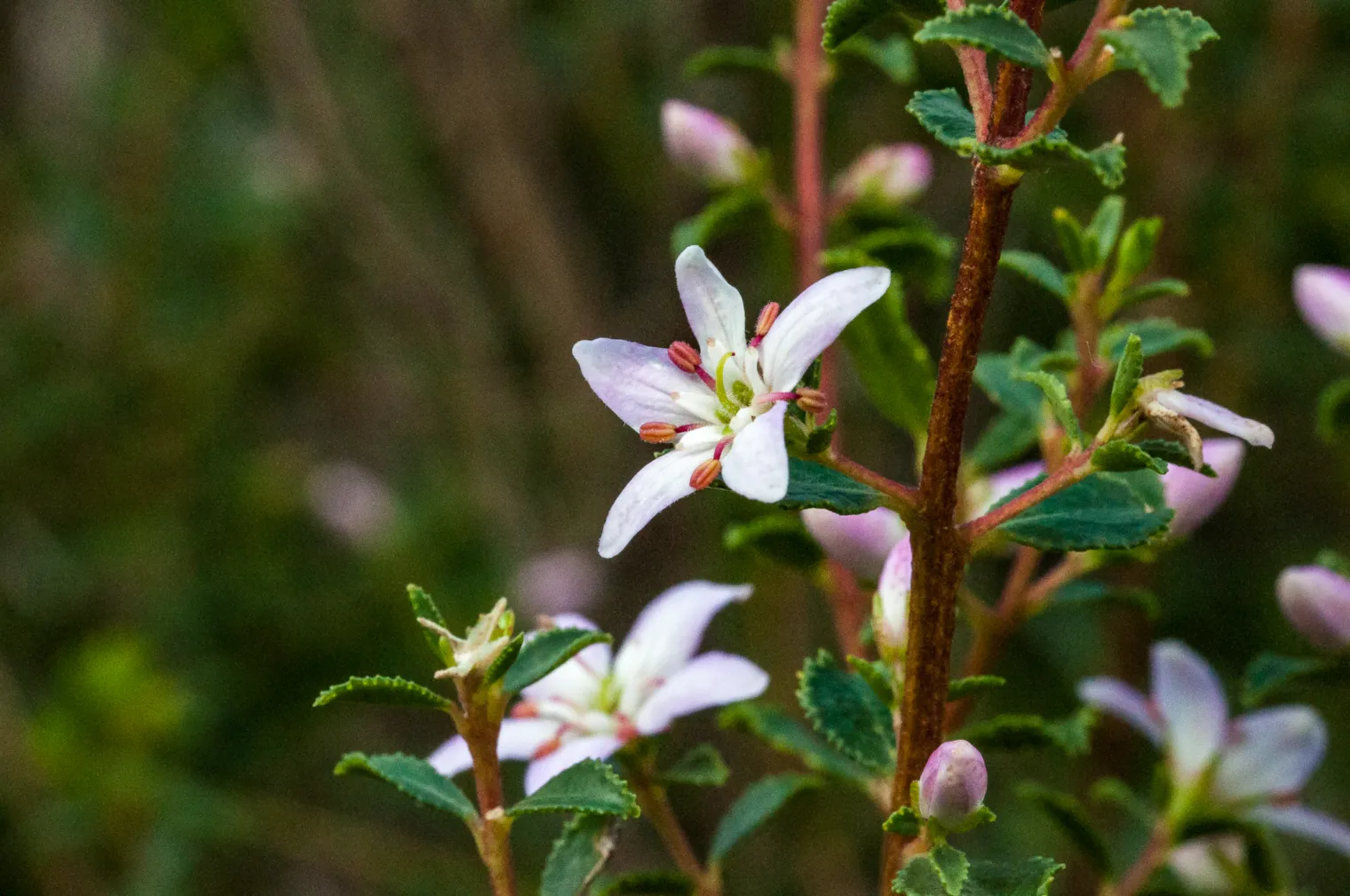
Buchu is the dried leaf of Agathosma betulina, a low shrub of the Cape fynbos that grows wild nowhere else. It was a Khoisan medicine and ceremonial herb long before it was written down, reached London around 1815, and by 1865 Helmbold’s Extract Buchu was the best-selling patent medicine in the United States, its proprietor spending about US$500,000 a year on newspaper advertising in 1869 to 1871. Thirteen countries and territories carried it in their pharmacopoeias and dispensatories, from the Dublin Pharmacopoeia of 1826 on. Then it went out: the USP dropped it in 1930, the National Formulary in 1960, and in 1990 the German Commission E published a negative monograph because there was nothing to support the claims. That verdict has not changed. No completed randomised controlled trial of an oral buchu preparation could be found on 27/09/2026 in PubMed or on ClinicalTrials.gov, and none is registered. What exists is preclinical: a methanol–dichloromethane extract with minimum inhibitory concentrations of 2 to 4 mg/mL against urinary organisms, which is weak; essential oil that is weaker still; aqueous and ethanolic extracts with no measurable effect on Escherichia coli at all. Two quality problems dominate the drug. The first is species: A. crenulata, the oval-leaved buchu, is traded under the same common name and carries up to 50 per cent pulegone in its oil against about 3 per cent in A. betulina, and the two hybridise freely where they are grown together. The second is that A. betulina itself comes in two chemotypes, one rich in diosphenol and one rich in isomenthone, and nothing on a certificate of analysis usually says which. Australian regulation has taken an unusual line here: the Permissible Ingredients Determination makes pulegone a mandatory component of Agathosma betulina and caps it at 4 per cent of the finished medicine, which is the only enforceable buchu specification in the world that AIP has been able to find. Anyone considering buchu should consult a degree-qualified herbalist with competencies and adequate training in pharmacognosy.
61 more pages follow · 30,639 words, 25 figures, 37 tables
Still to come in this monograph
- 1. Nomenclature
- 2. Definition
- 3. Source and Australian supply
- 3.1 Where it must be grown: origin, climate and chemistry
- 4. Macroscopy
- 5. Microscopy
- 6. Chemistry
- 7. Named markers and assay limits
- 8. TLC fingerprint
- 9. HPLC fingerprint
- 10. Identity, purity, adulterants and contaminants
- 11. Traditional use
- 12. Current practice: use, preparations and doses
- 13. Clinical evidence
- 14. Pharmacology
- 15. Safety
- 16. Discussion
- 17. Conclusions
- 18. Research still needed
- 19. References
- 20. Document control
The rest of this monograph is open to members. One membership covers every members’ feature on the site.
Checking your membership…
Report an error or submit evidence
If something in this monograph is wrong, out of date or missing, tell us and show us the evidence. Every report is logged under the AIP Evidence Charter and assessed on the evidence alone; the outcome is kept on the record, and an upheld report is corrected with a dated notice on this page.
Open the report form
The Institute sets and publishes its own monographs. The catalogue is in Publications.