
Australian Herbal Pharmacopoeia (working title), monograph AIP-HP 016
Date: 2026
Status: working document, version 1.0
Prepared by: Dr Thomas Ridley, Head of Education and Research, Australian Institute of Pharmacognosy, Cardwell, Queensland
0. Summary card, summary and contents
0.1 Identity card
| Field | Entry |
|---|---|
| Monograph | AIP-HP 016, version 1.0 draft. Published 2026; next review due 2029, or sooner if a controlled trial of the bark reports |
| Title | Albizia bark (Albizia lebbeck (L.) Benth.), Albiziae lebbeck cortex |
| Accepted name | Albizia lebbeck (L.) Benth., Fabaceae (Leguminosae), order Fabales. Accepted in WCVP (checked 29/09/2026) and in the Australian Plant Census [1,2] |
| Plant part | Dried stem bark, whole or cut (Albiziae lebbeck cortex) |
| Principal synonyms | Mimosa lebbeck L. (basionym); Acacia lebbeck (L.) Willd.; Albizia latifolia Boivin; Mimosa sirissa Roxb.; Mimosa speciosa Jacq. [1]. Spelling variants, which are not separate names: Albizzia lebbeck (Ayurvedic Pharmacopoeia of India) and Albizia lebbek (Bone and Mills). MediHerb and the TGA Permissible Ingredients Determination use Albizia lebbeck [3,6,12,13] |
| Common names | Albizia, siris, Indian siris, siris tree, lebbeck, woman’s tongue, Broome rain tree; Sanskrit Śirīṣa; Hindi Siris; Tamil Vakai [3,4,16] |
| Status in pharmacopoeias | Ayurvedic Pharmacopoeia of India: yes, Part I, Vol. III, monograph 90, Śirīṣa (stem bark) [3]. Ph. Eur.: no monograph (8th Edition searched) [5]. BP, USP–NF, WHO, EMA/HMPC, BHP: no monograph traced |
| Australian status | Permissible Ingredients Determination item 436, ALBIZIA LEBBECK, purposes A and H, no specific requirements [6]. Not in the Poisons Standard [7]. APC: native and naturalised in WA, native in NT, naturalised in Qld [2]. Not prohibited or restricted matter under Queensland biosecurity law [8]. Not CITES-listed [9] |
| Named markers | None set by any pharmacopoeia. Identity by TLC zones at Rf 0.07, 0.21 and 0.63 in the Ayurvedic Pharmacopoeia of India system [3]. No assay marker or limit is proposed in this version (section 7) |
| Evidence snapshot | Asthma, bark decoction alone: Tier C, 1 single-arm study, 50 patients analysed, very low certainty [10]. Asthma, 11-herb confection made with the bark: Tier C, 1 two-arm study with no placebo, 52 analysed; formulation result, not carried over to the bark [11]. Allergic rhinitis, urticaria, atopic dermatitis: Tier T, practice and Ayurvedic use, no trial of the bark [3,12,13]; trials of a seven-herb product that contains it (Aller-7) have been identified but not yet read or graded (section 13.1). Mast-cell stabilising action: Tier P [13,14,31] |
| Suggested citation | Australian Institute of Pharmacognosy. Albizia bark (Albizia lebbeck (L.) Benth.), Albiziae lebbeck cortex. Australian Herbal Pharmacopoeia (working title), AIP-HP 016, version 1.0. Cardwell, QLD: AIP; 2026. DOI to be assigned |
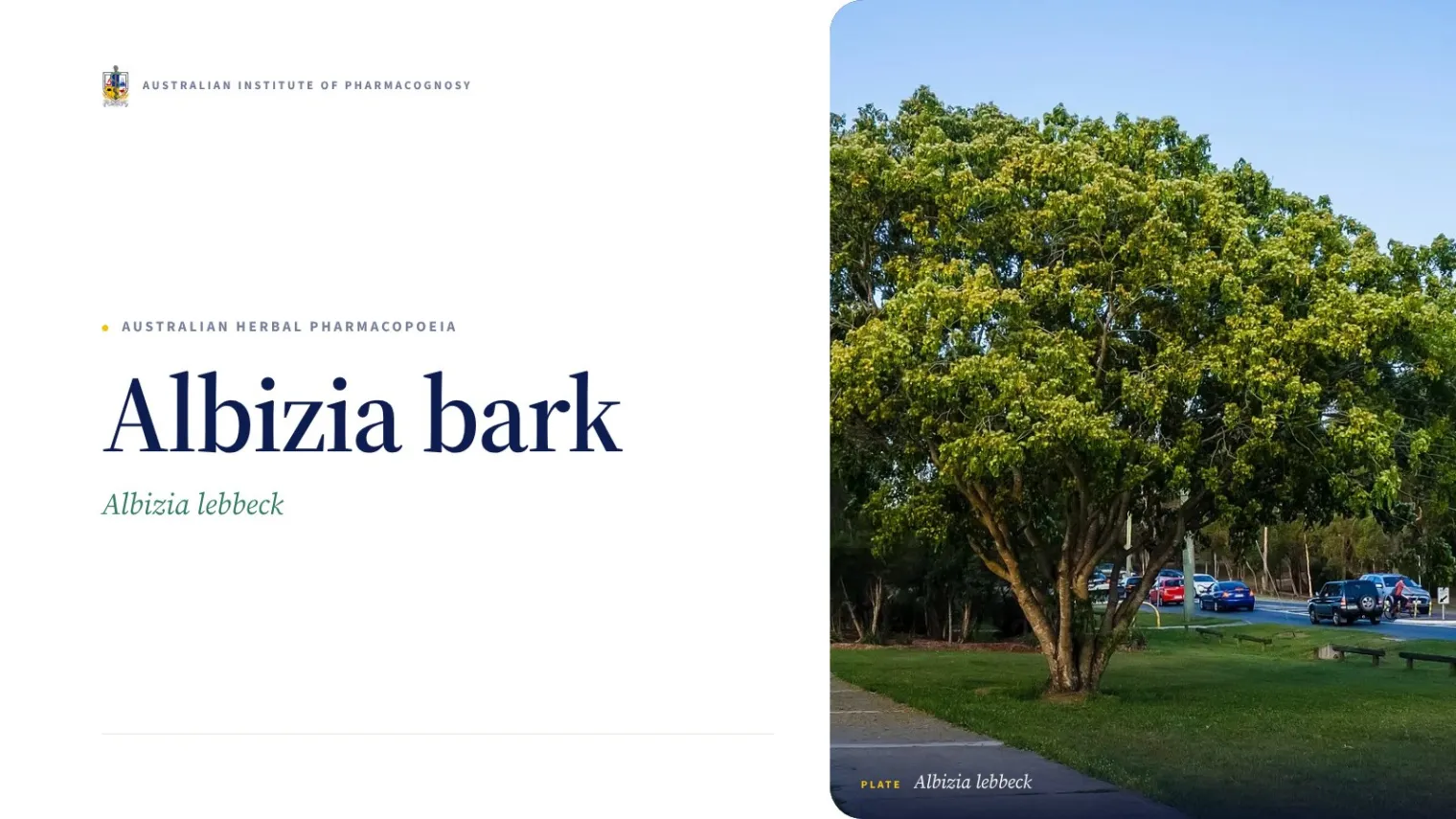
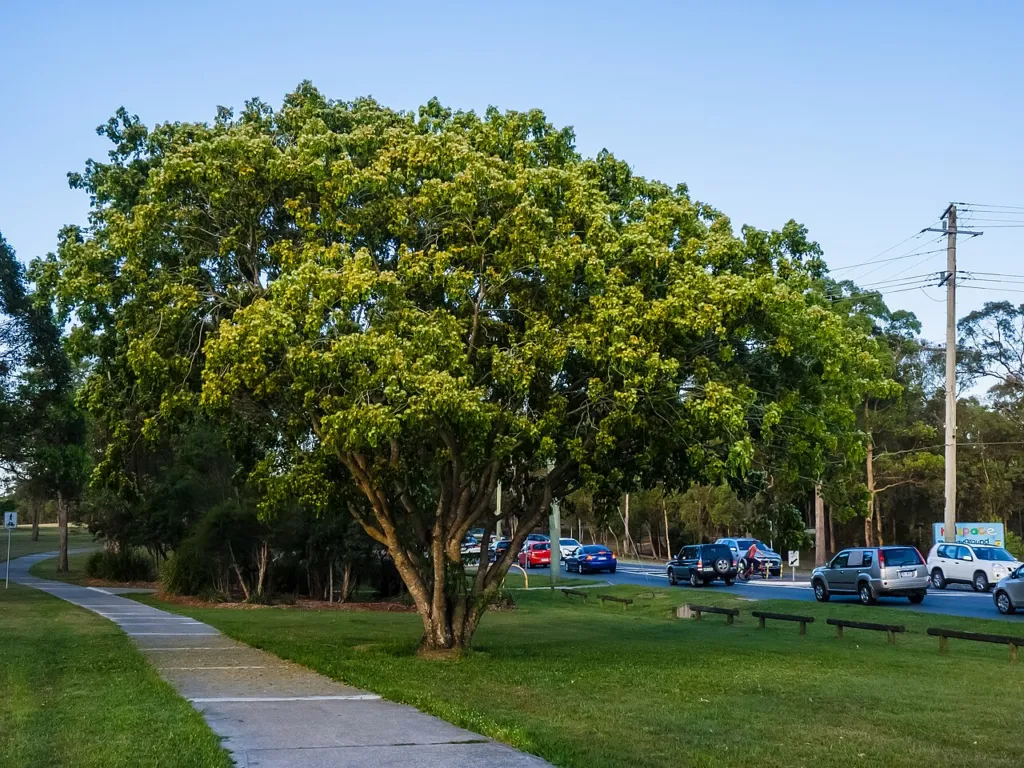
| Provenance | Original AIP data: none. Every analytical figure, limit, method and trial result in this monograph comes from the cited sources. One AIP field photograph (iNaturalist observation 334799306, Burdell QLD, 15/01/2026) illustrates foliage in section 3; its identification is provisional and it is not a voucher [15] |
| Compiler and review | Compiled by Dr Thomas Ridley (Education and Research). Technical review: Dr Fiona MacAllister (Botanical, sections 1-5, 10), reviewed in 2026; Dr Hana Suzuki (QA, sections 6-10), reviewed in 2026; Dr Eleanor Whitcombe (Medicine, sections 12, 13, 15), reviewed in 2026; evidence and citation audit of all references, figure sources and sections 11, 13, 14, 16 to 19 by Dr Thomas Ridley (Education and Research), reviewed in 2026; figure placement, captions, credit lines and page layout (Figures 1 to 18) by Jesse Kirby (Community Outreach), reviewed in 2026. Published: not yet. Last modified: 2026. Version 1.0 draft |
| Canonical URL | /pharmacopoeia/albizia-lebbeck/ (on publication) |
0.2 Summary
Albizia bark is the dried stem bark of Albizia lebbeck, a deciduous legume tree native to the Indian subcontinent and Myanmar and now planted and naturalised throughout the tropics, including northern Australia, where the Australian Plant Census treats the Kimberley and Top End populations as native and the Queensland ones as naturalised [1,2]. It is an official drug of the Ayurvedic Pharmacopoeia of India (Śirīṣa), which is the only pharmacopoeial standard for it: a thick, fissured, astringent bark with stone cells, crystal fibres and prismatic calcium oxalate, identified by a simple TLC system and held to ash and extractive limits [3]. No pharmacopoeia sets an assay. The bark contains tannins and flavan-3-ols and oleanane triterpenoid saponins; which of them, if any, carries the effect claimed for it is not known [3,14,16].
Australian practitioners use it for allergic conditions: hay fever, urticaria, eczema and asthma, usually alongside Baical skullcap [12,13]. That use rests on Ayurvedic tradition and on animal and in vitro work showing mast-cell stabilisation [13,14]. The human evidence is two uncontrolled or unblinded Indian studies in asthma, one of the bark decoction alone and one of a multi-herb confection, both at very low certainty [10,11]. At least two further registered trials of the confection in asthma are recorded as completed but have no report we could trace [32]. A 2026 "systematic review" that reports further trials fails our source check: its trial citations do not exist [17]. Rat studies show antispermatogenic effects of bark extracts and bark saponins, so the main safety question is male fertility, for which there are no human data [14,31].
0.3 Contents and extent
| Section | Pages (approx.) |
|---|---|
| 0 Summary card, summary, contents | 4 |
| 1 Nomenclature | 0.5 |
| 2 Definition | 0.5 |
| 3 Source and Australian supply, 3.1 origin and chemistry | 3 |
| 4 Macroscopy | 2 |
| 5 Microscopy | 2 |
| 6 Chemistry | 2 |
| 7 Named markers and assay limits | 0.5 |
| 8 TLC fingerprint | 1 |
| 9 HPLC fingerprint | 1 |
| 10 Identity, purity, adulterants, contaminants | 2 |
| 11 Traditional use | 0.5 |
| 12 Current practice, preparations and doses | 1.5 |
| 13 Clinical evidence | 4 |
| 14 Pharmacology | 1 |
| 15 Safety | 2 |
| 16–18 Discussion, conclusions, research needed | 3 |
| 19 References | 1 |
| 20 Document control | 1.5 |
Totals (approx.): 33 pages; 18 figures, of which 16 are images (9 photographs, botanical plates and a herbarium sheet; 7 AIP drawings, schematics and charts) and 2 are captioned placeholders; 0 photomicrographs and 0 chromatograms (both AIP bench data pending); 19 tables; 2 human studies graded; 2 sources excluded on the integrity screen; 33 references.
0.4 Contributors and access
Compiled by Dr Thomas Ridley, Head of Education and Research. Section reviews by Botanical (Dr Fiona MacAllister), QA (Dr Hana Suzuki) and Medicine (Dr Eleanor Whitcombe) are complete, the evidence and citation audit by Education and Research is done, and the layout review by Community Outreach (Jesse Kirby) is done; the Librarian and Legal reviews are pending. All are recorded in section 20. The free sample is the first five printed pages; the full text is available to Scholar members and above.
27 more pages follow · 13,649 words, 15 figures, 20 tables
Still to come in this monograph
- 1. Nomenclature
- 2. Definition
- 3. Source and Australian supply
- 3.1 Where it must be grown: origin, climate and chemistry
- 4. Macroscopy
- 5. Microscopy
- 6. Chemistry
- 7. Named markers and assay limits
- 8. TLC fingerprint
- 9. HPLC fingerprint
- 10. Identity, purity, adulterants and contaminants
- 11. Traditional use
- 12. Current practice: use, preparations and doses
- 13. Clinical evidence
- 14. Pharmacology
- 15. Safety
- 16. Discussion
- 17. Conclusions
- 18. Research still needed
- 19. References
- 20. Document control
The rest of this monograph is open to members. One membership covers every members’ feature on the site.
Checking your membership…
Report an error or submit evidence
If something in this monograph is wrong, out of date or missing, tell us and show us the evidence. Every report is logged under the AIP Evidence Charter and assessed on the evidence alone; the outcome is kept on the record, and an upheld report is corrected with a dated notice on this page.
Open the report form
The Institute sets and publishes its own monographs. The catalogue is in Publications.