
Australian Herbal Pharmacopoeia (working title), Monograph AIP-HP 002
Status: version 1.0 draft, live at https://www.australian-pharmacognosy.org/pharmacopoeia/andrographis-paniculata/ as a working document; the page names the stage it is at. Published at first draft under the CEO’s order of 23/09/2026. Botanical review (sections 1-5 and the adulterants in 10), QA review (sections 6-10), Medicine review (sections 12, 13, 15) and the Education and Research evidence and citation audit done 22/09/2026; not reviewed by Legal (internal draft).
Date: 22/09/2026 (AEST). Next review: on sign-off; brought forward to no later than 22/03/2027 because the Australian regulatory position changed on 17/09/2026 (section 15.9).
Prepared by: Dr Thomas Ridley, Head of Education and Research, Australian Institute of Pharmacognosy, Cardwell QLD.
Contributors: Dr Thomas Ridley (library and literature search, registry search, TGA document review, synthesis, drafting, reference verification). Technical review: Dr Fiona MacAllister (Botanical, sections 1-5 and 10), Dr Hana Suzuki (QA, sections 6-10), Dr Eleanor Whitcombe (Medicine, sections 12, 13 and 15), each on record 22/09/2026. Page design and textbook layout: Jesse Kirby (Community Outreach), 22/09/2026. Dr Luke Iggulden set the scope of the series in the CEO directive of 22/09/2026; he did not write this monograph.
Access marker for IT and Community Outreach: everything from here to the line "END OF FREE TEASER" is the free portion (section 0). Everything after it is paid.
0. Free teaser
Names
- Accepted name: Andrographis paniculata (Burm.f.) Wall. ex Nees
- Family: Acanthaceae (APG IV)
- Drug name: Andrographidis herba (dried aerial parts); WHO title Herba Andrographidis
- Basionym: Justicia paniculata Burm.f.
- Synonyms: Justicia latebrosa Russell ex Wall.; Justicia stricta Lam. ex Steud.; Andrographis paniculata var. glandulosa Trimen; Andrographis subspathulata C.B.Clarke (POWO, 22/09/2026)
- English: andrographis; king of bitters; green chiretta; creat
- Ayurveda: kalmegh, bhunimba (Sanskrit and Hindi)
- Unani: kiryat
- Siddha: nilavembu (Tamil)
- Chinese: chuan xin lian
- South-East Asian: fathalaaichon (Thai); sambiloto (Indonesian); xuyen tam lien (Vietnamese)
- Name status: accepted in POWO/WCVP (release of 16/09/2026, read 22/09/2026) and in the Australian Plant Census (checked 22/09/2026); IPNI 45226-1. The MediHerb work list, WHO and Mills and Bone write the authority as "(Burm.f.) Nees".
- Name trap: chiretta and chirayta are also names of Swertia chirayita (Gentianaceae). A label reading "chiretta" does not identify the species (section 1).
Botanical diagram
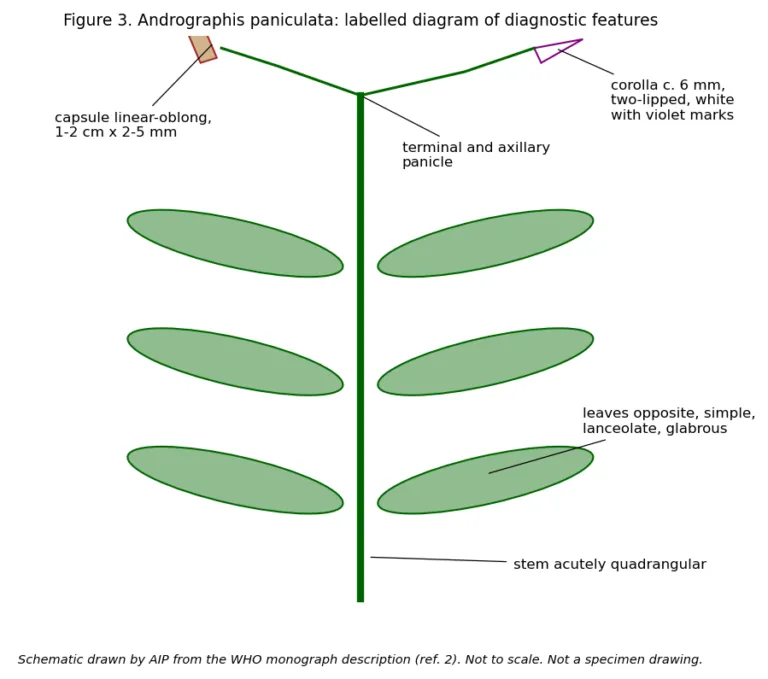
Parts to check (WHO description, ref. 2; section 4 has the full account):
- Stem acutely quadrangular, much branched.
- Leaves simple, opposite, lanceolate, glabrous.
- Inflorescence a terminal and axillary panicle.
- Corolla tube about 6 mm, two-lipped, white with violet markings on the lower lip.
- Capsule erect, linear-oblong, 1-2 cm long, 2-5 mm wide.
- Taste intensely bitter.
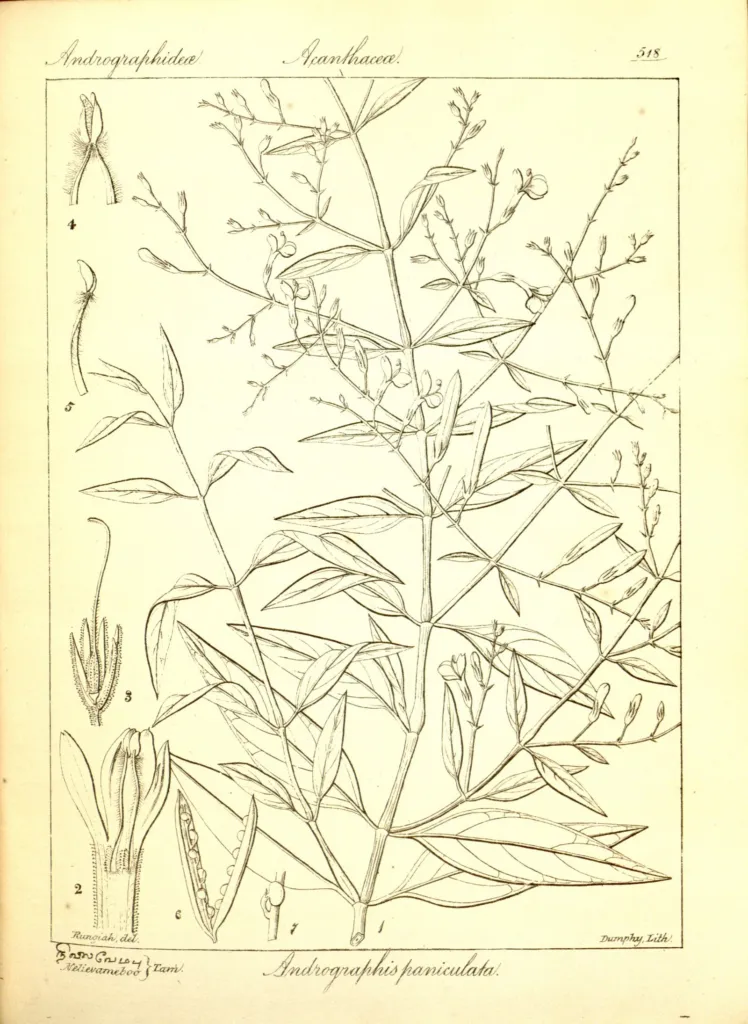
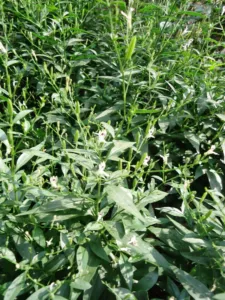
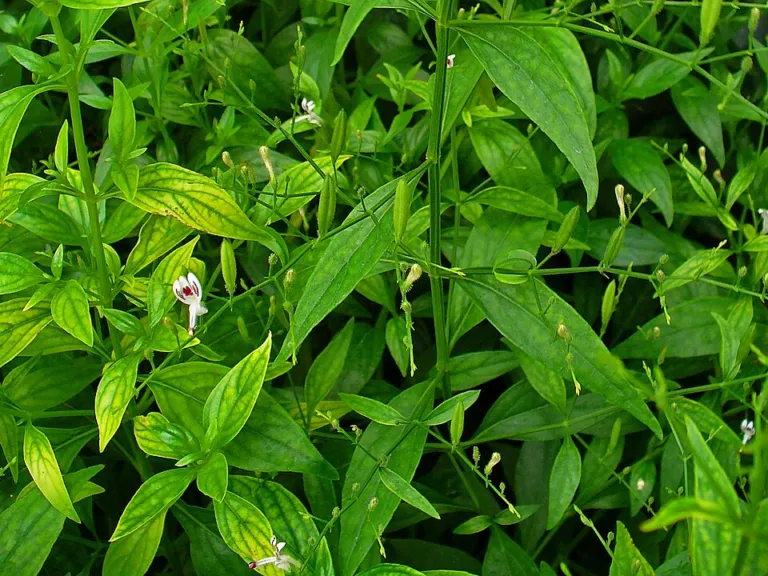
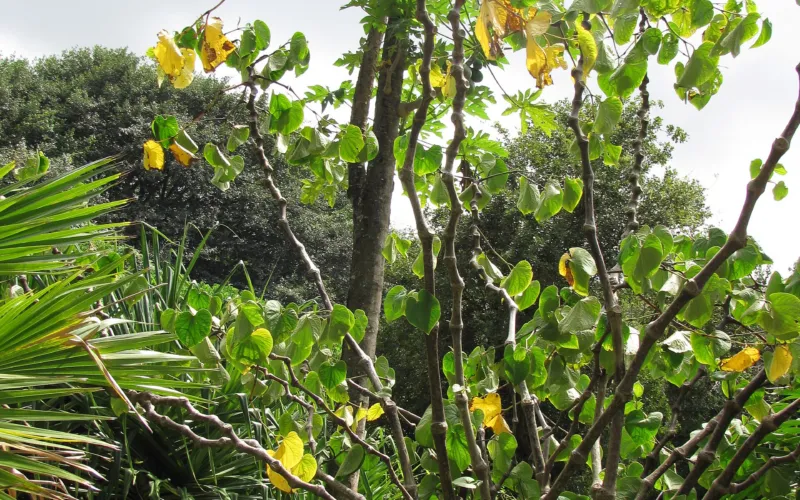
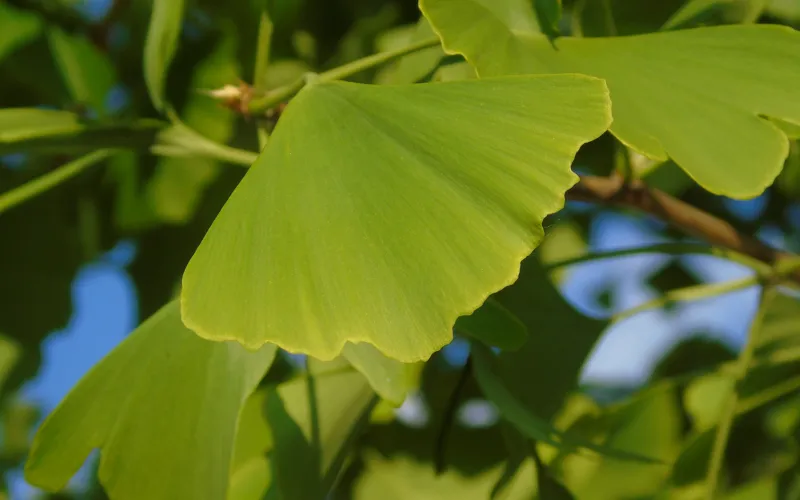
Figures 1-2 (F1, habit). Unaltered Wikimedia Commons photographs of living plants for orientation only; unvouchered and not reference images for identity. Licence record: img/LICENCES.md and img/figures.json.
0.1 Identity card
| Monograph | AIP-HP 002, Andrographis herb. Version 1.0 draft, 22/09/2026. Next review: on sign-off, and no later than 22/03/2027 |
| Pharmacopoeial status | WHO monographs vol. 2 (2002): yes; Chinese Pharmacopoeia: yes (2000 and 2005 English editions cited); Indian Pharmacopoeia: listed (edition not confirmed); Thai Herbal Pharmacopoeia and ASEAN standard: yes; USP-NF: yes, 3 monographs (texts not held); Ph. Eur.: yes, monograph 2712 (text not held) [76]; EMA/HMPC: no EU herbal monograph (2013); BHP 1996: not confirmed. Detail in section 2 |
| Australian status | Removed from the Therapeutic Goods (Permissible Ingredients) Determination on 17/09/2026 because of anaphylaxis risk. New listed medicines can no longer contain it; existing ARTG listings (about 80-86) may be cancelled or recalled. Since 2020, listed products have carried mandatory warnings on allergic reactions and taste disturbance. No Poisons Standard entry found in our search (QA to confirm). Not native; naturalised in the Northern Territory and on Christmas Island; not on the Queensland prohibited or restricted invasive plant lists |
| Assay marker | Total diterpene lactones calculated as andrographolide (CID 5318517): not less than 6.0% on the dried drug (WHO limit, adopted provisionally). Alternative: andrographolide plus 14-deoxy-11,12-didehydroandrographolide not less than 0.80% (Chinese Pharmacopoeia 2000/2005 as cited by Wagner) |
| Identity markers | Andrographolide (CID 5318517), 14-deoxy-11,12-didehydroandrographolide (CID 5708351), neoandrographolide (CID 9848024), 14-deoxyandrographolide (CID 11624161). Stability and age indicator: rising 14-deoxy-11,12-didehydroandrographolide with falling andrographolide |
| Evidence snapshot | Symptom relief in uncomplicated acute upper respiratory tract infection, standardised extracts alone or with Eleutherococcus: Tier B, 33 RCTs pooled in one meta-analysis (7175 participants), low certainty. Prevention of the common cold: Tier C, 1 small RCT. Sore throat and fever against paracetamol: Tier C, 1 RCT. Mild COVID-19: Tier C, 3 RCTs and 2 meta-analyses with conflicting results. Mild to moderate ulcerative colitis (one leaf extract): Tier C, 2 RCTs plus 1 phase III trial stopped for futility. Rheumatoid arthritis: Tier C, 1 RCT. Appetite and digestion (bitter tonic): Tier T. Liver protection: Tier P |
| Main safety point | Anaphylaxis: 287 reports to the TGA to 31/12/2025, one death (2024); unpredictable, often on first use, usually within 30 minutes. Taste loss and taste disturbance are common reports. Avoid in pregnancy |
| Suggested citation | Ridley T. Andrographis herb (Andrographis paniculata (Burm.f.) Wall. ex Nees). Australian Herbal Pharmacopoeia monograph AIP-HP 002 (draft v1.0). Cardwell (QLD): Australian Institute of Pharmacognosy; 2026. DOI to be assigned |
| Compiler and review | Compiled by Dr Thomas Ridley (Education and Research). Technical review: Dr Fiona MacAllister (Botanical, sections 1-5, 10), reviewed 22/09/2026; Dr Hana Suzuki (QA, sections 6-10), reviewed 22/09/2026; Dr Eleanor Whitcombe (Medicine, sections 12, 13, 15), reviewed 22/09/2026; Dr Thomas Ridley (Education and Research, evidence and citation audit of sources for sections 6-9 and of sections 11-19), reviewed 22/09/2026, as compiler, so an independent audit of section 19 by the Librarian is still required. Published: 23/09/2026. Last modified: 22/09/2026. Version 1.0 draft |
| Provenance | Original AIP data: none. Every limit, method, measurement and trial result here comes from the cited pharmacopoeias, regulators and papers; sections 4, 5, 7, 8, 9 and 10 are marked "AIP bench data pending" |
| Canonical URL | /pharmacopoeia/andrographis-paniculata/ |
0.2 Summary
Andrographis is the dried aerial part of a bitter annual herb of the acanthus family, native to southern India and Sri Lanka and grown across tropical Asia. It is used in Ayurveda, Siddha, Unani and Chinese medicine as a bitter, febrifuge and liver remedy, and in Western practice mainly for colds and sore throats.
The drug is identified by its square stems, lanceolate leaves, cystoliths and diacytic stomata under the microscope, and a thin-layer and liquid chromatographic profile of labdane diterpene lactones led by andrographolide. Andrographolide breaks down in storage, so marker content depends on age and handling as well as source.
Trials of standardised extracts show a modest reduction in cold and sore-throat symptoms, but most were small, manufacturer-linked and of poor quality. In Australia the safety picture changed the regulatory position: after 287 reports of anaphylaxis and one death, the TGA removed andrographis from the list of ingredients allowed in listed medicines on 17/09/2026.
Anyone considering it, or already taking it, should consult a degree-qualified herbalist with competencies and adequate training in pharmacognosy.
0.3 Contents and extent (draft)
| Section | Approx. pages |
|---|---|
| 1-3 Nomenclature, definition, source and Australian supply | 2.5 |
| 4-5 Macroscopy and microscopy | 1.5 |
| 6-7 Chemistry, markers and limits | 2.5 |
| 8-9 TLC and HPLC fingerprints | 2 |
| 10 Identity, purity, adulterants, contaminants | 2 |
| 11 Traditional use | 1.5 |
| 12 Current practice and doses | 1.5 |
| 13 Clinical evidence (search, graded trials, registered trials) | 5 |
| 14 Pharmacology | 2 |
| 15 Safety, interactions, pregnancy, Australian regulatory action | 4 |
| 16-18 Discussion, conclusions, research needed | 2.5 |
| 19-20 References and document control | 4 |
| Totals (draft) | @@PAGES@@ A4 pages in the textbook-layout PDF of 22/09/2026 (section page counts above are estimates for the final layout); 27 tables; 14 figures (2 licensed photographs of the living plant, 1 public-domain botanical plate (Wight, t. 518), 4 PubChem structures, 5 AIP schematics each labelled as redrawn from a cited description, 2 AIP data charts). Gaps: figure slots F4 (photomicrographs) and F8 (HPLC chromatogram) are AIP bench data pending; no photomicrograph or chromatogram of our own yet; 24 clinical studies tabulated, 19 with a risk-of-bias judgement; 79 references |
0.4 Contributors and access
Prepared by Dr Thomas Ridley, Head of Education and Research. Reviewed by Botanical, QA and Medicine (22/09/2026); A Legal read is advisory only and does not gate publication (CEO order 22/09/2026). Page design and textbook layout by Community Outreach (Jesse Kirby). The Australian Herbal Pharmacopoeia is AIP’s own series and carries no statutory, TGA or government standing. The first five printed pages are a free sample; the full monograph is for Scholar members (paywall wording to come from Legal and Community Outreach).
33 more pages follow · 16,548 words, 18 figures, 25 tables
Still to come in this monograph
- 1. Nomenclature
- 2. Definition
- 3. Source and Australian supply
- 4. Macroscopy
- 5. Microscopy
- 6. Chemistry
- 7. Named markers and assay limits
- 8. TLC fingerprint
- 9. HPLC fingerprint
- 10. Identity, purity, adulterants and contaminants
- 11. Traditional use
- 12. Current practice: use, preparations and doses
- 13. Clinical evidence
- 14. Pharmacology
- 15. Safety
- 16. Discussion
- 17. Conclusions
- 18. Research still needed
- 19. References
- 20. Document control
The rest of this monograph is open to members. One membership covers every members’ feature on the site.
Checking your membership…
Report an error or submit evidence
If something in this monograph is wrong, out of date or missing, tell us and show us the evidence. Every report is logged under the AIP Evidence Charter and assessed on the evidence alone; the outcome is kept on the record, and an upheld report is corrected with a dated notice on this page.