
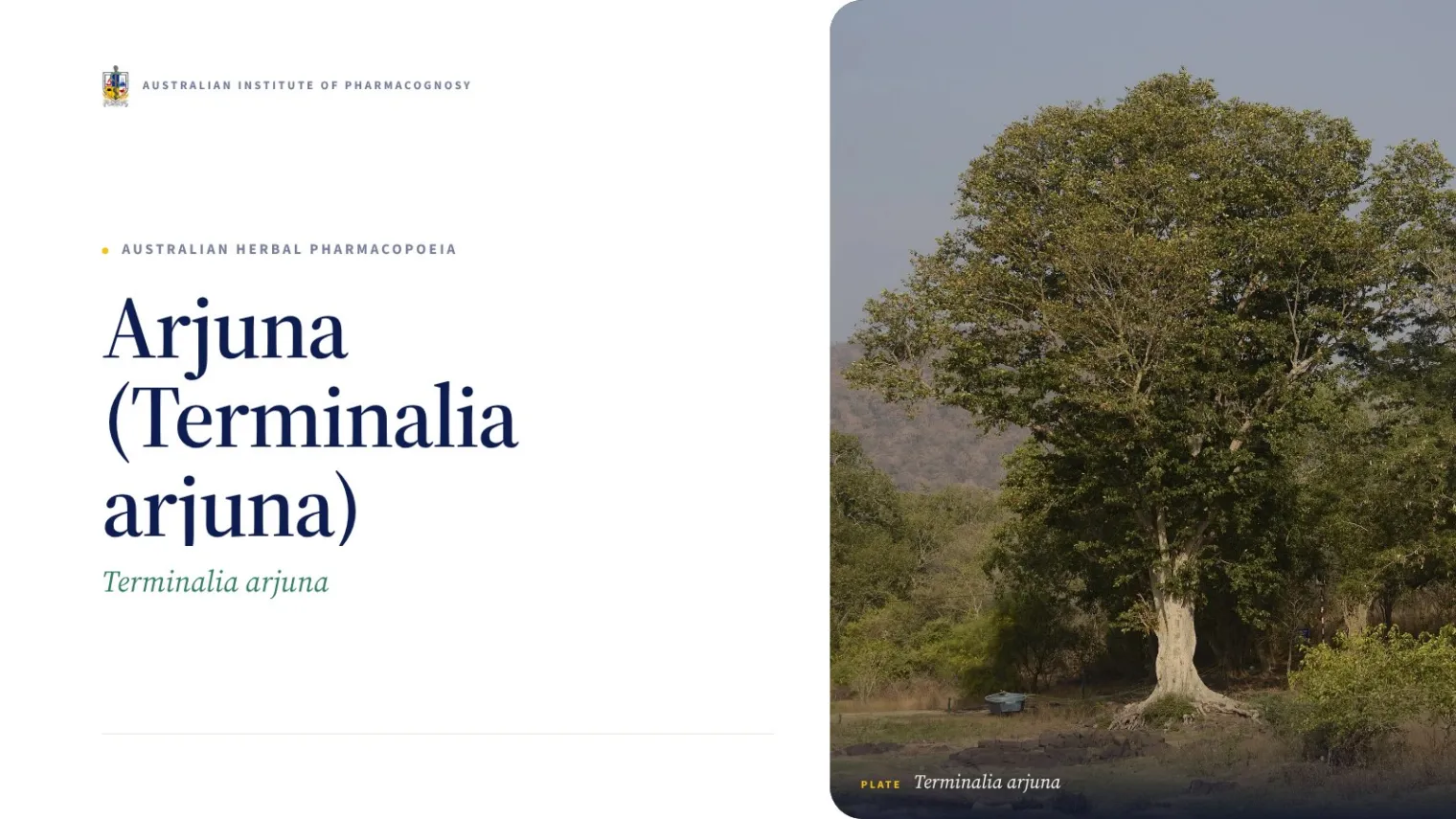
Australian Herbal Pharmacopoeia (working title), monograph AIP-PH-TERARJ (formerly AIP-HP 018)
Version: 1.0 draft
Date: 2026
Status: working document, version 1.0
Prepared by: Dr Thomas Ridley, Head of Education and Research, Australian Institute of Pharmacognosy, Cardwell, Queensland
0. Free-teaser block
0.1 Identity card
| Field | Entry |
|---|---|
| Monograph | AIP-PH-TERARJ (formerly AIP-HP 018), Arjuna bark (Terminalia arjuna (Roxb. ex DC.) Wight & Arn.), Terminaliae arjunae cortex. Version 1.0 draft. Published 2026 (working document); next review 2029, or sooner if a major trial reports |
| Accepted name | Terminalia arjuna (Roxb. ex DC.) Wight & Arn., published 1834 in Wight and Arnott’s Prodromus Florae Peninsulae Indiae Orientalis, vol 1, p 314; accepted in the World Checklist of Vascular Plants 16.0 (the dataset behind Plants of the World Online), IPNI 170962-1, checked 29/09/2026 [1] |
| Family | Combretaceae (APG IV) |
| Plant part | Dried stem bark. Latin drug name Terminaliae arjunae cortex (a descriptive title in pharmacopoeial form; no pharmacopoeia we have read gives this drug a Latin title) |
| Main synonym | Pentaptera arjuna Roxb. ex DC. (basionym); eleven heterotypic synonyms in section 1 [1] |
| Common and traditional names | Arjuna, arjun, arjun myrobalan (English trade use); Sanskrit arjuna, kakubha, pārtha, śvetavāha; Hindi arjuna; Tamil marudam; Telugu maddi [2, 11] |
| Pharmacopoeial status elsewhere | Ayurvedic Pharmacopoeia of India, Part I, Vol. II (1999), monograph 8, Arjuna (stem bark) [2]. No monograph in the Ph. Eur. 8th edition [18] or in WHO Monographs on Selected Medicinal Plants vols 1-4. BP, USP-NF, Chinese Pharmacopoeia and EMA/HMPC: no monograph known to us; not confirmed against current editions. British Herbal Pharmacopoeia: not checked (the AIP reference library holds only a two-page summary of it, without monographs) |
| Australian status | Permissible Ingredients Determination (No. 2) 2026, Schedule 1, item 4870 TERMINALIA ARJUNA: active ingredient only, oral use only, bark only, maximum recommended daily dose 6 g dried bark or extract equivalent, label warnings "Not recommended for use by pregnant and lactating women" and "Not suitable for children" [3]. Not in any Schedule of the Poisons Standard June 2026 [4]. Not native to Australia and not recorded as naturalised [1, 8]. Not prohibited or restricted matter under Queensland biosecurity law [5]. Not CITES-listed [6]. ARTG product entries not checked in this version |
| Named markers | Identity: arjunic acid (CID 15385516), arjungenin (CID 12444386), arjunetin (CID 21152828) by HPTLC [15]; ellagic acid (CID 5281855) and gallic acid (CID 370) by HPLC [14]. No assay limit set by any pharmacopoeia; AIP limit to be set, AIP bench data pending |
| Purity limits in force elsewhere | Foreign matter not more than 2 per cent; total ash not more than 25 per cent; acid-insoluble ash not more than 1 per cent; alcohol-soluble and water-soluble extractives each not less than 20 per cent [2] |
| Evidence snapshot | Chronic stable angina: Tier C, 5 small studies in one systematic review, very low certainty [22]. Chronic heart failure (add-on): Tier C, 2 RCTs, very low certainty [23, 24]. LVEF in healthy adults, one proprietary aqueous extract: Tier B, 1 RCT, low certainty, not carried over to other preparations [26]. Lipids, exercise capacity, type 2 diabetes: Tier C, single small trials [9, 25, 28]. Heart disease, wounds and fractures in Ayurveda: Tier T [2]. Cardioprotection and CYP inhibition: Tier P [9, 15] |
| Main safety point | Extracts inhibit CYP3A4, CYP2D6 and CYP2C9 in human liver microsomes [15], and bark powder prolonged prothrombin time in rabbits and in one old uncontrolled patient series [9], so warfarin and antiplatelet users need monitoring (section 15); people using this drug are usually already taking cardiac medicines. Not for pregnancy, lactation or children under the Australian listing conditions [3] |
| Suggested citation | Australian Institute of Pharmacognosy. AIP-PH-TERARJ: Arjuna bark (Terminalia arjuna (Roxb. ex DC.) Wight & Arn.), Terminaliae arjunae cortex. Australian Herbal Pharmacopoeia (working title). Version 1.0 draft. Cardwell (Qld): AIP; 2026. DOI to be assigned |
| Compiler and review | Compiled by Dr Thomas Ridley (Education and Research). Technical review: Dr Fiona MacAllister (Botanical, sections 1-5, 10), reviewed in 2026; Dr Hana Suzuki (QA, sections 6-10), reviewed in 2026; Dr Eleanor Whitcombe (Medicine, sections 12, 13, 15), reviewed in 2026; Dr Thomas Ridley (Education and Research, citation and evidence audit of all sections, references and figures), reviewed in 2026; Jesse Kirby (Community Outreach, figure placement, captions, credit lines and page layout), reviewed in 2026. Published: not yet. Last modified: 2026. Version 1.0 draft |
| Provenance | Original AIP data: none. Every analytical, clinical and botanical statement comes from the cited pharmacopoeia, literature or database; sections 4, 5, 7, 8, 9 and 10 carry "AIP bench data pending" |
| Canonical URL | /pharmacopoeia/terminalia-arjuna/ (on publication) |
0.2 Summary
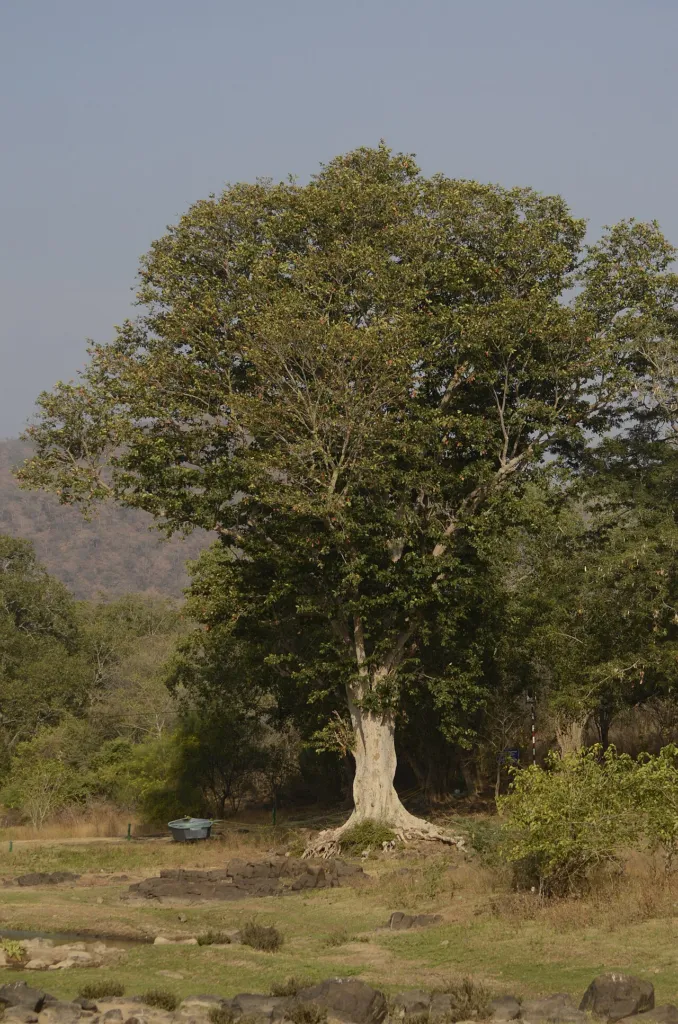
Arjuna is the stem bark of Terminalia arjuna, a large riverside tree of the Indian subcontinent and Sri Lanka, and the best-known heart remedy of Ayurveda [1, 2, 9]. The drug arrives as flat to channelled pieces of bark, grey and fairly smooth outside, pinkish and fibrous inside, bitter and astringent to taste. Under the microscope it shows a thin cork, a wide secondary phloem with rows of fibre groups, and large numbers of calcium oxalate rosettes and crystal idioblasts [2]. Chemically it is a tannin drug with a small triterpene fraction: an aqueous extract was 44 per cent polyphenols and under 1 per cent triterpenes [14]. No pharmacopoeia sets an assay; identity rests on macroscopy, microscopy and a published HPTLC system that resolves arjunic acid, arjungenin and arjunetin [2, 15]. The one official standard, the Ayurvedic Pharmacopoeia of India, gives ash and extractive limits only [2].
The clinical evidence is thin. Five small, high-risk-of-bias studies in stable angina gave no significant pooled benefit [22]; two heart-failure trials suggest improvement in NYHA class without a clear change in ejection fraction [23, 24]; single trials in healthy adults and in diabetes are small or maker-funded [25, 26, 28]. The main safety point is interaction: extracts inhibit three major CYP enzymes in vitro [15], bark powder lengthened prothrombin time in rabbits and in a small uncontrolled patient series [9], and the people who take arjuna are usually on cardiac drugs, warfarin among them.
0.3 Contents with extent
| Section | Pages (approx.) |
|---|---|
| 0 Free-teaser block | 4 |
| 1 Nomenclature | 0.7 |
| 2 Definition | 0.3 |
| 3 Source and Australian supply; 3.1 origin, climate and chemistry | 3 |
| 4 Macroscopy | 2.5 |
| 5 Microscopy | 2 |
| 6 Chemistry | 2 |
| 7 Named markers and assay limits | 1 |
| 8 TLC fingerprint | 1.5 |
| 9 HPLC fingerprint | 1.5 |
| 10 Identity, purity, adulterants and contaminants | 2 |
| 11 Traditional use | 0.5 |
| 12 Current practice | 1.5 |
| 13 Clinical evidence | 5 |
| 14 Pharmacology | 1 |
| 15 Safety | 1.5 |
| 16-18 Discussion, conclusions, research needed | 3 |
| 19 References | 1.5 |
| 20 Document control | 1.5 |
Totals: @@PAGES@@ printed A4 pages in the current layout; 16 figures (15 images plus 1 captioned slot awaiting AIP bench work); 0 AIP photomicrographs; 1 published HPLC chromatogram reproduced under CC BY 4.0 (not an AIP run); TLC shown as a schematic redrawn from published Rf values; 14 tables; 12 clinical studies described and graded by outcome (4 read in full as primary reports, 8 through full-text systematic reviews or reference books) and 3 systematic reviews read in full; 43 references.
Gaps listed openly: F4 (AIP photomicrographs) is pending: no licensed photomicrograph of this drug was found in Wikimedia Commons or in the open-access papers read for this version, and none will be drawn to look like a specimen. F7 is a schematic redrawn from published Rf values; an AIP plate is pending. F8 is a published chromatogram from another laboratory’s method; an AIP chromatogram is pending.
0.4 Contributors and access
Compiled by Dr Thomas Ridley, Head of Education and Research. Technical reviewers are named in the identity card; each is credited once their review is on record. Dr Luke Iggulden set the scope of the pharmacopoeia series; he did not write this monograph. The free sample of this monograph is its first five printed pages; the full text is available to Scholar members and above under the Institute’s personal-use licence.
30 more pages follow · 14,932 words, 14 figures, 13 tables
Still to come in this monograph
- 1. Nomenclature
- 2. Definition
- 3. Source and Australian supply
- 3.1 Where it must be grown: origin, climate and chemistry
- 4. Macroscopy
- 5. Microscopy
- 6. Chemistry
- 7. Named markers and assay limits
- 8. TLC fingerprint
- 9. HPLC fingerprint
- 10. Identity, purity, adulterants and contaminants
- 11. Traditional use
- 12. Current practice: use, preparations and doses
- 13. Clinical evidence
- 14. Pharmacology
- 15. Safety
- 16. Discussion
- 17. Conclusions
- 18. Research still needed
- 19. References
- 20. Document control
The rest of this monograph is open to members. One membership covers every members’ feature on the site.
Checking your membership…
Report an error or submit evidence
If something in this monograph is wrong, out of date or missing, tell us and show us the evidence. Every report is logged under the AIP Evidence Charter and assessed on the evidence alone; the outcome is kept on the record, and an upheld report is corrected with a dated notice on this page.
Open the report form
The Institute sets and publishes its own monographs. The catalogue is in Publications.