
Australian Herbal Pharmacopoeia (working title), Monograph AIP-HP 008
Status: version 1.0 draft, published as a working document at /pharmacopoeia/piper-methysticum/ under the CEO’s order of 23/09/2026, which puts Pharmacopoeia monographs live at first draft with their build status on the page. Botanical, Education and Research and Community Outreach reviews are on record; QA and Medicine edited and signed the text on 23/09/2026 but have not filed their review records (20.5); History and Philosophy (section 11), the Librarian audit and Legal review are still to come.
Date: 23/09/2026 (AEST). Next review: on sign-off, then three-yearly or sooner if a major trial, safety signal or new pharmacopoeial text appears.
Prepared by: Dr Thomas Ridley, Head of Education and Research, Australian Institute of Pharmacognosy, Cardwell QLD.
Contributors: Dr Thomas Ridley (library and literature search, full-text retrieval, registry and regulatory instrument search, synthesis, drafting, figure sourcing and placement, AIP schematics and charts, reference verification). Technical review: Dr Fiona MacAllister (Botanical), Dr Hana Suzuki (QA), Dr Eleanor Whitcombe (Medicine), all 23/09/2026. Jesse Kirby, Head of Community Outreach (page design, figure placement, captions and credit lines, rendered document), 23/09/2026. Dr Luke Iggulden set the scope of the series in the CEO directive of 22/09/2026; he did not write this monograph.
0. Free teaser
0.1 Identity card
| Monograph | AIP-HP 008, Kava root. Version 1.0 draft, 23/09/2026. Next review: on sign-off |
| Accepted name | Piper methysticum G.Forst., Piperaceae Giseke, order Piperales. Protologue: G. Forster, De Plantis Esculentis Insularum Oceani Australis, p. 76 (1786); IPNI 198437-2, type locality Tahiti, inPowo: true [2]. Accepted in the World Checklist of Vascular Plants, read 23/09/2026 through ChecklistBank dataset 2000; WCVP native-range note "Santa Cruz Is. to Vanuatu" [1] |
| Synonyms | Homotypic: Macropiper methysticum (G.Forst.) Miq.; Methysticum methysticum (G.Forst.) A.Lyons. Heterotypic: Methysticum esculentum Raf.; Piper inebrians Bertero ex Miq.; Piper spurium J.R.Forst. ex Miq. (the last two carried by WCVP with nomenclatural status "not established") [1]. "Piper methysticum L.f." is a different, invalid name (nom. inval., Suppl. Pl. 91, dated 1781 and issued April 1782) which WCVP places under Piper latifolium L.f.; it is widely mis-cited as the authority for kava (section 1) [1,2] |
| Drug name | Piperis methystici rhizoma. The article of commerce is the dried, peeled rootstock (stump) with its lateral roots. Australian law defines the permitted part as "root or rhizome", whole or peeled [9,10]. Mills and Bone record that the pithy underground stump "has been erroneously called a rhizome by botanists. Kava has no rhizome" [4] |
| Common names | Kava, kava kava, kava-kava, intoxicating pepper (English); ‘awa (Hawai’i); yaqona (Fiji); ‘ava (Samoa); malohu, maluk, meruk, gea, gi (Vanuatu and Micronesia); wati, waghi (New Guinea); kawa Pfeffer, Rauschpfeffer (German); kava, kawa (French) [3,4,5] |
| Pharmacopoeial status | WHO: yes (Rhizoma Piperis Methystici, WHO monographs on selected medicinal plants vol. 2, 2002, pp. 231-45, library copy [3]). BHP 1996: yes [5]. BHMA 2003: yes [5]. German Commission E: yes, positive monograph, Complete 1998 and Expanded 2000 [5]. Martindale 35th edn: yes [5]. Ph. Eur.: no, no kava monograph in the library copy; QA to confirm against the edition in force [7]. EMA/HMPC: no EU herbal monograph; the HMPC assessment of 2019 concluded a negative benefit-to-risk balance and kava remains banned in Germany [46]. Deutscher Arzneimittel-Codex: indirectly, as the source WHO cites for the 3.5 per cent assay (section 7), and not as a listing seen by AIP [3] |
| Australian status | Poisons Standard: Schedule 4 (Prescription only medicine) — "PIPER METHYSTICUM (kava) in preparations for human use", with a carve-out for ARTG-included listed preparations meeting stated dose, form and labelling limits (Therapeutic Goods (Poisons Standard—June 2026) Instrument 2026) [8]. Permitted in listed medicines under the Therapeutic Goods (Permissible Ingredients) Determination (No. 2) 2026, Schedule 1 item 3932, roles A and H, with a maximum 250 mg kavalactones per day, 125 mg per tablet or capsule, 3 g dried root or rhizome per tea bag, aqueous preparations only for oral use, and a mandatory liver warning above 25 mg per dose [9]. 24 ARTG entries name Piper methysticum, including MediHerb Kava (367710, Integria Healthcare) [11]. Importation is controlled: kava is item 112B in Schedule 4 (Drugs) of the Customs (Prohibited Imports) Regulations 1956, and reg 5F provides a separate commercial permission pathway for kava as a food, in force since 01/12/2021 [10]. Not native to Australia; not a declared weed in Queensland |
| Assay markers | Total kavalactones, the sum of the six majors — kavain (CID 5281565), dihydrokavain (CID 10220256), methysticin (CID 5281567), dihydromethysticin (CID 88308), yangonin (CID 5281575), desmethoxyyangonin (CID 5273621). WHO assay limit: not less than 3.5 per cent kava pyrones on the dried drug by infrared absorption at 1705 ± 5 cm⁻¹ [3]. Good-quality material runs 5.5-8.3 per cent [5] |
| Safety markers | Flavokavain B (CID 5356121) and flavokavains A and C, the chalcones implicated in hepatocyte cytotoxicity in vitro [34,36,38]; pipermethystine (CID 194391), a stem-peeling alkaloid absent from properly prepared root [30]. No numeric upper limit has been set for either by any pharmacopoeia. The FKs/KLs ratio (0.13 in noble varieties, 0.36 in two-day) and the kavain/flavokavain B ratio (7.31 noble, 1.50 two-day) separate noble from non-noble material [24] |
| Purity limits | Foreign organic matter maximum 2 per cent; total ash maximum 8 per cent; acid-insoluble ash maximum 1.5 per cent; water-soluble extractive not less than 5 per cent; loss on drying maximum 12 per cent (WHO vol. 2) [3] |
| Evidence snapshot | Non-psychotic anxiety, standardised acetone/ethanol extract: Tier B — Cochrane review of 11 RCTs, n = 645; the pooled HAM-A estimate comes from the 6 of those trials that reported the scale, weighted mean difference 5.0 points (95% CI 1.1 to 8.8), n = 345, low certainty. The review’s search closed in August 2002 and predates both Australian aqueous-extract trials [18]. Generalised anxiety disorder (DSM-diagnosed), aqueous extract: Tier B and conflicting — one positive 6-week RCT (n = 58, d = 0.62) and one larger negative 16-week RCT (n = 171, favouring placebo by 1.37 points) [12,13]. Elevated non-clinical anxiety, aqueous extract: Tier C — one crossover RCT, n = 60, with an effect size far outside the field [15]. Insomnia, menopausal anxiety, benzodiazepine withdrawal: Tier C. Genitourinary and topical uses: Tier T, traditional only. Anticancer, anticonvulsant: Tier P, preclinical only |
| Main safety point | Kava is a Schedule 4 poison in Australia outside the listed-medicine carve-out, and the reason is the liver. Rare idiosyncratic hepatotoxicity, including hepatic failure, is on record; of 189 reactions in 91 reports held for single-ingredient kava in the WHO Uppsala database to the end of 2005, from nine countries, 55 were liver and biliary disorders, among them three of hepatic failure and two of hepatic coma [5]. The one published Australian case ended in liver transplantation and death [5]. Heavy traditional-style use causes a reversible scaly dermopathy, raised GGT and ALP, low lymphocytes and weight loss [32,33]. Kava potentiates central depressants and inhibits CYP3A4 and CYP1A2 in vitro [42]. Anyone considering kava should consult a degree-qualified herbalist with competencies and adequate training in pharmacognosy |
| Suggested citation | Ridley T. Kava root (Piper methysticum G.Forst.). Australian Herbal Pharmacopoeia monograph AIP-HP 008 (draft v1.0). Cardwell (QLD): Australian Institute of Pharmacognosy; 2026. DOI to be assigned |
| Compiler and review | Compiled by Dr Thomas Ridley (Education and Research). Technical review: Dr Fiona MacAllister (Botanical, sections 1-5 and the adulterant part of 10) reviewed 23/09/2026; Dr Hana Suzuki (QA, sections 6-10) reviewed 23/09/2026; Dr Eleanor Whitcombe (Medicine, sections 12, 13, 15) reviewed 23/09/2026. Independent evidence and citation audit (sections 13, 16, 17, 18 and 19, and the reference, figure-licence and provenance audit across the whole text): Dr Thomas Ridley (Education and Research), reviewed 23/09/2026. Layout and visual review: Jesse Kirby (Community Outreach, free-teaser and whole-document page design, figure placement, captions and credit lines), reviewed 23/09/2026. Published: 23/09/2026. Last modified: 23/09/2026. Version 1.0 draft |
| Provenance | Original AIP data: none. Every limit, method, measurement, assay figure and trial result in this monograph comes from the cited pharmacopoeias, regulators, reference works and papers; sections 4, 5, 7, 8, 9 and 10 are marked "AIP bench data pending" |
| Canonical URL | /pharmacopoeia/piper-methysticum/ |
0.2 Summary
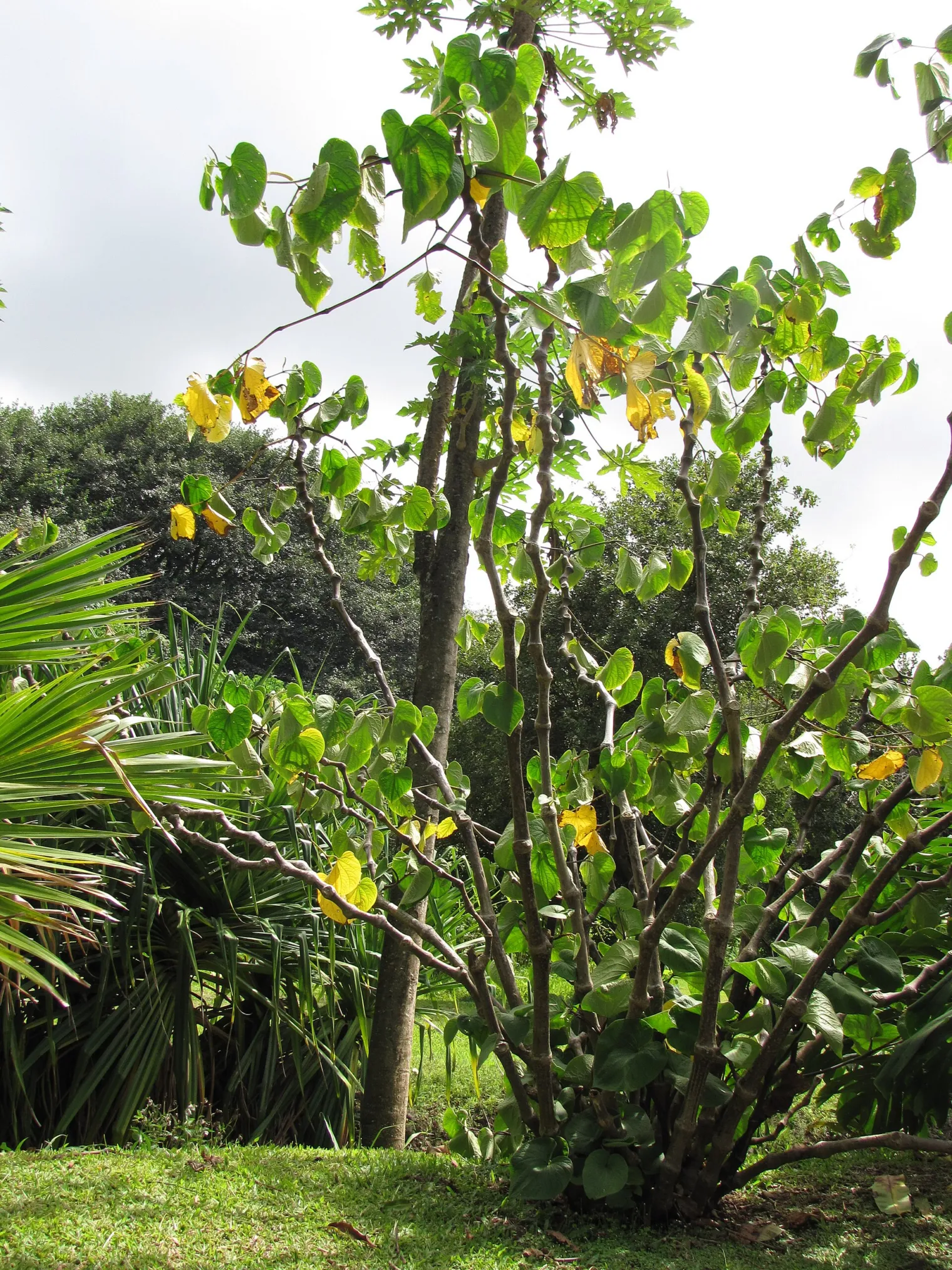
Kava is the dried, peeled underground stump and lateral roots of Piper methysticum, a sterile cultigen of the western Pacific that has been propagated by cuttings for perhaps three thousand years and drunk as a cold-water macerate across Melanesia, Polynesia and Micronesia. Its characteristic constituents are the kavalactones — kavain, dihydrokavain, methysticin, dihydromethysticin, yangonin and desmethoxyyangonin — with the chalcone flavokavains A, B and C as minor and more troublesome companions. The WHO monograph sets the quality standard this monograph follows: at least 3.5 per cent kava pyrones, total ash not more than 8 per cent, acid-insoluble ash not more than 1.5 per cent. Identity rests on the knotted stump with its whitish circular root scars, on a powder with abundant starch and brown resin masses and no calcium oxalate, and on an HPTLC or UHPLC fingerprint of the six kavalactones and three flavokavains. The clinical evidence is real and it is narrower than the reputation: standardised acetone and ethanol extracts beat placebo for non-psychotic anxiety in a Cochrane meta-analysis of 11 trials, while the two Australian trials of an aqueous extract in diagnosed generalised anxiety disorder disagree with each other, the larger and longer one favouring placebo. Australia regulates kava tightly. It is a Schedule 4 poison except in listed medicines that hold to 250 mg of kavalactones a day from an aqueous preparation of the peeled root, and importation needs a permit. Anyone considering kava should consult a degree-qualified herbalist with competencies and adequate training in pharmacognosy.
0.3 Contents and extent (draft)
| Section | Approx. pages |
|---|---|
| 1-3 Nomenclature, definition, source and Australian supply (1 map, 2 photographs) | 6 |
| 3.1 Origin, climate and chemistry: where it must be grown (1 chart, 5 tables) | 5 |
| 4-5 Macroscopy and microscopy (6 figures, 2 pending slots) | 5 |
| 6-7 Chemistry, markers and limits (11 structures, 1 chart) | 6 |
| 8-9 HPTLC and UHPLC fingerprints (2 AIP schematics, 2 licensed published figures) | 5 |
| 10 Identity, purity, adulterants, contaminants | 4 |
| 11 Traditional use (1 historical plate) | 4 |
| 12 Current practice and doses (1 chart) | 3 |
| 13 Clinical evidence (search, graded trials, registries, 1 evidence chart) | 7 |
| 14 Pharmacology and pharmacokinetics | 5 |
| 15 Safety, interactions, pregnancy | 7 |
| 16-18 Discussion, conclusions, research needed | 5 |
| 19-20 References and document control | 5 |
| Totals (draft) | 53 A4 pages; 28 tables; 30 embedded figures (4 licensed photographs, 3 public-domain images, 11 PubChem structures, 2 licensed CC BY 4.0 figures from the source papers (the published HPTLC plate and the published UHPLC chromatogram, each credited to its authors), 4 AIP schematics each labelled "schematic redrawn" or "schematic replot", 1 AIP map, 5 AIP data charts). Photomicrographs: none — AIP bench data pending, and no openly licensed photomicrograph of Piper methysticum root transverse section or powder was found on Wikimedia Commons or in an open-access paper on 23/09/2026, so slot F4 stays open. Two captioned "AIP bench data pending" placeholder boxes mark bench work still to be done: Figures 10a (vouchered macroscopy, section 4) and 11a (photomicrographs, section 5). The section 8 and section 9 slots are now filled with the published plate and the published chromatogram, reproduced under CC BY 4.0 and credited to their authors; AIP’s own plate and run are still outstanding and are noted as such under each figure. Chromatograms: none measured by AIP. Figures 24 and 25 are AIP schematics drawn from published method text and published retention factors; Figures 24a and 25a are the source papers’ own plate and chromatogram, reproduced under their CC BY 4.0 licences. Trials graded: 5 trials graded individually, 4 syntheses graded, 11 further RCTs graded through the Cochrane review, 26 registry records (4 ANZCTR, 16 ClinicalTrials.gov, 3 ISRCTN, 1 ChiCTR, 1 CTRI, 1 IRCT). 76 reference entries (numbered 1-68, with eight lettered additions), of which 55 are PubMed-indexed papers, each re-opened and verified at source on 23/09/2026; six of the 76 support no claim and are marked as such. |
0.4 Contributors and access
Prepared by Dr Thomas Ridley, Head of Education and Research. Botanical, QA, Medicine and Community Outreach reviews complete; who covered what is in 0.1 and 20.3. History and Philosophy (section 11) and the Librarian audit pending. A Legal read is advisory only and does not gate publication (CEO order 22/09/2026). The Australian Herbal Pharmacopoeia is AIP’s own series and carries no statutory, TGA or government standing. Access to the full monograph beyond the free sample follows the membership rules set by the CEO (paywall wording to come from Legal and Community Outreach).
62 more pages follow · 31,084 words, 29 figures, 27 tables
Still to come in this monograph
- 1. Nomenclature
- 2. Definition
- 3. Source and Australian supply
- 3.1 Where it must be grown: origin, climate and chemistry
- 4. Macroscopy
- 5. Microscopy
- 6. Chemistry
- 7. Named markers and assay limits
- 8. TLC fingerprint
- 9. HPLC fingerprint and assay
- 10. Identity, purity, adulterants and contaminants
- 11. Traditional use
- 12. Current practice: use, preparations and doses
- 13. Clinical evidence
- 14. Pharmacology
- 15. Safety
- 16. Discussion
- 17. Conclusions
- 18. Research still needed
- 19. References
- 20. Document control
The rest of this monograph is open to members. One membership covers every members’ feature on the site.
Checking your membership…
Report an error or submit evidence
If something in this monograph is wrong, out of date or missing, tell us and show us the evidence. Every report is logged under the AIP Evidence Charter and assessed on the evidence alone; the outcome is kept on the record, and an upheld report is corrected with a dated notice on this page.