
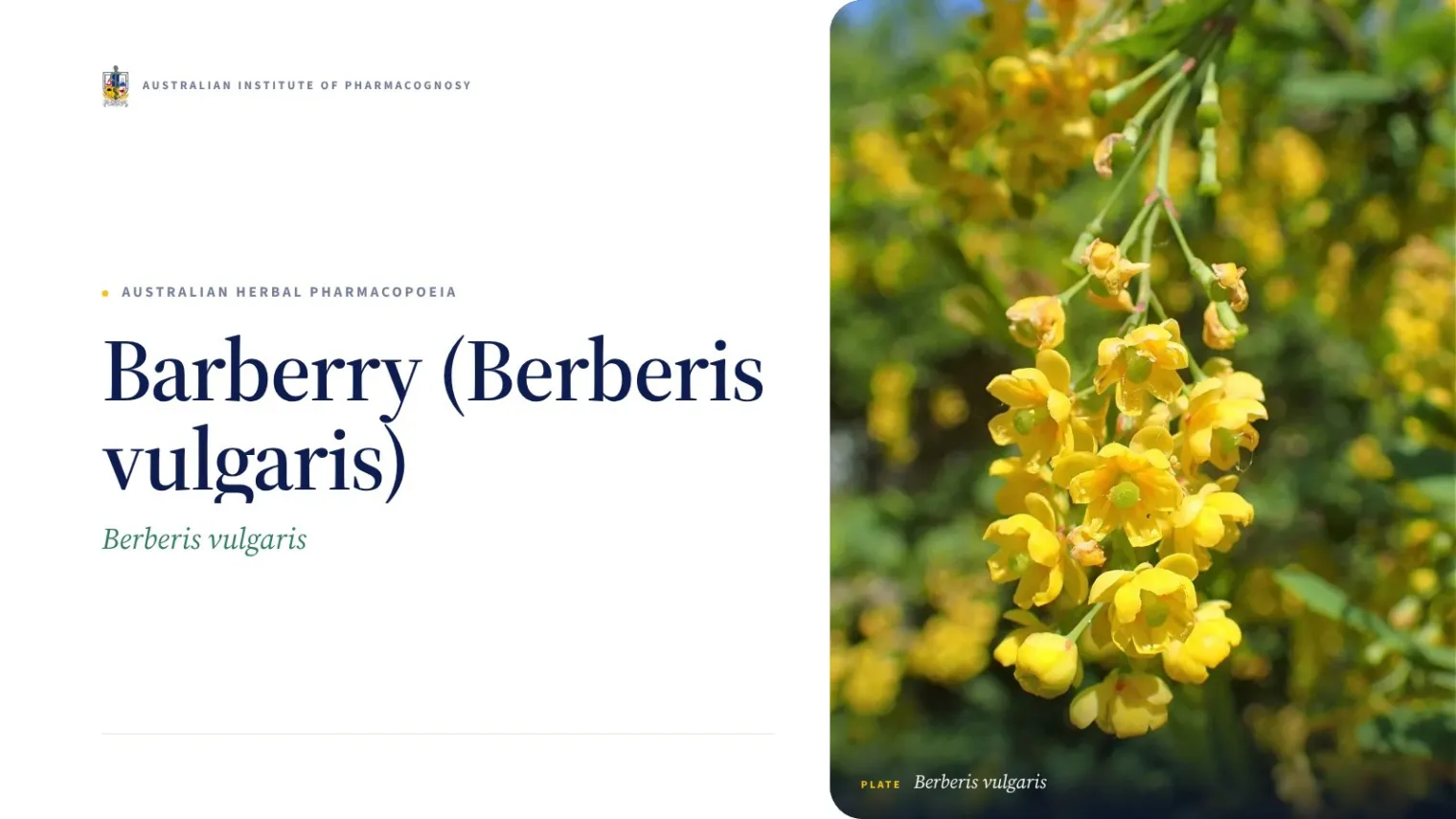
Barberry bark (Berberis vulgaris L.), Berberidaceae
Australian Herbal Pharmacopoeia (working title) · Monograph AIP-PH-BERVUL · Version 1.0 draft
Date: 2026
Status: working document, version 1.0. Not a statutory standard.
Prepared by: Dr Thomas Ridley, Head of Education and Research, Australian Institute of Pharmacognosy, Cardwell, Queensland.
0. Free-teaser block
0.1 Identity card
| Register number | AIP-PH-BERVUL (MediHerb A–Z list No. 12) |
| Title | Barberry bark (Berberis vulgaris L.), Berberidis cortex |
| Version / year | 1.0 draft, 2026. Next review 2029, or sooner if a controlled trial of the bark itself reports, or if an Australian regulator acts on berberine |
| Accepted binomial | Berberis vulgaris L., Species Plantarum: 330 (1753). Accepted in the World Checklist of Vascular Plants (WCVP) version 16.0, read through ChecklistBank on 29/09/2026; IPNI 328527-2 [2] |
| Family | Berberidaceae, order Ranunculales, as placed in APG IV, which WCVP follows for flowering-plant families [2,3,54]; no family change affects the genus |
| Plant part | Dried bark of the root, with or without the bark of the stem and larger branches. MediHerb lists the part as "Bark" [4]; Bone and Mills give "root or stem bark" and note that commercial root bark may contain branch and stem bark [3] |
| Latin drug name | Berberidis cortex [3]; Berberidis radicis cortex where the drug is root bark only [5] |
| Principal synonyms | Berberis racemosa Stokes (homotypic; an illegitimate, superfluous name) [2]. Two subspecies are accepted besides the type: subsp. australis (Boiss.) Heywood and subsp. seroi O.Bolòs & Vigo [2] |
| Common names | English: barberry, common barberry, European barberry, jaundice berry, pipperidge. German: Berberitze, Sauerdorn. French: épine-vinette, vinettier. Italian: berberi. Danish: almindelig berberis [3,5] |
| Pharmacopoeial status elsewhere | British Herbal Pharmacopoeia 1996: yes, "Barberry Bark", as listed by Trease and Evans [6]; the 1983 edition carried it too [3]. UK General Sale List: yes [3,6]. German Commission E: negative monograph [3]. Ph. Eur.: no monograph for the bark in the 8.0 edition read [7]. No USP–NF, WHO, EMA/HMPC, Japanese or Chinese monograph for this species was found in the sources read |
| Australian status | Permissible Ingredients Determination: yes, item 829 BERBERIS VULGARIS, purposes A, E and H, no requirements in column 4 [8]. Poisons Standard: neither the plant nor berberine is named [9]. Introduced: 41 Atlas of Living Australia records, from New South Wales, Tasmania, the ACT and South Australia, none from Queensland [10]; described as sparingly naturalised on the southern tablelands of New South Wales and possibly in Tasmania, and an alternate host of wheat stem rust [11]. Not named in the Biosecurity Regulation 2016 (Qld) [12]. Not native, so no Nature Conservation Act 1992 (Qld) permit applies |
| Named markers | Berberine (CID 2353): identity (TLC) and assay (HPLC) marker; no limit set by any pharmacopoeia for this drug; reported at up to 6 per cent of root bark and 2.44 per cent of whole dried root (as berberine chloride) [3,13]. Palmatine (CID 19009) and jatrorrhizine (CID 72323): identity only, no limit. An AIP berberine limit is proposed as research (sections 7, 18) |
| Evidence snapshot | Barberry root preparation in antipsychotic-induced metabolic syndrome: Tier C, 1 RCT (88 analysed), very low certainty, no benefit [14]. Isolated berberine for type 2 diabetes and blood lipids: Tier B for berberine only, many RCTs, low certainty, not transferable to the bark at practitioner doses [15,16]. Isolated berberine for acute infectious diarrhoea: Tier B for berberine only, 38 RCTs, low certainty [17]. Bitter tonic, cholagogue and "sluggish liver", topical mouth and eye use: Tier T [3,4,18]. Antimicrobial and metabolic mechanisms: Tier P [3]. Two further root trials in type 2 diabetes are known and not graded (section 13). No controlled trial has tested the bark as Australian practitioners dispense it |
| Suggested citation | Ridley T. Barberry bark (Berberis vulgaris L.), Berberidis cortex. AIP-PH-BERVUL, version 1.0 draft. Cardwell: Australian Institute of Pharmacognosy; 2026. DOI to be assigned |
| Provenance | Original AIP data: none. Every analytical figure, limit, method and trial result belongs to the source cited beside it. Sections 4, 5, 7, 8, 9 and 10 carry AIP bench data pending (no AIP voucher, section, plate or run yet). The distribution map (Figure 9), charts (Figures 10 to 13) and drawings (Figures 5 and 6) are AIP drawings from cited data |
| Compiler and review | Compiled by Dr Thomas Ridley (Education and Research). Technical review: Dr Fiona MacAllister (Botanical, sections 1-5, 10), reviewed in 2026; Dr Hana Suzuki (QA, sections 6-10), reviewed in 2026; Dr Eleanor Whitcombe (Medicine, sections 12, 13, 15), reviewed in 2026; Dr Thomas Ridley (Education and Research, evidence and citation audit of the whole document, done by the compiler and so not independent), reviewed in 2026; Jesse Kirby (Community Outreach, whole-document layout, figure placement, captions and credit lines), reviewed in 2026. Published: not yet. Last modified: 2026. Version 1.0 draft |
| Canonical URL | /pharmacopoeia/berberis-vulgaris/ (on publication) |
0.2 Summary
Barberry bark is the dried bark of the root, and sometimes of the stem, of the common or European barberry, a spiny deciduous shrub native from Europe to western and northern Iran. It is imported into Australia. The plant is sparingly naturalised in south-eastern Australia and is an alternate host of wheat stem rust, so it has no place in a Queensland planting.
The drug is bright yellow inside and intensely bitter because of its isoquinoline alkaloids, chiefly berberine, with palmatine, jatrorrhizine, magnoflorine and the bisbenzylisoquinolines berbamine and oxyacanthine. Berberine is the identity and assay marker, but no pharmacopoeia in force sets a limit for it in this drug, and published contents range over several hundredfold between parts, origins and methods.
Australian practitioners use a 1:2 liquid extract at 20 to 40 mL a week as a bitter tonic and cholagogue, and topically for mouth ulcers, skin and eyes. That use rests on Eclectic and British tradition. The large clinical literature concerns isolated berberine at 0.9 to 1.5 g a day, many times what bark supplies; the one trial of a barberry root preparation graded here found no benefit, and two further root trials in type 2 diabetes have not yet been graded. Berberine raises ciclosporin levels and inhibits CYP2D6, CYP2C9 and CYP3A4, and the drug is contraindicated in pregnancy, breastfeeding and neonatal jaundice.
0.3 Contents with extent
| Section | Extent (A4 pages, estimated for the first printing) |
|---|---|
| 0 Free-teaser block | 4 |
| 1 Nomenclature | 1 |
| 2 Definition | 1 |
| 3 Source and Australian supply, with 3.1 origin, climate and chemistry | 3 |
| 4 Macroscopy | 3 |
| 5 Microscopy | 2 |
| 6 Chemistry | 2 |
| 7 Named markers and assay limits | 1 |
| 8 TLC fingerprint | 2 |
| 9 HPLC fingerprint | 2 |
| 10 Identity, purity, adulterants and contaminants | 2 |
| 11 Traditional use | 2 |
| 12 Current practice | 2 |
| 13 Clinical evidence | 3 |
| 14 Pharmacology | 2 |
| 15 Safety | 3 |
| 16–18 Discussion, conclusions, research needed | 3 |
| 19 References | 3 |
| 20 Document control | 2 |
| Totals (draft) | About 40 A4 pages. 33 embedded figures: 12 licensed or public-domain photographs (3 of the crude drug), 10 public-domain plates and drawings, 1 licensed photomicrograph (genus level), 1 licensed HPTLC plate and 2 licensed HPLC chromatograms (all of B. vulgaris material), 1 AIP composite of PubChem structures and 6 AIP drawings and charts. About 20 tables. 0 AIP photomicrographs, 0 AIP chromatograms, 0 AIP plates. 1 trial of the drug graded with RoB 2 and 4 outcomes graded with GRADE; berberine and fruit evidence summarised from systematic reviews; 3 trial registers searched (ClinicalTrials.gov, ANZCTR, WHO ICTRP) and the TGA adverse-event database searched. 59 numbered references |
Gaps stated plainly. AIP holds no voucher, photomicrograph, TLC plate or chromatogram of barberry bark. No pharmacopoeia in force publishes a microscopy, TLC or assay standard for this species, so sections 5, 8 and 9 rest on a genus-level anatomy paper, pharmacopoeial berberine methods written for goldenseal and Coptis, and two published analyses of B. vulgaris root. The one randomised trial of a barberry root preparation graded here is small and its preparation was not characterised. Three more are known: root-extract trials in opiate withdrawal and in type 2 diabetes, both being obtained in full text, and a type 2 diabetes trial of capsules whose content cannot be identified from the paper; none is graded. Four registered root or extract studies have no results found in PubMed. The trial registers and the TGA adverse-event database were searched on 30/09/2026 (sections 13 and 15). The Commonwealth import conditions for dried barberry bark have not been read and are to be confirmed before any AIP import.
0.4 Contributors and access
Compiled by Dr Thomas Ridley, Head of Education and Research. Dr Fiona MacAllister, Head of Botanical, has reviewed sections 1–5 and 10 (names, sources, figures and adulterant species). Dr Hana Suzuki, Head of Botanical QA, has reviewed sections 6–10 (constituents, markers, limits, TLC and HPLC methods, purity and contaminant tests, and Figures 6 to 8b). Dr Eleanor Whitcombe, Head of Medicine, has reviewed sections 12, 13 and 15 (doses, trial grading, registry and adverse-event searches, safety and interactions, and Figures 10, 11 and 13). Dr Thomas Ridley, Head of Education and Research, has audited every reference, PMID and DOI and the evidence record against the sources; he is also the compiler, so that audit is not independent, and the Librarian’s reference audit remains the independent check. Jesse Kirby, Head of Community Outreach, has reviewed the layout of the whole document: where each figure sits, its caption and its credit line against the image record, and the printed page design. The History and Philosophy check of section 11 is pending, as are the Librarian’s reference audit and Legal’s advice before release. Dr Luke Iggulden set the scope of the pharmacopoeia series; he did not write this monograph. The free sample is the first five printed pages; the full text is available to Scholar members and above.
33 more pages follow · 16,416 words, 31 figures, 11 tables
Still to come in this monograph
- 1. Nomenclature
- 2. Definition
- 3. Source and Australian supply
- 4. Macroscopy
- 5. Microscopy
- 6. Chemistry
- 7. Named markers and assay limits
- 8. TLC fingerprint
- 9. HPLC fingerprint
- 10. Identity, purity, adulterants and contaminants
- 11. Traditional use
- 12. Current practice: use, preparations and doses
- 13. Clinical evidence
- 14. Pharmacology
- 15. Safety
- 16. Discussion
- 17. Conclusions
- 18. Research still needed
- 19. References
- 20. Document control
The rest of this monograph is open to members. One membership covers every members’ feature on the site.
Checking your membership…
Report an error or submit evidence
If something in this monograph is wrong, out of date or missing, tell us and show us the evidence. Every report is logged under the AIP Evidence Charter and assessed on the evidence alone; the outcome is kept on the record, and an upheld report is corrected with a dated notice on this page.
Open the report form
The Institute sets and publishes its own monographs. The catalogue is in Publications.