
Australian Herbal Pharmacopoeia (working title), monograph AIP-HP 017
Date: 2026
Status: working document, version 1.0
Prepared by: Dr Thomas Ridley, Head of Education and Research, Australian Institute of Pharmacognosy, Cardwell, Queensland
0. Summary card, summary and contents
0.1 Identity card
| Field | Entry |
|---|---|
| Monograph | AIP-HP 017, version 1.0 draft. Published 2026; next review due 2029, or sooner if a controlled trial of aloes alone reports or a regulator changes its position on hydroxyanthracene derivatives |
| Title | Aloes resin (Aloe ferox Mill. and Aloe vera (L.) Burm.f.), Aloes folii succus siccatus |
| Accepted names | Aloe ferox Mill. (Cape aloes) and Aloe vera (L.) Burm.f. (Barbados or Curaçao aloes), Asphodelaceae, order Asparagales. Both accepted in WCVP (checked 29/09/2026) [1]. The trade name "Aloe spp." covers these two sources and the hybrids of A. ferox named by the pharmacopoeias [4,5] |
| Plant part | Concentrated and dried juice (exudate) that drains from the cut leaves: dark brown masses or powder [4]. Trade name in Australian practice: aloes resin [2] |
| Principal synonyms | Aloe barbadensis Mill. (the name used by Ph. Eur., the EU monograph and the Permissible Ingredients Determination for A. vera); Aloe horrida Haw., A. pseudoferox Salm-Dyck, A. supralaevis Haw. (for A. ferox) [1,3,4,6] |
| Common names | Aloes, Cape aloes, bitter aloe, Barbados aloes, Curaçao aloes; Afrikaans bitteraalwyn; Indian names ghrita kumari, kumari, ghikuar; Chinese lu wei, lo-hoei [5] |
| Status in pharmacopoeias | Ph. Eur.: yes, monographs 0257 Aloes, Barbados; 0258 Aloes, Cape; 0259 Aloes dry extract, standardised (8th Edition read) [4]. Japanese Pharmacopoeia 18th edn: Aloe and Powdered Aloe (Cape type) [11]. WHO Monographs vol. 1: Aloe [5]. EU/HMPC: EU herbal monograph, well-established use, 2016 [6]. USP, BP, BHP 1996: listed by the HMPC and by Barnes; texts not read for this version [7,9] |
| Australian status | Permissible Ingredients Determination items 480 ALOE FEROX (purposes A, E, H), 481 ALOE PERRYI (A, H), 482 ALOE VERA (A, E, H) and 483 ALOES CAPE (A, H): for oral use, hydroxyanthracene derivatives calculated as anhydrous barbaloin are a mandatory component, with laxative warning statements set by dose [3]. Not in the Poisons Standard [12]. A. vera introduced in Queensland; A. ferox not recorded as established in Australia [1,15]. A. ferox is in CITES Appendix II; A. vera is not listed [13] |
| Named markers | Hydroxyanthracene derivatives expressed as barbaloin: not less than 28.0 per cent (Barbados), not less than 18.0 per cent (Cape), dried drug, Ph. Eur. spectrophotometric assay [4]. Barbaloin by HPLC: not less than 4.0 per cent, JP18 (Cape type) [11]. Identity: barbaloin, aloesin and aloinosides A and B (Cape) or the violet 7-hydroxyaloin zone (Barbados) by TLC [4] |
| Evidence snapshot | Short-term relief of occasional constipation, aloes alone: Tier T for the use and Tier P for the mechanism; no controlled trial of aloes alone exists; accepted in the EU as well-established use on marketing history and pharmacology [6,7]. Chronic constipation, celandine-aloe-psyllium capsules: Tier C, 1 small RCT of a three-herb product, very low certainty [7]. Blood glucose in type 2 diabetes: Tier C, 1 uncontrolled series of 5 patients [7,9]. Colorectal cancer risk with anthranoid laxatives: observational class data, inconsistent [7] |
| Suggested citation | Australian Institute of Pharmacognosy. Aloes resin (Aloe ferox Mill. and Aloe vera (L.) Burm.f.), Aloes folii succus siccatus. Australian Herbal Pharmacopoeia (working title), AIP-HP 017, version 1.0. Cardwell, QLD: AIP; 2026. DOI to be assigned |
| Provenance | Original AIP data: none. Every analytical figure, limit, method and trial result in this monograph comes from the cited sources; the distribution map, the dose comparison and the evidence map are drawn by AIP from published data, and the schematics are redrawn from pharmacopoeial descriptions |
| Compiler and review | Compiled by Dr Thomas Ridley (Education and Research). Technical review: Dr Fiona MacAllister (Botanical, sections 1-5 and adulterants in 10), reviewed in 2026; Dr Hana Suzuki (QA, sections 6-10), reviewed in 2026; Dr Eleanor Whitcombe (Medicine, sections 12, 13, 15), reviewed in 2026. Evidence and citation audit: Dr Thomas Ridley (Education and Research; the compiler, so not independent), reviewed in 2026. Layout review: Jesse Kirby (Community Outreach, whole-document layout and figures), reviewed in 2026. Published: not yet. Last modified: 2026. Version 1.0 draft |
| Canonical URL | /pharmacopoeia/aloe-spp/ (on publication) |
0.2 Summary
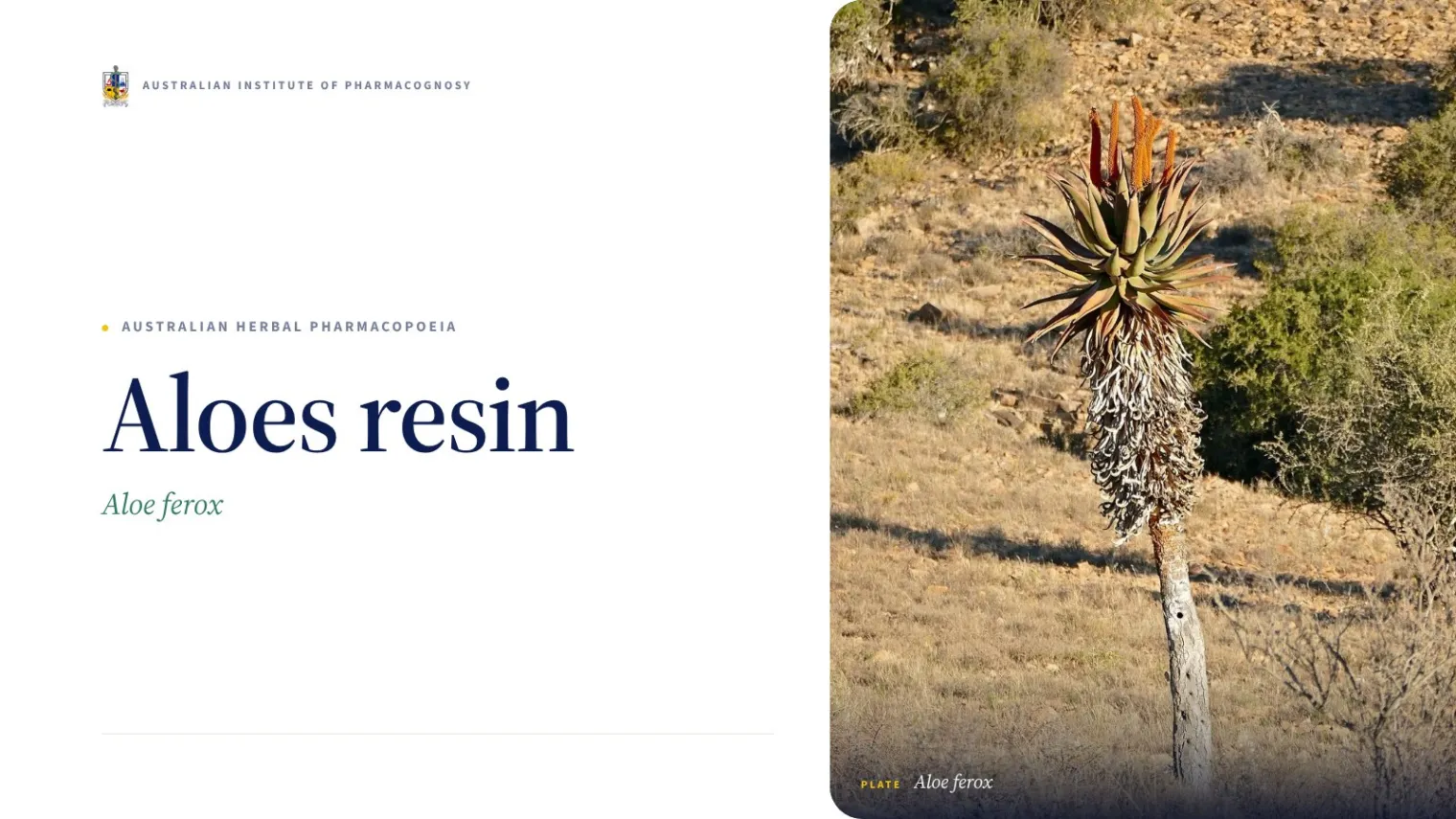
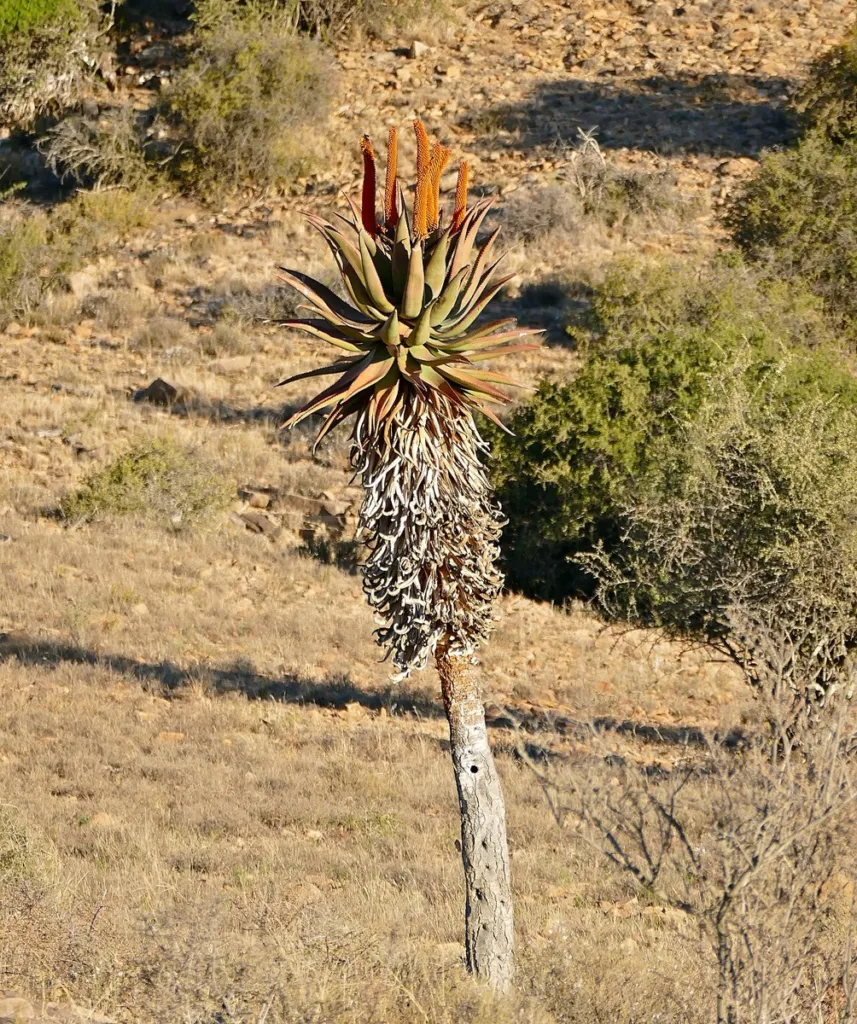
Aloes is the bitter yellow juice that drains from the cut leaves of two aloes, boiled down and left to set into dark brown masses. Cape aloes comes from wild Aloe ferox in South Africa; Barbados or Curaçao aloes comes from cultivated Aloe vera in the Caribbean and Venezuela [4,5,8]. The juice sits in a ring of cells around the vascular bundles of the leaf, apart from the clear central gel sold as "aloe vera", and the two products must never be confused [5,8]. The European Pharmacopoeia identifies each kind by TLC (barbaloin and aloesin in both; aloinosides in Cape aloes; a violet 7-hydroxyaloin zone in Barbados aloes) and assays hydroxyanthracene derivatives as barbaloin: at least 28 per cent in Barbados aloes and 18 per cent in Cape aloes [4].
Aloes is a stimulant laxative. The anthrone C-glycosides pass unchanged to the colon, where bacteria turn them into aloe-emodin-9-anthrone, which increases colonic secretion and motility; the effect comes 6 to 12 hours after a dose [6]. No controlled trial of aloes alone has been published. The EU accepts short-term use for occasional constipation on long marketing and class pharmacology [6,7]. The main safety points are electrolyte loss with prolonged use, a list of contraindications shared with all anthranoid laxatives, and an unresolved genotoxicity and carcinogenicity question: a whole-leaf A. vera extract caused large-bowel tumours in rats, and EFSA concluded that hydroxyanthracene derivatives should be treated as genotoxic and carcinogenic unless shown otherwise [22,23,24]. The doses given in Australian practitioner texts, if taken daily, supply more dried aloes than the WHO and EU ranges (section 12).
0.3 Contents and extent
| Section | Pages (approx.) |
|---|---|
| 0 Summary card, summary, contents | 4 |
| 1 Nomenclature | 1 |
| 2 Definition | 0.5 |
| 3 Source and Australian supply, 3.1 origin and chemistry | 3 |
| 4 Macroscopy | 2.5 |
| 5 Microscopy | 1.5 |
| 6 Chemistry | 2 |
| 7 Named markers and assay limits | 1 |
| 8 TLC fingerprint | 1 |
| 9 HPLC fingerprint | 1 |
| 10 Identity, purity, adulterants, contaminants | 2 |
| 11 Traditional use | 1 |
| 12 Current practice, preparations and doses | 1.5 |
| 13 Clinical evidence | 2.5 |
| 14 Pharmacology | 1 |
| 15 Safety | 3 |
| 16–18 Discussion, conclusions, research needed | 2 |
| 19 References | 2 |
| 20 Document control | 1 |
Totals (approx.): 32 printed A4 pages; 19 figures, of which 17 are images (6 photographs, 2 botanical plates and 1 photomicrograph of the source leaf, all openly licensed or public domain; 1 licensed drawing; 7 AIP drawings, schematics and charts) and 2 are captioned placeholders; 0 photomicrographs of the drug and 0 chromatograms; 23 tables; 1 randomised trial and 2 uncontrolled human reports graded, all on the HMPC summaries while the full texts are requested; 1 source graded "caution" on the integrity screen; 30 references.
Gaps in the figure set. Figure slot F4 (photomicrographs of the powdered drug) and slot F8 (HPLC chromatogram) are placeholders: no openly licensed photomicrograph of powdered aloes or chromatogram of the dried exudate was found (a licensed photomicrograph of A. vera leaf epidermis, Figure 12, shows the source leaf only), and AIP has not yet run either on a vouchered lot. Slot F3 is filled by a schematic redrawn from the pharmacopoeial descriptions and by two licensed photographs of the harvest; an AIP photograph of a dispensary lot with a scale bar is pending.
0.4 Contributors and access
Compiled by Dr Thomas Ridley, Head of Education and Research. The section reviews by Botanical (Dr Fiona MacAllister), QA (Dr Hana Suzuki) and Medicine (Dr Eleanor Whitcombe) and the evidence and citation audit by Education and Research (Dr Thomas Ridley) are on record, as is the layout review by Community Outreach (Jesse Kirby). Pending: the Librarian’s reference check and the Legal review. Each is recorded in section 20 when it lands. The free sample is the first five printed pages; the full text is available to Scholar members and above.
29 more pages follow · 14,639 words, 18 figures, 21 tables
Still to come in this monograph
- 1. Nomenclature
- 2. Definition
- 3. Source and Australian supply
- 3.1 Where it must be grown: origin, climate and chemistry
- 4. Macroscopy
- 5. Microscopy
- 6. Chemistry
- 7. Named markers and assay limits
- 8. TLC fingerprint
- 9. HPLC fingerprint
- 10. Identity, purity, adulterants and contaminants
- 11. Traditional use
- 12. Current practice: use, preparations and doses
- 13. Clinical evidence
- 14. Pharmacology
- 15. Safety
- 16. Discussion
- 17. Conclusions
- 18. Research still needed
- 19. References
- 20. Document control
The rest of this monograph is open to members. One membership covers every members’ feature on the site.
Checking your membership…
Report an error or submit evidence
If something in this monograph is wrong, out of date or missing, tell us and show us the evidence. Every report is logged under the AIP Evidence Charter and assessed on the evidence alone; the outcome is kept on the record, and an upheld report is corrected with a dated notice on this page.
Open the report form
The Institute sets and publishes its own monographs. The catalogue is in Publications.